Showing posts with label Byzantine. Show all posts

Wednesday, June 16, 2021

The Galloway Hoard Exhibit through September 12, 2021 at the National Museum of Scotland

Discovered by a metal detectorist in Dumfries and Galloway, Scotland in 2014, the Galloway Hoard, buried around 900 CE, contains over 100 diverse objects, from silver, gold and jewelled treasures to rarely surviving textiles, including wool, linen and Scotland’s earliest examples of silk. 

 It is thought that the hoard was buried some time in the mid-ninth or tenth century, though it is not known why it was buried. The hoard consists of a variety of gold and silver objects including armbands, a silver pectoral cross, brooches, ingots, and what is possibly the largest silver Carolingian pot ever discovered. The pot was one of the older items in the hoard and may have been more than 100 years old by the time it was deposited. It is made of a silver alloy and was found wrapped in the remains of a cloth, with its lid still in place. It contained a collection of silver Anglo-Saxon disc brooches, an Irish silver brooch, Byzantine silk from the area around Constantinople, a gold ingot and gold and crystal objects wrapped in cloth. 

Five of the silver armbands have runic inscriptions scratched on them. Although the hoard is considered to be a Viking hoard, the inscriptions are written in Anglo-Saxon runes, and they record Anglo-Saxon names, possibly some of the original owners of part of the hoard. The items among the treasure originated across a wide geographic area that includes Ireland, Scandinavia, and central Europe. 

The hoard was buried in two discrete levels. The more valuable objects – the gold items and the Carolingian pot – were more deeply buried, while the upper level consisted of smaller and less valuable items which would have been the equivalent of "loose change" in the Viking bullion economy.

After the exhibition ends at the National Museum of Scotland, it will tour on to Kirkcudbright Galleries from 9 October to 2021 to 10 July 2022 then on to Aberdeen Museum and Art Gallery from 30 July to 23 October 2022.

Selection of objects from the Galloway Hoard, 9th - 10th century CE, courtesy of Wikimedia Commons and the National Museum of Scotland.

Ornamented silver pectoral cross with wire chain. The cross is decorated with what appears to be gilding and niello, each arm ornamented with a motif and there appears to be an ornamentation missing from the centre. A chain of coiled silver wire is wrapped around the arms. The cross is from the Galloway Hoard, 9th - 10th century CE, courtesy of Wikimedia Commons and the National Museum of Scotland.

An Anglo-Saxon disc brooch from the Galloway Hoard, , 9th - 10th century CE, courtesy of Wikimedia Commons and the National Museum of Scotland.

A hinged mount with Anglo-Saxon Trewhiddle-style decoration from the Galloway Hoard, , 9th - 10th century CE, courtesy of Wikimedia Commons and the National Museum of Scotland.

A gold bird pin thought to be unique from the Galloway Hoard, , 9th - 10th century CE, courtesy of Wikimedia Commons and the National Museum of Scotland.

A selection of beads, including a large 'melon' style bead with ribbed edge, clear glass, slightly yellowed, from the Galloway Hoard, 9th - 10th century CE, courtesy of Wikimedia Commons and the National Museum of Scotland.

Anglo-Saxon quatrefoil brooch from the Galloway Hoard, , 9th - 10th century CE, courtesy of Wikimedia Commons and the National Museum of Scotland.


If you enjoyed this post, never miss out on future posts by following me by email!


Sunday, May 2, 2021

Hermeticism and the debate between Myth and Science

Two seated philosophers, labeled Ptolemy and Hermes, engage in a spirited discussion on this fragmentary plate. A woman stands behind each man, gesturing and partaking in the exchange. The woman on the left is identified as Skepsis. Above the two seated men, an unidentified enthroned man is partially preserved. The scene on this plate has been interpreted as an allegory of the debate between Myth and Science: Ptolemy, the founder of the Alexandrian school of scientific thought, debating Hermes Trismegistos, a deity supporting the side of myth. - J. Paul Getty Museum

Hermes Trismegistus, "Hermes the Thrice-Greatest" or Mercurius ter Maximus in Latin, is a legendary Hellenistic figure that originated as a syncretic combination of the Greek god of interpretive communication, Hermes, and the Egyptian god of wisdom, Thoth. He is the purported author of the Hermetica, a widely diverse series of ancient and medieval texts that lay the basis of various philosophical systems known as Hermeticism. During the Middle Ages and the Renaissance the Hermetica enjoyed great prestige and were popular among alchemists. Hermes was also strongly associated with astrology, by scholars including the influential Islamic astrologer Abu Ma'shar (787–886). The "hermetic tradition" consequently refers to alchemy, magic, astrology, and related subjects. The texts are usually divided into two categories: the philosophical and the technical hermetica. The former deals mainly with philosophy, and the latter with practical magic, potions, and alchemy, including the procedure to create the famed Philosopher's Stone that was capable of turning base metals into gold and theoretically could be used to achieve immortality.


Image: Silver plate possibly depicting the debate between Myth and Science, Byzantine from the eastern Mediterranean, 500-600 CE, now in the collections of the J. Paul Getty Museum.


If you enjoyed this post, never miss out on future posts by following me by email!


Sunday, March 7, 2021

The David Plates Plus One

 In 628–29 CE the Byzantine emperor Herakleios (also spelled Heraclius) (r. 610–41) successfully ended a long, costly war with Persia and regained Jerusalem, Egypt, and other Byzantine territory. Silver stamps dating to 613–29/30 on the reverse of these masterpieces place their manufacture in Herakleios’s reign. The biblical figures on the plates wear the costume of the early Byzantine court, suggesting to the viewer that, like Saul and David, the Byzantine emperor was a ruler chosen by God. Elaborate dishes used for display at banquets were common in the late Roman and early Byzantine world; generally decorated with classical themes, these objects conveyed wealth, social status, and learning. This set of silver plates may be the earliest surviving example of the use of biblical scenes for such displays. Their intended arrangement may have closely followed the biblical order of the events, and their display may have conformed to the shape of a Christogram, or monogram for the name of Christ. - Metropolitan Museum of Art

An early Sasanian silver gilt shield boss with a lion's head dated to the 4th century CE found in Iran was identified by British scholars as Sasanian partially because the Sasanian "Goliath" depicted on one of the David plates carries a shield decorated with a lion head boss similar to the one they were researching, that is now in the collections of the British Museum.

At the top of this magnificent plate, David confronts Goliath, and between them is a personification of the river from which David gathered stones for his sling. The major scene shows the decisive battle. Although David appears to be on the defensive, his men move forward, forcing Goliath’s soldiers into retreat. At the bottom, the victorious David beheads the giant. Image courtesy of the Metropolitan Museum of Art in New York

Closeup of David fighting a (Sasanian) Goliath wielding a shield with a lion head boss on one of the "David" plates, 7th century CE, that I photographed at the Metropolitan Museum of Art in New York.

Early Sasanian silver gilt shield boss (?) with lion's head dated to the 4th century CE found in Iran. Image courtesy of the British Museum.

In order to prove that he can kill Goliath, David describes to Saul how he killed a lion (1 Samuel 17:34–37). The accomplished naturalism of David’s flowing cape and the lion’s fur and mane demonstrates a conscious reference to and continuity of the traditions of Greco-Roman art. Image courtesy of the Metropolitan Museum of Art in New York.

While the theme of the set of plates is clear, the subject of each individual plate is sometimes difficult to determine. The scene here has been identified as showing David’s eldest brother, Eliab, accusing David of neglecting his duty as a shepherd to watch the battle with Goliath (1 Samuel 17:28–30). It may also portray Goliath’s challenge to David (1 Samuel 17:41–45) or David’s meeting with the Egyptian soldier (1 Samuel 30:11–15). Image courtesy of the Metropolitan Museum of Art in New York.

The prophet Samuel, recognizing David as God’s chosen one, anoints him (1 Samuel 16:13). David’s father, Jesse, and two of his brothers watch. The calf, knife, and altar below Samuel refer to the sacrifice he was supposed to offer in Bethlehem (1 Samuel 16:1–3); the ram and staff below David signify his role as keeper of his family’s flock (1 Samuel 16:11). Image courtesy of the Metropolitan Museum of Art in New York.

David is shown receiving Saul’s armor for his battle with Goliath (1 Samuel 17:38). He stands under an arcuated lintel. In late Roman and early Byzantine art, this architectural structure, suggesting a palace, was used to distinguish the emperor and here implies David’s future role as king. The armor is Roman, a metal breastplate over a short tunic. To David’s right is Saul, who wears a chlamys, or cloak, over a short-sleeved tunic, which covers another tunic with embroidered cuffs, a standard feature of Byzantine courtly dress. Image courtesy of the Metropolitan Museum of Art in New York.

David, brought before Saul, says he is willing to battle Goliath (1 Samuel 17:32–34). Saul is dressed as member of the Byzantine court. His chlamys, or cloak, worn over a long-sleeved tunic, is fastened with a cruciform fibula, or brooch, the sign of a high-ranking state official. The chlamys is adorned with a tablion, a rectangular embroidered panel indicating the wearer’s rank. The man at the far left wears the Persian costume fashionable at court during the early Byzantine period: short tunic with long sleeves, girdle, long trousers, and boots. Here again the arcade suggests a palatial setting. Image courtesy of the Metropolitan Museum of Art in New York.


If you enjoyed this post, never miss out on future posts by following me by email!


Monday, January 4, 2021

Byzantine warriors of the 4th - 5th centuries BCE

The Byzantine army evolved from that of the late Roman Empire, but it became considerably more sophisticated in strategy, tactics and organization over time. The language of the army was still Latin, until the 6th century when Greek became the official language of the entire empire. Unlike the Roman legions, though, the Byzantines' strength was in its cavalry, especially the armored cataphracts, which evolved from the clibanarii of the late empire. 

The Romans introduced armored cavalry after clashing with cataphracts at the battles of Magnesia in 190 BCE against the Seleucids, Trigranocerta in 69 BCE against the Armenians, and the disastrous Carrhae in 53 BCE against the Parthians. Parthian cataphracts became a constant threat from the 1st - 2nd centuries CE then their threat was replaced by the cataphracts of the Sassanian Persians in the 3rd century CE.

Marc Antony and Cleopatra employed contarii (from the Greek kontarioi meaning lancers) in the 1st century BCE and, when Thracia became a Roman province in 45 CE, the Thracian aristocracy provided Rome with heavy armored lancers.  According to Josephus, cavalrymen with long spears were used by Flavian troops in 69 CE, too, although scholars have not been able to determine if Vespasian raised regular units of contarii.  However, by the reigns of Trajan and Hadrian (98-138 CE) armored cavalrymen and, sometimes , completely armored horses, began to appear in allied cavalry recruited in the Eastern provinces. 

Contarii wielded the contus ( Greek kontos), using it two-handed.  The later Byzantine kontarion used by Byzantine cataphracts, from about 1100 CE onwards, was used single-handed couched under the armpit.

The kontarioi were supported by heavy infantry, the armored skutatoi (a name derived from the scutum, the classic rectangular Roman shield) and the psiloi, light infantry who usually acted as skirmishers and missile troops, including archers and slingers, and who fought irregularly in a loose formation and wore little armor.  The skutatoi were armed with the deadly, three metre-long kontarion, derived from the kontos lance favored by cataphracts. Some skutatoi were positioned on the front lines to repel cavalry, with their sword-armed counterparts behind them, ready for the melee that followed the initial charge. 

The Byzantines valued intelligence and discipline in their soldiers far more than bravery or brawn. The "Romaíoi stratiótai" were a loyal force composed of citizens willing to fight to defend their homes and their state to the death, augmented by mercenaries. The training was very much like that of the legionaries, with the soldiers taught close combat techniques with their swords, spears and axes, along with the extensive practice of archery. The Byzantine army's reliance on heavier cavalry, more archers and other missile troops, and fewer Foederati may have been contributing factors to the eastern empire's survival after the fall of the Western Empire in 476 CE. 


Bronze Byzantine Warrior of the 4th-5th century CE at the Metropolitan Museum of Art in New York.


Image: Illustration of Roman Heavy Cavalry by Andrey Negin for Osprey Publishing's title, "Roman Heavy Cavalry (1): Cataphractarii and Clibanarii, 1st century BCE-5th century CE.


If you enjoyed this post, never miss out on future posts by following me by email!


Tuesday, December 15, 2020

Triumphal Regalia

In Republican Rome, truly exceptional military achievement merited the highest possible honors, which connected the vir triumphalis ("man of triumph", later known as a triumphator) to Rome's mythical and semi-mythical past. Triumphs were tied to no particular day, season, or religious festival of the Roman calendar. Most seem to have been celebrated at the earliest practical opportunity, probably on days that were deemed auspicious for the occasion. Tradition required that, for the duration of a triumph, every temple was open. The ceremony was thus, in some sense, shared by the whole community of Roman gods, but overlaps were inevitable with specific festivals and anniversaries. 

The dates selected for some triumphs may have been coincidental with other official festivals while others were maneuvered to coincide. For example, March 1, the festival and dies natalis of the war god Mars, was the traditional anniversary of the first triumph by Publius Valerius Publicola (504 BCE), who, along with Lucius Junius Brutus, led the overthrow of the monarchy, as well as six other Republican triumphs, and of the very first Roman triumph by Romulus. 

According to Plutarch, Romulus' first Roman triumph complete with chariot and the "kingly" garb of the triumphator celebrated the defeat of King Acron of the Caeninenses, and is thought to coincide with Rome's foundation in 753 BCE. Like much in Roman culture, elements of the triumph were based on Etruscan and Greek precursors. In particular, the purple, embroidered toga picta worn by the triumphal general was thought to be derived from the royal toga of Etruscan kings. Arrian, however, attributes similar Dionysian elements to the emulation of a victory procession of Alexander the Great. 

Roman historians from the Principate identify the association of a triumph with Alexander the Great to the celebration of the victories of Scipio Africanus. The triumphal general was also  linked to the demi-god Hercules, who had labored selflessly for the benefit of all mankind. His sumptuous triumphal chariot was bedecked with charms against the possible envy (invidia) and malice of onlookers.  Of course, the demeanor of a triumphal Republican general would have been closely scrutinized by his aristocratic peers, as well as the symbols which he employed in his triumph. They would be alert for any sign that he might aspire to be more than "king for a day".


Images: Enameled Harness Ornaments, 200–400 CE, Late Roman or Byzantine at the Metropolitan Museum of Art. This large group of enamels, noteworthy for the vivid colors and exuberant presentation of classical motifs, likely adorned the yoke and harness of a ceremonial chariot.

If you enjoyed this post, never miss out on future posts by following me by email!


Sunday, November 22, 2020

Byzantine Temple Pendants

 Temple pendants are thought to have hung near the temple or cheek, suspended from the wearer’s hair or headdress. The pendant’s hollow interior probably held a piece of perfumed cloth. A small stick would have been used to guide the cloth in and out of the pendant.

When Kievan Rus, a powerful new state to the north of the Byzantine Empire, accepted Christianity as its official religion in 988, the aristocracy also adopted the manners and dress of the Byzantine court. Local artists soon produced their own versions of Constatinopolitan fashions. Temple pendants of precious metals worked in cloisonné enamel or niello are local variants of the more intricately detailed works made for the Byzantine court. As in Byzantium, temple pendants may have been worn next to the face by both the men and the women of Rus. The works in the Metropolitan Museum of Art were perhaps buried by their owners when the Mongol armies under Batu Khan sacked Kiev in 1240.

In her paper "Temple Pendants' in Medieval Rus': How Were They Worn?", Ntalija Ristovska points out that  excavated burials with the precise location of ornaments on the body revealed by oxide staining on the skeleton, have shown that up to 12 rings were worn entangled in the hair at each side of the head, either in a cluster at the level of the temples or ears or arranged in a single row in the area between the forehead and the shoulders.  In some cases ornaments were secured by plaits or twisted sections of hair which ran from the temples to the back of the head.  Other examples revealed that one of more rings were threaded through leather and textile straps hanging from a headband or hat.  She also observes that combinations of different ornament types on each side of the head was common.

To read more about these ornaments and see drawings of excavated examples being worn check out her paper:

https://www.academia.edu/4539478/Temple_Pendants_in_Medieval_Rus_How_Were_They_Worn_in_Ch_Entwistle_and_N_Adams_ed_Intelligible_Beauty_Recent_Research_on_Byzantine_Jewellery_London_The_British_Museum_Press_2010_

Temple Pendant and Stick ca. 1080–1150 CE Byzantine courtesy of the Metropolitan Museum of Art

Temple Pendant and Stick ca. 1080–1150 CE Byzantine courtesy of the Metropolitan Museum of Art


 Temple Pendant with Two Birds Flanking a Tree of Life courtesy of the Metropolitan Museum of Art

An historical reenactor wearing temple pendants courtesy of Pinterest.


Two Sirens flanking a Tree of Life ca. 1000–1200 CE from Kievan Rus courtesy of the 
Metropolitan Museum of Art

If you enjoyed this post, never miss out on future posts by following me by email!


Friday, July 24, 2020

Achilles and Briseis a popular motif in late Roman and early Byzantine art

This ivory/bone relief is part of a larger plaque that illustrated a scene from the life cycle of the Greek hero Achilles from the Iliad. What remains is a composition of 4 figures, two females (one holding her left hand to her face in a gesture of concern, the other kneeling at her feet offering a stringed instrument—the lyre of Achilles) and two males (one older with balding head and beard, the other younger who is seen from behind) from the left side of the fuller scene, now lost. The use of the architectural setting (a colonnade with fluted columns) and the figure of the draped and worried woman suggests that this a scene from the life cycle of Achilles.The closest composition is found on a large silver luxury plate found in France (now in the Cabinet des Médailles, Paris) seems to be a combination of the leading away of Briseis, the embassy of Phoenix, and the death of Patroclus.

The plaque was probably part of a larger group of decorated bone panels that were attached to a wooden chest or box, a luxury item favored in the late Roman and early Byzantine periods. It is unusual in that it represents a narrative scene as most of the surviving plaques are more ornamental. A number of grand silver display plates survive from this period with scenes from the life of Achilles which attest to the popularity of these myths for all range of luxury objects. - Museum of Fine Arts Boston


Ivory or bone plaque with partial scene of Briseis and Achilles, Late Roman or early Byzantine Period, 4th-5th century CE courtesy of the Museum of Fine Arts Boston

So-called Bouclier de Scipion (“Scipion's shield”) or Plat d'Achille (“Achilles' plate”) Patroclus leads Briseis outside the tent where Achilles is stting, Silver missorium (one of the biggest known), end 4th or beginning of 5th century CE, originally found in the Rhône near Avignon in 1656 and offered to king Louis XIV in 1697, now at the Cabinet des  Médailles in Paris.  Courtesy of Wikimedia Commons contributor Marsyas 


If you enjoyed this post, never miss out on future posts by following me by email!


Saturday, May 30, 2020

Heraclius: The David of the Eastern Roman Empire?

The year the Roman emperor Heraclius came to power, the empire was threatened on multiple frontiers. Heraclius immediately took charge of the Byzantine–Sasanian War of 602–628. The first battles of the campaign ended in defeat for the Byzantines. The Persian army fought their way to the Bosphorus but Constantinople was protected by impenetrable walls and a strong navy, and Heraclius was able to avoid total defeat. Soon after, he initiated reforms to rebuild and strengthen the military. Heraclius drove the Persians out of Asia Minor and pushed deep into their territory, defeating them decisively in 627 at the Battle of Nineveh. The Persian king Khosrow II was overthrown and executed by his son Kavad II, who soon sued for a peace treaty, agreeing to withdraw from all occupied territory.  The Eastern Roman empire thus regained Jerusalem, Egypt, and other Byzantine territory.  To celebrate his victory Heraclius ordered the production of a set of silver plates. Elaborate dishes used for display at banquets were common in the late Roman and early Byzantine world.  Generally decorated with classical themes, these objects conveyed wealth, social status, and learning. But the set commissioned by Heraclius featured the biblical characters of David and Goliath dressed in the costume of the early Byzantine court, suggesting to the viewer that, like Saul and David, the Byzantine emperor Heraclius was a ruler chosen by God who had defeated a foe as formidable as the legendary Goliath.

Heraclius subsequently lost much of the recovered lands to the Muslim conquests but he still ranks among the great emperors of the Eastern Roman Empire.  His reforms of the government reduced the corruption which had taken hold in Phocas's reign, and he reorganized the military with great success. Ultimately, the reformed Imperial army halted the Muslims in Asia Minor and held on to Carthage for another 60 years, saving a core from which the empire's strength could be rebuilt.


Images: Silver stamps dating to 613–29/30 on the reverse of these masterpieces place their manufacture in Heraclius’ reign. At the top of this magnificent plate, David confronts Goliath, and between them is a personification of the river from which David gathered stones for his sling. The major scene shows the decisive battle. Although David appears to be on the defensive, his men move forward, forcing Goliath’s soldiers into retreat. At the bottom, the victorious David beheads the giant.  The Metropolitan Museum of art has produced a short video about the plate narrated by curator Helen Evans featuring the photography of Bruce J. Schwarz:

https://82nd-and-fifth.metmuseum.org/cinematic

I saw this spectacular plate back in 2007 but it was in a corridor that wasn't very well illuminated so my photographs are not as amazing as those of museum photographer Bruce J. Schwarz taken in a well lit studio.

If you enjoyed this post, never miss out on future posts by following me by email!


Sunday, April 5, 2020

Oil Lamps: Bringing Light To The Ancient World

Cross post from my blog "Antiquities Exhibits." The first manufactured red pottery oil lamps appeared during the Chalcolithic Age (4500-3300 BCE. These were of the round bowl type. These evolved into wheel-made lamps during the Bronze Age (3200-1200 BCE). These lamps were essentially a shallow bowl with slight pinches on four sides for the wick and featured little or no decoration. In the Iron Age (1200-560 BCE) lamp rims became wider and flatter with a deeper and higher spout and shapes began to vary. Lamps also became more closed to avoid spilling.

During the early Roman period, molds were used to produce lamps in large scale factories. The lamp was produced in two parts, the upper part with the spout and the lower part with the fuel chamber. Most were round with nozzles of different forms (volute, semi-volute, U shaped), with a closed body and with a central disk decorated with reliefs and its filling hole. However, more simple factory-made lamps, known as Firmalampen, made in factories in Northern Italy and Southern Gaul between the 1st and 3rd centuries CE featured a channeled nozzle, plain discus, and 2 or 3 bumps on the shoulder, and were exported to the provinces.

 By the early imperial period, lamps sported spiral, scroll-like ornaments (volutes) extending from their nozzles, a wide discus, a narrow shoulder and no handle, elaborate imagery and artistic finishing, as well as a wide range of patterns of decoration. A regional lamp in the shape of a frog was exclusively produced in Egypt between c. 100 and 300 CE. The frog (Heqet) is an Egyptian fertility symbol. By the late Roman period , lamps known as the high imperial type with multiple nozzles began to appear. However, lamps produced for the masses were characterized by wider shoulders, but with a smaller discus and fewer decorations. The lamps still had handles but featured short plain nozzles with less overall artistic finishing. By the Byzantine period, slipper-shaped, highly decorated oil lanterns became more widely used and the use of multiple-nozzles continued.

Roman bronze oil lamp 1st - 2nd century BCE photographed at the British Museum in London.

Bronze lamp in the shape of a Nubian head in the collections of the Museo Archaeologico di Napoli in Naples, Italy photographed at "Pompeii: The Exhibit" at the Oregon Museum of Science and Industry.

If you enjoyed this post, never miss out on future posts by following me by email!


Sunday, January 24, 2016

Review: The Last Roman: Vengeance by Jack Ludlow

A history resource article by  © 2015

Before Belisarius became the famous general that recaptured much of the western Roman Empire for the emperor Justinian, he was a youth on the cusp of manhood in Durostorum (now called Silistra in Bulgaria), an outpost of the Eastern Roman Empire on the southern shore of the Danube River.  There, according to the novel, he was trained in the arts of war and honor under the watchful eye of his father, Decimus, a senior centurion commanding the local imperial cohort, and his three older brothers.

Historical note - Although Belisarius was born and raised in this area, little is known of his parentage or family.  Some scholars claim Belisarius was born of peasant stock.  But in his 1829 biography, "The Life of Belisarius", Earl Philip Henry Stanhope disagrees:

"Some modern historians deny Belisarius the advantage of liberal studies, and place his birth amongst the peasants of his province.  Yet from two passages in Procopius, which have not hitherto been observed, it may be concluded that he was of noble blood, and inherited a patrimonial fortune.  He is mentioned as possessing an estate near Constantinople in the year before the African expedition, when, having but very lately been appointed to any high or lucrative station, he could hardly have derived from it the means of purchase.  Nor could he have acquired this property by marriage, since his wife's first husband had died poor.  Besides the Greek word used by Procopius is almost always applied exclusively to that property which descends by hereditary right." - Earl Philip Henry Stanhope, The Life of Belisarius

Stanhope further points out that Procopius quotes a letter between Pharas, a Herulian prince to King Gelimer of the Vandals and Alans saying "should you consider it disgraceful to be a subject of Justinian with Belisarius and myself?  Though we also, like you, are of noble birth, we glory in obeying so magnanimous a sovereign." - Procopius, Vandal. lib.ii.c.6

Late Roman helmet, called the Deurne helmet,
covered in expensive silver-gilt sheathing
and inscribed to a cavalryman of the equites
stablesiani.  Image courtesy of  Rob Koopman,
Wikimedia Commons.  cc by-sa 2.0
Although Belisarius was taught the importance of honor in his noble household, it was no longer an attribute deemed essential by a corrupt senator, Senuthius Vicinus, who controls most of the land around Durostorum and commands the local militia. When Decimus discovers the extent of the senator's crimes and requests a formal imperial investigation, the senator connives with the Huns to put an end to Belisarius' meddlings.  The resulting treachery wipes out all of the Belisarius men except for 15-year-old Flavius who must flee to escape a horrific death on the cross planned by the senator and his henchman, the local Monophysite bishop.

Followers of Monophysitism held that Jesus Christ had only a single nature which was either purely divine or a synthesis of divine and human. Chalcedonian followers, including the Belisarius family and many others in Thrace and Illyricum, believed that Christ had two distinct natures, one divine and one human.  Unfortunately for the Chalcedonians, the reigning emperor Anastasius I (who reigned from 491 - 518 CE), decreed formal support for the Monophysite position after riots of the populace in Constantinople in 512 CE.  Although this may seem like a minor issue of interpretation to us, it caused a major schism in the developing Christianity of the early 6th century and resulted in a rebellion led by Flavius Vitalianus, a native of Moesia of possibly mixed Roman and barbarian descent, who had become a senior commander in Thrace, probably comes foederatorum.

Flavius' father had kept his family's religious position to himself, under the circumstances, like many other senior officials of the empire, including his old comrade-in-arms, Justinus, who now served as the commander of the emperor's bodyguard at the palace in the capital city.  It is Justinus who had been communicating with Decimus about the criminal activities of Senuthius, so Flavius decides he must somehow make his way to Constantinople and convince Justinus to help him avenge his family.

After a hair-raising escape across the Danube and capture by the barbarian Sklaveni tribe, Flavius finally meets up with Vitalian's army marching on Constantinople.  Despite his age, Flavius' military skills bring him to the attention of his superior officers and he soon finds himself a decanus - the leader of a contubernium, a squad of eight legionaries living in the same tent.

A figure thought to be Belisarius from the mosaic in the
Church of  San Vitale in Ravenna, Italy.
Vitalian's army, numbering some 50,000-60,000 men, was composed of both untrained peasants and disaffected imperial troops from the provinces of Thrace, Moesia II and Scythia Minor who were outraged that Anastatius and his very unpopular magister militum per Thracias, Hypatius (Anastasius' nephew) had refused to supply the foederati with "annonae" - rations and provisions.

How 5th-6th century CE emperors got away with not provisioning their troops is a mystery to me but it happened frequently in the collapsing Western Empire and must have not been considered disastrous in the Eastern Empire at this time either.  I recently took an online course through FutureLearn entitled "Hadrian's Wall: Life on the Roman Frontier" and learned that often troops in Britain towards the end of the occupation there were not paid for months at a time.  (Augustus must have been churning in his grave!) Although troops were fed, I wondered what happened to their "unofficial" families that lived outside the fort if no money for support was forthcoming.  Anway, back to our story.

The formidable walls of Constantinople depicted in a 14th century CE mural in the Istanbul Archaeological Museum.
Image courtesy of Wikimedia Commons CC by-sa 3.0.
When the army arrives at Constantinople, the soldiers are dismayed by the city's formidable walls as Vitalian has no siege equipment.  But, Anastasius, fearful of a restive populace within the city, offers to negotiate.  Vitalian demands the restoration of the Chalcedonian orthodoxy and settlement of the Thracian army's grievances.  Anastasius offers to restore Chalcedonian bishops to their parishes and to settle the army's grievances. As proof of his sincerity the emperor provides lavish gifts to Vitalian's officers.

But all is not as it seems and young Belisarius soon becomes entangled in an imperial web of intrigue orchestrated by Justinus' shrewd and calculating nephew, Flavius Petrus Sabbatius, who would become known to history as Justinianus Augustus - Justinian I.

Ludlow has once more done a masterful job of bringing this tumultuous period of Roman history to life.  He crafts an honorable but conflicted hero in Belisarius, a respectable though illiterate commander in Justinus and a suitably conniving and ambitious future emperor in Petrus.  Although Vitalian is mostly in the background, Ludlow carefully structures his story around the real events of Vitalian's rebellion and provides enough background on the religious controversy to make the causes of the rebellion understandable without allowing theology to dominate the storyline, no mean accomplishment during this period of Byzantine politics.

I'm very much looking forward to continuing this trilogy with "The Last Roman: Honour".

A Kindle Preview:


 More suggested readings:
If you enjoyed this post, never miss out on future posts by following me by email!


Wednesday, December 31, 2008

Byzantium explored in exhibit at the Royal Academy of Arts in London

The first major exhibit of Byzantine art in the last 50 years in the UK is on display now until March 22, 2009 at the Royal Academy of Arts in London. I hope those of you near London or visiting London during this time will take the opportunity to see these breathtaking works. Alas, my travel calendar is already booked for the coming year.

[Image - Perfume brazier in the form of a domed building, Constantinople or Italy, end of the twelfth century. Silver, partially gilded, embossed and perforated, 36 x 30 cm. On loan from the Basilica di San Marco, Venice, Tesoro, inv. no. 109. Photo per gentile concessione della Procuratoria di San Marco/Cameraphoto Arte, Venice]

"Byzantium 330–1453 follows a chronological progression covering the range, power and longevity of the artistic production of the Byzantine Empire through a number of themed sections. In this way the exhibition explores the origins of Byzantium; the rise of Constantinople; the threat of iconoclasm when emperors banned Christian figurative art; the post-iconoclast revival; the remarkable crescendo in the Middle Ages and the close connections between Byzantine and early Renaissance art in Italy in the 13th and early 14th centuries.

Between 1204 and 1261, Constantinople was in the hands of the Latin Crusaders, but the return of the Byzantine Emperors to the city initiated a final period of great diversity in art. Art from Constantinople, the Balkans and Russia show the final phase of refinement of distinctively Orthodox forms and functions, while Crete artists like Angelos Akotantos signed their icons and merged Byzantine and Italian styles. Up to the end of the Byzantine Empire, with the fall of Constantinople to the Ottoman Turks in 1453, manuscripts, micromosaics and metalwork demonstrates the virtuosity of its artists.

The exhibition shows the long history of Byzantine art and documents the patrons and artists and the world in which they lived. Seeing themselves as the members of a Christian Roman Empire they believed that they represented the culmination of civilisation on earth. The art emits an intellectual, emotional and spiritual energy, yet is distinctive for the expression of passionate belief and high emotion within an art of moderation and restraint."

The Academy's website includes a downloadable illustrated guidebook and a podcast from curator Robin Cormack.

If you enjoyed this post, never miss out on future posts by following me by email!


Thursday, October 25, 2007

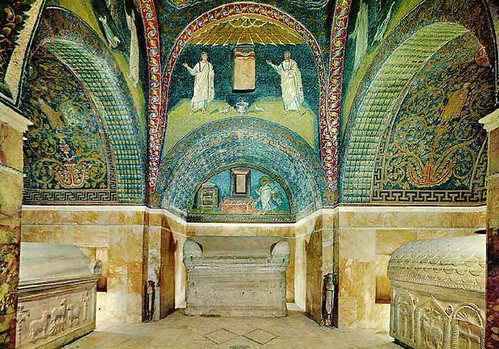
Mosaics in Ravenna Still Dazzle


I was searching for a picture of the Amazon Warrior sculpture that was recently found in Herculaneum and stumbled across this blog about Mosaic Art and these wonderful pictures of the tomb of Galla Placidia, the powerful half-sister of Honorius and wife of Emperor Constantius III. I had heard that the mosaics in Ravenna are particularly spectacular and if these are any indication, they certainly are!

"Galla Placidia was the daughter of Roman Emperor Theodosius I (379-395) and his second wife, Galla, the daughter of Valentinian I. She was the half-sister of the young Roman emperors Honorius (393-423) and Arcadius (383-408), the aunt of Theodosius II, the wife of Athaulf, King of the Goths, and then of Flavius Constantius (421) (who was promoted to co-emperor with Honorius shortly before his death), and the mother of Valentinian III.

When, under the leadership of Alaric, the Goths sacked Rome in August 410, they took Galla Placidia with them to Gaul. After the death of Alaric, Athaulf became the king. Galla Placidia married him in Narbo in January 414 -- against the wishes of her half-brother Honorius, and had a son named Theodosius who died soon thereafter. Following the death of Athaulf in 414, the Goths returned Galla Placidia to the Romans who wanted her to marry Flavius Constantius, who had succeeded Stilicho to power. Reluctantly, Galla Placidia did so and produced two children, Justa Grata Honoria and Valentinian. When, on February 8, 421, Constantius was made co-emperor (Constantius III) in the west by Honorius, Galla Placidia was named Augusta. Constantius died on September 2, 421. Galla Placidia and her childless half-brother Honorius became very close for a while, but then they quarreled. Galla Placidia fled with her children to Constantinople in 423 to escape a charge of aiding her brother's enemies. Although earlier Theodosius hadn't recognized the imperial elevation of Constantius and therefore, the status of his aunt as Augusta, he welcomed her, and soon recognized both her status and the legitimacy of her son as heir. Honorius died soon after, on August 27 of the same year. A usurper John assumed the throne in Ravenna. Theodosius set out to win the throne back for his family. When the imperial party reached Thessalonica the young Valentinian was made Caesar. Placidia was regent for her young son for the next 12 years. She had legislation passed in her son's name (according to Oost), stating that the emperor was subject to the laws of the land, as opposed to the situation in the east where the emperor was above the law. Galla Placidia was also involved in the power play between Felix, Boniface, and Aetius, who has been called the last of the Romans. Earlier, Placidia is thought to have been involved in the conspiracy against the Vandal Stilicho and the subsequent execution of Serena, Stilicho's wife and Galla Placidia's cousin." - About Ancient History

Image by designucdavic
If you enjoyed this post, never miss out on future posts by following me by email!