Showing posts with label portrait. Show all posts

Thursday, August 12, 2021

Ptolemaic dynastic portraits using a combination of marble and stucco: Economy, Practicality, or Distinctive Style?

 "Beginning with Ptolemy I Soter, the Ptolemaic dynasty reigned from 305 BCE to 30 BCE, when the last Ptolemaic ruler, Kleopatra VII, committed suicide, and Octavian made Egypt a province of Rome. In their capital at Alexandria and in historically prominent Egyptian cities and sanctuaries, the Ptolemies continued the practices of their pharaonic predecessors in an attempt to integrate themselves into Egyptian society and their images into Egypt’s visual culture," explains Yale University's Susan B. Matheson. "They employed architecture and sculpture to help establish their rightful place as rulers and to present themselves as a dynasty like those that came before. This impressive display of public art featured primarily Egyptian iconography and style. Egyptian dress and traditional royal and divine attributes were typical, and inscriptions were generally in the native hieroglyphic script."

Matheson points out that Ptolemaic dynastic portraits ranged from those appearing  as purely Greek, to those styled as purely Egyptian with some portraits rendered as a blend of both elements.

"It is likely that the sculptors commissioned to carve them determined the material, iconography, and style based on the wishes of their clients and the ultimate function of the portrait, Matheson notes, "Although there may have been official portrait types that emanated from Alexandria, as was later true of imperial portrait types disseminated from Rome, the king would find it expedient to have his image correspond to the preferences of local priests and officials."

Way back in 1925, classical archaeologist A. W. Lawrence in his article "Greek Sculpture in Ptolemaic Egypt" observes "It has been said that an Alexandrian School existed with ideals markedly different from those of the rest of the Hellenistic world."  Unfortunately, he does not really seem to recognize a blending of styles of the Egyptian with the Greek. He describes the works produced in Egypt as a poorly executed impressionist technique in which less than able local sculptors "neglect detail in their modelling and trust to the soft finish to conceal the fact that they had put no more work than they could help into the different parts of the face but merely made it up of various blank planes."

Egyptian sculptures from the Ptolemaic period often featured details added separately in stucco. Sometimes the entire head was imported from Greece or Asia Minor with the hair or hair extensions, beards, diadems, veils, etc. added in stucco once the work arrived in Egypt.  Some scholars point to this practice as common then because marble had to be imported and was therefore quite expensive.

Lawrence dismisses this observation as well.  

"This habit of finishing things in stucco has been put down to a desire to economize in marble, which is not found in Lower Egypt and so was naturally expensive there.  But in most cases, the quantity saved is infinitesimal, and the practice was employed in other countries where marble was abundant," Lawrence says. "It seems therefore to have been a device to save labour rather than material."

I doubt to some extent the conservation of materials as a reason for the use of stucco as well.  But, although some portrait heads seemed to have been prepared for stucco additions only on the top part of the head, others, like the portrait of Ptolemy I Soter appear to have used marble only for the face while the entire back of the head is assumed to have been completed in stucco.  This would appear to support the economy of materials theory. 

Classicist Flavia Vanni at the University of Birmingham, in her research for her PhD thesis, "Byzantine Stucco Decoration: Cultural and Economic Implications Across the Mediterranean World, 850-1453," points out that, from a shipping perspective, big bulky pieces of marble were not divisible cargo either, so incurred more cost because of the amount of space they consumed in a cargo hold.

I also can't fully embrace the labor saving aspect of the practice either, as Lawrence proposes, at least in respect to the original production. The labor expended in crafting an ornate hair style or diadem even in stucco surely would have been roughly equivalent to carving the remainder of the marble head. Lawrence's criticisms of style and workmanship seem to cast aspersions on the skill and dedication of Egyptian sculptors in the Ptolemaic Period. Due to the date of the article (1925) I can't help but suspect that Lawrence may have allowed his British colonial perceptions of Egyptians at the tiime to bias his observations, even if he was the brother of T.E. Lawrence (of Arabia).

So if the stucco additions were not the result of economy, either of materials or labor, why was this practice employed for a number of Ptolemaic dynastic portraits? Thinking of the turbulent history of this family and the frequent fratricides and changes in succession, I wondered if stucco was used on the top or back of the head and beards so changes in dynastic succession could be more easily depicted without recarving much of an expensive marble portrait.

I've seen a number of Roman portraits where one emperor's portrait was recarved into a subsequent emperor. Recarving a portrait of Nero is always a challenge because sculptors often cannot disguise telltale remnants of his sideburns and longer than normal hairstyle.  If the hair and sideburns had been rendered in stucco, a hairstyle alteration could have been relatively easy to remove and replace. The Ptolemies, following traditional Egyptian style, also attempted to have their portraits resemble, to some extent, their predecessors as a visual reference to the enduring nature of their dynasty, so recarving would be relatively minimal if a change in succession occurred. 

However, I don't know of many monarchs modest enough that would commission artwork of themselves with thoughts as to its subsequent recarving by their successors.

Of course the use of stucco could have been a further attempt to blend Egyptian and Greek traditions. The use of lime and gypsum plasters in Egypt date back to the 3rd millenium BCE. The famous bust of Nefertiti dating to 1345 BCE is an exquisite example of stucco's extensive use in the production of  sculpture "in the round" in ancient Egypt.

Lawrence does mention portraits outside of Egypt using a combination of marble and stucco in areas with abundant sources of marble. I found one on Christies auction site. It is tentatively identified as the Seleucid King Demetrios III Eucaerus (well-timed), on the basis of comparison to his coin portraits. 

"Both portraits share the prominent hooked nose and a beard. Many late Seleucid portraits are indebted in style to contemporary Ptolemaic imagery, since they were able to maintain their hold over their territories only through Ptolemaic support. Demetrios III was the son of Antiochos VIII Grypos (Hook-nose). He was able to recover part of his father's territories in 95 B.C. with the help of Ptolemy IX Lathyrus. He was eventually defeated by the Parthian king Mithridates II, who kept him in confinement until his death in 88 B.C.E." - Christies

Such emulation of Ptolemaic dynastic sculpture may point to recognition of the use of stucco as a distinctive artistic style.

What do you think?


Portrait head of a late Ptolemaic ruler possibly Ptolemy IX, Hellenistic Period, Late 2nd - early 1st century BCE, marble from Paros with stucco added in Egypt, now in the collections of the Museum of Fine Arts Boston, image courtesy of the museum. "With its large eyes, long face and aquiline nose, this is a powerful and unforgettable image of a semi-divine king. It continues, while altering and exaggerating, the tradition of late third century Ptolemaic portraiture. The head was converted from a slightly earlier, beardless image. It was cut down at the sides of the neck, and a beard and new hairline were created with stucco. Egyptian sculptures from the Ptolemaic period often featured details added separately in stucco. Sometimes the entire head was imported from Greece or Asia Minor with the hair or hair extensions, beards, diadems, veils, etc. added in stucco once the work arrived in Egypt. Some scholars point to this practice as common then because marble had to be imported and was therefore not readily available.
"The three times life-sized head, found at Memphis in what appears to have been a temple or shrine of the Hellenistic and Roman periods, was carved in Greek marble, with hair, the tip of the nose, and beard finished in stucco. Reddish ground color remains in the pupils of the eyes and on the lips. There are traces of stucco on the neck and possible touches of gold on the stucco in the hair. The marble surface below the beard was smoothed and polished, then scarred by diagonal incisions to hold the stucco, suggesting the portrait did not originally have a beard. The complete statue must have been about twelve feet high if seated, and well over fifteen feet if standing. The head comprises only a marble mask and neck, the area behind being hollowed out."
Most scholars agree that the head bears closest resemblance to Ptolemy IX (reigned 116–107 and 88–80)." - Museum of Fine Arts Boston. 


Extensively restored marble portrait head of Ptolemy I Soter, 4th - 3rd century BCE, only face is original, probably the entire skull was completed in stucco, courtesy of The Louvre.

Arsinoe III portrait with missing stucco hair at the Yale University Art Gallery. By all accounts, Arsinoe III Philopater (ca. 245–204 BCE) was a remarkable woman. A highly educated member of the Ptolemaic dynasty, she reigned as Queen of Egypt after marrying her brother, Ptolemy IV, in 221/220 BCE, until she was murdered in 204 BCE in response to her role as regent for her 6-year-old son, Ptolemy V. The Greek historian Polybius reports that Arsinoe accompanied her husband into battle at Raphia in 217, an event also recorded in the ancient text, 3 Maccabees. According to the poet and mathematician Eratosthenes, the queen condemned her husband’s infamous worldly excesses, providing a counterweight to the stereotypical decadence of the Ptolemies.

Ptolemy III Evergeta or Ptolemy IV Philopator or Ptolemy VI Philometor marble portrait head that would have had additional above the hair and across the back of the skull, 4th - 3rd century BCE, courtesy of The Louvre

Marble portrait head of Ptolemy XII Aulete with traces of stucco on the back of the skull, 2nd half of 1st century BCE to 1st century CE, courtesy of The Louvre

Head of Arsinoe II at The Louvre in Paris, 250-200 BCE, missing hair and possibly headdress that would have been finished in stucco.

Marble head, portrait of the queen Arsinoe II as Aphrodite. The hair is incomplete because it was made in stucco following the Alexandrian custom, due to the rarity of Greek marble in the capital of Hellenistic Egypt. Ptolemaic period. Arsinoe II was deified in the guise of Aphrodite after her death in 270 BCE, courtesy of Ekinium Gallery

Marble head, portrait of the queen Arsinoe II as Aphrodite. The hair is incomplete because it was made in stucco following the Alexandrian custom, due to the rarity of Greek marble in the capital of Hellenistic Egypt. Ptolemaic period. Arsinoe II was deified in the guise of Aphrodite after her death in 270 BCE, courtesy of Ekinium Gallery

Portrait head of a Ptolemic queen with missing stucco headdress, 270-250 BCE, now in the collections of the Metropolitan Museum of Art in New York. "This monumental head gives an impression of sovereign calm and power, even though the veil that once covered the top and back of the head is now missing. Although the features are cast in a thoroughly classical style typical of the late fourth century B.C., the face is stamped with enough individuality to identify it as a portrait. In all probability, it represents a member of the Ptolemaic dynasty, that succession of Macedonian Greeks who ruled Egypt from the death of Alexander the Great in 323 B.C. until the annexation of Egypt by Rome and the suicide of Cleopatra VII in 30 B.C. Most recently, the head has been identified as Arsinoe II, who ruled together with her brother, Ptolemy II, from 278 B.C. until her death in 270 B.C. Not only was the queen part of a dynastic ruler cult during her life, she was also transformed into an independent deity by her brother after her death. She was worshiped as an Egyptian goddess in association with Isis and also separately as a Greek goddess, with her own sanctuaries and festivals. This strongly idealized head, which resembles classical images of Hera and Demeter, was probably associated with the latter cult."

Ptolemy VIII Euergetes II with unfinished head, mid to late 2nd century BCE at the Yale University Art Gallery

Marble sculpture of Ptolemy of Mauretania from Aquae Calidae, 10-5 BCE according to Landwehr, 5-15 CE according to Fittschen - no stucco additions, courtesy of The Louvre. The use of stucco additions seems to disappear with the arrival of the Romans.

A GREEK MARBLE PORTRAIT OF A MAN LATE HELLENISTIC PERIOD, CIRCA 1ST CENTURY B.C.E. Turned slightly to his right, the short hair coarsely fashioned and completed in stucco, some stucco locks preserved above the forehead, his slender face with bulging, knitted brows and deep-set unarticulated eyes preserving extensive original pigment, including the brows and lashes, the distinctive hooked nose with a humped bridge and a drooping tip, the thin lips pressed together below the trimmed mustache, the beard shaped and roughly picked to be completed in stucco, courtesy of Christies
If you enjoyed this post, never miss out on future posts by following me by email!


Monday, April 12, 2021

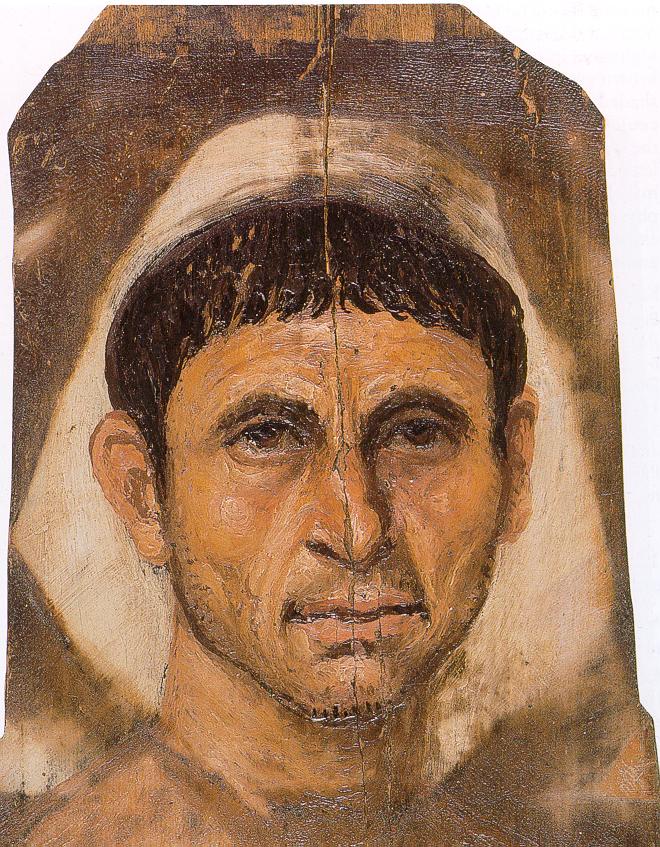
A Trajanic Period Roman in Egypt

This morning while I was researching a Fayum portrait of a priest of Serapis in the collections of the British Museum, I came across this encaustic portrait of what appears to be just a common Romano-Egyptian.  Although his face is painted with skill, he wears no adornments or displays even a hint of status from his clothing.  Because of the quality of the portrait, he must have been somewhat successful in whatever occupation he practiced, whether it was that of a tradesman or even a legionary.  

The British Museum points out that his mummy, found in the necropolis of Hawara, was simply wrapped in coarse linen.  His closely cropped hair is similar to Roman court portraiture of the Trajanic period and he is said to confront the viewer directly in the Roman manner. The portrait appears to be an example of what became known during Trajan's rule as the portrait of the decennial, an image seemingly devoid of emotion with firm, calm features emanating authority and dignity.  Scholars view this portrait style as a detachment from Hellenistic influence and a merging between two previously separate types of portraiture - the official, honorary, portrait, and the private, often funerary, portrait.

Trajan himself is depicted in this style on Trajan's column where he is shown in conversation with one of his commanders.  With simplicity, the emperor is depicted nonchalant while explaining a plan to the general, fixing him in the eyes and relaxing the palms of hands in front of him, illustrating a relationship of trust and respect between him and the subordinate, devoid of any orchestrated rhetoric or gestures of courtesy.


Image: Mummy portrait of a man in encaustic on limewood found in the necropolis of Hawara in the Fayum region of Egypt, 100-120 CE, at the British Museum in London.  Image courtesy of the museum and Wikimedia Commons. The portrait emphasizes  maturity and physical strength, the latter expressed in the rugged physique and sunburned countenance.


If you enjoyed this post, never miss out on future posts by following me by email!


Saturday, April 3, 2021

The tragic boy emperor, Philip II

Philip II (Latin: Marcus Julius Severus Philippus; 237 – 249CE), also known as Philip the Younger, was the son and heir of the Roman Emperor Philip the Arab by his wife Marcia Otacilia Severa. When his father became emperor in 244, young Philip was appointed caesar at the age of only seven-years-old. In 247, he became consul, and was later elevated by his father to the rank of augustus and co-ruler.  Although ancient historians claim both Philip the Arab and his son were killed in battle by Decius.  

Decius was a distinguished senator who had served as suffect consul in 232, had been governor of Moesia and Germania Inferior soon afterwards, served as governor of Hispania Tarraconensis between 235 and 238, and was urban prefect of Rome during the early reign of Emperor Philip the Arab. In 248 or 249 Decius was sent to quell the revolt of Pacatianus and his troops in Moesia and Pannonia, a rebellion seen by some modern historians as emerging Balkan separatism.  After the collapse of the revolt, Decius let the troops proclaim him emperor. Philip advanced against him and was killed at Verona, Italy, in September 249. The Senate then recognized Decius as emperor, giving him the attribute Traianus in reference to Emperor Trajan, an emperor considered the ultimate example of a ruler at the time. According to the Byzantine historian Zosimus, Decius was clothed in purple and forced to undertake the [burdens of] government, despite his reluctance and unwillingness.  

Modern scholars do not think Philip II was with his father in Verona and suggest that when news of his father's death and the proclamation of Decius as the new emperor reached Rome, the Praetorian Guard murdered the 12-years-old. 

Bust of Philip II at the archaeological museum in Venice, Italy, courtesy of Wikimedia Commons contributor Architas.

Previously crushed portrait of Philip the Younger from Asia Minor, 235 CE, bronze, at the J. Paul Getty Museum (Villa)

Portrait of Philip II, 247-249 CE, from the Chiragan Roman Villa, now in the Musée Saint-Raymond, image courtesy of Wikimedia Commons contributor Daniel Martin.


If you enjoyed this post, never miss out on future posts by following me by email!


Thursday, April 1, 2021

The challenge of ancient portrait identification

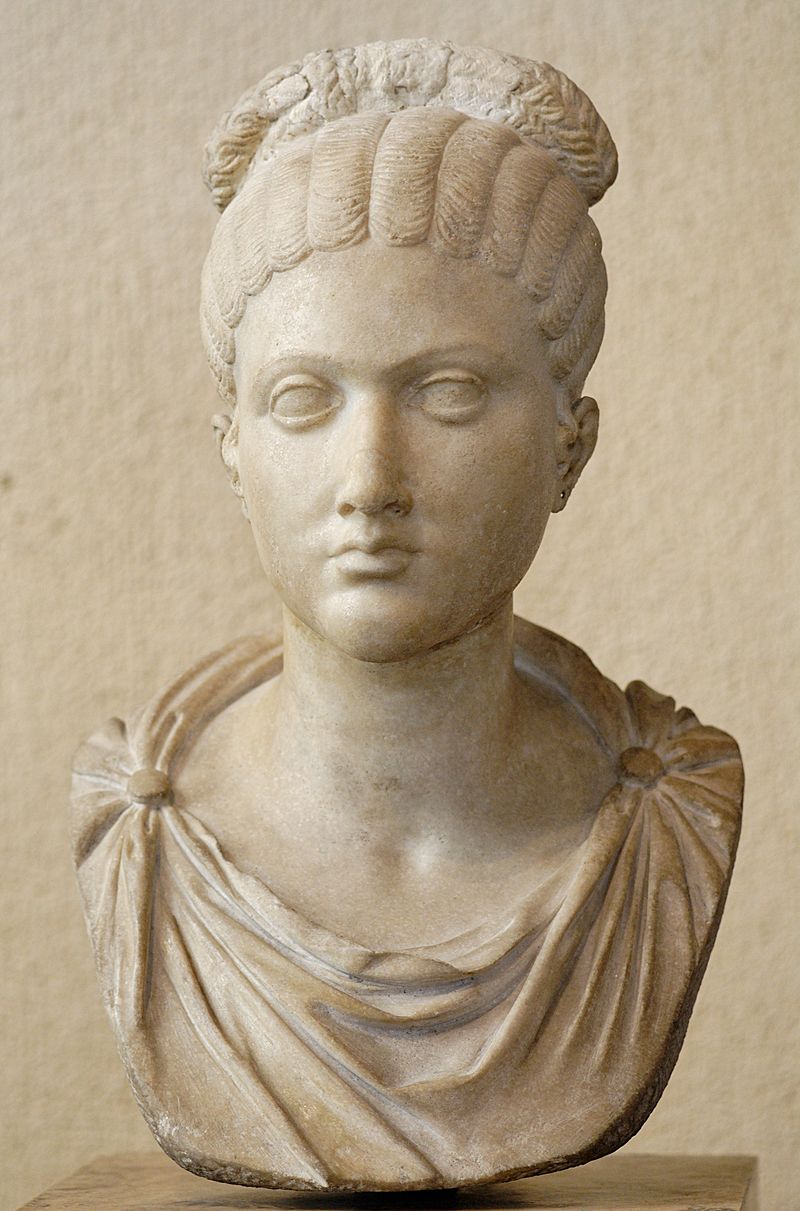
 This portrait of a well-fed 3rd century CE Roman empress caught my attention because the woman appears to be rather plump, obviously not suffering deprivation during the most tumultuous period of the crisis of the Third Century.  The Getty does not speculate on which empress this woman is so I compared it to known sculptures and coin portraits of powerful women surrounding Alexander Severus.  The longer looped hair behind the ears appears in portraits of both the emperor's mother, Julia Avita Mamaea and his first young wife, Orbiana Sallustius but neither are portrayed as plump or with the bun on the top of the head.  I could find no images of his second wife, Sulpicia Memmia, however, and his third wife's name is unknown.

When Alexander was assassinated in 235 CE, he was succeeded by Maximinus Thrax.  The coin portrait of his wife, Caecilia Paulina, depict a rather hawkish woman with none of the distinctive characteristics of this portrait either.

After Maximinus Thrax was killed in Aquileia, the aged Gordian, in his late 60s, was pressured to take the throne  along with his son but their reigns lasted only 21 days with the younger Gordian killed in the battle of Carthage fighting against Maximinus' loyalists and his father hanging himself after his son's defeat. Although Gordian I struck a coin with his portrait, there appears to be no portraits of his or his son's wives.

Gordians' successors, Pupienus and Balbinus, lasted only a few months and, again, there appears to be no images of their wives.  That brings us to Goridan III, son of Antonia Gordiana, the daughter of Emperor Gordian I and the younger sister of Emperor Gordian II.  Although there is no images of his wife, Furia Sabinia Tranquillina, I was struck by a similarity in the soft shape of Gordian III's chin and that of the woman in the portrait. So I couldn't help but wonder if the female portrait may be his mother, Antonia Gordiana, or his wife, sculpted at the same time as Gordian IIII's portrait, which is now in The Louvre.

Portrait Head of an Empress, Roman, second quarter of the 3rd century CE at the J. Paul Getty Museum, courtesy of the museum.

Bust of Gordianus III. Marble, Roman artwork, between 242 and 244 CE. From Gabii now in The Louvre, courtesy of Wikimedia Commons contributor Marie-Lan Nguyen
If you enjoyed this post, never miss out on future posts by following me by email!


Monday, March 1, 2021

Greco-Roman female portraiture


Head of a woman, Greek, 200-100 BCE Marble at the Yale University Art Gallery.


"In Greek and Roman female portraits, private women often imitated goddesses or queens in order to gain status and influence. This head, perhaps, echoes features of the goddess Aphrodite or the Egyptian ruler Cleopatra VII (reigned 69–30 BCE).  Although extensive damage and repairs, including a damaged nose and a missing section of hair, have made examinations of the head difficult, one can still see the resemblance to the two iconic figures."

"The figure’s melon hairstyle and the beginnings of what was probably a slightly aquiline nose relate the head to portraits of Cleopatra VII who is shown with these features in her more ‘masculinized’ portraits, as in her portrait on a silver denarius in the British Museum.  At the same time, the portrait of a woman also has the classic turn of the head and soft facial features one finds in portraits of typical Greek women and of Aphrodite.  Cleopatra VII herself is sometimes depicted in this softer, more classical style.  Thus this head can be related to Cleopatra VII, although the lack of a diadem indicates it cannot be a portrait of the queen herself." - Adria Brown, Yale University, Class of 2015 


If you enjoyed this post, never miss out on future posts by following me by email!


Monday, December 28, 2020

Melon hairstyles and mummy masks of the Roman Period

 Plaster Romano-Egyptian mummy masks of the 1st - 2nd century CE appear to be individualized, much like the famous mummy portraits of the Faiyum region. But, in fact, most were made in a mold.  Distinguishing details were added while the plaster was still moist with a spatula or knife. Ears were added separately and, sometimes, eyes were inlaid then the mask painted or gilded.

"This woman's waved hairstyle is based on Roman court fashion, but three hanging corkscrew curls behind the ears and a short fringe of curls over the forehead and in front of the ears seem to reflect a local style. Toward the back of her head, above her ears, are traces of a smooth area that once represented a pillow. In general earlier Roman-period masks such as this one show the deceased as if reclining on a bier with the head on a pillow, while later masks have the head raised as if the deceased is rising from the bier. The underneath edge of this example is flat where it is meant to be attached to a body covering of wood or other materials." - Metropolitan Museum of Art.

The "melon" hairstyle used to cap the top of the head of this woman appeared in Greece before the 3rd century BCE.  In Egypt, it was worn by the Ptolemaic queens Arsinoe II and Berenice II.  More "masculinized" portraits of Cleopatra VII, such as the one that appeared on a 1st century BCE silver denarius,  feature a melon hairstyle. Roman women are thought to have copied the hairstyle, especially after Cleopatra's visit in 46 and 44 BCE. But, it fell out of favor when Octavian declared war on Cleopatra. Although the hairstyle was eventually replaced by the lavish Flavian hairstyles for a time, it reappeared during the Antonine period, most notably on portraits of Julia Domna, wife of Septimius Severus. It continues to be shown on female portraits through the 3rd century CE. 


Mummy mask of a woman with corkscrew locks and bang, 50–150 CE, Roman Period Egypt at the Metropolitan Museum of Art in New York. 


Roman female portrait of the 1st century BCE at The Louvre, courtesy of Wikimedia Commons contributor Marie-Lan Nguyen.


If you enjoyed this post, never miss out on future posts by following me by email!


Monday, November 16, 2020

Elite Roman portraiture of the Republican Period

 Roman portrait sculpture from the Republican era tends to be somewhat more modest, realistic, and natural compared to early Imperial works  Republican Rome embraced imperfection in portraiture because, though there were different levels of power each class of society had, everybody had physical blemishes, so this type of untouched physical representation fostered a sense of community by implying that, while there were existing inequalities, that did not change the fact that they were Romans. Veristic portraits, including arguably ugly features, was also a way of showing confidence and of placing a value on strength and leadership above superficial beauty. This type of portraiture sought to show what mattered to the Romans - powerful character valued above appearances. This hyper-realism was often achieved through the production of a wax cast from the family member while they were still living,


Image: Sensitively modeled bronze portrait bust of a Roman male with inlaid ivory eyes, 50 BCE - 54 CE courtesy of the Metropolitan Museum of Art.

If you enjoyed this post, never miss out on future posts by following me by email!


Tuesday, August 11, 2020

Antonine Female Portraiture

 This nobly restrained composite statue depicts a virtuous Roman matron of a distinguished family. She is commemorated as both a chaste wife and mother of children, and her portrait celebrates marriage as an enduring value and symbol of Roman life. This figure provides a notable contrast with the DMA's luxuriant Roman portrait head of a youth (1984.163) in both style and character. Whereas the boy exudes exuberant youth with his active gaze and foppish curls, the Roman matron embodies the discreetly refined dignity of an aristocratic lady.  She holds her mantle like a veil over her shoulder and stands in modest dignity, as though she were a priestess of the home.

Often found in imperial female portrait statues, the body type is based on Greek draped figures from the 4th century BCE. Associated with the work of Late Classical sculptors such as Praxiteles or Lysippus, figures like this of the so-called Small Herculaneum type were frequently adapted in Roman art. Here the heavily draped figure, suggesting the virtuous character of the woman, was either a commemorative funerary portrait or a civic/religious dedication. The portrait head used with this standard body type is graceful and pensive. The complete figure radiates a gentle nobility that embodies the best traditions of Roman family life and the high value accorded to distinguished Roman women. In appearance, the lady recalls imperial Antonine women such as the younger Faustina, wife of Marcus Aurelius, though the figure is not sufficiently close to either her or her daughter, Lucilla, to be an actual royal portrait.  - Dallas Museum of Art

 Figure of a woman Roman 2nd century CE photographed at the Dallas Museum of Art in Dallas, Texas.


If you enjoyed this post, never miss out on future posts by following me by email!