Showing posts with label furniture. Show all posts

Friday, April 30, 2021

Bust of a Boy or Eros with the Attributes of Herakles, 150-100 BCE, Roman Period Greece

This thinly-cast bust depicts a youth wearing a lion-skin over his head and a quiver strap across the chest. The figure has delicate features and fine hair that is drawn up in a braid with tendrils falling onto his forehead. The figure may depict a young Herakles, or an unidentifiable youth in the guise of the great hero. A third possibility is that this young man is Eros, who was often depicted with attributes associated with Herakles. Two small holes at the bottom edge may have been used to attach this bust to a piece of furniture. 

While in wealthy households beds were used for sleeping in the bedrooms (lectus cubicularis), and couches for banqueting while reclining were used in the dining rooms (lectus tricliniaris), the less well off might use the same piece of furniture for both functions. The two types might be used interchangeably even in richer households, and it is not always easy to differentiate between sleeping and dining furniture. The most common type of Roman bed took the form of a three-sided, open rectangular box, with the fourth (long) side of the bed open for access. While some beds were framed with boards, others had slanted structures at the ends, called fulcra, to better accommodate pillows. The fulcra of elaborate dining couches often had sumptuous decorative attachments featuring ivory, bronze, copper, gold, or silver ornamentation.


Bust of a Boy with the Attributes of Herakles, 150-100 BCE, Greek, now part of the collections of the J. Paul Getty Museum on view at the Getty Villa in Pacific Palisades, California.  Image courtesy of Bruce White Photography.

If you enjoyed this post, never miss out on future posts by following me by email!


Saturday, March 13, 2021

Etruscan chariots


Silver panel, perhaps from a parade chariot or piece of furniture, overlaid with electrum and decorated in repoussé relief with two riders, perhaps taking part in a horse-race, with a fallen comrade below, Etruscan, 540-520 BCE, found in the Castel San Mariano near the city of Perugia.

Perguia, first called Perusia in the ancient sources, was one of the 12 confederate cities of Etruria.  The league was mostly an economic and religious league, or a loose confederation, similar to the Greek states.  The historical Etruscans had achieved a state system of society, with only remnants of the chiefdom and tribal forms used by surrounding Italics. The government was viewed as being a central authority, ruling over all tribal and clan organizations and wielding the power of life and death. The gorgon was revered as an ancient symbol of that power, and frequently appeared as a motif in Etruscan decoration.

The individual referred to as a "fallen comrade" in this Archaic period relief appears to somewhat resemble a gorgon and, as such, may represent the presence of death in such competitions or victory over death. (only my humble opinion, though)

Perusia was not mentioned in the ancient sources until, Q. Fabius Pictor's account, utilized by Livy, of the expedition carried out against the Etruscan League by Fabius Maximus Rullianus in 310 or 309 BCE. At that time a thirty-year indutiae (truce) was agreed upon. However, in 295 BCE Perusia took part in the Third Samnite War.

At the decisive Roman victory at Sentinum, the enemy fielded over 1,000 chariots (although I doubt any of these were plated with silver) along with 60,000 infantry and 40,000 cavalry.  The Roman consuls Quintus Fabius Maximus Rullianus who commanded the right and Publius Decius Mus who commanded the left were ultimately victorious after Publius Decius decided to devote himself to galvanize the troops. This term refers to a military commander offering prayers to the gods and launching himself into the enemy lines, effectively sacrificing himself, when his troops are in dire straits. His father had done the same at the Battle of Vesuvius (340 BCE). 

If you enjoyed this post, never miss out on future posts by following me by email!


Wednesday, March 10, 2021

The Esquiline Treasure

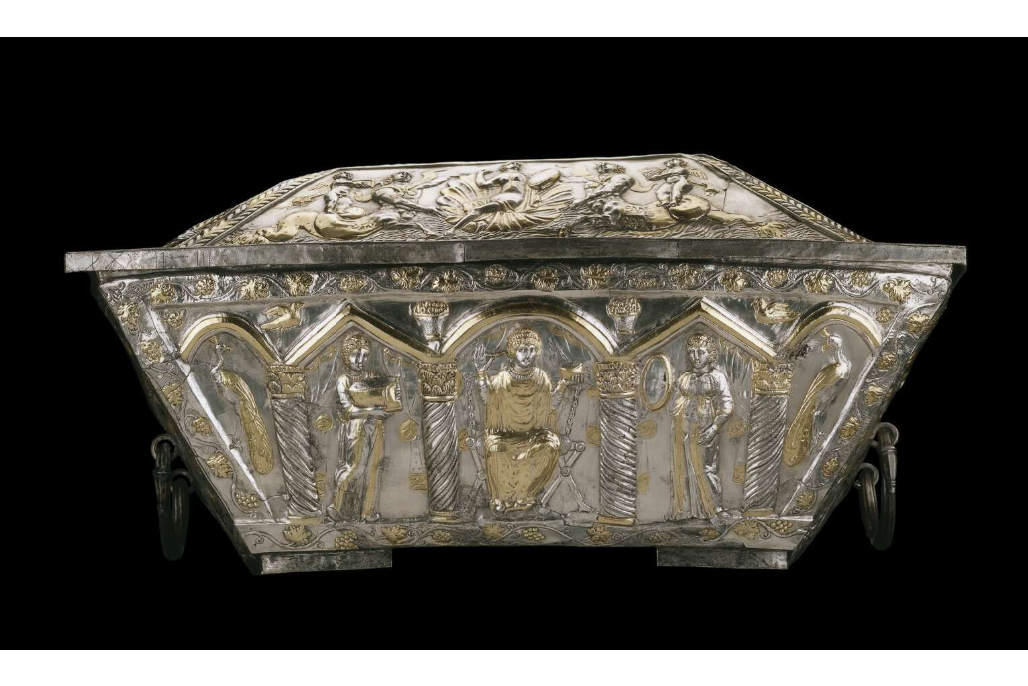
The Esquiline Treasure is an ancient Roman silver treasure that was found in 1793 on the Esquiline Hill in Rome. The hoard is considered an important example of late antique silver work from the 4th century CE, probably about 380 for the major pieces. Since 1866, 57 objects, representing the great majority of the treasure, have been in the British Museum. Two of the most important objects in the treasure are the ornate silver-gilt engraved boxes known as the Projecta Casket and the Muse Casket. The treasure was part of the belongings of a wealthy Roman household of high social status. The collection includes 8 plates (4 circular and 4 rectangular), a fluted dish, a ewer inscribed for "Pelegrina", a flask with embossed scenes, an amphora, 6 sets of horse trappings, with furniture fittings including 4 Tyche figures representing the 4 main cities of the Roman Empire: Rome, Constantinople, Antioch and Alexandria, two hands clenching bannisters, and an assortment of jewelry. The four silver Tyches are represented with different attributes: military attire for the Tyche of Rome, a cornucopia for the one of Constantinople, sheaves of corns and the bow of a ship for the Tyche of Alexandria, and a male swimmer personifying the Orontes River at the feet of the Tyche of Antioch. The five panels on the lid of the Projecta Casket represent three mythological scenes, a double portrait and a bathing scene. On the top panel of the lid are half-length figures of a man and woman within a wreath held by standing erotes (or putti in modern terms) and an inscription which reads: "SECVNDE ET PROIECTA VIVATIS IN CHRI[STO] ('Secundus and Projecta, may you live in Christ'). The attire of the two figures is clearly that of an affluent couple from late antiquity. The woman is wearing a long-sleeved tunic with a large necklace. In her hands she holds a papyrus roll alluding to her education. The man is in a long-sleeved tunic that he wears under a chlamys. The four panels of the box itself represent the preparations for a grand Roman wedding. These are placed between columns joined by alternating arches and bottomless pediments, all under a frieze with scrolling vines. In one scene, Projecta is shown sitting on an ornate chair holding a decorated box similar in shape to the Muse Casket. She wears a long-sleeved tunic under a colobium or short-sleeved tunic. A smaller inscription on the front rim of the lid gives the weight as "XXII-III", meaning "[Pondo] XXII,III [Unciae],S[emuncia]" or "Twenty-two pounds, three and one-half ounces" in Roman units. The Muse Casket is divided into sixteen panels, with flat and concave faces. The 'flat' panel decoration includes: vases, vines and birds. The fluted panels are undecorated and those on body contain standing female figures under arches (eight of the nine muses). They are, to the right of the hasp, reading counter-clockwise: Urania, with a globe, Melpomene, with a Heraclean club and a mask, Clio, with a book and a caspa with scrolls, Polyhymnia, with a small mask, Terpsichore, with a lyre, Euterpe, with a double flute, Thalia, with a Dionysiac pedum and comic mask, and Calliope, with a scroll. The top of dome has a medallion containing female figures seated in landscape setting. The interior is fitted for five vessels - four identical silver canisters and one silver flask. Current research suggests that the Projecta Casket and some other items in the treasure (but probably not all of them) were a wedding gift to the newly married couple Projecta and Secundus. Sadly, Projecta is thought to be associated with an epitaph dated to 383 CE stating she died shortly before her 17th birthday.

Silver furniture fittings depicting two hands clenching bannisters part of the Esquiline Treasure, Roman 330-380 CE, now in the British Museum. Image courtesy of Wikimedia Commons contributor Recruos

Silver repousse vase, part of the Esquiline Treasure, Roman 330-380 CE, now in the British Museum courtesy of Wikimedia Commons contributor Sailko

The Pelegrina Ewer. The bride's name can be seen at the widest point, across the three "dimples" to the right. Part of the Esquiline Treasure, Roman 330-380 CE, now in the British Museum. Image courtesy of Wikimedia Commons contributor Sailko

The Muse Casket, part of the Esquiline Treasure, Roman 330-380 CE, now in the British Museum. Image courtesy of the museum.

The Muse Casket, part of the Esquiline Treasure, Roman 330-380 CE, now in the British Museum. Image courtesy of the museum.

The Muse Casket, part of the Esquiline Treasure, Roman 330-380 CE, now in the British Museum. Image courtesy of the museum.

The Muse Casket, part of the Esquiline Treasure, Roman 330-380 CE, now in the British Museum. Image courtesy of the museum.

The Projecta Casket, part of the Esquiline Treasure, Roman 330-380 CE, now in the British Museum. Image courtesy of the museum.

The Projecta Casket, part of the Esquiline Treasure, Roman 330-380 CE, now in the British Museum. Image courtesy of the museum.

The Projecta Casket, part of the Esquiline Treasure, Roman 330-380 CE, now in the British Museum. Image courtesy of the museum.

The Projecta Casket, part of the Esquiline Treasure, Roman 330-380 CE, now in the British Museum. Image courtesy of the museum.

Silver charm depicting a crouching mouse, part of the Esquiline Treasure, Roman 330-380 CE, now in the British Museum. Image courtesy of the museum.

Silver horse trappings found in the Esquiline Treasure, Roman, 330-380 CE now in the British Museum. Image courtesy of the museum.

Silver ring depicting Nike, part of the Esquiline Treasure, Roman 330-380 CE, now in the British Museum. Image courtesy of the museum.

Roman pin, part of the Esquiline Treasure, Roman 330-380 CE, now in the British Museum. Image courtesy of the museum.

Gilded silver furniture ornament depicting Tyche of Alexandria, part of the Esquiline Treasure, Roman 330-380 CE, now in the British Museum. Image courtesy of the museum.

Gilded silver furniture ornament depicting Tyche of Antioch, part of the Esquiline Treasure, Roman 330-380 CE, now in the British Museum. Image courtesy of the museum.

Gilded silver furniture ornament depicting Tyche of Constantinople, part of the Esquiline Treasure, Roman 330-380 CE, now in the British Museum. Image courtesy of the museum.

Gilded silver furniture ornament depicting Tyche of Rome, part of the Esquiline Treasure, Roman 330-380 CE, now in the British Museum. Image courtesy of the museum.

Silver fluted bowl, part of the Esquiline Treasure, Roman 330-380 CE, now in the British Museum courtesy of Wikimedia Commons contributor Jononmac46

Silver decorated trulla or saucepan, part of the Esquiline Treasure, Roman 330-380 CE, now in the Petit Palais Museum in Paris courtesy of Wikimedia Commons contributor Sailko.


If you enjoyed this post, never miss out on future posts by following me by email!


Wednesday, November 11, 2020

Furniture applique in the Greco-Roman world

 Little wood survives from ancient Greek and Roman furniture, although ancient texts tell us woods used for such purpose were maple, oak, beech, yew, and willow. Pieces were assembled using mortise-and-tenon joinery, held together with lashings, pegs, metal nails, and glue. Wood was shaped by carving, steam treatment, and the lathe, and furniture is known to have been decorated with ivory, tortoise shell, glass, gold, or bronze attachments similar to this example.  Furniture was also veneered with expensive types of wood in order to make the object appear more costly, although not as elaborate as palatial furnishings in the Near East.

The sella, or stool or chair, was the most common type of seating in the Roman period, probably because of its easy portability. Although those of the poor were surely plain, the wealthy had access to precious woods, ornamented with inlay, metal fittings, ivory, and silver and gold leaf. Bronze sellae from Herculaneum were square in form and had straight legs, decorative stretchers, and a dished seat. The sella curulis, or folding stool, was an important indicator of power in the Roman period. There were sellae resembling both stools and chairs that folded in a scissor fashion to facilitate transport.

A chair with a back, sometimes crafted of wickerwork, was known as a cathedra.  Some scholars think it was a later version of the Greek klismos although others propose it was a type of chair associated primarily with women.  Roman artwork shows it being used in a classroom setting with the tutor ensconced in a cathedra, the seat of power, while pupils sit around him.  A chair with both a back and armrests was termed a solium in Latin and were equivalent to the Greek thronos. A type of of solium resting upon a cylindrical or conical base is thought to have been derived from Etruscan prototypes.

Roman couches, some with elaborate bronze fittings were used for both sleeping and dining. The two types might be used interchangeably even in richer households, and it is not always easy to differentiate between sleeping and dining furniture. The most common type of Roman bed took the form of a three-sided, open rectangular box, with the fourth (long) side of the bed open for access. While some beds were framed with boards, others had slanted structures at the ends, called fulcra, to better accommodate pillows. The fulcra of elaborate dining couches also often had sumptuous decorative attachments featuring ivory, bronze, copper, gold or silver ornamentation.

The subselium was an elongated bench for two or more people and were considered to be “seats of the humble.” They were used in peasant houses, farms, and bathhouses but also found in lecture halls, in the vestibules of temples, and served as the seats of senators and judges. Roman benches, like their Greek precedents, were practical for the seating of large groups of people and were common in theaters, amphitheaters, odeons and auctions. The scamnum, related to the subsellium but smaller, was used as both a bench and a footstool.

Applique with Scylla Greek possibly from South Italy 300 BCE Silver and Gold that I photographed at the Getty Villa

Roman applique of a winged sphinx Byzantine Period courtesy of the Getty Villa

Applique with two men in togas Roman 50-75 CE Bronze that I photographed at the Getty Villa. 

Box Mirror Applique with Eros and Psyche in Relief Greek 4th century BCE Bronze that I photographed at the Santa Barbara Museum of Art

Applique of Youth Wearing a Lion Skin possibly Eros Greek 100 BCE that I photographed at the Getty Villa

 Ivory or bone furniture fragment Etruscan 300-100 BCE that I photographed at the Getty Villa

Applique with Medusa Greek 300-275 BCE Silver and Gold that I photographed at the Getty Villa

Bacchus Applique from a Triclinium Couch Roman Bronze 1st century CE that I photographed at "Pompeii: The Exhibit" at the Pacific Science Center in Seattle, Washington.


Applique of Ceres or Juno from furniture or a chariot Roman 50-75 CE courtesy of the Getty Villa

Etruscan applique of Kore from Cerveteri courtesy of the Getty Villa

Applique of Roma or Virtus from furniture or a chariot Roman 50-75 CE courtesy of the Getty Villa

Greek or Roman bronze relief of the head of a woman 3rd–1st century BCE or 4th century CE possibly used as an applique for a piece of furniture courtesy of the Metropolitan Museum of Art
If you enjoyed this post, never miss out on future posts by following me by email!