Showing posts with label wedding. Show all posts

Wednesday, March 10, 2021

The Esquiline Treasure

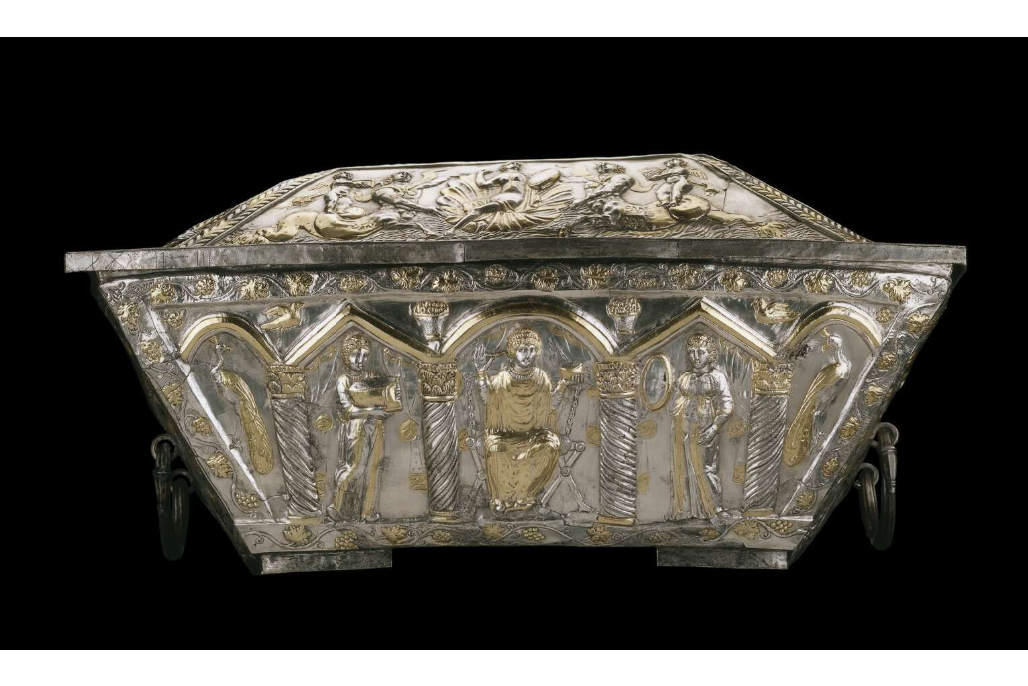
The Esquiline Treasure is an ancient Roman silver treasure that was found in 1793 on the Esquiline Hill in Rome. The hoard is considered an important example of late antique silver work from the 4th century CE, probably about 380 for the major pieces. Since 1866, 57 objects, representing the great majority of the treasure, have been in the British Museum. Two of the most important objects in the treasure are the ornate silver-gilt engraved boxes known as the Projecta Casket and the Muse Casket. The treasure was part of the belongings of a wealthy Roman household of high social status. The collection includes 8 plates (4 circular and 4 rectangular), a fluted dish, a ewer inscribed for "Pelegrina", a flask with embossed scenes, an amphora, 6 sets of horse trappings, with furniture fittings including 4 Tyche figures representing the 4 main cities of the Roman Empire: Rome, Constantinople, Antioch and Alexandria, two hands clenching bannisters, and an assortment of jewelry. The four silver Tyches are represented with different attributes: military attire for the Tyche of Rome, a cornucopia for the one of Constantinople, sheaves of corns and the bow of a ship for the Tyche of Alexandria, and a male swimmer personifying the Orontes River at the feet of the Tyche of Antioch. The five panels on the lid of the Projecta Casket represent three mythological scenes, a double portrait and a bathing scene. On the top panel of the lid are half-length figures of a man and woman within a wreath held by standing erotes (or putti in modern terms) and an inscription which reads: "SECVNDE ET PROIECTA VIVATIS IN CHRI[STO] ('Secundus and Projecta, may you live in Christ'). The attire of the two figures is clearly that of an affluent couple from late antiquity. The woman is wearing a long-sleeved tunic with a large necklace. In her hands she holds a papyrus roll alluding to her education. The man is in a long-sleeved tunic that he wears under a chlamys. The four panels of the box itself represent the preparations for a grand Roman wedding. These are placed between columns joined by alternating arches and bottomless pediments, all under a frieze with scrolling vines. In one scene, Projecta is shown sitting on an ornate chair holding a decorated box similar in shape to the Muse Casket. She wears a long-sleeved tunic under a colobium or short-sleeved tunic. A smaller inscription on the front rim of the lid gives the weight as "XXII-III", meaning "[Pondo] XXII,III [Unciae],S[emuncia]" or "Twenty-two pounds, three and one-half ounces" in Roman units. The Muse Casket is divided into sixteen panels, with flat and concave faces. The 'flat' panel decoration includes: vases, vines and birds. The fluted panels are undecorated and those on body contain standing female figures under arches (eight of the nine muses). They are, to the right of the hasp, reading counter-clockwise: Urania, with a globe, Melpomene, with a Heraclean club and a mask, Clio, with a book and a caspa with scrolls, Polyhymnia, with a small mask, Terpsichore, with a lyre, Euterpe, with a double flute, Thalia, with a Dionysiac pedum and comic mask, and Calliope, with a scroll. The top of dome has a medallion containing female figures seated in landscape setting. The interior is fitted for five vessels - four identical silver canisters and one silver flask. Current research suggests that the Projecta Casket and some other items in the treasure (but probably not all of them) were a wedding gift to the newly married couple Projecta and Secundus. Sadly, Projecta is thought to be associated with an epitaph dated to 383 CE stating she died shortly before her 17th birthday.

Silver furniture fittings depicting two hands clenching bannisters part of the Esquiline Treasure, Roman 330-380 CE, now in the British Museum. Image courtesy of Wikimedia Commons contributor Recruos

Silver repousse vase, part of the Esquiline Treasure, Roman 330-380 CE, now in the British Museum courtesy of Wikimedia Commons contributor Sailko

The Pelegrina Ewer. The bride's name can be seen at the widest point, across the three "dimples" to the right. Part of the Esquiline Treasure, Roman 330-380 CE, now in the British Museum. Image courtesy of Wikimedia Commons contributor Sailko

The Muse Casket, part of the Esquiline Treasure, Roman 330-380 CE, now in the British Museum. Image courtesy of the museum.

The Muse Casket, part of the Esquiline Treasure, Roman 330-380 CE, now in the British Museum. Image courtesy of the museum.

The Muse Casket, part of the Esquiline Treasure, Roman 330-380 CE, now in the British Museum. Image courtesy of the museum.

The Muse Casket, part of the Esquiline Treasure, Roman 330-380 CE, now in the British Museum. Image courtesy of the museum.

The Projecta Casket, part of the Esquiline Treasure, Roman 330-380 CE, now in the British Museum. Image courtesy of the museum.

The Projecta Casket, part of the Esquiline Treasure, Roman 330-380 CE, now in the British Museum. Image courtesy of the museum.

The Projecta Casket, part of the Esquiline Treasure, Roman 330-380 CE, now in the British Museum. Image courtesy of the museum.

The Projecta Casket, part of the Esquiline Treasure, Roman 330-380 CE, now in the British Museum. Image courtesy of the museum.

Silver charm depicting a crouching mouse, part of the Esquiline Treasure, Roman 330-380 CE, now in the British Museum. Image courtesy of the museum.

Silver horse trappings found in the Esquiline Treasure, Roman, 330-380 CE now in the British Museum. Image courtesy of the museum.

Silver ring depicting Nike, part of the Esquiline Treasure, Roman 330-380 CE, now in the British Museum. Image courtesy of the museum.

Roman pin, part of the Esquiline Treasure, Roman 330-380 CE, now in the British Museum. Image courtesy of the museum.

Gilded silver furniture ornament depicting Tyche of Alexandria, part of the Esquiline Treasure, Roman 330-380 CE, now in the British Museum. Image courtesy of the museum.

Gilded silver furniture ornament depicting Tyche of Antioch, part of the Esquiline Treasure, Roman 330-380 CE, now in the British Museum. Image courtesy of the museum.

Gilded silver furniture ornament depicting Tyche of Constantinople, part of the Esquiline Treasure, Roman 330-380 CE, now in the British Museum. Image courtesy of the museum.

Gilded silver furniture ornament depicting Tyche of Rome, part of the Esquiline Treasure, Roman 330-380 CE, now in the British Museum. Image courtesy of the museum.

Silver fluted bowl, part of the Esquiline Treasure, Roman 330-380 CE, now in the British Museum courtesy of Wikimedia Commons contributor Jononmac46

Silver decorated trulla or saucepan, part of the Esquiline Treasure, Roman 330-380 CE, now in the Petit Palais Museum in Paris courtesy of Wikimedia Commons contributor Sailko.


If you enjoyed this post, never miss out on future posts by following me by email!


Thursday, January 28, 2021

Anthesteria: a precursor to Roman Saturnalia?

The three-day festival of the Anthesteria was celebrated around the time of the full moon in January or February.  It celebrated the beginning of spring, particularly the maturing of the wine stored at the previous vintage, whose pithoi were now ceremoniously opened. During the feast, small gifts were exchanged and social order was interrupted or inverted, much like Roman Saturnalia, with the household slaves allowed to participate. The Anthesteria also had aspects of a festival of the dead.  Both the Keres, female spirits who bewailed violent death on the battlefield, or the Carians were ritually entertained and thought to roam the city until they were expelled at the conclusion of the festival.  A Greek proverb, said of those who pestered for continued favors,  "Out of doors, Keres! It is no longer Anthesteria!"

On day one of the festival, known as Pithoigia, the jars of wine from the previous year were opened, libations offered to Dionysus, and the entire household (including the slaves) joining in the festivities. Spring flowers were used to decorate the rooms of the house, the home's drinking vessels, and any children over three years of age.

On day two of the festival, known as Choes, merrymaking continued: people dressed themselves gaily, some in the figures of Dionysus's entourage, and paid a round of visits to their acquaintances. Drinking clubs held contests to see who could drain their cups the most rapidly. Others poured libations on the tombs of deceased relatives. The day also marked a state occasion: a peculiarly solemn and secret ceremony in the sanctuary of Dionysus 'in the marshes' which was closed throughout the rest of the year. Despite the name, there were no actual marshes in the immediate surroundings of Athens and the sanctuary was located in the Bouleuterion in the Athenian Agora. Athens' ritual queen, the basilinna, underwent a ceremony of marriage to the god. Precisely what this entailed, and how physical was the public union, remain matters of discussion, but it may have involved intercourse. She was assisted by the gerarai, 14 Athenian matrons chosen by her husband the archon basileus, who were sworn to secrecy. Burkert regarded the ceremony as a recreation of the yielding of Ariadne to Dionysus by Theseus during their escape from Minoan Crete.

On day three, the Chytroi, considered a festival of the dead, fruit or cooked pulse was offered to Hermes in his capacity as Hermes Chthonios, an underworld figure, and to the souls of the dead, who were then bidden to depart. None of the Olympians were included and no one tasted the pottage, which was food of the dead. Celebration continued and games were held. Although no performances were allowed at the theater, a sort of rehearsal took place, at which the players for the ensuing dramatic festival were selected.

Terracotta oinochoe: chous (jug), Greek, attributed to the Meidias Painter, 420-410 BCE.  The scene depicts two women in festive dress perfuming garments. A stool suspended by chords is piled with folded clothing. On the ground below, there is a pile of wood shavings and twigs from which smoke rises. One woman carefully empties an oinochoe onto the fire. The other woman surveys the "swing" and stands beside a stately chair with a footstool over which more clothes are slung. At the far left is a wreathed boy wearing a himation (cloak). The shape of the vase associates it with the Anthesteria.  Courtesy of the Metropolitan Museum of Art in New York.

This small "chous," a vessel for wine, would have been given as a gift to a young boy during the Athenian festival known as the Anthesteria, celebrating the new wine. Such vessels depict children at play, often imitating adults. Here, a chubby Eros runs, pulling a child's toy cart behind him. He wears a wreath, a spiked headdress, and a string of amulets across his chest.  Courtesy of the Walters Art Museum in Baltimore, Maryland.

A red-figured chous depicting Dionysus and a satyr recalling drunken festivities of the first two days of the Anthesteria, 430-420 BCE, courtesy of the Ancient History Encyclopedia.

Oinochoe with Anthesteria scene, Athens, 460-450 BCE in the Martin von Wagner Museum - Würzburg, Germany. Courtesy of Wikimedia Commons contributor Daderot.


If you enjoyed this post, never miss out on future posts by following me by email!


Friday, January 22, 2021

Lebes gamikos: ceremonial wedding jars

The lebes gamikos, or "nuptial lebes," (plural - lebetes gamikoi) is a form of ancient Greek pottery used in marriage ceremonies (literally, it means marriage vase). It was probably used in the ritual sprinkling of the bride with water before the wedding. In form, it has a large bowl-like body and a stand that can be long or short. A typical lebes gamikos shows wedding scenes (including mythic weddings such as the wedding of Peleus and Thetis, but the iconography can also be related to scenes such as mimes.

One of the earliest lebetes gamikoi was painted by, apparently, a follower of Sophilos (c. 580 - 570 BCE). The lebes gamikos had the typical wedding procession, accompanied by the unique addition of chariots bearing Helen and Menelaos and the bride's brothers.

Sophilos (active about 590 – 570 BCE) was an Attic potter and vase painter in the black-figure style. Sophilos is the oldest Attic vase painter so far to be known by his true name. Fragments of two wine basins ('’dinoi’’) in Athens are signed by him, indicating that he both potted and painted them. Apart from his work for the domestic market, he was also one of the masters of major significance in the process of supplanting the dominance of Corinthian vase painting in the markets of Etruria, and Southern Italy, the most important export area for Greek vases. His works were exported as far as the Black Sea region, Syria and Egypt (Naukratis). He was one of the first painters to use additional colors at a grand scale, thus increasing the optical and artistic distinction between Corinthian and Attic vase painting. While he was conservative and traditionalist in terms of the ornamentation and animal figures he used, his intervening figural scenes, mostly of mythological motifs, were entirely innovative. He broke up established standard scenes, had figures act individually, and found clever and unconventional new ways of structuring the narrative. As his artistic style progressed, he increasingly pushed ornamental designs into the margin, as his figural scenes became more and more important.

Woman and youth. Side B from a Apulian red-figure lebes gamikos, 360–350 BCE at The Louvre by Wikimedia Commons contributor Marie-Lan Nguyen

Lebes gamikos with eros seated in front of a woman, from Apulia, 350-300 BCE at the Cincinnati Museum of Art courtesy of Wikimedia Commons contributor Sailko

Lebes Gamikos with lid in the form of a lekanis, attributed to Asteas or his workshop, Paestum, 350-340 BCE at the Martin von Wagner Museum in Würzburg, Germany courtesy of Wikimedia Commons contributor Daderot.

Gynaeceum scene. Side A of an Attic red-figure lebes gamikos, 420–410 BCE at The Louvre courtesy of Wikimedia Commons contributor Marie-Lan Nguyen.

Lebes Gamikos, ascribed to the Sabouroff painter, depicting the adornment of a bride, around 450 BCE, with another piece from a grave in Athens, Antikensammlung Berlin / Altes Museum courtesy of Wikimedia Commons contributor Marcus Cyron

Lebes gamikos with judgment of paris and marriage scene, from Attica, 520-510 BCE courtesy of Wikimedia Commons contributor Sailko

Nuptial lebes with representation of female worshippers, deposited as a grave good. Thebes, 4th century BCE at the Archaeological Museum of Thebes courtesy of Wikimedia Commons contributor Zde.

Lebes Gamikos marriage jar, Asteas-Python Workshop, Paestan red figure, 325-320 BCE, terracotta - Spurlock Museum courtesy of Wikimedia Commons contributor Daderot

Lebes gamikos with lid. Second half of fourth century B.C.E. in the Mediterranean Museum in Sweden courtesy of Wikimedia Commons contributor Lokal Profil

Terracotta lebes gamikos (jar associated with weddings) with lid, Greek from Centuripe, Sicily, 3rd century B.C.E. at the Metropolitan Museum of Art.

Two women at a bathtub on which Eros is standing. Paestum red-figure lebes gamikos, ca. 340 BCE at the National Archaeological Museum in Madrid courtesy of Wikimedia Commons contributor Marie-Lan Nguyen


If you enjoyed this post, never miss out on future posts by following me by email!


Saturday, January 9, 2021

Epinetrae: Women and weaving in the ancient world

 Producing cloth for garments and other fabrics needed in a household was a significant task for women. It required special equipment such as a loom and loomweights as well as this utensil, known as an onos or epinetron. It is a generally semicircular tile that is closed at one end. It was placed over the lower thigh and knee. Although its exact function is not clear, the roughened upper surface suggests that it served to prepare wool for spinning. - Metropolitan Museum of Art

 Epinetra were often decorated, sometimes depicting black figure Amazon women, as in the case of an epinetron painted by Sappho between 500-490 BCE. A female head was often placed on the closed end where the knee was covered. Because of the strong association between wool-working and the ideal woman and wife, as in the case of Penelope weaving in the Odyssey, it was associated with weddings so decorated epinetra were placed on the graves of unmarried girls, or dedicated at temples of female deities.

Black-figured decorated epinetron, 500 BCE, depicting a scene of women weaving at The Louvre courtesy of Wikimedia Commons contributor Marie-Lan Nguyen.

Red-figured decorated epinetron, 450 BCE, decorated on both sides with youths and women at the Antikensammlung in Berlin courtesy of Wikimedia Commons contributor Marcus Cyron.

Black-figured Terracotta epinetra (leg guard used in carding wool) ca. 510–500 BCE at the Metropolitan Museum of Art.

Illustration of the use of an epinetron courtesy of Wikimedia Commons contributor MM.

If you enjoyed this post, never miss out on future posts by following me by email!


Wednesday, May 20, 2020

The kline as platform for the nuptial banquet

Sculpture of a nuptial banquet, Greek, 3rd-2nd century BCE at the Metropolitan Museum of Art

"A nuptial banquet takes place on a lavishly decorated and furnished couch (kline). The man reclining at the far right raises a wine jug, while the female, seated at the front edge of the couch, once played a lyre. Two child Erotes join the young couple and all participants are crowned with ivy leaves and wreaths. Exceptional for its three-dimensionality, ornate style and preservation of polychromy, this group visualizes the semantic overlap in Greek thought and art between the bridal and the death kline and the role of lyre music as expression of marital love."  - The Metropolitan Museum of Art

The couch, or kline, was a form used in Greece as early as the late seventh century B.C.E.  Three types are distinguished by G.M.A. Richter – those with animal legs, those with “turned” legs, and those with “rectangular” legs,  two of which could be longer than the other, providing support for an armrest or headboard.  Coverings and accessories would have been made of leather, wool, or linen, though silk could also have been used. Stuffing for pillows, cushions, and beds could have been made of wool, feathers, leaves, or hay.


Image: Sculpture of a nuptial banquet, Greek, 3rd-2nd century BCE at the Metropolitan Museum of Art.  Image courtesy of the museum.
If you enjoyed this post, never miss out on future posts by following me by email!