Showing posts with label goddess. Show all posts

Wednesday, March 24, 2021

Rome's integration of Isis

In the first millennium BCE, Osiris and Isis became the most widely worshipped Egyptian deities, and Isis absorbed traits from many other goddesses. Rulers in Egypt and its neighbor to the south, Nubia, built temples dedicated primarily to Isis, and her temple at Philae was a religious center for Egyptians and Nubians alike. Her reputed magical power was greater than that of all other gods, and she was said to protect the kingdom from its enemies, govern the skies and the natural world, and have power over fate itself.

In the Hellenistic period (323–30 BCE), when Egypt was ruled and settled by Greeks, Isis was worshipped by Greeks and Egyptians, along with a new god, Serapis. Their worship diffused into the wider Mediterranean world. Isis's Greek devotees ascribed to her traits taken from Greek deities, such as the invention of marriage and the protection of ships at sea, and she retained strong links with Egypt and other Egyptian deities who were popular in the Hellenistic world, such as Osiris and Harpocrates. As Hellenistic culture was absorbed by Rome in the first century BCE, the cult of Isis became a part of Roman religion. Her devotees were a small proportion of the Roman Empire's population but were found all across its territories. Her following developed distinctive festivals such as the Navigium Isidis, as well as initiation ceremonies resembling those of other Greco-Roman mystery cults. Some of her devotees said she encompassed all feminine divine powers in the world.

Authorities in the Republic tried to define which cults were acceptable and which were not, as a way of defining Roman cultural identity amid the cultural changes brought on by Rome's expansion. In Isis's case, shrines and altars to her were set up on the Capitoline Hill, at the heart of the city, by private persons in the early first century BCE. The independence of her cult from the control of Roman authorities made it potentially unsettling to them. In the 50s and 40s BCE, when the crisis of the Roman Republic made many Romans fear that peace among the gods was being disrupted, the Roman Senate destroyed these shrines, although it did not ban Isis from the city outright.

Egyptian cults faced further hostility during the Final War of the Roman Republic (32–30 BCE), when Rome, led by Octavian, the future emperor Augustus, fought Egypt under Cleopatra VII. After Octavian's victory, he banned shrines to Isis and Serapis within the pomerium, the city's innermost, sacred boundary, but allowed them in parts of the city outside the pomerium, thus marking Egyptian deities as non-Roman but acceptable to Rome. Despite being temporarily expelled from Rome during the reign of Tiberius (14–37 CE), the Egyptian cults gradually became an accepted part of the Roman religious landscape. The Flavian emperors in the late first century CE treated Serapis and Isis as patrons of their rule in much the same manner as traditional Roman deities such as Jupiter and Minerva. The cults also expanded into Rome's western provinces, beginning along the Mediterranean coast in early imperial times. At their peak in the late second and early third centuries CE, Isis and Serapis were worshipped in most towns across the western empire, though without much presence in the countryside.[145] Their temples were found from Petra and Palmyra, in the Arabian and Syrian provinces, to Italica in Spain and Londinium in Britain.

My closeup of the Marble statue of Isis found at Hadrian's Villa that I photographed at the Capitoline Museum in 2005.

Marble statue of Isis, the goddess holds a situla and sistrum, ritual implements used in her worship, from 117 until 138 CE, found at Hadrian's Villa (Pantanello), Palazzo Nuovo, Capitoline Museums, courtesy of  Wikimedia Commons contributor Carole Raddato.

Statue of Isis-Persephone holding a sistrum. Temple of the Egyptian gods, Gortyn. Roman period ( 180-190 CE) at the Archaeological Museum in Herakleion, courtesy of Wikimedia Commons contributor Wolfgang Sauber.

Bust of Isis-Sothis-Demeter. White marble, Roman artwork, second part of Hadrian's reign, ca. 131–138 CE. From the gymnasium in the Villa Adriana, near Tivoli, courtesy of Wikimedia Commons contributor Marie-Lan Nguyen.

Roman statue of Isis at Kunsthistorisches Museum in Vienna, Austria courtesy of Wikimedia Commons contributor Manfred Werner. 

Head of divinity, possibly Isis, 2nd century CE, at the Musée Saint-Raymond courtesy of Wikimedia Commons contributor Daniel Martin.

Roman statue of Isis from the 1st - 2nd century CE at the Museo Nazionale Romano, Terme di Diocleziano, courtesy of Wikimedia Commons contributor Szilas.


If you enjoyed this post, never miss out on future posts by following me by email!


Thursday, March 11, 2021

Epona

 The worship of Epona, "the sole Celtic divinity ultimately worshipped in Rome itself",  was the patroness of cavalry and widespread in the Roman Empire between the first and third centuries CE.  This is unusual for a Celtic deity, most of whom were associated with specific localities.  Evidence of her worship was first found in the Danubian provinces and scholar Fernand Benoît asserted that she had been introduced in the limes of Gaul by horsemen from the east.  However, although the name is Gaulish, dedicatory inscriptions to Epona are in Latin or, rarely, Greek. They were made not only by Celts, but also by Germans, Romans, and other inhabitants of the Roman Empire. An inscription to Epona from Mainz, Germany, identifies the dedicator as Syrian.

Epona's feast day in the Roman calendar was given as December 18 on a rustic calendar from Guidizzolo, Italy. She was incorporated into the imperial cult by being invoked on behalf of the Emperor, as Epona Augusta or Epona Regina.

Perceptions of native Celtic goddesses changed under Roman hegemony. only the names remained the same. As Gaul was Romanized under the early Empire, Epona’s sovereign role evolved into a protector of cavalry. The cult of Epona was spread over much of the Roman Empire by the auxiliary cavalry, alae, especially the Imperial Horse Guard or equites singulares augustii recruited from Gaul, Lower Germany, and Pannonia. A series of their dedications to Epona and other Celtic, Roman and German deities was found in Rome, at the Lateran. Her cult is said to have been "widespread also in Carinthia and Styria."

Epona relief from the Limes fort Kapersburg, 2nd century CE, in the Wetterau Museum in Friedberg with the inscription: In h(onorem) d(omus) d(ivinae) de(ae) Epon(ae) Bilic[i]/us Gematus col(l)eg(ii)s su[i]/s de iu[s(su)] de(ae) I[mp(eratore) C]a[e]s(are) L(ucio) Sep[t(imio)] / [Severo] A[rabic]o Adia[b(enico)] / [Parth(ico) ma]xi[mo] co(n)s(ule) II[I]. Image courtesy of Wikimedia Commons contributor Haselburg-müller.

Copper alloy figure of the goddess Epona, seated between two ponies, Romano-British, at the British Museum.

Gallo-Roman bas-relief in Saint-Béat marble representing the Celtic goddess Epona courtesy of Wikimedia Commons contributor Ecole d'Agassac (31).

The worship of Epona in Thessaloniki may have been introduced by Galerius, who was descended from a region along the Danube. This relief is the only evidence of Epona's cult in Macedonia. 4th c. CE now in the Archaeological Museum of Thessaloniki, Greece, courtesy of Wikimedia Commons contributor Tilemahos.

Replica of the figure of the horse goddess Epona found in the former Roman vicus in Boppard, Germany courtesy of Wikimedia Commons contributor Christian Kipping.

Silver dish in the shape of a shell, detail of the central medallion representing the goddess Epona surrounded by two foals. From the Rethel treasure, collected around 270 to 280 CE. courtesy of Wikimedia Commons contributor Zunkir

Sculpture of Épona, 2nd, 3rd-century, sandstone, found in Le Hérapel site (Cocheren, Moselle, France now in Metz Museum courtesy of Wikimedia Commons contributor Fab5669.


If you enjoyed this post, never miss out on future posts by following me by email!


Saturday, February 6, 2021

The Many Faces of Artemis (Diana)

Artemis, the Greek goddess of the hunt, the wilderness, wild animals, the Moon, and chastity, was the daughter of Zeus and Leto and twin sister of Apollo.   Artemis was worshipped as one of the primary goddesses of childbirth and midwifery along with Eileithyia. Much like Athena and Hestia, Artemis preferred to remain a maiden and is sworn never to marry.  Artemis was one of the most widely venerated of the Ancient Greek deities and was assimilated into the Roman pantheon as Diana. The most important sanctuary of Diana for the ancient Romans was located at Aricia, some eleven miles outside of Rome on the shore of lake Nemi, which was known as the speculum Dianae (mirror of Diana).

One of the most famous myths involving Artemis is the story of Artemis (Diana) and Actaeon.  According to the Latin version of the story told by the Roman Ovid[24] having accidentally seen Diana on Mount Cithaeron while she was bathing, he was changed by her into a stag, then pursued and killed by his 50 hounds. This tale was the subject of a beautiful fresco in the women's quarters of the House of Sallust in Pompeii which was originally called the House of Actaeon in archaeological excavation records.  It was, sadly,  destroyed by allied bombs during World War II.

According to Herodotus, the Greek playwright Aeschylus identified Artemis with Persephone as a daughter of Demeter. Her worshipers in Arcadia also traditionally associated her with Demeter and Persephone. In Asia Minor, she was often conflated with local mother goddess figures, such as Cybele, and Anahita in Iran. However, the archetype of the mother goddess was not highly compatible with the Greek pantheon, and though the Greeks had adopted worship of Cybele and other Anatolian mother goddesses as early as the 7th century BCE, she was not directly conflated with any Greek goddesses. Instead, bits and pieces of her worship and aspects were absorbed variously by Artemis, Aphrodite, and others as Eastern influence spread.

The oldest representations of Artemis in Greek Archaic art portray her as Potnia Theron ("Queen of the Beasts"), a winged goddess holding a stag and lioness in her hands, or sometimes a lioness and a lion. This winged Artemis lingered in ex-votos as Artemis Orthia, with a sanctuary close by Sparta.

In Greek classical art she is usually portrayed as a maiden huntress, young, tall and slim, clothed in a girl's short skirt, with hunting boots, a quiver, a bow and arrows. Often, she is shown in the shooting pose, and is accompanied by a hunting dog or stag. When portrayed as a moon goddess, Artemis wore a long robe and sometimes a veil covered her head. Her darker side is revealed in some vase paintings, where she is shown as the death-bringing goddess whose arrows fell young maidens and women, such as the daughters of Niobe.

Artemis (Diana). Marble, Roman copy of a Greek statue. - Galleria dei Candelabri - Vatican Museums, courtesy of Wikimedia Commons contributor Jean-Pol Grandmont.

Bronze statuette of Artemis. The very careful workmanship is apparent in spite of the bad state of preservation. The goddess wears a high-girded Attic peplos and a himation. She was holding a libation bowl in her right hand and a bow in her left hand. The type belongs to the school of Praxiteles, known from the Attic reliefs of the end of the 4th century B.C. Accession number: 4648. Archaeological Museum of Piraeus. Piraeus, Greece, courtesy of Wikimedia Commons contributor George E. Koronaios.

Bronze statuette of Artemis. The very careful workmanship is apparent in spite of the bad state of preservation. The goddess wears a high-girded Attic peplos and a himation. She was holding a libation bowl in her right hand and a bow in her left hand. The type belongs to the school of Praxiteles, known from the Attic reliefs of the end of the 4th century B.C. Accession number: 4648. Archaeological Museum of Piraeus. Piraeus, Greece, courtesy of Wikimedia Commons contributor George E. Koronaios.

Although her body appears to be female, it is a fifth century BC Greek statue of the god Apollo with the head of a second century Roman Diana. She is identified as the goddess of the moon because of the lunar crescent on her forehead, and of the hunt as shown by the Greyhound and the quiver at her side, which were carved and attached in the late 18th century by a local sculptor.  Sculpture now in the Vatican Museums courtesy of Wikimedia Commons contributor Henry Townsend.

Diane the Huntress mosaic in the Bardo National Museum originally discovered in Utica, 150-200 CE, Roman, courtesy of Wikimedia Commons contributor, Rais67

Mosaic of Diana and her nymph being surprised by Actaeon. House of Venus, Volubilis, Morocco, courtesy of YoTuT.

Artemis (Diana) the huntress, Roman, that I photographed at the Capitoline Museum in Rome.

So-called Artemis of Gabii. Marble, Roman copy of the reign of Tiberius (14-37 CE) after a Greek original traditionnally attributed to Praxiteles. Found in 1792 by Gavin Hamilton at Gabii, Italy now in The Louvre, courtesy of Wikimedia Commons contributor Marie-Lan Nguyen.

Statue of Diana in East Melbourne, Melbourne, Australia courtesy of Wikimedia Commons contributor Michael Coghlan.

Diana discovered at bath by Actaeon, Roman mosaic in As-Suwayda, Syria, courtesy of Wikimedia Commons contributor Franco Pecchio.

Diana the Huntress by the School of Fontainebleau (1530-1610) courtesy of The Louvre.  

Mosaic Floor with Diana and Callisto Surrounded by Hunt Scenes, Villelaure, France, Gallo-Roman, 3rd century CE, that I photographed at the Los Angeles County Museum of Art in Los Angeles, California.  The central element of this mosaic depicts the nymph Callisto and Diana, the virgin goddess of the hunt.  Callisto broke the vow of Diana's followers to remain chaste and was seduced by Jupiter.  Here Diana discovers Callisto's pregnancy.  The mosaic was found in the ruins of an ancient villa (the Villa Laura) in sourthern France, then province of the Roman Empire, near the present-day French town of Villelaure.  

Watercolor of Casa de Sallustio and the fresco of Actaeon and Diana (1886) by Josef Theodor Hansen. This section of the house was destroyed by an Allied bombing raid in 1943.


Beautiful atmospheric photograph of Sleeping Diana by Emil Epple (1877-1948) at the Villa gemmingen-Hornberg in Stuttgart, Germany courtesy of Wikimedia Commons contributor Rainer Halama.

Bronze statue of Artemis and a Deer, ca. 1st century BCE–1st century CE, Greco-Roman, at the Metropolitan Museum of Art in New York.  Artemis, known to the Romans as Diana, stands with her weight on her right leg, her left foot trailing. She wears a short chiton, appropriate to her role as goddess of the hunt, a finely wrought diadem embellished with silver, and elaborate sandals. Originally, she would have held a bow in her left hand. In other Roman statues of similar type, the goddess is striding, but here she stands as if in an epiphany, an impression that is emphasized by the high classicizing style of the figure with its wind-blown drapery and her strongly idealized features. A deer stands to her left and there was another small figure on her right, possibly a dog. The statue and its base were cast in several sections by means of the lost wax method, as was characteristic in antiquity, and these parts were then joined together with flow welds. 


If you enjoyed this post, never miss out on future posts by following me by email!


Tuesday, December 22, 2020

Hekate: The Dark Side of Artemis?

 Hecate or Hekate is a goddess in ancient Greek religion and mythology, most often shown holding a pair of torches or a key. In later periods she is often depicted in triple form. She is variously associated with crossroads, entrance-ways, night, light, magic, witchcraft, knowledge of herbs and poisonous plants, ghosts, necromancy, and sorcery. Her earliest appearance in literature was in Hesiod's Theogony in the late 8th century BCE as a goddess of great honor with domains in sky, earth, and sea. Her place of origin is debated by scholars, but she had popular followings amongst the witches of Thessaly and an important sanctuary among the Carians of Asia Minor in Lagina. 

Hecate was one of several deities worshiped in ancient Athens as a protector of the oikos (household), alongside Zeus, Hestia, Hermes, and Apollo.  Some scholars have suggested Hecate was originally considered an aspect of Artemis prior to the latter's adoption into the Olympian pantheon. Artemis would have, at that point, become more strongly associated with purity and maidenhood, on the one hand, while her originally darker attributes like her association with magic, the souls of the dead, and the night would have continued to be worshiped separately under her title Hecate.

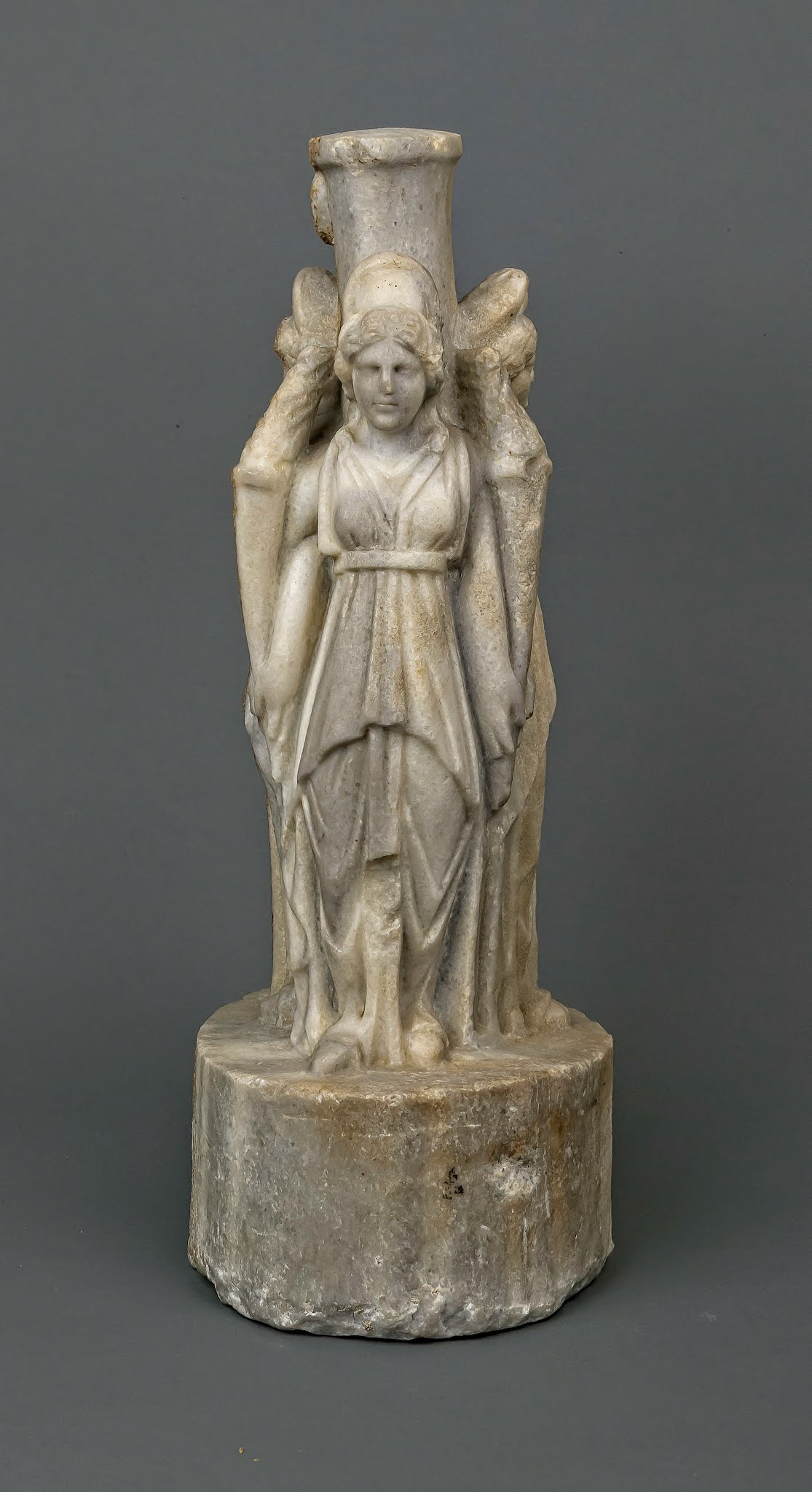
The general motif of a triple Hecate situated around a central pole or column, known as a hekataion, was used both at crossroads shrines as well as at the entrances to temples and private homes. These typically depict her holding a variety of items, including torches, keys, serpents, and daggers.  Sometimes she is depicted with Charites dancing around her.  Charites are sometimes called the Graces (Gratiae in Roman mythology) and refer to three or more goddesses of charm, beauty, nature, human creativity, goodwill, and fertility.

Hecate was closely associated with dogs and her approach was heralded by the howling of a dog. Although in later times Hecate's dog came to be thought of as a manifestation of restless souls or demons who accompanied her, its docile appearance and its accompaniment of a Hecate who looks completely friendly in many pieces of ancient art suggests that its original signification was positive and thus likelier to have arisen from the dog's connection with birth than the dog's underworld associations. 

Triple-formed representation of Hecate, Marble, Roman copy after an original of the Hellenistic period courtesy of Wikimedia Commons contributor Marie-Lan Nguyen


Gilt bronze Hekataion, 1st century CE Musei Capitolini, Rome courtesy of Wikimedia Commons contributor Daderot (digitally enhanced)


Hekataion with the Charites, Attic, 3rd century BCE at the Glyptothek, Munich courtesy of Wikimedia Commons contributor Bibi Saint-Pol.


Juniper wood Hekataion from Ptolemaic Egypt, 304–30 BCE, courtesy of the Metropolitan Museum of Art


Marble hekataion, Roman, 2nd century CE, courtesy of the Metropolitan Museum of Art


If you enjoyed this post, never miss out on future posts by following me by email!


Saturday, December 12, 2020

"Emerging" Aphrodite

This morning while searching for additional information about rare Roman funerary cippi recovered on Cyprus, I stumbled across this little figurine of "emerging" Aphrodite in the collections of the Museum of Cycladic Art. The reason it caught my attention is the pose is strikingly similar to the fresco of Venus in the triclinium of the House of the Prince of Naples that I studied earlier this year.  At the time, I was  wondering why the fresco was identified as Venus (Aphrodite) when the other main fresco in the room was identified as Bacchus (Dionysus), since Ariadne was the consort of Dionysus, not Venus.  Dr. Wallace-Hadrill had patiently explained to me that the goddess in the triclinium was identified as Venus because she is depicted wringing the sea water from her hair as described in Greek mythology (Hesiod's "Theogony" to be exact) but up until now I had never seen other ancient artwork with Venus in that particular pose.

According to the museum, the emerging Aphrodite was a common theme up to about the 1st century BCE, corresponding with the period leading up to Pompeii's destruction. The museum points out that, although Aphrodite was represented in Greek art as early as the 5th century BCE, the "emerging" Aphrodite was a creation of the Hellenistic period rather than the Classical period.

 "Some scholars believe that the type derives its origin from a famous painting of the emerging Aphrodite by the painter Apellis in the Asclepieion of Kos (second half of the 4th century BCE), which, like the pragmatic statue of Cnidia Aphrodite, is mentioned in innumerable ancient sources and seems to have contributed to the formation of a new model of female beauty in Hellenistic times. It is, after all, clear that the erotic dimension of Aphrodite emerges only during the Hellenistic period, when the naked depictions of the goddess increase and the word "Aphrodite" becomes synonymous with the erotic encounter. This fact is probably connected with an improvement of the social position of the woman and her release from the conservatism of the strictly male-dominated cities of the Classical era but also of classical art, which based its aesthetics on the worship of the male body." - Museum of Cycladic Art, Athens, Greece.

So the depiction of "emerging" Venus in the House of the Prince of Naples was not a questionable mismatch of consorts that I initially perceived as the less educated choice of art made by a merchant class resident seeking to project a more elite status, but simply a reflection of Pompeii's earlier Greek influence.  Sigh...so much to learn about ancient art and so little time!! 


Fresco of Emerging Venus (Aphrodite) in the summer triclinium of the House of the Prince of Naples in Pompeii.


Terracotta  Figurine of "Emerging" Aphrodite, Hellenistic 200 BCE - 1 BCE courtesy of the Museum of Cycladic Art, Athens, Greece.
If you enjoyed this post, never miss out on future posts by following me by email!


Saturday, November 28, 2020

Minerva or Bellona?

Despite the Roman association between Minerva and Athena and the frequent depiction of both goddesses with armor, unlike Athena, Minerva was not considered a war goddess in the Roman pantheon. The Romans had their own war goddess Bellona, originally an ancient Sabine goddess of war identified with Nerio, the consort of the war god Mars, and later with the Greek war goddess Enyo. 

Bellona's main attribute is the military helmet that was worn on her head much like Athena.  Bellona  is often depcicted holding a sword, spear, or shield, and brandishing a torch or whip as she rides into battle in a four-horse chariot. 

Bellona had a temple near the Theatre of Marcellus dedicated in 296 BCE near the Circus Flaminius by Appius Claudius Caecus, during the war with the Etruscans and Samnites. The Roman Campus Martius area, in which Bellona’s temple was situated, had extraterritorial status. Ambassadors from foreign states, who were not allowed to enter the city proper, stayed in this complex. Since the area of the temple was outside the pomerium, the Senate met there with ambassadors and received victorious generals prior to their triumphs. Beside the temple was the war column (columna bellica), which represented non-Roman territory. To declare war on a distant state, a javelin was thrown over the column by one of the priests concerned with diplomacy (fetiales) toward the direction of the enemy land. This symbolic attack was considered the opening of war.

Bellona's festival was celebrated on June 3, and her priests were known as Bellonarii and used to wound their own arms or legs as a blood sacrifice to her. These rites took place on March 24, called the day of blood (dies sanguinis), after the ceremony. In consequence of this practice, which was similar to the rites of Cybele in Asia Minor, both Enyo and Bellona became identified with her Cappadocian aspect, Ma.

In the military cult of Bellona, she was associated with Virtus, the personification of valour. Her worship by the legions extended her cult into the provinces. Temples to Bellona have been recorded in France, Germany, Britain, and North Africa.

In art, Bellona and Minerva have been frequently confused.  French artist Augustin Pajou created a sculpture between 1775-1785 that he dubbed Minerva but bearing the attributes of Bellona.  I was surprised on reading the J. Paul Getty Museum's entry for the sculpture stating Minerva was the Roman goddess of wisdom (a shared attribute with Athena) and war (??), striding forward to protect Painting, Sculpture, Music, Justice, and Medicine, the attributes of which lie at her feet.  But she wears the helmet and carries the torch of Bellona. A beautiful ancient Roman relief in the Carthage National Museum, however, clearly illustrates the difference between the two deities.  In this relief, Minerva stands beside a collection of a warrior's armor (although not the goddess of war, Minerva was considered a patron of warriors) but does not wear a helmet or brandish a weapon or torch.


Roman relief of Minerva at the Carthage National Museum courtesy of Wikimedia Commons contributor Mourad Ben Abdallah (digitally enhanced).


"Minerva" by Augustin Pajou at the J. Paul Getty Museum in Los Angeles, California courtesy of the museum. 


If you enjoyed this post, never miss out on future posts by following me by email!


Thursday, October 29, 2020

Aphrodite of the East - A warrior love goddess

The cult of Aphrodite in Greece was imported from, or at least influenced by, the cult of Astarte in Phoenicia, which, in turn, was influenced by the cult of the Mesopotamian goddess known as "Ishtar" to the East Semitic peoples and as "Inanna" to the Sumerians. Pausanias states that the first to establish a cult of Aphrodite were the Assyrians, followed by the Paphians of Cyprus and then the Phoenicians at Ascalon. The Phoenicians, in turn, taught her worship to the people of Cythera.

Aphrodite took on Inanna-Ishtar's associations with sexuality and procreation. Furthermore, she was known as Ourania, which means "heavenly", a title corresponding to Inanna's role as the Queen of Heaven. Early artistic and literary portrayals of Aphrodite are extremely similar on Inanna-Ishtar. Like Inanna-Ishtar, Aphrodite was also a warrior goddess. The second-century CE Greek geographer Pausanias records that, in Sparta, Aphrodite was worshipped as Aphrodite Areia, which means "warlike". He also mentions that Aphrodite's most ancient cult statues in Sparta and on Cythera showed her bearing arms. Modern scholars note that Aphrodite's warrior-goddess aspects appear in the oldest strata of her worship and see it as an indication of her Near Eastern origins. 

Nineteenth century classical scholars had a general aversion to the idea that ancient Greek religion was at all influenced by the cultures of the Near East, but, even Friedrich Gottlieb Welcker, who argued that Near Eastern influence on Greek culture was largely confined to material culture, admitted that Aphrodite was clearly of Phoenician origin. The significant influence of Near Eastern culture on early Greek religion in general, and on the cult of Aphrodite in particular, is now widely recognized as dating to a period of orientalization during the eighth century BCE, when archaic Greece was on the fringes of the Neo-Assyrian Empire.


Image: A sensuous bronze figurine of Aphrodite from a mirror or oil lamp thought to be from Roman Syria, 4th-6th century CE.  that I photographed at the Nelson-Atkins Museum of Art in Kansas City, Missouri in 2016.


If you enjoyed this post, never miss out on future posts by following me by email!


Wednesday, August 19, 2020

Senhouse Roman Museum reopens!

Senhouse Roman Museum is built upon the site of Alauna, a castrum or fort in Roman Britannia just north of the town of Maryport in Cumbria. It was linked by a Roman road to the Roman fort and settlement at Derventio (Papcastle) to the southeast, and thence by another road northeast to the regional hub of Luguvalium (Carlisle). The fort was established around 122 CE as a command and supply base for the coastal defences of Hadrian's Wall at its western extremity. There are substantial remains of the Roman fort, which was one of a series along the Cumbrian coast intended to prevent Hadrian's Wall being outflanked by crossing the Solway Firth. 

Geo-magnetic surveys have revealed a large Roman town surrounding the fort. An archaeological dig discovered evidence of a second, earlier, larger fort next to, and partially under the present remains. The Roman fort site was owned from the 16th century by generations of the Senhouse family. The main building on the site was constructed as a naval artillery drill hall in 1885. It was converted into the Senhouse Roman Museum in 1990. The Senhouse family's collections contained numerous Roman artefacts including dedicated altars. Beginning in Tudor times, the site has yielded more altars than any other Roman site in Britain.  One of the best known, now in the British Museum, has an inscription dedicated by Gaius Cornelius Peregrinus, a decurion (town councilor) from Saldae (present-day Bejaia in Algeria), who was tribunus (military commander) of the auxiliary garrison. 

Another interesting artifact in the collections of the local museum is a column base bearing a relief of the Celtic horse goddess Epona, discovered in the 18th Century in the Headquarters Building within the fort. This is one of only two representations of Epona in Britain. Epona is depicted riding sideways on a prancing horse with a basket of fruit in her lap. She was the personification of the horse and protector of horses, particularly going into battle or breeding stock. Auxiliary cavalrymen brought the belief in Epona with them from their tribal territories. The Celtic goddess was also revered as the patroness for wagoners. She was popular among the military particularly in the provinces of Gaul and Germania.

http://www.senhousemuseum.co.uk/

A column base bearing a relief of the Celtic horse goddess Epona, discovered in the 18th century in the headquarters building within the fort. This is one of only two representations of Epona in Britain. 

Epona, Roman, Second or Third century CE, from Contern, Luxembourg at the Musée National d'Art et d'Histoire, Luxembourg City courtesy of Wikimedia Commons contributor Owen Cook

Relief depicting the "Lady of Animals", Epona, sitting on a throne holding a fruit basket on her lap, 200 CE at the Kunst der Kelten, Historisches Museum Bern courtesy of Wikimedia Commons contributor Rosemania

Epona relief, Gallo-roman, from Allerey, Dijon Archeological Museum, France courtesy of Wikimedia Commons contributor Siannan


Epona relief, 70-100 CE, later incorporated into the city wall of Bregenz, revered as "Ehre-Guta" at the Vorarlberg Museum, Bregenz, Austria


If you enjoyed this post, never miss out on future posts by following me by email!


Monday, August 10, 2020

Roman worship of the Egyptian goddess Isis

Greeks were aware of Egyptian deities, including Isis, at least as early as the Archaic Period (c. 700–480 BCE), and her first known temple in Greece was built during or before the fourth century BCE by Egyptians living in Athens. The conquests of Alexander the Great late in that century created Hellenistic kingdoms around the Mediterranean and Near East, including Ptolemaic Egypt, and put Greek and non-Greek religions in much closer contact. The resulting diffusion of cultures allowed many religious traditions to spread across the Hellenistic world in the last three centuries BCE. 

Isis's cult reached Italy and the Roman sphere of influence at some point in the second century BCE. It was one of many cults that were introduced to Rome as the Roman Republic's territory expanded in the last centuries BCE. Authorities in the Republic tried to define which cults were acceptable and which were not, as a way of defining Roman cultural identity amid the cultural changes brought on by Rome's expansion. In Isis's case, shrines and altars to her were set up on the Capitoline Hill, at the heart of the city, by private persons in the early first century BCE. The independence of her cult from the control of Roman authorities made it potentially unsettling to them. In the 50s and 40s BCE, when the crisis of the Roman Republic made many Romans fear that peace among the gods was being disrupted, the Roman Senate destroyed these shrines, although it did not ban Isis from the city outright.

Egyptian cults faced further hostility during the Final War of the Roman Republic (32–30 BCE), when Rome, led by Octavian, the future emperor Augustus, fought Egypt under Cleopatra VII. After Octavian's victory, he banned shrines to Isis and Serapis within the pomerium, the city's innermost, sacred boundary, but allowed them in parts of the city outside the pomerium, thus marking Egyptian deities as non-Roman but acceptable to Rome. Despite being temporarily expelled from Rome during the reign of Tiberius (14–37 CE), the Egyptian cults gradually became an accepted part of the Roman religious landscape. The Flavian emperors in the late first century CE treated Serapis and Isis as patrons of their rule in much the same manner as traditional Roman deities such as Jupiter and Minerva. The cults also expanded into Rome's western provinces, beginning along the Mediterranean coast in early imperial times. At their peak in the late second and early third centuries CE, Isis and Serapis were worshipped in most towns across the western empire, though without much presence in the countryside. Their temples were found from Petra and Palmyra, in the Arabian and Syrian provinces, to Italica in Spain and Londinium in Britain.

Image:  Oracle statue of Isis, Roman, Bronze, 150 CE, that I 
photographed at the Neues Museum in Berlin.

If you enjoyed this post, never miss out on future posts by following me by email!


Sunday, July 19, 2009

Tullio sculptures demonstrate antiquity's influence on Renaissance Art

When I glanced at the images of some of the sculptures in the new exhibit, "An Antiquity of Imagination: Tullio Lombardo and Venetian High Renaissance Sculpture" at the National Gallery of Art in Washington D.C., I could hardly believe I was looking at Renaissance sculpture and not Roman funerary art (except for the bared breasts - the ancient Romans were a little more modest than that!).

"Carved from a single block of marble in high relief, this double portrait is so deeply undercut that the two figures appear almost in the round. Traces of applied color survive on the eyes, the lips, and the background, which was once black. The intense emotions of the pair, who do not look at each other, remain a mystery. Was this work a memorial, emulating Roman funerary reliefs of married couples? An ancient love story, perhaps with a tragic conclusion? A pair of idealized contemporary portraits in antique guise? At a time when even formal portrait busts were rare in Venice, this ambiguity may have been part of Tullio’s appeal. The prominent signature was inscribed at a point perhaps meant to be at the viewer’s eye level." - National Gallery of Art.


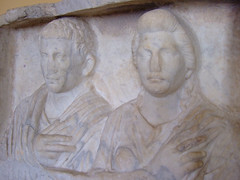
This tomb sculpture would have looked quite natural along side the collection of ancient funerary art I saw this past spring displayed in the new tunnel gallery of the Capitoline Museum in Rome or in the halls of the Getty Villa like the first century CE grave monument of the freedman Popillius and wife Calpurnia [right] I photographed there.

Grieving was actually regulated by the Roman state.

Pompilius Numa, the legendary second king of Rome (c. 715-673 BC), was credited with creating the basic framework for Roman public religion and the grief process.

Numa himself set out rules for the periods of mourning according to age and time. So, for xample, there was to be no mourning at all for a child of less than l year; for a child older than that, up to 10 years old, the mourning was not to last more months than it had lived years; and the longest time of mourning for any person was not to exceed 10 months. This was also the time set for
widowhood for women who had lost their husbands, and any woman who took another husband before this time was out was obliged by the laws of Numa to sacrifice a cow with calf. - Plutarch, Numa 12.

Paulus further interpreted the mourning laws of the Twelve Tables in a legal opinion in the late 2nd c. or early 3rd c. AD.

"Parents and children over 6 years of age can be mourned for a year, children under 6 for a month. A husband can be mourned for 10 months, close blood relatives for 8 months. Anyone who acts contrary to the restrictions is placed in public disgrace. Anyone in mourning ought to refrain from dinner parties, jewellery and other adornments, and purple and white clothing." - Paulus, Opinions 1.21.2-5


Although Roman males were expected to keep a "stiff upper lip" when it came to mourning one's lost loves, I could easily imagine an inscription quoting a line from the Roman poet Tibullus, "May I look on you when my last hour comes; as I die, may I hold your hand in my failing grasp."

The exhibit also features the bust of a grieving heroine, with head tilted slightly, by Antonio di Giovanni Minello, a great admirer of Tullio Lombardo [left]. It reminded me of a Roman Imperial Period sculpture of a goddess at the Palazzo Altemps, Museo Nazionale Romano [below right].

"The sculptor’s admiration for Tullio is suggested by the tragic expression, seminude treatment, and intricately winding hair, which is raised in relief in some places and incised into the marble in others. The medallion above her forehead is based on a famous ancient gem. The Trojan hero Aeneas is among the identities proposed for the seated figure in Minello’s version. If it is he, the woman would be his grief-stricken lover Dido, queen of Carthage, whom he abandoned." - National Gallery of Art.
A relief of Mars (left) by Tullio's younger brother, Antonio Lombardo, seems to have been inspired by the Ludovisi Ares or the seated warrior thought to be the pendant to the Ludovisi Ares [below right], a second century BCE copy of a Greek original, also on display at the Palazzo Altemps in Rome.

"This deeply undercut high relief reflects a type of small sculpture developed by Tullio Lombardo’s younger brother Antonio for the luxurious private chambers of the Duke of Ferrara. Reliefs like this one, with single figures based on ancient myth, history, or philosophy, soon gained popularity among collectors. Here, the ancient Roman god of war, full of an energy echoed by his windblown drapery, appears amid his divested armor. Some believe this relief was made to be paired with a marble version of the bronze Peace. Others argue that the inscription refers to Mars’ amorous exploits and that a more likely pendant would be Venus, the goddess of love." - National Gallery of Art

Tullio Lombardo, also known as Tullio Solari, was born into a family of sculptors in 1460. After studying in Rome, he returned to the family business that had been established in Venice after a short sojourn in Padua. Building upon his father's style, Tullio developed a more natural form with fluid lines.

The Lombardo family branched out into architecture as well, building the Church of S. Maria dei Miracoli, and contributing to numerous other structures, including the Church of S. Giobbe and the Scuola di S. Giovanni Evangelista.

In Venice the Church of SS. Giovanni e Paolo [Zanipolo] contains two sculptural works of Tullio: the Monument to Doge Pietro Mocenigo, executed with his father and brother, and the Monument to Doge Andrea Vendramin, an evocation of a Roman triumphal arch encrusted with decorative figures, which appears to be Tullio's work alone. To Tullio are also attributed the Funeral Monument of Cav. Marco Cornaro in the Church of SS. Apostoli and the frieze in the Cornaro Chapel of the Church S. Maria Gloriosa dei Frari. - More: Boglewood.com


"The Lombardos' church monuments reflected the latest Florentine ideas about reviving classical antiquity through statues inspired by archaeological finds.

The exhibit displays only four sculptures known to be solely carved by Tullio, but these are enough to demonstrate his enormous talent. The most striking are marble reliefs portraying two couples, each figure carved so deeply as to resemble a freestanding bust set against a block of stone.

With its rounded faces, glancing eyes and curly hair, the earlier work from around 1490-1495 reveals Tullio's close study of Roman funerary reliefs and other ancient sculptures. However, its depiction of a toga-clad man and bare-breasted woman isn't just a dry copy but is infused with the psychological intrigue of a Giorgione or a Titian.

The pairing suggests a bridal couple doomed to separation, since the figures seem to occupy different worlds. They do not face one another but stare in opposite directions, their full lips parted as if sighing at an unseen presence. - More: The Washington Post

The exhibit is tiny - only a dozen sculptures - but well worth a look if you are planning a visit to the National Gallery anytime soon. The exhibit will be on display until October 31, 2009.

Read more about it!


If you enjoyed this post, never miss out on future posts by following me by email!