I was working on my "virtual" Julius Caesar today, a natural language conversational agent depicting a resurrected Julius Caesar, when I happened upon this fascinating excerpt from Maria Wyke's book, "Caesar: A Life in Western Culture" about all of the fables that have grown up around the man and the myth that was Julius Caesar. I had been specifically searching for references to his unique horse "Toes".
Wyke observes:
Every conqueror needs a distinguished horse which only he can ride. A number of classical sources note that Julius Caesar possessed such a horse, born on his own lands, whose front hooves resembled feet since they were divided in such a way that they looked like toes. This unusual condition was interpreted by a soothsayer as an omen that the master of such a horse would one day rule the world. Naturally, the horse would endure no other rider save Caesar. This observation in Caesar’s ancient biography seems to recall the characteristics of Bucephalus, the wild horse tamed by Alexander, which provided that hero too with an oracle predicting world empire. In medieval romance, Alexander’s horse becomes a horned creature so wild that it eats men. In a later medieval epic on Julius Caesar, in addition to unmistakable feet, his horse gains a fabulous horn on its head with which it can topple other riders and their mounts. A number of depictions survive in which this mythic horse (rather than its owner) is in sharp focus. A colourful earthenware dish of the early sixteenth century, which captures a moment in the triumph of Julius Caesar, appears to jettison the medieval horn in favour of a more rational spike attached to a harness, but all four of the horse’s human feet remain clearly visible as it is ridden on parade by a youth, who carries a globetipped branch to signify that their master is ruler of the whole world . -
Caesar: A Life in Western CultureI found her discussion of Caesar as one of the medieval "Nine Worthies" quite interesting as well:

The mature Caesar was also included in the medieval canon of the Western world’s greatest military heroes. This collection of champions, or Nine Worthies (‘neuf preux’), was first identified, categorized, and made popular in the early fourteenth century in a poem composed by a French
jongleur or itinerant ministrel. Joining a neatly composed arrangement of three Christians, three Hebrews and two other pagans (Hector and Alexander the Great), Julius Caesar along with the rest was made to embody chivalric goodness, wisdom, prowess and valour. Perfect warriors, the Nine Worthies conferred glory on their nations and provided patterns of both military virtue and moral conduct for imitation. They frequently appeared on frescoes, tapestries, enamelled cups and playing cards owned by medieval princes and noblemen. In a similar way to a collection of saints, their role was to exhort a supposedly degenerate present to live up to medieval ideals projected back into the past. In this line-up, Julius Caesar was conventionally distinguished by his imperial crown and the crest of a two-headed eagle emblazoned on his medieval armour. In a fourteenth-century tapestry of the Nine Worthies commissioned by the Duke of Berry (and now surviving only in parts), a majestic and heavily bearded Caesar sits enthroned within a fantastic Gothic niche. He grasps a broad, unsheathed sword and is surrounded by his courtiers (mainly musicians, but also a soldier and, directly above him, his lady). His heraldic symbol of the double-headed imperial eagle is woven in sable on gold."
Caesar: A Life in Western Culture
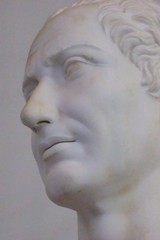
The idea of a heavily-bearded Caesar seemed pretty far-fetched since Caesar was so meticulous about his appearance he frequently had his body plucked to remove any unsightly hair (except on the top of his head) and all ancient sculptures of him show him clean shaven like most military men of the late Republican era.
[Image: Imperial Statue from the Antonine Period with modern head of Julius Caesar, Museo Archaeologico di Napoli. Photo by Mary Harrsch]Wyke also said medieval chroniclers further elaborated on the evil portents preceding Caesar's assassination. In addition to the ancient references to horses Caesar had dedicated to the gods that would no longer graze but wept abundantly; a bull Caesar was sacrificing turning out to have no heart and a ‘king’ bird torn to pieces by other birds in Rome’s senate-hall, a 15th century poem related:
"... on that dark night, at the sixth hour, when the betrayal was arranged, terrible voices were heard clamouring in the sky, the earth quaked as if it were releasing a great sigh, fires with bloody tails circled through the air in battle, a lamb cried out ‘Slaughter! Slaughter!’, oxen pointed out to their ploughmen the pointlessness of carrying on …"
These strange manifestations of fame that Caesar openly sought seem to point to the fulfillment of an eerie prophecy by Cicero during his own on-again, off-again relationship with Caesar.

"Posterity will be staggered to hear and read of the military commands you have held and the provinces you have ruled … battles without number, fabulous victories, monuments and shows and Triumphs. And yet unless you now restore this city of ours to stability by measures of reorganization and lawgiving, your renown, however far and wide it may roam, will never be able to find a settled dwelling-place or firm abode. For among men still unborn, as among ourselves, there will rage sharp disagreements. Some will glorify your exploits to the skies. But others, I suggest, may find something lacking, and something vital at that. (Cicero,
pro Marcello 28û9. Trans. M. Grant, 1969)"
[Image: Marcus Tullius Cicero. 1st century BCE. Capitoline Museum, Rome, Italy. Photograph by Mary Harrsch]Yet, the two-edged nature of such fame, however, has served men's purposes through the centuries.
"Caesar has been deployed to legitimate or undermine the authority of kings, to justify or denounce the coups of generals, to launch or obstruct revolutions, to demonstrate incisive literary style and perfect grammar, to teach military strategy and tactics or the workings of fortune and destiny, to display luxury, to play out sexual excess, to stimulate expenditure and consumption. Moreover, the history of Caesar’s reception is not only a matter of re-presenting him in ways that speak to the present (in paintings, plays, novels, operas, films and computer games, as well as in political speeches and historical treatises); it is also often a matter of adopting aspects of his life in someone else’s, or replicating his murder for political reasons—a matter of becoming or removing a new Caesar. -
Caesar: A Life in Western Culture
Like Achilles who accepted death to obtain enduring fame, I think Caesar would have found it a worthy trade off.
If you enjoyed this post, never miss out on future posts by following me by email!