Showing posts with label Cicero. Show all posts

Friday, September 18, 2020

The Real Cleopatra

  The "real" Cleopatra?

Cleopatra is barely mentioned in De Bello Alexandrino, the memoirs of an unknown staff officer who served under Caesar. The writings of Cicero, who knew her personally, provide an unflattering portrait of Cleopatra although it actually sounds more like Cicero did not feel he was greeted by her as one of the most important senators of Rome.  I found this imagined letter between Cicero and J.W. Worthy, late professor of philosophy at John Tarleton Military Academy, based on Cicero's writings, interesting:

"I do not wish to be unfair to the graecula.  She is clever beyond words, no denying it.  You may understand my impatience with her if I remind you that, although she chatters on in Hebrew, Aramaic, Syriac, Greek of course, Parthian, Median, Egyptian (she is said to be the first Ptolemy to master that), Ethiopian, and Trogodyte, all with marvelous fluency so they say, she was unable to receive me in Latin!  Or claimed to be unable to do so, so that right here in the city I was compelled to converse in Greek.  It is no different with her vaunted drive, energy and ambition:  they were not enough to motivate her to cultivate the most important Roman senator.  And of  her fabled treasure:  although her aides had promised a purely literary acknowledgment of my merits, I came and went empty handed".  

For more of Professor Worthy's "correspondence", see:

https://lettersfromthedustbowl.com/home.html

The Augustan-period authors Virgil, Horace, Propertius, and Ovid perpetuated the negative views of Cleopatra approved by the ruling Roman regime, although Virgil established the idea of Cleopatra as a figure of romance and epic melodrama. Horace also viewed Cleopatra's suicide as a positive choice, an idea that found acceptance by the Late Middle Ages with Geoffrey Chaucer. The historians Strabo, Velleius, Valerius Maximus, Pliny the Elder, and Appian, while not offering accounts as full as Plutarch, Josephus, or Dio, provided some details of her life that had not survived in other historical records.

Cassius Dio, writing in the 3rd century CE claimed Cleopatra was a woman of surpassing beauty, and at the time (48 BCE), was "most stunning" in the prime of her youth.  He said even at Mark Antony's funeral, where she appeared in mourning garments, she was still "most stunning."  In Octavian's propaganda, Cleopatra was presented as a beautiful witch that cast a spell over Antony, consciously refusing to acknowledge her as the wealthiest and most powerful female sovereign of the Hellenistic Mediterranean.  Plutarch, however, said her beauty did not exceed Octavia's, Antony's official Roman wife and sister of Octavian.  But he does admit her charm rested in her persuasive character and stimulating discourse  because she was highly educated and spoke many foreign languages.

The fragmentary Libyka commissioned by Cleopatra's son-in-law Juba II provides a glimpse at a possible body of historiographic material that presented a more favorable view of Cleopatra.

Cleopatra's gender has perhaps led to her depiction as a minor if not insignificant figure in ancient, medieval, and even modern historiography about ancient Egypt and the Greco-Roman world. For instance, the historian Ronald Syme asserted that she was of little importance to Caesar and that the propaganda of Octavian magnified her importance to an excessive degree. Although the common view of Cleopatra was one of a prolific seductress, she had only two known sexual partners, Caesar and Antony, the two most prominent Romans of the time period, who were most likely to ensure the survival of her dynasty. 

There is an excellent article by Branko van Oppen on the Ancient History Encyclopedia about various portraits of Cleopatra:

https://www.ancient.eu/article/1491/was-cleopatra-beautiful/

Seal impression with bust of Cleopatra VII at the Royal Ontario Museum in Toronto, Canada courtesy of the museum.

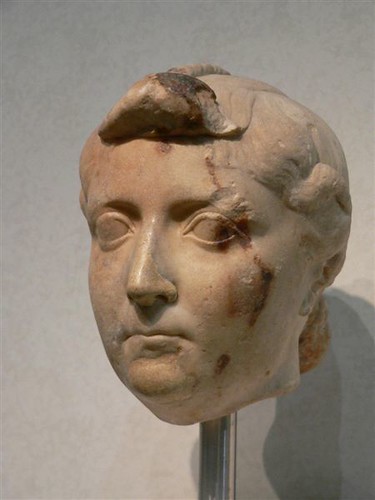
An ancient Roman portrait head, c. 50–30 BCE, now located in the British Museum, London, that depicts a woman from Ptolemaic Egypt, either Queen Cleopatra or a member of her entourage during her 46–44 BCE visit to Rome courtesy of Wikimedia Commons.

Roman fresco in the Pompeian Third Style possibly depicting Cleopatra, from the recently reopened House of the Orchard at Pompeii, Italy, mid-1st century CE

A probable posthumously painted portrait of Cleopatra with red hair and her distinct facial features, wearing a royal diadem and pearl-studded hairpins, from Roman Herculaneum, Italy, 1st century CE, courtesy of Wikimedia Commons contributor Ángel M. Felicísimo from Mérida, Spain.

Egyptian portrait of a Ptolemaic queen, possibly Cleopatra, c. 51–30 BCE, located in the Brooklyn Museum courtesy of Wikimedia Commons courtesy of the museum.

A silver tetradrachm of Cleopatra minted at Ascalon, Israel courtesy of Wikimedia Commons contributor PHGCOM.

A silver tetradrachm of Cleopatra minted at Seleucia Pieria, Syria courtesy of Wikimedia Commons contributor PHGCOM
If you enjoyed this post, never miss out on future posts by following me by email!


Wednesday, July 8, 2020

King Antiochus I Theos of Commagene: Meeting the Challenges of a Buffer Kingdom

Head of King Antiochus I at Nemrut Dağ, Turkey,
courtesy of Carole Raddato
The hierothesion (burial complex) of King Antiochus I Theos of Commagene is 50-meter-high man-made burial mound situated upon the peak of Nemrut Dağ within the Taurus mountain range of South-East Turkey, over 2,150 m above sea level. The site was rediscovered in the early 1881 by Karl Sester, a German engineer assessing transport routes for the Ottomans, who reported the discovery of a large number of colossal statues, which he incorrectly believed to be Assyrian in origin. Excavations in the 20th century dated the monumntal tomb to the latter part of the reign of Antiochus I, about 50-36 BCE. The complex is flanked on the north, east, and west with terraces.  The East and West terraces have the remains of colossal seated statues as well as rows of relief stelae (orthostates). The statues have been identified as Antiochus I and a pantheon of Greek, Armenian, and Iranian deities. Antiochus practiced astrology of a very esoteric kind, and laid the basis for a calendrical reform, by linking the Commagenian year, which till then had been based on the movements of the Moon, to the Sothic (Star of Sirius) cycle used by the Egyptians as the basis of their calendar. This would suggest that Antiochus was knowledgeable about, if not fully initiated into Hermeticism,  a tradition based primarily upon writings attributed to Hermes Trismegistus, a pagan philosopher, who taught belief in a single, universal spirit.  He also supposedly invented the process of making a glass tube airtight, hence our term for "hermetically sealed."

Although a vassal state of the Seleucids, Commagene asserted its independence in the 1st century BCE but suffered hardships during the Roman war with Pontus and Armenia. Although Armenia initially succeeded in extending its influence over Commagene, Antiochus was ultimately forced to side with the Romans when the commander Pompey declared war against him.  Although Antiochus claims in his inscriptions on Mount Nemrut to be a friend of the Romans, he was distrusted by them, especially by Cicero.  In 57-37 BCE, he allied with the Parthian monarch Orodes II and offered his daughter Laodice to Orodes in marriage. Later, in 51 BCE, however, some disaffection prompted Antiochus to provide intelligence about Parthian forces led by Prince Pacorus I to the Romans.  But when Pacoras was defeated and killed by the Romans in 38 BCE, the Parthian army fled to Commagene where Antiochus gave them refuge.  This, of course, angered the Romans and the Roman general Publius Ventidus Bassus laid siege to Antiochus' capital of Samosata. Antiochus offered a reimbursement of 1,000 talents and a renewed alliance to the Romans but this offer was rejected by the senior Roman commander Marc Antony, who then took over the siege.  However, Antony failed to capture the capital and finally accepted a new offer of only 300 talents.  Antiochus disappeared from history after this except for a notation by Cassius Dio who said Antiochus was killed by the Parthian king Phraates IV, in 31 BCE.

For a thorough description of Nemrut Dağ and portfolio of images, see Carole Raddato's excellent article at:

https://followinghadrianphotography.com/2019/01/21/mount-nemrut/
.

If you enjoyed this post, never miss out on future posts by following me by email!


Sunday, June 7, 2020

The Sacrifice of Publius Decius Mus

Publius Decius Mus recounts his prophetic dream to his troops during the Latin War by Jacob Matthias Schmutzer, 1733-1811, (PD)
Defend the belief that a public assembly ought to be kept pure, the Campus Martius holy, the body of every Roman citizen undefiled, and the right of liberty unassailable.  M. Tullius Cicero.  Speech before Roman Citizens on Behalf of Gaius Rabirius, Defendant, Against the Charge of treason.  Section 11.

According to Livy, during the Latin War, as the army marched near Capua, it was given to the two consuls in mutual dreams that the army whose general pledged himself and his foemen's host to the Dii Manes and Earth, would be victorious. Upon confirmation from the haruspices the two divulged a plan to their senior officers and their army, that they may not lose heart, for they intended that whosoever's wing should falter first, should so pledge his life to the gods of the underworld and the Earth.

Once the battle was engaged, the left wing began to falter and Decius Mus called upon the Pontifex Maximus, M. Valerius, to tell him the means by which to save the army. The pontifex prescribed the required ritual acts and a prayer (for which see devotio). After performing the religious ritual, the fully armored Decius Mus plunged his horse into the enemy with such supernatural vigor and violence that the awe-struck Latins soon refused to engage him, eventually bringing him down with darts. Even then, the Latins avoided his body, leaving a large space around it; and so the left wing of the Romans, once faltering, now swept into this weakness in the enemy lines. Manlius, conducting the right wing, held fast, allowing the Latins to use up their reserves, before crushing the enemy host between the renewed left and Samnite foederati at their flank, leaving only a quarter of the enemy to flee.

If you enjoyed this post, never miss out on future posts by following me by email!


Friday, September 26, 2014

The House of the Tragic Poet: What's love got to do with it?


A history resource article by  © 2014

Recently, I watched a fascinating lecture by Professor Steven Tuck of Miami University on the interpretation of imagery found in the House of the Tragic Poet in Pompeii in his course "Pompeii: Daily Life in an Ancient Roman City", recorded for The Great Courses.   He describes the scenes of mythical and literary events as sharing an overall theme of love with the exception of a panel depicting the sacrifice of Iphigenia in a vestibule of the peristyle adjacent to the triclinium.  He also explained that this jumble of images was possibly the target of Petronius, Nero's official "arbiter of taste". In his "Satyricon" written during this period, Petronius derided such, as he perceived it, tasteless displays proffered up by the nouveau riche.

When Dr. Tuck described the images I found myself searching for more meaning in their inclusion in a family home, too, other than just ostentation. So I searched the web and stumbled across an article by Bettina Bergmann entitled "The Roman House As Memory Theater".  Bergmann expresses her opinion that, what on the surface may appear to some to be unrelated lavish literary and mythical depictions, may have actually been carefully chosen scenes to enable visitors to the house, as well as its residents, to relate contemporary events to the ancient epic past as a means to both appreciate and understand the culture they all shared.  I hope I understood her correctly.

Remains of frescoes depicting mythological scenes in the triclinium
(dining room) in the House of the Tragic Poet in Pompeii.  Image courtesy
of Wikimedia Commons.
She thinks the choice of decor served as memory tools, called the method of loci, or the "Roman Room" technique, to facilitate intelligent discourse as described by Cicero in his thesis on oratory, "De Oratore".  The method of loci, also known as the memory palace or mind palace technique, is a mnemonic device adopted by ancient Greek and Roman rhetoricians that relies on memorized spatial relationships to establish, order and recollect memorized content.

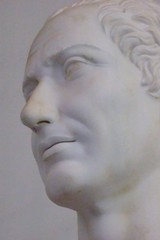
Portrait bust of the famous Roman orator Cicero.
Photographed at the Capitoline Museum by
 © 2005

"In this technique, the subject memorizes the layout of some building, or the arrangement of shops on a street, or any geographical entity which is composed of a number of discrete loci. When desiring to remember a set of items the subject literally 'walks' through these loci and commits an item to each one by forming an image between the item and any distinguishing feature of that locus. Retrieval of items is achieved by 'walking' through the loci, allowing the latter to activate the desired items. The efficacy of this technique has been well established (Ross and Lawrence 1968, Crovitz 1969, 1971, Briggs, Hawkins and Crovitz 1970, Lea 1975), as is the minimal interference seen with its use." - John O'Keefe and Lynn Nadel, The Hippocampus as a Cognitive Map

Although I agree that the House of the Tragic Poet could have served wonderfully well as a "memory theater", I think each room's decor would not only provide a distinctive locus but remind the visitor of an important aspect of human relationship either within the family or the society as a whole.  Dr. Tuck focused on an underlying theme of love and it is certainly an underlying thread in many of the images.   But depictions of the power of those in authority over socially subordinate individuals and the consequences of defying authority is also present and in the strictly ordered society of late Republican and early Imperial Rome, this message to visiting clients would not be overlooked.

As a client enters the atrium, to the right he would see a panel depicting Zeus and Hera on Mount Ida.

Fresco depicting the wedding of Zeus and Hera in the atrium
of the House of the Tragic Poet in Pompeii.  Image courtesy of
Wikimedia Commons.
"Zeus persuades his modest bride to lift her veil and reveal her face, which she turns suggestively to the viewer.  This canonical scheme, seen in a metope from Hera's 5th century BCE Temple at Selinus, celebrates that liminal passage in a woman's life from invisibility to exposure, virginity to marriage." - Bettina Bergmann, The Roman House as Memory Theater

Bergmann refers to various interpretations of the Iliad for this example.  From a client's perspective, though, the marriage could represent a metaphorical one between the client and the patron. Furthermore, the lifting of the veil could represent the need for complete disclosure between the client and patron as a necessary foundation for trust.

Next, the client would see a painting of Achilles sitting before his tent after he reluctantly releases his concubine, Briseis, to Patroclus, who leads her away to the tent of Agamemnon.  Briseis, too, turns her glance back toward the viewer as she holds up her veil to dry a tear.  To a client, this could remind him that sacrifices may have to be made but the patron has the right to expect this.
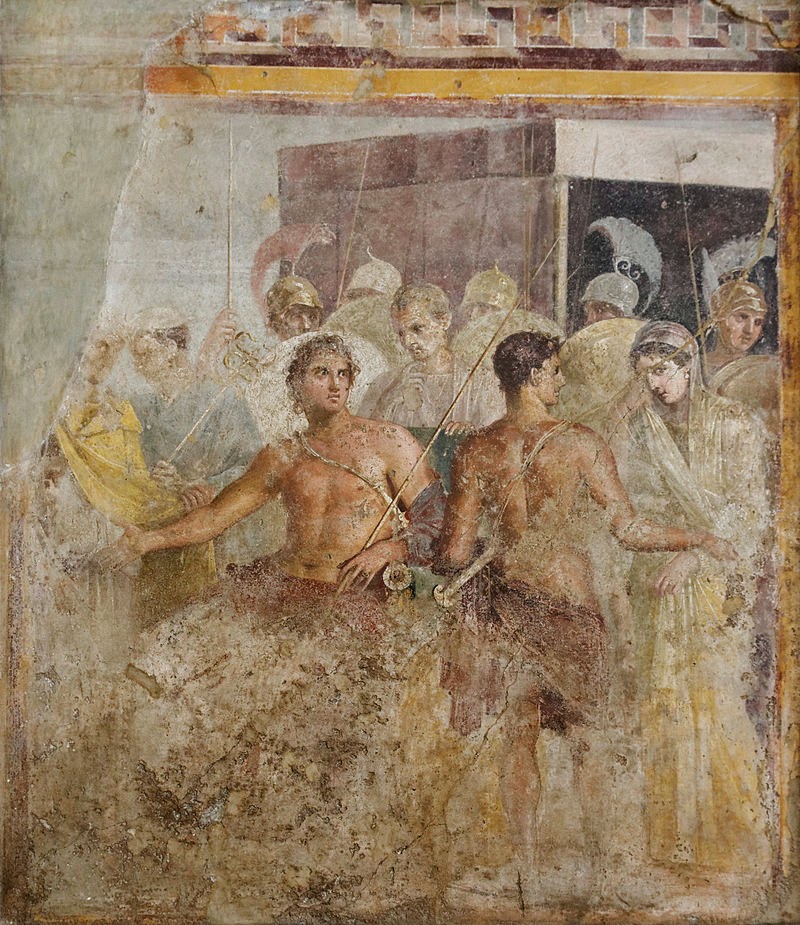
Fresco depicting The Greek hero Achilles surrounding his captive
prize Briseis to Patroclus who prepares to take her to King Agamemnon.
Image from the House of the Tragic Poet courtesy of Wikimedia Commons.
The third panel depicts Helen, also unveiled, boarding a ship that will take her from her homeland to Troy where strife and heartache await.  Again a client is reminded of the degree of sacrifice and obedience to which a patron is entitled.

Fresco depicting Helen boarding a ship
for Troy in the atrium of the House of
the Tragic Poet in Pompeii.  Image
courtesy of Wikimedia Commons.
Once the client is called into the tablinum, they find a scene of Alcestis hearing the news that her husband Admetus may be spared death if another dies in his place.  In the myth, the wife offers herself instead.  Euripides’ play Alcestis was popular in Italy since the fourth century BCE.
Bergmann believes this scene of the Greek heroine represents the exemplum of the ideal wife for most mid-first century CE Romans.

However, if you consider the level of fidelity expected from a client in this period of Rome, the self-sacrifice of the subordinate wife is to be acknowledged and taken very seriously. A client is clearly reminded that he may need to be willing to throw himself under the chariot, so to speak, to save his patron.

Fresco of Alcestis hearing the news that her husband Admetus
will be spared if someone (her) dies in his place from the
House of the Tragic Poet in Pompeii.  Image courtesy of
Wikimedia Commons.
The famous mosaic of actors preparing to present a tragic satyr play stares up at the client from the floor.  The elderly choragos could again represent the patron who is instructing a flute player and two actors dressed in goatskin loincloths, representatives of the clients who are presenting themselves for their daily assignment.  I also think of this mosaic as reminding clients that they all have their parts to play (Even though Shakespeare was born many centuries later!)

Mosaic depicting the choregos and tragic actors from the tablinum in the
House of the Tragic Poet in Pompeii.  Image courtesy of Wikimedia Commons.
Of course, all of my speculation is based on the viewpoint of a client visiting the patron which occurred every morning during the salutatio. But the underlying messages of respect for authority, obedience, and sacrifice would apply even to the patron's visiting friends and peers since all would be considered in service to Rome. In her treatise, Bergmann offers all kinds of alternate suggestions based on image groupings from different angles that you may find interesting as well.

One image that gave Dr. Tuck pause to explain its connections to all the others from a viewpoint of love as the predominant theme is the image depicting the sacrifice of Iphigenia that adorns a small space of the peristyle diagonally across from the lararium.  I think it is actually the ultimate expression of love in the entire house, though.  In a Roman world of patron and client relationships and the powerful role of pater familias, where the head of household has the power of life and death even over family members, I think this image served to remind the patron each morning after he sacrificed to his ancestors and household gods and turned to enter the tablinum, not to allow the heady intoxication of power and ambition lead him to sacrifice the most important people in his life or there would be dire consequences (like there was for Agamemnon!) - serving the purpose very much like the slave who rides with the triumphator in the triumphal chariot whispering, "remember, thou art mortal".

The sacrifice of Iphigenia found in a vestibule of the peristyle adjacent to
the triclinium.  I think this image would have reminded the patron of the
dire consequences of placing ambition above love for his familias.
Image courtesy of Wikimedia Commons.


I highly recommend that you read Bettina Bergmann's paper as it is not only interesting but has beautiful illustrations of the various reconstructed spaces within the House of the Tragic Poet.  I also recommend Dr. Steven Tuck's lecture series "Pompeii: Daily Life in an Ancient Roman City" available through The Great Courses.

The famous Cave Canem Mosaic at the entrance to the House of the Tragic
Poet.  Image courtesy of Wikimedia Commons. 
The House of the Tragic Poet wasn't the only one with a
"Cave Canem" mosaic in the entryway.  Here's another
one I found in Pompeii in 2005.  Photograph by
 © 2005
One last comment on the domus’ imagery — Dr.Tuck said Petronius made particular fun of the fact that the nouveau riche house in the Satyricon had a "Beware of Dog" mosaic at its entrance just like the House of the Tragic Poet. Petronius pointed out that it was totally ridiculous because all Roman houses have their door opened to the public during the day with, theoretically, all comers welcome.  

To Bergmann, the mosaic recalls the scene in the Satyricon in which Encolpius is tricked by a painted dog on the vestibule wall with the words “Cave Canem” written beside it.

“Raoul-Rochette related the mosaic dog to the Neronian taste for naïve realism satirized by Petronius,” Bergmann points out.


Considering the pragmatism of the Romans, I think the mosaic served as a subtle and very practical reminder to those who might be contemplating entering the home to do harm that, although the door is open, the house is guarded, whether literally or metaphorically - sort of the modern equivalent of posting a "Beware of Dog" sign even when you don't own one.  It makes perfect sense to me but, of course, I have never been designated as an emperor’s arbiter of taste!

References

Tuck, S. L. (n.d.). Pompeii: Daily Life in an Ancient Roman City. Retrieved September 05, 2017, from http://www.thegreatcourses.com/courses/pompeii-daily-life-in-an-ancient-roman-city.html Produced by The Great Courses


Bergmann, B. (1994). The Roman House as Memory Theater: The House of the Tragic Poet in Pompeii. The Art Bulletin, 76(2), 225-256. doi:10.2307/3046021

If you enjoyed this post, never miss out on future posts by following me by email!


Wednesday, October 12, 2011

Excellent princes, ridiculous sophists or jealous tyrants? Gibbon's take on some of Rome's good emperors

Caesar Augustus by Boschetti Italian
Bronze 19th century  CE after Prima Porta
 Augustus 2nd century CE.  Photographed
at the University of Utah Museum of Art by
Mary Harrsch.
In my ongoing readings of Gibbon's Decline and Fall of the Roman Empire I was surprised to learn that Edward Gibbon maintained a rather harsh opinion of three of Rome's most respected emperors.

Gibbon claimed Vespasian's merit was "more useful than shining" and his virtues "disgraced by a strict and even sordid parsimony."  He declared Hadrian to be, in turn, an excellent prince, ridiculous sophist and, eventually, jealous tyrant.  But most surprising was his blistering assessment of Gaius Octavius Thurinus - the emperor Augustus.

Of Augustus, Gibbon declared, "A cool head, an unfeeling heart, and a cowardly disposition, prompted him at the age of nineteen to assume the mask of hypocrisy, which he never afterwards laid aside."

Whoa!  That's certainly an extreme assessment of the man ultimately responsible for ushering in the Pax Romana!  I doubt Octavian was particularly likable since he appeared to calculate the political advantage in every move, but despite concessions that he had to make to his ill health, I would hardly call him a coward.  It took a lot of brass for a 19-year-old stripling to go up against a man with the military experience and following of Marc Antony or the Roman world's most renowned orator and formidable politician, Cicero.

Cicero, 1st century BCE.  Photographed at the
Capitoline Museum by Mary Harrsch
Gibbon seems to blame Octavian for authorizing Cicero's proscription but that was really done at the insistence of Antony.  Octavian pragmatically didn't have any particular reason to oppose it.  It's very much like the recent debt ceiling negotiations.  Some programs were ultimately considered expendable in the overall "game of thrones".

Cicero had been so openly hostile to Antony, his appearance on Antony' hit list must have surely been a foregone conclusion.  Cicero had also arrogantly miscalculated Octavian's political astuteness and assumed he could simply dispose of Octavian after he had served the purposes of the power brokers in the Senate - also a fatal error.

As for hipocrisy, Augustus, like many politicians today, maintained power and control by telling people what they wanted to hear while quietly disposing of those deemed a threat to his position through political maneuvering or outright assassination covered by some socially engineered construct.  Scholars point to Augustus' blatant philandering while enacting morality laws to dictate the behavior of the people of Rome.  But as I pointed out in an earlier post on Roman infanticide, perhaps these laws were meant as deterrents to abortion and infant abandonment and to encourage larger Roman families because Roman birthrates were falling noticeably and there was administrative concern that the economic system was in jeopardy.


A decidedly different view of Rome's first emperor was presented by author John Williams in his novel "Augustus".  It is a novel written in the form of a collection of correspondence between the emperor and various members of his family and his imperial courtiers - much like Thornton Wilder's "Ides of March".  Williams, in contrast to Gibbon, was relatively kind to Octavian and seemed to gloss over some of his shortcomings, like his false promises of military support to Marcus Antonius during the latter's Parthian campaigns.  I think Williams did a good job, though, of demonstrating the overwhelming turmoil Octavian faced when he assumed the reins of power upon the death of his uncle, Julius Caesar.
Livia, 1st century BCE.
Photographed at the Palazzo
Massimo by Mary Harrsch.

Unlike Robert Graves, however, Williams also spared  the empress Livia from any insinuations of overt murder in relating the deaths of many of Octavian's would-be successors.  Instead, however, he surprisingly portrayed her as a cold, rather loveless individual who ran Octavian's household but did not command his heart.  In Williams novel, most of Augustus' later years were spent in the company of Terentia, the wife of Octavian's close friend and advisor, Maecenas.  I knew Octavian reputedly engaged in adultery in flagrant violation of his own morality laws, but I guess I didn't realize much of his philandering was targeted at the wife of one of his closest friends.  Williams portrays Maecenas as openly homosexual and willingly supportive of his friend's dalliances but other scholars point out that the relationship between Maecenas and Augustus appears to have become more strained in later life probably due to the emperor's indiscretions.  Marcus Velleius Paterculus said Maecenas was "of sleepless vigilance in critical emergencies, far-seeing and knowing how to act, but in his relaxation from business more luxurious and effeminate than a woman." Perhaps Williams relied on that reference to support his development of Maecenas' character.


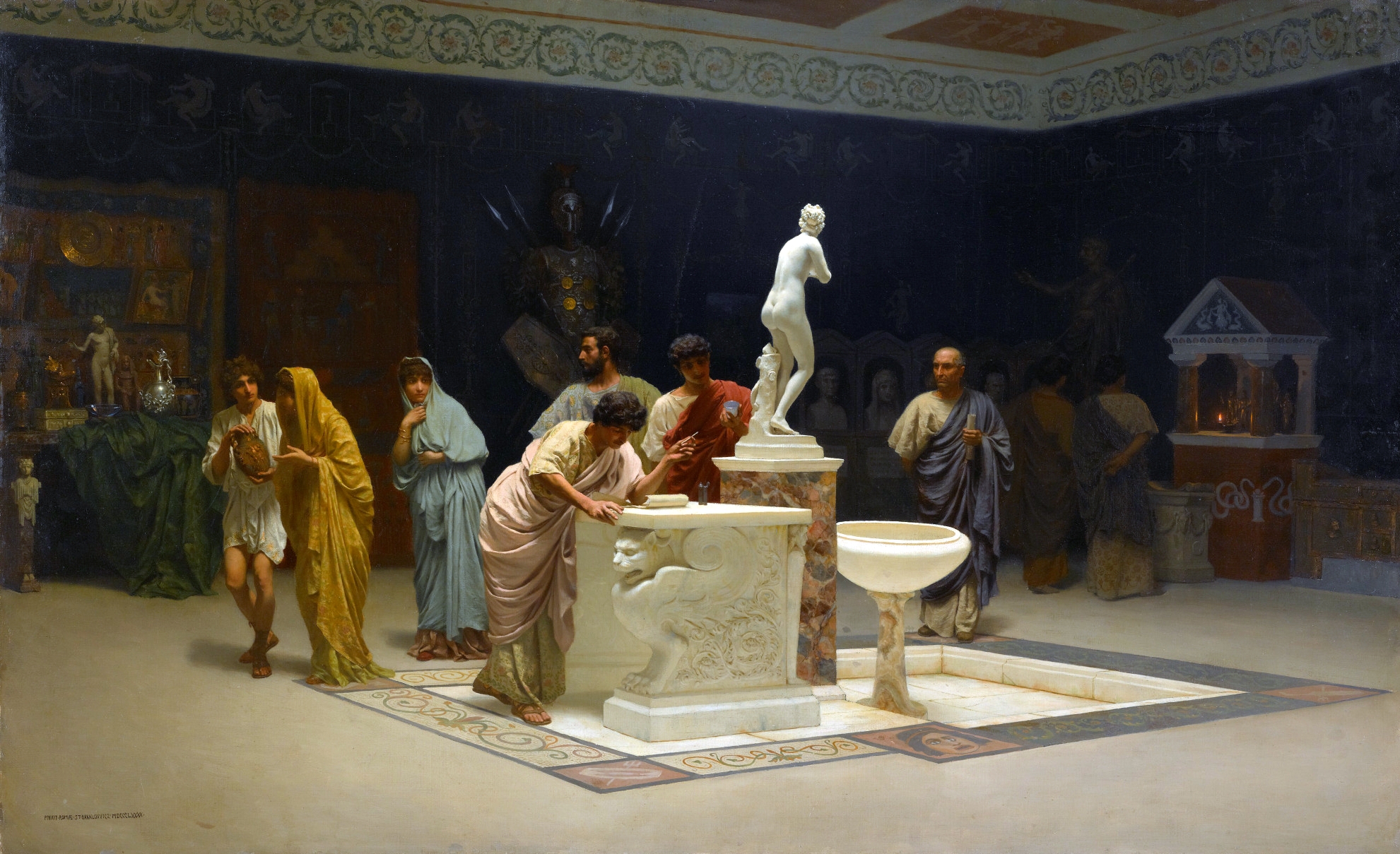
At Maecenas' reception room by Stepan Bakalovich (1890)


Williams also had a decidedly different take on Octavian's banishment of his daughter Julia as punishment for her licentiousness.  This has often been a sticking point with scholars who, like Gibbon, decry Octavian's hypocrisy.  Instead of the traditional approach to this incident, Williams portrayed their father-daughter relationship as one that was quite close even to the point that Augustus simply ignored the string of lovers his daughter entertained in her efforts to display her contempt for her husband, the future emperor Tiberius because Augustus despised Tiberius as well. 
Julia Livilla, daughter of Germanicus, like
Julia the Elder, daughter of Augustus, also
suffered exile to the island of Pandataria
after being accused by the emperor Claudius
of adultery with Seneca.  Photographed at
the Palazzo Massimo by Mary Harrsch.


But when Augustus' spies reported that Julia's latest lover, Jullus Antonius, son of Augustus' dead arch rival, Marcus Antonius and his third rebellious wife Fulvia, was plotting a coup and the emperor's assassination, Augustus had no alternative except to condemn her. 


This may have been simply dramatic license on Wiliams' part - after all it is a novel not a text book - but this coup may have been more fact than fancy.  When Julia and her lovers were tried for their breach of Augustus' morality laws, all of the lovers except Jullus were exiled.  Jullus, however, was condemned to death as a traitor.  Williams proposes that Julia, although apparently not aware of the particulars of the plot, would have been found guilty of treason too and also sentenced to death if Augustus' had not engineered her conviction on the violation of his morality laws.  Thus, Julia's subsequent exile actually was an effort by her father to save her life, not severely punish her for moral indiscretions.  The thing I find puzzling, however, is if her exile was meant only to preserve her life, why did Augustus keep up the pretense of punishment for the rest of his life, as he reportedly refused to ever see her or speak of her again.  Had Tiberius already gained so much power that he could have pushed aside the aging Augustus whenever he chose to and exacted his revenge against Julia despite her father's acclaim as father of his country?
If you enjoyed this post, never miss out on future posts by following me by email!


Wednesday, July 6, 2011

On Scipio's Villa


Scipio Africanus the ElderImage courtesy of  Wikipedia
Scipio Africanus the Elder
Today I was listening to one of Professor Steven Tuck's lectures in his series "Pompeii: Daily Life in an Ancient Roman City" and  I was intrigued to learn that Dr. Tuck ascribes the introduction of Roman villa architecture to none other than Scipio Africanus.  Not only did Scipio come back from conquering Carthage with a boatload
of money, but he subsequently ran afoul of other members of the senate, particularly Cato the Elder, so eventually chose self exile to free himself of the political bickering.

According to Seneca he cried “It is my wish,” said he, “not to infringe in the least upon our laws, or upon our customs, let all Roman citizens have equal rights. O my country, make the most of the good that I have done, but without me. I have been the cause of your freedom, and I shall also be its proof; I go into exile, if it is true that I have grown beyond what is to your advantage!”

So, Scipio took his hard earned wealth and moved to the seaside town of  Liternum.  There, he constructed a personal residence of significant proportions that would be emulated and embellished by Rome's later elite.


Two hundred years after Scipio's death, Seneca visited the villa and we are fortunate to have an extant copy of his observations.
Lucius Annaeus Seneca, sculpture by Puerta de ...Lucius Annaeus Seneca in Cordoba Spain.  Image courtesy of  Wikipedia


"I have inspected the house, which is constructed of hewn stone; the wall which encloses a forest; the towers also, buttressed out on both sides for the purpose of defending the house; the well, concealed among buildings and shrubbery, large enough to keep a whole army supplied; and the small bath, buried in darkness according to the old style, for our ancestors did not think that one could have a hot bath except in darkness. It was therefore a great pleasure to me to contrast Scipio’s ways with our own. Think, in this tiny recess the “terror of Carthage,” to whom Rome should offer thanks because she was not captured more than once, used to bathe a body wearied with work in the fields! For he was accustomed to keep himself busy and to cultivate the soil with his own hands, as the good old Romans were wont to do. Beneath this dingy roof he stood; and this floor, mean as it is, bore his weight." - Lucius Annaeus Seneca, On Scipio's Villa


I assume the forest (sometimes translated as "park") enclosed by the villa's walls represents the first vestiges of what would later become the peristyle garden.  Although the structure was probably palatial for the time period, Seneca, tutor to the emperor Nero in the 1st century CE and well acquainted with the lavish accommodations of the imperial court, is obviously appalled by the modest nature of Scipio's bathing facility.


"But who in these days could bear to bathe in such a fashion? We think ourselves poor and mean if our walls are not resplendent with large and costly mirrors; if our marbles from Alexandria are not set off by mosaics of Numidian stone, if their borders are not faced over on all sides with difficult patterns, arranged in many colors like paintings; if our vaulted ceilings are not buried in glass; if our swimming-pools are not lined with Thasian marble, once a rare and wonderful sight in any temple-pools into which we let down our bodies after they have been drained weak by abundant perspiration; and finally, if the water has not poured from silver spigots." - Lucius Annaeus Seneca, On Scipio's Villa


Seneca goes on to point out that Scipio probably only washed his soiled limbs on a daily basis and did not fully bathe but once a week since he toiled at honest work and had no need to rid himself of perfumed oils like later members of elite Roman society.  I found this interesting because I often think about how our own society has been influenced by the Romans and wonder if my parents view of weekly bathing back in the 1950s and 60s was ultimately a European adoption of a ritual handed down from conservative merchant-class Romans who also did not use perfumed oils excessively.


Seneca also makes much of the fact that Scipio bathed almost in the dark as his bathing chamber featured only "tiny chinks-you cannot call them windows-cut out of the stone wall in such a way as to admit light without weakening the fortifications..."  I think Seneca should have, instead, marveled at how much safer the Italian countryside was in his time as opposed to the early 2nd century CE.  After all, Scipio had just defeated Hannibal a few years before Scipio retired to Liternum and Hannibal had ravaged much of the surrounding Campanian countryside during the Second Punic War.  It's hardly surprising, then, that Scipio would have been careful to preserve the strength of his walls rather than carelessly focus on aesthetics.


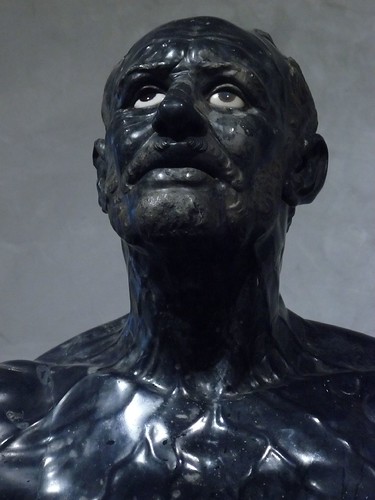
Old fisherman or Dying Seneca 2nd century
CE Roman copy of Hellenistic original.
Photographed at The Louvre by Mary Harrsch
Seneca also should have pondered Scipio's reputed mystic nature.  Perhaps Scipio found that bathing in a relatively dark chamber encouraged the visitations of prophetic dreams.  Most of what I had read about Scipio up until now described his military strategies and his political activities so I was not aware that some ancient sources, including Livy, reported that Scipio was prescient.  Polybius, on the other hand, attributed Scipio's successes to good planning, rational thinking and intelligence, which he perceived as a better indication of divine favor than prophetic dreams.

"His [Livy's] account is more literary than historical, more dramatic and careless. He was not very critical of sources. In his effort to promote Roman patriotism he reduces Roman strength and increases that of the enemy. As for his attitude toward Scipio, he did not assume the mystical religion bit was purely 'a cloak and tool'..."
"The closest we can come to Scipio is the writing of Polybius, the eminent Greek general and historian, who composed his history of Rome some 60 years after Scipio's active career...He was, however, a Stoic. This philosophy insisted on the rationality of the universe and the existence of natural causes for historical events. This philosophy certainly helped him in comparison with the more mystic ideas held by others, but in Scipio's case it caused Polybius trouble."
"Polybius' sources besides the Scipio family and Laelius, were Greeks, on both the Roman and Carthaginian side. These Greeks followed the school of thought of Alexander the Great - that of a mystic leader. They were perhaps the original "image makers". They liked to surround the idea of the leader with a divine glow. If they could not explain something, they said it was due to divine intervention. Hence they developed the Legend of Scipio. Polybius was anxious to refute this legend. [However,] He admired Scipio as his Stoic HERO, so made him a supremely rational genius. The result was a kind of caricature, a cunning individual who purposely plays on the superstition of his followers and uses religion for his own ends. Polybius makes it seem Scipio spread these ideas of his divinity himself, while disbelieving them." - John Sloan, Scipio Africanus, Publius Cornelius, (The Elder) (237 - 183 BC), son of Publius Cornelius Scipio


So called Patrizio Torlonia. Escultura de Marc...Image courtesy of Wikipedia
A rather sour-faced Cato the Elder
Sloan also mentions that some scholars point to Scipio's Etruscan origins and the widespread acknowledgment of Etruscan mystical gifts as the source of belief in his prophecy.  Whatever the reason behind this legendary aspect of his nature, I find it quite intriguing.


I noticed another interesting tidbit about Scipio in my research, too.  He supposedly wore his toga in the Greek fashion, resembling the dress of Greek poets and artists.  He was well known to be an avid Graekophile but this overt demonstration of his embrace of Greek culture did not endear him to many of the staunch Roman traditionalists, particularly Cato the Elder.  Yet, Scipio also introduced the practice of being clean shaven, perhaps emulating images of Alexander the Great, but not typical of Greek philosophers and poets of the time.  Definitely, a man of unusual contradictions.  Perhaps what frustrated Cato the Elder so much was that he couldn't pigeon-hole Scipio into any particular category making it difficult for Cato to mount an all out political attack on the man.


Cato did ultimately succeed in driving him away, though.  Apparently, Scipio took his resulting bitterness to his grave, reportedly ordering a tomb inscription that read:  "Ingrata patria, ne ossa quidem habebis"—ungrateful fatherland, you will not even have my bones!" (although we don't really know where Scipio was ultimately buried and have never recovered any funerary monument with these words.)  


I was curious whether any effort had been made to find Scipio's villa and learned that an initial excavation of Liternum was begun in 1923 and continued until 1937 but apparently no evidence of the villa was unearthed.  A UNESCO volunteer excavation was launched in the 1970s but it, too, did not reveal the site of Scipio's last days. Then in 1988 a more extensive excavation was launched.


"The remains as they stand today date mostly from the the early imperial period. The standing monuments consist of a temple, a basilica and a small theatre, positioned on the west side of the forum with a large open area in front. These are contained within a surrounding wall onto which are abutted a number of small rectangular buildings that are thought to be shops.
"The temple is in a typical Roman style set on a high podium of locally quarried tufa, with the emphasis of approach from the front of the building, the facade of which would have dominated the space in front of the temple. One complete and one partial column are all that remain of the temple facade.." 
"To the left of the temple lie the scant remains of the basilica. The brickwork in opus reticulatum suggests a date for the building between the second half of the first century BC and the first century AD, although the existing structure would almost certainly have been built to replace an earlier building on the site. The remains of the basilica today are unimpressive, but the vestiges of the marble that originally decorated the building, visible in one or two places where modern 'quarriers' haven't yet found it, give some indication of a rather grander past for the building."
"The other main structure on the site, to the right of the temple, is a small theatre of the imperial period. The remains show that the theatre follows a typical Roman plan. After removal of dense vegetation the scaena or stage building, and the cavea or seating area where clearly visible. The upper part of the cavea had collapsed, creating the impression that the theatre was much smaller than it actually had been. Although very small, the theatre would have been quite adequate for a town of this size. It might be surmised that the population had grown from the three hundred families of the original foundation, but probably not by much." - Jim Devine, University of Glasgow, Liternum: A Campanian Coastal Town


So, it seems that Scipio remains as elusive as ever.  As for Scipio being credited with the development of one of the first villas, though, it seems the jury is still out on that one too.  Helsinki scholar Eeva Maria Viitanen points out that the "Auditorium Villa", excavated in the 1990s, indicates there was a luxurious residential complex constructed as early as the 6th century BCE.


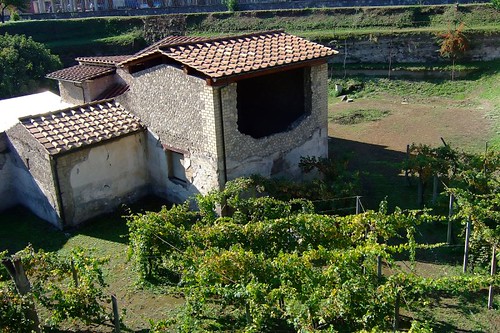
The Villae Regina, a villae rusticae unearthed at Boscoreale near Naples, Italy
was one of 30 small holdings situated  on the lower slopes of Vesuvius and
 on the adjacent plain of Sarno.  These 
small- and medium-sized 
properties
 were family-run or employed
 a few slaves.  Photographed 
by Mary Harrsch.
"The building has a very long history, starting from the Archaic period, and its earlier phases are also fairly well perserved.  What is special about this site is the rebuilding of the early small farm as a large and luxurious complex with what are probably separate living quarter and productive parts towards the end of the 6th century BCE.  In comparison with other sites of the period, the built area is enormous and it remains very large among its peers until the 1st century BCE, when the villa becomes quite normal in size among the many other large country houses.  It has been suggested that the Auditorium Villa was in fact a country residence for the head of a Roman elite family, who thus asserted his right over the landscape inhabited by members of his clan.  Such residences would have been relatively rare which is why they probably have not been found before.  The other farms were small in size and there would not have been intermediary forms between the very large and the small.  The possible model for these large residences might have been the slightly earlier Etruscan elite palaces, such as Murlo.  It is also claimed that there were no Catonian small or medium-sized villae rusticae in the 3rd-2nd centuries BCE.  The development into the 1st century BCE villa would have been faster and the changes would have happened closer to this boom period than suggested before.  The economic explanation echoes the common model of war booty invested in land, as external funds were needed to establish the new large villas and that the owners would have represented a much more heterogeneous group of persons than before." - Eeva Maria Viitanen, Locus Bonus: The Relationship of the Roman Villa to its Environment in the Vicinity of Rome


But whether Scipio inspired the widespread development of Roman villa architecture or not, he certainly was a passionate and gifted individual that I plan to study further.  I hope that by giving up those "triumphs with their withering laurels" he found those "lasting rewards that keep forever fresh and green" Cicero described so eloquently in Scipio's Dream.


Enhanced by Zemanta
If you enjoyed this post, never miss out on future posts by following me by email!


Thursday, July 23, 2009

Caesar's Fables and the Price of Fame


I was working on my "virtual" Julius Caesar today, a natural language conversational agent depicting a resurrected Julius Caesar, when I happened upon this fascinating excerpt from Maria Wyke's book, "Caesar: A Life in Western Culture" about all of the fables that have grown up around the man and the myth that was Julius Caesar. I had been specifically searching for references to his unique horse "Toes".

Wyke observes:

Every conqueror needs a distinguished horse which only he can ride. A number of classical sources note that Julius Caesar possessed such a horse, born on his own lands, whose front hooves resembled feet since they were divided in such a way that they looked like toes. This unusual condition was interpreted by a soothsayer as an omen that the master of such a horse would one day rule the world. Naturally, the horse would endure no other rider save Caesar. This observation in Caesar’s ancient biography seems to recall the characteristics of Bucephalus, the wild horse tamed by Alexander, which provided that hero too with an oracle predicting world empire. In medieval romance, Alexander’s horse becomes a horned creature so wild that it eats men. In a later medieval epic on Julius Caesar, in addition to unmistakable feet, his horse gains a fabulous horn on its head with which it can topple other riders and their mounts. A number of depictions survive in which this mythic horse (rather than its owner) is in sharp focus. A colourful earthenware dish of the early sixteenth century, which captures a moment in the triumph of Julius Caesar, appears to jettison the medieval horn in favour of a more rational spike attached to a harness, but all four of the horse’s human feet remain clearly visible as it is ridden on parade by a youth, who carries a globetipped branch to signify that their master is ruler of the whole world . - Caesar: A Life in Western Culture

I found her discussion of Caesar as one of the medieval "Nine Worthies" quite interesting as well:

The mature Caesar was also included in the medieval canon of the Western world’s greatest military heroes. This collection of champions, or Nine Worthies (‘neuf preux’), was first identified, categorized, and made popular in the early fourteenth century in a poem composed by a French jongleur or itinerant ministrel. Joining a neatly composed arrangement of three Christians, three Hebrews and two other pagans (Hector and Alexander the Great), Julius Caesar along with the rest was made to embody chivalric goodness, wisdom, prowess and valour. Perfect warriors, the Nine Worthies conferred glory on their nations and provided patterns of both military virtue and moral conduct for imitation. They frequently appeared on frescoes, tapestries, enamelled cups and playing cards owned by medieval princes and noblemen. In a similar way to a collection of saints, their role was to exhort a supposedly degenerate present to live up to medieval ideals projected back into the past. In this line-up, Julius Caesar was conventionally distinguished by his imperial crown and the crest of a two-headed eagle emblazoned on his medieval armour. In a fourteenth-century tapestry of the Nine Worthies commissioned by the Duke of Berry (and now surviving only in parts), a majestic and heavily bearded Caesar sits enthroned within a fantastic Gothic niche. He grasps a broad, unsheathed sword and is surrounded by his courtiers (mainly musicians, but also a soldier and, directly above him, his lady). His heraldic symbol of the double-headed imperial eagle is woven in sable on gold." Caesar: A Life in Western Culture

The idea of a heavily-bearded Caesar seemed pretty far-fetched since Caesar was so meticulous about his appearance he frequently had his body plucked to remove any unsightly hair (except on the top of his head) and all ancient sculptures of him show him clean shaven like most military men of the late Republican era.

[Image: Imperial Statue from the Antonine Period with modern head of Julius Caesar, Museo Archaeologico di Napoli. Photo by Mary Harrsch]

Wyke also said medieval chroniclers further elaborated on the evil portents preceding Caesar's assassination. In addition to the ancient references to horses Caesar had dedicated to the gods that would no longer graze but wept abundantly; a bull Caesar was sacrificing turning out to have no heart and a ‘king’ bird torn to pieces by other birds in Rome’s senate-hall, a 15th century poem related:

"... on that dark night, at the sixth hour, when the betrayal was arranged, terrible voices were heard clamouring in the sky, the earth quaked as if it were releasing a great sigh, fires with bloody tails circled through the air in battle, a lamb cried out ‘Slaughter! Slaughter!’, oxen pointed out to their ploughmen the pointlessness of carrying on …"

These strange manifestations of fame that Caesar openly sought seem to point to the fulfillment of an eerie prophecy by Cicero during his own on-again, off-again relationship with Caesar.

"Posterity will be staggered to hear and read of the military commands you have held and the provinces you have ruled … battles without number, fabulous victories, monuments and shows and Triumphs. And yet unless you now restore this city of ours to stability by measures of reorganization and lawgiving, your renown, however far and wide it may roam, will never be able to find a settled dwelling-place or firm abode. For among men still unborn, as among ourselves, there will rage sharp disagreements. Some will glorify your exploits to the skies. But others, I suggest, may find something lacking, and something vital at that. (Cicero, pro Marcello 28û9. Trans. M. Grant, 1969)"

[Image: Marcus Tullius Cicero. 1st century BCE. Capitoline Museum, Rome, Italy. Photograph by Mary Harrsch]

Yet, the two-edged nature of such fame, however, has served men's purposes through the centuries.

"Caesar has been deployed to legitimate or undermine the authority of kings, to justify or denounce the coups of generals, to launch or obstruct revolutions, to demonstrate incisive literary style and perfect grammar, to teach military strategy and tactics or the workings of fortune and destiny, to display luxury, to play out sexual excess, to stimulate expenditure and consumption. Moreover, the history of Caesar’s reception is not only a matter of re-presenting him in ways that speak to the present (in paintings, plays, novels, operas, films and computer games, as well as in political speeches and historical treatises); it is also often a matter of adopting aspects of his life in someone else’s, or replicating his murder for political reasons—a matter of becoming or removing a new Caesar. - Caesar: A Life in Western Culture

Like Achilles who accepted death to obtain enduring fame, I think Caesar would have found it a worthy trade off.
If you enjoyed this post, never miss out on future posts by following me by email!