Showing posts with label Virgil. Show all posts

Tuesday, June 8, 2021

Triton and the fate of Misenus

This morning while browsing artifacts in the collections of the Getty Villa, I came across this exquisite gilded silver sculpture of a Triton forming the handle of an oinochoe.  As I described in a post a couple of years ago, the original sea god, Triton, was the son of Poseidon and Amphitrite according to Hesiod's Theogony. Triton is usually represented as a merman, with the upper body of a human and the tailed lower body of a fish. At some time during the Greek and Roman era, Tritons became a generic term for mermen in art and literature. A female version (tritoness) was eventually introduced as well.

Triton was said to dwell with his parents in  a golden palace claimed to be located at Aegae on the island of Euboea in a passage from book 5 of Homer's Iliad. It describes how  Poseidon "lashed his long-maned horses and drove to Aegae, where he had his famous palace" after having destroyed Odysseus' raft with a storm. Later in Book 13 of the Iliad, Poseidon "took three strides, and with the fourth he reached his goal—Aegae, where is his glittering golden palace, imperishable, in the depths of the sea."

Only in later times was Triton associated with possessing a conch shell, which he blew like a trumpet to calm or raise the waves. He was "trumpeter and bugler" to Oceanus and Poseidon. Its sound was so cacophonous that when loudly blown, it was said to put the giants to flight, who imagined it to be the roar of a dark wild beast.

in Virgil's epic poem the Aeneid, Misenus, a brother-in-arms of Hector and, after Hector's death, Aeneas' trumpeter, challenged the gods to a musical contest on a conch shell. He, like Marsyas, was punished for his hubris when he was drowned by Triton.  Aeneas was told by the Cumaean Sibyl at that time that Misenus's body had to be buried before he could enter the Underworld and detailed the necessary funeral rites required that were later adopted by the Romans. Cape Misenum, the headland that marks the northwestern limit of the Gulf of Naples as well as the Bay of Pozzuoli in southern Italy and supposedly named for Misenus,  was important to the Romans since it was a natural shelter for passage into the inner harbor of Portus Julius, the home port for the Roman western imperial fleet.


Image: Gilded silver oinochoe handle depicting Triton from Macedonia or Illyria, 100-1 BCE, at the Getty Villa in Gallery 111, Pacific Palisades, California. Now detached from the vessel of which it was once part, Triton’s scaly lower body serves as the functional part of the handle, and the acanthus leaves from which the torso rises would have hidden the join at the rim. Triton's torso would have projected as a decorative element above the mouth, and gilding elaborates much of its surface. The figure probably held a trident in its left hand, a frequent attribute of sea beings. Such an elaborate pouring vessel would have been part of an ornate set of serving and drinking vessels used at banquets or symposia.

If you enjoyed this post, never miss out on future posts by following me by email!


Friday, February 19, 2021

Adrastus and the Seven against Thebes

Adrastus was a king of Argos, and leader of the Seven against Thebes. He was said to be the founder of the Nemean Games, had hero cults at Sicyon, Megara, and Colonus, and was depicted in works of art from as early as the 6th century BCE.  Adrastus is mentioned as early as Homer's Iliad,  figures prominently in the poetry of Pindar, and is a main character in Euripides' The Suppliants.

From the lyric poets Bacchylides and Pindar we first hear that Adrastus was the son of Talaus, who according to Apollonius of Rhodes was an Argonaut.  Adrastus was the owner of the fabulously fast horse Arion, who was the offspring of Poseidon and Demeter when they mated in horse form. Adrastus was given Arion by Heracles, and the horse saved Adrastus' life during the war of the Seven against Thebes, when all the other champions of the expedition were killed.

The war of the Seven against Thebes resulted from a quarrel between Oedipus' sons Polynices and Eteocles over the kingship of Thebes, which left Eteocles on the throne, and Polynices in exile. One night, Polynices arrived at Adrastus' palace seeking shelter. He found a place to sleep, but soon after Tydeus, the exiled son of the Calydonian king Oeneus, also arrived seeking shelter, and the two began to fight over the same space. When Adrastus discovered Polynices and Tydeus fighting like wild beasts (or in later accounts when he saw that Polynices wore the hide of a lion and that Tydeus wore the hide of a boar, or that they had those animals on their shields), he remembered an oracle of Apollo that said he should marry his daughters to a lion and a boar. So Adrastus gave his daughters, Argia to Polynices, and Deipyle to Tydeus, and promised to restore them to their kingdoms, beginning with Polynices.

Adrastus proceeded to assemble a large Argive army to attack Thebes, appointing seven champions to be its leaders. These became known as the Seven against Thebes. As foretold by a seer, the expedition ended in disaster at Thebes. All of the champions perished, except for Adrastus who was saved by the speed of his divine horse Arion. Creon, who with the death of Eteocles became the new ruler of Thebes, forbade the burial of the expeditions' dead. Athenian tradition held that Theseus, the king and founder-hero of Athens, assisted Adrastus in recovering the bodies of his fallen comrades.

Ten years after the failed expedition against Thebes, to avenge their father's deaths, the sons of the fallen Seven, who were called the Epigoni ("Afterborn"), marched again on Thebes. Adrastus accompanied them on this second Theban expedition, called the war of the Epigoni. This time (according to Pindar) the omens foretold success for the expedition, but death for Adrastus' son Aegialeus. According to Hyginus, as Adrastus was the only one of the Seven to survive the first expedition, his son Aegialeus was the only one of the Epigoni to die in the second. According to Pausanias, the Megarians said that Adrastus, leading the Argive army home after taking Thebes, died at Megara of old age and grief for the death of his son.

Of Adrastus, Pindar writes "I shall exalt the hero with fame-bringing honors."  He goes on to describe the ill-fated expedition:

"...they led an army of men to seven-gated Thebes, on a journey with no favorable omens, and Cronus’ son brandished his lightning and urged them not to set out, recklessly from home, but to forgo the expedition. But after all, the host was eager to march, with bronze weapons and cavalry gear, into obvious disaster, and on the banks of the Ismenus, they laid down their sweet homecoming and fed the white-flowering smoke with their bodies, for seven pyres feasted on the men’s young limbs."

Adrastus appears in vase paintings as early as the late 6th century BCE. Pausanias reports seeing Adrastus depicted on the Amyclae Throne of Apollo (6th century BCE) and a monument at Delphi dating to the 450s BCE.  Adrastus was found in a scene on a shield strap from Olympia as well.  The hero makes the leap to Etruria and, along with four of the seven champions, appears on an Etruscan gem dated to the 5th century BCE.  Centuries later, Adrastus is described by Virgil in the Aeneid where Aeneas encounters the pale shade of Adrastus in the underworld. Late 4th or early 5th century CE Roman grammarian, Maurus Servius Honoratus, in his commentaries on the works of Virgil, explains the pallor of Adrastus as a result of seeing the deaths of the seven at Thebes.  Thereafter, the phrase "pallor of Adrastus" became a proverbial reference. 

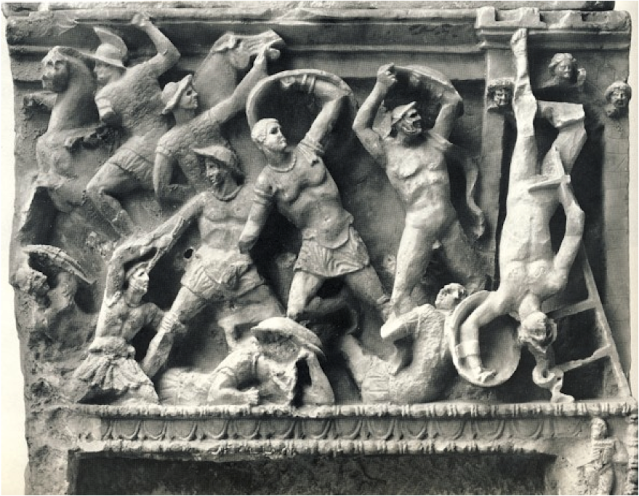
Terracotta pediment from the temple of Talamone (Grosseto), the first closed pediment in Etruria, showing the fate of the Seven against Thebes, 2nd century BCE, at the National Archaeological Museum in Florence, Italy courtesy of Wikimedia Commons contributor Nicolò Musmeci

Terracotta pediment from the temple of Talamone (Grosseto), the first closed pediment in Etruria, showing the fate of the Seven against Thebes, 2nd century BCE, at the National Archaeological Museum in Florence, Italy courtesy of Wikimedia Commons contributor Sailko

High terracotta Etruscan relief depicting scenes from the myth of the Seven Against Thebes. It decorated the back of the temple of the sanctuary at Pyrgi, 470-460 BCE, National Etruscan Museum of Villa Giulia, Rome, courtesy of Wikimedia Commons contributor Carole Raddato.

Antigone with Polynices' Body by Sebastien Norblin, 1825 CE, Paris, Ecole Nationale Supérieure des Beaux-Art courtesy of Wikimedia Commons.

This image of a young warrior cutting his hair before battle may reflect a scene in Seven against Thebes, a tragedy by Aeschylus. The seven heroes knew that only one of them would survive battle. Each cut a lock of his hair and tied it to the chariot that would carry home the survivor. This terracotta lekythos (oil flask) was probably made as a tomb gift c. 470-460 BCE. Now in the collections of the Metropolitan Museum of Art in New York.

The Oath of the Seven Chiefs against Thebes, 1800, by Anne-Louis Girodet de Roucy-Trioson, chalk on paper, at the Cleveland Art Museum.

Terracotta amphoriskos (flask) depicting Adrastos in his chariot, Attic, ca. 420 B.C.E. at the Metropolitan Museum of Art in New York.

Etruscan Seven Against Thebes-themed Ash Urn from Volterra, early 1st century BCE. (PD)


If you enjoyed this post, never miss out on future posts by following me by email!


Saturday, May 16, 2020

Owls: Symbols of Wisdom or Harbingers of Death

Those of us who study the ancient world are familiar with Athena's owl and its association with wisdom and vigilance but even in the ancient world owls were not always viewed in such a positive light.  Pliny the Elder tells us Rome had to undergo a lustration, a purification of the entire city normally performed at the conclusion of the taking of the census every five years, because an owl found its way into the Capitolia. Pliny describes the owl as a funereal bird, a monster of the night and the very abomination of human kind.  Virgil describes an owl's death-howl as a precursor to Dido's death and Ovid speaks of the bird's presence as an evil omen.

Surprisingly, the same viewpoint was held by the Aztecs and Maya who considered the owl a symbol of death and destruction.  The Aztec god of death, Mictlantecuhtli, was often depicted with owls.  The Popol Vuh, a Mayan religious text, describes owls as messengers of Xibalba (the Mayan "Place of Fright").  Later tribes of Native Americans also believed owls were messengers and represented supernatural forces.  Apache and Seminole people associated owls with the spirits of the dead and the bony circles around an owl's eyes are said to comprise the fingernails of apparitional humans.  The Hopi associated owls with sorcery and the Ojibwe used an owl as a symbol for both evil and death. Pueblo people associated owls with Skeleton Man, the god of death and spirit of fertility. Other tribes, though, had a less dire viewpoint.  Pawnee tribes viewed owls as the symbol of protection from any danger within their realms. Yakama tribes use an owl as a powerful totem, often to guide where and how forests and natural resources are useful with management.

Owl in a Roman mosaic in the Archaelogical Museum of El Jem, Tunisia courtesy of Wikimedia Commons contributor Effi Schweizer

Owl with the inscription from an Attic black-figure amphora, ca 500 BCE at the Staatliche Antikensammlungen in Munich courtesy of Wikimedia Commons contributor Bibi Saint-Pol

Owl from the Athenian Acropolis 5th century BCE at the Acropolis Museum courtesy of Wikimedia Commons contributor Wpopp.

Armed owl Attic red-figure Anthesteria oinochoe, ca 410–390 BCE at the Louvre courtesy of Wikimedia Commons contributor Marie-Lan Nguyen

Owl-shaped protocorinthian aryballos at the Staatliche Antikensammlungen in Munich courtesy of Wikimedia Commons contributor Bibi Saint-Pol

Large Native American owl shaped mortar from the Columbia Plateau region photographed at the Maryhill Museum of Art in Goldendale, Washington.

Native American Stone Owl Effigies from the Columbia River region photographed at the Maryhill Museum of Art, Goldendale, Washington.

Silver Vessel in the form of an owl found in the silver hoard of Hacienda Mocollope in the Chicama Valley of Peru 14th-15th century CE photographed at the Metropolitan Museum of Art.

Painting of an owl in the Vienna Dioscoride manuscript dated to 512 CE courtesy of Wikimedia Commons.

Owl-shaped Zun wine vessel Shang Dynasty, 1600 - 1046 BCE courtesy of the Minneapolis Institute of Art
If you enjoyed this post, never miss out on future posts by following me by email!


Thursday, August 19, 2010

Turkish documentary to retrace sea voyage of Aeneas

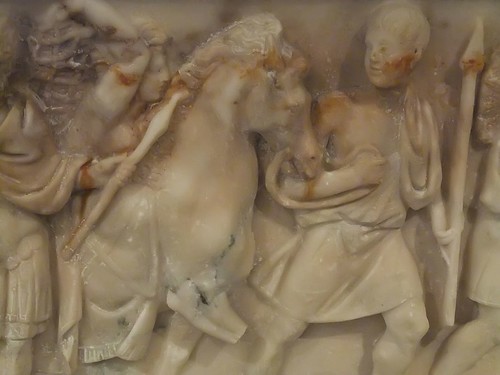
Roman Sarcophagus Depicting Scenes from the Aeneid
2nd century CE from the Giustiniana area along the
Via Cassia Rome.  Photographed at the National Museum
in Rome, Italy by Mary Harrsch.
In an effort to promote the parallel study of the post- Trojan period in Turkey and Italy, Turkish archaeologists are planning to produce a documentary film about the sea journey of Aeneas  from Antandrus in Turkey to the Latium region of Italy.

“A ship, which we’ll name ‘Tempest,’ will set off from Altınoluk and follow the route that was taken by Aeneas’ band in 700 B.C. using sails and oars only,” said Excavation Chairman GĂĽrcan Polat in detailing the plans for the journey from the northwestern Turkish province to Italy.

The ship to be used in re-creating Aeneas’ journey will be built in the style of the post-Trojan period, the excavation coordinator said.

“Aeneas’ experiences in every place he passed will be dramatically re-created and documented. In this way, we will have a very significant historical documentary,” said Polat, detailing plans for a documentary film to accompany the seafarers. “I hope it will also contribute to the promotion of both Antandrus and Turkey abroad.” - Turkey Daily News & Economic Review
Homer tells us that Antandrus was among the 11 cities and 12 islands conquered by Achilles during the Trojan War.


Aristotle states that Antandrus was occupied by the Cimmerians about 700 BCE and was referred to as Kimmeris for a hundred years during their occupation.


Antandrus was later colonized by the Greeks on the north side of the Adramyttian Gulf in the Troad region of Anatolia, near the modern village of Avcilar in Turkey in the 5th century BCE but scholars disagree on the founders.

"Strabo, quoting the poet Alcaeus, mentions the Leleges (Geography, 13.1.51), Herodotus believed the first settlers were Pelasgians (Histories, 7.42), and Thucydides mentions the Aeolians (History of the Peloponnesian War, 8.108)." - Livius.org

After participating in the Ionian Revolt, Antandrus later joined the Delian League.

During the Peloponnesian War, exiles from Lesbos captured the city, used it as base to recapture Mytilene, but were expelled by the Athenians, who garrisoned the place (Diodorus, World History, 12.72.2). - Livius.org

During the Corinthian War, it was used as a strategic naval base. 

The economy of Antandrus was based on the sale of timber from Ida Mountains.

In Search of a Homeland: The Story of the Aeneid   Vergil's Aeneid: Hero War Humanity   Art of the Aeneid (Bristol Classical Paperbacks.)   In Search of the Trojan War, Updated edition   Troy and its Remains: A Narrative of Researches and Discoveries Made on the Site of Ilium, and in the Trojan Plain (Cambridge Library Collection - Archaeology)   The Modern Scholar Archaeology and the Iliad: The Trojan War in Homer and History   The Trojan War: Literature and Legends from the Bronze Age to the Present
If you enjoyed this post, never miss out on future posts by following me by email!