Showing posts with label plate. Show all posts

Sunday, May 2, 2021

Hermeticism and the debate between Myth and Science

Two seated philosophers, labeled Ptolemy and Hermes, engage in a spirited discussion on this fragmentary plate. A woman stands behind each man, gesturing and partaking in the exchange. The woman on the left is identified as Skepsis. Above the two seated men, an unidentified enthroned man is partially preserved. The scene on this plate has been interpreted as an allegory of the debate between Myth and Science: Ptolemy, the founder of the Alexandrian school of scientific thought, debating Hermes Trismegistos, a deity supporting the side of myth. - J. Paul Getty Museum

Hermes Trismegistus, "Hermes the Thrice-Greatest" or Mercurius ter Maximus in Latin, is a legendary Hellenistic figure that originated as a syncretic combination of the Greek god of interpretive communication, Hermes, and the Egyptian god of wisdom, Thoth. He is the purported author of the Hermetica, a widely diverse series of ancient and medieval texts that lay the basis of various philosophical systems known as Hermeticism. During the Middle Ages and the Renaissance the Hermetica enjoyed great prestige and were popular among alchemists. Hermes was also strongly associated with astrology, by scholars including the influential Islamic astrologer Abu Ma'shar (787–886). The "hermetic tradition" consequently refers to alchemy, magic, astrology, and related subjects. The texts are usually divided into two categories: the philosophical and the technical hermetica. The former deals mainly with philosophy, and the latter with practical magic, potions, and alchemy, including the procedure to create the famed Philosopher's Stone that was capable of turning base metals into gold and theoretically could be used to achieve immortality.


Image: Silver plate possibly depicting the debate between Myth and Science, Byzantine from the eastern Mediterranean, 500-600 CE, now in the collections of the J. Paul Getty Museum.


If you enjoyed this post, never miss out on future posts by following me by email!


Sunday, February 7, 2021

Sasanian royal gifts of silver

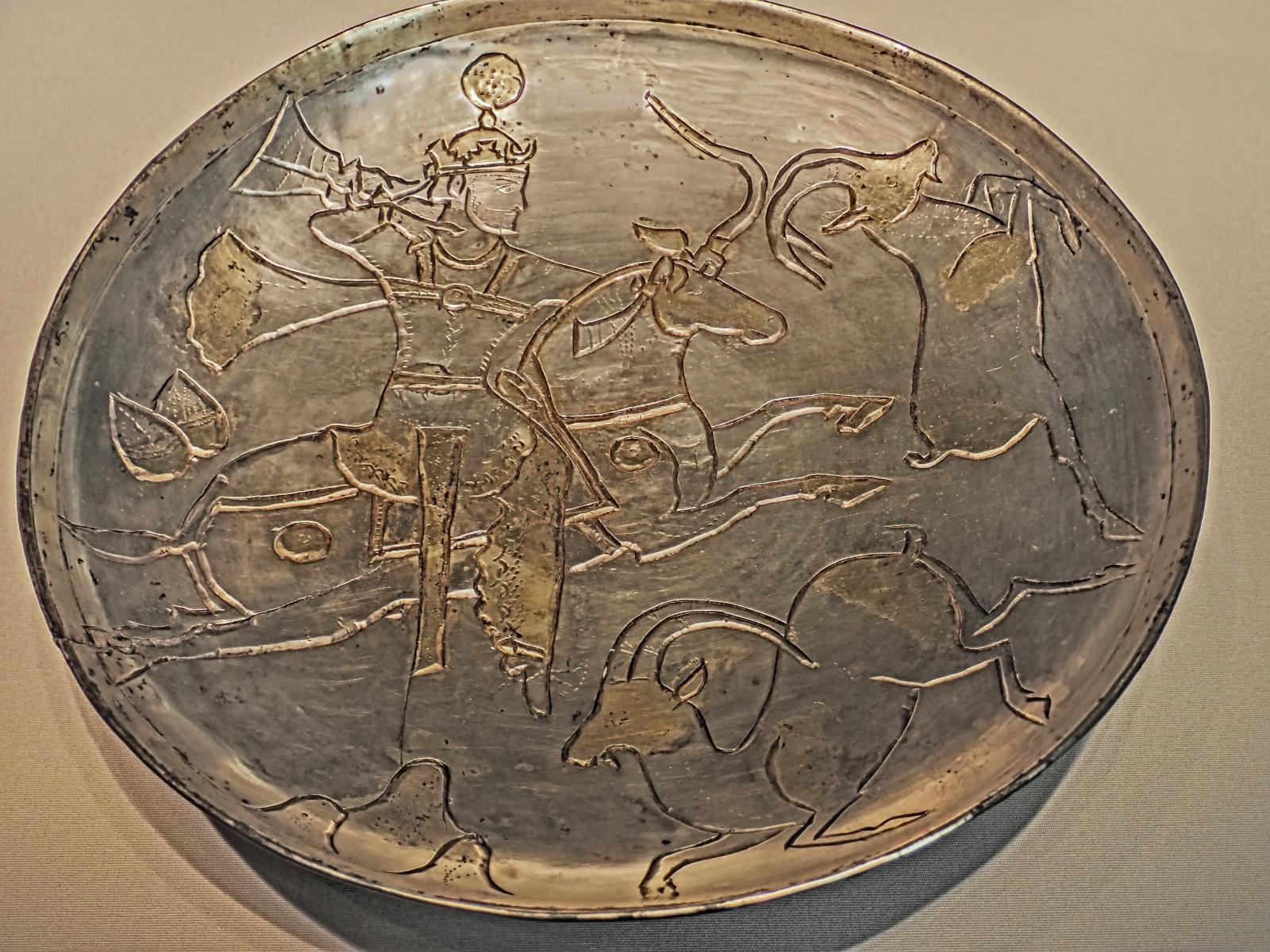
Sasanian silver plates were usually hammered into shape and then decorated using a variety of complex techniques.  Gilding was often used to highlight the hunter, usually the king, and sometimes extra pieces of metal were added to create high relief.

The king as hunter became a standard image on silver plates during the reign of Shapur II (r. 310–379 CE). The motif symbolizes the prowess of Sasanian rulers, and these royal plates were often sent as gifts to neighboring and vassal courts.  Some plates included inscriptions with the king's name and the plate's weight.  With other plates, art historians must attempt to identify the king by his distinctive apparel or shape of the crown he wears.  Each Sasanian king wore a different personal crown, which became more and more elaborate during the four centuries of the dynasty. Fortunately, the different crowns have been identified from coins or sometimes compared with existing rock reliefs with inscriptions such as those at Ṭāq-e Bostān or Naqš-e Rostam, Iran.

"In a few cases identification by crown can be reinforced by the presence of contemporary inscriptions. The best instance of this – and a very important example - is the Investiture of Ardašir I at Naqš-e Rostam. This magnificent relief shows two mounted horsemen, one handing the ribboned diadem or symbol of kingship to the other, and both with defeated enemies lying dead beside them. The left hand figure is wearing the skull-cap surmounted by korymbos, the final version of his personal crown developed by Ardašir (224-241 CE), seen on both his gold and silver coins. The figure on the right wears the mural crown, his hair arranged in a top-knot as well as falling in luxuriant curls to his shoulders." - iranicaonline.org 


King Hunting Plate, Sasanian period 4th-5th century CE silver and gilt courtesy of Wikimedia Commons contributor Daderot

Closeup of a Plate depicting a boar hunt Persia (Iran) Sasanian Period 4th century CE Silver and Gilt that I photographed at the Smithsonian's Sackler Gallery of Asian Art in Washington D.C.

Plate depicting a boar hunt Persia (Iran) Sasanian Period 4th century CE Silver and Gilt that I photographed at the Smithsonian's Sackler Gallery of Asian Art in Washington D.C.

Silver and gilt plate depicting winged horses Persian Sasanian Period 7th century CE that I photographed at the Smithsonian's Sackler Gallery of Asian Art in Washington D.C.

Sasanian Silver and Gilt Plate depicting a royal hunt Persia 7th century CE that I photographed at the Smithsonian's Sackler Gallery of Asian Art in Washington D.C.

Sasanian Silver plate with Shapur killing a deer, 4th century CE courtesy of Wikimedia Commons contributor Sailko.

Hunting scene depicting King Chosroes II. 7th century CE Sassanid, Cabinet des Medailles, Paris courtesy of Wikimedia Commons

The scene on this example is striking: the king is depicted standing and slaying a rearing stag, whose protruding tongue indicates that he is either dying or already dead. The king is identifiable as Yazdgard I (r. 399-420) due to his crown, although it is topped with a striated globe rather than the cloth-covered one with which he is normally represented. His beaded skirt resembles those shown on the rock reliefs of Shapur II (r. 310-379), Shapur III (r. 383-388) and Ardashir II (r. 379-383) at Taq-i Bustan, Iran. The crescent-tipped spear with a counterweight in the form of a human fist is unique amongst weapons represented on Sasanian silver plates. Image courtesy of the Metropolitan Museum of Art in New York.

Sivler Plate of Peroz I hunting argali, Sasanian, courtesy of the Hermitage Museum and Wikimedia Commons

King Hunting Plate, 303-309 CE, Sasanian, Iran, silver and gilt courtesy of the Cleveland Museum of Art


Hunting with a bowl Sasanian Great King; Iran; 7 Century, Museum of Islamic Art in Berlin (Pergamon Museum) courtesy of Wikimedia Commons contributor Anagoria

Sasanian Silver and Gilt Plate portraying a royal ibex hunt Persia 7th century CE that I photographed at the Smithsonian's Sackler Gallery of Asian Art in Washington D.C.


If you enjoyed this post, never miss out on future posts by following me by email!


Saturday, May 30, 2020

Heraclius: The David of the Eastern Roman Empire?

The year the Roman emperor Heraclius came to power, the empire was threatened on multiple frontiers. Heraclius immediately took charge of the Byzantine–Sasanian War of 602–628. The first battles of the campaign ended in defeat for the Byzantines. The Persian army fought their way to the Bosphorus but Constantinople was protected by impenetrable walls and a strong navy, and Heraclius was able to avoid total defeat. Soon after, he initiated reforms to rebuild and strengthen the military. Heraclius drove the Persians out of Asia Minor and pushed deep into their territory, defeating them decisively in 627 at the Battle of Nineveh. The Persian king Khosrow II was overthrown and executed by his son Kavad II, who soon sued for a peace treaty, agreeing to withdraw from all occupied territory.  The Eastern Roman empire thus regained Jerusalem, Egypt, and other Byzantine territory.  To celebrate his victory Heraclius ordered the production of a set of silver plates. Elaborate dishes used for display at banquets were common in the late Roman and early Byzantine world.  Generally decorated with classical themes, these objects conveyed wealth, social status, and learning. But the set commissioned by Heraclius featured the biblical characters of David and Goliath dressed in the costume of the early Byzantine court, suggesting to the viewer that, like Saul and David, the Byzantine emperor Heraclius was a ruler chosen by God who had defeated a foe as formidable as the legendary Goliath.

Heraclius subsequently lost much of the recovered lands to the Muslim conquests but he still ranks among the great emperors of the Eastern Roman Empire.  His reforms of the government reduced the corruption which had taken hold in Phocas's reign, and he reorganized the military with great success. Ultimately, the reformed Imperial army halted the Muslims in Asia Minor and held on to Carthage for another 60 years, saving a core from which the empire's strength could be rebuilt.


Images: Silver stamps dating to 613–29/30 on the reverse of these masterpieces place their manufacture in Heraclius’ reign. At the top of this magnificent plate, David confronts Goliath, and between them is a personification of the river from which David gathered stones for his sling. The major scene shows the decisive battle. Although David appears to be on the defensive, his men move forward, forcing Goliath’s soldiers into retreat. At the bottom, the victorious David beheads the giant.  The Metropolitan Museum of art has produced a short video about the plate narrated by curator Helen Evans featuring the photography of Bruce J. Schwarz:

https://82nd-and-fifth.metmuseum.org/cinematic

I saw this spectacular plate back in 2007 but it was in a corridor that wasn't very well illuminated so my photographs are not as amazing as those of museum photographer Bruce J. Schwarz taken in a well lit studio.

If you enjoyed this post, never miss out on future posts by following me by email!