Showing posts with label succession. Show all posts

Sunday, July 26, 2020

The Fate of Crispus

Anytime I read about a Roman imperial execution and the rationale given is a sexual tryst I become suspicious because sexual indiscretions have historically been used to justify Roman assassinations since the beginning of Roman history.  So, after writing that post about Constantine's wife, Fausta, yesterday, I did a little more research on Constantine's son, Crispus.

Crispus was leader in victorious military operations against the Franks and the Alamanni in 318, 320 and 323. Thus he secured the continued Roman presence in the areas of Gaul and Germania. The soldiers adored him thanks to his strategic abilities and the victories to which he had led the Roman legions.

Crispus spent the following years assisting Constantine in the war against by then hostile Licinius. In 324, Constantine appointed Crispus as the commander of his fleet which left the port of Piraeus to confront Licinius' fleet. The subsequent Battle of the Hellespont was fought at the straits of Bosporus. The 200 ships under the command of Crispus managed to decisively defeat the enemy forces, which were at least double in number. Thus Crispus achieved his most important and difficult victory which further established his reputation as a brilliant general.

Following his navy activities, Crispus was assigned part of the legions loyal to his father. The other part was commanded by Constantine himself. Crispus led the legions assigned to him in another victorious battle outside Chrysopolis against the armies of Licinius.

The two victories were his contribution to the final triumph of his father over Licinius. Constantine was the only Augustus left in the Empire. He honored his son for his support and success by depicting his face in imperial coins, statues, mosaics, cameos, etc. Eusebius of Caesaria wrote for Crispus that he is "an Imperator most dear to God and in all regards comparable to his father."

"...Comparable to his father." There are the damning words (in my opinion).  After reading this summary of Crispus' career, I can't help but suspect that the son's military genius actually outshone Constantine and like other successful generals before him, including  Germanicus, Corbulo, and Agricola, and those who followed him, including Aetius and Belisarius, was perceived as a threat to Constantine's power.

I also suspect both Constantine's mother, Helena, and his wife, Fausta, fiercely defended young Crispus, infuriating Constantine, so the fiction of adultery was concocted to provide a socially acceptable pretext that unfortunately required the murder of Fausta as well. Some scholars think Fausta's execution was subsequently delayed because of a final pregnancy since the dates of birth of the last two daughters of Constantine are not known. 


Image: Tapestry showing Constantine's triumphal entry into Rome by Peter Paul Rubens Flemish 1623-1625 CE wool and silk that I photographed at the Philadelphia Museum of Art.
If you enjoyed this post, never miss out on future posts by following me by email!


Saturday, July 9, 2011

Hail Caesar: The evolution of family name to imperial title

"The princes who by their birth or their adoption belonged to the family of the Caesars, took the name of Caesar.    After the death of Nero, this name designated the Imperial dignity itself, and afterwards the appointed successor. - Footnote, Gibbon's Decline and Fall of the Roman Empire

However, scholars in Gibbon's time were unsure of the exact point in the Roman succession that the name transitioned to an imperial title.

Augustus as Pontifex Maximus
photographed at the Palazzo
Massimo in Rome by Mary
Harrsch.
"The time at which it was employed in the latter sense, cannot be fixed with certainty. Bach (Hist. Jurisprud. Rom. 304) affirms from Tacitus, H. i. 15, and Suetonius, Galba, 17, that Galba conferred on Piso Lucinianus the title of Caesar, and from that time the term had this meaning: but these two historians simply say that he appointed Piso his successor, and do not mention the word Caesar.  [Actually, Galba himself assumed the title "Servius Galba Imperator Caesar" then passed it on by adoption to his successor.]

Aurelius Victor (in Traj. 348, ed. Artzen) says that Hadrian first received this title on his adoption; but as the adoption of Hadrian is still doubtful, and besides this, as Trajan, on his death-bed, was not likely to have created a new title for his successor, it is more probable that Aelius Verus was the first who was called Caesar when adopted by Hadrian. Spart. in Aelio Vero, 102.- W."   - Footnote, Gibbon's Decline and Fall of the Roman Empire

Adoption certainly accounts for Augustus, who was adopted by Julius Caesar, and Tiberius, who was subsequently adopted by Augustus.  Claudius assumed the name of Caesar upon accession without previous adoption but he was a direct descendant of Caesar's bloodline.  Claudius later adopted Lucius Domitius Ahenobarbus (Nero) thus transmitting the name Caesar to him. So Gibbon's initial observations are correct.  However,  Gibbon seems to become a bit confused with the successions occurring in the Year of the Four Emperors.

Roman emperor Otho in 69 CE.  
Photographed at The Louvre in Paris
by Mary Harrsch.
"Galba's reign did not last long and he was soon deposed by Marcus Otho. Otho did not use the title "Caesar", but occasionally used the title "Nero" as emperor. Otho was then defeated by Aulus Vitellius who acceded with the name "Aulus Vitellius Germanicus Imperator Augustus." Vitellius did not at first adopt the cognomen "Caesar" as part of his name, and may have intended to replace it with "Germanicus" (he bestowed the name "Germanicus" upon his own son that year).

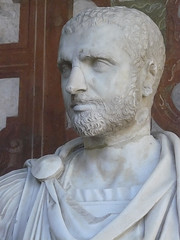
Publis Septimus Geta 3rd century CE.
Photographed at the Palazzo Altemps
in Rome by Mary Harrsch.
Nevertheless, Caesar had become such an integral part of the imperial dignity that its place was immediately restored by Titus Flavius Vespasianus ("Vespasian"), whose defeat of Vitellius in 69 [CE] put an end to the period of instability and began the Flavian dynasty. Vespasian's son, Titus Flavius Vespasianus became "Titus Caesar Vespasianus". - Wikipedia

Following the Flavians, the emperor Nerva assumed the title as well then passed it on through adoption to his heir  Caesar Nerva Traianus who, supposedly, adopted his heir Hadrian, passing the title to him.  At this point our path once more converges with Gibbon.


I thought it was also interesting to read that to further distinguish the use of the name to designate the imperial heir, the title Nobilissimus (meaning "most noble") was added in the 3rd century CE beginning with  Publius Septimius Geta.


If you enjoyed this post, never miss out on future posts by following me by email!