Wednesday, July 25, 2007

Julian the Apostate's support of the Jews

A history resource article by  © 2007

Julian the Apostate presiding at a conference of sectarians by Edward Armitage, 1875.  Image courtesy of
Wikimedia Commons.
I found this article about Julian's support for the reconstruction of the Jewish Temple in Jerusalem quite interesting. I have read Michael Curtis Ford's "Gods and Legions", a novel about the life and reign of the emperor Julian and gained an admiration for this "soldier, inspired military commander and rhetorician" despite the centuries of vilification heaped upon him by subsequent Christian rulers.

"The Roman Emperor Julian, who ruled 361-363 CE, called on the Jews to return to the Land of Israel and rebuild their Temple in Jerusalem. Whatever his motives, he showed our ancestors unusual respect and understanding. 
Julian was hardly an ordinary emperor, though history has failed to pay sufficient attention to his policies. In Julian, the Romans had a just ruler and brave soldier. He was a modest man who labored to relieve the distress of his subjects while endeavoring to connect authority with merit and happiness with virtue. 

A bronze coin portrait of the Emperor Julianus II (the Apostate)

As a young soldier Julian subdued, against the odds, the German threat in Gaul with a small force. He ruled ancient Gaul with wisdom and authority, hardly ever seeking a personal gain. He slept on the ground with his legionnaires, earning their respect. Julian was an excellent organizer, an honest judge, a writer and a philosopher. 
Brought up as a Christian, Julian rejected the religion and turned back to the paganism of Greek and Roman days. He argued that Christianity would weaken and ultimately destroy the Roman Empire. As a result, he attempted to restore Hellenism, which earned him everlasting Christian disdain. 
Known to Christians as Julian the Apostate, the emperor restored pagan temples and the cult of the old Roman gods. These were to be served by a reform-minded pagan clergy with high moral character, who would compete with the Christian clergy in meeting the religious needs of the people. 
Julian remains famous for having declared absolute freedom for all religious beliefs - making him perhaps the first leader to extend toleration of religion to all Romans. 
ON THE July 19, 362 C.E., Julian left Constantinople and arrived in Antioch to prepare for the invasion of Persia. However busy he must have been, he met with "the chiefs of the Jews." 
The details of this fascinating meeting, preserved only in Christian sources, are cited in Michael Avi Yona's The Jews under Roman and Byzantine Rule - A Political History from the Bar Kochba War to the Arab Conquest. 
Julian, who wanted to form a common cause with the Jews against Christianity, asked: "Why do you not sacrifice to God, as required by the laws of Moses?" 
The Jews replied: "We are not allowed by our laws to sacrifice outside our Holy City. How can we do it now? Restore to us the City, rebuild the Temple and the altar, and we shall offer sacrifices, as in days of old." 
He promised: "I shall endeavor with the utmost zeal to set up the Temple of the Most High God." 
THE RESTORATION of the Jewish Temple in Jerusalem would, in Julian's opinion, defeat the Christian argument of replacement theology - that the Church was the true Israel, and that the Temple's destruction and the subsequent exile was the just punishment suffered by the Jewish people for the Crucifixion. The Temple's restoration, Julian figured, would persuade Christian converts that God still favored the Jewish people. 
As an army commander, embarking on a war against a formidable Persian enemy, Julian could also expect that the Jews of Mesopotamia would assist his legions. But there can also be no doubt that Julian's attitude of fairness and his respect for the stubborn stand of the Jewish remnant played a role in his desire to achieve a Jewish restoration. 
In his "Four Letters" addressed to the Jewish people, Julian recognized their dire situation and appealed to them to join him in his campaign. That's a vast difference from the Persian ruler Cyrus, who had only allowed the Jews to rebuild the Temple; Julian virtually ordered them to do so, and perhaps, upset by their initial hesitation, appointed Alypius, a pagan native of Antioch and his best friend, to supervise the work. 
In a letter to the Jewish Patriarch Hillel II, residing in Tiberias, Julian abrogated the entire gamut of anti-Jewish legislation and recognized Jewish authority in Israel, including the right to levy taxes. 
ACCORDING TO the Christian sources, there was considerable initial enthusiasm among the Jews of Diaspora. Many purses were opened. But other leading Jews were confused and apprehensive. The community had only recently suffered yet another painful defeat in the failed uprising against Gallus (351 C.E.), which erupted in protest against discriminatory anti-Jewish legislation. The Patriarchate had lost Lydda, the few remaining settlements in Judea and several vital Galilean villages. 
A 354 CE sketch of Constantius Gallus.  Image courtesy of Wikimedia Commons.

The people quoted a verse from Daniel (11:34): "Now when they shall stumble, they shall be helped with a little help; but many shall join themselves unto them with blandishments." 
The Jews were doubtless divided between those who believed that Julian was a savior and those who remembered Rabbi Simon Ben Eliezer's warning against the youthful enthusiasm of the second generation after the Bar Kochba disaster: "If children tell you: 'Go, build the Temple - do not listen to them.'" 
Above all, could Jewish hopes depend on the fortunes of one man? 
In the end, no attempt was made to set up a temporary altar and offer sacrifices on the former Temple grounds, as the Maccabeans had done. While the Jews could not oppose the will of the Roman emperor, they could drag their feet. Apparently the majority did. They remembered Rome as Amalek, not as a benefactor. 
THE WORK ordered on the Temple's foundation advanced slowly. It took time to provide silver spades and pickaxes, since no iron was allowed to be used. And then, according to the Roman writer Ammianus, "balls of fire" supposedly erupted from the foundations and rendered the place inaccessible. 
The Christian majority of Jerusalem described this fire in glowing terms, as a splendid miracle, a further proof of the rightness of Christianity. The Jews suspected Christian arson. Meanwhile Alypius, Julian's pagan friend, seemed hardly in a hurry to carry out the emperor's order."
A Kindle preview of "Gods and Legions" by Michael Curtis Ford:


More suggested reading:


If you enjoyed this post, never miss out on future posts by following me by email!


Monday, July 23, 2007

Julius Caesar Study Guide

A history resource article by  © 2007

A bronze bust of Julius Caesar photographed
near the Forum Romanum in Rome, Italy
by Mary Harrsch © 2005
N.S. Gill from About.com has put together a number of references for students studying Julius Caesar:

"Julius Caesar (July 12/13, 102/100 B.C. - March 15, 44 B.C.) may have been the greatest man of all times. By age 39/40, Caesar had been a widower, divorce, governor (propraetor) of Further Spain, captured by pirates, hailed imperator by adoring troops, quaestor, aedile, consul, and pontifex maximus -- a lifelong honor usually reserved for the end of a man's career. What was left for his remaining 16/17 years? That for which Julius Caesar was most well known: the Triumvirate, military victories in Gaul, the dictatorship, civil war, and, finally, assassination.

Julius Caesar was a general, a statesman, a lawgiver, an orator, an historian, and a mathematician. His government (with modifications) endured for centuries. He never lost a war. He fixed the calendar. He created the first news sheet, Acta Diurna, which was posted on the forum to let everyone who cared to read it know what the Assembly and Senate were up to. He also instigated an enduring law against extortion." - N.S. Gill
A Kindle preview of a recent biography:


Other suggested reading:

If you enjoyed this post, never miss out on future posts by following me by email!


Friday, July 6, 2007

York moves its Roman Festival to October

"York's popular Roman Festival is being moved from its summer time slot to the autumn school holiday weekend of October 26, 27 and 28.

The organisers of the Roman Festival have moved the dates for this year's festival in the hope it can improve the event, with more re-enactors and more attendees.

Organisers say moving the festival back until the end of the week of the half-term break in October gives more time to promote the event and gives York a big festival event at a quieter time of the year.
Furthermore, they claim it allows lots of other re-enactment groups, who are booked elsewhere in July, to attend, meaning more soldiers will be able to march around the city.

Last year's extravaganza - in the city centre and at Castle Howard - attracted up to 30,000 people..."
If you enjoyed this post, never miss out on future posts by following me by email!


Wednesday, June 27, 2007

Brennus and the First Sack of Rome


I'm about two-thirds of the way through Steven Saylor's latest epic novel, "Roma", and am enjoying it very much. I just finished a section about the first sack of Rome by the Gauls under the command of Brennus. Most of my study has concentrated on the Late Republic so I didn't know much about this first sack other than when it occurred and it was the Gauls who did it.

However, Steven's characters are among the defenders that fortified themselves up on top of the Capitoline and held off the Gauls for seven months. I always assumed the sack was over in a few days like most sacks but it went on for quite a prolonged period. I also did not realize that the Veii question was so disruptive. I knew the Romans had conquered Veii but I assumed they simply added its people to the expanding Republic. I didn't realize the people were sold away into slavery and the city was left abandoned. Perhaps its people were treated so harshly because of the legendary massacre of the 300 Fabii at Cremora.

"Within a year of the victory at Cremora, the Etruscan navy, in conflict with Greece, was destroyed by Hieron of Syracuse, off of Cumae. The result was a military disaster for the Etruscans that they never really seemed to recover from. The various city states of the Etruscan league, including Veii, devolved more and more into separate unrelated entities, thereby losing the strength of mutual protection. Veii, despite its recent upper hand at Cremora, was forced to make a treaty with Rome.

Within this time frame a more consequential series of events were taking place, however. Celtic Gauls had been migrating into northern Italy from the 6th century BC and establishing themselves at or near Etruscan territory. Raids and warfare with these people would have a debilitating effect on the Etruscans and play directly into the growing strength of Rome. The Gauls so weakened the Etruscans that the Romans, between 406 and 396 BC, went on the offensive.

It's about this period in history that Livy tells us of the legendary Roman hero M. Furius Camillus. Under his command Fidemae was retaken from Veii, and then the city of Veii itself came under siege. According to the legend, the Siege of Veii lasted 10 years, but its description is so closely paralleled to the Homeric Siege of Troy, that we must take into account the propaganda used by ancient sources to inflate the glory of Rome. The actual siege probably lasted considerably less time, though the introduction of a paid professional legion during this course of events indicates that it was a protracted campaign. The siege was finally broken, in 396 BC, when the Romans supposedly drained Alban Lake. This not only would divert water supplies from the city but allowed access for Roman soldiers to sneak under the walls through empty stream beds. In the end, whatever the truth behind the legend may be, Camillus was credited with saving Rome and bestowed with the unending admiration of the Romans throughout its history.

Gaining Veii, the Romans, in stark contrast to their general conquest policies of incorporation, destroyed much of the city and drove out many of the Etruscan residents. The territory was allotted to Roman citizens, and four new tribes were created: the Stellatine, Tromentina, Sabatina and Aniensis." - Veii and the Etruscans, UNRV.com

Therefore, when the Gauls practically destroyed Rome, the hotly debated question became whether to rebuild Rome or to transfer her entire population to the empty city of Veii only twelve miles away. The hero Camillus was instrumental in persuading the people to rebuild Rome although those jealous of his success constantly complained that he was enriching himself through building contracts since he controlled most of the spoils and property from the Veii conquest.
If you enjoyed this post, never miss out on future posts by following me by email!


Saturday, June 16, 2007

Gallic-Romano mythology - Tarvos Trigaranus

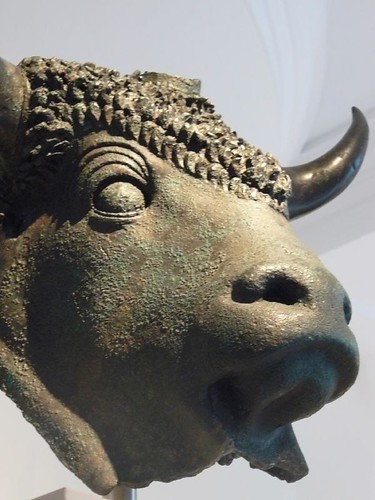
I uploaded some more images from the Met today and among them are several images of a bronze three-horned bull (unfortunately the center horn is missing) that was recovered from Octodurus, a city founded by the Emperor Claudius, in Switzerland.

It's a wonderful sculpture and I'm so glad the piece was not melted down as it appears to be part of a statue that had been rendered apart in preparation for scrapping. It made me curious about the worship of a three-horned bull so I researched it further and learned that the three-horned bull, sometimes called Tarvos Trigaranus, was worshiped by the Celts in Gaul and Britain.

According to an article by Susan Read, Martin Henig, and Leslie Cram that appeared in the journal Brittania, art depicting three-horned bulls was common in northeastern Gaul. They said it seems to have been derived from statues of two-horned bulls from Campania that were constructed with a crescent between their horns. They mention four such statues found in Britain - one in Maiden Castle at Dorset, one from the Jewry Wall Site in Leicester, one from Southbroom near Devizes in Wiltshire, and the last a pipeclay figurine, "certainly an import from Gaul", found at Colcester.

I also read an interesting description of a divination to determine a new Celtic king using a bull.

"Bulls were used in divination in both Ireland and Scotland. At Tara a new king might be chosen in the tarbfheis, `bull-feast' or `bull-sleep', in which a bull was killed and a man ate his fill of its flesh, drank its broth, and then lay down to sleep. After an incantation had been chanted over him by four druids, the dreamer would know the new king in his dream. In Scotland a person might answer an important question about the future (no king was to be selected) by wrapping himself in the warm, smoking hide of a newly slain bull in a remote place, such as near a waterfall. Upon going into a trance the person would have the answer. This method was known as taghairm." - Celtic Mythology, Oxford University Press.

Apparently the three-horned bull even found its way to the standards of the Roman Legions:

"...standards of ala Longiniana (CIL XI11 8094) and cohors I Gallica (ILS 9127) appear to have been adorned with animals popular in Gallic religious
iconography - respectively, a three-horned bull (Green 1976, 13) and a small boar.6 Such animals almost certainly appeared on signa of the type referred to by Tacitus (Germ. 7; Hist. 4.22), borne by the pagi and tribal groupings of the Gauls (Royrnans 1990,19). They appear open to different symbolic interpretations: depending on the cultural perspective of the viewer, they could have been seen primarily as traditional Gallic tribal totems or as Roman military regimental standards." - The Roman Army As A Community .
If you enjoyed this post, never miss out on future posts by following me by email!