Showing posts with label Steven Saylor. Show all posts

Thursday, July 19, 2018

Review: The Throne of Caesar by Steven Saylor

A historical resource article by Mary Harrsch © 2018


Gordianus "The Finder," with his 66th birthday approaching, now spends much of his day relaxing in his peristyle garden reading and sipping a cup of the best vintage he can afford.  But some of his old clients can't seem to let him slip away into anonymity.  First Tiro, Cicero's secretary, comes knocking with a request for Gordianus to call upon his master.  Then Meto, Gordianus' oldest adopted son and trusted officer in the service of Gaius Julius Caesar, pays his father a visit. Caesar, now ruling dictator of Rome, also wishes to consult with the old "Finder".

So, we are once more immersed in the politics of a crumbling Roman Republic as Gordianus must brush the cobwebs from his tired brain and consider a list of possible suspects who may be contemplating the assassination of the most powerful man in the Mediterranean world. To help him do this, he decides to retreat to one of his favorite hangouts, the Salacious Tavern, and banter with his old friend Helvius Cinna, the most renowned poet in Rome.

When I began reading this book, I had heard that this was to be the capstone of Steven Saylor's Roma Sub Rosa series. The pace of the novel is leisurely with Gordianus reminiscing about old cases and now dimly remembered characters who once played a role in his life as he meets with famous historical personalities like Cicero, Caesar, Cleopatra, Calpurnia, Cassius, and Brutus . I must admit this was a bit jarring, at first, for me having just read eleven of Anthony Riches' action-packed novels of the Roman Army.  But, I realized that the author was using this opportunity to remind us of why this period of history and this civilization was so memorable, carefully evoking the atmosphere and lifestyles of its inhabitants.

Saylor also spends a significant portion of the book revisiting Greco-Roman mythology and its role in Roman poetry.  Some readers may consider this a bit of an indulgence by the author. But as it turns out, myth is central to the final plot twist.

Mystery has always been the centerpiece of Saylor's novels and this one would be no different. We are given the chance to experience Caesar's fate through the eyes of Gordianus but it is not his death that will take center stage in the novel's climax.

It did appear to me that, sadly, Gordianus' powers of observation have lost some of their acuity and was a painful reminder of the decline I have experienced as advancing age has made its effects felt.  This is made a little more pronounced by the author's third person asides pointing out suspicious behaviors of the conspirators that seemingly went unnoticed. I am just two years older than the fictional hero and found myself cringing each time he referred to himself as an old man.

Fulvia depicted as Phrygia Eumeneia on a coin minted in 41-40 BCE


But, I appreciated the opportunity to explore the characters and motivations of such historical figures as Antony and Fulvia as the story within a story unfolded.  We find Antony is not just the bull-necked riotous playboy often depicted in Octavian's propaganda but a skilled orator and seemingly conscientious, though pragmatic, Roman politician.  In Fulvia, we find a woman not only driven by ambition but a forceful feminist who has learned how to balance Roman-prescribed pudicitia with power obtained from a carefully managed relationship with her marital partner.

So, be forewarned that this is not just a retelling of Caesar's final days, but an evaluation of relationships, missed opportunities, the power of literature, and the weight of responsibility even the "elderly" have to family, to friends and to society.


If you enjoyed this post, never miss out on future posts by following me by email!


Monday, December 29, 2014

Review: The Seven Wonders by Steven Saylor

An historical fiction review by  © 2014

I know Steven Saylor's "The Seven Wonders" came out in 2013 but my "to-read" stack has gotten so tall, I am a bit overwhelmed and only just now finally got a chance to read it.  (Listen to it actually, as I have the unabridged version from Audible.com) Several of us on Facebook's Roman History Reading Group had suggested to Steven that he go back and write more stories about Gordianus the Finder when Gordianus was a young man.  So, I was pleased to see that is exactly what he did with "The Seven Wonders."

Gordianus, the son of Gordianus the Finder (the elder) has just turned 18 and his old tutor Antipater of Sidon, an acclaimed poet, has invited him to go on a grand tour of the Seven Wonders of the Ancient World.  But first, Gordianus the younger and his father must participate in a charade where they arrange the "death" and funeral of Antipater before the journey.  Even after reading the entire book, I'm still not sure why Antipater requested this.  But, the funeral is held and young Gordianus and Antipater, now calling himself Zodicus or Zeugma, slip out of Rome without being recognized.

The first stop is Ephesus where the pair will explore the famous Temple of Artemis.  While in Ephesus, Gordianus gets involved in a local plot designed to discredit local politicians who support Rome.

1st century CE Roman copy of
the cult statue in the Temple of Ephesus
Image courtesy of
 
Pvasiliadis, Wikimedia Commons
Of course, Gordianus solves the mystery using his own natural instincts coupled with lessons in investigation that he learned from his father.  Then, Gordianus and Antipater move on to the next wonder where another mystery awaits.

So the book is like an anthology of short mysteries with the overarching narrative of a travelogue.  Each little mystery is intriguing but what I enjoyed the most was the intricate description of each wonder in the condition it must have been in during the 1st century BCE.  Saylor describes each structure so vividly I felt like I had personally visited it and seen it for myself.

As it turns out, Antipater of Sidon was a real Greek poet that lived either during the second half of the 2nd century BCE or, according to Cicero, in Rome during the time of Crassus and Catulus.  Some scholars think Cicero confused Antipater of Sidon with Antipater of Thessalonice.  But, for the purposes of this novel, Saylor uses Cicero's Antipater of Sidon. Antipater of Sidon, along with Philo of Byzantium, Strabo, Herodotus and Diodoros of Sicily are attributed with developing the list of the Seven Wonders of the Ancient World.

In the book, though, Antipater credits Alexander the Great who he said developed the list to prove that his kingdom encompassed the greatest structures in the world.  Antipater also explains the sacred significance of the number seven.

However, as I read the book, I must admit I became baffled when Gordianus and Antipater reached the Great Pyramid and proclaimed they had seen all seven since they had not yet traveled to Alexandria and seen the Pharos.  But as it turns out, Antipater's Anthology never included the famous lighthouse as we see from his poem:

I have set eyes on the wall of lofty Babylon on which is a road for chariots, and the statue of Zeus by the Alpheus, and the hanging gardens, and the Colossus of the Sun, and the huge labour of the high pyramids, and the vast tomb of Mausolus; but when I saw the house of Artemis that mounted to the clouds, those other marvels lost their brilliancy, and I said, 'Lo, apart from Olympus, the Sun never looked on aught so grand.'  — Antipater, Greek Anthology IX.58

So, Antipater counted the remains of the beautifully enameled walls of Babylon and the Hanging Gardens, only remembered from tales by the time of Gordianus, as two wonders.

I didn't miss out on a thorough description of the Pharos in Alexandria, though, because Gordianus and Antipater have their last adventure there.  I knew the lighthouse had three tiers but I had always thought the Pharos contained only one great mirror, not a series of mirrors that could be redirected to transmit coded messages from Ptolemy to his subordinates as well as guide ships entering the harbor.  But I have never read the original descriptions by Arab authors that are said to be the most thorough and consistent.

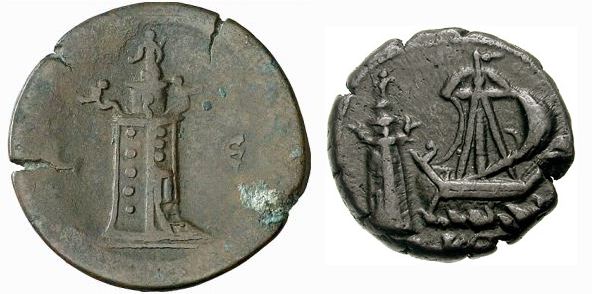
The Pharos depicted on a coin from the reigns of Antoninus Pius
and Commodus.  Image courtesy of Wikimedia Commons.
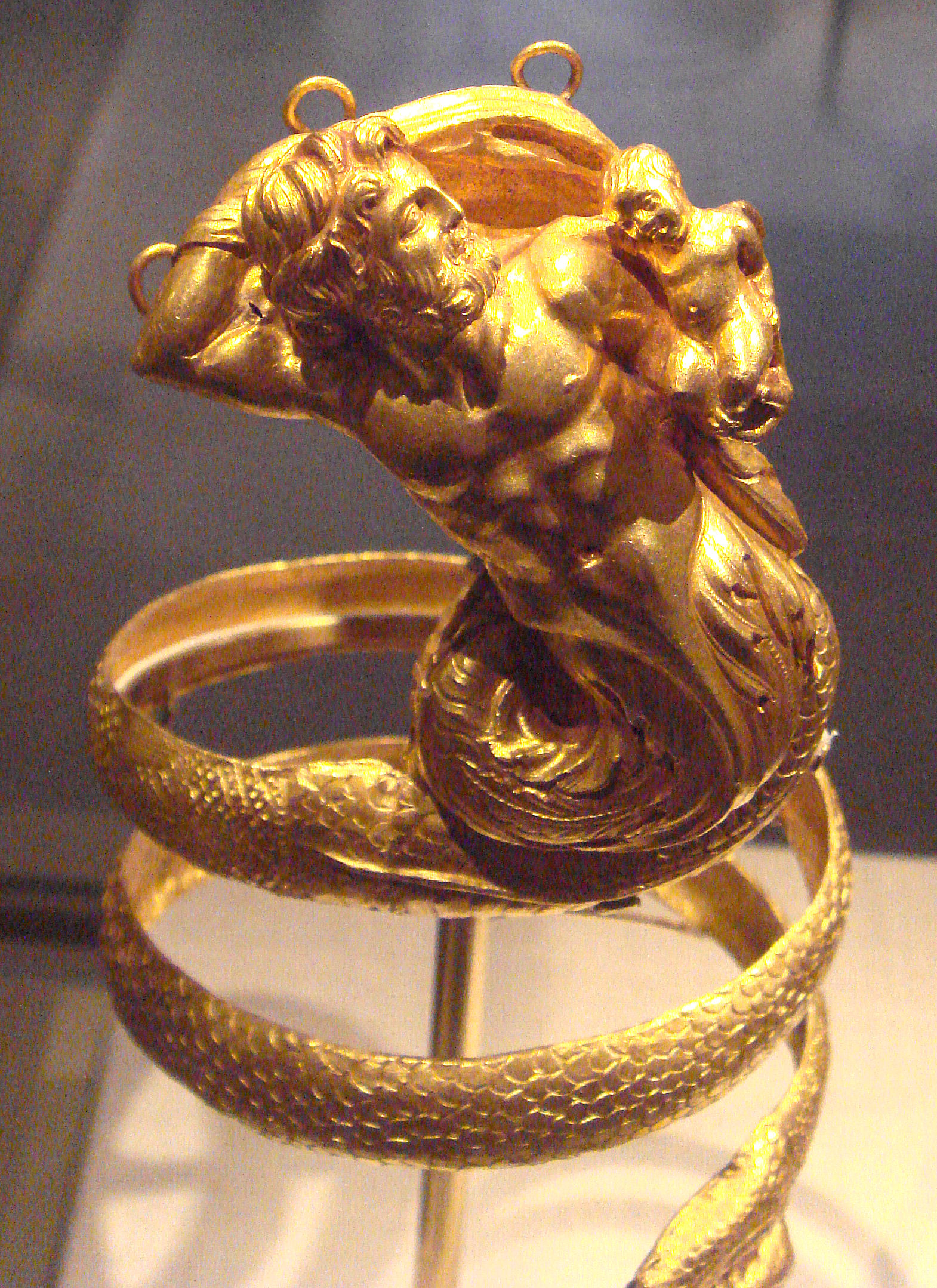
Saylor's description of the lighthouse included Tritons on each of the structure's four corners that are depicted on extant Roman coins struck by the Alexandrian mint and a statue of Zeus at the very top.  In the novel, Antipater explains that it is definitely Zeus, not Poseidon, the god of the seas, because Zeus is considered the protector of sailors.

Gold armband, with Triton holding a Putti,
Greek, 200 BCE.  Photographed at the
Metropolitan Museum of Art courtesy of
Wikimedia Commons.
So, like all of Steven Saylor's novels, "The Seven Wonders" taught me more fascinating details about the ancient world while thoroughly entertaining me.

It made me sorry I haven't seen the last surviving ancient wonder, though.  I postponed my trip to visit the Great Pyramid due to the political unrest following the Arab Spring in Egypt. But I will certainly have Steven's description in my mind if I finally get there.  At least I have seen the beautifully enameled creatures that once flanked the Ishtar Gate in Babylon at the Oriental Institute at the University of Chicago and the remains of the famous Mausoleum of Halicarnassus at the British Museum (until I visited the British Museum I didn't even realize there was anything left of the Mausoleum!).

Vibrant Striding Lion from the Processional Way of Babylon
Neo-Babylonian Period 604-562 BCE Molded and glazed brick
Photographed at the Oriental Institute of the University of Chicago
by Mary Harrsch © 2009
There's also a replica of the Parthenon with a huge statue of Athena (not Artemis but close!) in Nashville, Tennessee that I found quite impressive several years ago.

Multistory statue of Athena in a replica of the
Parthenon in Nashville, TN.  Photo by Mary Harrsch.
 I think even Antipater of Sidon would have agreed, too!

If you enjoyed this post, never miss out on future posts by following me by email!


Sunday, July 18, 2010

Don't miss my review of Steven Saylor's "Empire"!!

Empire: The Novel of Imperial Rome (Novels of Ancient Rome)I just finished an extensive review of Steven Saylor's new novel "Empire" and posted it to my Books and Novels of the Ancient World blog.    The novel follows the fictional patrician Pinarii family from the late Augustan Age to the reign of Hadrian with particularly fascinating "behind the scenes" exploration of the reigns of Nero and Domitian.  I found the novel so fascinating that I spent hours on supplemental research after I finished reading it to learn more about some of the personalities introduced in the novel that I knew very little about.  I highly recommend it!  Five Stars!!
If you enjoyed this post, never miss out on future posts by following me by email!


Wednesday, June 27, 2007

Brennus and the First Sack of Rome


I'm about two-thirds of the way through Steven Saylor's latest epic novel, "Roma", and am enjoying it very much. I just finished a section about the first sack of Rome by the Gauls under the command of Brennus. Most of my study has concentrated on the Late Republic so I didn't know much about this first sack other than when it occurred and it was the Gauls who did it.

However, Steven's characters are among the defenders that fortified themselves up on top of the Capitoline and held off the Gauls for seven months. I always assumed the sack was over in a few days like most sacks but it went on for quite a prolonged period. I also did not realize that the Veii question was so disruptive. I knew the Romans had conquered Veii but I assumed they simply added its people to the expanding Republic. I didn't realize the people were sold away into slavery and the city was left abandoned. Perhaps its people were treated so harshly because of the legendary massacre of the 300 Fabii at Cremora.

"Within a year of the victory at Cremora, the Etruscan navy, in conflict with Greece, was destroyed by Hieron of Syracuse, off of Cumae. The result was a military disaster for the Etruscans that they never really seemed to recover from. The various city states of the Etruscan league, including Veii, devolved more and more into separate unrelated entities, thereby losing the strength of mutual protection. Veii, despite its recent upper hand at Cremora, was forced to make a treaty with Rome.

Within this time frame a more consequential series of events were taking place, however. Celtic Gauls had been migrating into northern Italy from the 6th century BC and establishing themselves at or near Etruscan territory. Raids and warfare with these people would have a debilitating effect on the Etruscans and play directly into the growing strength of Rome. The Gauls so weakened the Etruscans that the Romans, between 406 and 396 BC, went on the offensive.

It's about this period in history that Livy tells us of the legendary Roman hero M. Furius Camillus. Under his command Fidemae was retaken from Veii, and then the city of Veii itself came under siege. According to the legend, the Siege of Veii lasted 10 years, but its description is so closely paralleled to the Homeric Siege of Troy, that we must take into account the propaganda used by ancient sources to inflate the glory of Rome. The actual siege probably lasted considerably less time, though the introduction of a paid professional legion during this course of events indicates that it was a protracted campaign. The siege was finally broken, in 396 BC, when the Romans supposedly drained Alban Lake. This not only would divert water supplies from the city but allowed access for Roman soldiers to sneak under the walls through empty stream beds. In the end, whatever the truth behind the legend may be, Camillus was credited with saving Rome and bestowed with the unending admiration of the Romans throughout its history.

Gaining Veii, the Romans, in stark contrast to their general conquest policies of incorporation, destroyed much of the city and drove out many of the Etruscan residents. The territory was allotted to Roman citizens, and four new tribes were created: the Stellatine, Tromentina, Sabatina and Aniensis." - Veii and the Etruscans, UNRV.com

Therefore, when the Gauls practically destroyed Rome, the hotly debated question became whether to rebuild Rome or to transfer her entire population to the empty city of Veii only twelve miles away. The hero Camillus was instrumental in persuading the people to rebuild Rome although those jealous of his success constantly complained that he was enriching himself through building contracts since he controlled most of the spoils and property from the Veii conquest.
If you enjoyed this post, never miss out on future posts by following me by email!