A history resource article by Mary Harrsch © 2014 updated 2017
In Terry Deary's book "Dangerous Days in the Roman Empire" Deary apparently promotes claims that the ancient Romans and the emperor known as Julian "The Apostate" in particular regularly engaged in anthropomancy, the foretelling of the future by the examination of the entrails of human sacrifices. Deary gained notoriety for his "Horrible Histories" series for children. The books were later the basis for a BBC television series.
It's fairly common knowledge among Roman scholars, though, that the Romans abhorred human sacrifice.
"... the killing of humans offerings to the gods as a regular, required part of worship was sacrifice and it was generally unacceptable. It was foreign to Roman practice or, if we accept what the Roman themselves claimed, foreign to Roman practice in the historical period. The Romans did not tolerate human sacrifice among the peoples they conquered, forbidding the Bletonesii [a Celtic tribe living in the central part of the Iberian peninsula] from performing it and seriously curtailing (if not actually eliminating it) among the Carthaginians and among the Celts. Even so, the Romans were willing on at least three occasions to offer human victims to the gods. This type of ritual was permissible but only just barely, within the Roman religious tradition because it was enacted only as an extraordinary, or ad hoc, response to an exceptional circumstance. It was not part of regular worship, but was ordered, as Plutarch points out, by the Sibylline books." - Celia E. Schultz, The Romans and Ritual Murder
So where did these charges originate? The 19th-century agnostic Robert Green Ingresoll references such reports and attributes them to two of the Roman emperor Julian's Christian enemies, Gregory of Nazianzus and Theodoret of Cyrrhus.
How did the cousin of Constantius II, the emperor who actively promoted Christianity at the expense of paganism and decreed the closing of pagan temples, the banning of animal sacrifices, and introduced the death penalty for those who performed such sacrifices, end up the target of such Christian invectives?
"Constantius' cousin Julian, who was overseeing the Western Empire as Caesar, saw such actions as undermining the Empire, " explains Dr. Eugenia Russell, Lecturer in History at St Mary's University, Twickenham, UK. "He was already a successful general who had been proclaimed Augustus (in 360 CE) by his troops in Paris, and a decisive conflict between the two was only averted by the death-bed recognition by Constantius of Julian as his successor, leaving the latter in sole control in AD 361...With an empire riven by internal conflict and beset by external forces, he attempted to promote peace and tolerance through the reaffirmation of what he saw as Roman virtues, becoming the last emperor to worship the pagan deities and uphold the customs of the ancient world." — Eugenia Russell, "The Last Non-Christian Roman Emperor, Julian the Apostate"
Julian was actually raised in a Christian household, even serving as a Church reader (Anagnostes) at one point. But, after studying philosophy and the classics at the Academy at Athens, he became an admirer of the academy's founder, Plato, and of the Homeric deities in traditional Graeco-Roman religion.
However, Julian remained a monotheist who sought to unite Neoplatonism with Homeric myth.
"Julian insisted there is one supreme god called by many names," observes Vasiliki Limberis in his paper 'Religion' as the Cipher for Identity: The Cases of Emperor Julian, Libanius, and Gregory Nazianzus.
So was Julian really a pagan or not?
"In some aspects, Julian's religion is consistent with Greco-Roman tradition. It is noteworthy, for example, that for Julian, religion is a public duty, whose obligations are designated by the civic calendar and local custom. This includes pleasing a host of gods by ritual sacrifice, proper fulfillment of ritual obligations, and festive celebrations in feasts, theatre events, games, or contests, all arranged in an annual cycle. Nor was Julian much of an innovator when he emphasized the ritual, even the magical, aspects of religion; he was simply tapping into current trends of the days a combination of philosophy and cultic ritual. However despite the elements of Julian's religious program that appear traditional, it was his attempt to democratize religion that represented his most startling innovation." - Vasiliki Limberis
Limberis points out that at that time there was a surge of interest in theurgy, the practice of rituals for the purpose of encouraging divine intervention in the perfection of oneself. Many of the popular mystery religions incorporated theurgy into their practice and even some Christian teachers including Clement of Alexandria, Cyrillus and Synesius embraced the concept.
But, Christians were also engaged in fighting between themselves over the "nature" of Christ. Those referred to as Arians considered Christ to be begotten of God but distinctly separate from him and subordinate. The Monophysites believed Christ was of a single essence with God the Father. The single essence concept was officially adopted at the First Council of Nicaea in 325 CE and Arians were declared heretical and, for all intents and purposes, considered no longer doctrinal Christians, splitting a very small minority, less than 10% of the total Roman population at the time, even further.
"Julian adhered to the syncretic form of Graeco-Roman religion popular in the Late Empire that absorbed a wide variety of beliefs and practices. Although an initiate in at least three of the 'mystery religions' (including Mithraism), he abhorred the exclusivity that made Christianity incompatible with his view of toleration, referring to it as a disease." — Eugenia Russell, "The Last Non-Christian Roman Emperor, Julian the Apostate"
Unlike previous emperors like Diocletian, however, Julian still protected Christianity's followers, making it unlawful to force a Christian to offer a sacrifice, even if this was expected of someone in a public office. Julian did, however, give preference to pagan citizens for public duty, revoke exemptions previously granted to Christian clergy, return public property that had been confiscated for the building of Christian churches, and ban the teaching of classical texts by Christians, apparently fearing the Homeric myths would be presented with a negative spin.
But if Julian only attempted to return the Empire to a religious status quo, why did his actions inflame such influential Christian leaders as Gregory of Nazianzus?
"Gregory of Nazianzus was born into an elite family around 329 or 330 CE near the
provincial city of Nazianzus in southwest Cappadocia. At the time of his birth, his father and
the rest of his family had only recently converted to Christianity, according to Raymond van
Dam, due to Constantine’s patronage." - Benjamin James Rogaczewski, Killing Julian: the Death of an Emperor and the Religious History of the Later Roman Empire
Gregory's father was eventually named Bishop of Nazianzus and, like many Roman fathers, wanted his son to become a cleric, too. But Gregory, educated in the classics at Athens, chose to teach rhetoric instead until his father ordained him a priest against his wishes in 361 CE. Gregory rebelled and fled with his friend Basil of Caesarea to a monastery.
"Around early 361, soon after Gregory left Nazianzus, emperor Constantius compelled many eastern bishops to sign a creed meant to unify the eastern churches under an “Arian” doctrine of faith. Although many of these bishops, one of whom was Gregory’s father, opposed Constantius, they feared possible persecution and subscribed to the creed. When Constantius died, the Nicene accused Gregory the Elder of heresy and “betraying” orthodox doctrine..."
"In 361, while Gregory was in monastic retreat, Julian became emperor and declared not only his rejection of Christianity, but also economical and religious reforms that directly affected the church. He allowed all previously exiled bishops and clerics to return, which only fueled the Arian controversy, creating more dissension within Christian communities, such as Nazianzus. He also removed state funding for the church and seized the municipal lands Constantine and Constantius had given to the church and returned them to the cities. These measures were intended to restore the finances of many cities, which had fallen into neglect, but they also had the effect of removing an important source of income from the control of the church." Benjamin James Rogaczewski
Julian penned a satirical work entitled The Caesars in which he attacked what he viewed as Constantine's hypocritical advocacy of Christianity. Julian was particularly critical of the Christian doctrine of forgiveness of sins:
"He that is a seducer, he that is a murderer, he that is sacrilegious and infamous, let him approach without fear! For with this water will I wash him and will straightway make him clean. And though he should be guilty of those same sins a second time, let him but smite his breast and beat his head and I will make him clean again." - Flavius Claudius Iulianus Augustus, The Caesars
Julian also despised his predecessors' luxuriant lifestyle. He forbid the use of the reference Dominus (Lord) when addressed and dispensed with court formalities and elaborate dress, preferring to live simply. He even espoused chastity outside of marriage.
You would have thought Julian's character that closely resembled the qualities, once so admired by early Christian believers would have found favor among the pious. But the wealthy Christians that had once populated the imperial court and dominated Antioch were enraged by his behavior and his scraggly philosopher's beard, considering it inappropriate for a ruling monarch.
Already seething with anger, Gregory also appears to have had to defend his abandonment of his priestly duties to his father's Christian constituents when he penned the Apology for his Flight to Pontus. Then Gregory went on the attack penning two long rambling invectives against the emperor himself.. Gregory needed a worthy adversary to oppose in his prodigious literary outpourings and Julian, the "apostate" who had been raised a Christian then rejected its teachings, was just the target he needed.
"Gregory’s acutely hostile language in this oration foreshadows the vicious attacks against the emperor in his Invectives against Julian. The emperor of course opposed the use of violence against Christians and carefully avoided persecuting them. Instead, he removed the privileges previously granted to the church to encourage Christians to turn away from Christianity as he had done. However, Gregory wished to convey the impression that Julian actually was persecuting Christians and hurting the church—and, indeed, he may have perceived it that way; for Gregory surely understood the importance of imperial patronage to the church. Hence, it is perhaps not surprising that he portrays Julian as a persecutor of Christians, recalling images of the Christian persecutions of old. This “wild beast” that now ruled the empire had discovered “fresh tortures of greater severity” namely tortures that affected the coffers of the church." - Benjamin James Rogaczewski
Rogaczewski also points out that Gregory also had personal reasons to despise Julian
"Around the time he wrote the Apology, Julian had passed Nazianzus on his way to Antioch to prepare for war against the Persians. Julian was displeased with the Christian zeal of the Cappadocians and his correspondence during this time suggests that he dismissed many, if not all, Christian Cappadocians from court, including Gregory’s brother, Caesarius [a court physician]. Not only had Julian prohibited Gregory from teaching rhetoric, which he loved, but he also slighted Gregory’s family." - Benjamin James Rogaczewski
Gregory actually knew Julian personally, having become acquainted when both young men studied the classics in Athens. I also wonder if Gregory had attempted a relationship with Julian that was rejected or if Gregory had become deeply jealous of Julian because, as the emperor's cousin, he probably received more of the teachers' attention.
In any case, Gregory's apparent hatred of Julian was so complete, Gregory, who would be later referred to with the reverential epithet of "the Theologian," is suspected of fictionalizing his account of Julian's death and to make it appear that, in the end, Julian surrendered to the Christ on his deathbed.
Gregory actually relays more than one account of Julian's death.
"In one of Gregory’s versions, Julian’s death was similar to the death of Cyrus the Younger who fought alongside Xenophon and his “Ten-Thousand” in the battle of Cunaxa. The story goes that Cyrus recklessly attacked the enemy king, his brother Artaxerxes, and was killed by enemies because of his rashness. This version of Julian’s death, comparing Julian’s death to that of the reckless Cyrus, finds an echo in the versions of Libanius and Ammianus in which a reckless Julian is mortally wounded because he is not wearing a breastplate." - Benjamin James Rogaczewski
Then Gregory goes on to claim Julian was actually assassinated by one of his own soldiers.
"Gregory likely has included this story, a fool killing an even greater fool, to incite laughter amongst his audience at the expense of Julian," observes Rogaczewski.
David Woods disagrees saying Gregory may have misinterpreted the reference and that it may have pointed to the member of a barbarian light infantry unit known as the Petulantes.
"As an auxilium palatinum, the Petulantes were an elite mobile unit attached to the palace, and it would have not have been surprising had they been fighting in relatively close proximity to the emperor himself at the time of his fatal wounding. More importantly, the auxilia palatina were light-infantry units, and Ammianus seems to describe the main group involved in the repulse of the Persians during the skirmish in which Julian was wounded as a light-infantry force. Given the confused circumstances of the skirmish, the fact that there seems to have been no co-ordination between this light-infantry force on the one hand and the small group gathered about Julian on the other, it is not impossible that a weapon thrown by a member of the light-infantry force may have hit Julian as he was engaged in hot pursuit of the retreating Persians. In this way, although relatively little is known about the skirmish which resulted in the death of Julian, such details as are preserved by Ammianus at least are consistent with the belief that it was a member of the Petulantes, or an associated light-infantry unit, who threw the weapon that fatally wounded him." - David Woods, Gregory of Nazianzus on the Death of Julian the Apostate
Finally, Gregory claims Julian, an obvious madman, tried to throw himself into a river to attain godhood. Rogaczewski thinks Gregory wanted to not only mock Julian's attempt to attain divinity but to criticize the pagan ritual of deification.
"The story is particularly interesting in that it is not completely Gregory’s, but rather a twisted borrowing, taken from Arrian’s narrative of Alexander the Great’s death in the Anabasis," Rogaczewski points out.
Unfortunately, Gregory's grossly biased narratives would be embraced by three other revered Christian historians, Theodoret of Cyrrhus, Socrates Scholasticus of Constantinople, and Sozomen of Gaza and whose histories of the church became enormously influential in the Byzantine East and the medieval West.
Theodoret of Cyrus, the fifth-century Eusebian scholar, was probably merely repeating stories promulgated by Gregory and, perhaps, Theodoret's knowledge that Julian was an initiate of the Eleusinian Mysteries (associated with mysterious nighttime rituals).
Theodoret may have been further motivated by Gregory's possible association of Julian with the Assyrian Church of the East since Gregory derogatorily refers to Julian as "the Assyrian" in his invectives. This could have been merely an ethnic slur, though, as Julian was born in Constantinople - ancient Assyria, known for its martial brutality.
The Assyrian Church of the East originally developed during the 1st century CE in the Mesopotamian Eastern Aramaic speaking regions of Assyria, Babylonia, and northwestern Persia (today's Iraq, southeast Turkey, northeast Syria and northwestern Iran. It is considered an apostolic church founded by the apostles St. Thomas (Mar Toma), St. Thaddeus (Mar Addai), and St. Bartholomew (Mar Bar Tulmay). Scholars of the church advanced the doctrine that Christ embodied two natures, one human and the other divine. But this viewpoint (later referred to as Nestorianism) was later declared heretical and was one of many rejected by Theodoret and other followers of Eusebius of Caesarea who promoted Arian-like interpretations of the nature of Christ. I find this villification ironic, though, since Julian actually spent his early childhood with Eusebius of Nicomedia.
Julian spent quite a bit of time in Mesopotamia and another scenario could have been that he at one point actively studied cultural beliefs of the region in anticipation of its conquest and this apparent interest was misinterpreted. Sadly, our contemporary source material for the 4th century is woefully fragmented, so all we can do is speculate.
Socrates Scholasticus embroiders the death of Julian still further in his Ecclesiastical History of 439.
"Socrates discusses the reign of Julian in book three, where he also describes Julian’s death, drawing on Libanius and Gregory Nazianzus. However, Socrates provides his own commentary on the events. For instance, he quotes verbatim a passage from Libanius’s Funeral Oration, but then proceeds to a discussion on whether or not a Christian soldier killed Julian. After considering the charge, he replaces the Christian murderer with an evil supernatural being, whom Christians often associated with the pagan gods." - Benjamin James Rogaczewski
Sozomen of Gaza, in his work composed between 440 and 443 with much of it based on the works of Socrates Scholasticus, admits Julian was killed by a Christian soldier but claims the murder was not a crime because "God Willed It!," an excuse that would be used liberally later during the Crusades.
"All these stories rest upon the same foundation, the mendacity of [Christian] priests. Julian changed the religion of the Empire, and diverted the revenues of the church. Whoever steps between a priest and his salary, will find that he has committed every crime. No matter how often the slanders may be refuted, they will be repeated until the last priest has lost his body and found his wings. These falsehoods about Julian were invented some fifteen hundred years ago, and they are repeated to-day by just as honest and just as respectable people as these who told them at first. Whenever the church cannot answer the arguments of an opponent, she attacks his character. She resorts to falsehood, and in the domain of calumny she has stood for fifteen hundred years without a rival." — Robert Green Ingersoll, Julian the Apostate
Ingersoll claims the description provided by pagan contemporaries of the emperor, the philosopher Libanius and soldier/historian Ammianus Marcellinus, appeared to provide an ending more consistent with Julian's character and philosophical education.
'Brought back to his tent, and feeling that he had but a short time to live, he [Julian] spent his last hours in discoursing with his friends on the immortality of the soul. He reviewed his reign and declared that he was satisfied with his conduct, and had neither penitence nor remorse to express for anything that he had done.' His last words were: 'I submit willingly to the eternal decrees of heaven, convinced that he who is captivated with life, when his last hour has arrived is more weak and pusillanimous than he who would rush to voluntary death when it is his duty still to live.'" — Robert Green Ingersoll, Julian the Apostate
Some scholars think Libanius may have been trying to give the philosopher-emperor a more Socratic end, though.
However, I thought it was particularly interesting that Ammianus Marcellinus, a historian who was serving as a soldier on Julian's Persian campaign, claiming not to have been present at the emperor's death, mentions a rumor among the Persians that the emperor Julian was killed by his own men.
The period immediately following Julian's death was especially dangerous with the wealthy Christians seizing power once more. Even Libanius, a respected sophist, teacher of rhetoric, and comrade of Julian did not publish his Funeral Oration in which he defended Julian as a just ruler, a devout Hellene, and most importantly, a monarch treacherously murdered, until a year after Julian's death. This was followed by an entreaty for justice entitled Avenging Julian. Even Marcellinus waited until the 390s to pen his thirty-one volume Res Gestae and notably published it in Latin in Rome not his native Greek in his hometown of Antioch, a city that had been so adamantly opposed to Julian.
"Libanius hints that Julian was not only killed by a Roman soldier, but by a Christian soldier. This shift in blame from a foreign enemy to a domestic, internal one is highly significant, since with that Libanius clearly sought more explicitly to implicate Christians in the death of an emperor—an act of high treason. The charge would prove to be both controversial and influential. Libanius’s imperial connections, his familiarity with Julian, his renown as an effective orator, and wide readership (which included none other than John Chrysostom, one of his Christian students) may have fueled the controversy around the allegation long into the fifth century when the ecclesiastical historians Socrates and Sozomen picked it up and responded to it in their church histories..." - Benjamin James Rogaczewski
Anyway, I hope I have made my point about the folly of quoting sources (even ancient ones) without investigating the social and political context in which they were made and the relationship of the source with the target, especially if the information is defamatory in nature. Blindly repeating such allegations as a sensational "fact" as Deary does in a book touted as "nonfiction" may sell books but is not the kind of "shallow" scholarship I would want foisted on children.
References:
Schultz, C. (2010). The Romans and Ritual Murder. Journal of the American Academy of Religion, 78(2), 516-541. Retrieved from http://www.jstor.org/stable/40666530
Ingersoll, R. G. (1881). The Great Infidels: A Lecture
Russell, E. (2017, August). The Last Non-Christian Roman Emperor, Julian the Apostate". Ancient History Magazine, (11), 15-17.
Rogaczewski, Benjamin James, "Killing Julian: the Death of an Emperor and the Religious History of the Later Roman Empire"(2014). Theses and Dissertations Paper 423.
Gregory of Nazianzus, Second Invective Against Julian
Limberis, V. (2000). "Religion" as the Cipher for Identity: The Cases of Emperor Julian, Libanius, and Gregory Nazianzus. The Harvard Theological Review, 93(4), 373-400. Retrieved from http://www.jstor.org.libproxy.uoregon.edu/stable/1510164
Woods, D. (2015). Gregory of Nazianzus on the Death of Julian the Apostate (Or. 5.13). Mnemosyne, 68, 297–303. https://doi.org/10.1163/1568525X-12301532
In Terry Deary's book "Dangerous Days in the Roman Empire" Deary apparently promotes claims that the ancient Romans and the emperor known as Julian "The Apostate" in particular regularly engaged in anthropomancy, the foretelling of the future by the examination of the entrails of human sacrifices. Deary gained notoriety for his "Horrible Histories" series for children. The books were later the basis for a BBC television series.
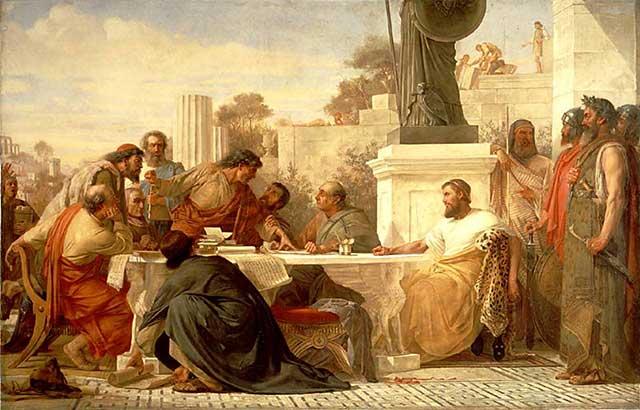 |
| Julian the Apostate presiding at a conference of sectarians, by Edward Armitage, 1875 |
 |
| 19th century agnostic and orator Robert Green Ingersoll. |
"... the killing of humans offerings to the gods as a regular, required part of worship was sacrifice and it was generally unacceptable. It was foreign to Roman practice or, if we accept what the Roman themselves claimed, foreign to Roman practice in the historical period. The Romans did not tolerate human sacrifice among the peoples they conquered, forbidding the Bletonesii [a Celtic tribe living in the central part of the Iberian peninsula] from performing it and seriously curtailing (if not actually eliminating it) among the Carthaginians and among the Celts. Even so, the Romans were willing on at least three occasions to offer human victims to the gods. This type of ritual was permissible but only just barely, within the Roman religious tradition because it was enacted only as an extraordinary, or ad hoc, response to an exceptional circumstance. It was not part of regular worship, but was ordered, as Plutarch points out, by the Sibylline books." - Celia E. Schultz, The Romans and Ritual Murder
So where did these charges originate? The 19th-century agnostic Robert Green Ingresoll references such reports and attributes them to two of the Roman emperor Julian's Christian enemies, Gregory of Nazianzus and Theodoret of Cyrrhus.
How did the cousin of Constantius II, the emperor who actively promoted Christianity at the expense of paganism and decreed the closing of pagan temples, the banning of animal sacrifices, and introduced the death penalty for those who performed such sacrifices, end up the target of such Christian invectives?
"Constantius' cousin Julian, who was overseeing the Western Empire as Caesar, saw such actions as undermining the Empire, " explains Dr. Eugenia Russell, Lecturer in History at St Mary's University, Twickenham, UK. "He was already a successful general who had been proclaimed Augustus (in 360 CE) by his troops in Paris, and a decisive conflict between the two was only averted by the death-bed recognition by Constantius of Julian as his successor, leaving the latter in sole control in AD 361...With an empire riven by internal conflict and beset by external forces, he attempted to promote peace and tolerance through the reaffirmation of what he saw as Roman virtues, becoming the last emperor to worship the pagan deities and uphold the customs of the ancient world." — Eugenia Russell, "The Last Non-Christian Roman Emperor, Julian the Apostate"
 |
| 19th century depiction of Julian being proclaimed Emperor in Paris at the Thermes de Cluny, standing on a shield in the Frankish manner, in February 360. Image courtesy of Wikimedia Commons. |
However, Julian remained a monotheist who sought to unite Neoplatonism with Homeric myth.
"Julian insisted there is one supreme god called by many names," observes Vasiliki Limberis in his paper 'Religion' as the Cipher for Identity: The Cases of Emperor Julian, Libanius, and Gregory Nazianzus.
So was Julian really a pagan or not?
"In some aspects, Julian's religion is consistent with Greco-Roman tradition. It is noteworthy, for example, that for Julian, religion is a public duty, whose obligations are designated by the civic calendar and local custom. This includes pleasing a host of gods by ritual sacrifice, proper fulfillment of ritual obligations, and festive celebrations in feasts, theatre events, games, or contests, all arranged in an annual cycle. Nor was Julian much of an innovator when he emphasized the ritual, even the magical, aspects of religion; he was simply tapping into current trends of the days a combination of philosophy and cultic ritual. However despite the elements of Julian's religious program that appear traditional, it was his attempt to democratize religion that represented his most startling innovation." - Vasiliki Limberis
-CNG.jpg) |
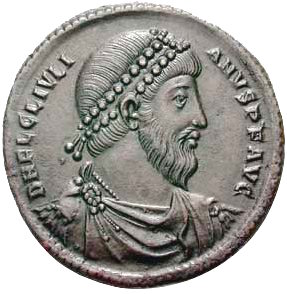
| An official coin depicting the Emperor Julian minted in Antioch in 360 CE Image courtesy of Wikimedia Commons. |
Limberis points out that at that time there was a surge of interest in theurgy, the practice of rituals for the purpose of encouraging divine intervention in the perfection of oneself. Many of the popular mystery religions incorporated theurgy into their practice and even some Christian teachers including Clement of Alexandria, Cyrillus and Synesius embraced the concept.
But, Christians were also engaged in fighting between themselves over the "nature" of Christ. Those referred to as Arians considered Christ to be begotten of God but distinctly separate from him and subordinate. The Monophysites believed Christ was of a single essence with God the Father. The single essence concept was officially adopted at the First Council of Nicaea in 325 CE and Arians were declared heretical and, for all intents and purposes, considered no longer doctrinal Christians, splitting a very small minority, less than 10% of the total Roman population at the time, even further.
"Julian adhered to the syncretic form of Graeco-Roman religion popular in the Late Empire that absorbed a wide variety of beliefs and practices. Although an initiate in at least three of the 'mystery religions' (including Mithraism), he abhorred the exclusivity that made Christianity incompatible with his view of toleration, referring to it as a disease." — Eugenia Russell, "The Last Non-Christian Roman Emperor, Julian the Apostate"
Unlike previous emperors like Diocletian, however, Julian still protected Christianity's followers, making it unlawful to force a Christian to offer a sacrifice, even if this was expected of someone in a public office. Julian did, however, give preference to pagan citizens for public duty, revoke exemptions previously granted to Christian clergy, return public property that had been confiscated for the building of Christian churches, and ban the teaching of classical texts by Christians, apparently fearing the Homeric myths would be presented with a negative spin.
But if Julian only attempted to return the Empire to a religious status quo, why did his actions inflame such influential Christian leaders as Gregory of Nazianzus?
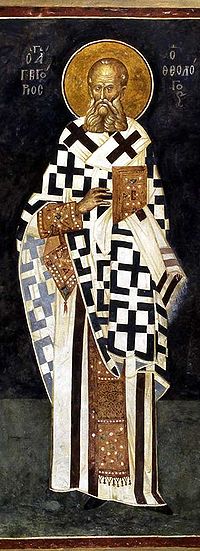 |
| St. Gregory Nazianzen. Image courtesy of Wikipedia. |
Gregory's father was eventually named Bishop of Nazianzus and, like many Roman fathers, wanted his son to become a cleric, too. But Gregory, educated in the classics at Athens, chose to teach rhetoric instead until his father ordained him a priest against his wishes in 361 CE. Gregory rebelled and fled with his friend Basil of Caesarea to a monastery.
"Around early 361, soon after Gregory left Nazianzus, emperor Constantius compelled many eastern bishops to sign a creed meant to unify the eastern churches under an “Arian” doctrine of faith. Although many of these bishops, one of whom was Gregory’s father, opposed Constantius, they feared possible persecution and subscribed to the creed. When Constantius died, the Nicene accused Gregory the Elder of heresy and “betraying” orthodox doctrine..."
"In 361, while Gregory was in monastic retreat, Julian became emperor and declared not only his rejection of Christianity, but also economical and religious reforms that directly affected the church. He allowed all previously exiled bishops and clerics to return, which only fueled the Arian controversy, creating more dissension within Christian communities, such as Nazianzus. He also removed state funding for the church and seized the municipal lands Constantine and Constantius had given to the church and returned them to the cities. These measures were intended to restore the finances of many cities, which had fallen into neglect, but they also had the effect of removing an important source of income from the control of the church." Benjamin James Rogaczewski
Julian penned a satirical work entitled The Caesars in which he attacked what he viewed as Constantine's hypocritical advocacy of Christianity. Julian was particularly critical of the Christian doctrine of forgiveness of sins:
"He that is a seducer, he that is a murderer, he that is sacrilegious and infamous, let him approach without fear! For with this water will I wash him and will straightway make him clean. And though he should be guilty of those same sins a second time, let him but smite his breast and beat his head and I will make him clean again." - Flavius Claudius Iulianus Augustus, The Caesars
Julian also despised his predecessors' luxuriant lifestyle. He forbid the use of the reference Dominus (Lord) when addressed and dispensed with court formalities and elaborate dress, preferring to live simply. He even espoused chastity outside of marriage.
You would have thought Julian's character that closely resembled the qualities, once so admired by early Christian believers would have found favor among the pious. But the wealthy Christians that had once populated the imperial court and dominated Antioch were enraged by his behavior and his scraggly philosopher's beard, considering it inappropriate for a ruling monarch.
Already seething with anger, Gregory also appears to have had to defend his abandonment of his priestly duties to his father's Christian constituents when he penned the Apology for his Flight to Pontus. Then Gregory went on the attack penning two long rambling invectives against the emperor himself.. Gregory needed a worthy adversary to oppose in his prodigious literary outpourings and Julian, the "apostate" who had been raised a Christian then rejected its teachings, was just the target he needed.
"Gregory’s acutely hostile language in this oration foreshadows the vicious attacks against the emperor in his Invectives against Julian. The emperor of course opposed the use of violence against Christians and carefully avoided persecuting them. Instead, he removed the privileges previously granted to the church to encourage Christians to turn away from Christianity as he had done. However, Gregory wished to convey the impression that Julian actually was persecuting Christians and hurting the church—and, indeed, he may have perceived it that way; for Gregory surely understood the importance of imperial patronage to the church. Hence, it is perhaps not surprising that he portrays Julian as a persecutor of Christians, recalling images of the Christian persecutions of old. This “wild beast” that now ruled the empire had discovered “fresh tortures of greater severity” namely tortures that affected the coffers of the church." - Benjamin James Rogaczewski
Rogaczewski also points out that Gregory also had personal reasons to despise Julian
"Around the time he wrote the Apology, Julian had passed Nazianzus on his way to Antioch to prepare for war against the Persians. Julian was displeased with the Christian zeal of the Cappadocians and his correspondence during this time suggests that he dismissed many, if not all, Christian Cappadocians from court, including Gregory’s brother, Caesarius [a court physician]. Not only had Julian prohibited Gregory from teaching rhetoric, which he loved, but he also slighted Gregory’s family." - Benjamin James Rogaczewski
Gregory actually knew Julian personally, having become acquainted when both young men studied the classics in Athens. I also wonder if Gregory had attempted a relationship with Julian that was rejected or if Gregory had become deeply jealous of Julian because, as the emperor's cousin, he probably received more of the teachers' attention.
In any case, Gregory's apparent hatred of Julian was so complete, Gregory, who would be later referred to with the reverential epithet of "the Theologian," is suspected of fictionalizing his account of Julian's death and to make it appear that, in the end, Julian surrendered to the Christ on his deathbed.
Gregory actually relays more than one account of Julian's death.
"In one of Gregory’s versions, Julian’s death was similar to the death of Cyrus the Younger who fought alongside Xenophon and his “Ten-Thousand” in the battle of Cunaxa. The story goes that Cyrus recklessly attacked the enemy king, his brother Artaxerxes, and was killed by enemies because of his rashness. This version of Julian’s death, comparing Julian’s death to that of the reckless Cyrus, finds an echo in the versions of Libanius and Ammianus in which a reckless Julian is mortally wounded because he is not wearing a breastplate." - Benjamin James Rogaczewski
 |
| Closeup of the fallen Julian inscribed on the Sassanian relief of the investiture of Ardashir II showing Mithra, Shapur II and Ahura Mazda above a defeated Julian, lying prostrate. Image courtesy of Wikimedia Commons |
"[Julian] had gone up upon a lofty hill to take a view of his army and ascertain how much was left him for carrying on the war; and then when he saw the number considerable and superior to his expectation, he exclaimed, “What a dreadful thing if we shall bring back all these fellows to the land of the Romans!” as though he begrudged them a safe return. Whereupon one of his officers, being indignant and not able to repress his rage, ran him through the bowels, without caring for his own life." - Gregory of Nazianzus, Second Invective Against Julian The EmperorThen Gregory continues, as if spinning a tale, blaming an itinerant barbarian jester. This is thought to be a reference to the death of the emperor Alexander Severus as described in the Historia Augusta which had been recently published at the time.
"Gregory likely has included this story, a fool killing an even greater fool, to incite laughter amongst his audience at the expense of Julian," observes Rogaczewski.
David Woods disagrees saying Gregory may have misinterpreted the reference and that it may have pointed to the member of a barbarian light infantry unit known as the Petulantes.
"As an auxilium palatinum, the Petulantes were an elite mobile unit attached to the palace, and it would have not have been surprising had they been fighting in relatively close proximity to the emperor himself at the time of his fatal wounding. More importantly, the auxilia palatina were light-infantry units, and Ammianus seems to describe the main group involved in the repulse of the Persians during the skirmish in which Julian was wounded as a light-infantry force. Given the confused circumstances of the skirmish, the fact that there seems to have been no co-ordination between this light-infantry force on the one hand and the small group gathered about Julian on the other, it is not impossible that a weapon thrown by a member of the light-infantry force may have hit Julian as he was engaged in hot pursuit of the retreating Persians. In this way, although relatively little is known about the skirmish which resulted in the death of Julian, such details as are preserved by Ammianus at least are consistent with the belief that it was a member of the Petulantes, or an associated light-infantry unit, who threw the weapon that fatally wounded him." - David Woods, Gregory of Nazianzus on the Death of Julian the Apostate
Finally, Gregory claims Julian, an obvious madman, tried to throw himself into a river to attain godhood. Rogaczewski thinks Gregory wanted to not only mock Julian's attempt to attain divinity but to criticize the pagan ritual of deification.
"The story is particularly interesting in that it is not completely Gregory’s, but rather a twisted borrowing, taken from Arrian’s narrative of Alexander the Great’s death in the Anabasis," Rogaczewski points out.
Unfortunately, Gregory's grossly biased narratives would be embraced by three other revered Christian historians, Theodoret of Cyrrhus, Socrates Scholasticus of Constantinople, and Sozomen of Gaza and whose histories of the church became enormously influential in the Byzantine East and the medieval West.
"It is related that when Julian had received the wound, he filled his hand with blood, flung it into the air and cried, "Thou hast won, O Galilean." Theodoret, Ecclesiastical History, Book III, Ch. 20 (c. 429)"...The story that the dying emperor acknowledged that he was conquered by the Galilean was originated by some of the so-called Fathers of the Church, probably by Gregory or Theodoret. They are the same wretches who said that Julian sacrificed a woman to the moon, tearing out her entrails with his own hands." — Robert Green Ingersoll, Julian the Apostate
Theodoret of Cyrus, the fifth-century Eusebian scholar, was probably merely repeating stories promulgated by Gregory and, perhaps, Theodoret's knowledge that Julian was an initiate of the Eleusinian Mysteries (associated with mysterious nighttime rituals).
Theodoret may have been further motivated by Gregory's possible association of Julian with the Assyrian Church of the East since Gregory derogatorily refers to Julian as "the Assyrian" in his invectives. This could have been merely an ethnic slur, though, as Julian was born in Constantinople - ancient Assyria, known for its martial brutality.
The Assyrian Church of the East originally developed during the 1st century CE in the Mesopotamian Eastern Aramaic speaking regions of Assyria, Babylonia, and northwestern Persia (today's Iraq, southeast Turkey, northeast Syria and northwestern Iran. It is considered an apostolic church founded by the apostles St. Thomas (Mar Toma), St. Thaddeus (Mar Addai), and St. Bartholomew (Mar Bar Tulmay). Scholars of the church advanced the doctrine that Christ embodied two natures, one human and the other divine. But this viewpoint (later referred to as Nestorianism) was later declared heretical and was one of many rejected by Theodoret and other followers of Eusebius of Caesarea who promoted Arian-like interpretations of the nature of Christ. I find this villification ironic, though, since Julian actually spent his early childhood with Eusebius of Nicomedia.
Julian spent quite a bit of time in Mesopotamia and another scenario could have been that he at one point actively studied cultural beliefs of the region in anticipation of its conquest and this apparent interest was misinterpreted. Sadly, our contemporary source material for the 4th century is woefully fragmented, so all we can do is speculate.
Socrates Scholasticus embroiders the death of Julian still further in his Ecclesiastical History of 439.
"Socrates discusses the reign of Julian in book three, where he also describes Julian’s death, drawing on Libanius and Gregory Nazianzus. However, Socrates provides his own commentary on the events. For instance, he quotes verbatim a passage from Libanius’s Funeral Oration, but then proceeds to a discussion on whether or not a Christian soldier killed Julian. After considering the charge, he replaces the Christian murderer with an evil supernatural being, whom Christians often associated with the pagan gods." - Benjamin James Rogaczewski
Sozomen of Gaza, in his work composed between 440 and 443 with much of it based on the works of Socrates Scholasticus, admits Julian was killed by a Christian soldier but claims the murder was not a crime because "God Willed It!," an excuse that would be used liberally later during the Crusades.
 |
| Some early Christians attribute Julian's death to Saint Mercurius, a converted Roman soldier executed by the Roman emperor Decius during one of his religious persecutions. Image courtesy of Wikipedia. |
Ingersoll claims the description provided by pagan contemporaries of the emperor, the philosopher Libanius and soldier/historian Ammianus Marcellinus, appeared to provide an ending more consistent with Julian's character and philosophical education.
'Brought back to his tent, and feeling that he had but a short time to live, he [Julian] spent his last hours in discoursing with his friends on the immortality of the soul. He reviewed his reign and declared that he was satisfied with his conduct, and had neither penitence nor remorse to express for anything that he had done.' His last words were: 'I submit willingly to the eternal decrees of heaven, convinced that he who is captivated with life, when his last hour has arrived is more weak and pusillanimous than he who would rush to voluntary death when it is his duty still to live.'" — Robert Green Ingersoll, Julian the Apostate
Some scholars think Libanius may have been trying to give the philosopher-emperor a more Socratic end, though.
However, I thought it was particularly interesting that Ammianus Marcellinus, a historian who was serving as a soldier on Julian's Persian campaign, claiming not to have been present at the emperor's death, mentions a rumor among the Persians that the emperor Julian was killed by his own men.
The period immediately following Julian's death was especially dangerous with the wealthy Christians seizing power once more. Even Libanius, a respected sophist, teacher of rhetoric, and comrade of Julian did not publish his Funeral Oration in which he defended Julian as a just ruler, a devout Hellene, and most importantly, a monarch treacherously murdered, until a year after Julian's death. This was followed by an entreaty for justice entitled Avenging Julian. Even Marcellinus waited until the 390s to pen his thirty-one volume Res Gestae and notably published it in Latin in Rome not his native Greek in his hometown of Antioch, a city that had been so adamantly opposed to Julian.
"Libanius hints that Julian was not only killed by a Roman soldier, but by a Christian soldier. This shift in blame from a foreign enemy to a domestic, internal one is highly significant, since with that Libanius clearly sought more explicitly to implicate Christians in the death of an emperor—an act of high treason. The charge would prove to be both controversial and influential. Libanius’s imperial connections, his familiarity with Julian, his renown as an effective orator, and wide readership (which included none other than John Chrysostom, one of his Christian students) may have fueled the controversy around the allegation long into the fifth century when the ecclesiastical historians Socrates and Sozomen picked it up and responded to it in their church histories..." - Benjamin James Rogaczewski
Anyway, I hope I have made my point about the folly of quoting sources (even ancient ones) without investigating the social and political context in which they were made and the relationship of the source with the target, especially if the information is defamatory in nature. Blindly repeating such allegations as a sensational "fact" as Deary does in a book touted as "nonfiction" may sell books but is not the kind of "shallow" scholarship I would want foisted on children.
References:
Schultz, C. (2010). The Romans and Ritual Murder. Journal of the American Academy of Religion, 78(2), 516-541. Retrieved from http://www.jstor.org/stable/40666530
Ingersoll, R. G. (1881). The Great Infidels: A Lecture
Russell, E. (2017, August). The Last Non-Christian Roman Emperor, Julian the Apostate". Ancient History Magazine, (11), 15-17.
Rogaczewski, Benjamin James, "Killing Julian: the Death of an Emperor and the Religious History of the Later Roman Empire"(2014). Theses and Dissertations Paper 423.
Gregory of Nazianzus, Second Invective Against Julian
Limberis, V. (2000). "Religion" as the Cipher for Identity: The Cases of Emperor Julian, Libanius, and Gregory Nazianzus. The Harvard Theological Review, 93(4), 373-400. Retrieved from http://www.jstor.org.libproxy.uoregon.edu/stable/1510164
Woods, D. (2015). Gregory of Nazianzus on the Death of Julian the Apostate (Or. 5.13). Mnemosyne, 68, 297–303. https://doi.org/10.1163/1568525X-12301532


 Years ago when I went to the theater to see "Troy" and within the first few minutes saw Menelaus skewered by Hector, I muttered to myself, "So much for Homer". To me, that plot point signaled that I shouldn't expect much as far as literary parallel was concerned. I felt the same way watching 300: Rise of an Empire" when Themistocles drew a bead on Darius and skewered the great king with an arrow during the battle of Marathon. At least Menelaus was at the siege of Troy! Darius wasn't even present at the battle of Marathon and I'm afraid Xerxes wasn't either!


 An ice storm and four day power outage gave me the opportunity to finally read a Kindle version of this book by new author, Robert Colton.