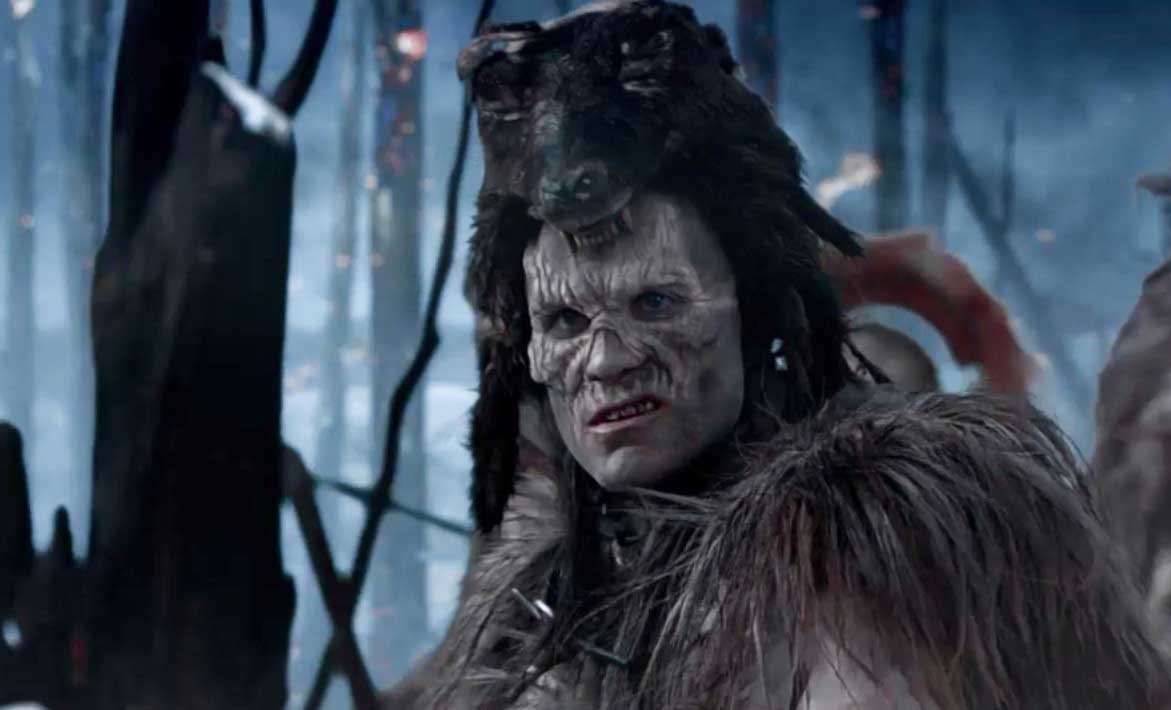
Every time I read something about the Getae, I envision the skull wearing savage warriors depicted in the opening battle scenes of the Starz series "Spartacus." But according to Herodotus, the Getae were "the noblest as well as the most just of all the Thracian tribes." When Lysimachus tried to subdue the Getae he was defeated by them. The Getae king, Dromichaetes, took him prisoner but he treated him well and convinced Lysimachus there is more to gain as an ally than as an enemy of the Getae and released him. According to Diodorus, Dromichaetes entertained Lysimachus at his palace at Helis, where food was served on gold and silver plates. The discovery of the celebrated tomb at Sveshtari (1982) suggests that Helis, the capital of the Getae, was located perhaps in its vicinity, where remains of a large antique city are found along with dozens of other Thracian mound tombs.
The Getae were several Thracian-related tribes that once inhabited the regions to either side of the Lower Danube, in what is today northern Bulgaria and southern Romania. Their proximity to Greek colonies on the Black Sea coast brought the Getae into contact with the Greeks at an early date.
There seems to be disagreement among scholars whether the Getae and Dacians were separate peoples. In his Geographic (c. 7 BC – 20 CE), Strabo said the Dacians lived in the western parts of Dacia, "towards Germania and the sources of the Danube", while the Getae lived in the eastern parts, towards the Black Sea, both south and north of the Danube but both cultures spoke the same language as the Thracians. Justin, the 3rd century CE Latin historian, wrote in his "Epitome of Pompeius Trogus" that Dacians are spoken of as descendants of the Getae. In his Roman History, Cassius Dio observes "I call the people Dacians, the name used by the natives themselves as well as by the Romans, though I am not ignorant that some Greek writers refer to them as Getae, whether that is the right term or not..." According to Herodotus, the Getae differed from other Thracian tribes in their religion, centered around the god (daimon) Zalmoxis whom some of the Getae called Gebeleizis.
Herodotus says the Getae were one of the conquered tribes of the Scythian campaign of Darius I in 513 BCE. But by the 5th century BCE through the 3rd century BCE, the Getae were mostly under the rule of the flourishing Odrysian kingdom. During this time, the Getae provided military services and became famous for their cavalry.
After the disintegration of the Odrysian kingdom, the Getic principalities began to consolidate themselves. By about 200 BCE, strong Getic princes such as Zalmodegicus had extended their domain as far as Histria near the mouth of the Danube River. They minted their own coins and practiced a ruler cult.
In 72–71 BCE Marcus Terentius Varro Lucullus became the first Roman commander to march against the Getae. This was done to strike at the western Pontic allies of Mithridates VI, but he had limited success. A decade later, a coalition of Scythians, Getae, Bastarnae and Greek colonists defeated C. Antonius Hybrida at Histria. This victory over the Romans allowed Burebista, the leader of this coalition, to organize a kingdom consisting of descendants of those whom the Greeks had called Getae, as well as Dacians, or Daci, the name applied to people of the region by the Romans and he ruled independently from 60–50 BCE.
Meanwhile, Augustus aimed at subjugating the entire Balkan peninsula, and used an incursion of the Bastarnae, a Celtic or Germanic people depending on which ancient source you accept, who crossed the Danube, as a pretext to devastate the Getae and Thracians. He put Marcus Licinius Crassus in charge of the plan. In 29 BCE, Crassus defeated the Bastarnae with the help of the Getic prince Rholes. Crassus promised him help for his support against the Getic ruler Dapyx. After Crassus had reached as far as the Danube Delta, Rholes was appointed king and Crassus returned to Rome. In 16 BCE, the Sarmatae invaded the Getic territory and were driven back by Roman troops. The Getae were placed under the control of the Roman vassal king in Thrace, Rhoemetalces I. In 6 CE, the province of Moesia was founded, incorporating the Getae south of the Danube River. The Getae north of the Danube continued tribal autonomy outside the Roman Empire.
 |
| Skull-wearing Getae warrior of Starz series "Spartacus". |
 |
| Getae warrior (Thracians related to the Dacians) armed with two specimens of the fearsome falx, courtesy of artist Mariusz Kozik. |
 |
| A Geto-Dacian helmet dating from the 4th century BCE known as the Helmet of Iron Gates, Mehedinţi County, Romania, now in the collections of the Detroit Institute of Arts, courtesy of Wikimedia Commons contributor Codrin B. |
 |
| Gilded silver Getae-Dacian helmet found in Peretu at the National Museum of Romanian History in Bucharest, courtesy of Wikimedia Commons contributor Sailko. |
 |
| Detail of a Gilded silver Getae-Dacian helmet found in Peretu at the National Museum of Romanian History in Bucharest, courtesy of Wikimedia Commons contributor Cristian Chirita |
 |
| Gilded silver Getae-Dacian helmet, part of the Aghighiol treasure of Getae-Dacian artifacts at the National Museum of Romanian History in Bucharest, courtesy of Wikimedia Commons contributor Cristian Chirita. |
 |
| Detail of Getae-Dacian horseman on a helmet, part of the Aghighiol treasure of Getae-Dacian artifacts at the National Museum of Romanian History in Bucharest, courtesy of Wikimedia Commons contributor Cristian Chirita. |
 |
| Beaker with birds and animals, Thraco-Getian, 4th century BC, silver, height: 18.7 cm (7.4 in), Metropolitan Museum of Art in New York, courtesy of Wikimedia Commons contributor, Marie-Lan Nguyen. |
 |
| Bottom of a Silver Getae-Dacian beaker depicting mythical beasts, part of the Aghighiol treasure of Getae-Dacian artifacts at the National Museum of Romanian History in Bucharest, courtesy of Wikimedia Commons contributor Cristian Chirita. |
 |
| Gilt silver tableware from the princely burial of Peretu, Getae, 310-290 BCE, at the National Museum of Romanian History in Bucharest, courtesy of Wikimedia Commons contributor Sailko. |
 |
| Aghighiol treasure of Getae-Dacian artifacts at the National Museum of Romanian History in Bucharest, courtesy of Wikimedia Commons contributor Cristian Chirita. |
 |
| Tropeum Traiani Metope commemorating the Battle of Adamclisi, Roman, showing Dacian warriors wielding a two-handed falx, , courtesy of Wikimedia Commons contributor Cristian Chirita. |
 |
| A Geto-Dacian Rhyton dating from the last half of the 4th century or the first half of the 3rd BCE at the National Museum of Romanian History courtesy of Wikimedia Commons contributor Cristian Chirita. |
 |
| Closeup of a gold disc embossed with a helmeted head of Athena recovered from the Great Tumulus of Sveshtari in the Getae Capital, courtesy of https://aktuelarkeoloji.com.tr/kategori/guncel-kazilar/getae-baskenti-buyuk-sveshtari-tumulus |
 |
| Gold applique depicting a female head, Getae, Athena recovered from the Great Tumulus of Sveshtari in the Getae Capital, courtesy of https://aktuelarkeoloji.com.tr/kategori/guncel-kazilar/getae-baskenti-buyuk-sveshtari-tumulus |
 |
| Gilded Getae-Dacian Greave, part of the Aghighiol treasure of Getae-Dacian artifacts at the National Museum of Romanian History in Bucharest, courtesy of Wikimedia Commons contributor Cristian Chirita. |
 |
| Getae-Dacian Greave, part of the Aghighiol treasure of Getae-Dacian artifacts at the National Museum of Romanian History in Bucharest, courtesy of Wikimedia Commons contributor Cristian Chirita. |
 |
| Getae-Dacian animorphic gilt silver disk , part of the Aghighiol treasure of Getae-Dacian artifacts at the National Museum of Romanian History in Bucharest, courtesy of Wikimedia Commons contributor Cristian Chirita. |
 |
| The Thracian Tomb of Sveshtari, 3rd century BCE, courtesy of Wikimedia Commons contributor Interact-Bulgaria. |
If you enjoyed this post, never miss out on future posts by following me by email!


 Years ago when I went to the theater to see "Troy" and within the first few minutes saw Menelaus skewered by Hector, I muttered to myself, "So much for Homer". To me, that plot point signaled that I shouldn't expect much as far as literary parallel was concerned. I felt the same way watching 300: Rise of an Empire" when Themistocles drew a bead on Darius and skewered the great king with an arrow during the battle of Marathon. At least Menelaus was at the siege of Troy! Darius wasn't even present at the battle of Marathon and I'm afraid Xerxes wasn't either!


