Showing posts with label Achilles. Show all posts

Monday, May 10, 2021

Archaic Period Horse Sculptures

 Horses, with or without riders, were favorite subjects for Boeotian artisans. The figurines were frequently left as burial offerings in graves. Horses were a sign of wealth for the Greeks of this period, and the terracotta horses were probably left to symbolize and to reinforce the high status of the deceased. Thousands of clay figurines like this one survive from the Archaic period (600 to 480 BCE).

"Horses played a central role in the great civic festivals in the ancient world, such as the Panathenaic Games in Athens and the Olympic games at Olympos, where they took part in chariot races and single horse races. The horse’s long affiliation with gods and heroes in Greek mythology no doubt also fostered a special respect and admiration for this remarkable creature in the minds of “ordinary” Greeks. In Homer’s Iliad, horses drive the chariots of the heroes and are praised for their swiftness and beautiful coats. They are often depicted as having special relationships with their owners, like Achilles and his immortal horses, Balius and Xanthus.  In the Iliad, it is told how, when Patroclus was killed in battle, Xanthus and Balius stood motionless on the field of battle, and wept, yet when Achilles rebuked Xanthus for letting Patroklus get slain, Hera granted the horse human speech to deliver to Achilles a warning about his own fate." - Stasahatzoglou, The significance of the horse in ancient Greece.

Terracotta horse and rider, Greek, Boeotian, about 550 BCE, courtesy of the Getty Villa in Pacific Palisades, California.


Archaeic Period Horse and Rider from Cyprus, 700 BCE 


Pyxis Lid with Three Horses Greek made in Boeotia 760-750 BCE Terracotta that I photographed at the Getty Villa in Pacific Palisades, California


Terracotta horse with warrior rider Cypriot Cypro-Archaic I-II 600 BCE said to be from the temple of Apollo Hylates at Kourion that I photographed at the Metropolitan Museum of Art in New York.


Terracotta wheeled horse thought to be a toy Cypriot Cypro-Archaic 6th century BCE that I photographed at the Metropolitan Museum of Art in New York


A BOEOTIAN TERRACOTTA HORSE AND RIDER, 575-550 BCE,  courtesy of Christies


Greek Horse and Rider 6th century BCE Terracotta with slip decoration courtesy of The Barnes Foundation


If you enjoyed this post, never miss out on future posts by following me by email!


Monday, April 19, 2021

Gallo-Roman villa of Orbe-Boscéaz

Orbe-Boscéaz, also named Boscéay, is an archaeological site in Switzerland, located at the territory of the town of Orbe (Vaud). It includes a vast Roman villa measuring over 200 m long comprised of about 100 rooms, some heated by hypocaust, colonnaded porticoes, and ornamental ponds.  Nine of the rooms featured intricate mosaics depicting gods, trompe l’œil geometric shapes or figurative scenes of Greek mythology, such as the famous labyrinth of Theseus and the Minotaur.

Excavations have revealed the villa, constructed at the end of the 2nd century CE on the remains of a structure from the 1st century CE, was mostly abandoned during the crisis of the 3rd century CE.  Sadly, by the 5th century CE much of the structure became a quarry for building materials.

The first of its mosaics were discovered in 1841. The Triton and the Labyrinth mosaics were found in 1845 (the latter is reburied the same year, then rediscovered in 1930), the Divinities mosaic in 1862, the laurel leaves mosaic in 1863 (reburied and rediscovered several times up to 1925), and the Mosaic of Achilles on the island of Skyros, was discovered in 1993 and recently underwent restoration. The site is now open to the public.

The Triton mosaic at this villa depicts ichthyocentaurs, mermen with a horse's forelegs in place of arms.  The earliest known examples of this artistic variation of traditional Greek tritons date from the 2nd century BCE. The term "Ichthyocentaur" did not originate in ancient Greece, though, and only appeared in writing in the Byzantine period (12th century).  They were also known as "Centaur-Tritons".  Double-tailed tritons began to be depicted by the late 2nd century BCE, and can be seen on the Altar of Domitius Ahenobarbus at the Glyptothek in Munich.

Gallo-Roman Villa of Orbe-Boscéaz (Vaud, Switzerland) - The Deities Mosaic includes four medallions with a Triton and a Nereid. This photo shows the southwest medallion. The Deities Mosaic is preserved in its original location and the Gallo-Roman villa is a site open to the public and can be visited. Image courtesy of Wikimedia Commons contributor Sylvain Gailloud. (adjusted perspective, sharpened and enhanced)


Mosaic depicting Zeus in the form of an eagle and Ganymede at the Gallo-Roman Villa of Orbe-Boscéaz (Vaud, Switzerland) courtesy of Wikimedia Commons contributor Leemburg-CH.


Another medallion from the Triton mosaic at the Gallo-Roman Villa of Orbe-Boscéaz (Vaud, Switzerland) courtesy of Wikimedia Commons contributor Leemburg-CH.


Geometric mosaic with leaves at the Gallo-Roman Villa of Orbe-Boscéaz (Vaud, Switzerland) courtesy of Wikimedia Commons contributor Paulusburg


Closeup of the Deities Mosaic depicting Mars, the God of War at the Gallo-Roman Villa of Orbe-Boscéaz (Vaud, Switzerland), courtesy of Wikimedia Commons contributor Leemburg-CH


Mosaic of the deities at the Gallo-Roman Villa of Orbe-Boscéaz (Vaud, Switzerland) courtesy of Wikimedia Commons contributor Leemburg-CH


Mosaic of the Rustic Procession at the Gallo-Roman Villa of Orbe-Boscéaz (Vaud, Switzerland) courtesy of Wikimedia Commons contributor Leemburg-CH


Triton with two fish-tails. Altar of Domitius Ahenobarbus. Glyptothek Munich courtesy of Wikimeddia Commons contributor Miguel Hermoso Cuesta


If you enjoyed this post, never miss out on future posts by following me by email!


Sunday, April 18, 2021

Achilles' Ambush of Troilus

All Greek and Etruscan metal rings with engraved bezels ultimately derive from Egyptian and Phoenician cartouche-shaped rings. The cartouche-shaped ring was especially popular in Etruria in the later 500s B.C., where immigrant Greek goldsmiths from Ionia introduced it.

This example features an intricate scene of two men approaching a fountain where water gushes into a vessel from a lion's head spout. Behind the fountain, a man squats as if hiding, holding a sword. These details identify the scene as a standard depiction of the ambush of Troilos (Troilus), prince of Troy, by the Greek hero Achilles during the Trojan War. On this ring, however, a strange dog-headed creature, who is not part of the Troilos myth, sits atop the fountain. The creature may actually be jackal-headed and thus meant to recall the Egyptian god Anubis harking back to the origin of such rings from Egypt.

Prophecies retold in the Iliad link the fate of Troilos, one of the sons of King Priam (or Apollo in some versions of Greek myth), with the fate of Troy itself. Ancient writers including Sophocles treated Troilos, a paragon of youthful male beauty, as the epitome of a dead child mourned by his parents. 

 Only 54 words have been identified as coming from Sophocles' play, Troilos.  Fragment 619 refers to Troilos as an andropais, a man-boy. (A fragment from the 6th century tragic poet Phyrnichus refers to Troilus as possessing the light of love glowing on his reddening cheeks) Fragment 621 indicates that Troilos was going to a spring with a companion to fetch water or to water his horses but a scholion (explanatory comment) to the Iliad states that Sophocles relates how Troilos was ambushed by Achilles while exercising his horses in the Thymbra. Fragment 623 indicates that Achilles mutilated Troilos' corpse by a gruesome method known as maschalismos. This involved preventing the ghost of a murder victim from returning to haunt their killer by cutting off the corpse's extremities and stringing them under its armpits. 

Considering Troilos, according to many versions and interpretations, was still a child, Achilles' behavior was beyond the pale. Greek heroes were not always heroic!

Gold finger ring depicting Achilles' Ambush of Troilos, Etruscan, 550-500 BCE, at the J. Paul Getty Museum, image courtesy of the museum.

Red-figured bell-krater depicting Achilles in wait for Troilos. Troilos leads up a mule to drink, with right arm over its back. He is represented as a child, with curls in front of his ears, chlamys over left shoulder, petasos hanging from neck, in left hand two spears. Mid-fifth to third centuries BCE, British Museum.

Roman relief from a statue of Germanicus, 2nd c. CE, depicting the ambush of Troilos, Archeological Museum of Perugia courtesy of Wikimedia Commons contributor Haiduc.

Achilles ambushing Troilos and Polyxena, shoulder of an Attic black-figure hydria, 560-550 BCE at the Metropolitan Museum of Art courtesy of Wikimedia Commons contributor Marie-Lan Nguyen.

Image: Achilles (left) ambushing Troilus (on horseback, right). Etruscan fresco, Tomb of the Bulls, Tarquinia, 530–520 BCE courtesy of Wikimedia Commons.
If you enjoyed this post, never miss out on future posts by following me by email!


Saturday, March 27, 2021

The rise and decline of the chariot in ancient warfare

I ran across these images of this fascinating chariot while researching the Roman cavalry relief in the Capitoline Museum.  I've photographed the beautiful Monteleone Etruscan chariot at the Metropolitan Museum of Art in New York dated to 530 BCE but have never seen this one before. Over 300 ancient chariots are known to still exist but only six are reasonably complete.

Surprisingly, the chariot was actually invented to provide a moving platform from which soldiers could shoot at enemies with arrows or javelins before mounted cavalry was introduced into ancient warfare.  Scholars think the horses were initially weaker and unable to support a man.  They were eventually bred to be stronger until they could be mounted and rode about a millennium and a half after the chariot was invented.

The first reference to chariots was found in Syria and dated to about 1800 BCE.  Scholars claim on suitable terrain the chariot was an effective weapon and the number of chariots compared to infantry troops was a good indicator of how effective chariots were.  It is estimated in ancient China the ratio was up to 25 infantry soldiers per chariot.

Chariots began to decline in use around the Mediterranean about 500 BCE as horseback riding continued to develop led by the Scythians who attacked the Assyrian empire in the 7th century BCE.  The use of phalanx formations with iron weapons also contributed to their disappearance from the battlefield. 

The chariot remained a symbol of elite status, however, as this chariot and the Monteleone chariot demonstrate.

Etruscan bronze chariot depicting scenes from the life of Achilles, 4th century BCE, in an exhibit in the Palazzo dei Conservatori at the Musei Capitolini courtesy of Wikimedia Commons contributor Daderot.

Etruscan bronze chariot depicting scenes from the life of Achilles, 4th century BCE, in an exhibit in the Palazzo dei Conservatori at the Musei Capitolini courtesy of Wikimedia Commons contributor José Luiz Bernardes Ribeiro

Etruscan bronze chariot depicting scenes from the life of Achilles, 4th century BCE, in an exhibit in the Palazzo dei Conservatori at the Musei Capitolini courtesy of Wikimedia Commons contributor José Luiz Bernardes Ribeiro

Etruscan bronze chariot depicting scenes from the life of Achilles, 4th century BCE, in an exhibit in the Palazzo dei Conservatori at the Musei Capitolini courtesy of Wikimedia Commons contributor Miguel Hermoso Cuesta

Etruscan bronze chariot depicting scenes from the life of Achilles, 4th century BCE, in an exhibit in the Palazzo dei Conservatori at the Musei Capitolini courtesy of Wikimedia Commons contributor Sailko


If you enjoyed this post, never miss out on future posts by following me by email!


Sunday, February 21, 2021

The psychological cost of warfare in the ancient world

Then said Achilles, "Son of Atreus, king of men Agamemnon, see to these matters at some other season, when there is breathing time and when I am calmer. Would you have men eat while the bodies of those whom Hector son of Priam slew are still lying mangled upon the plain? Let the sons of the Achaeans, say I, fight fasting and without food, till we have avenged them; afterwards at the going down of the sun let them eat their fill. As for me, Patroclus is lying dead in my tent, all hacked and hewn, with his feet to the door, and his comrades are mourning round him. Therefore I can think of nothing but slaughter and blood and the rattle in the throat of the dying." - Iliad 19.226

As some of you know, I am the spouse of a veteran who has suffered from PTSD since service in Vietnam back in 1967-68. Although the psychological trauma suffered by those who have experienced a traumatic event now has a very modern-sounding diagnosis, it is not a recent phenomenon but has been a plague upon mankind, probably since men began engaging in warfare to wrest the territory or possessions from a competing group or avenge the losses incurred in such actions.

Some scholars have proposed PTSD is a modern phenomenon brought on by the use of explosive weapons like IEDs, land mines, or booby traps and the concussions that resulted from their use.  

In her paper, Caesar in Vietnam: Did Roman Soldiers Suffer from Post-Traumatic Stress Disorder?, classicist Aislinn Melchior admits that concussion is not the only risk factor for PTSD but says it is so strongly correlated that it suggests the incidence of PTSD may have risen sharply with the arrival of gunpowder, shells, and plastic explosives.

"In Roman warfare, wounds were most often inflicted by edged weapons. Romans did of course experience head trauma, but the incidence of concussive injuries would have been limited both by the types of weapons they faced and by the use of helmets," Melchior observes. Melchior also speculates that death was so common in the ancient world that it desensitized many of its residents to the prospect of unexpected death. 

But in his 1999 paper entitled "The Cultural Politics of Public Spectacle in Rome and the Greek East in 167-166 BCE"  Jonathan C. Edmondson points out that when King Antiochus IV introduced Roman-style gladiatorial combats in Syria in 166 BCE, the Syrians were terrified rather than entertained.

"In time gladiatorial contests came to be accepted and even popular, but only after Antiochus had instituted a local variation whereby fights sometimes ended as soon as a gladiator was wounded."

This hardly sounds like people desensitized to death.

Recently, scholars studying cuneiform medical texts left behind by ancient Mesopotamians point to passages describing mental disorders expressed by soldiers and even a king during the Assyrian Period (1300–609 BCE) when military activity was extremely frequent and brutal. The King of Elam is said to have had his mind changed.  Soldiers were described as suffering from periods where they were forgetful, their words were unintelligible, they would wander about, and suffer regular bouts of depression.

I also think scholars dismiss too readily the psychological aspects of PTSD in the ancient world because of their observations that the ancient world was a far more brutal environment than we have now (outside of inner city ghettos).  They point out how people were surrounded by death because of disease, accidents without proper medical treatment, and entertainments that featured the orchestrated deaths of both people and animals.  I propose that observed deaths occurring in a venue where the observer and the participants are separated both by physical barriers and social hierarchy (most human victims were criminals, prisoners of war, "Others" so to speak, or slaves, those whose social status separated them from the vast number of citizens in the audience) are distinctly different when compared to violent deaths of friends, family members, and comrades, your "band of brothers," fighting right beside you in a person-to-person battle scenario.

Furthermore, ancient executions were designed to further distance the audience from the victim through the use of mythological reenactments or by placement outside the city.

"Crucifixions were usually carried out outside the city limits thus stressing the victims rejection from the civic community. Because of the absence of bloodshed out of an open and lethal wound, which evoked the glorious fate of warriors, this type of death was considered unclean, shameful, unmanly, and unworthy of a freeman. In addition the victim was usually naked. Essential, too, was the fact that the victim lost contact with the ground which was regarded as sacrilegious." - J.J. Aubert, "A Double Standard in Roman Criminal Law?" from "Speculum Juris: Roman Law as a Reflection of Social and Economic Life in Antiquity"

We also cannot forget the medical personnel either.  The medical environment of an ancient treatment facility following a major battle was far worse than in a modern field hospital.  Ancient surgeons attempted to treat often thousands of wounded in a relatively short time compared to only handfuls at a time during the Vietnam conflict.  Ancient physicians were surprisingly quite skilled, especially Roman military surgeons, but they had little but herbal compounds (and honey if the Romans listened to the Egyptian physicians) to ward off infections.  Their patients' mortality rate was much higher than the relatively low mortality rate experienced in Vietnam. 

I sometimes wonder, though, if modern scholars think that ancient people just didn't value their lives as much as we do, since they did not shrink from casualties as high as 50,000 in a single military engagement or investment of an enemy city.  But if you've ever looked at some of the poignant grave goods found in ancient burials or studied the reliefs and inscriptions on ancient funerary monuments, I think you will conclude that we are only separated by time, not by our shared human nature.

This post is a condensed summary of a paper I wrote, "Concussion and PTSD in the Ancient World" back in 2013.  You can read the full article at:

https://ancientimes.blogspot.com/2013/01/concussion-and-ptsd-in-ancient-world.html


Terracotta plate, ca. 510 B.C.E. Greek, Attic, at the Metropolitan Museum of Art.  The weight of the wounded or dead Amazon is beautifully conveyed by the lowered spears and shield carried by her companion.


Terracotta kylix (drinking cup), ca. 500 B.C.E., Attributed to a painter of the Thorvaldsen Group at the Metropolitan Museum of Art. Sober depiction of a warrior. While his attendant looks on, he discards his shield and helmet and leans on his spear with a pensive, downcast face. 

If you enjoyed this post, never miss out on future posts by following me by email!


Thursday, February 18, 2021

Tales of Telephus

In Greek mythology, Telephus (also Telephos - meaning "far-shining") was the son of Auge, a priestess of Athena who was raped by Heracles.  When her father, King Aleus of Tegea learned of her violation, he attempted to dispose of mother and child. But they ended up in Asia Minor at the court of Teuthras, king of Mysia, where Telephus was adopted as the childless king's heir.

How mother and son ended up in Asia Minor is explained in a variety of versions. In the oldest extant account from a fragment of Hesiod's "Catalogue of Women, 6th century BCE, Auge goes to Mysia, is raised as a daughter by Teuthras, raped by Heracles when he arrives seeking the horses of Laomedon, and Telephus is born there. In some accounts Telephus arrives in Mysia as an infant with his mother, where Teuthras marries Auge, and adopts Telephus. In still another tale, while Auge (in various ways) is delivered to the Mysian court where she again becomes wife to the king, Telephus is instead left behind in Arcadia, having been abandoned on Mount Parthenion, either by Aleus, or by Auge when she gave birth while being taken to the sea by Nauplius to be drowned. However Telephus is suckled by a deer found and raised by King Corythus, or his herdsmen. Seeking knowledge of his mother, Telephus consulted the Delphic oracle which directed him to Mysia, where he was reunited with Auge and adopted by Teuthras.

It is this last version that found favor with Romans in Herculaneum where a fresco depicting Heracles finding Telephus suckled by a deer, with Arkadia, Pan and a winged Virgo looking on was recovered from the Augusteum and is now at the National Archaeological Museum in Naples.

Various plays were centered on the birth of Telephus including a tragedy by Sophocles entitled "Aleadae" (Sons of Aleus) and a play by Euripedes named "Auge," both of which only fragments survive. In Sophocles' play as recounted by 4th century BCE orator Alcidamas, Auge's father Aleus had been warned by the Delphic oracle that if Auge had a son, then this grandson would kill Aleus' sons, so Aleus made Auge a priestess of Athena, telling her she must remain a virgin, on pain of death. But Heracles passing through Tegea, being entertained by Aleus in the temple of Athena, became enamored of Auge and while drunk had sex with her. Aleus discovered that Auge was pregnant and gave her to Nauplius to be drowned. But, on the way to the sea, Auge gave birth to Telephus on Mount Parthenion, and according to Alcidamas, Nauplius, ignoring his orders, sold mother and child to the childless Mysian king Teuthras, who married Auge and adopted Telephus, and "later gave him to Priam to be educated at Troy".  Alcidamas' version of the story must have diverged from Sophocles in at least this last respect, though. For, rather than the infant Telephus being sold to Teuthras, as in Alcidamas, an Aleadae fragment seems to infer that in the Sophoclean play, the new-born Telephus was instead abandoned (on Mount Parthenion?), where he is suckled by a deer. 

It is Sophocles that includes the connection to Troy where, eventually, Telephus, was reportedly wounded by the Greek hero Achilles during the Greeks' first offensive against Troy. 

"The Delphic oracle told Telephos that he could be healed only by the offending weapon. In an attempt to secure Achilles' help, he sought out Orestes, the young son of Agamemnon, and threatened to kill him. Achilles finally heeded Telephos' entreaties and furnished scrapings of his spear that healed the festering wound. - Metropolitan Museum of Art

Representations of various events of the Telephus myth have been depicted on red-figure pottery from as early as 510 BCE and east-Ionian engraved gems from about 480 BCE. As at Herculaneum, scenes showing Telephus suckled by a deer or holding Orestes hostage were particularly popular. Roman depictions of Telephus suckled by a deer were popular through the 3rd century CE.

Other scenes include either his wounding or his healing by Achilles. In the House of the Relief of Telephus, also from Herculaneum, we see a seated Telephus being healed by Achilles who scrapes rust from his spear on the festered wound.

The most complete single account of the life of Telephus is depicted in the first-century BCE Telephus frieze, a decorative relief from the Pergamon Altar produced between 180 and 156 BCE now reconstructed in the Pergamon Museum in Berlin.  

Fresco from the Augusteum in Herculaneum depicting Heracles finding Telephus suckled by a deer, now in the National Archaeological Museum in Naples.

Marble statue of Hercules holding baby Telephus in his arms. Ancient Roman copy from a Greek original of 4th century BCE. Found in the 16th century in Campo de’ Fiori in Rome, courtesy of Wikimedia Commons contributor Jean-Pol Grandmont.

Heracles with the infant Telephus and deer, Roman, mid second century CE at The Louvre, courtesy of Wikimedia Commons contributor Marie-Lan Nguyen.


Roman relief from the House of the Relief of Telephus depicting Achilles (right) scraping rust from his spear on the wound of the seated Telephus, c. first century BCE, now in the National Archaeological Museum in Naples, courtesy of Wikimedia Commons contributor Miguel Hermoso Cuesta


Terracotta lekythos (oil flask), with raised relief depicting Clytemnestra pleading with Telephos for the life of her child Orestes, Greek, late 4th century BCE at the Metropolitan Museum of Art

Telephus threatens the infant Orestes, at Agamemnon's altar. Telephus frieze (panel 42), second century BCE from the Pergamon Altar now in Berlin at the Antikensammlung , courtesy of Wikimedia Commons contributor Marcus Cyron.


If you enjoyed this post, never miss out on future posts by following me by email!


Tuesday, January 26, 2021

The Zeugma Mosaic Museum

The Zeugma Mosaic Museum  in the town of Gaziantep, Turkey, the biggest mosaic museum in the world, containing 1700m2 of mosaics opened to the public on 9 September 2011,  Named for its pontoon bridge of boats that crossed the Euphrates River at that location, Zeugma was founded as Seleucia by Seleucus I Nicator, one of the general successors of Alexander the Great, in the early 3rd century BCE.  By 64 BCE, the Romans controlled the city and Zeugma became a military base and thriving commercial center with a population of about 70,000 people. In 253 CE, it was destroyed by the Sassanids, but was later rebuilt.  However, continuing raids by the Persians and Arabs led to its abandonment in the 7th century CE.

The mosaics, remained relatively unknown until 2000 when plans for new dams on the Euphrates meant that much of Zeugma would be flooded. Many of the mosaics remain covered and teams of researchers continue to work on the project to rescue them.

In addition to the mosaics featured here, more can be seen at:

https://commons.wikimedia.org/wiki/Category:Ancient_Roman_mosaics_in_the_Zeugma_Mosaic_Museum_(Gaziantep)

This incredible mosaic known as the Eros and Psyche Mosaic from the 2nd-3rd century CE was found at the Poseidon Villa at Zeugma. Depicted in astonishing detail is Eros, preparing Telete for marriage. According to Apuleius, the jealous Venus commanded her son Cupid (the god of love) to inspire Psyche with love for the most despicable of men. Instead, Cupid placed Psyche in a remote palace where he could visit her secretly and, by his warning, only in total darkness. One night Psyche lit a lamp and found that the figure at her side was the god of love himself. When a drop of oil from the lamp awakened him, he reproached Psyche and fled. Wandering the earth in search of him, Psyche fell into the hands of Venus, who imposed upon her difficult tasks. Finally, touched by Psyche's repentance, Cupid rescued her, and, at his instigation, Jupiter made her immortal and gave her in marriage to Cupid. This is a floor mosaic from the presence chamber in the Poseidon villa, representing the moment Psyche and her lover rejoin.  Courtesy of Carole Raddato.


The Achilles Mosaic was at the bottom of a pool with a waterspout in the impluvium of the Poseidon Villa in Zeugma. Achilles has been sent by his parents to a friend-King's palace where he even dresses up as a woman. Odysseus wants to find him, an plays a trick to find him amongst the "women": he brings fine gifts of clothing, jewellery, but also fine weaponry. The one to grab that must be Achilles. Here he's found out.  Courtesy of Wikimedia Commons contributor and friend, Dick Osseman.

The Andromeda Mosaic.  Perseus was the son of Zeus and Danaë, the daughter of Acrisius of Argos. As an infant he was cast into the sea in a chest with his mother by Acrisius, to whom it had been prophesied that he would be killed by his grandson. A [..] deed attributed to Perseus was his rescue of the Ethiopian princess Andromeda when he was on his way home with Medusa's head. Andromeda's mother, Cassiopeia, had claimed to be more beautiful than the sea nymphs, or Nereid ; so Poseidon had punished Ethiopia by flooding it and plaguing it with a sea monster. An oracle informed Andromeda's father, King Cepheus, that the ills would cease if he exposed Andromeda to the monster, which he did. Perseus, passing by, saw the princess and fell in love with her. He turned the sea monster to stone by showing it Medusa's head and afterward married Andromeda. Courtesy of Wikimedia Commons contributor and friend, Dick Osseman.

The Daedalus Mosaic.  The Daedalus and Icarus mosaic. From the Enc. Britt. about Daedalus: (Greek: “Skillfully Wrought”), mythical Greek architect and sculptor, who was said to have built, among other things, the paradigmatic Labyrinth forKing Minos of Crete. Daedalus fell out of favour with Minos and was imprisoned; he fashioned wings of wax and feathers for himself and for his son Icarus and escaped to Sicily. Icarus, however, flew too near the Sun, and his wings melted; he fell into the sea and drowned. The island on which his body was washed ashore was later named Icaria. Courtesy of Wikimedia Commons contributor and friend, Dick Osseman.

The Zeus and Europa Mosaic.  Europa [is] in Greek mythology, the daughter either of Phoenix or of Agenor, king of Phoenicia. The beauty of Europa inspired the love of Zeus, who approached her in the form of a white bull and carried her away from Phoenicia to Crete. There she bore Zeus three sons: King Minos of Crete, King Rhadamanthus of the Cyclades Islands, and, according to some legends, Prince Sarpedon of Lycia. She later married the king of Crete, who adopted her sons, and she was worshiped under the name of Hellotis in Crete, where the festival Hellotia was held in her honour.  Possibly Astypalaia (Europa's sister who was abducted by Poseidon) rides a sea-leopard (pardalokampos). . Courtesy of Wikimedia Commons contributor and friend, Dick Osseman.


If you enjoyed this post, never miss out on future posts by following me by email!


Friday, July 24, 2020

Achilles and Briseis a popular motif in late Roman and early Byzantine art

This ivory/bone relief is part of a larger plaque that illustrated a scene from the life cycle of the Greek hero Achilles from the Iliad. What remains is a composition of 4 figures, two females (one holding her left hand to her face in a gesture of concern, the other kneeling at her feet offering a stringed instrument—the lyre of Achilles) and two males (one older with balding head and beard, the other younger who is seen from behind) from the left side of the fuller scene, now lost. The use of the architectural setting (a colonnade with fluted columns) and the figure of the draped and worried woman suggests that this a scene from the life cycle of Achilles.The closest composition is found on a large silver luxury plate found in France (now in the Cabinet des Médailles, Paris) seems to be a combination of the leading away of Briseis, the embassy of Phoenix, and the death of Patroclus.

The plaque was probably part of a larger group of decorated bone panels that were attached to a wooden chest or box, a luxury item favored in the late Roman and early Byzantine periods. It is unusual in that it represents a narrative scene as most of the surviving plaques are more ornamental. A number of grand silver display plates survive from this period with scenes from the life of Achilles which attest to the popularity of these myths for all range of luxury objects. - Museum of Fine Arts Boston


Ivory or bone plaque with partial scene of Briseis and Achilles, Late Roman or early Byzantine Period, 4th-5th century CE courtesy of the Museum of Fine Arts Boston

So-called Bouclier de Scipion (“Scipion's shield”) or Plat d'Achille (“Achilles' plate”) Patroclus leads Briseis outside the tent where Achilles is stting, Silver missorium (one of the biggest known), end 4th or beginning of 5th century CE, originally found in the Rhône near Avignon in 1656 and offered to king Louis XIV in 1697, now at the Cabinet des  Médailles in Paris.  Courtesy of Wikimedia Commons contributor Marsyas 


If you enjoyed this post, never miss out on future posts by following me by email!


Friday, June 5, 2020

The Pasquino Group: Menelaus Carrying the Body of Patroclus or Ajax Carrying the Body of Achilles?

Among the most poignant sculptures at the Loggia dei Lanzi (and my favorite) is the ancient Flavian era (1st century CE) Pasquino Group (also known as "Menelaus Carrying the Body of Patroclus" or "Ajax Carrying the Body of Achilles"), a group of marble sculptures that copy a Hellenistic bronze original, dating to ca. 200–150 BCE.    During the 16th century, various authors proposed different identifications for the dead figure, including Hercules, Geryon, and Alexander the Great. Bernhard Schweitzer's 1936 "Das Original der sogennanten Pasquino-Gruppe" identifies the subject of the group as Menelaus carrying the body of Patroclus, However, this identification has been questioned and the identification of Ajax carrying the body of Achilles is now widely accepted for most of the known 15 Roman copies.  However, five fragments of a Pasquino group were excavated from Hadrian's Villa by Gavin Hamilton in 1769. This sculpture was a part of the Roman emperor Hadrian's collection of copies of Greek masterpieces. Unlike other copies, the deceased figure in Hadrian's copy is wounded on the back. This has been interpreted as evidence that Hadrian's copy was meant to represent Menelaus and Patroclus, since the Iliad states that he was killed by a blow to the back. These fragments are in the Vatican Museums. The head of Menelaus is on display in the museum's Hall of Busts.

Menelaus (or Ajax), part of the Pasquino Group, at the Loggia dei Lanzi in Florence, Italy © 2005 Mary Harrsch

Menelaus cradling a dead Patroclus or Ajax holding a dead Achilles, the so-called Pasquino Group, at the Loggia dei Lanzi in Florence, Italy.© 2005 Mary Harrsch

Menelaus (or Ajax) at the Loggia dei Lanzi in Florence, Italy © 2005 Mary Harrsch

The dead Patroclus (or Achilles), part of the Pasquino Group, at the Loggia dei Lanzi in Florence, Italy
© 2005 Mary Harrsch

Bust of Menelaus at the Vatican Museums courtesy of Wikimedia Commons contributor shakko

Images are all mine except the one of the bust of Menelaus at the Vatican Museum.  It is courtesy of Wikimedia Commons contributor shakko.

If you enjoyed this post, never miss out on future posts by following me by email!


Tuesday, June 2, 2020

The erroneous mythology of the Renaissance

The so-called Rape of Polyxena by Pio Fedi, (1855-1865) at the Loggia dei Lanzi in Florence Italy
Another statue in the Loggia dei Lanzi in Florence is the so-called Rape of Polyxena by Pio Fedi produced between 1855 and 1865. Classicly speaking, however, it is not accurate to the original myth.

Polyxena is considered the Trojan version of Iphigenia, daughter of Agamemnon and Clytemnestra. She is not in Homer's Iliad, appearing in works by later poets, perhaps to add romance to Homer's austere tale. 

During the Trojan War, Polyxena and Troilus were ambushed when they were attempting to fetch water from a fountain, and Troilus was killed by the Greek warrior Achilles, who soon became interested in the quiet sagacity of Polyxena.  Achilles, still recovering from Patroclus' death, found Polyxena's words a comfort and was later told to go to the temple of Apollo to meet her after her devotions. Achilles seemed to trust Polyxena—he told her of his only vulnerability: his vulnerable heel.

It was later in the temple of Apollo that Polyxena's brothers, Paris and Deiphobus, ambushed Achilles and shot him in the heel with an arrow, supposedly guided by the hand of Apollo himself, steeped in poison. 

Some claimed Polyxena committed suicide after Achilles' death out of guilt. According to Euripides, however, in his plays The Trojan Women and Hecuba, Polyxena's famous death was caused at the end of the Trojan War. Achilles' ghost had come back to the Greeks to demand the human sacrifice of Polyxena so as to appease the wind needed to set sail back to Hellas. Polyxena's virginity was critical to the honor of her character, and she was described as dying bravely as the son of Achilles, Neoptolemus, slit her throat.  There was no rape involved.

I was looking through my images of the sculpture by Fedi and came across a closeup that I had never shared online before.  When I was in Florence in 2005, the Uffitzi was doing some repair work and there was a rather unsightly framework of piping in the Loggia dei Lanzi and it appeared in the background of my closeup.  So, for those of you interested in photography and image editing, I selected the background and rendered just enough Gaussian blur in Photoshop to obscure the framework.  Then I also had a problem that Neoptolemus was heavily shadowed. I reduced the shadow as much as I could using Adobe Camera Raw then opened the image in ON1 Photo Raw, added dynamic contrast to enhance the texture then "painted" with light using the local effects palette to improve the light balance between Neoptolemus and Polyxena.  To finish it off I used Topaz Labs' Studio 2 Glow filter with the Bloom preset at 22 percent to soften the edges just enough to make them blend more naturally into the blurred background.
If you enjoyed this post, never miss out on future posts by following me by email!


Thursday, January 17, 2013

Concussion and PTSD in the Ancient World


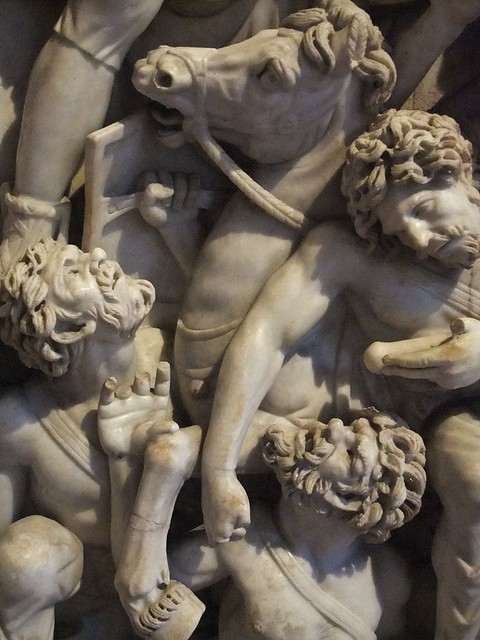
The Ludovisi Battle Sarcophagus depicting Roman conquest
of Barbarians, 2nd - 3rd century CE.  Photographed at the 
Palazzo Altemps, Museo Nazionale Romano, in Rome Italy
by Mary Harrsch.
After I suggested in my review of "Semper Fidelis"  that the antagonist in Ruth Downie's novel, a brutal Centurion named Geminus, may have been suffering from PTSD, Ruth sent me a link to a very thoughtful post by Dr. Dorothy King  entitled  "PTSD in Antiquity."  (Sadly, it is no longer online.)

In my review, I cited a post by Dr. Jonathan Eaton who had generally dismissed the probability that many ancient soldiers suffered from PTSD because modern research points to PTSD being most prevalent in soldiers experiencing explosive events (like IEDs, land mines or booby traps).  He theorizes that since gunpowder or other explosive material was generally not used in ancient warfare, such explosive events did not occur so the probability that PTSD could develop was quite low.  He also pointed to the death-filled environment of the ancient world as something that he felt would desensitize ancient peoples to the trauma of warfare.

Dr. Eaton's viewpoint may have reflected a study done in 2011 by C.W. Hoge. In it, the researchers followed 2,525 soldiers and questioned them three to four months after their return from a year-long deployment in Iraq.

"Of the majority of soldiers who suffered no combat injuries of any sort, 9.1 percent exhibited symptoms consistent with PTSD. This allows a baseline for susceptibility of roughly 10 per cent of the population.  A slightly higher number (16.2 per cent) of those who were injured in some way, but suffered no concussion, also experienced symptoms. As soon as concussive injuries were involved, however, the rates of PTSD climbed dramatically. Although only 4.9 percent of the troops suffered concussions that resulted in complete loss of consciousness, 43.9 percent of these soldiers noted on their questionnaires that they were experiencing a range of PTSD symptons.  Of the 10.3 per cent of the unit who suffered concussion resulting in confusion but retained consciousness, more than a quarter (27.3 per cent) suffered symptoms. This suggests a high correlation between head trauma and the occurrence of subsequent psychological problems." - Aislinn Melchior, Caesar in Vietnam: Did Roman Soldiers Suffer from Post-Traumatic Stress Disorder

 Melchior admits that concussion is not the only risk factor for PTSD but says it is so strongly correlated that it suggests the incidence of PTSD may have risen sharply with the arrival of gunpowder, shells, and plastic explosives.

"In Roman warfare, wounds were most often inflicted by edged weapons. Romans did of course experience head trauma, but the incidence of concussive injuries would have been limited both by the types of weapons they faced and by the use of helmets." - Aislinn Melchior, Caesar in Vietnam: Did Roman Soldiers Suffer from Post-Traumatic Stress Disorder

In his footnotes, Melchior speculates that the Romans designed their helmets with an eye to blunting the force of the blows they most often encountered.  Although Peter Connolly argued that the helmet design in the Republican period suggested a crouched fighting stance, Melchior disagrees suggesting the change in helmet design at that point may have signaled instead a shift in the role of troops from performing assaults on towns and fortifications when the empire was expanding and the blows would more often rain from above to the defense and guarding of the frontiers.

Melchior, like Eaton, also speculates that death was so common in the ancient world that it desensitized many of its residents to the prospect of unexpected death.

But in his 1999 paper entitled "The Cultural Politics of Public Spectacle in Rome and the Greek East in 167-166 BCE"  Jonathan C. Edmondson points out that when King Antiochus IV introduced Roman-style gladiatorial combats in Syria in 166 BCE, the Syrians were terrified rather than entertained.
"In time gladiatorial contests came to be accepted and even popular, but only after Antiochus had instituted a local variation whereby fights sometimes ended as soon as a gladiator was wounded."
This hardly sounds like people desensitized to death.

Dr. King also disagrees pointing to the fact that she, a diagnosed victim of PTSD, had never experienced an explosive event and she knew of a military general diagnosed with PTSD that had never been near explosive devices either.  She was particularly impressed with the research of Jonathan Shay summarized in his book " Achilles in Vietnam: Combat Trauma and the Undoing of Character . 


Shay's work has now been made into a poignant documentary entitled "Odysseus in America." 

In another of King's articles, "The Rage of Achilles and PTSD". King discusses what she feels (and I concur) are clear examples of PTSD in the ancient texts.  Her post opens with a moving passage from Homer:


Then said Achilles, "Son of Atreus, king of men Agamemnon, see to these matters at some other season, when there is breathing time and when I am calmer. Would you have men eat while the bodies of those whom Hector son of Priam slew are still lying mangled upon the plain? Let the sons of the Achaeans, say I, fight fasting and without food, till we have avenged them; afterwards at the going down of the sun let them eat their fill. As for me, Patroclus is lying dead in my tent, all hacked and hewn, with his feet to the door, and his comrades are mourning round him. Therefore I can think of nothing but slaughter and blood and the rattle in the throat of the dying."
Iliad 19.226
Then she goes on to examine descriptions of the behaviors of such ancient military men as a Greek warrior at Marathon, Leonidas at Thermopylae, Alexander the Great and Gaius Marius, all supported by quotes from the ancient sources.

So, I was gratified to find another scholar with personal experience with PTSD who also disagrees with Eaton and Melchior.   

Recently, scholars studying cuneiform medical texts left behind by ancient Mesopotamians point to passages describing mental disorders expressed by soldiers and even a king during the Assyrian Period (1300–609 BCE) when military activity was extremely frequent and brutal. The King of Elam is said to have had his mind changed.  Soldiers were described as suffering from periods where they were forgetful, their words were unintelligible, they would wander about, and suffer regular bouts of depression.

"If in the evening, he sees either a living person or a dead person or someone known to him or someone not known to him or anybody or anything and becomes afraid; he turns around but, like one who has [been hexed with?] rancid oil, his mouth is seized so that he is unable to cry out to one who sleeps next to him..." - Translation by Scurlock and Andersen, Diagnoses in Assyrian and Babylonian Medicine

"As seen in the cases of military casualties, the signs and symptoms of the victim were attributed by the ancient Mesopotamians to ghosts, as was the case with many mental and psychosomatic disorders seen during that period. It looks as if, in the case of military casualties, the responsible ghosts were usually assumed by the treating ašipu to be the ghosts of the enemies whom the patient had killed during military operations..."

"...Generally, the symptoms described fit the symptoms of post-traumatic stress disorder as we understand them now. The flashbacks of images of dead people, particularly those occurring at night (in the form of nightmares) and accompanied by fear, are an important symptom. The changes of mental state with fear, forgetfulness and depression are also symptoms that we see often in
clinical practice. - Walid Khalid Abdul-Hamid and Jamie Hacker Hughes, Nothing New under the Sun: Post-Traumatic Stress Disorders in the Ancient World (2015)

I would like to take all of their observations just a few steps further and point to even more recent findings that I feel call into question the "explosive events as the primary cause of PTSD" theory.

I think the results of the autopsy of one of the NFL players who recently committed suicide is particularly significant.  The news reported that the individual had significant brain damage from repeated concussions suffered not from explosive events but from the impacts experienced during a series of football games.  If you consider the repeated impacts ancient soldiers experienced in set piece battles where tight formations were used, such as Greek or Macedonian phalanxes or Roman maniples, the probability of the occurrence of repeated concussions similar to those experienced by modern football players is quite high.  The news program went on to interview the football player's family and they discussed how he had deteriorated mentally from an outgoing, very social individual to a sullen, withdrawn person who no longer found life fulfilling.  As the spouse of a war veteran who has been permanently disabled by severe PTSD, I found the symptoms described by the football player's family all too familiar.

I also think Eaton and Melchior dismiss too readily the psychological aspects of PTSD in the ancient world because of their observations that the ancient world was a far more brutal environment than we have now (outside of inner city ghettos).  They point out how people were surrounded by death because of disease, accidents without proper medical treatment, and entertainments that featured the orchestrated deaths of both people and animals.  I propose that observed deaths occurring in a venue where the observer and the participants are separated both by physical barriers and social hierarchy (most human victims were criminals, prisoners of war, "Others" so to speak, or slaves, those whose social status separated them from the vast number of citizens in the audience) are distinctly different when compared to violent deaths of friends, family members, and comrades, your "band of brothers," fighting right beside you in a person-to-person battle scenario.

Furthermore, ancient executions were designed to further distance the audience from the victim through the use of mythological reenactments or by placement outside the city.

"Crucifixions were usually carried out outside the city limits thus stressing the victims rejection from the civic community. Because of the absence of bloodshed out of an open and lethal wound, which evoked the glorious fate of warriors, this type of death was considered unclean, shameful, unmanly, and unworthy of a freeman. In addition the victim was usually naked. Essential, too, was the fact that the victim lost contact with the ground which was regarded as sacrilegious." - J.J. Aubert, "A Double Standard in Roman Criminal Law?" from "Speculum Juris: Roman Law as a Reflection of Social and Economic Life in Antiquity"

We also cannot forget the medical personnel either.  Following the Vietnam War, many veterans (both male and female) who served in a medical capacity were later found to be suffering from PTSD.  The medical environment of an ancient treatment facility following a major ancient battle was far worse than in a modern field hospital.  Ancient surgeons attempted to treat often thousands of wounded in a relatively short time compared to only handfuls at a time during the Vietnam conflict.  Ancient physicians were surprisingly quite skilled, especially Roman military surgeons, but they had little but herbal compounds (and honey if the Romans listened to the Egyptian physicians) to ward off infections.  Their patients' mortality rate was much higher than the relatively low mortality rate experienced in Vietnam.  So, how could they have escaped the effects of PTSD, often after years of service, not "just" 6 - 12 months - more than enough to trigger PTSD in modern warfare?

Psychotherapist Alan Greaves in his paper, "Post Traumatic Stress Disorder (PTSD) in Ancient Greece: A Methodological Review" points out that identifying the characteristic behaviors associated with PTSD in an ancient culture is particularly problematic because of socio-cultural factors such as social taboos on men crying or the abrogation of suicide.

"...we do not know how common or acceptable somatisation or the outward expression of any of the other psychological symptoms of PTSD would have been in ancient Greece, which in itself was made up of many differing local cultures or communities."

Greaves does acknowledge, though, that there is enough description in historical sources to point to a recognizable human response to traumatic stress in earlier ages.

"...the fact that PTSD has been identified, to various degrees and variously expressed, across different ethnic and cultural groups does indicate that the human species is naturally predisposed towards reaction formation following episodes of traumatic stress. As discussed above, there would appear to be some evidence that Conversion Disorder was present in Greece in the 1st millennium BC, even if finding similar evidence for PTSD is a more complicated matter because of the nature of our sources and its symptoms and definition. The sheer  prevalence of PTSD across modern populations adds further weight to the argument that it has  been a feature of human experience for a considerable  period of our history, even if the precise form of its expression has varied across contemporary and historical cultures." - Alan Greaves, "Post Traumatic Stress Disorder (PTSD) in Ancient Greece: A Methodological Review"

However, in a 1996 study of emotion, Fischer and Manstead argue: ‘there are both cross-cultural similarities and differences in emotion.’ There is, therefore, no universal human reaction that can be predicted in all circumstances of traumatic stress, but neither are our reactions entirely culturally determined. Bearing in mind the very different incidences and presenting symptoms in different cultures, can we  possibly ever know what PTSD, or any of the other post-traumatic conditions discussed above, would have looked like in ancient Greece?

Perhaps, not. I sometimes wonder, though, if modern scholars think that ancient people just didn't value their lives as much as we do, since they did not shrink from casualties as high as 50,000 in a single military engagement or investment of an enemy city.  But if you've ever looked at some of the poignant grave goods found in ancient burials or studied the reliefs and inscriptions on ancient funerary monuments, I think you will conclude that we are only separated by time, not by our shared human nature.

References:

Abdul-Hamid, W. K., & Hughes, J. H. (2014). Nothing New under the Sun: Post-Traumatic Stress Disorders in the Ancient World. Early Science and Medicine19(6), 549-557. doi:10.1163/15733823-00196p02

Aubert, J.-J, & Sirks, A. J. (2002). A double standard in Roman criminal law? In Specvlvm ivris: Roman law as a reflection of social and economic life in antiquity. Ann Arbor, MI: The University of Michigan Press.

Cook, J. (2012). Crucifixion as Spectacle in Roman Campania. Novum Testamentum, 54(1), 68-100. Retrieved from http://www.jstor.org.libproxy.uoregon.edu/stable/23253630

Edmonson, J. C. (1999). The cultural politics of public spectacle in Rome and the Greek East in 167-166 BCE. Studies in the History of Art56, 76-95.

Fischer, A. and Manstead, A. H. 1996. Emotions. In A. Kuper and J. Kuper (eds.), The Social Science  Encyclopaedia 2nd ed., 239-240. London, Routledge.


Greaves, A. M. (2008). Post Traumatic Stress Disorder (PTSD) in Ancient Greece: A Methodological Review. Warfare and Society in the Ancient Eastern Mediterranean. Retrieved from https://www.academia.edu/6897230/Post-Traumatic_Stress_Disorder_PTSD_in_Ancient_Greece_A_Methodological_Review

A. Melchior (2011). Caesar In Vietnam: Did Roman Soldiers Suffer From Post-Traumatic Stress Disorder. Greece & Rome, 58(2), 209-223. Retrieved from http://www.jstor.org.libproxy.uoregon.edu/stable/41306157

JoAnn Scurlock and Burton Andersen, Diagnoses in Assyrian and Babylonian Medicine: Ancient Sources, Translations, and Modern Medical Analyses (Urbana and Chicago: University of Illinois Press, 2005), Pp. xxiii + 879.


If you enjoyed this post, never miss out on future posts by following me by email!