Nearly every Greek and Roman city of note had an open-air theater consisting of the orchestra, the flat dancing floor of the chorus, and the theatron, the actual structure of the theater building. Vase paintings indicate the stage stood about three feet high with a flight of steps in the center. The actors entered from either side and from a central door in the skene, which also housed the ekkyklema, a wheeled platform with sets of scenes. A mechane, or crane, located at the right end of the stage, was used to hoist gods and heroes through the air onto the stage.
Theatrical performances were usually part of a seasonal festival and were accompanied by processions, sacrifices in the theater, parades, and competitions between playwrights. Almost all Greek tragedies were based on heroic myths although the dialogue between actor and chorus sometimes served an instructional purpose and reflected current debate in the public assembly.
"Unlike the Greek tragedy, the comic performances produced in Athens during the fifth century BCE, the so-called Old Comedy, ridiculed mythology and prominent members of Athenian society. There seems to have been no limit to speech or action in the comic exploitation of sex and other bodily functions. Terracotta figurines and vase paintings dated around and after the time of Aristophanes (450–ca. 387 BCE) show comic actors wearing grotesque masks and tights with padding on the rump and belly, as well as a leather phallus." - Art historian, Colette Hemingway
Comic characters and their masks eventually became standardized indicating the popularity not of a specific figure but of types—the old man, the slave, the courtesan, etc.—that appeared repeatedly in different plays. Terracotta or bronze figurines of these popular characters were often sold as souvenirs. Fourteen such figurines were found in one burial in Attica. Apparently the deceased was either an actor themselves or an avid theater-goer!
"In the second half of the fourth century BCE, the so-called New Comedy of Menander (343–291 BCE) and his contemporaries gave fresh interpretations to familiar material. In many ways comedy became simpler and tamer, with very little obscenity. The grotesque padding and phallus of Old Comedy were abandoned in favor of more naturalistic costumes that reflected the playwrights’ new style. Subtle differentiation of masks worn by the actors paralleled the finer delineation of character in the texts of New Comedy, which dealt with private and family life, social tensions, and the triumph of love in a variety of contexts." - Art historian, Colette Hemingway.
Read more about it:
Hemingway, Colette. “Theater in Ancient Greece.” In Heilbrunn Timeline of Art History. New York: The Metropolitan Museum of Art, 2000–. http://www.metmuseum.org/toah/hd/thtr/hd_thtr.htm (October 2004)
 |
| Terracotta Lamp with seated Comic Actor Greek made in Egypt 125-100 BCE that I photographed at The Getty Villa in Pacific Palisades, California. |
 |
| Roman Terracotta Lamp with Reclining Comic Actor 100-200 CE that that I photographed at The Getty Villa in Pacific Palisades, California. |
 |
| Statuette of a Comic Actor Wearing an Animal Mask Roman 100 BCE-100 CE Bronze that I photographed at The Getty Villa in Pacific Palisades, California. |
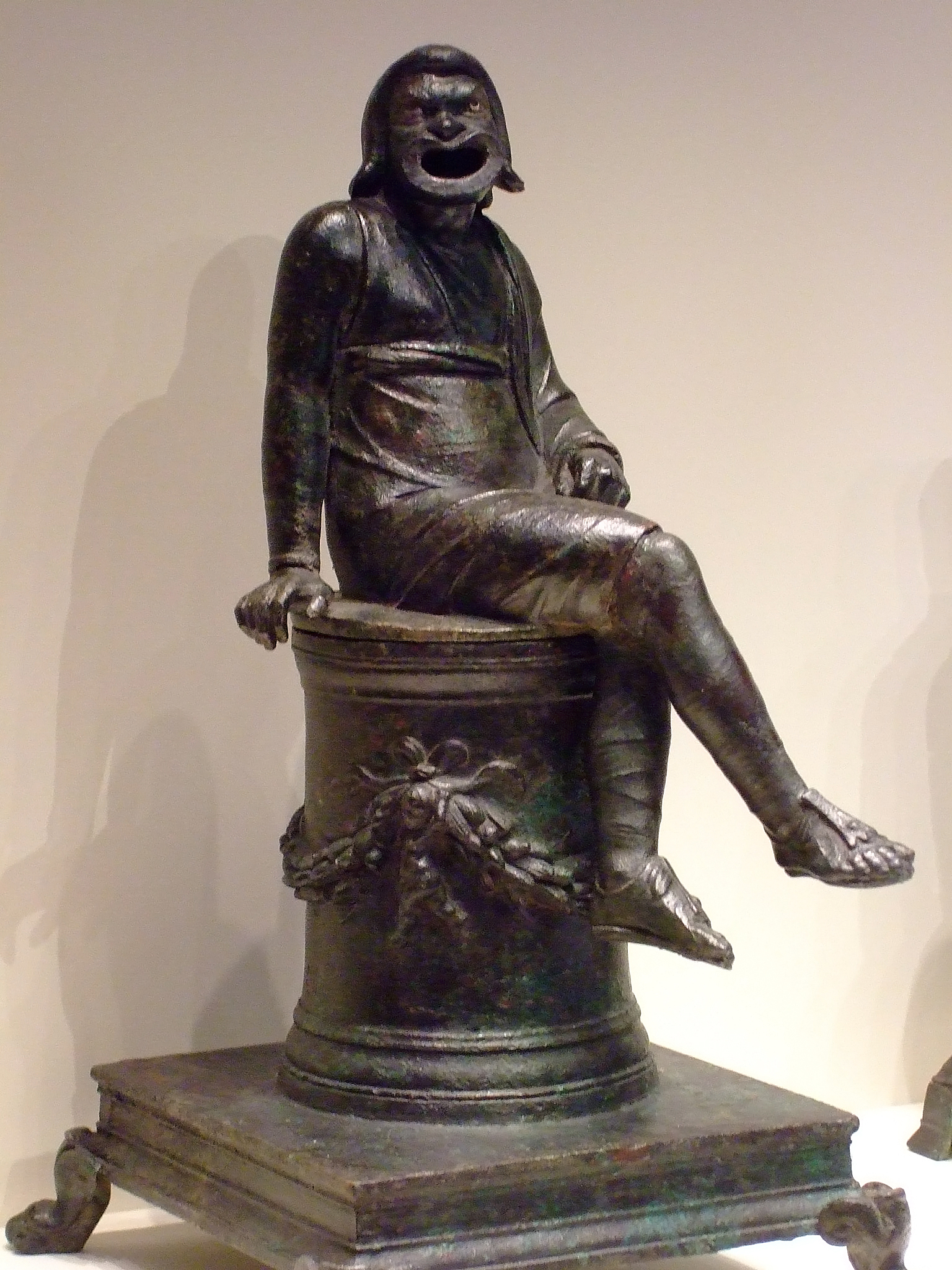 |
| Incense Burner (Thymiaterion) shaped as a Comic Actor Seated on an Altar Roman 1-50 CE Bronze and Silver that I photographed at The Getty Villa in Pacific Palisades, California. |
 |
| Detail from a red-figured Bell Krater with a scene of Phlyax actors Greek made in Apulia South Italy 370-360 BCE attributed to the Cotugno Painter Terracotta that I photographed at The Getty Villa in Pacific Palisades, California. |
 | |
| Bronze furniture decoration in the shape of theater masks Roman Imperial Period that I photographed at the Palazzo Massimo in Rome. |
 |
| The Decumano Max leads to remains of the ancient Roman theater I photographed at Ostia built at the end of the 1st century BCE |
 |
| Architectural elements depicting theater masks that I photographed at the ancient Roman theater in Ostia Antica. |
 | |
| Male comic theater mask Roman 2nd century CE that I photographed at the Terme di Diocleziano in Rome. |
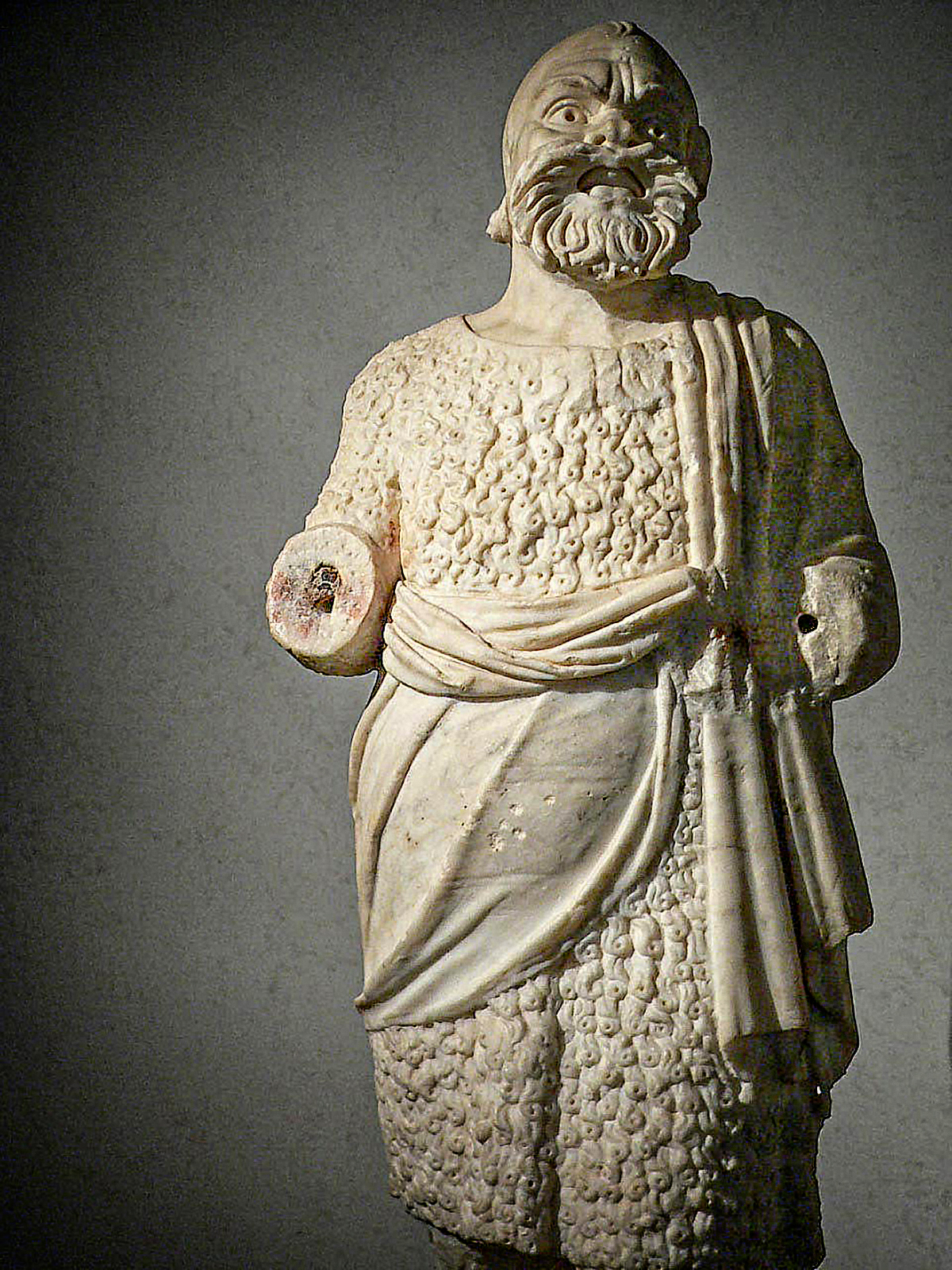 |
| Roman Actor dressed as Papposilenus father of the satyrs from the Villa of Torre Astura 1st century BCE-1st century CE that I photographed at the Palazzo Massimo in Rome. |
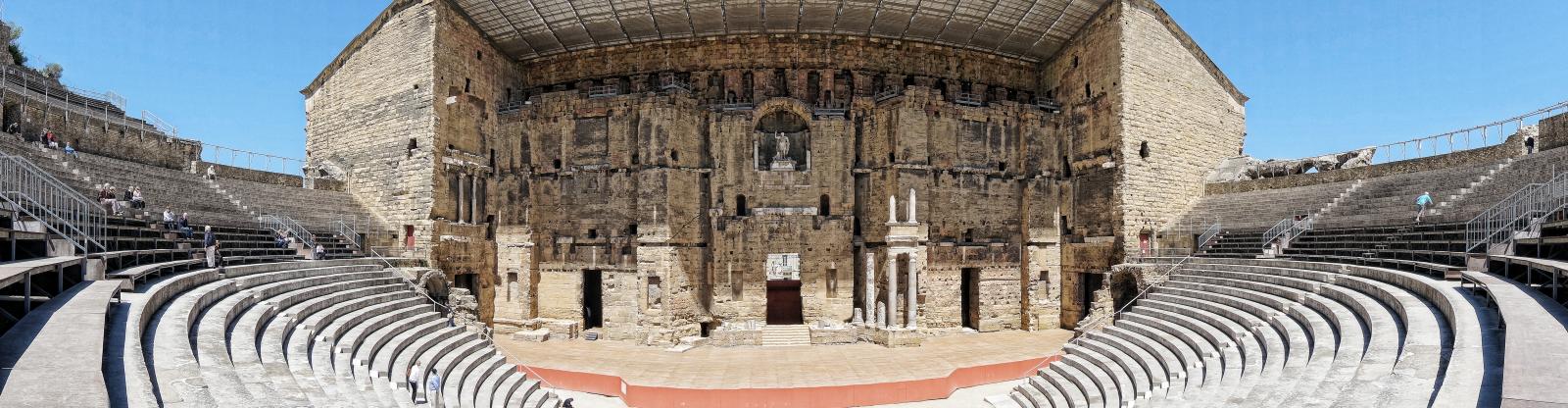 |
| Panoramic view of the ancient Roman theater in Orange, France, a World Heritage Site, 1st century CE that I photographed. |
 | |
| A theater mask carved on the corner of a Roman funerary monument that I photographed at the Musèe de l'Arles Antique in Arles, France. |
 | |
| Terracotta scent bottle in the form of a squatting man, perhaps a comic actor Corinthian from Camirus Rhodes 600-575 BCE that I photographed at The British Museum. |
 |
| Masked actors perform Dyskolos "The Grouch" by Menander at ancient Alexandria's theater, a screenshot I took in Assassin's Creed Origins Discovery Tour. |
 |
| Cleopatra leaves the Greek theater in ancient Alexandria, a screenshot I took in Assassin's Creed Origins Discovery Tour. |
 |
| Terracotta statuette of an actor, late 5th–early 4th century BCE, Greek, at the Metropolitan Museum of Art. |
 |
| Terracotta statuette of an actor, late 5th–early 4th century BCE, Greek, at the Metropolitan Museum of Art. |
 |
| Terracotta statuette of an actor, late 5th–early 4th century BCE, Greek, at the Metropolitan Museum of Art. |
 |
| Terracotta statuette of an actor, late 5th–early 4th century BCE, Greek, at the Metropolitan Museum of Art. |
 |
| Terracotta statuette of an actor, late 5th–early 4th century BCE, Greek, at the Metropolitan Museum of Art. |
 |
| Terracotta statuette of an actor, late 5th–early 4th century BCE, Greek, at the Metropolitan Museum of Art. |


