Showing posts with label tragedy. Show all posts

Sunday, April 18, 2021

Achilles' Ambush of Troilus

All Greek and Etruscan metal rings with engraved bezels ultimately derive from Egyptian and Phoenician cartouche-shaped rings. The cartouche-shaped ring was especially popular in Etruria in the later 500s B.C., where immigrant Greek goldsmiths from Ionia introduced it.

This example features an intricate scene of two men approaching a fountain where water gushes into a vessel from a lion's head spout. Behind the fountain, a man squats as if hiding, holding a sword. These details identify the scene as a standard depiction of the ambush of Troilos (Troilus), prince of Troy, by the Greek hero Achilles during the Trojan War. On this ring, however, a strange dog-headed creature, who is not part of the Troilos myth, sits atop the fountain. The creature may actually be jackal-headed and thus meant to recall the Egyptian god Anubis harking back to the origin of such rings from Egypt.

Prophecies retold in the Iliad link the fate of Troilos, one of the sons of King Priam (or Apollo in some versions of Greek myth), with the fate of Troy itself. Ancient writers including Sophocles treated Troilos, a paragon of youthful male beauty, as the epitome of a dead child mourned by his parents. 

 Only 54 words have been identified as coming from Sophocles' play, Troilos.  Fragment 619 refers to Troilos as an andropais, a man-boy. (A fragment from the 6th century tragic poet Phyrnichus refers to Troilus as possessing the light of love glowing on his reddening cheeks) Fragment 621 indicates that Troilos was going to a spring with a companion to fetch water or to water his horses but a scholion (explanatory comment) to the Iliad states that Sophocles relates how Troilos was ambushed by Achilles while exercising his horses in the Thymbra. Fragment 623 indicates that Achilles mutilated Troilos' corpse by a gruesome method known as maschalismos. This involved preventing the ghost of a murder victim from returning to haunt their killer by cutting off the corpse's extremities and stringing them under its armpits. 

Considering Troilos, according to many versions and interpretations, was still a child, Achilles' behavior was beyond the pale. Greek heroes were not always heroic!

Gold finger ring depicting Achilles' Ambush of Troilos, Etruscan, 550-500 BCE, at the J. Paul Getty Museum, image courtesy of the museum.

Red-figured bell-krater depicting Achilles in wait for Troilos. Troilos leads up a mule to drink, with right arm over its back. He is represented as a child, with curls in front of his ears, chlamys over left shoulder, petasos hanging from neck, in left hand two spears. Mid-fifth to third centuries BCE, British Museum.

Roman relief from a statue of Germanicus, 2nd c. CE, depicting the ambush of Troilos, Archeological Museum of Perugia courtesy of Wikimedia Commons contributor Haiduc.

Achilles ambushing Troilos and Polyxena, shoulder of an Attic black-figure hydria, 560-550 BCE at the Metropolitan Museum of Art courtesy of Wikimedia Commons contributor Marie-Lan Nguyen.

Image: Achilles (left) ambushing Troilus (on horseback, right). Etruscan fresco, Tomb of the Bulls, Tarquinia, 530–520 BCE courtesy of Wikimedia Commons.
If you enjoyed this post, never miss out on future posts by following me by email!


Tuesday, January 19, 2021

Megarian bowls

Relief-decorated pottery with scenes from epic poetry and from Classical Greek tragedy became more popular than painted pottery during the Hellenistic period. The name Megarian was first given to this type of mold-made relief bowl in the late nineteenth century, because some of the first known examples were said to have come from the city of Megara. It has since been demonstrated that bowls of this type, which were produced at a number of different centers, originated in Athens in the third quarter of the third century B.C.E. - Metropolitan Museum of Art

Unlike earlier, wheelmade wares with surfaces decorated only with slip, paint, and glaze, these bowls were made in stamp-decorated molds that added decoration in relief. This method of manufacture gave the vessels an embossed effect that may have been intended to imitate metalwork. The vessels were thrown on a potter's wheel while inside the mold in order to produce a smooth and even inner surface while allowing the outside to pick up the pattern of the mold clearly.  The molds themselves were made on the wheel and decorated on the interior with stamps. These bowls functioned as drinking cups and replaced the earlier kantharos shape. - Summer Trentin and Debby Sneed, University of Colorado

Such bowls depicting mythological scenes as well as floral bowls with figures like Eros were produced in the 3rd to 2nd century BCE.  In the 2nd century BCE, though, the floral and figural bowls were replaced by a more stylized type with repeated petal-like motifs referred to as "Long-Petal Bowls." 

In Italy, these thin-walled molded bowls became known as "Popilius" bowls since a number of them signed by C. Popilius have been discovered around workshops in Umbria, north of Rome on the Via Flaminia.  However, other workshops of different potters have been found in Tivoli, Cosa, and Arezzo. Some scholars point to a shift from controlled to more dramatic naturalism in their decoration.


Terracotta Megarian bowl, 2nd century B.C.E., Boeotian, at the Metropolitan Museum of Art depicting a scene from Euripides' play "Iphigenia at Aulis", a messenger, Agamemnon, who has weakened in his resolve to sacrifice his daughter to Artemis, biding his slave to take a letter to his wife, Clytemnestra, instructing her not to send her daughter to Aulis.

 
Terracotta Megarian bowl, 2nd century B.C.E., Boeotian, at the Metropolitan Museum of Art depicting a scene from Euripides' play "Iphigenia at Aulis", Agamemnon's brother, taking the letter from the messenger by force; Menelaos, with the letter in hand, blaming Agamemnon for refusing to go through with the sacrifice.

Terracotta Megarian bowl, 2nd century B.C.E., Boeotian, at the Metropolitan Museum of Art depicting a scene from Euripides' play "Iphigenia at Aulis", a messenger, bringing news to Agamemnon that Iphigenia has arrived

Terracotta Megarian bowl, 2nd century B.C.E., Boeotian, at the Metropolitan Museum of Art depicting a scene from Euripides' play "Iphigenia at Aulis", the cart that has come from Argos, bearing Queen Clytemnestra and her children, Iphigenia and the little Orestes. The story would have been continued on additional bowls.

Terracotta Megarian bowl, Greek, 165-100 BCE at the Metropolitan Museum of Art in New York.

Terracotta Megarian bowl, Greek, 165-100 BCE at the Metropolitan Museum of Art in New York.

Megarian bowl from a Rhodian workshop depicting scenes from the Trojan War and the Odyssey, 3d/2nd century B.C.E. at the antinkensammlung Museum in Berlin, Germany courtesy of Wikimedia Commons contributor Marcus Cyron.

Nike crowning a trophy, Poseidon, Ariadne with Dionysos supported by a satyr, and Athena with shield and spear, Terracotta Megarian bowl, 2nd century B.C.E. at the Metropolitan Museum of Art in New York.

The reddish-brown glaze of this bowl suggests it was made in Asia Minor, and perhaps more specifically, Pergamon. Red-ware, as this type of pottery is called, had a relatively short period of production. It was ultimately supplanted by red-glossed Roman terra-sigillata and Arrentine pottery beginning around the middle of the 1st century B.C.E. Courtesy of the Metropolitan Museum of Art in New York.

Relief-moulded black Megarian bowl, c. 225-175 BCE at the British Museum, courtesy of Wikimedia Commons contributor AgTigress.

Megarian bowl With Dionysiac thiasos from ancient Epidaurus at the Archaeological Museum of Nafplion, 200-150 BCE, courtesy of Wikimedia Commons contributor Zde.

Megarian bowl from a Macedonian workshop depicting the homecoming of Odysseus; 3d/2nd century B.C.E. at the Antikensammlung Museum in Berlin, Germany courtesy of Wikimedia Commons. (digitally enhanced)


If you enjoyed this post, never miss out on future posts by following me by email!


Monday, January 18, 2021

Ancient theater in Greece and Rome

Nearly every Greek and Roman city of note had an open-air theater consisting of the orchestra, the flat dancing floor of the chorus, and the theatron, the actual structure of the theater building. Vase paintings indicate the stage stood about three feet high with a flight of steps in the center. The actors entered from either side and from a central door in the skene, which also housed the ekkyklema, a wheeled platform with sets of scenes. A mechane, or crane, located at the right end of the stage, was used to hoist gods and heroes through the air onto the stage.  

Theatrical performances were usually part of a seasonal festival and were accompanied by processions, sacrifices in the theater, parades, and competitions between playwrights. Almost all Greek tragedies were based on heroic myths although the dialogue between actor and chorus sometimes served an instructional purpose and reflected current debate in the public assembly.

"Unlike the Greek tragedy, the comic performances produced in Athens during the fifth century BCE, the so-called Old Comedy, ridiculed mythology and prominent members of Athenian society. There seems to have been no limit to speech or action in the comic exploitation of sex and other bodily functions. Terracotta figurines and vase paintings dated around and after the time of Aristophanes (450–ca. 387 BCE) show comic actors wearing grotesque masks and tights with padding on the rump and belly, as well as a leather phallus." - Art historian, Colette Hemingway

Comic characters and their masks eventually became standardized indicating the popularity not of a specific figure but of types—the old man, the slave, the courtesan, etc.—that appeared repeatedly in different plays. Terracotta or bronze figurines of these popular characters were often sold as souvenirs. Fourteen such figurines were found in one burial in Attica. Apparently the deceased was either an actor themselves or an avid theater-goer!

"In the second half of the fourth century BCE, the so-called New Comedy of Menander (343–291 BCE) and his contemporaries gave fresh interpretations to familiar material. In many ways comedy became simpler and tamer, with very little obscenity. The grotesque padding and phallus of Old Comedy were abandoned in favor of more naturalistic costumes that reflected the playwrights’ new style. Subtle differentiation of masks worn by the actors paralleled the finer delineation of character in the texts of New Comedy, which dealt with private and family life, social tensions, and the triumph of love in a variety of contexts." - Art historian, Colette Hemingway.

Read more about it:

Hemingway, Colette. “Theater in Ancient Greece.” In Heilbrunn Timeline of Art History. New York: The Metropolitan Museum of Art, 2000–. http://www.metmuseum.org/toah/hd/thtr/hd_thtr.htm (October 2004)

Terracotta Lamp with seated Comic Actor Greek made in Egypt 125-100 BCE that I photographed at The Getty Villa in Pacific Palisades, California.

Roman Terracotta Lamp with Reclining Comic Actor 100-200 CE that that I photographed at The Getty Villa in Pacific Palisades, California.

Statuette of a Comic Actor Wearing an Animal Mask Roman 100 BCE-100 CE  Bronze that I photographed at The Getty Villa in Pacific Palisades, California.

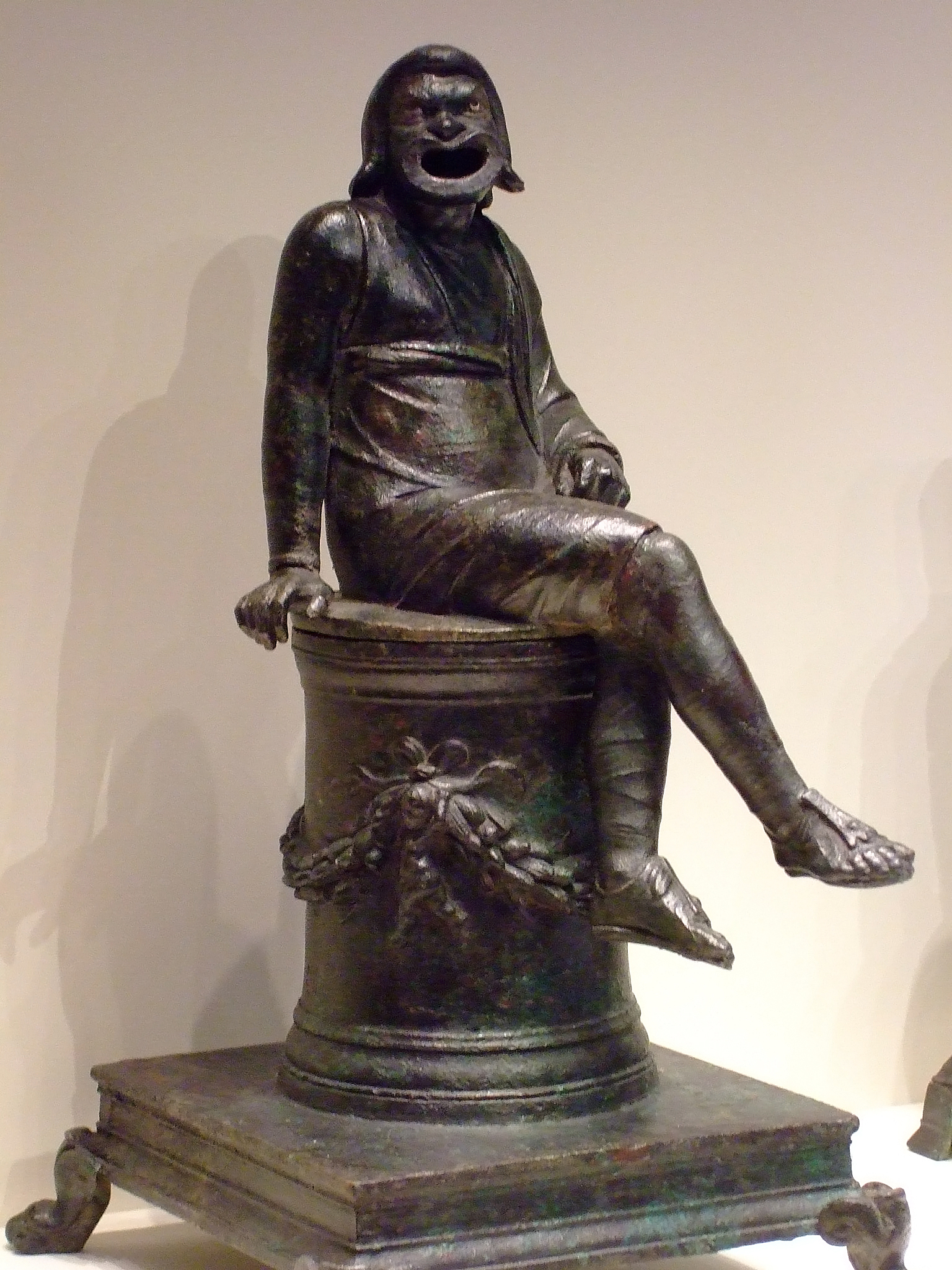
Incense Burner (Thymiaterion) shaped as a Comic Actor Seated on an Altar Roman 1-50 CE Bronze and Silver that I photographed at The Getty Villa in Pacific Palisades, California.

Detail from a red-figured Bell Krater with a scene of Phlyax actors Greek made in Apulia South Italy 370-360 BCE attributed to the Cotugno Painter Terracotta that I photographed at The Getty Villa in Pacific Palisades, California.

Bronze furniture decoration in the shape of theater masks Roman Imperial Period that I photographed at the Palazzo Massimo in Rome.


The Decumano Max leads to remains of the ancient Roman theater I photographed at Ostia built at the end of the 1st century BCE 

Architectural elements depicting theater masks that I photographed at the ancient Roman theater in Ostia Antica.

Male comic theater mask Roman 2nd century CE that I photographed at the Terme di Diocleziano in Rome.


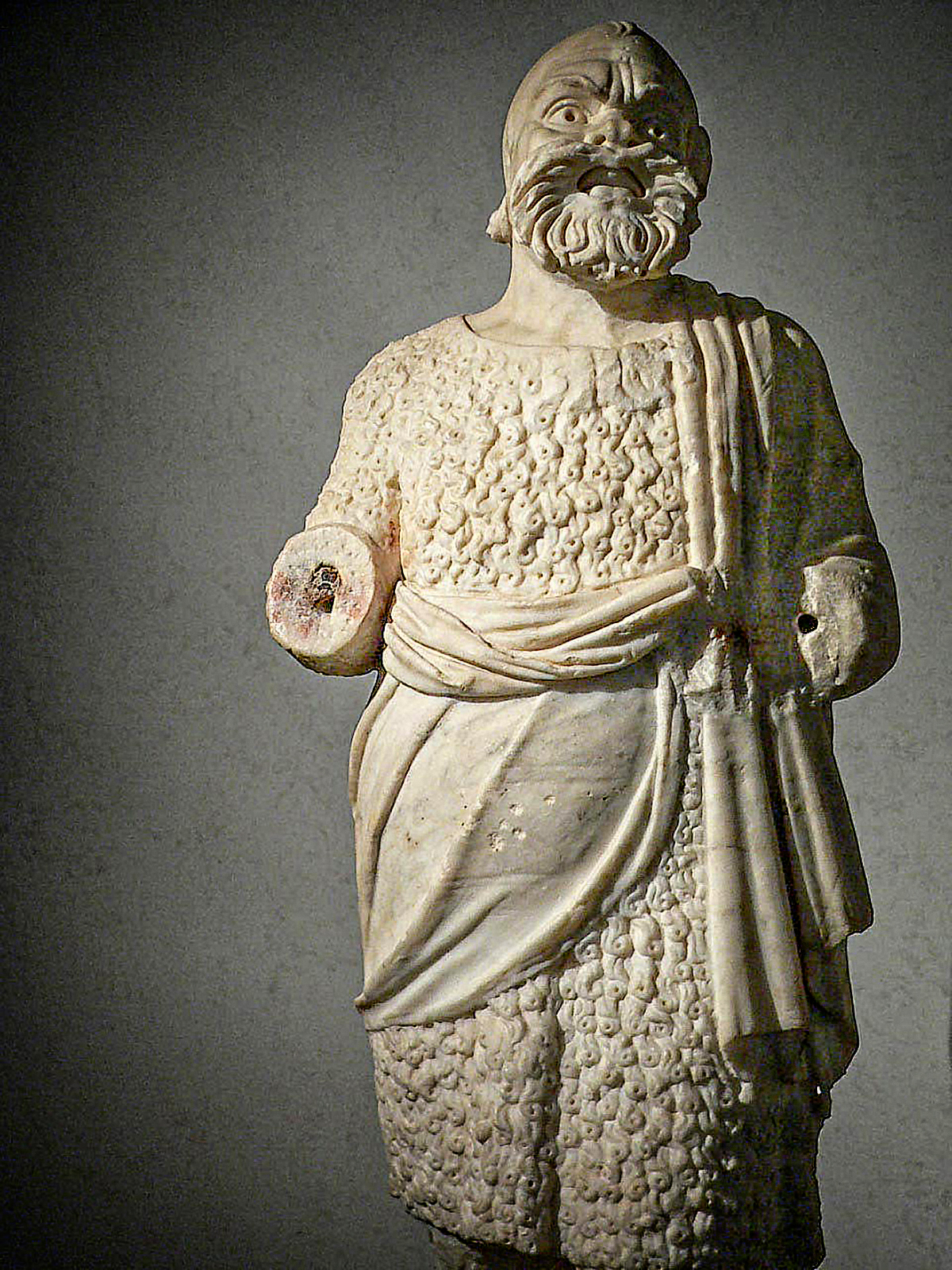
Roman Actor dressed as Papposilenus father of the satyrs from the Villa of Torre Astura 1st century BCE-1st century CE that I photographed at the Palazzo Massimo in Rome.

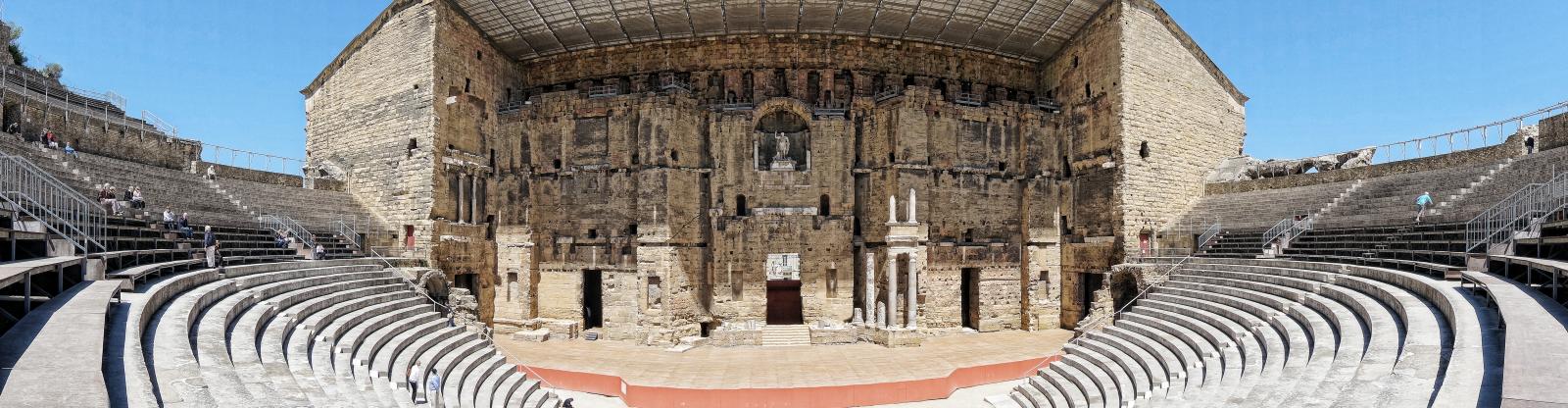
Panoramic view of the ancient Roman theater in Orange, France, a World Heritage Site, 1st century CE that I photographed.

A theater mask carved on the corner of a Roman funerary monument that I photographed at the Musèe de l'Arles Antique in Arles, France.


Terracotta scent bottle in the form of a squatting man, perhaps a comic actor  Corinthian from Camirus Rhodes 600-575 BCE that I photographed at The British Museum.


Masked actors perform Dyskolos "The Grouch" by Menander at ancient Alexandria's theater, a screenshot I took in Assassin's Creed Origins Discovery Tour.

Cleopatra leaves the Greek theater in ancient Alexandria, a screenshot I took in Assassin's Creed Origins Discovery Tour.

Terracotta statuette of an actor, late 5th–early 4th century BCE, Greek, at the Metropolitan Museum of Art.

Terracotta statuette of an actor, late 5th–early 4th century BCE, Greek, at the Metropolitan Museum of Art.

Terracotta statuette of an actor, late 5th–early 4th century BCE, Greek, at the Metropolitan Museum of Art.

Terracotta statuette of an actor, late 5th–early 4th century BCE, Greek, at the Metropolitan Museum of Art.

Terracotta statuette of an actor, late 5th–early 4th century BCE, Greek, at the Metropolitan Museum of Art.

Terracotta statuette of an actor, late 5th–early 4th century BCE, Greek, at the Metropolitan Museum of Art.


If you enjoyed this post, never miss out on future posts by following me by email!


Sunday, November 15, 2020

Roman theater and Seneca's tragedies

Roman theater began to develop following the devastation of a widespread plague in 364 BCE. Roman citizens began including theatrical presentations as a supplement to the Lectisternium ceremonies, religious propitiatory meals, in a stronger effort to pacify the gods. In the years following the establishment of these practices, actors began adapting these dances and games into performances by acting out texts set to music and simultaneous movement.

As the era of the Roman Republic progressed, citizens began including professionally performed drama in the eclectic offerings of the ludi (celebrations of public holidays) held throughout each year—the largest of these festivals being the Ludi Romani, held each September in honor of the Roman god Jupiter. It was as a part of the Ludi Romani in 240 BCE that author and playwright Livius Adronicus became the first to produce translations of Greek plays to be performed on the Roman stage.

In the 1st century CE, Seneca, the famous Stoic philosopher and tutor to the emperor Nero, wrote tragedies that used a declamatory style emphasizing rhetoric. These works sought to reflect the soul of a tragic character by using rhetoric to reveal something about the state of the character's mind. One of the most notable ways that Seneca developed a tragedy, was through the use of an aside, a common theatre device in Hellenistic drama, but, at the time, foreign to the world of Attic tragedy. Seneca used 'self-representational soliloquies or monologues,' which focused on one's inner thoughts, the central causes of their emotional conflicts, their self-deception, as well as other varieties of psychological turmoil to dramatize emotion in a way that became central to Roman tragedy, distinguishing it from prior forms of Greek tragedy. Perhaps this figure represented a  rhetorician in one of Seneca's dramas.

Of course one of the most eye-catching aspects of this figure is the very short tunic and cloak he wears. The length of a Roman tunic indicated the wearer's social status.  Soldiers, manual workers, and even slaves usually wore tunics that reached to just a little above the knee.  Actors, however, were considered "infamia," an official exclusion from the legal protections enjoyed by a Roman citizen that included corporal punishment, usually reserved for slaves. This lowly status is reflected in the length of this figure's garments.


Image: Bronze statuette of a draped man thought to be an actor, 1st century BCE - 1st century CE, Greek or Roman, courtesy of the Metropolitan Museum of Art. This impressive statuette shows a mature, bearded man who stands purposefully and looks upward. The cloak that covers his torso also conceals his arms, bent forward over his chest. Proposed identifications have linked him with the theater, specifically as an actor declaiming a text rather than playing a role. - Metropolitan Museum of Art


If you enjoyed this post, never miss out on future posts by following me by email!