An online magazine about current archaeology and classical research into the lives of inhabitants of the Roman Empire and Byzantium and the civilizations around them.
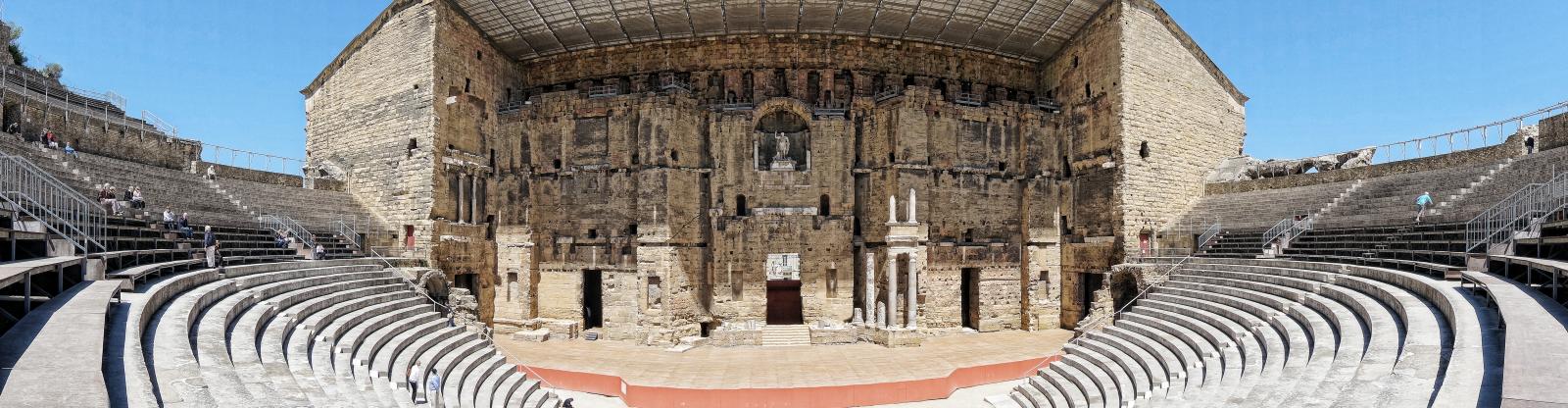
Nearly every Greek and Roman city of note had an open-air theater consisting of the orchestra, the flat dancing floor of the chorus, and the theatron, the actual structure of the theater building. Vase paintings indicate the stage stood about three feet high with a flight of steps in the center. The actors entered from either side and from a central door in the skene, which also housed the ekkyklema, a wheeled platform with sets of scenes. A mechane, or crane, located at the right end of the stage, was used to hoist gods and heroes through the air onto the stage.
Theatrical performances were usually part of a seasonal festival and were accompanied by processions, sacrifices in the theater, parades, and competitions between playwrights. Almost all Greek tragedies were based on heroic myths although the dialogue between actor and chorus sometimes served an instructional purpose and reflected current debate in the public assembly.
"Unlike the Greek tragedy, the comic performances produced in Athens during the fifth century BCE, the so-called Old Comedy, ridiculed mythology and prominent members of Athenian society. There seems to have been no limit to speech or action in the comic exploitation of sex and other bodily functions. Terracotta figurines and vase paintings dated around and after the time of Aristophanes (450–ca. 387 BCE) show comic actors wearing grotesque masks and tights with padding on the rump and belly, as well as a leather phallus." - Art historian, Colette Hemingway
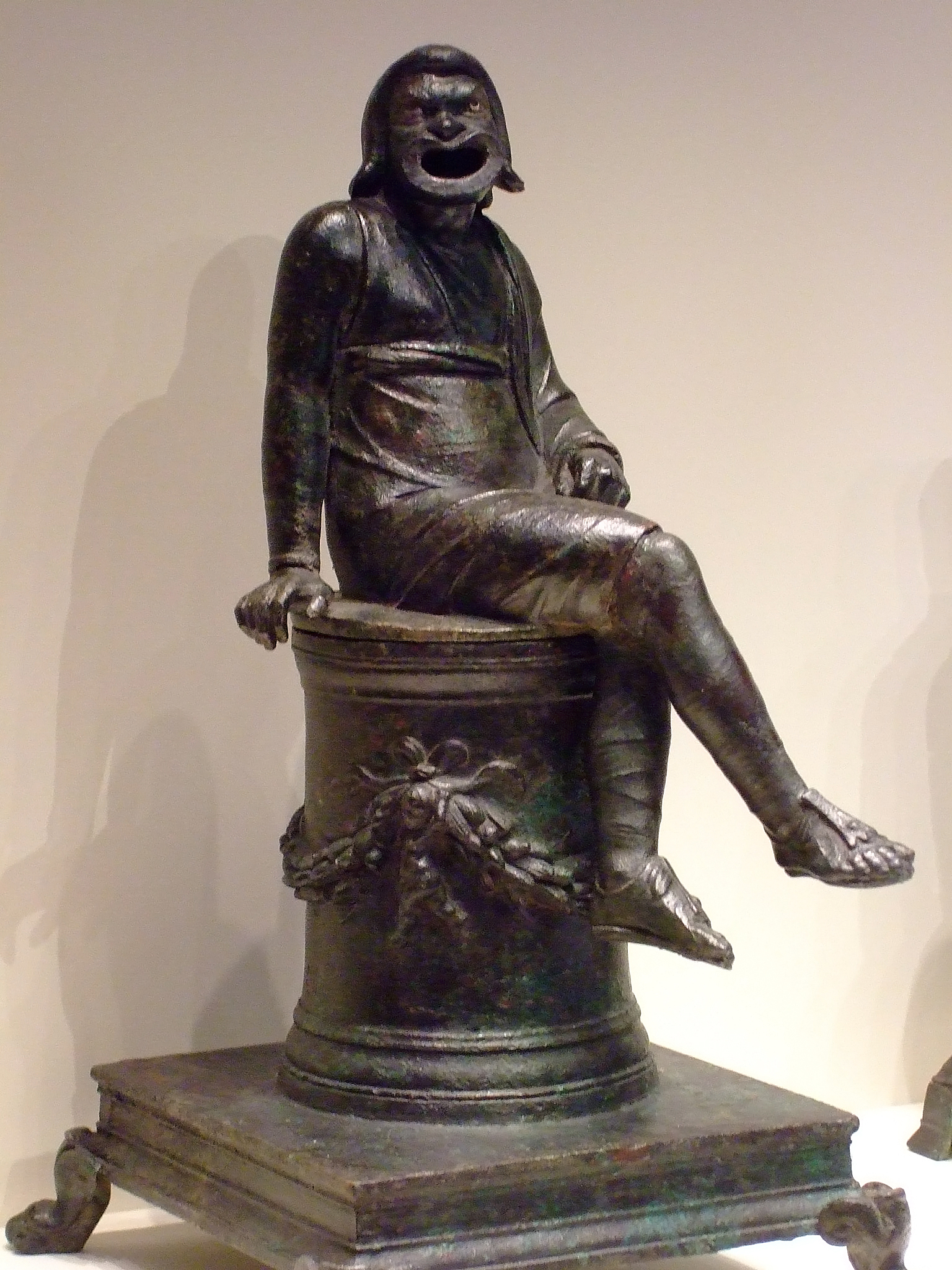
Comic characters and their masks eventually became standardized indicating the popularity not of a specific figure but of types—the old man, the slave, the courtesan, etc.—that appeared repeatedly in different plays. Terracotta or bronze figurines of these popular characters were often sold as souvenirs. Fourteen such figurines were found in one burial in Attica. Apparently the deceased was either an actor themselves or an avid theater-goer!
"In the second half of the fourth century BCE, the so-called New Comedy of Menander (343–291 BCE) and his contemporaries gave fresh interpretations to familiar material. In many ways comedy became simpler and tamer, with very little obscenity. The grotesque padding and phallus of Old Comedy were abandoned in favor of more naturalistic costumes that reflected the playwrights’ new style. Subtle differentiation of masks worn by the actors paralleled the finer delineation of character in the texts of New Comedy, which dealt with private and family life, social tensions, and the triumph of love in a variety of contexts." - Art historian, Colette Hemingway.
Read more about it:
Hemingway, Colette. “Theater in Ancient Greece.” In Heilbrunn Timeline of Art History. New York: The Metropolitan Museum of Art, 2000–. http://www.metmuseum.org/toah/hd/thtr/hd_thtr.htm (October 2004)
Terracotta Lamp with seated Comic Actor Greek made in Egypt 125-100 BCE that I photographed at The Getty Villa in Pacific Palisades, California.
Roman Terracotta Lamp with Reclining Comic Actor 100-200 CE that that I photographed at The Getty Villa in Pacific Palisades, California.
Statuette of a Comic Actor Wearing an Animal Mask Roman 100 BCE-100 CE Bronze that I photographed at The Getty Villa in Pacific Palisades, California.
Incense Burner (Thymiaterion) shaped as a Comic Actor Seated on an Altar Roman 1-50 CE Bronze and Silver that I photographed at The Getty Villa in Pacific Palisades, California.
Detail from a red-figured Bell Krater with a scene of Phlyax actors Greek made in Apulia South Italy 370-360 BCE attributed to the Cotugno Painter Terracotta that I photographed at The Getty Villa in Pacific Palisades, California.
Bronze furniture decoration in the shape of theater masks Roman Imperial Period that I photographed at the Palazzo Massimo in Rome.
The Decumano Max leads to remains of the ancient Roman theater I photographed at Ostia built at the end of the 1st century BCE
Architectural elements depicting theater masks that I photographed at the ancient Roman theater in Ostia Antica.
Male comic theater mask Roman 2nd century CE that I photographed at the Terme di Diocleziano in Rome.
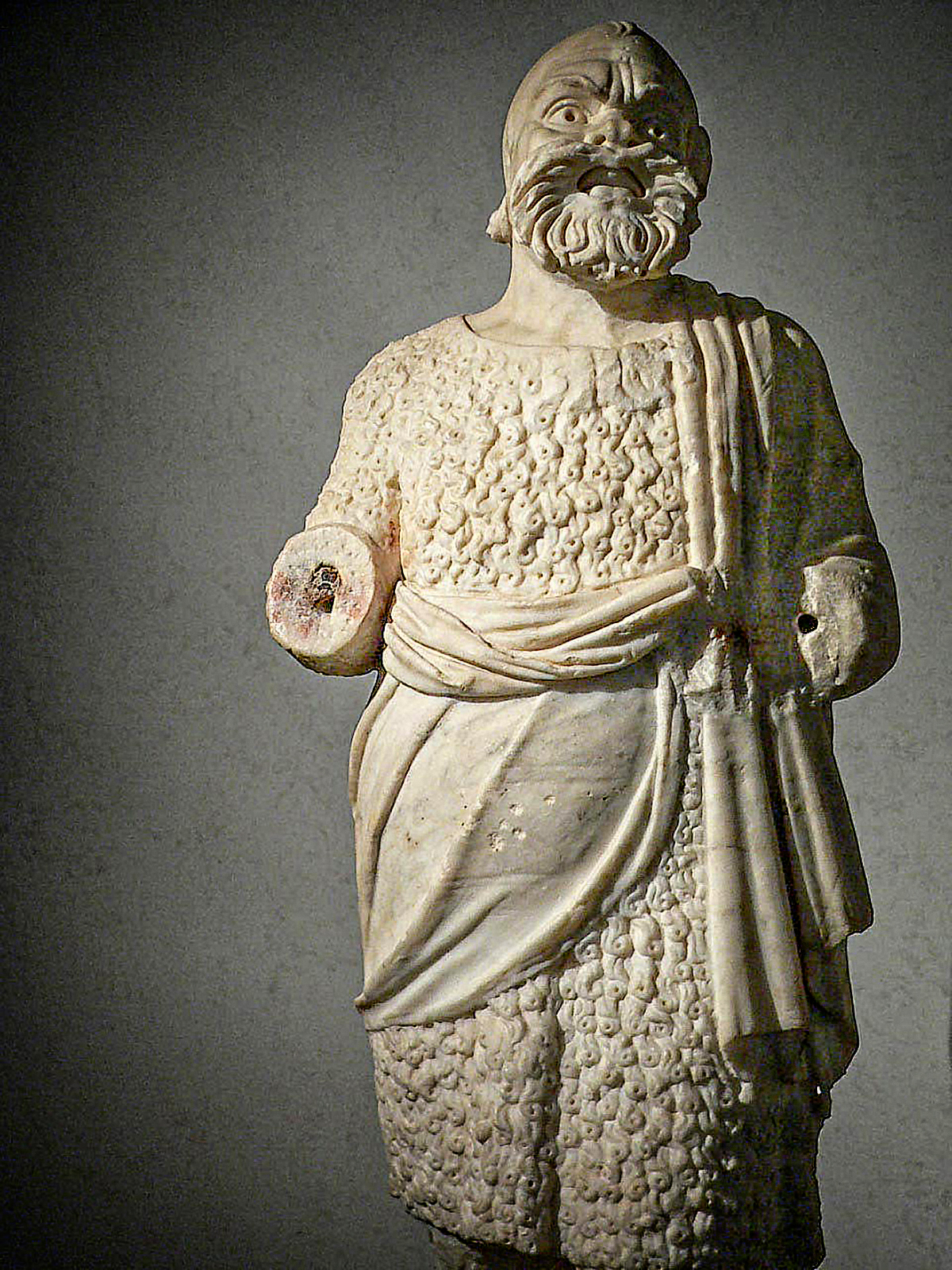
Roman Actor dressed as Papposilenus father of the satyrs from the Villa of Torre Astura 1st century BCE-1st century CE that I photographed at the Palazzo Massimo in Rome.
Panoramic view of the ancient Roman theater in Orange, France, a World Heritage Site, 1st century CE that I photographed.
A theater mask carved on the corner of a Roman funerary monument that I photographed at the Musèe de l'Arles Antique in Arles, France.
Terracotta scent bottle in the form of a squatting man, perhaps a comic actor Corinthian from Camirus Rhodes 600-575 BCE that I photographed at The British Museum.
Masked actors perform Dyskolos "The Grouch" by Menander at ancient Alexandria's theater, a screenshot I took in Assassin's Creed Origins Discovery Tour.
Cleopatra leaves the Greek theater in ancient Alexandria, a screenshot I took in Assassin's Creed Origins Discovery Tour.
Terracotta statuette of an actor, late 5th–early 4th century BCE, Greek, at the Metropolitan Museum of Art.
Terracotta statuette of an actor, late 5th–early 4th century BCE, Greek, at the Metropolitan Museum of Art.
Terracotta statuette of an actor, late 5th–early 4th century BCE, Greek, at the Metropolitan Museum of Art.
Terracotta statuette of an actor, late 5th–early 4th century BCE, Greek, at the Metropolitan Museum of Art.
Terracotta statuette of an actor, late 5th–early 4th century BCE, Greek, at the Metropolitan Museum of Art.
Terracotta statuette of an actor, late 5th–early 4th century BCE, Greek, at the Metropolitan Museum of Art.
If you enjoyed this post, never miss out on future posts by following me by email!
Recently, I watched Dr. Steven Tuck's lecture on the Pompeii earthquake of 62 CE from his course "Pompeii: Daily Life in an Ancient Roman City" recorded for The Great Courses. Dr. Tuck mentioned that the Pompeii earthquake produced a tsunami that destroyed 200 of 300 grain ships in the harbor at Ostia (actually the newly constructed harbor subsequently named Portus). I was intrigued by this as Tacitus mentions a storm that destroyed 200 ships but does not seem to make the connection between the earthquake in Pompeii and that storm. Tacitus merely says they occurred in the same year.
Anyway, I was intrigued enough to research the history of Ostia further on JSTOR and stumbled across a research paper, "Nero's Quinquennium: The Ostian Connection", by Oxford scholar M.K. Thornton that appeared in the journal Historia in 1989. Although it made no mention of a tsunami-like phenomenon, Thornton mentions a quote by Trajan in which Trajan openly expresses profound admiration for Nero. I found this even more intriguing than verification of the tsunami. The quote was attributed to Trajan by Aurelius Victor and his Epitomator:
"...un merito Traianus saepius testaretur procul differre cunctos principes Neronis quinquennio." (Trajan quite often declared that all other emperors fell behind Nero in his quinquennium).
Apparently, this quote has puzzled scholars for over a century since Nero's moral shortcomings and political brutality are usually the focus of most scholarship. Thus we are regaled by stories of his initially bungled assassination of his mother, Agrippina the Younger, by collapsible boat and Nero's temper tantrum that ended in the death of his second wife, Poppaea Sabina, and unborn child. We hear of his ridiculous performances in Greece and his brutal persecution of the Christians in retribution for the Great Fire of 64 CE.
The Torches of Nero by Henryk Siemiradzki (1876). Image courtesy of Wikimedia Commons.
In fact, Nero's shenanigans are so extensive, Dr. Garrett Fagan must use three lectures to detail them in his course "Emperors of Rome" produced by The Great Courses. In contrast, Trajan who the Roman Senate voted "Optimus Princeps" and is widely recognized by scholars as one of the "good" emperors, warrants only one and a half.
So, what other aspects of Nero's reign could have prompted such an exclamation from a subsequent respectable emperor? Actually, there were a number of military conflicts, administrative challenges and major natural disasters that took place during Nero's rather short, less than 14-year, reign that was resolved successfully despite Nero's obvious moral shortcomings. Nero did not spend all of his time conspiring to murder his relatives or practicing his lyre.
Thornton discovered this question has confounded scholars since the early 20th century. He also found that the first problem that arises when attempting to resolve this issue is identifying the time period Trajan was referencing. Some scholars point to the first five years of Nero's reign when he was under the close supervision of his tutor Seneca the Younger and the aged Praetorian Prefect Sextus Afranius Burrus, considered a creature of Nero's mother Agrippina. Therefore, they dismiss any favorable outcomes attributable to Nero himself. However, an early 20th-century scholar, Professor F. Haverfield, one of the references cited by Thornton, points to the first five years of Nero's reign after Burrus died (presumably of natural causes) and Seneca resigned his court position as the period Trajan may have been referencing.
In his article "Trajan on the Quinquennium Neronis" that appeared in the 1911 Vol. 1 Issue of The Journal of Roman Studies, Professor Haverfield explains, "...Nero himself tried to divide his reign up into quinquennia by establishing in 60 a quinquennale ludicrum (Tac. Ann. xiv, 20,21) and repeating it in 65 (Ann. xvi, 2). As the second lustrum was not concluded before his death, it might be held that the period 60-65 was his [first] quinquennium."
Haverfield and his co-author J.G.C. Anderson are both convinced Trajan's admiration is directed at Nero's building programs based on a strict translation of Trajan's entire quote, in particular, the qualification "augenda urbe maxime". They dismiss a natural interpretation, "enlarging the city", pointing out "augere" may denote an increase not only in size but also greatness, splendor, and dignity of the city.
I personally agree with this point and would take this interpretation a step further since most Romans viewed their city as representative of the empire as a whole. Therefore I would include not only his building projects but his management of imperial business as well.
Looking at the years 60 - 65, we see that Nero's handling of the Boudiccan Revolt (60-61 CE) resulted in the successful retention of Britannia as a province. In 62 we know from Dr. Tuck's lecture that Nero must have successfully developed a strategy to relieve any loss of Rome's food supplies and fleet from the catastrophic tsunami that destroyed 200 ships in the newly constructed harbor at Ostia and caused another 100 ships in the Tiber to catch fire. We also know Poppaea Sabina became Nero's consort in 62 and had close family connections to Pompeii, (her villa in Oplontis still exists and is a fascinating archaeological site with many frescoes still in situ!). She would have undoubtedly insisted Nero send aid to Pompeii after its devastating earthquake and assist in its reconstruction. Dr. Tuck tells us the Pompeii quake was of a magnitude roughly equal to that of the catastrophic 1906 San Francisco earthquake. So aid sent to Pompeii would have had to have been comprehensive and very expensive.
From 58 - 63 Nero, through his talented general Corbulo, deflected an attempt by Parthia to wrest control of Armenia away from the Romans and ultimately resolved the conflict by placing a brother of the Parthian king Vologases I on the Armenian throne. However, the agreement included the requirement that Tiridates I swear allegiance to and be crowned by Nero as a Roman client king. Although some scholars dismiss this agreement as relatively short-lived (50 years), it forestalled any major confrontations with the Parthians until the Roman appointed Armenian king was deposed in 113 CE and the Parthians placed the nephew of then disputed Parthian King Osroes I on the throne. This resulted in Trajan's invasion of Parthia in 114 CE.
Rome and Parthia were the two great super powers in the region during this period. The U.S. government has certainly never been able to accomplish a period of peace lasting that long. So, I would not dismiss this accomplishment so readily.
Although Nero was not a military man, he still expanded the empire during his reign as well. In 63 CE Pontus Polemaniacus was formally annexed into the empire as a new Roman province. Between 63 and 66 CE the Cottian Alps was annexed as well.
Then in 64 CE, The Great Fire devastated Rome. Tacitus tells us of Rome's 14 districts, three districts were levelled to the ground, seven districts had only a few shattered, half-burnt relics of houses remaining, and only three escaped damage. Nero managed the aftermath of the Great Fire and began rebuilding the city on a plan that not only enhanced the city's appearance but made it easier to defend from future conflagrations.
Of Rome meanwhile, so much as was left unoccupied by his mansion, was not built up, as it had been after its burning by the Gauls, without any regularity or in any fashion, but with rows of streets according to measurement, with broad thoroughfares, with a restriction on the height of houses, with open spaces, and the further addition of colonnades, as a protection to the frontage of the blocks of tenements. These colonnades Nero promised to erect at his own expense, and to hand over the open spaces, when cleared of the debris, to the ground landlords. He also offered rewards proportioned to each person's position and property, and prescribed a period within which they were to obtain them on the completion of so many houses or blocks of building. He fixed on the marshes of Ostia for the reception of the rubbish, and arranged that the ships which had brought up corn by the Tiber, should sail down the river with cargoes of this rubbish. The buildings themselves, to a certain height, were to be solidly constructed, without wooden beams, of stone from Gabii or Alba, that material being impervious to fire. And to provide that the water which individual license had illegally appropriated, might flow in greater abundance in several places for the public use, officers were appointed, and everyone was to have in the open court the means of stopping a fire. Every building, too, was to be enclosed by its own proper wall, not by one common to others. These changes which were liked for their utility also added beauty to the new city. - Tacitus, Annals, Book XV
A fresco from Nero's Domus Aurea (Golden House). Image courtesy of Wikimedia Commons.
I knew Nero had thrown open public buildings and even his own garden to refugees from the fire but I was surprised to read in "Nero: The Man Behind The Myth" by Richard Holland that Nero took over personal leadership of the vigiles (firefighters).
"Nero now took over personal leadership of these already exhausted men, whose prefect, until recently, had been Tigellinus. The young Emperor was to be seen rushing about the city, directing operations by day and night, unprotected by his usual armed guards, whom he had presumably already pressed into temporary service as firefighters, along with any other able-bodied men he could find." - Richard Holland, "Nero: The Man Behind The Myth".
Doesn't sound much like fiddling while Rome burned, does it?
Unfortunately, I have been unable to find any ancient references to this account in the translations of Tacitus, Suetonius or Cassius Dio I have read so I'm not sure who Holland used for a source.
Nero also had to manage a plague that struck Rome and claimed 30,000 victims. Suetonius is the only source for this incident and we're not sure when it occurred other than "one autumn". But it would certainly have been a real possibility following the fire when so many people were forced to live in cramped temporary dwellings while awaiting reconstruction
In 64 CE Nero also issued a coin memorializing the completion of the great new harbor at Ostia. The harbor was begun by his adopted father Claudius in 42 CE and some scholars scoff that it was almost complete when Claudius was assassinated and Nero simply took credit for it. But, we know from Tacitus (Ann. 15.18.3) that in 62 CE a terrible storm destroyed 200 ships anchored in the new harbor and most certainly must have done tremendous damage to the harbor itself as well. This would account for a rather delayed recognition of the completion of this project.
Portus: Claudius' first harbor and hexagonal basin extension under Trajan Image courtesy of Wikimedia Commons
Thornton points out, "...Nero obviously credited himself with much of the construction: he placed the harbor of Ostia on his coins as a symbol of his reign. He would be unlikely to do that if he could not convincingly claim it as his own contribution. Trajan's remark must be construed as showing that in the minds of the Romans Nero should get credit for the harbor than we today might be inclined to give him." - - M. K. Thornton, Nero's Quinquennium: The Ostian Connection
Thornton is convinced it is the harbor at Ostia that evoked the admiring quote from Trajan.
"Who else built a harbor? Trajan did. Not only the one at Ostia but a number of others; Nero also built a harbor at Antium and was interested in other waterways which would improve the obtaining of the food supply. Trajan, having built the more easily constructed second and smaller harbor at Ostia would respect Nero's accomplishment in building the first and far more difficult outer harbor, without which the inner harbor would have been impossible. Trajan knew first hand that the building of the harbor was a difficult task. His admiration for Nero came honestly from a deep appreciation of a very large task well done." - M. K. Thornton, Nero's Quinquennium: The Ostian Connection
But then Thornton goes on to dismiss other achievements mentioned by Aurelius Victor in the complete Trajan quotation as mere citations of other accomplishments of Nero, not necessarily within his first five years. I disagree. I think Trajan, speaking out of genuine respect for Nero's multiple administrative achievements, probably considered the first five years of Nero's reign after the death of Claudius as more of a regency period rather than Nero's own. So Trajan viewed Nero's first quinquennium as really 60 - 65 CE.
Reviewing the almost overwhelming events of those five years, I no longer find Trajan's quote puzzling at all!
References:
Thornton, M. (1989). Nero's Quinquennium: The Ostian Connection. Historia: Zeitschrift Für Alte Geschichte,38(1), 117-119. Retrieved from http://www.jstor.org/stable/4436096
Victor, A. De Caesaribus.
Anderson, J., & Haverfield, F. (1911). Trajan on the Quinquennium Neronis. The Journal of Roman Studies,1, 173-179. doi:10.2307/295862
Tacitus, C. Annals. multiple references.
Holland, R. (2000). Nero: the man behind the myth. Stroud: Sutton.
If you enjoyed this post, never miss out on future posts by following me by email!
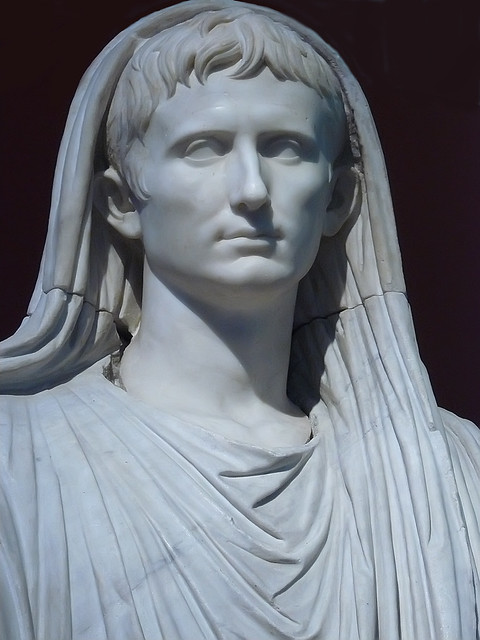
The notes accompanying the image says it was found on the Street of the Vigiles, the firefighters and watchmen of the city. I realize Augustus is credited with establishing the vigiles in 6 CE after levying a 4% tax on the sale of slaves to fund the new force. But this portrait head looks more like heads I have seen of Julius Caesar rather than Augustus. I realize the damage to the frontal part of the forehead makes it difficult to determine the hairline but the hair appears much more sparse and combed forward rather than Augustus' thick locks almost always depicted in a slightly longer, more casual style:
Augustus as Pontifex Maximus photographed
at the Palazzo Massimo in Rome by Mary Harrsch.
I wish I knew if there was any accompanying epigraphic evidence discovered with the head.
I also noticed a portrait head of Hadrian found in a lime kiln:
Head of the Emperor Hadrian found in a lime kiln
in the Caseggiato del Serapide in Ostia.
It pains me to think of all of the exquisite sculpture that was unceremoniously rendered down to make plaster in the Middle Ages. What a tragic loss to our cultural heritage!
If you enjoyed this post, never miss out on future posts by following me by email!