An online magazine about current archaeology and classical research into the lives of inhabitants of the Roman Empire and Byzantium and the civilizations around them.
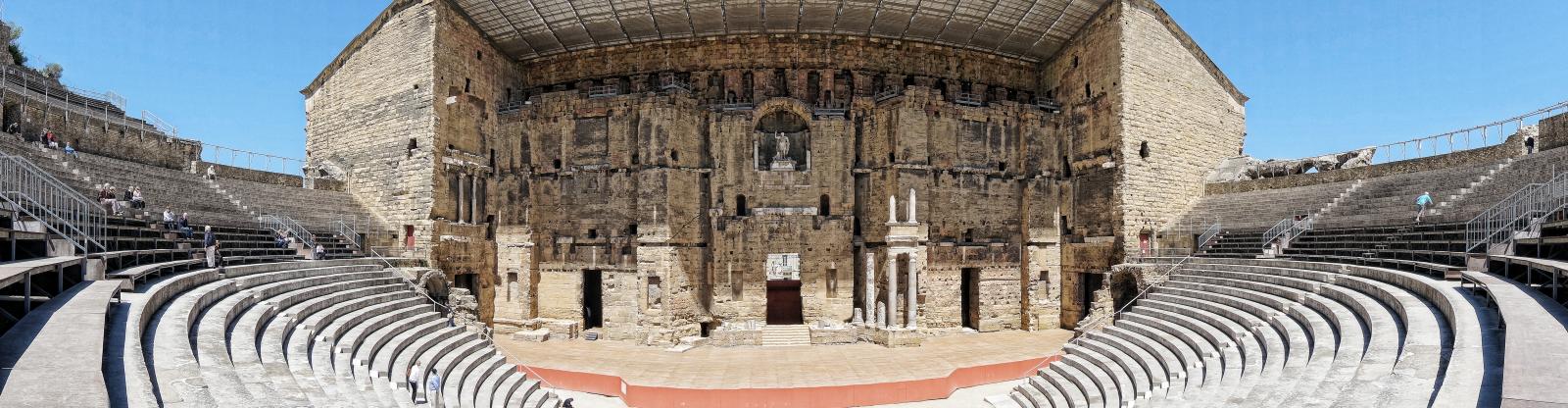
Nearly every Greek and Roman city of note had an open-air theater consisting of the orchestra, the flat dancing floor of the chorus, and the theatron, the actual structure of the theater building. Vase paintings indicate the stage stood about three feet high with a flight of steps in the center. The actors entered from either side and from a central door in the skene, which also housed the ekkyklema, a wheeled platform with sets of scenes. A mechane, or crane, located at the right end of the stage, was used to hoist gods and heroes through the air onto the stage.
Theatrical performances were usually part of a seasonal festival and were accompanied by processions, sacrifices in the theater, parades, and competitions between playwrights. Almost all Greek tragedies were based on heroic myths although the dialogue between actor and chorus sometimes served an instructional purpose and reflected current debate in the public assembly.
"Unlike the Greek tragedy, the comic performances produced in Athens during the fifth century BCE, the so-called Old Comedy, ridiculed mythology and prominent members of Athenian society. There seems to have been no limit to speech or action in the comic exploitation of sex and other bodily functions. Terracotta figurines and vase paintings dated around and after the time of Aristophanes (450–ca. 387 BCE) show comic actors wearing grotesque masks and tights with padding on the rump and belly, as well as a leather phallus." - Art historian, Colette Hemingway
Comic characters and their masks eventually became standardized indicating the popularity not of a specific figure but of types—the old man, the slave, the courtesan, etc.—that appeared repeatedly in different plays. Terracotta or bronze figurines of these popular characters were often sold as souvenirs. Fourteen such figurines were found in one burial in Attica. Apparently the deceased was either an actor themselves or an avid theater-goer!
"In the second half of the fourth century BCE, the so-called New Comedy of Menander (343–291 BCE) and his contemporaries gave fresh interpretations to familiar material. In many ways comedy became simpler and tamer, with very little obscenity. The grotesque padding and phallus of Old Comedy were abandoned in favor of more naturalistic costumes that reflected the playwrights’ new style. Subtle differentiation of masks worn by the actors paralleled the finer delineation of character in the texts of New Comedy, which dealt with private and family life, social tensions, and the triumph of love in a variety of contexts." - Art historian, Colette Hemingway.
Read more about it:
Hemingway, Colette. “Theater in Ancient Greece.” In Heilbrunn Timeline of Art History. New York: The Metropolitan Museum of Art, 2000–. http://www.metmuseum.org/toah/hd/thtr/hd_thtr.htm (October 2004)
Terracotta Lamp with seated Comic Actor Greek made in Egypt 125-100 BCE that I photographed at The Getty Villa in Pacific Palisades, California.
Roman Terracotta Lamp with Reclining Comic Actor 100-200 CE that that I photographed at The Getty Villa in Pacific Palisades, California.
Statuette of a Comic Actor Wearing an Animal Mask Roman 100 BCE-100 CE Bronze that I photographed at The Getty Villa in Pacific Palisades, California.
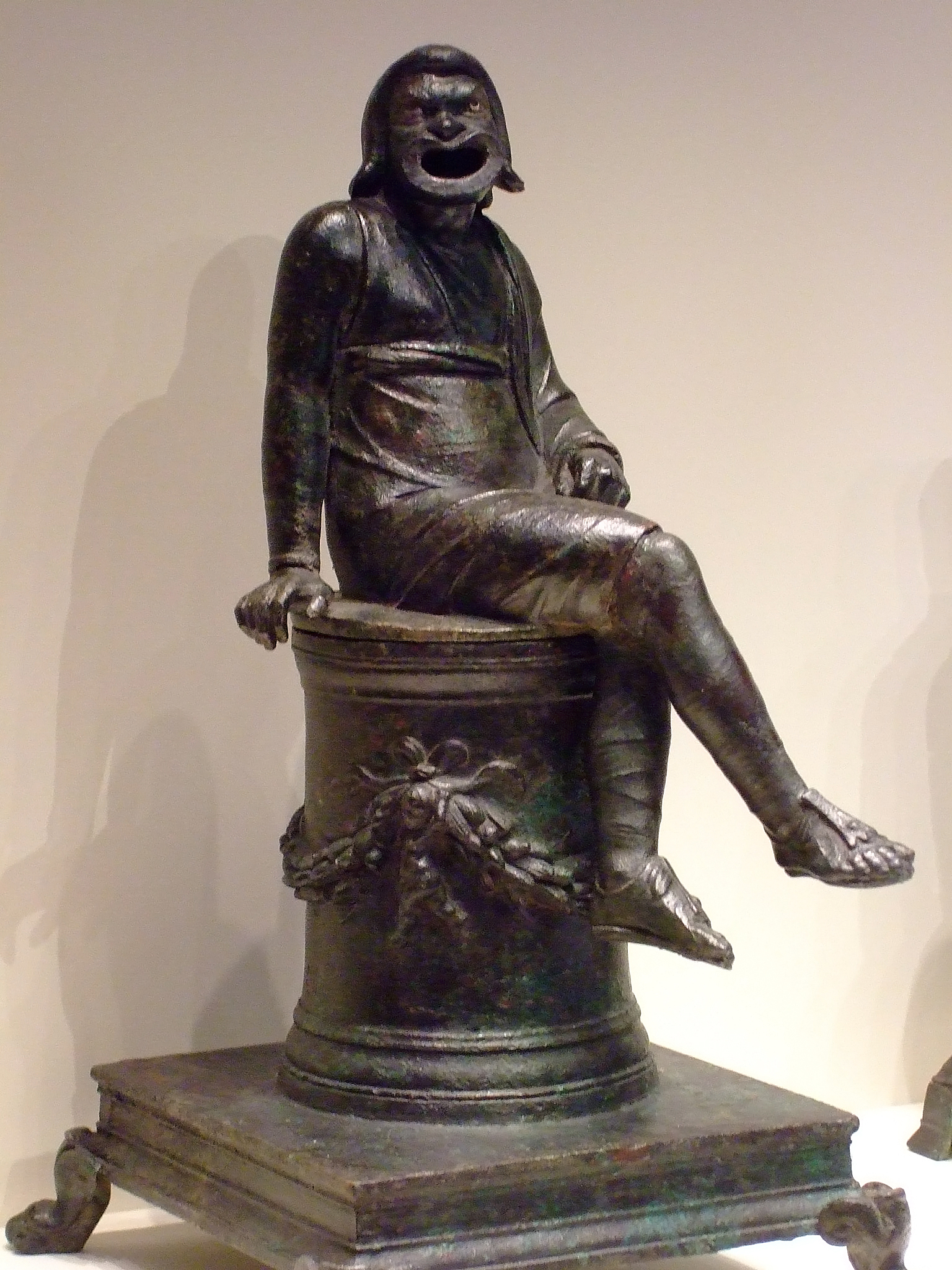
Incense Burner (Thymiaterion) shaped as a Comic Actor Seated on an Altar Roman 1-50 CE Bronze and Silver that I photographed at The Getty Villa in Pacific Palisades, California.
Detail from a red-figured Bell Krater with a scene of Phlyax actors Greek made in Apulia South Italy 370-360 BCE attributed to the Cotugno Painter Terracotta that I photographed at The Getty Villa in Pacific Palisades, California.
Bronze furniture decoration in the shape of theater masks Roman Imperial Period that I photographed at the Palazzo Massimo in Rome.
The Decumano Max leads to remains of the ancient Roman theater I photographed at Ostia built at the end of the 1st century BCE
Architectural elements depicting theater masks that I photographed at the ancient Roman theater in Ostia Antica.
Male comic theater mask Roman 2nd century CE that I photographed at the Terme di Diocleziano in Rome.
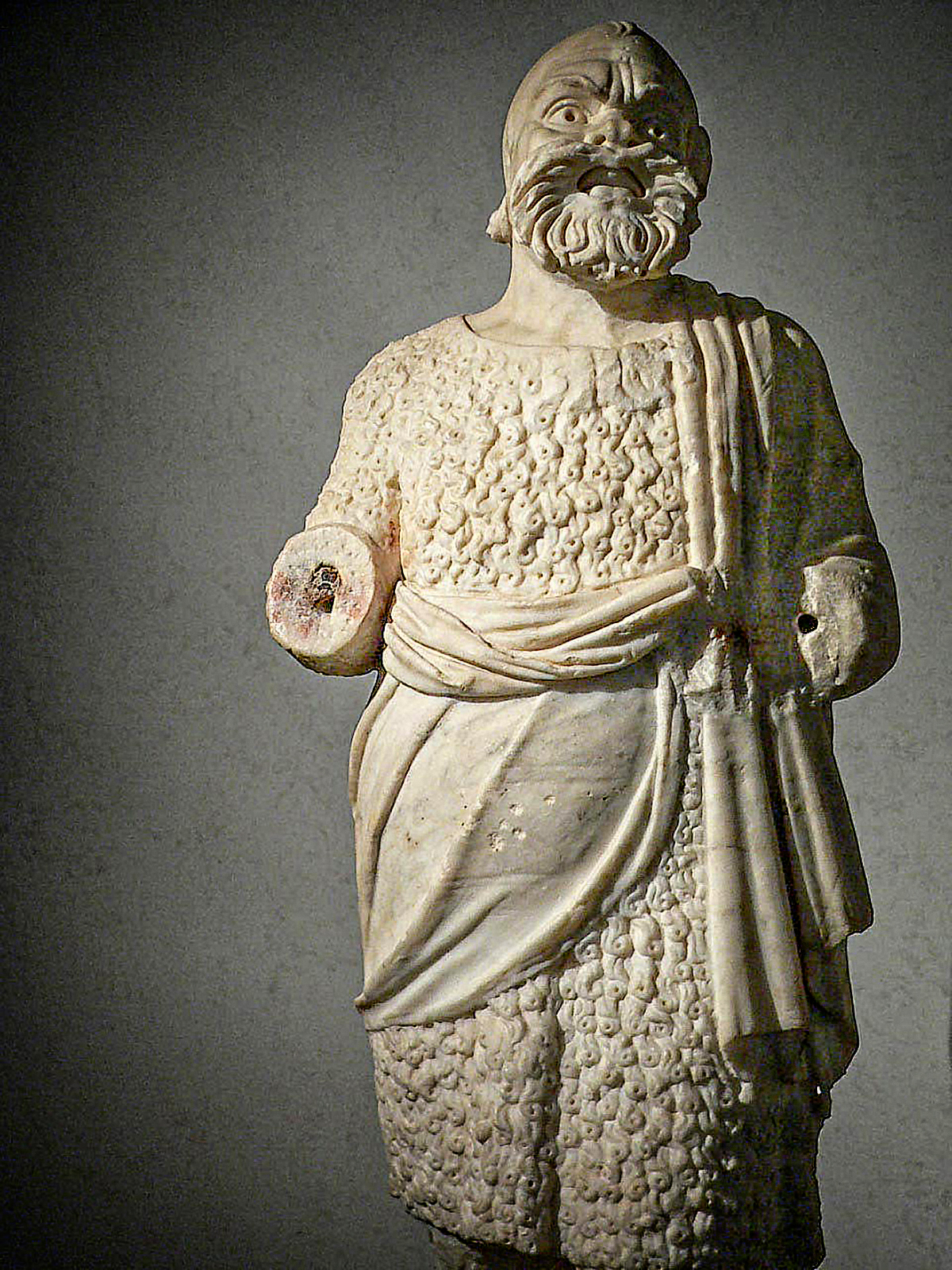
Roman Actor dressed as Papposilenus father of the satyrs from the Villa of Torre Astura 1st century BCE-1st century CE that I photographed at the Palazzo Massimo in Rome.
Panoramic view of the ancient Roman theater in Orange, France, a World Heritage Site, 1st century CE that I photographed.
A theater mask carved on the corner of a Roman funerary monument that I photographed at the Musèe de l'Arles Antique in Arles, France.
Terracotta scent bottle in the form of a squatting man, perhaps a comic actor Corinthian from Camirus Rhodes 600-575 BCE that I photographed at The British Museum.
Masked actors perform Dyskolos "The Grouch" by Menander at ancient Alexandria's theater, a screenshot I took in Assassin's Creed Origins Discovery Tour.
Cleopatra leaves the Greek theater in ancient Alexandria, a screenshot I took in Assassin's Creed Origins Discovery Tour.
Terracotta statuette of an actor, late 5th–early 4th century BCE, Greek, at the Metropolitan Museum of Art.
Terracotta statuette of an actor, late 5th–early 4th century BCE, Greek, at the Metropolitan Museum of Art.
Terracotta statuette of an actor, late 5th–early 4th century BCE, Greek, at the Metropolitan Museum of Art.
Terracotta statuette of an actor, late 5th–early 4th century BCE, Greek, at the Metropolitan Museum of Art.
Terracotta statuette of an actor, late 5th–early 4th century BCE, Greek, at the Metropolitan Museum of Art.
Terracotta statuette of an actor, late 5th–early 4th century BCE, Greek, at the Metropolitan Museum of Art.
If you enjoyed this post, never miss out on future posts by following me by email!
Roman theater began to develop following the devastation of a widespread plague in 364 BCE. Roman citizens began including theatrical presentations as a supplement to the Lectisternium ceremonies, religious propitiatory meals, in a stronger effort to pacify the gods. In the years following the establishment of these practices, actors began adapting these dances and games into performances by acting out texts set to music and simultaneous movement.
As the era of the Roman Republic progressed, citizens began including professionally performed drama in the eclectic offerings of the ludi (celebrations of public holidays) held throughout each year—the largest of these festivals being the Ludi Romani, held each September in honor of the Roman god Jupiter. It was as a part of the Ludi Romani in 240 BCE that author and playwright Livius Adronicus became the first to produce translations of Greek plays to be performed on the Roman stage.
In the 1st century CE, Seneca, the famous Stoic philosopher and tutor to the emperor Nero, wrote tragedies that used a declamatory style emphasizing rhetoric. These works sought to reflect the soul of a tragic character by using rhetoric to reveal something about the state of the character's mind. One of the most notable ways that Seneca developed a tragedy, was through the use of an aside, a common theatre device in Hellenistic drama, but, at the time, foreign to the world of Attic tragedy. Seneca used 'self-representational soliloquies or monologues,' which focused on one's inner thoughts, the central causes of their emotional conflicts, their self-deception, as well as other varieties of psychological turmoil to dramatize emotion in a way that became central to Roman tragedy, distinguishing it from prior forms of Greek tragedy. Perhaps this figure represented a rhetorician in one of Seneca's dramas.
Of course one of the most eye-catching aspects of this figure is the very short tunic and cloak he wears. The length of a Roman tunic indicated the wearer's social status. Soldiers, manual workers, and even slaves usually wore tunics that reached to just a little above the knee. Actors, however, were considered "infamia," an official exclusion from the legal protections enjoyed by a Roman citizen that included corporal punishment, usually reserved for slaves. This lowly status is reflected in the length of this figure's garments.
Image: Bronze statuette of a draped man thought to be an actor, 1st century BCE - 1st century CE, Greek or Roman, courtesy of the Metropolitan Museum of Art. This impressive statuette shows a mature, bearded man who stands purposefully and looks upward. The cloak that covers his torso also conceals his arms, bent forward over his chest. Proposed identifications have linked him with the theater, specifically as an actor declaiming a text rather than playing a role. - Metropolitan Museum of Art
If you enjoyed this post, never miss out on future posts by following me by email!
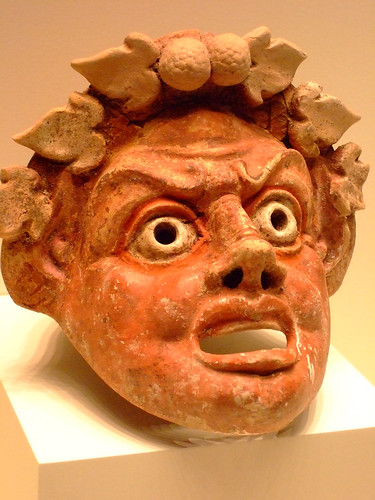
Votive mask of a Satyr Greek made in
the eastern Mediterranean 300-100 BCE
Terracotta. Photographed at the Getty
Villa by Mary Harrsch.
Elaborate costumes, complex choreography, scenic architecture, and the iconic masks of tragedy and comedy depicted in the visual arts of ancient Greece from the 5th to 1st century BCE are the focus of the new exhibit at the Getty Villa, "The Art of Ancient Greek Theater" on display now through January 3, 2011.
The exhibition is being presented in conjunction with the Getty Villa’s annual outdoor theater performance. This year's production will be Sophocles’ Elektra, directed by Carey Perloff, artistic director of the American Conservatory Theater in San Francisco, with a new translation commissioned from Timberlake Wertenbaker. Performances are scheduled Thursday, Friday, and Saturday evenings, September 9 through October 2, 2010. A two-day international scholarly conference that will further explore the themes of the exhibition will be held September 24-25, 2010. In addition, the Villa Theater Lab will present Understanding a Satyr Play: The Trackers on November 19 and 20, 2010.
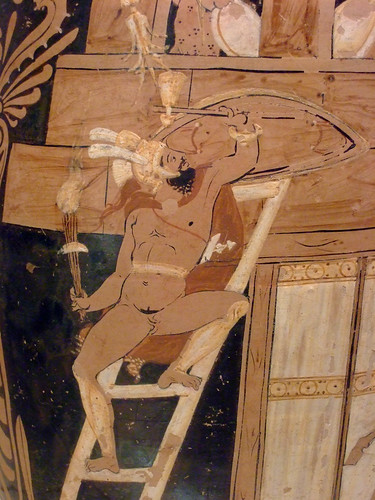
Scene from "Seven Against Thebes" by Aeschylus
depicted on a red-figure storage jar produced
in Campania, Italy about 340 BCE. Photographed
at the Getty Villa by Mary Harrsch.
“Ancient art and theater share a strong and enduring connection–one that is inspired
by mythology and the social, cultural, and political realities of life in ancient Greece and Rome,” says David Bomford, acting director of the J. Paul Getty Museum. “With this exhibition and our annual production in the outdoor theater, we are delighted to bring ancient theater alive at the Getty Villa and invite our visitors to join us and discover how those themes found in ancient times persist today.”
In addition to the Getty's own collection of Athenian and South Italian vases, marble reliefs, figurines and masks, the exhibit will draw from major collections in Denmark, Australia, New Zealand, France, Germany, Italy, Spain, The Netherlands, Switzerland, the United Kingdom and elsewhere in the United States.
I found a humorous description of the history of Greek comedy by Brander Matthews in "The Development of Drama" published in 1912:
"Comedy seems to have sprung into being at the vintage-festival of the Greek villagers, when all was jovial gaiety and jesting license in honor of Dionysus. "On public occasions," so a recent historian of the origin of art has reminded us, "the common mood, whether joy or sorrow, is often communicated even to those who were originally possessed by the opposite feeling; and so powerful is infection of excitement that a sober man will join in the antics of his drunken comrades--yeilding to a drunkenness by induction." And these seasons of contagious revelry were exactly suited to a development of the double desire of mankind for personation--one man seeking to get outside of his own individuality and to assume a character not his own, while another finds his satisfaction rather in the observation of this simulation, in being a sympathetic spectator when actions are represented not proper to the actor's own character.
So it came to pass that there were companies of young fellows, often disguised grossly as beasts or birds, who broke out into riotous phallic dances, enjoyed equally by those who looked on and by those who took part. In time the dancers grouped themselves in rival bands, the leaders of which indulged in a give-and-take of banter and repartee, certainly vulgar and personal, and probably as direct and artless as the chop-logic dialogues of the medieval quack-doctor and his jack-pudding, or of the modern ring-master and circus clown. The happy improvisation of this carnival spirit which happened to delight the crowd one year would surely be repeated the next year deliberately, perhaps only to evoke an unexpected retort with which it would thereafter be conjoined in what might prove to be the nucleus of a comic scene of some length. Thus a species would tend to appear, as the tradition was handed down from season to season, enriching itself constantly with the accretions of every venturesome jester. However frail this framework might be, it would be likely to contain a rough realization of the more obvious types of rural character; and almost from the beginning there would be abundant and irreverent parody of heroic legend and of religious myth." - Brander Matthews, The Development of Drama
Perhaps because of its riotous origins, Greek theater, like other aspects of Greek culture, was only tentatively embraced by the Romans. Until the Theater of Pompey was built in 55 BCE, theaters were temporary structures of wood that were erected before scheduled performances and torn down afterwards. The construction of two stone temples had been attempted in 179 and 174 BCE but never completed. Then a third temple was begun in 154 BCE but the consul P. Scipio Nasica, declared the structure to be "undesirable" and "harmful to public morals" (Livy, Periochae 48.68) and had the construction torn down. Even in the late Republic, Pompey was forced to disguise his theater as a temple to Venus. Until 145 BCE audiences were not even allowed to sit while attending a theatrical performance.
A decree of the Roman Senate forbade sitting at theatrical performances "so that the manly behavior of standing might be known as proper to the Roman people for the relaxation of their spirits (Valerius Maximus, Memorable Words and Deeds 2.4.2)." - Introduction to Greek and Roman Comedy
There were several key differences in both the construction of theaters and in the structure of the performances presented to Roman audiences.
The Roman theater, although similar in form to the Greek theater, developed a magnificence and splendor in keeping with Rome's imperial status. This grandeur is most evident in the stage building, which was raised to the height of the seating area. Thus the stage building was normally three stories high in comparison with the two stories of the skene in later Greek theaters. The orchestra in the Roman theater for the most part became a seating areabecause of the virtual disappearance of the chorus from Roman drama." - Introduction to Greek and Roman Comedy
I found a rather anti-Roman comparison of Greek and Roman theater written by Wilhelm Schlegel in 1904. Like many Victorian-era classicists of the period, he appears to idolize the cultural contributions of the Greeks and consider the Roman poets and playwrights little more than copyists!
Other deviations from the Grecian mode of representation were also sanctioned, which can hardly be considered as improvements. At the very first introduction of the regular drama, Livius Andronicus, a Greek by birth, and the first tragic poet and actor of Rome, in his monodies (lyrical pieces which were sung by a single person, and not by the whole chorus), separated the song from the mimetic dancing, the latter only remaining to the actor, in whose stead a boy, standing beside the flute-player, accompanied him with his voice. Among the Greeks, in better times, the tragic singing, and the accompanying rhythmical gestures, were so simple, that a single person was able to do at the same time ample justice to both. The Romans, however, it would seem, preferred separate excellence to harmonious unity. Hence arose, at an after period, their fondness for pantomime, of which the art was carried to the greatest perfection in the time of Augustus. From the names of the most celebrated of the performers, Pylades, Bathyllus, &c., it would appear that it was the Greeks that practiced this mute eloquence in Rome; and the lyric pieces which were expressed by their dances were also delivered in Greek. Lastly, Roscius frequently played without a mask, and in this respect probably he did not stand alone; but, as far as we know, there never was any instance of it among the Greeks. The alteration in question might be favourable to the more brilliant display of his own skill, and the Romans, who were pleased with it, showed here also that they had a higher relish for the disproportionate and prominant talents of a virtuoso, than for the harmonious impression of a work of art considered as a whole. -Lectures on Dramatic Art and Literature by Wilhelm Schlegel
To see a variety of both Greek and Roman art objects embellished with theatrical masks or scenes from theatrical performances, I encourage you to view the following slideshow of artifacts I have photographed at the Getty as well as the British Museum, The Louvre, and various museums in Italy:
For those of you who can visit the Getty Villa in November, I highly recommend that you attend one of the performances of "Elektra" in the Villa's reproduction of a Greek theater.
The story of Elektra carries forward the tragic history of the House of Atreus. Years after the bloody murder of King Agamemnon, his widow, Clytemnestra, and her lover Aegisthus, rule the city with an iron hand, while their daughter Elektra prays to the gods that her exiled brother Orestes might return to avenge their father's death. Believed to have been written near the end of Sophocles' life, Elektra embodies the playwright's most profound portrait of the endurance of the human spirit, brilliantly ablaze with the warring, inner flames of hope and despair. - Elektra Director, Carey Purloff
Actually, both Sophocles and Euripedes wrote plays about Elektra (sometimes spelled Electra) the very same year. A modern reviewer compares the two versions, pointing out that in his opinion Sophocles' characters adhere to societal values regardless of the personal consequences where Euripedes appears to advocate the assessment of alternative solutions and a degree of thought independent of societal dictates.
I see next year the Getty will present "The Trojan Women". I had the privilege of attending a performance of a modern adaptation of "The Trojan Women" presented by the drama department at the University of Oregon at their Robinson Theater a couple of years ago and enjoyed it immensely.
I learned even more fascinating information about Greek theater when I listened to The Teaching Company's excellent lecture series on Greek tragedy presented by Professor Elizabeth Vandiver of Whitman College. I found it absolutely riveting!
If you enjoyed this post, never miss out on future posts by following me by email!
This mask of Atellan character, Buccus [left], seems to have a more human expression, despite the prescribed comic grimace, than the more stilted and formal masks I have seen elsewhere like the theater at Ostia Antica. Of course it could have been distorted from volcanic heat following the eruption of Vesuvius.
The Discovery article describing a collection of masks recently "rediscovered" from Pompeii pointed out that some of the masks had closed mouths indicating they were used as models for the mask craftsman. However, the masks could have been worn by dancers in a pantomine, who wore masks with closed mouths because they did not speak but performed using only expressive gestures.
"...the most popular genres were unquestionably mime and pantomime, which sought to please the audience. Here even nudatio mimarum (a sort of striptease) was sometimes staged or, more surprising yet, the reenaction of real executions and torture. Mime was based on action and performed without masks. It was the only type of performance in which women played the female roles."
The number of days devoted annually to [theatrical] games gradually increased over time. At the end of the third century BC there were probably twelve at the most and, yet, at the beginning of the Empire, there were already 56 consecrated to theatre performances, reaching 100 by the mid-fourth century AD - The Roman Theater: Staging the Performance
A set of 15 mysterious life-size masks, reminiscent of ancient Roman drama, have been rediscovered in Pompeii after being forgotten for more than two centuries, according to Italian archaeologists who have shown them for the first time at an exhibition in Naples, Italy.
Made of plaster, the rather heavy masks were unearthed in 1749 in Pompeii during the excavations promoted by King Charles of Bourbon. They were deposited, along with many other artifacts, in the Royal Palace of Portici, a town on the Bay of Naples.
"Two masks show letters in the space usually reserved to the mouth. While the meaning of one is incomprehensible, on the other we can clearly read the word 'Buco,'" Borriello said. The word refers to Buccus, a stock character from the earliest form of Italian farce, known as fabula Atellana.
Deriving its name from the town of Atella in the southern Campania region, the fabula Atellana was a form of entertainment widely popular from the second century B.C. to the fourth century A.D. Basically a form of improvised farce, it used masked actors, stock characters and conventional plots. - More: Discovery News
Atellan farces also relied on the physical comedy of slapstick and burlesque.
By the early Imperial period, Atellan farces were no longer improvisational, but scripted performances.
Livy describes the Atellan Farces and the names for the actors (histriones) in section 7.2. of his History of Rome, where he says the Romans first performed them to try to fight a pestilence (in 363 B.C., according to Richard C. Beacham in The Roman Theatre and Its Audience). - About.com
If you enjoyed this post, never miss out on future posts by following me by email!
Here's a really nice piece on Petra and the Nabateans.
"Although Petra was inhabited by the Edomites before the arrival of the Nabateans, the latter carved grandiose buildings, temples and tombs out of solid sandstone rock. They also constructed a wall to fortify the city, although Petra was almost naturally defended by the surrounding sandstone mountains. Building an empire in the arid desert also forced the Nabateans to excel in water conservation. They were highly skilled water engineers, and irrigated their land with an extensive system of dams, canals and reservoirs.
Detail of the Treasury in Petra. Photo courtesy of Richard White.
We still know comparatively little about Nabatean society. However, we do know that they spoke a dialect of Arabic and later on adopted Aramaic. Much of what is now known about Nabatean culture comes from the writings of the Roman scholar Strabo. He recorded that their community was governed by a royal family, although a strong spirit of democracy prevailed. According to him there were no slaves in Nabatean society, and all members shared in work duties. The Nabateans worshipped a pantheon of deities, chief among which were the sun god Dushara and the goddess Allat.The Nabateans were exceptionally skilled traders, facilitating commerce between China, India, the Far East, Egypt, Syria, Greece and Rome. They dealt in such goods as spices, incense, gold, animals, iron, copper, sugar, medicines, ivory, perfumes and fabrics, just to name a few. From its origins as a fortress city, Petra became a wealthy commercial crossroads between the Arabian, Assyrian, Egyptian, Greek and Roman cultures. Control of this crucial trade route between the upland areas of Jordan, the Red Sea, Damascus and southern Arabia was the lifeblood of the Nabatean Empire.
As the Nabateans grew in power and wealth, they attracted the attention of their neighbors to the north. The Seleucid King Antigonus, who had come to power when Alexander’s empire was divided, attacked Petra in 312 BCE. His army met with relatively little resistance, and was able to sack the city. The quantity of booty was so great, however, that it slowed their return journey north and the Nabateans were able to annihilate them in the desert. Records indicate that the Nabateans were eager to remain on good terms with the Seleucids in order to perpetuate their trading ambitions. Throughout much of the third century BCE, the Ptolemies and Seleucids warred over control of Jordan, with the Seleucids emerging victorious in 198 BCE. Nabatea remained essentially untouched and independent throughout this period.
Although the Nabateans resisted military conquest, the Hellenistic culture of their neighbors influenced them greatly. Hellenistic influences can be seen in Nabatean art and architecture, especially at the time that their empire was expanding northward into Syria, around 150 BCE. However, the growing economic and political power of the Nabateans began to worry the Romans. In 65 BCE, the Romans arrived in Damascus and ordered the Nabateans to withdraw their forces. Two years later, Pompey dispatched a force to cripple Petra. The Nabatean King Aretas III either defeated the Roman legions or paid a tribute to keep peace with them..."
My friend and fellow photographer Richard White just returned from Petra not long ago with some great photos as always! His Flickr photostream on Petra can be viewed at: