Showing posts with label Hispania. Show all posts

Friday, July 30, 2021

The Romanization of northwest Iberia (modern Portugal)

During the last two centuries of the second millennium BCE a series of settlements were established along the coastal areas of northern Portugal. Their noble elite celebrated ritual banquets and participated in an extensive network of interchange of prestige items such as  cauldrons, knives, bronze vases, roasting spits, flesh-hooks, swords, axes and jewelry, from the Mediterranean up to the British Isles. But this network appears to collapse at the beginning of the first millennium and their open settlements were gradually replaced by fortified hill-forts constructed of earthen walls, battlements and ditches, which enclosed an inner habitable space. Trade dwindled to just the production of various axes and tools.

Then, beginning in the 6th century BCE, the "Castro" culture once again began to expand and widespread trade returned driven by Carthaginian merchants who brought imports of wine glass, pottery, and other goods.  The Carthaginians constructed emporia that sometimes even included temples and other civic structures. While the archaeological record of the Iron Age Castro suggests a very egalitarian society, a privileged class appears to have developed with better access to prestige items as evidenced by findings of large quantities of fibulae, pins, pincers for hair extraction, pendants, earrings, torcs, bracelets, and other personal objects used to enhance personal appearance.

Their hill-forts evolved as well, becoming semi-urban fortified towns we now know as oppida that in some cases housed several thousand inhabitants. These citadels included paved streets equipped with channels for stormwater runoff, reservoirs of potable water, and evidence of urban planning. Many of them also presented an inner and upper walled space, relatively large called acrópole by local scholars and the structures were surrounded by concentric ditches and stone walls sometimes reinforced with towers. Gates to these oppida become monumental and were decorated by sculptures of warriors.  Dwelling areas that have been excavated were frequently externally walled, with kitchens, sheds, granaries, workshops and living rooms ordered around an inner paved yard, sometimes equipped with fountains, drains and reservoirs.

People inhabiting the far northwestern corner of Iberia, now northern Portugal, became known as the Gallaeci. Those tribes living in what is now southern Portugal became known collectively as the Lusitani.

The people eventually encountered Rome when the Carthaginians hired them as mercenaries to fight the Romans during the Punic wars. During the Second Punic War between the years 218 and 201 BCE,  Silius Italicus reports a combined Celtic contingent of Lusitani and the Gallaeci led by a commander named Viriathus raided northern Italy whenever the terrain was too rough for Hannibal's famed Numidian cavalry. 

In retaliation, the Romans levied heavy taxes from the tribes. Between 209 and 169 BCE, the Roman army collected 4 tons of gold and 800 tons of silver from the locals and a number of their men were required to serve in the legions. The exploitation and extortion reached such an extreme degree that Rome had to create a special tribunal and laws, like the Lex Calpurnia which established the first permanent criminal court in Roman history, in order to deal with the growing number of crimes committed by Roman governors in the provinces.

In 150 BCE Praetor of Hispania Ulterior, Servius Sulpicius Galba joined forces with the Governor of Hispania Citerior, Lucius Licinius Lucullus and began to systematically depopulate Lusitania. Fearing a long siege and the destruction the Roman siege engines would cause in their towns, the Lusitanians sent an embassy to Galba to negotiate a peace treaty. Galba seemingly agreed but when the Lusitanians were gathered together to turn over their weapons, Galba's army surrounded them with a ditch, to prevent them from escaping. Then , Roman soldiers were sent in and began to massacre all the males of military age. Galba killed 9,000 Lusitanians and later sold 20,000 more as slaves in Gaul (modern France).  

Three years after the massacre, another Viriathus appeared with an understanding of Roman military tactics and proceeded to wreak havoc among the Romans until 139 BCE when he was betrayed and killed in his sleep by three of his companions who had been sent as emissaries to the Romans.  The warriors were bribed by Marcus Popillius Laenas to perform their treachery. However, when the three returned to receive their reward from the Romans, the Consul Quintus Servilius Caepio ordered their execution, declaring, "Rome does not pay traitors".

Viriathus stands as the most successful leader who ever opposed the Roman conquest in Iberia. During the course of his campaigns he was only defeated in battle against the Romans once, and from a military standpoint can be said to have been one of the most successful generals to have ever opposed Rome's expansion.

After the death of Viriatus, the Gallaecians and Lusitanians kept fighting and as a result the Roman general Decimus Junius Brutus Callaicus led a successful punishment expedition into the North in 137 BCE. The victory he celebrated in Rome granted him the title Callaicus (“Galician”). During the next century Gallaecia was still theatre of operation for Perpenna (73 BCE), Julius Caesar (61 BCE) and the generals of Augustus (29-19 BCE), but gradually the native people acquired Roman culture and language and eventually gained the status of "Citizens of Rome". Although most of their oppida were abandoned or converted to religious sanctuaries, some continued to be occupied up to the 5th century CE when the Germanic Suevi established themselves in the region.

Rebuilt hut in the oppidum of Santa Tegra, A Guarda, Galicia earth courtesy of Wikimedia Commons contributor Froaringus

Statue of a Gallaecian Warrior, Castro Culture, 1st Century CE, North Western Iberian Peninsula, courtesy of the National Museum of Archaeology (Portugal) and Wikimedia Commons.

Gold fibula, of long-footed form decorated with the figure of a naked warrior, wearing a Celtic helmet, with scabbard suspended from his waist and carrying a sword (scabbard and pommel are both of La Tene type), with another figure of a hunting dog jumping up to him. The eyes of both figures were originally inlaid with enamel. The arched bow has eight curls and the side panels are elaborated with running spirals and loops, also originally inlaid with blue enamel. Each end of the brooch is terminated by a dog's head. The hinge or spring and pin are now lost. The long foot of the fibula comprises two thick wires, twisted together and terminated with another dog's head, jaws agape and ears raised. The brooch was probably made by a Greek craftsman active on the Iberian Peninsular. Image courtesy of the British Museum and Wikimedia Commons.

Diadem from Moñes (Piloña, Asturias). Warriors with horned helmets parade carrying torcs and cauldrons, Castro Culture, 3rd - 1st century BCE, courtesy of Wikimedia Commons contributor Ángel M. Felicísimo

Lunula from Chão de Lamas, Coimbra (Portugal) courtesy of Wikimedia Commons contributor Luis Garcia. (removed glare spots) 

Boat-shaped earrings decorated with filigree and granules, Gallaecian, gold, from the "Bedoya Treasure", exhibited in the Museum of Pontevedra

Late Bronze Age golden helmet from Galicia courtesy of Wikimedia Commons contributor Carlos de Paz.

Iron Age Castro Culture Torcs from Asturias, Spain courtesy of Wikimedia Commons contributor Dageno.


Head of an stone Iron Age Galician warrior, wearing a torc. Now, in the Museo Provincial de Ourense, courtesy of Wikimedia Commons contributor Froaringus.

A Castro Culture severed head sculpture courtesy of Wikimedia Commons contributor Froaringus.

Nabia Fountain in Braga, Portugal. The deity probably had an association with water, the sky and the earth courtesy of Wikimedia Commons contributor Snitrom

Galician Celtic Stele for the deceased, called Apana, presumably an aristocrat of the tribe of Celtic Supertamáricos courtesy of Wikimedia Commons contributor Alexandre Gal.

Mosaic from the Casa dos Repuxos Roman villa in ancient Conimbriga, Portugal courtesy of Wikimedia Commons contributor Halley Oliveira

Roman mosaic with marine life in ancient Conimbriga, Portugal courtesy of Wikimedia Commons contributor Marta Magalhães 

Mosaics in the House of the Swastika in ancient Conimbriga, Portugal, courtesy of Wikimedia Commons contributor Carole Raddato.

Roman mosaic with man and dog in ancient Conimbriga, Portugal courtesy of Wikimedia Commons contributor GFreihalter (Adjusted perspective and cropped)

Mosaic in ancient Conimbriga, Portugal courtesy of Wikimedia Commons contributor Elisardojm. (Adjusted perspective and cropped)

Roman peristyle with mosaics in ancient Conimbriga, Portugal courtesy of Wikimedia Commons contributor Elisardojm

A Roman mosaic depicting Dionysus (?) in ancient Conimbriga, Portugal, courtesy of Wikimedia Commons contributor Elisardojm.

A Roman mosaic depicting a man walking a dog (?) in ancient Conimbriga, Portugal, courtesy of Wikimedia Commons contributor Elisardojm

More Roman mosaics in ancient Conimbriga, Portugal courtesy of Wikimedia Commons contributor Duca696.


Conimbriga is one of the best preserved Roman archaeological sites in Portugal.  You can see many more of its beautiful Roman mosaics here:  

https://commons.wikimedia.org/wiki/Category:Ancient_Roman_mosaics_in_Conimbriga


If you enjoyed this post, never miss out on future posts by following me by email!


Sunday, April 11, 2021

The Visigoths: ECCESVINTHUS REX OFFERET

The Visigoths were an early Germanic people who, along with the Ostrogoths, constituted the two major political entities of the Goths within the Roman Empire in Late Antiquity, or what is known as the Migration Period. The Visigoths emerged from earlier Gothic groups, including a large group of Thervingi, who had moved into the Roman Empire beginning in 376 CE and had played a major role in defeating the Romans at the Battle of Adrianople in 378 CE. Relations between the Romans and the Visigoths were variable, alternately warring with one another and making treaties when convenient. Under their first leader, Alaric I, they invaded Italy and sacked Rome in August 410 CE. Afterwards, they began settling down, first in southern Gaul and eventually in Hispania, where they founded the Visigothic Kingdom and maintained a presence from the 5th to the 8th centuries CE.

The Visigoths were never called Visigoths, only Goths, until Cassiodorus used the term, when referring to their loss against Clovis I in 507. Cassiodorus apparently invented the term based on the model of the "Ostrogoths", but using the older name of the Vesi, one of the tribal names which the 5th century poet Sidonius Apollinaris had already used when referring to the Visigoths.

The Visigoths first settled in southern Gaul as foederati to the Romans, a relationship that was established in 418. However, they soon fell out with their Roman hosts (for reasons that are now obscure) and established their own kingdom with its capital at Toulouse. They next extended their authority into Hispania at the expense of the Suebi and Vandals. In 507, however, their rule in Gaul was ended by the Franks under Clovis I, who defeated them in the Battle of Vouillé.

In the March/April issue of Archaeology Magazine is an interesting article, "The Visigoth's Imperial Ambitions".  In it author Jason Urbanus describes excavations of the former Visigoth stronghold at Reccopolis. I was actually disturbed by the fact that the city contained none of the typically Roman civic features of a forum, bath complex, theater, circus, or arena for public entertainment even though Hispania had been a Roman province for centuries and the Visigoths were previously Roman foederati. Instead the heart of the city was an enormous palatial compound  containing structures for administration, religious activities, and luxurious dwellings for the aristocracy.  Urbanus says scholars think this layout centered primarily around the rich was an effort by the local elite to emulate portions of Constantinople. 

The surrounding urban structures underscored the city's role as a major fiscal center (they had their own mint) and industrial complex (much of it focused on importing or crafting luxury items for the wealthy) but I was dismayed by the lack of public facilities for bathing with their libraries and gymnasia, or entertainment venues.  Even Constantinople had the hippodrome and public baths! At least Reccopolis was the only city constructed by the Visigoths with an aqueduct which brought water from a few miles away.  In fact, at the time there were only five remaining functional Roman aqueducts in Iberia so the aqueduct at Reccopolis was viewed as an important symbol of power and, so the author thinks, civic pride. 

To me, though, it seemed that what I view as devolution to a feudal model focused on selfish elite with little or no sense of civic duty and their control of government and use of religion to extract wealth from the populace had already taken shape.


Image: Visigothic votive crown that was part of the so-called Guarrazar treasure.  The "treasure" consisted of several crowns (more than twenty), crosses, chalices and other objects of gold and gems in a chest.  Image courtesy of Ángel M. Felicísimo from Mérida, Spain.


If you enjoyed this post, never miss out on future posts by following me by email!


Wednesday, November 14, 2012

Review: "Gods of War" by Jack Ludlow


Note:  Contains historical references that may be considered spoilers if the reader is unfamiliar with this period of Roman history

In the third book of Jack Ludlow's "Republic" trilogy, the protagonist, Aquila Terentius, having gained battle experience in the Servile War on Sicily, returns to Italy and makes his way to Rome where he hopes his adoptive brother may help him in his quest to achieve the destiny foretold by his adopted mother and the ancient soothsayer, Drisia.

Background and story up to now

Aquila is the bastard son of a Druid chieftain named Brennos and the wife of Aulus Cornelius Macedonicus, the Roman proconsul charged with putting down a revolt of Celts in Iberia led by Brennos.  The Lady Claudia is captured by the Celts in an ambush and when she is rescued two years later, Claudia is found pregnant.  Her husband, Aulus, assuming the child to be a product of rape, exposes the child soon after it is born.  But Claudia has wrapped a golden amulet shaped like an eagle in flight around the child's foot in hopes that the child will be found and reared by some other loving Roman family.

That family turns out to be an old legionary named Clodius Terentius and his wife who name the boy Aquila after the gold charm they found wrapped around his foot.  Clodius, a poor excuse for a farmer, barely scrapes by  as an occasional day laborer  but loves the little tot with red gold hair and bright blue eyes.
One day Clodius is duped into another stint in the legions by a wealthy neighbor who promises to care for Clodius' family if Clodius would serve in the legions in his stead.  So little Aquila is left to wander the fields around the tiny Terentius hut alone until one day he meets a Celtic slave named Gadoric.   Gadoric pretends to be crippled so he will be left alone to watch over a wealthy neighbor's flock rather than sent off to hard labor on the Roman's large latifundia on Sicily.  Gadoric suspects Aquila may be at least part Celt because of his tall stature and coloring.  So, Gadoric teaches Aquila his language and how to use a spear.  He also teaches him all the secrets of hunting and reading the signs of life in the forest and hills which ultimately proves quite useful when Gadoric's deception is discovered and he is shipped off to Sicily and Aquila is left alone once more.  (End of Book 1: "Pillars of Rome" - see full review here)

After his adoptive mother dies, Aquila falls in with a motley cadre of ex-gladiators led by a former Centurion in his father's legion named Flaccus.  Flaccus has stopped by the wealthy neighbor's farm to bring the news of Clodius' death at the battle of Thralaxas in Illyria.  The group sails to Sicily where they are contracted to serve as overseers of a large farm there.  But Aquila becomes entangled in the Servile War when he finds Gadoric and helps him and a Greek slave named Hippolytas to escape.  But Hippolytas, a charismatic fellow who claims to have visions, is convinced all the slaves can unite and drive the Romans back to Italy and sets about organizing a slave army to pillage the surrounding countryside.  Aquila, given command of a number of the men, tries to limit the brutality of the slave army.  But, he becomes increasingly uncomfortable with the slaves' hatred for Romans since Aquila considers himself Roman.   So Aquila eventually retreats to the mountains to avoid any further conflict with them.

The treacherous Greek, Hippolytas, secretly sends an envoy to the Romans to negotiate a peace that includes betrayal of Gadoric and the slave army in exchange for wealth and a large villa on the Italian mainland.  When Gadoric is ambushed and meets a warrior's death, Aquila follows the Greek and the co-conspirators back to Italy where he wreaks his bloody revenge upon them for the death of his friend.  (End of Book 2: "Sword of Revenge" - see my full review here)

Now a seasoned warrior, Aquila heads towards Rome, wearing the eagle amulet proudly around his neck.  Aquila is unaware that the amulet is the original talisman worn by the rebel Celt Brennos with a mystical destiny attached to it.  The Celts in Iberia believe the man who wears the amulet will one day bring down Rome.

In Rome, Aquila is not given any encouragement by his step brother Demetrius but befriends his "nephew" Fabius.  After some dubious adventures, Aquila talks Fabius into joining the legions with him.  Unknown to Aquila, his legion is on its way to Iberia to fight the rebellious tribes being led by Brennos, Aquila's real father, who has taken over a hill fort named Numantia.

The events of what became known as the Numantine War are the focus of this third (and last) novel of the series.

Aquila's 18th legion first serves under Quintus Cornelius Macedonicus, the oldest son of Aquila's stepfather, Aulus Cornelius Macedonicus, although neither man knows of the relationship.

Historically there really was a Quintus Caecilius Metellus Macedonicus who fought in Spain.  But I think the character of Quintus Cornelius Macedonicus represents Quintus Fabius Maximus Aemilianus, the adopted son of Lucius Aemilius Paullus Macedonicus, the model for Aquila's step father, Aulus Cornelius Macedonicus (see my original analysis of character models in my review of the first book in the trilogy, "Pillars of Rome").

The Roman senate sent Quintus Maximus to quell an uprising of the Lusitani, a Celtic tribe inhabiting what is now modern day Portugal, led by a chieftain named Viriathus.  In the novel, paralleling actual history, Quintus brought two legions that had never engaged in warfare before, as well as inexperienced staff officers that were brought along for political reasons.  Despite repeated provocation of the surrounding Celtic tribes, Quintus just dig in and concentrates on exercising and training his men.

"But Maximus declined an engagement with the whole army and continued to exercise his men, frequently sending out skirmishing parties, making trial of the enemy's strength, and inspiring his own men with courage. When he sent out foragers he always placed a cordon of legionaries around the unarmed men and himself rode about the region with his cavalry. He had seen his father Paullus do this in the Macedonian war." - Appian, Roman History, The Spanish Wars

In the novel, one of the skirmishing parties, led by one of Quintus' inexperienced greedy and ambitious junior officers, marches into the territory of a tribe allied to the Romans.  He has been told by an informer from a non-allied tribe that the friendly Celts were planning to lure the Romans into a trap and kill them.  Why the officer would believe a non-friendly Celt over his allies is a mystery but he figures he can turn the tables and plunder the properous friendly village that sprawls out before him like a plum ready to be picked.

The village elders come out and greet the Romans warmly and offer hospitality.  The Roman officer appears to accept their welcome but under his breath issues orders to kill all the males as soon as they enter the village.

This incident sounds very much like an actual event recounted by Appian:

"... the elders of the city came out wearing crowns on their heads and bearing olive-branches, and asked Lucullus what they should do to establish friendly relations. He replied that they must give hostages and 100 talents of silver, and furnish a contingent of horse to the Roman army. When all these demands had been complied with, he asked that a Roman garrison should be admitted to the city. When the Caucaei assented to this he brought in 2,000 soldiers carefully chosen, to whom he gave orders that when they were admitted they should occupy the walls. When this was done, Lucullus introduced the rest of his army and ordered them at the sound of the trumpet to kill all the adult males of the Caucaei. The latter, invoking the gods who preside over promises and oaths, and upbraiding the perfidy of the Romans, were cruelly slain, only a few out of 20,000 escaping by leaping down the sheer walls at the gates. Lucullus sacked the city and brought infamy upon the Roman name. The rest of the barbarians collecting together from the fields took refuge among inaccessible rocks or in the most strongly fortified towns, carrying away what they could, and burning what they were obliged to leave, so that Lucullus should not find any plunder."  - Appian, Roman History, The Spanish Wars

Aquila attempts to dissuade the officer but the officer angrily dismisses him and orders Aquila and his men to return to base camp.  But as Aquila travels back through the narrow defile leading to the little valley where the friendly village is located, he notices large number of horse tracks that were not there when the skirmishing party passed through earlier.

He finds the non-friendly Celts preparing to ambush the Romans after they have plundered the friendly village.  It takes all of Aquila's skill to avert the ambush and rescue the foolish  officer and rest of the Roman force.  Aquila uses tactics that sounded similar to those described by Appian in another engagement.

"When he discovered the ambush he divided his horse into two bodies and ordered them to charge the enemy on either side alternately, hurling their javelins all together and then retiring, not to the same spot from which they had advanced, but a little further back each time. In this way the horsemen were brought in safety to the plain." - Appian, Roman History, The Spanish Wars

Quintus is furious when the skirmishing force finally returns to base camp but goes ahead and claims the body count so he may enjoy a triumph when he returns to Rome at the end of the year.  But Quintus does not return to Rome with his troops.  Aquila's 18th legion must remain behind to continue the struggle to pacify the Celts.  However, Aquila receives a silver Spear for his bravery and courage, the first of many honors, and a promotion to Centurion.

A reconstruction of an early Celt-Iberian House courtesy
of About.com


As the years pass, Aquila becomes increasingly more frustrated as each year a new consul from Rome appears to plunder the territory and gain enough of a body count to claim a triumph in Rome.  Aquila finds their greediness and foolishness totally inexcusable but rescues them from certain defeat time after time, garnering even more honors and a promotion to Primus Pilus in the process.

Finally, a real commander with military experience and integrity arrives on the scene.  In the novel, he is named Titus Cornelius Macedonicus, the younger son of Aulus Cornelius Macedonicus.  Historically, the commander was Scipio Aemilianus, the actual son of Aemilius Paullus Macedonicus.

Titus decides to lay siege to Numantia, the most powerful hill fort in central Iberia, to finally bring an end to the Celt-Iberian Wars.  But first he must restore strict discipline to the troops that had been left in Spain and had grown demoralized and out of shape over the years .   With Aquila's help, Titus orders the expulsion of all of the legions' camp followers and sets about retraining the legions to bring them back into fighting condition.  This coincides exactly with the preparations of Scipio Aemilianus.

"When he arrived he expelled all traders and harlots; also the soothsayers and diviners, whom the soldiers were continually consulting because they were demoralized by defeat. For the future he forbade the bringing in of anything not necessary, or any victims for purposes of divination. He ordered all wagons and their superfluous contents to be sold, and all pack animals, except such as he designated, to remain. For cooking utensils it was permitted to have only a spit, a brass kettle, and one cup. Their food was limited to plain boiled and roasted meats. They were forbidden to have beds, and Scipio was the first one to sleep on straw. He forbade them to ride on mules when on the march; "for what can you expect in a war," said he, "from a man who is not able to walk?" Those who had servants to bathe and anoint them were ridiculed by Scipio, who said that only mules, having no hands, needed others to rub them." - Appian, Roman History, The Spanish Wars

Under Aquila's guiding hand, the Romans once more become a formidable force and Aquila is promoted to second in command.  Titus' legate, Marcellus Falerius, son of the ruthless politician that was the childhood friend of Titus' father, resents Aquila, claiming such a low born plebian has no social right to such an elevated position.  But Titus stands firm on his decision.

I found it ironic that Marcellus was so haughty to Aquila.  In the first book we discover that Marcellus is really the bastard child of a barbarian slave and the wife of Lucius Falerius Nerva, a ruthless politician who paid the slave to have relations with Falerius' wife because the politician was apparently sterile but wanted an heir.  Of course Marcellus does not know and never learns of the deception.

Titus does respect Marcellus, though, and finds him to be a promising officer.  So Titus grants Marcellus the command of an attack force against the Lusitani  to keep that formidable tribe busy so they cannot come to Numantia's aid.

Marcellus accomplishes this by building a fleet of ships and launching his attacks by sea. The sea battle passages in the novel are thrilling and extremely well written.  However, I could not find any historical references to indicate the Lusitani were defeated in this way.  But, after all, this is a novel, right?

I was really tense reading the sea battle passages, though, because I remembered that in the end of book 2, Marcellus visits the Sybil and receives what he thinks is a mundane prophecy saying he will inherit his father's fortune.  As the sole heir to Lucius Falerius Nerva, Marcellus does inherit his "father's" financial fortune but Sybilline prophecies are never what they seem.  Marcellus' real father was betrayed by Falerius who hired assassins to kill him.  The ex-gladiators succeed in wounding the slave but he escapes by leaping into the Tiber River.  However, the river's current is too swift and the barbarian is eventually pulled under and drowned.  So, every time Marcellus gets into a sea battle I was always afraid he would end up wounded and drowned.  I really liked the character of Marcellus so I didn't want him to suffer that fate.

Anyway, back to the story!

Titus lays siege to Numantia.  To prevent the inhabitants from escape or from bringing in provisions, Titus has the men build a boom of logs across the Durius River that courses through the hill fort.

This, too, parallels history quite closely.

"... the river Durius, which took its course through the fortifications, was very useful to the Numantines for bringing provisions and sending men back and forth, some diving and others concealing themselves in small boats, some making their way with sail-boats when a strong wind was blowing, or with oars aided by the current." 
"As he was not able to span it on account of its breadth and swiftness, Scipio built two towers in place of a bridge. To each of these towers he moored large timbers with ropes and set them floating across the river. The timbers were stuck full of knives and spear-heads, which were kept constantly in motion by the force of the stream dashing against them, so that the enemy were prevented from passing covertly, either by swimming, or diving, or sailing in boats." - Appian, Roman History, The Spanish Wars

To prevent the nearby Arevaci tribe from coming to the aid of the Numantines, Titus sends Aquila as his envoy to dissuade them.   During his years in Iberia, Aquila, who already knew some of the Celtic language from his years with Gadoric, taught himself to speak the local dialect so was the perfect candidate for an envoy.  When Aquila meets Masagori, the chieftain of the Arevaci, the leader spots the golden eagle amulet around the neck of this Roman with the red-gold hair who resembles a younger version of Brennos, the old Druid leading the Numantines.  Recognizing Aquila as the manifestation of the ancient prophecy, the Arevaci agree to withdraw.

But, as the Numantine plight becomes desperate, one night Brennos orders a group of his men to assault the Roman log boom as a distraction so he and a handful of horseman can ride to the Arevaci for help.

"...a man of the greatest valor, induced five of his friends to take an equal number of servants and horses, and cross the space between the two armies secretly, on a cloudy night, carrying a bridge made in sections. Arriving at the wall he and his friends sprang upon it, slew the guards on either side, sent back the servants, drew the horses up the bridge, and rode off to the towns of the Arevaci, bearing olive-branches and entreating them, as blood relations, to help the Numantines. - Appian, Roman History, The Spanish Wars

But Masagori refuses Brennos and tells him of the tall red-haired Roman with an eagle amulet.  He says Brennos has brought on his own destruction by planting his seed in the belly of his enemy.

However, some of the younger warriors of the Arevaci, hoping to gain personal glory in this monumental struggle, voice their support of Brennos even though their chieftain will not relent.

"The chiefs of the Arevaci, fearing the Romans, would not even listen to them, but sent them away immediately. There was a rich town named Lutia, distant 55 kilometers from Numantia, whose young men sympathized with the Numantines and urged their city to send them aid. The older citizens secretly communicated this fact to Scipio." 
"Receiving this intelligence about the eighth hour , he marched thither at once with a numerous and well-equipped force. Surrounding the place about daylight, he demanded that the leaders of the young men should be delivered up to him. When the citizens replied that they had fled from the place, he sent a herald to tell them that if these men were not surrendered to him he would sack the city. Being terrified by this threat, they delivered them up, to the number of about 400. Scipio cut off their hands, withdrew his force, rode away, and was back in his own camp the next morning." - Appian, Roman History, The Spanish Wars

Brennos then seeks help from the Lusitani but Marcellus has done his work well and the Lusitani fear they no longer have the favor of their gods.  So Brennos returns to Numantia where he meets a grisly fate and the mighty hill fort of Numantia falls.

The present day archaeological site of Numantia
courtesy of About.com

"Many, directly after the surrender, killed themselves in whatever way they chose, some in one way and some in another." 
"The remainder congregated on the third day at the appointed place, a strange and shocking spectacle. Their bodies were foul, their hair and nails long, and they were smeared with dirt. They smelt most horribly, and the clothes they wore were likewise squalid and emitted an equally foul odor. For these reasons they appeared pitiable even to their enemies. At the same time there was something fearful to the beholders in the expression of their eyes - an expression of anger, grief, toil, and the consciousness of having eaten human flesh." 
"Having reserved fifty of them for his triumph, Scipio sold the rest and razed the city to the ground." - Appian, Roman History, The Spanish Wars

So, do the visions described by the old crone, Drisia those many years ago come to pass at last?  You'll have to read the book yourself to find out.  But, Ludlow leaves several loose ends at the end of the novel.  Will Aquila use his newly acquired status to enter the political arena and support reforms that will eventually lead to the destruction of the Roman Republic?  Will Marcellus oppose Aquila and lead the opposition into a civil war?   Will the prophecy of the amulet totally come true and Aquila or his descendants eventually bring down the Roman Empire? I'm afraid we'll never know since Ludlow has moved on to other historical time periods and settings.

I still found this final installment of Ludlow's Republic Series offers enough resolution along with excitement and vibrant characters to be a very gratifying read, though.


Enhanced by Zemanta
If you enjoyed this post, never miss out on future posts by following me by email!


Saturday, July 7, 2012

Review: The Pillars of Rome by Jack Ludlow


"One shall tame a might foe, the other strike to save Rome's fame, neither will achieve their aim.  Look aloft if you dare, though what you fear cannot fly, both will face it before you die." - Jack Ludlow, The Pillars of Rome

This prophesy by the Alban Sybil, accompanied by a crude drawing of an eagle in flight that bursts into flame of its own accord, set the stage for Jack Ludlow's first novel set in ancient Rome.

"The Pillars of Rome" is the first book in a trilogy by Jack Ludlow set in the late 2nd century BCE.  Ludlow is an experienced writer and has published a number of books set in other time periods but this is his first with a Roman theme.  Ludlow does an excellent job of developing vibrant characters and deftly recreates Republican Rome with its strict social hierarchy, scheming and corrupt senators and provincial governors, politically motivated marriages, military reliance on landowners (this is before Marius approved career soldiers without land ownership requirements) and strict military "disciplina" in the conduct of its troops who, in turn, extended little mercy to the conquered.

However, Ludlow chooses to populate his book with purely fictional characters, making it more of a challenge for me to identify the time period and discuss the differences between events described in the novel compared to actual historical events like I usually do in most of my reviews.

Ludlow did give me some clues, though, as to the historical personages used as models for his main characters thus pinpointing the period of Roman history as well.

Ludlow's two main protagonists, Aulus Cornelius Macedonicus and Lucius Falerius Nerva, are lifelong companions and the prologue opens with a scene of the two as boys creeping into a dark cavern to clandestinely meet with the Sybil to gain insight into their respective futures.  It is soon apparent that Aulus is far more pious and god-fearing than Lucius  who is willing to risk eternal damnation to learn if he will realize his dreams of fame and fortune.  Aulus' piety will eventually become revered by Roman society and serve him well in his ascension to the peak of military success.  Likewise, Lucius' ambition will be the driving force in his future where risk-taking becomes second nature in his struggle to become politically the first man in Rome.

From his cognomen, Macedonicus, we know that Aulus apparently was instrumental in the Roman conquest of Macedon.  There were a number of Macedonian Wars but as we read the novel, we learn that he defeated King Perseus, son of King Philip V of Macedon, who ascended the throne in 179 BCE giving us a historical period of the early to mid 2nd century BCE.

Perseus was defeated by the legions led by Lucius Aemilius Paullus at the Battle of Pydna in 168 BCE at the climax of the Third Macedonian War.  Thereafter, he became known as  Lucius Aemilius Paullus Macedonicus.  So, we can assume Aulus is a surrogate for Paullus and examine the life of Paullus  to gain historical insight into this personage and the events surrounding this period of history.

In Plutarch's Lives, Paullus is held up as an examplery nobleman with "traditional Roman firmness and courage in adversity" ( an introduction by Philip A. Stadter and Robin Vaterfield to Roman Lives: A Selection of Eight Lives by Plutarch).  He carefully prepared for each engagement unlike his nemesis Perseus who is characterized as miserly, cowardly and unfaithful to his mercenaries who he failed to pay.
Perseus surrenders to Paullus. Painting by Jea...
Perseus surrenders to Paullus. Painting by Jean-François Pierre Peyron from 1802. Museum of Fine Arts, Budapest. (Photo credit: Wikipedia)
Paullus was also painfully aware of the fickleness of fortune.  One of his young sons, a boy of only 14, died just five days before Paullus was set to celebrate his victory.  While preparing for his triumph, Aemilius chided the cowering Perseus for failing to bear his reversal of fortune but follows this with reproaching his sons and officers for taking too much pride in their victory:

"What occasion can there possibly be for men to take heart, when victory over others is precisely the time when we are most compelled to be afraid of fortune, and when a happy man can be plunged into the depths of depression by the realization that fate follows a cyclical course and attaches itself to different people at different times?"

This reminds me of the fatalism expressed by Scipio Aemilianus, son of Paullus, upon witnessing the destruction of Carthage in 146 BCE.  Polybius reports:

"Scipio, when he looked upon the city as it was utterly perishing and in the last throes of its complete destruction, is said to have shed tears and wept openly for his enemies. After being wrapped in thought for long, and realizing that all cities, nations, and authorities must, like men, meet their doom; that this happened to Ilium, once a prosperous city, to the empires of Assyria, Media, and Persia, the greatest of their time, and to Macedonia itself, the brilliance of which was so recent, either deliberately or the verses escaping him, he said:

A day will come when sacred Troy shall perish,
And Priam and his people shall be slain.

And when Polybius speaking with freedom to him, for he was his teacher, asked him what he meant by the words, they say that without any attempt at concealment he named his own country, for which he feared when he reflected on the fate of all things human."

The son obviously learned this sad truth from his father.


Detail of The Triumph of Aemilius Paulus
Detail of The Triumph of Aemilius Paulus (Photo credit: Wikipedia)


Aulus' [Paullus'] triumph is mentioned several times in the novel and was obviously the crowning achievement of his career.  Fortunately, a wonderful description of the  three day spectacle comes down to us from Plutarch in his biography of Paullus:

"The first day - and it was only just enough - was given over to the spectacle of all the statuettes, paintings, and statues taken during the war, which were transported on 250 wagons.  On the next day the most beautiful and valuable of the Macedonian arms and armour were carried through the streets on large numbers of carts.  The bronze and iron parts of the weapons had been polished until they shone, and all the objects had been artfully and aesthetically positioned, so as to look as much as possible as though they had fallen into random heaps of their own accord: there were helmets lying next to shields, breastplates on top of greaves, Cretan targes and Thracian wicker shields and quivers all jumbled up with horses' bridles; the piles bristled with unsheathed swords, and pikes had been planted among them.  The arms and armour were somewhat loosely arranged, so that as they were carried along they struck against one another and gave out a harsh and fearsome sound, and even though they had belonged to the losers in the war their appearance was not without its terrors.  After the wagons with the arms and armour came three thousand men carrying coined silver money in 750 boxes; each box held three talents' worth of money and was carried by four men.  Then came more men carrying silver mixing-bowls, drinking-horns, drinking bowls, and cups, each shown off to its best advantage and each remarkable for its size and for the depth of the chased work on it."

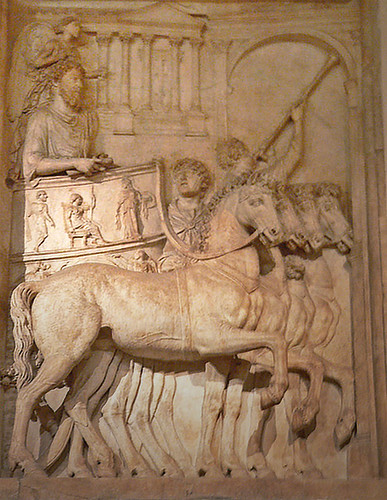
Marcus Aurelius driving a quadriga in a 
triumphal procession.  Photographed at the
Capitoline Museum by Mary Harrsch.


"Early in the morning of the third day trumpeters made their way through the streets, but the music they played was unusual for a procession or an exhibition; it was the kind with which the Romans used to rouse themselves in battle.  Behind the trumpeters 120 stall-fed oxen, with their horns gilded, and arrayed with headbands and chaplets were being led to sacrifice by young men dressed in ceremonial aprons with purple borders, and boys went with them, carrying silver and gold libation cups.  Next came the men carrying the gold coinage, which had been divided up, like the silver money, into vessels with a capacity of three talents, and there were seventy-seven such vessels altogether.  They were followed by men carrying the sacred bowl, which had been made, on Aemilius' instructions, out of ten talents of gold and studded with gems.  Next came men displaying the Antigonid, Seleucid, and Thericlean goblets, and all the golden tableware Perseus used.  They were followed by Perseus' chariot, which carried his arms and armour with his diadem lying on top of them.  Not far behind the chariot Perseus' children were led along as slaves, accompanied by a throng of weeping nurses, teachers, and tutors, who stretched out their hands in supplication to the spectators and taught the children to beg and plead.  There were two boys and one girl, too young to comprehend the magnitude of the disaster - and this made people feel so much more sad for them, considering the fact that one day this incomprehension would end, that Perseus walked by almost unnoticed by the Romans, who were just staring at the children in pity.  Many people started crying, and in all of them the spectacle aroused a mixture of pleasure and pain, until the children had passed by."

"Behind the children and their retinue came Perseus.  He wore a grey cloak and Macedonian boots, and looked as though he was utterly astounded and bewildered by the magnitude of the disaster that had happened to him.  He too was accompanied by a crowd of associates and friends; their faces were heavy with grief, but because they were constantly glancing at Perseus and weeping they gave the spectators to understand that they were mourning his fate and did not care in the slightest for their own.  Perseus had written to Aemilius, asking not to be paraded through the streets and included in the triumph, but Aemilius, apparently in mockery of Perseus' cowardice and fear of death, remarked: 'The situation is no different now from what it was before: he could grant his own request, if he wanted.' He [Aemilius] meant that he [Perseus] could always choose death instead of dishonour, but the coward could not bring himself to do that.  Instead, unmanned by hope, he became a part of his own spoils."

"After Perseus and his retinue, four hundred golden garlands were carried along, which had been brought and presented to Aemilius by representatives from the various cities in recognition of his valour.  Then came the man himself, mounted on a magnificiently decorated chariot.  He would have made a remarkable sight even without all these trappings of power; he wore a cloak dyed with purple and shot through with gold, and held in his right hand a spray of laurel.  Every single soldier likewise carried laurel.  The army marched behind their commander's chariot in their units and divisions, with the men singing partly traditional songs with an element of humour in them , and partly hymns of victory and praise for Aemilius' achievements."
In the novel, Aulus is said to have ritually strangled Perseus at the conclusion of the triumph but historically this did not occur.  Paullus actually arranged for Perseus to be moved from the "carcer" (prison) to a place that was clean "where he could life more like a human being."  But Perseus died anyway.  Plutarch says some writers say he starved himself to death while others report he angered his guards who, in retaliation, decided to not allow him to sleep, "until, eventually, worn out by this treatment he died."-  Plutarch, Aemilius Paullus, Roman Lives: A Selection of Eight Lives, edited by Philip A. Stadter and Robin Vaterfield.

As for his children that were so pitied by the Roman spectators, two of the children also died.  But Perseus' son Alexander survived and became an expert engraver and an accomplished secretary.

I sometimes wonder if ritual strangulation was as common as we are led to believe when I read about kings and rulers, like Perseus, that escaped the executioner's rope.  Maybe this ritual only occurred occasionally much like fights to the death between gladiators in the arena.

Returning to the novel, I think  Ludlow did a superb job of capturing this essence of nobility in his characterization of Aulus Cornelius.

Ludlow's novel makes a giant leap in time from the boyhood of the prologue to the mature years of his two main characters that comprise most of the novel.  When we pick up the tale in Chapter 1, Lucius has, indeed, become a powerful senator and leader of the Optimates while Aulus, the consummate warrior, has just returned from Spain where he has been battling the Celt-Iberians who have been stirred up by an outcast Gallic Druid by the name of Brennos.  The rebel activity must have been a prelude to the Celtiberian War.

"The Celtiberians, famous for their martial ability, fought a long and bitter war against Rome known as the Celtiberian war (Bellum Celtibericum, 153-133 BCE) and were involved in other conflicts with Rome throughout the 2nd century BC." -John T. Koch,  Celtic Culture: A Historical Encyclopedia

Aulus, like Paullus, had fought the Celt-Iberians in Spain earlier in his military career before his victories in Macedonia.

"Rome's most competent commanders were busy with the war against Antiochus the Great when another war broke out in the west, in Spain, where there had been serious disturbances.  Aemilius was dispatched there with the rank of praetor, but he had six extra lictors over and above the usual six praetorian lictors, with the reulst that his office was equivalent in dignity to that of a consul.  He won two pitched battles against the local tribesmen, who lost about thirty thousand men, and apparently it was plain to see that his success was due to his tactical skill, since he made victory easy for his troops by ensuring that they fought on favourable ground, on the far side of a certain river.  He also subdued 250 towns, which were happy to open their gates to him." Plutarch, Aemilius Paullus, Roman Lives: A Selection of Eight Lives, edited by Philip A. Stadter and Robin Vaterfield.

Although Plutarch never mentions Paullus' return to Spain, this is certainly a plausible plot development considering the ongoing conflicts  referred to by Koch.

Aulus finds Lucius, who has built his career around his ability to manipulate people with clever words rather than military prowess, mired in a dispute with a tribune of the plebs pushing land reform.  This can be no other than Tiberius Gracchus and Ludlow has kept the praenomen Tiberius but given his character a different gens name, Lavonius.   Tiberius Gracchus was elected tribune of the people in 133 BCE.  Historically, the problem is Paullus was already dead, having died in 160 BCE.  So Ludlow has compressed the historical timeframe at this point.  The only other reference I could find to earlier land reform efforts was a bill introduced during the consulship of Laelius in 140 BCE that was supported by Scipio Aemilianus but rejected by the senate (Paullus' younger son was adopted by the son of Scipio Africanus because Paullus, having four sons, could not afford to fund that many sons in their efforts to climb the Coursus Honorum).

Ludlow also portrays Lucius as the senator most violently opposed to the Gracchus figure which would make Lucius equivalent to Scipio Nasica Serapio.  Lucius,  like Nasica, unable to sway Tiberius Lavonius [Gracchus] from his determination to alleviate the inequality between the priviledged wealthy and thousands of Rome's destitute, hires thugs armed with clubs to seek out the tribune and club him to death - the actual fate that befell Tiberius Gracchus.

For those of you unfamiliar with Gracchus' land reform bill, here is a very good summary:

"There already existed a law at Rome - the so-called Licinian law - which limited the number of acres to be possessed by any one citizen to five hundred.  But this Licinian law had been a dead letter for many years, and there were many rich citizens in Rome who counted the number of their acres by the thousand or even ten thousand.  It was this violation of the Licinian law, and the open injustice done to the poor by this violation, which Teiberius Gracchus wanted to correct.  He therefore introduced a new agrarian law which aimed to revive the Licinian law, but at the same time greatly modified and attenuated its provision.  The change in the law which Tiberius Gracchus proposed was in one respect an act of injustice, because it put a premium on the violation of the law as it had existed, instead of punishing that biolation by imposing an adequate fine.  Under the new law a citizen might hold 500 acres of the public lands in his own name, and in addition, 250 acres for each son still under the paternal roof and authority.  Moreover, the new law provided that, whenever a citizen should be compelled to give up land which he held in excess of the share which the law allowed him, he should be reimbursed for this loss, at the appraised value, from the public treasury.  Tiberius Gracchus also favored the immediate distribution of the conviscated lands among the poor as their absolute property, and proposed that, whenever a Roman colony was founded on conquered territory, a similar distribution of the newly acquired land should be made." - Francis Johnson, Famous Assassinations of History From Philip of Macedon to Alexander of Servia

There is no mention of any violence surrounding the earlier debate over land reform in 140 BCE.  So, I feel I have teased out the historical figure represented by Lucius with a caveat.  In Ludlow's novel, Lucius and Aulus have been friends since boyhood.  However, if Lucius is really a surrogate for Scipio Nasica Serapio who orchestrated the death of Tiberius Gracchus, Ludlow must have decided to consolidate historical personages with Scipio Nasica Corculum (his father) since it is that Nasica that was more of a contemporary with Aemilius Paullus.  It is also that Nasica that served under Paullus in the Third Macedonian War, according to Plutarch in his description of the key battle of Pydna. 

Lucius is also portrayed as having no real military gifts except logistics (supply) but both Nasica Corculum and Nasica Serapio served as military commanders with Corculum leading a night action that was instrumental in the victory at Pydna. Serapio, however, is thought to be the praetor who suffered a great Roman defeat at the hands of the Pannonians in 141 BCE.  So Ludlow must have decided to soften this disparity with a middle path.

Now, let us return to Ludlow's narrative.

Aulus, suspects Lucius of having a part in the death of Tiberius Lavonius [Gracchus]and withdraws his political support, leaving Lucius angry and resentful.  Historically we know Paullus was considered a member of the aristocracy but he was recognized as being of such noble stature that he was considered "above" the day-to-day political mudslinging of the period.  We also know that his younger son did openly support the first efforts at land reform under Laelius.

Lucius is also put out about a social snub inadvertently committed by Aulus  when he failed to appear when summoned to attend the birth of Lucius' first son because Aulus was dealing with a secret birth within his own household - the subject of a subplot in the novel that will further manifest itself in successive books.

This subplot involving Paullus' second wife is, of course, totally fictitious because of the timeline if nothing else.  However, we know nothing about Paullus' second wife from the ancient sources so it isn't really historically misleading.  The ancient sources record the name of Paullus' first wife and state that Paullus actually divorced her - some say without adequate cause - even though  Aulus is portrayed as a widower in the novel.  Ludlow portrays the lady Claudia as barely 16 when she is offered to Aulus, even though he is quite mature, a common practice for the period.

(Spoiler alert) The baby is the result of Paullus' wife being captured by the Celt-Iberians and Aulus and his faithful Greek body servant Cholon take the child far away and expose it where they think no one would possibly find it.  Of course, someone does just like in the ancient Greek epics.  It's at this point that land ownership requirements for serving in the legions plays an important part in succeeding events.

One of the minor characters, a well meaning but unsuccessful former legionary who has gambled away the plot of land he received upon discharge from the army, is seduced into rejoining the legions as a surrogate for a neighbor who has been far more successful with his own plot.  The neighbor agrees to take care of the man's wife and adopted son (the child exposed by Aulus) while the hapless man is on campaign in the neighbor's stead.  In the meantime, the neighbor further fattens his pockets by avoiding taxes on his properties because he has had his surrogate enlist under the prosperous neighbor's name, making him exempt from taxation.

I never really thought about this much before since most of my study has focused on the post-Marius reform period where just about anyone could join the legions, but I'm sure these types of deceptions probably occurred during the second century BCE when military service was restricted to landowners.  The wealthy have always had carefully orchestrated loopholes to avoid mandatory military service in my lifetime so it would be logical to assume this practice has come down to us from antiquity.

But back to Aulus and Lucius!

To get Aulus out of his way politically, Lucius arranges for Aulus to head an investigation of the corrupt activities of the new governor of Illyricum since Aulus had initially pacified the area earlier in his career.

This background information about Aulus (Paullus) is also based on history.

"After being elected consul, Aemilius led an army against the Ligurians, whose territory ran alongside the Alps.  The Ligurians were a warlike and courageous people who were having their military skills honed by the Romans, whose neighbours they were...Aemilius' advance was met by a force of forty thousand, five times the number of his eight thousand men, but he engaged them in battle, forced them back, and pinned them inside their strongholds...The Ligurians trusted Aemilius and surrendered both their ships and their settlements to him.  He restored their settlements to them unharmed..." - Plutarch, Aemilius Paullus, Roman Lives: A Selection of Eight Lives, edited by Philip A. Stadter and Robin Vaterfield.

But after his conquest of Macedon, we have no evidence Paullus returned to Illyricum so this coupled with the timeline issue points to the rest of story as purely fictional.

In Illyricum, Aulus finds that the people who he had left pacified were on the verge of open revolt because the greedy governor was gouging them with taxes while at the same time delaying payment to his own legions so he could loan out money in the pay chests and reap the interest for himself.  The men of the legions have lost their discipline and are no longer in fighting trim.  So Aulus has his work cut out for him and takes command offending the corrupt governor Vegetius.  Meanwhile the rebels of Epirus rise up against the Roman administration there. Aulus marches a relief force towards the gathering rebel army near a narrow defile named Thralaxas where he faces the dire fate forecast those many years ago in the Sybil's cavern.

I'm sure Paullus would have welcomed such a heroic end but in fact, he died of natural causes.  Apparently not long after being named censor (although Plutarch points out he had time to complete all of the most important things) he fell critically ill.  His doctors advised him to rest in the country by the sea so he sailed to Velia.  But the Romans missed him.

"...in the theaters they often gave voice to what seemed to be prayers and appeals to see him.  And so, when a sacrifice was to take place which required his presence, and his health seemed up to it, he returned to Rome.  He performed the sacrifice along with his fellow priests, surrounded by a crowd of visibly happy Romans, and then the next day made another sacrifice, in private, asking the gods to keep him in good health.  When the sacrifice had been performed in the prescribed manner, he returned home and lay down, but suddenly, before he had time to notice and comprehend the change, he became delirious and deranged, and two days later he died." - Plutarch, Aemilius Paullus, Roman Lives: A Selection of Eight Lives, edited by Philip A. Stadter and Robin Vaterfield.

I found Ludlow's novel to be culturally immersive and with enough complexity to be intellectually satisfying.  His battle sequences were exhilarating and his characters empathetic.  I have already begun book two in the trilogy "The Sword of Revenge" and look forward to Aulus' son Titus exacting retribution for his father's betrayal.


Enhanced by Zemanta
If you enjoyed this post, never miss out on future posts by following me by email!