Showing posts with label Marc Antony. Show all posts

Thursday, May 20, 2021

Forgeries of ancient engraved gems

The J. Paul Getty Museum has some spectacular ancient engraved gems in their collections and I have featured a number of them in my posts.  But, during the pandemic one of their curators, Kenneth Lapatin, researched one gem in their collection with a portrait of Marc Antony engraved upon it, and discovered, unfortunately, it was not ancient at all but a 19th century forgery produced by Giovanni Calandrelli for Prince Stanislas Poniatowski, nephew and heir to the King of Poland and Lithuania, and one of the richest men in Europe.

Alerted by a friend, the late Gertrud Platz from the Berlin Antikensammlung, who had  just published a study of Giovanni Calandrelli, Lapatin learned she had recently examined a plaster impression that was made of one of Calandrelli's forgeries featuring a portrait of Marc Antony.  Platz suspected the Getty gem was the same work.  So Lapatin sent an impression of the Getty gem to her and they were found to be virtually identical.

"There are three smoking guns," explains Lapatin. "There is the plaster impression in Berlin, and another sent to St. Petersburg, Russia, that show that the gem had been in the Poniatowski collection, which was full of forgeries. That doesn’t prove anything, because Poniatowski’s collection also contained some genuine antiquities, but puts the gem in very bad company. Then, there’s Calandrelli’s notebook, which says he made a Mark Antony with the signature of Gnaios. And then, the third is when we put our gem next to ones that we know are genuine ancient engravings by Gnaios, we can see stylistic discrepancies, especially in the way the skin and hair is rendered."

Mistakes such as this are certainly understandable since it is widely known Pompey the Great, Julius Caesar, and the nephew of the Emperor Augustus, as well as other ancient aristocrats, all collected gems and donated their collections to the gods in temples.  This particular gem came to be widely known in 1968 when John Boardman (now Sir John), one of the foremost authorities on ancient gems, published and praised this gem very highly as one of the masterpieces of late Roman Republican, early Augustan gem carving. It is just unfortunate that some wealthy 19th century collectors sought to boost their prestige by clandestinely hiring talented gem engravers to simulate ancient works.

Read more about it:  https://blogs.getty.edu/iris/a-gem-of-a-mystery/  

Amethyst gem with engraved portrait of Marc Antony originally thought to be late Roman Republican to early Augustan work.  Actually, it is a forgery produced by 19th century gem carver, Giovanni Calandrelli.  It remains in the collections of the J. Paul Getty Museum due to its quality but has been moved from the Getty Villa to the Getty Center where it is now displayed with the works of other 19th century engravers.


If you enjoyed this post, never miss out on future posts by following me by email!


Wednesday, July 8, 2020

King Antiochus I Theos of Commagene: Meeting the Challenges of a Buffer Kingdom

Head of King Antiochus I at Nemrut Dağ, Turkey,
courtesy of Carole Raddato
The hierothesion (burial complex) of King Antiochus I Theos of Commagene is 50-meter-high man-made burial mound situated upon the peak of Nemrut Dağ within the Taurus mountain range of South-East Turkey, over 2,150 m above sea level. The site was rediscovered in the early 1881 by Karl Sester, a German engineer assessing transport routes for the Ottomans, who reported the discovery of a large number of colossal statues, which he incorrectly believed to be Assyrian in origin. Excavations in the 20th century dated the monumntal tomb to the latter part of the reign of Antiochus I, about 50-36 BCE. The complex is flanked on the north, east, and west with terraces.  The East and West terraces have the remains of colossal seated statues as well as rows of relief stelae (orthostates). The statues have been identified as Antiochus I and a pantheon of Greek, Armenian, and Iranian deities. Antiochus practiced astrology of a very esoteric kind, and laid the basis for a calendrical reform, by linking the Commagenian year, which till then had been based on the movements of the Moon, to the Sothic (Star of Sirius) cycle used by the Egyptians as the basis of their calendar. This would suggest that Antiochus was knowledgeable about, if not fully initiated into Hermeticism,  a tradition based primarily upon writings attributed to Hermes Trismegistus, a pagan philosopher, who taught belief in a single, universal spirit.  He also supposedly invented the process of making a glass tube airtight, hence our term for "hermetically sealed."

Although a vassal state of the Seleucids, Commagene asserted its independence in the 1st century BCE but suffered hardships during the Roman war with Pontus and Armenia. Although Armenia initially succeeded in extending its influence over Commagene, Antiochus was ultimately forced to side with the Romans when the commander Pompey declared war against him.  Although Antiochus claims in his inscriptions on Mount Nemrut to be a friend of the Romans, he was distrusted by them, especially by Cicero.  In 57-37 BCE, he allied with the Parthian monarch Orodes II and offered his daughter Laodice to Orodes in marriage. Later, in 51 BCE, however, some disaffection prompted Antiochus to provide intelligence about Parthian forces led by Prince Pacorus I to the Romans.  But when Pacoras was defeated and killed by the Romans in 38 BCE, the Parthian army fled to Commagene where Antiochus gave them refuge.  This, of course, angered the Romans and the Roman general Publius Ventidus Bassus laid siege to Antiochus' capital of Samosata. Antiochus offered a reimbursement of 1,000 talents and a renewed alliance to the Romans but this offer was rejected by the senior Roman commander Marc Antony, who then took over the siege.  However, Antony failed to capture the capital and finally accepted a new offer of only 300 talents.  Antiochus disappeared from history after this except for a notation by Cassius Dio who said Antiochus was killed by the Parthian king Phraates IV, in 31 BCE.

For a thorough description of Nemrut Dağ and portfolio of images, see Carole Raddato's excellent article at:

https://followinghadrianphotography.com/2019/01/21/mount-nemrut/
.

If you enjoyed this post, never miss out on future posts by following me by email!


Wednesday, April 15, 2020

Ptolemaic Prince, 51-30 B.C.E. thought to be possibly the son of Cleopatra VII and Julius Caesar, Caesarion at the Brooklyn Museum

The young Egyptian kinglet stands with his arms by his sides and hands clenched holding cylinders. His hair is in a naturalistic Roman style and he wears a narrow diadem with uraeus. His eyes were originally inlaid. Could this be one of the few portrayals of Caesarion, Cleopatra's son by Julius Caesar?

There is actually little historical mention of Caesarion as a young man until he is named in the Donations of Antioch in 36 BCE. Surprisingly, Octavian gave public approval to the Donations of Antioch, which have been described as an Antonian strategy to rule the East making use of Cleopatra's unique royal Seleucid lineage in the regions donated.

However, Octavian did not greet the news of the Donations of Alexandria with a positive response. In that ceremony, Marc Antony proclaimed Caesarion to be a god, son of a god, and "King of Kings" as well as Caesar's true son and heir. Octavian used Roman resentment over the Donations of Alexandria to gain support for war against Antony and Cleopatra. When Octavian subsequently invaded Egypt, Caesarion was sent to India, according to Plutarch saying "Caesarion, who was said to be Cleopatra's son by Julius Caesar, was sent by his mother, with much treasure, into India, by way of Ethiopia. There Rhodon, another tutor like Theodorus, persuaded him to go back, on the ground that [Octavian] Caesar invited him to take the kingdom." However, some scholars think Plutarch's account should not be taken literally. There is some corroborating sources from India, however, that shouldn't be overlooked. I wrote about it in my 2010 blog post "Caesarion: Victim of the wicked who whispered 'Too Many Caesars.'

https://ancientimes.blogspot.com/2010/12/caesarion-victim-of-wicked-who.html 


A Ptolemaic Prince thought to be possibly Caesarion at the Brooklyn Museum in New York courtesy of the museum.
If you enjoyed this post, never miss out on future posts by following me by email!


Tuesday, April 7, 2020

The Royal Nisean Horse of Ancient Persia

The horse was a favorite artistic subject in ancient Iran, where horsebreeding flourished. This muscular Sasanian stallion was descended from the royal and sacred Nisean breed of the Achaemenian Persians. Although now extinct, Nisean horses were highly sought after in the ancient world. The ancient Greeks called him the Nisean after the town Nisa, where he was bred but the Chinese called him the Tien Ma – Heavenly Horse or Soulon-Vegetarian dragon. The horse came in a variety of colors including the more common dark bay, chesnut and seal brown but also the more rare black, roan, palomino, and various spotted patterns. The royal Nisean was the mount of the nobility in ancient Persia. Two gray Nisean stallions pulled the King of Kings’ royal chariot, while four of the regal animals pulled the chariot of Ahura Mazda, the supreme god of Persia and Medea. Cyrus the Great was so distraught when one of his stallions was drowned while crossing a river, he had the river where the horse was drowned drained. He did not believe that anything could kill a horse so beautiful.
The Greeks (mainly, the Spartans) imported Nisean horses and bred them to their native stock. The Romans had their first encounter with the Nisean and the Parthian cataphract at the disastrous Battle of Carrhae. Later, when Marc Antony avenged Marcus Licinius Crassus and his legions lost at Carrhae by ravaging Armenia, his plunder included the first Nisean horses in Rome. Later, when Antony died in Egypt, Augustus seized the horses. The Nisean became extinct with the conquest of Constantinople in 1204.
Although Sasanian horse-trappings were elaborate, they did not include stirrups for mounting. In this rendition, the steed lies still, as camels in the Near East do today, waiting for its rider to mount. The medallions on each shoulder contain busts, perhaps of rulers of different parts of the Sasanian Empire, holding their rings of authority. Images courtesy of the museum.

Silver Sasanian Horse-Shaped Drinking Vessel 200-325 CE at the Cleveland Art Museum in Cleveland, Ohio

Silver Sasanian Horse-Shaped Drinking Vessel 200-325 CE at the Cleveland Art Museum in Cleveland, Ohio

If you enjoyed this post, never miss out on future posts by following me by email!


Wednesday, October 12, 2011

Excellent princes, ridiculous sophists or jealous tyrants? Gibbon's take on some of Rome's good emperors

Caesar Augustus by Boschetti Italian
Bronze 19th century  CE after Prima Porta
 Augustus 2nd century CE.  Photographed
at the University of Utah Museum of Art by
Mary Harrsch.
In my ongoing readings of Gibbon's Decline and Fall of the Roman Empire I was surprised to learn that Edward Gibbon maintained a rather harsh opinion of three of Rome's most respected emperors.

Gibbon claimed Vespasian's merit was "more useful than shining" and his virtues "disgraced by a strict and even sordid parsimony."  He declared Hadrian to be, in turn, an excellent prince, ridiculous sophist and, eventually, jealous tyrant.  But most surprising was his blistering assessment of Gaius Octavius Thurinus - the emperor Augustus.

Of Augustus, Gibbon declared, "A cool head, an unfeeling heart, and a cowardly disposition, prompted him at the age of nineteen to assume the mask of hypocrisy, which he never afterwards laid aside."

Whoa!  That's certainly an extreme assessment of the man ultimately responsible for ushering in the Pax Romana!  I doubt Octavian was particularly likable since he appeared to calculate the political advantage in every move, but despite concessions that he had to make to his ill health, I would hardly call him a coward.  It took a lot of brass for a 19-year-old stripling to go up against a man with the military experience and following of Marc Antony or the Roman world's most renowned orator and formidable politician, Cicero.

Cicero, 1st century BCE.  Photographed at the
Capitoline Museum by Mary Harrsch
Gibbon seems to blame Octavian for authorizing Cicero's proscription but that was really done at the insistence of Antony.  Octavian pragmatically didn't have any particular reason to oppose it.  It's very much like the recent debt ceiling negotiations.  Some programs were ultimately considered expendable in the overall "game of thrones".

Cicero had been so openly hostile to Antony, his appearance on Antony' hit list must have surely been a foregone conclusion.  Cicero had also arrogantly miscalculated Octavian's political astuteness and assumed he could simply dispose of Octavian after he had served the purposes of the power brokers in the Senate - also a fatal error.

As for hipocrisy, Augustus, like many politicians today, maintained power and control by telling people what they wanted to hear while quietly disposing of those deemed a threat to his position through political maneuvering or outright assassination covered by some socially engineered construct.  Scholars point to Augustus' blatant philandering while enacting morality laws to dictate the behavior of the people of Rome.  But as I pointed out in an earlier post on Roman infanticide, perhaps these laws were meant as deterrents to abortion and infant abandonment and to encourage larger Roman families because Roman birthrates were falling noticeably and there was administrative concern that the economic system was in jeopardy.


A decidedly different view of Rome's first emperor was presented by author John Williams in his novel "Augustus".  It is a novel written in the form of a collection of correspondence between the emperor and various members of his family and his imperial courtiers - much like Thornton Wilder's "Ides of March".  Williams, in contrast to Gibbon, was relatively kind to Octavian and seemed to gloss over some of his shortcomings, like his false promises of military support to Marcus Antonius during the latter's Parthian campaigns.  I think Williams did a good job, though, of demonstrating the overwhelming turmoil Octavian faced when he assumed the reins of power upon the death of his uncle, Julius Caesar.
Livia, 1st century BCE.
Photographed at the Palazzo
Massimo by Mary Harrsch.

Unlike Robert Graves, however, Williams also spared  the empress Livia from any insinuations of overt murder in relating the deaths of many of Octavian's would-be successors.  Instead, however, he surprisingly portrayed her as a cold, rather loveless individual who ran Octavian's household but did not command his heart.  In Williams novel, most of Augustus' later years were spent in the company of Terentia, the wife of Octavian's close friend and advisor, Maecenas.  I knew Octavian reputedly engaged in adultery in flagrant violation of his own morality laws, but I guess I didn't realize much of his philandering was targeted at the wife of one of his closest friends.  Williams portrays Maecenas as openly homosexual and willingly supportive of his friend's dalliances but other scholars point out that the relationship between Maecenas and Augustus appears to have become more strained in later life probably due to the emperor's indiscretions.  Marcus Velleius Paterculus said Maecenas was "of sleepless vigilance in critical emergencies, far-seeing and knowing how to act, but in his relaxation from business more luxurious and effeminate than a woman." Perhaps Williams relied on that reference to support his development of Maecenas' character.


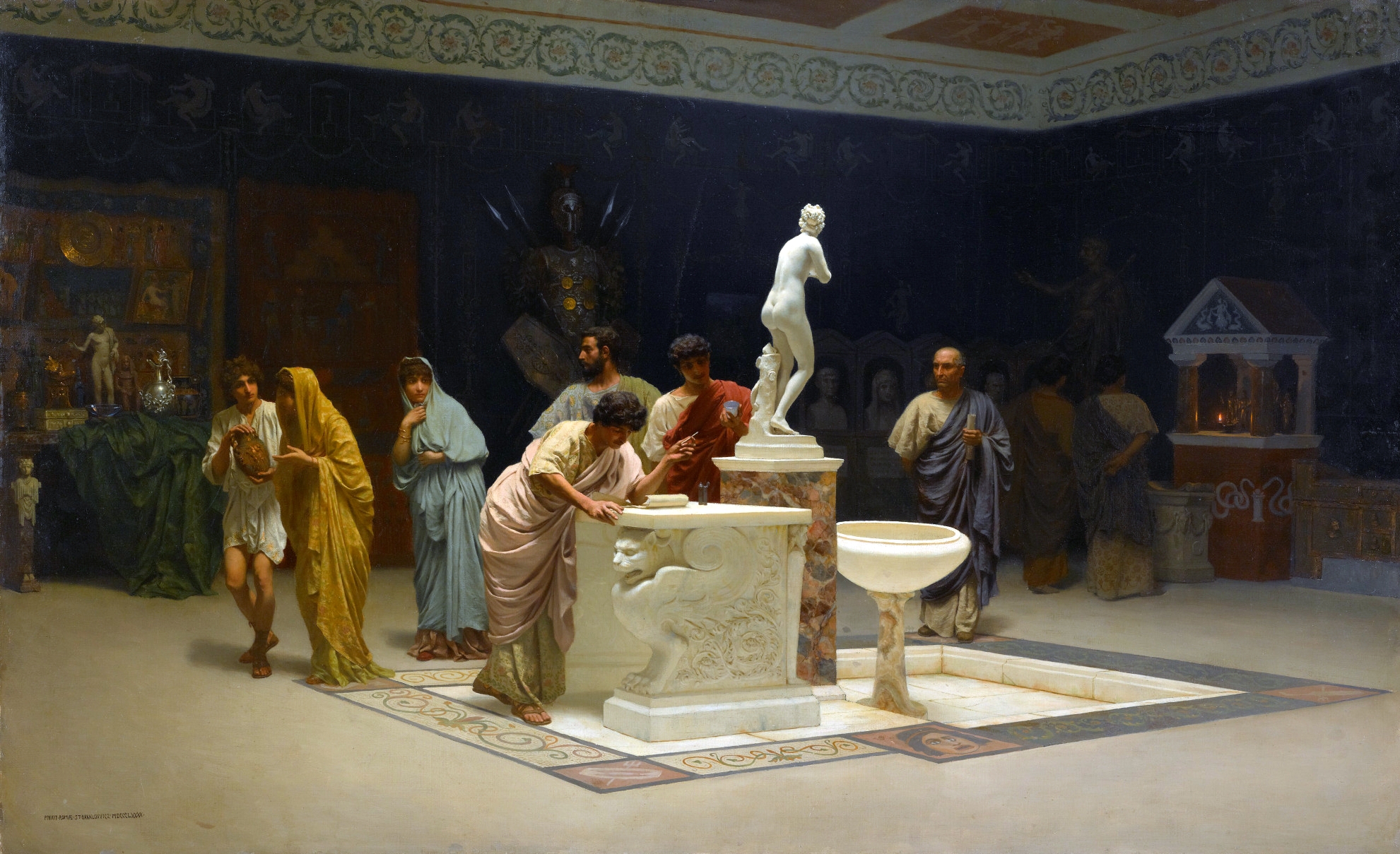
At Maecenas' reception room by Stepan Bakalovich (1890)


Williams also had a decidedly different take on Octavian's banishment of his daughter Julia as punishment for her licentiousness.  This has often been a sticking point with scholars who, like Gibbon, decry Octavian's hypocrisy.  Instead of the traditional approach to this incident, Williams portrayed their father-daughter relationship as one that was quite close even to the point that Augustus simply ignored the string of lovers his daughter entertained in her efforts to display her contempt for her husband, the future emperor Tiberius because Augustus despised Tiberius as well. 
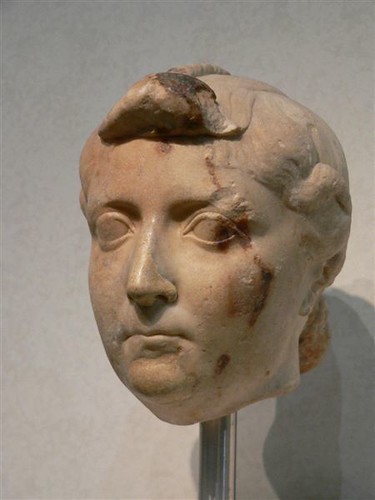
Julia Livilla, daughter of Germanicus, like
Julia the Elder, daughter of Augustus, also
suffered exile to the island of Pandataria
after being accused by the emperor Claudius
of adultery with Seneca.  Photographed at
the Palazzo Massimo by Mary Harrsch.


But when Augustus' spies reported that Julia's latest lover, Jullus Antonius, son of Augustus' dead arch rival, Marcus Antonius and his third rebellious wife Fulvia, was plotting a coup and the emperor's assassination, Augustus had no alternative except to condemn her. 


This may have been simply dramatic license on Wiliams' part - after all it is a novel not a text book - but this coup may have been more fact than fancy.  When Julia and her lovers were tried for their breach of Augustus' morality laws, all of the lovers except Jullus were exiled.  Jullus, however, was condemned to death as a traitor.  Williams proposes that Julia, although apparently not aware of the particulars of the plot, would have been found guilty of treason too and also sentenced to death if Augustus' had not engineered her conviction on the violation of his morality laws.  Thus, Julia's subsequent exile actually was an effort by her father to save her life, not severely punish her for moral indiscretions.  The thing I find puzzling, however, is if her exile was meant only to preserve her life, why did Augustus keep up the pretense of punishment for the rest of his life, as he reportedly refused to ever see her or speak of her again.  Had Tiberius already gained so much power that he could have pushed aside the aging Augustus whenever he chose to and exacted his revenge against Julia despite her father's acclaim as father of his country?
If you enjoyed this post, never miss out on future posts by following me by email!