Showing posts with label Edward Gibbon. Show all posts

Sunday, July 5, 2020

Books That Matter: The Decline and Fall of the Roman Empire

Yesterday, I finished listening to the Great Courses lecture series, Books That Matter: The History of the Decline and Fall of the Roman Empire presented by Professor Leo Damrosch of Harvard (I listen to audiobooks while I exercise!).  Although Professor Damrosch summarizes the content of the actual volumes, he is more focused on analyzing the lifestyle and Enlightenment thinking of Edward Gibbon and those he associated with as he wrote the great work.  As a rather impoverished member of Britain's aristocracy, Gibbon apparently thought aristocrats both in ancient Rome and in his late 18th century homeland should be entitled to a life without the drudgery of manual labor so they could explore and discuss ideas and study the writings of other great thinkers as well as the cultures of the past.

I have heard Gibbon frequently criticized by modern historians but Professor Damrosch makes it clear that Gibbon's research was meticulous and he did not shy away from conflicts in religion or fail to salute those individuals of the past that clearly excelled in their endeavors.  One of his main blindspots, though, (according to Damrosch) was Gibbon's dislike of the Byzantine period and his disregard for most of the Byzantine emperors who he described as "feckless" with the exception of Justinian.  I noticed, though, that he did not appear to have addressed the jealous rivalry between Belisarius and Theodora and seems to have welcomed the writings of Procopius as a reliable source. Although Procopius appears to be accurate during his early years on campaign with Belisarius, his later "Secret History" describes such ridiculous events as the emperor's head being able to disassociate itself from his body and float through the halls of the palace in Constantinople.  Maybe one of these days I'll have time to read Procopius in its entirety and I'll try to determine at what point in the narrative he sort of "runs off the rails."  (The hazard of reading for research purposes is that you usually only read the portion of a work that pertains to your inquiry and not the work in its entirety!)

Damrosch also thinks Gibbon was a bit too dismissive of religion in general and the internicene conflicts within the Christian church in particular.  Damrosch said Gibbon essentially attributes the decline and fall of the Roman Empire to barbarian incursions and the "triumph" of religion (not in a positive way). Some scholars call Gibbon an atheist but he was actually more of a theist who simply didn't ascribe to the myriad of divine relationships  identified by various religious sects. Gibbon was far more comfortable explaining events as much as possible by the actions of influential individuals and  factual evidence, as far as can be determined from reliable ancient sources, not by attributing anything to the vagaries of divine preference or will.

Gibbon lived in a time before archaeology was developed into a procedural discipline so his only sources were ancient records, many fragmentary at best. So, obviously, Gibbon may have interpreted some events differently if he had access to some of the analysis of remains we have today.  But, all in all, Gibbon's History of the Decline and Fall of the Roman Empire, is considered a masterpiece of both history and literature, and a worthy monument to the twenty years Gibbon spent in this endeavor.
If you enjoyed this post, never miss out on future posts by following me by email!


Wednesday, October 12, 2011

Excellent princes, ridiculous sophists or jealous tyrants? Gibbon's take on some of Rome's good emperors

Caesar Augustus by Boschetti Italian
Bronze 19th century  CE after Prima Porta
 Augustus 2nd century CE.  Photographed
at the University of Utah Museum of Art by
Mary Harrsch.
In my ongoing readings of Gibbon's Decline and Fall of the Roman Empire I was surprised to learn that Edward Gibbon maintained a rather harsh opinion of three of Rome's most respected emperors.

Gibbon claimed Vespasian's merit was "more useful than shining" and his virtues "disgraced by a strict and even sordid parsimony."  He declared Hadrian to be, in turn, an excellent prince, ridiculous sophist and, eventually, jealous tyrant.  But most surprising was his blistering assessment of Gaius Octavius Thurinus - the emperor Augustus.

Of Augustus, Gibbon declared, "A cool head, an unfeeling heart, and a cowardly disposition, prompted him at the age of nineteen to assume the mask of hypocrisy, which he never afterwards laid aside."

Whoa!  That's certainly an extreme assessment of the man ultimately responsible for ushering in the Pax Romana!  I doubt Octavian was particularly likable since he appeared to calculate the political advantage in every move, but despite concessions that he had to make to his ill health, I would hardly call him a coward.  It took a lot of brass for a 19-year-old stripling to go up against a man with the military experience and following of Marc Antony or the Roman world's most renowned orator and formidable politician, Cicero.

Cicero, 1st century BCE.  Photographed at the
Capitoline Museum by Mary Harrsch
Gibbon seems to blame Octavian for authorizing Cicero's proscription but that was really done at the insistence of Antony.  Octavian pragmatically didn't have any particular reason to oppose it.  It's very much like the recent debt ceiling negotiations.  Some programs were ultimately considered expendable in the overall "game of thrones".

Cicero had been so openly hostile to Antony, his appearance on Antony' hit list must have surely been a foregone conclusion.  Cicero had also arrogantly miscalculated Octavian's political astuteness and assumed he could simply dispose of Octavian after he had served the purposes of the power brokers in the Senate - also a fatal error.

As for hipocrisy, Augustus, like many politicians today, maintained power and control by telling people what they wanted to hear while quietly disposing of those deemed a threat to his position through political maneuvering or outright assassination covered by some socially engineered construct.  Scholars point to Augustus' blatant philandering while enacting morality laws to dictate the behavior of the people of Rome.  But as I pointed out in an earlier post on Roman infanticide, perhaps these laws were meant as deterrents to abortion and infant abandonment and to encourage larger Roman families because Roman birthrates were falling noticeably and there was administrative concern that the economic system was in jeopardy.


A decidedly different view of Rome's first emperor was presented by author John Williams in his novel "Augustus".  It is a novel written in the form of a collection of correspondence between the emperor and various members of his family and his imperial courtiers - much like Thornton Wilder's "Ides of March".  Williams, in contrast to Gibbon, was relatively kind to Octavian and seemed to gloss over some of his shortcomings, like his false promises of military support to Marcus Antonius during the latter's Parthian campaigns.  I think Williams did a good job, though, of demonstrating the overwhelming turmoil Octavian faced when he assumed the reins of power upon the death of his uncle, Julius Caesar.
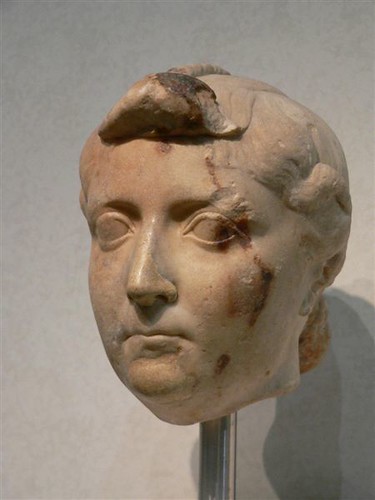
Livia, 1st century BCE.
Photographed at the Palazzo
Massimo by Mary Harrsch.

Unlike Robert Graves, however, Williams also spared  the empress Livia from any insinuations of overt murder in relating the deaths of many of Octavian's would-be successors.  Instead, however, he surprisingly portrayed her as a cold, rather loveless individual who ran Octavian's household but did not command his heart.  In Williams novel, most of Augustus' later years were spent in the company of Terentia, the wife of Octavian's close friend and advisor, Maecenas.  I knew Octavian reputedly engaged in adultery in flagrant violation of his own morality laws, but I guess I didn't realize much of his philandering was targeted at the wife of one of his closest friends.  Williams portrays Maecenas as openly homosexual and willingly supportive of his friend's dalliances but other scholars point out that the relationship between Maecenas and Augustus appears to have become more strained in later life probably due to the emperor's indiscretions.  Marcus Velleius Paterculus said Maecenas was "of sleepless vigilance in critical emergencies, far-seeing and knowing how to act, but in his relaxation from business more luxurious and effeminate than a woman." Perhaps Williams relied on that reference to support his development of Maecenas' character.


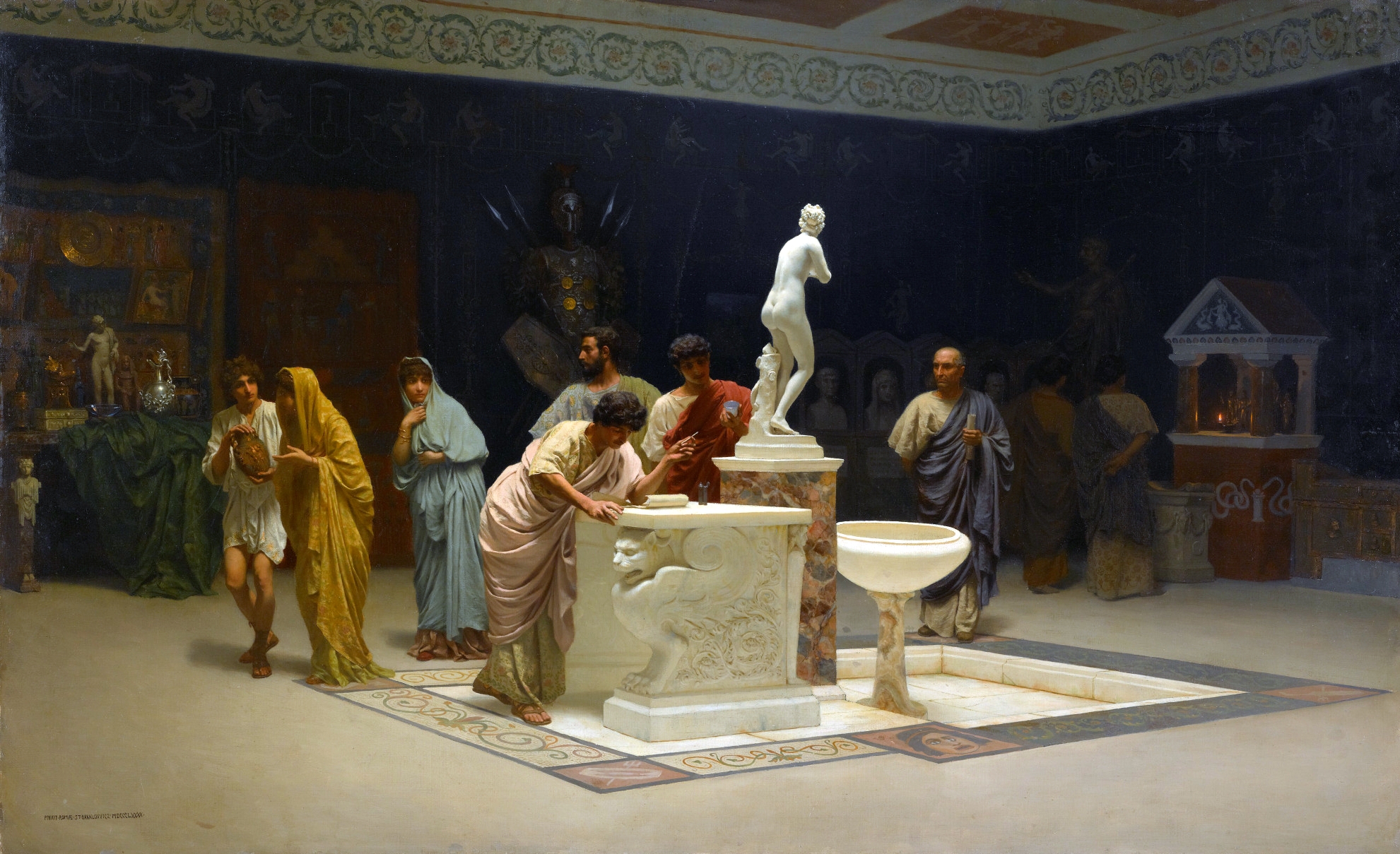
At Maecenas' reception room by Stepan Bakalovich (1890)


Williams also had a decidedly different take on Octavian's banishment of his daughter Julia as punishment for her licentiousness.  This has often been a sticking point with scholars who, like Gibbon, decry Octavian's hypocrisy.  Instead of the traditional approach to this incident, Williams portrayed their father-daughter relationship as one that was quite close even to the point that Augustus simply ignored the string of lovers his daughter entertained in her efforts to display her contempt for her husband, the future emperor Tiberius because Augustus despised Tiberius as well. 
Julia Livilla, daughter of Germanicus, like
Julia the Elder, daughter of Augustus, also
suffered exile to the island of Pandataria
after being accused by the emperor Claudius
of adultery with Seneca.  Photographed at
the Palazzo Massimo by Mary Harrsch.


But when Augustus' spies reported that Julia's latest lover, Jullus Antonius, son of Augustus' dead arch rival, Marcus Antonius and his third rebellious wife Fulvia, was plotting a coup and the emperor's assassination, Augustus had no alternative except to condemn her. 


This may have been simply dramatic license on Wiliams' part - after all it is a novel not a text book - but this coup may have been more fact than fancy.  When Julia and her lovers were tried for their breach of Augustus' morality laws, all of the lovers except Jullus were exiled.  Jullus, however, was condemned to death as a traitor.  Williams proposes that Julia, although apparently not aware of the particulars of the plot, would have been found guilty of treason too and also sentenced to death if Augustus' had not engineered her conviction on the violation of his morality laws.  Thus, Julia's subsequent exile actually was an effort by her father to save her life, not severely punish her for moral indiscretions.  The thing I find puzzling, however, is if her exile was meant only to preserve her life, why did Augustus keep up the pretense of punishment for the rest of his life, as he reportedly refused to ever see her or speak of her again.  Had Tiberius already gained so much power that he could have pushed aside the aging Augustus whenever he chose to and exacted his revenge against Julia despite her father's acclaim as father of his country?
If you enjoyed this post, never miss out on future posts by following me by email!


Tuesday, May 31, 2011

Patient diligence - the fruit of habit and discipline of the legions

"Active valor may often be the present of nature; but such patient diligence can be the fruit only of habit and discipline." - Edward Gibbon, Decline and Fall of the Roman Empire


Roman fort depicted in the Witheridge Historical Archive
Gibbon made this observation after describing the formidable strength of a typical Roman encampment that was erected at the end of a day after marching 20 or more miles.  He points out that the encampment was encircled by a rampart that was 12 feet high paralleled by a 12 foot ditch.  The vallum, the Roman term for the palisade, (a term that Gibbon does not use by the way) was derived from the word for a stake. 


I found it interesting that this feature of Roman military practice was actually adopted from the Greeks.  We are told by both Polybius and Livy that both Romans and Greeks used young, preferably oak, trees with three to four substantial side branches.  However, the Greeks spaced the trees farther apart, filling in the extra space with more branches.  This enabled them to open the palisade by grasping the fill branches and dragging them out of the way, then sally forth from any point of the rampart. 


The Romans, however, placed the trees much closer together, interlacing the branches and sharpening the ends into points.  It was very difficult to breech and not intended to be a temporary convenience, easily cast aside.   Ideologically the Romans used their fortification to reestablish the encircling sacred boundary that was used to demarcate a Roman city from surrounding countryside and once erected remained so until the mobile "city" of the legions moved on. 

"Boundaries are very important in the Roman world, and defining those boundaries is essential to knowing what is Roman," explains Professor Steven Tuck, Miami University, in his lecture on Roman military forts and fortifications in his Teaching Company Course, Experiencing Rome: A Visual Exploration of Antiquity's Greatest Empire.  He observes that gateways were viewed as a point of weakness, not only from a military viewpoint but from a religious one as a gateway represented a break in the religious protection of the pomerium.  "...wherever you put a gate in one of these symbolic religious boundaries, you're creating a zone of religious conflict." 


Tuck points out that formal Roman gateways were often protected by a protome, like the bust of Medusa or an important individual, that served an apotropaic purpose to ward off evil.


So we see that, like the eagle standard, the protective palisade served both a military and religious function, protecting the legions while projecting Roman power, reinforcing religious beliefs and demonstrating tangible benefits of Roman citizenship.  


Roman Auxiliary Forts 27 BC-AD 378 (Fortress)  The Roman Fort (Roman World)   Life and Letters on the Roman Frontier


Enhanced by Zemanta
If you enjoyed this post, never miss out on future posts by following me by email!


Monday, May 23, 2011

Devouring Gibbon's Decline and Fall of the Roman Empire 5 minutes at a time

Portrait, oil on canvas, of Edward Emily Gibbo...Image via Wikipedia
PORTRAIT, OIL ON CANVAS, OF EDWARD EMILY GIBBON
 (1737–1794) BY SIR JOSHUA REYNOLDS (1723–1792)
The masters of the fairest and most wealthy climates of the globe [The Romans] turned with contempt from gloomy hills, assailed by the winter tempest, from lakes concealed in a blue mist, and from cold and lonely heaths, over which the deer of the forest were chased by a troop of naked barbarians [Scotland]. - Edward Gibbon, Decline and Fall of the Roman Empire


18th century historians like Edward Gibbon (April 27, 1737 – January 16, 1794) write such stilted prose that I have found myself hesitant to tackle his Decline and Fall of the Roman Empire for fear that I would toss my hard-bound collection of this classic work into some cob-webbed abyss in the attic in frustration before I even finished Volume 1.  But, despite its errors that have been revealed by research in the last 300 years, Gibbon's work is considered one of those sources that a well read Roman scholar should have studied in the course of their career.

Lately, though, I have found a technical solution to my dilemma.  I read about a new service called Daily Lit that offers to email you five minutes worth of any work in their fairly extensive library of mostly public domain titles each day so you can "eat your vegetables" in tiny little bites.

I must admit trying to digest Gibbon's preface was a challenge, even at five minutes a day!  But now I'm finally into the meat of his first chapter and found the quote above that made me smile at the flourishes in his description.

Daily Lit also offers to email you free video lectures from Khan Academy that run between 10 and 25 minutes long.  Although Khan Academy's lectures are predominately math, they have begun offering history lectures too.  I'm presently subscribed to their lecture series on The French Revolution.

Instructor Sal Khan, a graduate of MIT, uses a virtual blackboard overlaid with images on which he writes and draws as he lectures in a very laid back manner, referring to Napoleon Bonaparte as a "dude who really knew what he was doing!"  His conversational style is so natural that you quickly become immersed in the topic and it doesn't feel like a formal lecture at all.  I was so excited by their efforts to offer free educational experiences that I sent them an e-mail offering the free use of my image archive.  I would love to have Sal explain the decline and fall of the Roman Empire!  His efforts even drew the attention of Google who gave him a $2 million grant to further develop his courses. I encourage you to check him out!


Related articles
The History of the Decline and Fall of the Roman Empire (Penguin Classics) 


If you enjoyed this post, never miss out on future posts by following me by email!