Showing posts with label Hadrian. Show all posts

Wednesday, April 21, 2021

Death of Antinous

In my travels I have photographed a number of sculptures of Hadrian's companion, Antinous.  Over 100 sculptures of the tragic young man have survived to modern times and classicist Caroline Vout has noted more images have been identified of Antinous than of any other figure in classical antiquity with the exceptions of Augustus and Hadrian himself.  This is probably attributable to Hadrian's deification of the young man after his death and the subsequent cult of Antinous that became widespread throughout much of the Roman Empire. 

Although officially, Hadrian announced that Antinous fell into the Nile and drowned, there have been a number of hypotheses about the young man's death.  Hadrian's entourage at the time is thought to have included  Lucius Ceionius Commodus, a young aristocrat whom Antinous might have deemed a rival to Hadrian's affections. In fact, soon after Antinous died, gossip quickly spread that Antinous had been intentionally killed.  Despite the official circumstances of the young man's death (at the time of his death, Antinous is thought to have been only 18-20 years old), Hadrian does not describe the death as being an accident, however, and some scholars point to this as suspicious.

If Antinous' death was not accidental, some scholars propose that he may have been murdered by a member of a court conspiracy.  The entourage assembled at Heliopolis included powerful military figures including the Prefect in Egypt as well as army and naval commanders.   But Royston Lambert, author of "Beloved and God: The Story of Hadrian and Antinous," points out that, besides lacking any supporting historical evidence, Antinous appeared to exert little influence over Hadrian's political activities, thus an assassination would seem to serve little purpose.

Other scholars have suggested Antinous died during a voluntary castration as part of an attempt to retain his youth and thus his sexual appeal to Hadrian. However, Lambert observes this is improbable because Hadrian deemed both castration and circumcision to be abominations and as Antinous was aged between 18 and 20 at the time of death, any such operation would have been ineffective anyway.

Another possibility is that Antinous represented a voluntary human sacrifice. The earliest surviving evidence for this comes from the writings of Dio Cassius, 80 years after the event, although it was subsequently repeated in many later sources. In the 2nd century Roman Empire, a belief that the death of one could rejuvenate the health of another was widespread, and Hadrian had been ill for many years. In this scenario, Antinous could have sacrificed himself in the belief that Hadrian would have recovered. If this last situation were true, Hadrian might not have revealed the cause of Antinous's death because he did not wish to appear either physically or politically weak. Conversely, opposing this possibility is the fact that Hadrian disliked human sacrifice and had strengthened laws against it in the Empire. Hadrian also appeared to be genuinely devastated by the youth's death and was probably directly responsible for his immediate deification by the local Egyptian priests. Although deification was not uncommon, in the Roman world formal divinization was, until that time,  reserved for the Emperor and members of the imperial family. Hadrian also did so without permission of the Senate, making the establishment of Antinous' cult highly unusual.

Archaeological evidence makes it clear that the cult ended up being genuinely popular among the different societal classes in the Empire. Part of the appeal was that Antinous had once been human himself, and thus was more relatable than many other deities. It is also possible, however, that his cult borrowed power from parallels between Antinous and beautiful young male immortals in the Greco-Roman pantheon like Apollo, Dionysus, and Silvanus as well as mortal youths beloved by gods in classical mythology like Ganymede, Hylas, Hyacinth, and Narcissus. These characteristics were common also to the cults of Attis, Endymion, and Adonis. Like the latter and the god of the newly established Christian religion, Antinous was also treated as a dying-and-rising god, not only in Egypt, but in Rome and Greece.

By the way, Lucius Ceionius Commodus was eventually named Hadrian's heir and became Lucius Aelius Caesar, who would father the Emperor Lucius Verus. Although Lucius had no military experience, he had served as a senator, and had powerful political connections. Perhaps Hadrian's affection for Antinous just proved to be too much of an obstacle to the political proponents of Lucius Ceionius Commodus even though Antinous himself expressed no political ambitions.  After all, Hadrian was seriously ill during this period and succession may have appeared imminent.


Image: A portrait bust of Antinous thought to have been sculpted around the time of his death that I photographed at the Palazzo Vecchio in Florence in 2005. 


If you enjoyed this post, never miss out on future posts by following me by email!


Tuesday, March 23, 2021

Mars and the Roman celebration of war


Statue of the Roman emperor Hadrian as Mars, God of War, 117–125 CE, that I photographed at the Capitoline Museums, Rome, Italy

In ancient Roman religion and myth, Mars was the god of war and also an agricultural guardian, a combination characteristic of early Rome. He was the son of Jupiter and Juno, and he was the most prominent of the military gods in the religion of the Roman army. 

Under the influence of Greek culture, Mars was identified with the Greek god Ares, whose myths were reinterpreted in Roman literature and art under the name of Mars. But the character and dignity of Mars differed in fundamental ways from that of his Greek counterpart, who is often treated with contempt and revulsion in Greek literature. Mars' altar in the Campus Martius, the area of Rome that took its name from him, was supposed to have been dedicated by Numa, the peace-loving semi-legendary second king of Rome. Although the center of Mars's worship was originally located outside the sacred boundary of Rome (pomerium), Augustus made the god a renewed focus of Roman religion by establishing the Temple of Mars Ultor in his new forum.

Although Ares was viewed primarily as a destructive and destabilizing force, Mars represented military power as a way to secure peace, and was a father (pater) of the Roman people. In the mythic genealogy and founding myths of Rome, Mars was the father of Romulus and Remus by his rape of Rhea Silvia. His love affair with Venus symbolically reconciled the two different traditions of Rome's founding; Venus was the divine mother of the hero Aeneas, celebrated as the Trojan refugee who "founded" Rome several generations before Romulus laid out the city walls.

Most of Mars' festivals were held in March, the month named for him (Latin Martius), which began the season for military campaigning and October, that ended the season for campaigning and farming.  

The Tubilustrium was the ceremony held using tubae, sacred trumpets,  to make the army fit for war. The ceremony was held on March 23, the last day of the Quinquatria festival held in tribute to the Roman God Mars and Nerine, a Sabine goddess. The Salii, the "leaping priests" (from the verb saliƍ "leap, jump") of Mars supposed to have been introduced by King Numa Pompilius, danced through the streets. They were twelve patrician youths, dressed as archaic warriors: an embroidered tunic, a breastplate, a short red cloak (paludamentum), a sword, and a spiked headdress called an apex. They were charged with the twelve bronze shields called ancilia, which, like the Mycenaean shield, resembled a figure eight. One of the shields was said to have fallen from heaven in the reign of King Numa and eleven copies were made to protect the identity of the sacred shield on the advice of the nymph Egeria, consort of Numa, who prophesied that wherever that shield was preserved, the people would be the dominant people of the earth.

If you enjoyed this post, never miss out on future posts by following me by email!


Thursday, February 18, 2021

Living well in the Roman Empire

 As thou intendest to live when thou art gone out,...so it is in thy power to live here.  Marcus Aurelius.  Meditations.  Book 5.


Images: Some of my images from Hadrian's Villa taken way back on my first visit to Italy in 2005. All images licensed with Creative Commons Attribution courtesy of Mary Harrsch (Required).


If you enjoyed this post, never miss out on future posts by following me by email!


Monday, July 27, 2020

The emperor Hadrian and the Castel Sant'Angelo

The emperor Hadrian's tomb was erected on the right bank of the Tiber, between AD 134 and 139. Now known as the Castel Sant'Angelo, originally the mausoleum was a decorated cylinder, with a garden top and golden quadriga. Hadrian's ashes were placed here a year after his death in Baiae in 138, together with those of his wife Sabina, and his first adopted son, Lucius Aelius, who died in 138. Following this, the remains of succeeding emperors were also placed here, the last recorded deposition being Caracalla in 217 CE. But much of the tomb  contents and decorations were lost when the building was converted to a military fortress in 401 CE then subsequently included in the Aurelian Walls by Flavius Honorius Augustus. The urns and ashes were scattered by Visigoth looters during Alaric's sack of Rome in 410, and the original decorative bronze and stone statuary were thrown down upon the attacking Goths when they besieged Rome in 537, as recounted by Procopius.  In the 14th century the popes converted the tomb into a castle and connected it to St. Peter's Basilica by a covered fortified corridor called the Passetto di Borgo. It was also used as a prison and executions were performed in the inner courtyard.

I first visited the castle in 2005 when  a friend and I walked there after spending the morning at St. Peter's and the Vatican Museums.  At that time, however, photography was disappointingly not allowed inside the structure.  But yesterday when I was researching the origins of a Roman relief I thought might be in the Castel Sant'Angelo, I was searching the images of the castle on Wikimedia Commons and discovered quite a number of excellent interior images, including this one of a fresco of Hadrian. Rome must have changed their policy on photography at this site!  I encourage you to browse the images of this impressive monument on Wikimedia Commons.  


They certainly refreshed my memory of my experience there!  You can find the fresco of Hadrian in the room known as the Sala Paolina.  This image is courtesy of Wikimedia Commons contributor, Vassil. 

Fresco of the Emperor Hadrian in the Sala Paolina of Castel Sant'Angelo courtesy of
Wikimedia Commons contributor, Vassil.

If you enjoyed this post, never miss out on future posts by following me by email!


Thursday, January 10, 2013

Review: Semper Fidelis by Ruth Downie


A history resource article by Mary Harrsch © 2013


Assimilating conquered warriors into the vanquishing army has been a problem for military commanders for thousands of years.  When Alexander the Great attempted to form an elite cavalry unit composed of the sons of conquered Persian nobles, his own officer corps was so enraged it led to the tragic death of Cleitus the Black, a longtime loyal officer to both Phillip II and Alexander, who was slain by Alexander himself after heated words about Alexander's efforts to incorporate Persians into positions of authority within his army.

It is this issue that forms the foundation for the plot of Ruth Downie's latest novel "Semper Fedelis".  We find our heroic medicus, Gaius Petreus Ruso, trying to find out what is happening to native Briton recruits at the hands of an apparently sadistic much-decorated centurion in second century Eboracum (modern day York).

As is usually the case, his native-born wife, Tilla, tries to help by questioning some of the local townspeople but ends up causing Ruso even more trouble with the commanding tribune who happens to be related to the family-honored centurion.  Ruso is summarily ordered to keep his nose out of things that don't concern him and Tilla receives a less subtle warning in the form of a severed pig's head found between her bedsheets.

But a recruit shows up at the hospital with a nasty infected arm after the young man had attempted to carve off a tribal tattoo to avoid any more abuse.  Then Ruso is further appalled when the man's friend turns up asking Ruso if he could remove the tattoos that embellish his arms as well.

With Tilla's urging, Ruso takes matters into his own hands when the emperor Hadrian shows up to inspect the fort, and Ruso attempts to explain the problem directly to Hadrian.  After all, Hadrian and Ruso served together in Antioch where Ruso was instrumental in saving the life of the emperor Trajan, Hadrian's adopted uncle.  Meanwhile, Tilla is called into the presence of the empress Sabina who thinks conversing with a colorful local would be amusing and Tilla attempts to bring the recruits plight to the empress' attention.
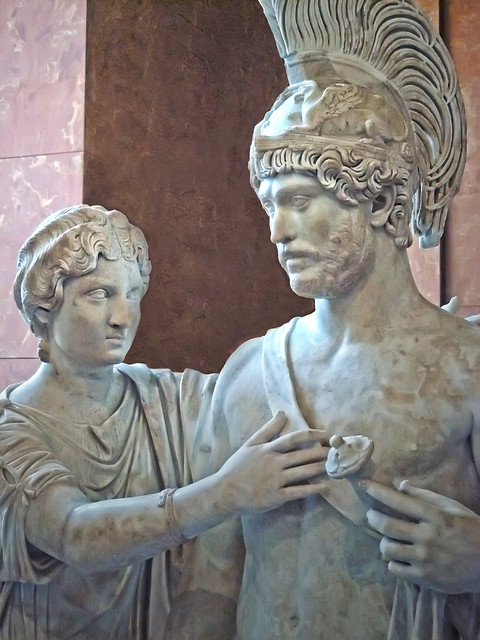
Interesting image of Mars the God of War with the face
of the Roman Emperor Hadrian and a female companion
whose face was resculpted in 170-175 CE to resemble
the Empress Lucille (according to The Louvre), wife of
the Roman emperor Lucius Verus (???) Photographed at The Louvre in Paris, France by Mary Harrsch

Then things take an even more nasty turn and the centurion in question is found murdered.  The related tribune throws Ruso into chains, more out of outrage that Ruso went to the emperor over his head than truly believing Ruso had anything to do with the murder. So Ruso and Tilla must scramble to discover the truth before Ruso is marched off to Deva for what is believed will be a summary trial and execution on the orders of the legate there.

The exciting conclusion involves Praetorian guards, conspiratorial royal secretaries, Tilla's less expert use of one of Ruso's scalpels, near mutiny of the recruits of the 22nd Legion and an ultimate solution devised by a very wise man who happens to be the most powerful ruler of the known world.

Again Downie has given us a mystery with twists and turns that keep readers guessing until almost the very end.  The characterizations of Ruso and Tilla are consistent with previous novels and, as I mentioned in a recent post to the Roman History Reading Group on Facebook, Downie offers each character's thoughts to us to flesh out their personalities.  She also provides a little backstory for tribune Accius letting us imagine his rather lonely childhood and the social importance of having an uncle publicly decorated for valor.  We can then understand, at least partly, the rational for what would normally be seen as outrageous behavior towards a respected medical officer.

The only thing I didn't understand in the plot was why Hadrian, who remained at the fort for several days during the time that tribune Accius imprisoned Ruso, did not act to prevent the mistreatment and possible loss of a valued medical officer who had proven himself in the Antioch earthquake?  Of course, our hero is ultimately saved but Hadrian's apparent indifference earlier in the story does not seem consistent with his obvious longtime respect for Ruso expressed at the end.

Of course, we don't know when Hadrian's knowledge of all of the events that occurred was realized, but as astute as Hadrian was, I can't imagine him not knowing that the tribune was blaming Ruso before Hadrian had left Eboracum for his next port of call.  If the tribune had simply locked up the native deserter, Victor, and blamed him from the beginning, it would have been more understandable that Hadrian would have been reticent to get involved.  Hadrian was a soldier's soldier and would not have intervened in a matter that should have been handled by the existing chain of command in circumstances that did not involve a professional officer held in high esteem by the emperor.  Perhaps this was Downie's way of developing events that would lead up to Russo's offer to sacrifice his own life to preserve order on the frontier and the emperor's continued successful reign.  Such an offer would then justify the size of the favor Ruso requests at the end of the story.

As for the supporting history behind the abuse of native recruits to the legions in Britain, we can look to the Vindolanda Tablets that include correspondence from the professional  auxiliaries from the Tungri tribe of the Aardennes region (Belgium/France/Luxembourg).  Although these men were not originally Romans from the Empire's heartland, they still  used a disparaging nickname for their British hosts: Brittunculi.

"In Latin, the suffix -unculus is both diminutive and pejorative: the term translates as "pathetic little Brits" (Vindolanda Tablet 164). The author was probably not referring to the provincial population as a whole, but specifically to young trainee recruits to the regiment. - Roman auxiliaries in Britain, Wikipedia

The Vindolanda Tablets, dated from 85 - 122 CE, also reveal that the military was understrength at the time of Hadrian's visit in 122 CE. The I Tungrorum listed its strength at 752 instead of the official 800 men expected to fill its rolls.  So, it would have been a time that recruits would have been sought, even from the local tribes.

Originally, Rome did not deploy auxiliary units in their home country or region but this policy relaxed to some degree as military shortages became more acute in the second century.

Centurion abuse of young recruits, outside the demanding regimen of basic training, is also documented in the ancient sources, although the most prominent record involves the Germanic Batavians.  In the "Year of the Four Emperors" (69-70 CE), the governor of Germania Inferior was ordered to raise more troops.  The Batavians  were regarded by the Romans as the very best (fortissimi, validissimi) of their auxiliary so the governor attempted to conscript more Batavi than the maximum stipulated in their treaty.  This action was compounded by the brutality and corruption of Roman recruiting-centurions including reports of sexual  assault on Batavi young men.
A Batavian helmet with remnants of blonde wig,
Courtesy of the Nijmegen museum.

Then, Julius Civilis, himself a decorated veteran of 25-years service in Britain and prince of the Batavi people, led his people in open revolt.

"... the uprising soon became a bid for independence.  Civilis exploited the fact that some legions were absent from the Rhine area due to the civil war, and the rest under-strength. In addition, the Roman commanders and their rank-and-file soldiers were divided by loyalty to rival emperors. Civilis quickly won the support of the Batavi's neighbours and kinsmen, the Cananefates, who in turn won over the Frisii. First the rebel allies captured two Roman forts in their territory, and a cohort of Tungri defected to Civilis.  Then two legions sent against Civilis were defeated when their companion Batavi ala defected to his side. The Classis Germanica (Rhine flotilla), largely manned by Batavi, was seized by Civilis. Most importantly, the eight Batavi cohorts stationed at Mainz with XIV Gemina mutinied and joined him, defeating at Bonn a Roman force that attempted to block their return to their homeland. By now, Civilis commanded at least 12 regiments (6,000 men) of Roman-trained and equipped auxiliary troops, as well as a much larger number of tribal levies. A number of German tribes from beyond the Rhine joined his cause. Several other German and Gallic units sent against him deserted, as the revolt spread to the rest of Gallia Belgica, including the Tungri, Lingones and Treviri tribes. He was able to destroy the two remaining legions in Germania Inferior, (V Alaudae and XV Primigenia). 
By this stage Rome's entire position on the Rhine and even in Gaul was imperiled. Their civil war over, the Romans mustered a huge task force of eight legions (five dispatched from Italy, two from Spain and one from Britain) to deal with Civilis. Its commander Petillius Cerialis had to fight two difficult battles, at Trier and Xanten, before he could overrun the Batavi's homeland. Tacitus' surviving narrative breaks off as he describes a meeting on an island in the Rhine delta between Civilis and Cerialis to discuss peace terms. We do not know the outcome of this meeting or Civilis' ultimate fate. But in view of his former friendship with Vespasian, who had already offered him a pardon, and the fact that the Romans still needed the Batavi levies, it is likely that the terms were lenient by Roman standards." - Roman military Auxiliaries, Wikipedia

So, the situation described in the novel could have been equally disastrous for Hadrian, who would have been keenly aware of the outcome of the Batavian revolt just 50 years before.  Furthermore, by Hadrian's time auxiliaries outnumbered legionaries by 2.5 to 1 in Britain.  Unfortunately for Ruso, Tribune Accius was far more nearsighted, thinking only of his family's social standing and not the welfare of the empire.

I also though Downie accurately portrayed the relationship between Hadrian and his wife Vibia Sabina.  Downie's townspeople mention rumors that Hadrian preferred to spend more time with his mother-in-law than Sabina.  Although that sounds strange, Hadrian's mother-in-law was actually his second cousin and only eight years older than Hadrian.  Furthermore, they were raised together in Trajan's household.

Sabina, as portrayed in the novel, was known to be independent minded and by the time of the novel, she had already had an affair with the historian Suetonius, secretary to Hadrian.  So, it would be totally in character for her to admonish Tilla by saying "Don't pray too hard" when Tilla said she would pray for the empress to be fruitful.

As a war veteran's spouse, another issue I always ponder when I read about a character being particularly brutal to other characters is whether the brutal character may be suffering from post-traumatic stress disorder.  Geminus was described as a valorous, much-decorated veteran about to retire when he finishes training this particular batch of recruits.  Although scholars like Dr. Jonathan Eaton question a diagnosis of PTSD in members of the Roman Army because of a lack of explosive or concussive events in a typical Roman battle (PTSD and the Roman Army ), I would point out that heroic epics like those of Homer formed a foundation of source material used in the formation of the Roman heroic ideal.  In Chapter 3 of "From Melos to Mylai: War and Survival", Lawrence Tritle asserts that the heroes portrayed in Homer, Tyrtaeus, Archilochus, and Aeschylus share the characteristic of being someone who takes revenge for the death of his friends and strongly believing a good man is a brave man.

Not only may Geminus have been subconsciously seeking revenge for friends lost in past campaigns but as the recruits quaked from the centurion's actions, he may have dismissed the lot of them as not worthy since they apparently displayed no bravery in his eyes.

Tritle further points out that in war, officers are taught to instill in the troops an image of the enemy as foreign and different.  "[these] emotional factors... were greater inducements to carry out brutal acts of violence than racially or culturally based perceptions of the 'Other'."

So despite his horrendous behavior, perhaps we should reserve at least a little sympathy for Geminus just as Ruso expressed for Geminus' dog, Bella.  She may have attacked Ruso because of her training, but in the end she waited calmly beside the body of her beloved master, unaware that she, too, would be struck down for her learned behavior and share his funeral pyre.

If you enjoyed this post, never miss out on future posts by following me by email!


Friday, April 6, 2012

Augustus or Julius Caesar? Ostia head another puzzle

Lately, I've been working on images I took of the Roman remains of the ancient port of Ostia.  I went to the official website of the archaeological site of Ostia to look through their images to help me identify some of the sculptures I photographed there and stumbled across an image of a head labeled as Augustus:


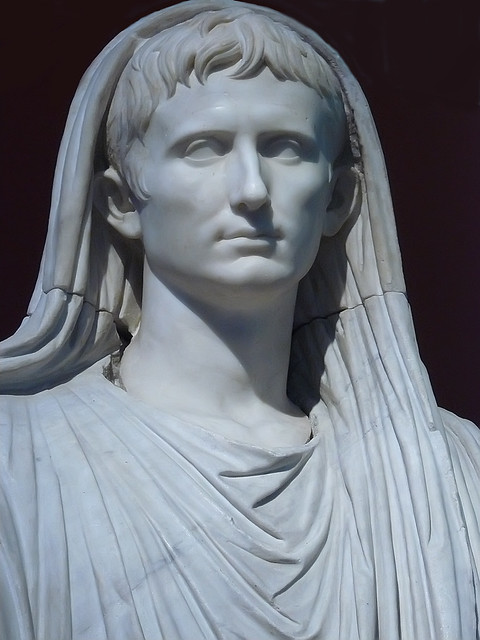
The notes accompanying the image says it was found on the Street of the Vigiles, the firefighters and watchmen of the city.  I realize Augustus is credited with establishing the vigiles in 6 CE after levying a 4% tax on the sale of slaves to fund the new force.  But this portrait head looks more like heads I have seen of Julius Caesar rather than Augustus.  I realize the damage to the frontal part of the forehead makes it difficult to determine the hairline but the hair appears much more sparse and combed forward rather than Augustus' thick locks almost always depicted in a slightly longer, more casual style:

Augustus as Pontifex Maximus photographed
at the Palazzo Massimo in Rome by Mary Harrsch.

I wish I knew if there was any accompanying epigraphic evidence discovered with the head.

I also noticed a portrait head of Hadrian found in a lime kiln:

Head of the Emperor Hadrian found in a lime kiln
 in the Caseggiato del Serapide in Ostia.


It pains me to think of all of the exquisite sculpture that was unceremoniously rendered down to make plaster in the Middle Ages.  What a tragic loss to our cultural heritage!


If you enjoyed this post, never miss out on future posts by following me by email!


Wednesday, October 12, 2011

Excellent princes, ridiculous sophists or jealous tyrants? Gibbon's take on some of Rome's good emperors

Caesar Augustus by Boschetti Italian
Bronze 19th century  CE after Prima Porta
 Augustus 2nd century CE.  Photographed
at the University of Utah Museum of Art by
Mary Harrsch.
In my ongoing readings of Gibbon's Decline and Fall of the Roman Empire I was surprised to learn that Edward Gibbon maintained a rather harsh opinion of three of Rome's most respected emperors.

Gibbon claimed Vespasian's merit was "more useful than shining" and his virtues "disgraced by a strict and even sordid parsimony."  He declared Hadrian to be, in turn, an excellent prince, ridiculous sophist and, eventually, jealous tyrant.  But most surprising was his blistering assessment of Gaius Octavius Thurinus - the emperor Augustus.

Of Augustus, Gibbon declared, "A cool head, an unfeeling heart, and a cowardly disposition, prompted him at the age of nineteen to assume the mask of hypocrisy, which he never afterwards laid aside."

Whoa!  That's certainly an extreme assessment of the man ultimately responsible for ushering in the Pax Romana!  I doubt Octavian was particularly likable since he appeared to calculate the political advantage in every move, but despite concessions that he had to make to his ill health, I would hardly call him a coward.  It took a lot of brass for a 19-year-old stripling to go up against a man with the military experience and following of Marc Antony or the Roman world's most renowned orator and formidable politician, Cicero.

Cicero, 1st century BCE.  Photographed at the
Capitoline Museum by Mary Harrsch
Gibbon seems to blame Octavian for authorizing Cicero's proscription but that was really done at the insistence of Antony.  Octavian pragmatically didn't have any particular reason to oppose it.  It's very much like the recent debt ceiling negotiations.  Some programs were ultimately considered expendable in the overall "game of thrones".

Cicero had been so openly hostile to Antony, his appearance on Antony' hit list must have surely been a foregone conclusion.  Cicero had also arrogantly miscalculated Octavian's political astuteness and assumed he could simply dispose of Octavian after he had served the purposes of the power brokers in the Senate - also a fatal error.

As for hipocrisy, Augustus, like many politicians today, maintained power and control by telling people what they wanted to hear while quietly disposing of those deemed a threat to his position through political maneuvering or outright assassination covered by some socially engineered construct.  Scholars point to Augustus' blatant philandering while enacting morality laws to dictate the behavior of the people of Rome.  But as I pointed out in an earlier post on Roman infanticide, perhaps these laws were meant as deterrents to abortion and infant abandonment and to encourage larger Roman families because Roman birthrates were falling noticeably and there was administrative concern that the economic system was in jeopardy.


A decidedly different view of Rome's first emperor was presented by author John Williams in his novel "Augustus".  It is a novel written in the form of a collection of correspondence between the emperor and various members of his family and his imperial courtiers - much like Thornton Wilder's "Ides of March".  Williams, in contrast to Gibbon, was relatively kind to Octavian and seemed to gloss over some of his shortcomings, like his false promises of military support to Marcus Antonius during the latter's Parthian campaigns.  I think Williams did a good job, though, of demonstrating the overwhelming turmoil Octavian faced when he assumed the reins of power upon the death of his uncle, Julius Caesar.
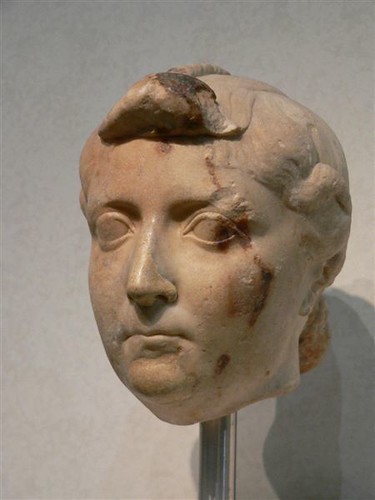
Livia, 1st century BCE.
Photographed at the Palazzo
Massimo by Mary Harrsch.

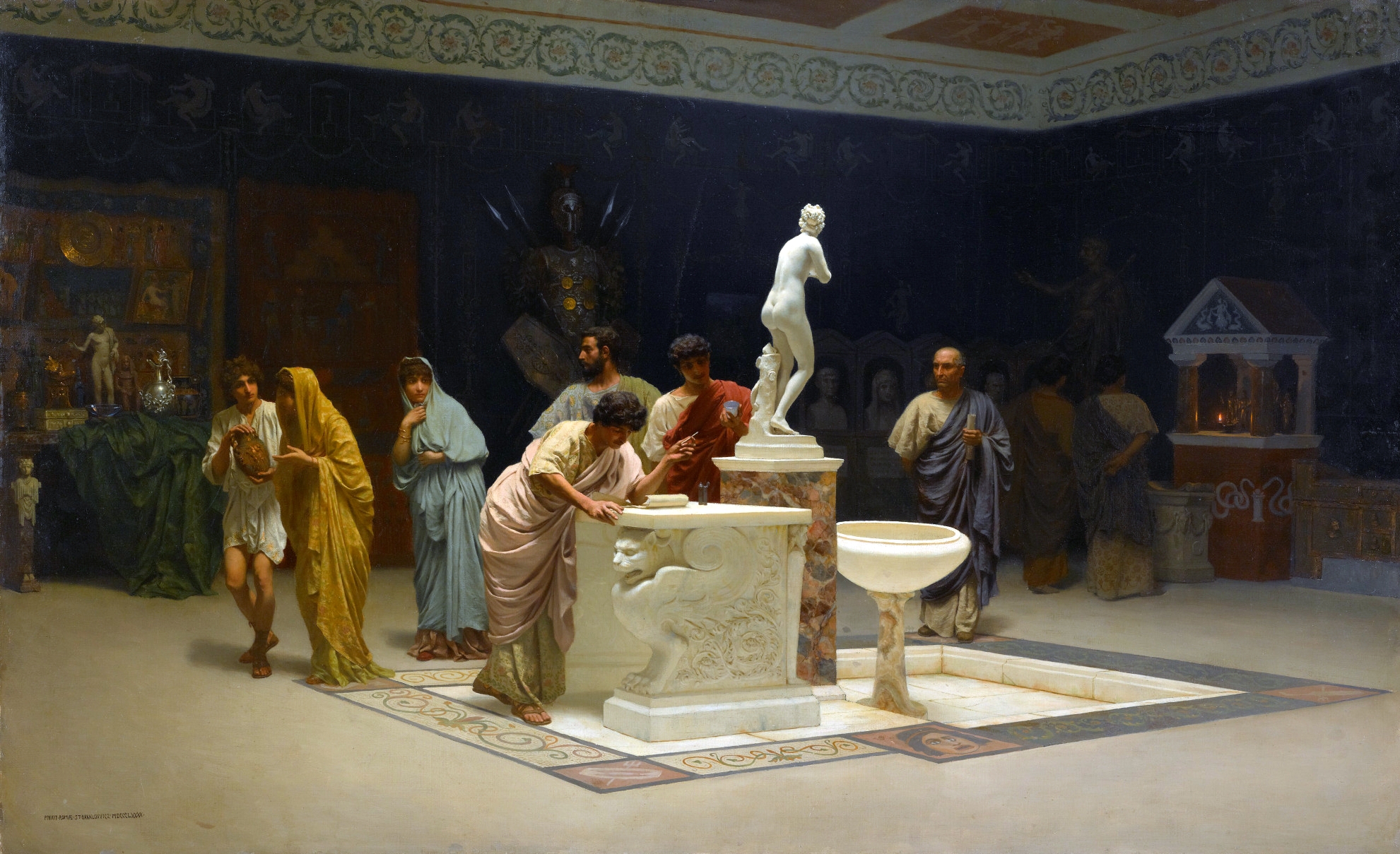
Unlike Robert Graves, however, Williams also spared  the empress Livia from any insinuations of overt murder in relating the deaths of many of Octavian's would-be successors.  Instead, however, he surprisingly portrayed her as a cold, rather loveless individual who ran Octavian's household but did not command his heart.  In Williams novel, most of Augustus' later years were spent in the company of Terentia, the wife of Octavian's close friend and advisor, Maecenas.  I knew Octavian reputedly engaged in adultery in flagrant violation of his own morality laws, but I guess I didn't realize much of his philandering was targeted at the wife of one of his closest friends.  Williams portrays Maecenas as openly homosexual and willingly supportive of his friend's dalliances but other scholars point out that the relationship between Maecenas and Augustus appears to have become more strained in later life probably due to the emperor's indiscretions.  Marcus Velleius Paterculus said Maecenas was "of sleepless vigilance in critical emergencies, far-seeing and knowing how to act, but in his relaxation from business more luxurious and effeminate than a woman." Perhaps Williams relied on that reference to support his development of Maecenas' character.


At Maecenas' reception room by Stepan Bakalovich (1890)


Williams also had a decidedly different take on Octavian's banishment of his daughter Julia as punishment for her licentiousness.  This has often been a sticking point with scholars who, like Gibbon, decry Octavian's hypocrisy.  Instead of the traditional approach to this incident, Williams portrayed their father-daughter relationship as one that was quite close even to the point that Augustus simply ignored the string of lovers his daughter entertained in her efforts to display her contempt for her husband, the future emperor Tiberius because Augustus despised Tiberius as well. 
Julia Livilla, daughter of Germanicus, like
Julia the Elder, daughter of Augustus, also
suffered exile to the island of Pandataria
after being accused by the emperor Claudius
of adultery with Seneca.  Photographed at
the Palazzo Massimo by Mary Harrsch.


But when Augustus' spies reported that Julia's latest lover, Jullus Antonius, son of Augustus' dead arch rival, Marcus Antonius and his third rebellious wife Fulvia, was plotting a coup and the emperor's assassination, Augustus had no alternative except to condemn her. 


This may have been simply dramatic license on Wiliams' part - after all it is a novel not a text book - but this coup may have been more fact than fancy.  When Julia and her lovers were tried for their breach of Augustus' morality laws, all of the lovers except Jullus were exiled.  Jullus, however, was condemned to death as a traitor.  Williams proposes that Julia, although apparently not aware of the particulars of the plot, would have been found guilty of treason too and also sentenced to death if Augustus' had not engineered her conviction on the violation of his morality laws.  Thus, Julia's subsequent exile actually was an effort by her father to save her life, not severely punish her for moral indiscretions.  The thing I find puzzling, however, is if her exile was meant only to preserve her life, why did Augustus keep up the pretense of punishment for the rest of his life, as he reportedly refused to ever see her or speak of her again.  Had Tiberius already gained so much power that he could have pushed aside the aging Augustus whenever he chose to and exacted his revenge against Julia despite her father's acclaim as father of his country?
If you enjoyed this post, never miss out on future posts by following me by email!


Saturday, July 9, 2011

Hail Caesar: The evolution of family name to imperial title

"The princes who by their birth or their adoption belonged to the family of the Caesars, took the name of Caesar.    After the death of Nero, this name designated the Imperial dignity itself, and afterwards the appointed successor. - Footnote, Gibbon's Decline and Fall of the Roman Empire

However, scholars in Gibbon's time were unsure of the exact point in the Roman succession that the name transitioned to an imperial title.

Augustus as Pontifex Maximus
photographed at the Palazzo
Massimo in Rome by Mary
Harrsch.
"The time at which it was employed in the latter sense, cannot be fixed with certainty. Bach (Hist. Jurisprud. Rom. 304) affirms from Tacitus, H. i. 15, and Suetonius, Galba, 17, that Galba conferred on Piso Lucinianus the title of Caesar, and from that time the term had this meaning: but these two historians simply say that he appointed Piso his successor, and do not mention the word Caesar.  [Actually, Galba himself assumed the title "Servius Galba Imperator Caesar" then passed it on by adoption to his successor.]

Aurelius Victor (in Traj. 348, ed. Artzen) says that Hadrian first received this title on his adoption; but as the adoption of Hadrian is still doubtful, and besides this, as Trajan, on his death-bed, was not likely to have created a new title for his successor, it is more probable that Aelius Verus was the first who was called Caesar when adopted by Hadrian. Spart. in Aelio Vero, 102.- W."   - Footnote, Gibbon's Decline and Fall of the Roman Empire

Adoption certainly accounts for Augustus, who was adopted by Julius Caesar, and Tiberius, who was subsequently adopted by Augustus.  Claudius assumed the name of Caesar upon accession without previous adoption but he was a direct descendant of Caesar's bloodline.  Claudius later adopted Lucius Domitius Ahenobarbus (Nero) thus transmitting the name Caesar to him. So Gibbon's initial observations are correct.  However,  Gibbon seems to become a bit confused with the successions occurring in the Year of the Four Emperors.

Roman emperor Otho in 69 CE.  
Photographed at The Louvre in Paris
by Mary Harrsch.
"Galba's reign did not last long and he was soon deposed by Marcus Otho. Otho did not use the title "Caesar", but occasionally used the title "Nero" as emperor. Otho was then defeated by Aulus Vitellius who acceded with the name "Aulus Vitellius Germanicus Imperator Augustus." Vitellius did not at first adopt the cognomen "Caesar" as part of his name, and may have intended to replace it with "Germanicus" (he bestowed the name "Germanicus" upon his own son that year).

Publis Septimus Geta 3rd century CE.
Photographed at the Palazzo Altemps
in Rome by Mary Harrsch.
Nevertheless, Caesar had become such an integral part of the imperial dignity that its place was immediately restored by Titus Flavius Vespasianus ("Vespasian"), whose defeat of Vitellius in 69 [CE] put an end to the period of instability and began the Flavian dynasty. Vespasian's son, Titus Flavius Vespasianus became "Titus Caesar Vespasianus". - Wikipedia

Following the Flavians, the emperor Nerva assumed the title as well then passed it on through adoption to his heir  Caesar Nerva Traianus who, supposedly, adopted his heir Hadrian, passing the title to him.  At this point our path once more converges with Gibbon.


I thought it was also interesting to read that to further distinguish the use of the name to designate the imperial heir, the title Nobilissimus (meaning "most noble") was added in the 3rd century CE beginning with  Publius Septimius Geta.


If you enjoyed this post, never miss out on future posts by following me by email!


Sunday, July 18, 2010

Don't miss my review of Steven Saylor's "Empire"!!

Empire: The Novel of Imperial Rome (Novels of Ancient Rome)I just finished an extensive review of Steven Saylor's new novel "Empire" and posted it to my Books and Novels of the Ancient World blog.    The novel follows the fictional patrician Pinarii family from the late Augustan Age to the reign of Hadrian with particularly fascinating "behind the scenes" exploration of the reigns of Nero and Domitian.  I found the novel so fascinating that I spent hours on supplemental research after I finished reading it to learn more about some of the personalities introduced in the novel that I knew very little about.  I highly recommend it!  Five Stars!!
If you enjoyed this post, never miss out on future posts by following me by email!


Sunday, January 13, 2008

Colossal statue of Hadrian found at Sagalassos, Turkey to be highlight of new British Museum exhibition

Two thousand years after he built a wall across Britain to keep out the barbarians, Hadrian is returning to this part of his empire. More than 200 treasures relating to the Roman Emperor will go on display in a block-buster exhibition this summer, the British Museum announced yesterday.

Spectacular artefacts that have only just been found will be among loans from 31 countries - a reflection of the global scale of Hadrian’s empire. It extended from Scotland to the Sahara, and from the Nile to the Danube.

Negotiations are now under way to bring to London a colossal marble statue of Hadrian that was found only a few months ago at Sagalassos, Turkey.

Archaeologists were excavating the site of a huge Roman bath complex, whose construction began under Hadrian, when they found the lower part of a leg and a foot with an exquisitely decorated sandal. The foot alone is about 0.8 metres (2.6ft) long. The complete statue, topped by an imposing head, was originally nearly five metres high. Traces of red paint have survived on both the hair and sandal...

The exhibits will include a sculpture of Hadrian’s wife, created with a beauty that, according to Thorsten Opper of the British Museum, “would have had Michelangelo in raptures, if he had seen it”.

There will also be exquisite bronzes, including an extraordinary statue found in Israel in the 1970s and a silver bowl bearing an intricate portrait of his young Greek lover, Antinous, who accompanied him on his travels around the empire.

A papyrus fragment will give an insight into the man himself as the only surviving section of Hadrian’s autobiography. Its contents are particularly touching in that Hadrian described the loss of his father at the age of 9.

The show also includes objects from the museum’s own collection such as the famous Vindolanda wooden tablets, the oldest surviving examples of handwriting in Britain, which were discovered near Hadrian’s Wall.

Before the exhibition, a bronze head of the emperor from the 2nd century AD will travel to both ends of the wall, which extends 80 miles from the Solway Firth to the Tyne at Wallsend. The head, one of the rare remaining bronzes from Roman times, has never left the museum since its discovery in the Thames in 1834."

This sounds like a fantastic exhibit. If the blood clot in my leg dissolves in time, maybe I can pop over to London and have a look!


If you enjoyed this post, never miss out on future posts by following me by email!