Showing posts with label Vespasian. Show all posts

Wednesday, November 18, 2020

The cult of Serapis: Visions and Portents

Serapis, sometimes spelled Sarapis, is a Graeco-Egyptian deity promoted during the 3rd century BCE by Ptolemy I Soter as a means to unify Greeks and Egyptians in his realm.  Alexander the Great had attempted to use Amun for this purpose, but he was more prominent in Upper Egypt, and not as popular in Lower Egypt, where the Greeks had stronger influence. Ptolemy built an immense temple to the god in Alexandria which became known as the Serapeum.  

However, there is evidence the cult of Serapis existed before the Ptolemies came to power in Alexandria as a temple of Serapis in Egypt is mentioned in 323 BCE by both Plutarch (Life of Alexander, 76) and Arrian (Anabasis, VII, 26, 2).  In descriptions of Alexander's death, a temple of Serapis is said to have existed in Babylon at the time and Serapis was considered so important,  he alone is named as being consulted on behalf of the dying king.  Some scholars point out, though, that a Babylonian god named Ea (also referred to as Enki) was titled Šar Apsi, meaning "king of the Apsu" or "the watery deep", and perhaps he is the one meant in the diaries.

Plutarch claimed Ptolemy stole the cult statue of Serapis from Sinope in Asia Minor after being  instructed in a dream by the "unknown god" to bring the statue to Alexandria.  There, a member of the  Eumolpidae, the ancient family from whose members the hierophant of the Eleusinian Mysteries had been chosen, proclaimed it to be Serapis. Tacitus, however, stated that Serapis had been the god of the village of Rhakotis before it expanded into the great capital of Alexandria.

The statue suitably depicted a figure resembling Hades or Pluto, both being kings of the Greek underworld, and was shown enthroned with the modius, a basket/grain-measure, on his head, since it was a Greek symbol for the land of the dead. He also held a sceptre in his hand indicating his rulership, with Cerberus, gatekeeper of the underworld, resting at his feet. The statue also had what appeared to be a serpent at its base, fitting the Egyptian symbol of rulership, the uraeus.

Whatever its origins, by the second century Serapis was well ensconced in both the Greek world and throughout the Roman Empire.  Pausanias notes two Serapeia on the slopes of Acrocorinth, above the rebuilt Roman city of Corinth and one at Copae in Boeotia. At Rome, Serapis was worshiped in the Iseum Campense, the sanctuary of Isis built during the Second Triumvirate in the Campus Martius. The Roman cults of Isis and Serapis gained in popularity late in the 1st century CE when Vespasian experienced a vision while visiting the Temple of Serapis in Alexandria where he was securing Egypt's grain supply before returning to Rome triumphantly as emperor in 70 CE. Later, Vespasian  was confronted by two laborers, who were convinced that he possessed a divine power that could work miracles. From the Flavian Dynasty onward, Serapis was one of the deities who sometimes appeared on imperial coinage with the reigning emperor.

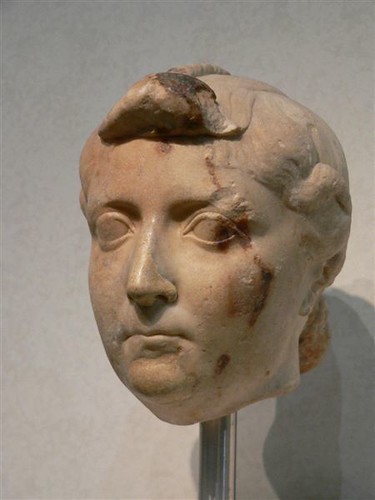
High Clerk in the Cult of Serapis, 230 - 240 CE,  at the Altes Museum, Berlin, courtesy of Wikimedia Commons contributor Ophelia2.


A fragmented statue of Serapis with a modius on the head, depicted as Pluto, next to him is standing the three headed dog Cerberus, guardian of the Hades, from the Roman Villa of Chiragan, 3rd - 4th century CE at the Musée Saint-Raymond in Toulouse, France, courtesy of Carole Raddato.  


If you enjoyed this post, never miss out on future posts by following me by email!


Sunday, July 29, 2018

Review: Onslaught by Anthony Riches

A historical resource article by Mary Harrsch © 2018


As I began listening to Anthony Riches' "Retribution" today, I realized I had not reviewed its prequel "Onslaught", the second in "The Centurions" series about the Batavian Revolt during the year of the Four Emperors, 69 CE. So, let's remedy that now.

Toward the end of The Centurions Book 1, "Betrayal", a sizable portion of the Batavian cohorts has been sent south from Germania Inferior to fight the forces of Marcus Salvius Otho, a young Roman aristocrat who has instigated the assassination of the short-lived emperor Servius Sulpicius Galba and now claims the purple for himself. The legions guarding the Rhine frontier, who initially marched south to fight Galba, are unwilling to accept Otho either, since they declared their own commander Aulus Vitellius emperor before hearing of Otho's coup. Now they plan to enforce their will regardless of which man the weak Roman senate ordains.

The forces clash violently at Cremona with Vitellius' forces victorious due in no small part to the ferocity of the Batavians.  As a reward, Vitellius orders the Batavians to return to their homeland.

But then word comes Titus Vespasianus, a general who has personally fought beside the Batavians in Britannia and even owes his life to them, has declared his intention to wrest control of the empire from Vitellius' tenuous grasp.  So, Vitellius changes his mind about sending the Batavians home to their prince.

This poses quite a dilemma for the Batavians as they have no real personal allegiance to Vitellius and they also know the Rhine legions he commands are determined to eliminate their prince Gaius Julius Civilis for his apparent collusion with Gaius Julius Vindex in an ill-fated revolt to support Galba a year earlier. Then, word leaks out that Vitellius plans to break up the Batavian cohorts and distribute them across his legions to blunt any threat they may present in the future.

Meanwhile, Civilis meets with envoys from Vespasianus including Pliny the Elder, and agrees to begin a rebellion to distract Vitellius and prevent him from ordering the remaining Rhine legions south to meet Vespasian's forces. Historically, this may have occurred, but is not specifically stated in any ancient sources.

Civilis knows it is a dangerous game he plays as Rome has always ruthlessly punished any tribal group who attempt to throw off the Roman yoke.  How far can he really trust Vespasian or even his own countrymen knowing he, himself, does not go unchallenged for leadership?  Much hinges on arrangements he has made with a long-time tribal opponent, Claudius Labeo. The plan is kept secret from even Civilis' closest kinsmen. Civilis wonders whether he can restrain his warriors from claiming Roman battle trophies and accept the defeat and plunder of Roman auxiliaries and fellow Germans instead.  Furthermore, for the plan to succeed, Civilis needs the rest of the Batavian cohorts now poised between returning to Batavia and continuing south with the forces of Vitellius.

His choice apparently made, Civilis sends a secret messenger to the Batavians in the south asking them to ignore Vitellius and continue their march north to join their countrymen and the game of thrones begins in earnest.

The grisly battle scenes, as is always the case with Riches' tales, keep you riveted to the action and guessing as to what Prince Civilis has up his sleeve. The characters are vibrantly drawn and  you can't help but feel empathy for them as they desperately battle their former comrades for the continued freedom of their tribe and even life itself.

I found myself still more partial to the Batavians than the defenders of the "Old Camp" and didn't really find a new Roman centurion called Aquilius particularly appealing either due to his brutal nature. But I know such characters really crank up the tension and realism of the narrative.

I am anxious to continue the Centurions' trilogy with "Retribution" and highly recommend this masterful series.


If you enjoyed this post, never miss out on future posts by following me by email!


Thursday, December 24, 2015

Review: Daughters of Rome by Kate Quinn

A history resource article by  © 2015

The momentous Year of the Four Emperors, 69 CE, has attracted a number of historical fiction authors.  This year alone I have read three different novels using the events preceding the rise of the Flavian dynasty as a framework for their stories, with Kate Quinn's "Daughters of Rome" being the latest.  Quinn's novel, however, is the first to view the events from the perspective of four patrician women, two sisters and two cousins, all named Cornelia.

To help the reader keep them all straight, Quinn gives three of them nicknames, Marcella, Lollia and Diana.  The eldest and most reserved of the women retains her own name, Cornelia (Prima).

As the novel begins, we meet most of the main characters at cousin Lollia's wedding. Lollia, her scheming and very wealthy grandfather's "little jewel", has endured a series of marriages and divorces to promote her grandfather's business interests.  This wedding (for the third or fourth time) is to an old senator she casually refers to as "old flacid."  We later learn that Lollia was once married to Vespasian's eldest son, Titus, and has a little daughter by him named Flavia.  Historically, Lollia's real name would have been Marcia Furnilla, Titus' second wife, whom he divorced because of her family's connections to the Pisonian conspiracy during the reign of Nero.  Titus' daughter lives with Lollia because her father is campaigning in Judea.  Historically, this would not have occurred as a Roman male's offspring are considered his property and upon dissolution of marriage would have been raised by other females of the Flavian gens but this is fiction, after all.

Relief depicting a Roman wedding ceremony.  Photographed
at the British Museum by Sarah Tarnopolsky.  Reproduced
with permission via Creative Commons by-NC-ND 2.0

Quinn does a good job of describing the excesses of a Roman wedding feast.  As the celebration progresses we learn that Diana, whose father is a famous sculptor, is a free-spirited young woman who is totally obssessed by chariot racing, the red faction in particular, and despite her beauty has no interest in anything without four legs.  Marcella, we discover, is an aspiring historian although she realizes as a woman she would probably never be published.  Marcella is married to a lackluster, miserly senator named Lucius Aelius Plautius Lamia Aelianus (also a historical person) who is serving as a military observer in the east.  Since he is not in Rome he sees no reason to spend money on a home for Marcella.  So, Marcella is forced to live with her brother, Gaius and his shrewish, social-climbing wife, Tullia.

Mosaic pavement depicting a charioteer of the red faction from the Villa dei
Severi 3rd century CE.  Photographed at the Palazzo Massimo venue of the
National Museum of Rome in Rome, Italy by Mary Harrsch.

We learn that Servius Sulpicius Galba has been proclaimed emperor by the senate and that Cornelia (Prima) is married to Lucius Calpurnius Piso, a young aristocrat that is named Galba's successor within the first few chapters.  We also meet  the charismatic Marcus Salvius Otho.  Unfortunately, Quinn does not include any of the political background between Galba and Otho that would have provided more context to the story and heightened the tension.  Quinn only sporadically mentions glimpses of life under Nero's rule, too, so uninitiated readers would have little idea what made Galba seize the throne in the first place.

The women gossip about Galba's dour personality and that Piso has been tactfully trying to get Galba to pay a promised donative to the Praetorian Guard, but the Cornelii seem only vaguely aware of the level of unrest that is increasing around the new emperor.

Cornelia (Prima) looks and behaves every inch the soon-to-be empress as she glides around the room greeting guests.  She is also very much in love with Piso and I couldn't help but think what few days were left to her beloved.

Galba orders a Praetorian body guard for Piso and it is led by a handsome and seriously honorable centurion named Drusus Sempronius Densus - the Densus who is revered in history as the only Praetorian who honored his loyalty oath and defended Galba when the assassins attacked Galba's litter.

Detail of a triumphal arch depicting Praetorian Guards.  Photographed in The
Louvre by Eric Huybrechts.  Reproduced with permission via Creative
Commons by-SA 2.0
Quinn has Densus narrowly survive the attack on Galba and Piso, although he is severely wounded. Ancient sources do not agree on the details, but they state unequivocally that Densus fights to the death.  His fictional survival, however, provides an important dramatic plot point so I understand why this variation from history was chosen.  Furthermore, Quinn does remain true to history when Piso meets his demise on the steps of the Temple of Vesta.

As each successive emperor takes the stage, Quinn pretty much follows the overall historical narrative while providing insight into the lives of patrician women in the first century.   The women are not in positions of power, however, so are pretty much subject to the whims of the male power players around them.  Dramatically this would be considered a disadvantage to a story's protagonist(s) but would be difficult to avoid if your protagonists are women during this historical period.

To overcome this character disadvantage, Quinn injects quite a bit of fantasy into the storyline surrounding Diana, who learns to be a charioteer.  Although women eventually tried their hand at becoming gladiatrices, I could find no reference whatsoever to women attempting to become charioteers, probably because of the sheer upper body strength needed to control four horses racing at breakneck speed.  However, Diana's skill becomes crucial in an exciting escape sequence towards the end of the novel so I understand why this subplot was introduced, although it was pretty far fetched.

A cultural faux pas that Quinn should have avoided was repeated references to a vomitorium as a room where satiated banquet guests go to relieve their overfull stomachs.  Although this is a common misconception, a vomitorium is actually a passage situated below or behind a tier of seats in an amphitheatre or a stadium, through which big crowds can exit rapidly at the end of a performance. Although the word vomitorium is derived from the Latin word vomō, meaning "to spew forth" and hence the root of our word vomit, it has nothing to do with the act.

Quinn also mentioned salmon at a banquet and that gave me pause as well.  The salmon I am familiar with (being from the Pacific Northwest) are from the colder regions of the North Pacific and North Atlantic. Although they may have been served in the northern provinces, I had serious doubts about fresh salmon on the menu in Rome.  However, I did some research on this and I guess there are species of salmonids in the Adriatic and Black Sea so it was theoretically possible, I guess, although I've never read any other books that mention it in their sometimes extensive descriptions of dishes served.  I felt much more comfortable when Quinn talked about the possibility of a poisoned mullet that sickened Vitellius' general (and another of Lollia's husbands), Fabius Valens.

Roman mosaic pavement depicting various fish species from the House of the 
Severi.  Photographed at the Palazzo Massimo venue of the National Museum
of Rome in Rome, Italy by Mary Harrsch.
My biggest source of confusion, however, was the names of the female protagonists, as I could not recall any Cornelii having any connections to the historical men in the story.  My confusion only increased when Quinn has a teenaged Domitian become infatuated with Marcella.  I kept thinking to myself that he obviously must lose interest in her when Domitia comes along.  Then Quinn mentions Cornelia and Marcella's father, Gnaeus Domitius Corbulo, the famous Roman statesman and general. These sisters were really Domitia (Prima) and Domitia Longina.  I'm baffled why she named the characters Cornelia unless it was to emphasize their aristocracy by recalling the consumate Roman matron who gained fame as the mother of the Gracchi or to make this a plot surprise (sorry for the spoiler if that's the case).  The Domitias certainly did not need any help from the ancestry of the Cornelii as they were direct descendants of Augustus.  Not only is this naming convention confusing to those of us who have studied the history but made it necessary for Quinn to contrive an awkward name change forced on Marcella by Domitian when she becomes his empress.

Gnaeus Domitius Corbulo.  Photographed by
Quinn Dombrowski at the Musée des beaux-arts de Montréal.
Reproduced with permission via Creative Commons by-sa 2.0.

I also thought her characterization of Corbulo as a cold father who probably could not even tell his daughters apart was unlikely.  Corbulo, besides being a brilliant general, was also a revered stateman and consul, which means he would have been resident in Rome for extended periods.  I'm relatively sure he would have not only known his daughters but been instrumental in the formation of their characters.  I much preferred Douglas Jackson's portrayal of Corbulo (and Domitia for that matter) in his novel "Avenger of Rome".

Marcella's unfeeling comment about the murder of Vespasian's "silly" brother, Sabinus, and Domitian's narrow escape from the Vitellian mob by cowering in the temple of Isis also showed little understanding of the value of Titus Flavius Sabinus to both his brother, Vespasian, and his nephew as well as the traumatic impact on Domitian when he witnesses the crowd tear his uncle to pieces. Perhaps Quinn intended this remark to reflect the insensitive nature of Marcella, but it seemed to strike a false chord for someone like Marcella who prides herself on her understanding of Roman politics.

Of course a major problem with portraying this period from a female perspective, too, is that you have no protagonist involvement in pivotal battles fought during this contentious period.  If Quinn had developed the Densus character more fully she could have written a more visceral battle sequence as seen through his perspective.  Instead, Quinn chooses to have Marcella supposedly convince Otho to let her travel to the first battle of Bedriacum as an observer.  But Marcella, the consummate historian, describes this horrendous confrontation of Romans fighting Romans in vague terms as if she is watching a stormy sea from a remote hilltop.  As someone used to reading the dramatic battle sequences in the novels of Douglas Jackson and Harry Sidebottom, this lackluster passage did little to drive the story forward, other than to describe the death of Otho, and would not have been very satisfying to male readers.

At least Quinn did have Densus go into hiding after the battle of Bedriacum to escape a Vitellian death sentence.  She made it sound like he was, ironically, blamed for the death of Galba and Piso, when historically Vitellius issued execution orders for all of the centurions of Otho's Praetorian Guard who fought at Bedriacum.  Perhaps she was trying to increase the reader's sympathy for Densus, but Quinn gave Densus so little to do with the events driving the narrative after Piso dies until almost the end of the story that this plot development was, in my opinion, not fully exploited for dramatic potential.

Still,  I found Quinn's evocation of first century Rome immersive and her characterization of the women compelling enough to keep me interested in what would happen to the women and their paramours.  If you would like more details of the actual politics and battles during this turning point in Roman history, though, I would highly recommend Douglas Jackson's historical novel "Sword of Rome" or Nic Fields historical text, AD 69: Emperors, Armies and Anarchy.

A Kindle preview:


More suggested reading:

If you enjoyed this post, never miss out on future posts by following me by email!


Wednesday, November 11, 2015

Review: Vespasian: Rome's Executioner by Robert Fabbri

A history resource article by  © 2015

I didn't realize it but I guess I started this series about one of Rome's "good" emperors with book 2 of the series.  However, the story, woven around the downfall of the infamous Praetorian Prefect Sejanus, stood on its own quite nicely.

There is no indication in history that Vespasian and his brother Sabinus conspired with the Lady Antonia, Tiberius' sister-in-law, to overthrow Sejanus to protect the reign of Tiberius.  However, a successful conspiracy is one in which the participants remain anonymous so Fabbri takes advantage of the lack of documentation to creatively spin this tale.

Sejanus was born into the equestrian class in 20 BCE at Volsinii in Etruria.  Sejanus' grandfather had improved the family's social standing by marrying a sister of the wife of Gaius Maecenas, one of the Emperor Augustus' closest political allies.  Sejanus' father, Lucius Seius Strabo, also married well and his uncle Quintus Junius Blaesus distinguished himself as a military commander and became proconsul of Africa in 21 CE.  Junius subsequently earned triumphal honors by crushing the rebellion of Tacfarinas, a Numidian deserter from the Roman Army who led a coalition of rebels against the forces of Rome in north Africa for 10 years.

It is thought Strabo eventually came to the notice of Augustus through his connection to Maecenas. Anyway, sometime after 2 BCE, Strabo, Sejanus' father, was appointed prefect of the Praetorian Guard.

We know little of Sejanus' early career until, according to Tacitus, Sejanus accompanies Gaius Caesar, adopted grandson of Augustus, to Armenia in 1 BCE.  Gaius Caesar dies from wounds supposedly received in a campaign in Artagira, Armenia in 4 CE.  Tacitus suggests there may have been foul play involved in the death of Gaius, orchestrated by Augustus' wife Livia to facilitate the accession of her own son Tiberius to the throne of the Roman principate.  However, Tacitus does not point an accusing finger at Sejanus.  But when Tiberius is crowned emperor in 14 CE, Sejanus is immediately appointed prefect of the Praetorian Guard as a colleague of his father.

A young Patrick Stewart as Sejanus in the 1976 production of
"I, Claudius".  Image courtesy of the British Broadcasting Company.
© 1976
Then when Sejanus' father is appointed to the governorship of Egypt in 15 CE, Sejanus assumes sole command of the Praetorians.  He centralizes the guards into a single garrison on the outskirts of Rome, personally appoints the centurions and tribunes and increases the number of cohorts from nine to twelve, resulting in a force of 12,000 soldiers now loyal to him.

Sejanus then conspires with the wife of Drusus, Tiberius' son, to have Drusus poisoned.  But when Sejanus asks permission to marry Drusus' widow, Tiberius ominously warns Sejanus not to overstep his bounds.  So Sejanus sets about sowing unrest between Tiberius and the senate.  Tiberius, already deeply depressed over the loss of his son, finally retreats to Campania in 26 CE then the island of Capri, leaving Sejanus to essentially rule Rome in Tiberius' absence.  Sejanus then sets about eliminating anyone he deems a threat that includes many of the elite.

A bronze statue of the Roman emperor Tiberius (not Augustus)
with head veiled (capite velato) preparing to perform a
religious rite found in Herculaneum 37 CE.  Photographed at
the Getty Villa by Mary Harrsch © 2014.
While matters were going thus with Sejanus, many of the other prominent men perished, among them Gaius Fufius Geminus. This man, having been accused of maiestas against Tiberius, took his will into the senate-chamber and read it, showing that he had left his inheritance in equal portions to his children and to the emperor. Upon being charged with cowardice, he went home before a vote was taken; then, when he learned that the quaestor had arrived to look after his execution, he wounded himself, and showing the wound to the official, exclaimed: “Report to the senate that it is thus one dies who is a man.” Likewise his wife, Mutilia Prisca, against whom some complaint had been lodged, entered the senate chamber and there stabbed herself with a dagger, which she had brought in secretly. - Cassius Dio, History of Rome, 58.4
Sejanus was so great a person by reason both of his excessive haughtiness and of his vast power, that, to put it briefly, he himself seemed to be emperor and Tiberius a kind of island potentate, inasmuch as the latter spent his time on the island of Capreae. - Cassius Dio, History of Rome, 58.5

Sejanus is wielding this immense power when Fabbri's story begins in Thrace where Vespasian is completing his appointment as tribune.  The plot involves Sejanus' funding of a rebellion in Thrace as a strategy to weaken the empire and redirect the attention of the legions from politics in Rome to the provinces. The groundwork for these clandestine activities may have been laid in Book 1 but I had to simply accept them as described as I had not read book 1 and have not found any references to them in the ancient sources.

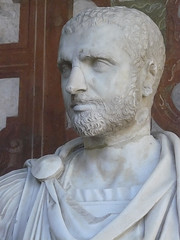
A portrait bust of the Roman emperor Vespasian.
Photographed near the Forum Romanun
in Rome, Italy by Mary Harrsch © 2005
Fabbri's pacing of the story is good and the characters thoughtfully fleshed out.  The only thing I found a bit distracting was Vespasian's use of colloquial language such as referring to "me mates".  I realize Vespasian was born into a rather undistinguished family of tax farmers and debt collectors in a little village northeast of Rome but I think he would have tried to speak in a more educated manner in the presence of military legates and a Thracian queen.

The constant bickering between Vespasian and his brother Sabinus also grew tiresome, especially since I know the two Flavian brothers were actually quite close and during the tumultuous Year of the Four Emperors, Vespasian entrusted the care of his youngest son Domitian to Sabinus during a very dangerous period.  But, soon the action kicked into high gear and there wasn't much time for the siblings to snipe at each other any more.

Vespasian's relationship to Antonia's slave Caenis was also more out in the open than it was portrayed in Lindsey Davis' book, "The Course of Honor".  Their little trysts did provide the opening for the development of another strong female character, however, so I can understand why Fabbri plotted the story in this way.

Vespasian is portrayed as being a childhood friend of Caligula's and, although there is no evidence of this in the ancient sources, the plot device worked well to provide an inside source in Tiberius' household on Capri to enable the band of rescuers access to the emperor.

Fabbri developed Tiberius' character as described by his detractors, Suetonius and Tacitus - a sinister demented pervert.  I personally think Suetonius and Tacitus' accounts of Tiberius' behavior in his last years are full of discrepancies and represent more character assassination than fact (See my article "Sexual innuendo and character assassination in the ancient world".)

But, from a dramatic standpoint, such a character definitely adds a heightened level of suspense to the narrative.

Fabbri appears to have intentionally changed one aspect of history.  Early in his career Vespasian obtained a post as a minor magistrate in the vigintivirate.  In the book, Vespasian becomes a tresviri capitales, one of three magistrates charged with managing prisons and the execution of criminals. This places him in a key position to be informed of the Senate proceedings surrounding the treason of Sejanus (since he is not a senator himself) and to witness both the execution of Sejanus and his eldest son as well as the tragic execution of Sejanus' young children (and provide the title for the book). Scholars, however, think Vespasian served as a quattuorviri viis in urbe purgandis - one of four magistrates charged with road maintenance within the city of Rome.  He was so unsuccessful in this position it is said the emperor Caligula publicly stuffed fistfuls of muck down Vespasian's toga because the streets were so filthy.

All in all, though, the novel followed the history of the fall of Sejanus quite closely including the dramatic climax and the fates of key characters.  I will definitely add the first book of the series and the sequel to this novel to my "to read" stack!

Kindle preview:


More Suggested Reading:

If you enjoyed this post, never miss out on future posts by following me by email!


Wednesday, December 5, 2012

Pewter Calathus featuring scenes of Vespasian's Legio II Augusta unique holiday gift

A few days ago I received an email from Calix Imperium, a new giftware company in the UK, that is offering, just in time for the holidays,  a beautiful pewter beaker called a Calathus after a vase-shaped basket often found in Greek painting and sculpture that represented fruitfulness.  The company's first release depicts three members of Vespasian's Legio Augusta - a centurion, an aquilifer and a legionary dressed in an Imperial Gallic helmet and the famous lorica segmentata body armor.


"He [The centurion] is depicted wearing the Imperial Gallic helmet (Cassis) surmounted with the insignia of his rank, the transverse crest. His body armour is mail (Lorica Hamata) with strips of leather (pteruges) protecting his upper arms and groin."
"Over his mail he wears a harness, on which are attached his various medals (phalarae). The large shield (Scutum) with a central boss is adorned with the Legion emblems, the CAPRICORN and the edge of the PEGASUS. These shield emblems where found on the Arch of Orange in France and deemed to be associated with Legio II Augusta." 
"The Centurion is seen wielding his principal weapon, the short sword (Gladius); his secondary weapon, the dagger (Pugio) is shown on his right side. To complete his body armour he is wearing greaves (Ocrea), in this case with decorative embossed Lion heads." - Calix Imperium


More pictures and descriptions may be viewed on the Calix Imperium website.  These 5 1/2" beakers are exceptionally detailed and would be a great addition to any Roman history buff's collection!  I wonder if my husband is listening??!!
Enhanced by Zemanta
If you enjoyed this post, never miss out on future posts by following me by email!


Wednesday, October 12, 2011

Excellent princes, ridiculous sophists or jealous tyrants? Gibbon's take on some of Rome's good emperors

Caesar Augustus by Boschetti Italian
Bronze 19th century  CE after Prima Porta
 Augustus 2nd century CE.  Photographed
at the University of Utah Museum of Art by
Mary Harrsch.
In my ongoing readings of Gibbon's Decline and Fall of the Roman Empire I was surprised to learn that Edward Gibbon maintained a rather harsh opinion of three of Rome's most respected emperors.

Gibbon claimed Vespasian's merit was "more useful than shining" and his virtues "disgraced by a strict and even sordid parsimony."  He declared Hadrian to be, in turn, an excellent prince, ridiculous sophist and, eventually, jealous tyrant.  But most surprising was his blistering assessment of Gaius Octavius Thurinus - the emperor Augustus.

Of Augustus, Gibbon declared, "A cool head, an unfeeling heart, and a cowardly disposition, prompted him at the age of nineteen to assume the mask of hypocrisy, which he never afterwards laid aside."

Whoa!  That's certainly an extreme assessment of the man ultimately responsible for ushering in the Pax Romana!  I doubt Octavian was particularly likable since he appeared to calculate the political advantage in every move, but despite concessions that he had to make to his ill health, I would hardly call him a coward.  It took a lot of brass for a 19-year-old stripling to go up against a man with the military experience and following of Marc Antony or the Roman world's most renowned orator and formidable politician, Cicero.

Cicero, 1st century BCE.  Photographed at the
Capitoline Museum by Mary Harrsch
Gibbon seems to blame Octavian for authorizing Cicero's proscription but that was really done at the insistence of Antony.  Octavian pragmatically didn't have any particular reason to oppose it.  It's very much like the recent debt ceiling negotiations.  Some programs were ultimately considered expendable in the overall "game of thrones".

Cicero had been so openly hostile to Antony, his appearance on Antony' hit list must have surely been a foregone conclusion.  Cicero had also arrogantly miscalculated Octavian's political astuteness and assumed he could simply dispose of Octavian after he had served the purposes of the power brokers in the Senate - also a fatal error.

As for hipocrisy, Augustus, like many politicians today, maintained power and control by telling people what they wanted to hear while quietly disposing of those deemed a threat to his position through political maneuvering or outright assassination covered by some socially engineered construct.  Scholars point to Augustus' blatant philandering while enacting morality laws to dictate the behavior of the people of Rome.  But as I pointed out in an earlier post on Roman infanticide, perhaps these laws were meant as deterrents to abortion and infant abandonment and to encourage larger Roman families because Roman birthrates were falling noticeably and there was administrative concern that the economic system was in jeopardy.


A decidedly different view of Rome's first emperor was presented by author John Williams in his novel "Augustus".  It is a novel written in the form of a collection of correspondence between the emperor and various members of his family and his imperial courtiers - much like Thornton Wilder's "Ides of March".  Williams, in contrast to Gibbon, was relatively kind to Octavian and seemed to gloss over some of his shortcomings, like his false promises of military support to Marcus Antonius during the latter's Parthian campaigns.  I think Williams did a good job, though, of demonstrating the overwhelming turmoil Octavian faced when he assumed the reins of power upon the death of his uncle, Julius Caesar.
Livia, 1st century BCE.
Photographed at the Palazzo
Massimo by Mary Harrsch.

Unlike Robert Graves, however, Williams also spared  the empress Livia from any insinuations of overt murder in relating the deaths of many of Octavian's would-be successors.  Instead, however, he surprisingly portrayed her as a cold, rather loveless individual who ran Octavian's household but did not command his heart.  In Williams novel, most of Augustus' later years were spent in the company of Terentia, the wife of Octavian's close friend and advisor, Maecenas.  I knew Octavian reputedly engaged in adultery in flagrant violation of his own morality laws, but I guess I didn't realize much of his philandering was targeted at the wife of one of his closest friends.  Williams portrays Maecenas as openly homosexual and willingly supportive of his friend's dalliances but other scholars point out that the relationship between Maecenas and Augustus appears to have become more strained in later life probably due to the emperor's indiscretions.  Marcus Velleius Paterculus said Maecenas was "of sleepless vigilance in critical emergencies, far-seeing and knowing how to act, but in his relaxation from business more luxurious and effeminate than a woman." Perhaps Williams relied on that reference to support his development of Maecenas' character.


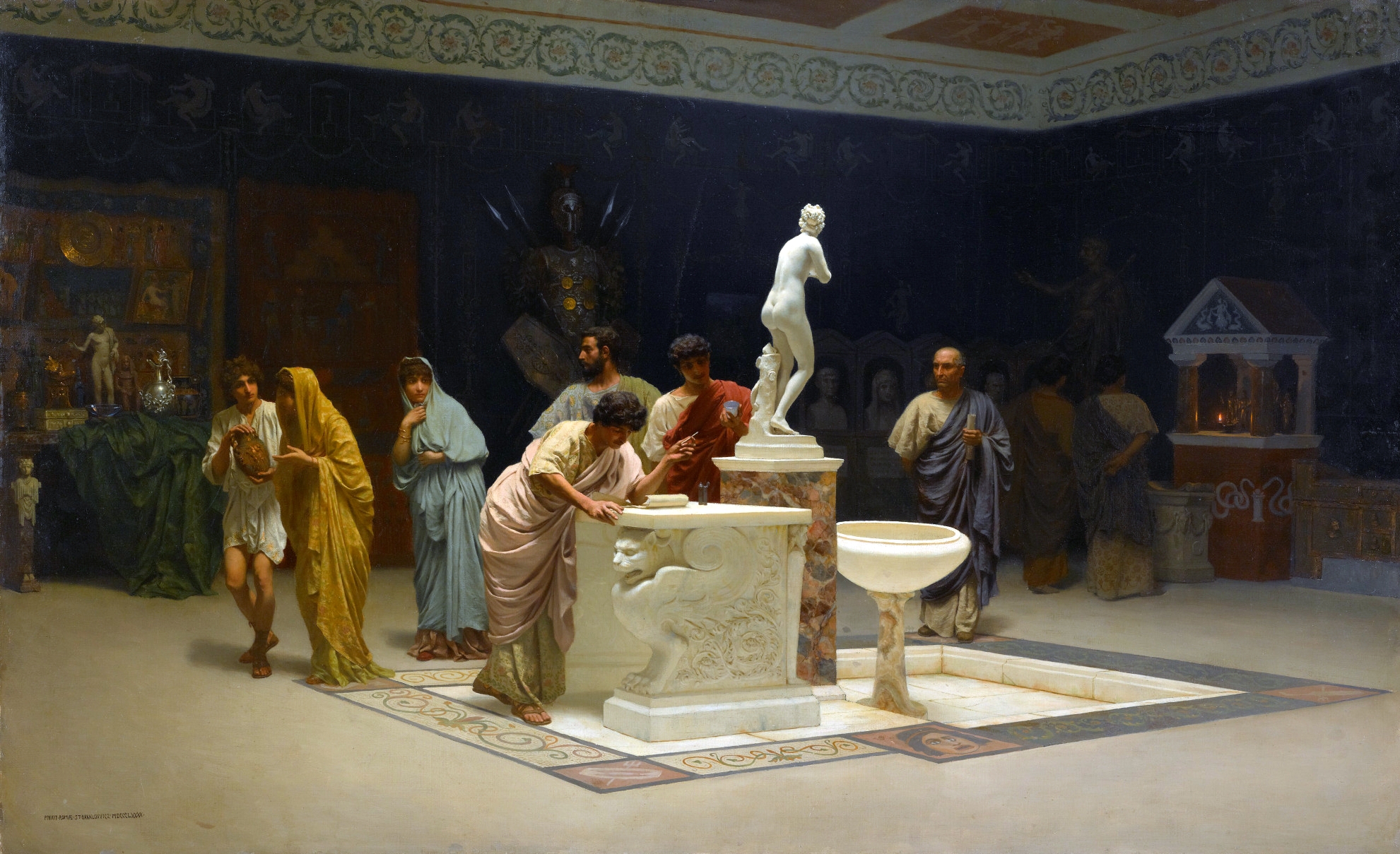
At Maecenas' reception room by Stepan Bakalovich (1890)


Williams also had a decidedly different take on Octavian's banishment of his daughter Julia as punishment for her licentiousness.  This has often been a sticking point with scholars who, like Gibbon, decry Octavian's hypocrisy.  Instead of the traditional approach to this incident, Williams portrayed their father-daughter relationship as one that was quite close even to the point that Augustus simply ignored the string of lovers his daughter entertained in her efforts to display her contempt for her husband, the future emperor Tiberius because Augustus despised Tiberius as well. 
Julia Livilla, daughter of Germanicus, like
Julia the Elder, daughter of Augustus, also
suffered exile to the island of Pandataria
after being accused by the emperor Claudius
of adultery with Seneca.  Photographed at
the Palazzo Massimo by Mary Harrsch.


But when Augustus' spies reported that Julia's latest lover, Jullus Antonius, son of Augustus' dead arch rival, Marcus Antonius and his third rebellious wife Fulvia, was plotting a coup and the emperor's assassination, Augustus had no alternative except to condemn her. 


This may have been simply dramatic license on Wiliams' part - after all it is a novel not a text book - but this coup may have been more fact than fancy.  When Julia and her lovers were tried for their breach of Augustus' morality laws, all of the lovers except Jullus were exiled.  Jullus, however, was condemned to death as a traitor.  Williams proposes that Julia, although apparently not aware of the particulars of the plot, would have been found guilty of treason too and also sentenced to death if Augustus' had not engineered her conviction on the violation of his morality laws.  Thus, Julia's subsequent exile actually was an effort by her father to save her life, not severely punish her for moral indiscretions.  The thing I find puzzling, however, is if her exile was meant only to preserve her life, why did Augustus keep up the pretense of punishment for the rest of his life, as he reportedly refused to ever see her or speak of her again.  Had Tiberius already gained so much power that he could have pushed aside the aging Augustus whenever he chose to and exacted his revenge against Julia despite her father's acclaim as father of his country?
If you enjoyed this post, never miss out on future posts by following me by email!


Saturday, July 9, 2011

Hail Caesar: The evolution of family name to imperial title

"The princes who by their birth or their adoption belonged to the family of the Caesars, took the name of Caesar.    After the death of Nero, this name designated the Imperial dignity itself, and afterwards the appointed successor. - Footnote, Gibbon's Decline and Fall of the Roman Empire

However, scholars in Gibbon's time were unsure of the exact point in the Roman succession that the name transitioned to an imperial title.

Augustus as Pontifex Maximus
photographed at the Palazzo
Massimo in Rome by Mary
Harrsch.
"The time at which it was employed in the latter sense, cannot be fixed with certainty. Bach (Hist. Jurisprud. Rom. 304) affirms from Tacitus, H. i. 15, and Suetonius, Galba, 17, that Galba conferred on Piso Lucinianus the title of Caesar, and from that time the term had this meaning: but these two historians simply say that he appointed Piso his successor, and do not mention the word Caesar.  [Actually, Galba himself assumed the title "Servius Galba Imperator Caesar" then passed it on by adoption to his successor.]

Aurelius Victor (in Traj. 348, ed. Artzen) says that Hadrian first received this title on his adoption; but as the adoption of Hadrian is still doubtful, and besides this, as Trajan, on his death-bed, was not likely to have created a new title for his successor, it is more probable that Aelius Verus was the first who was called Caesar when adopted by Hadrian. Spart. in Aelio Vero, 102.- W."   - Footnote, Gibbon's Decline and Fall of the Roman Empire

Adoption certainly accounts for Augustus, who was adopted by Julius Caesar, and Tiberius, who was subsequently adopted by Augustus.  Claudius assumed the name of Caesar upon accession without previous adoption but he was a direct descendant of Caesar's bloodline.  Claudius later adopted Lucius Domitius Ahenobarbus (Nero) thus transmitting the name Caesar to him. So Gibbon's initial observations are correct.  However,  Gibbon seems to become a bit confused with the successions occurring in the Year of the Four Emperors.

Roman emperor Otho in 69 CE.  
Photographed at The Louvre in Paris
by Mary Harrsch.
"Galba's reign did not last long and he was soon deposed by Marcus Otho. Otho did not use the title "Caesar", but occasionally used the title "Nero" as emperor. Otho was then defeated by Aulus Vitellius who acceded with the name "Aulus Vitellius Germanicus Imperator Augustus." Vitellius did not at first adopt the cognomen "Caesar" as part of his name, and may have intended to replace it with "Germanicus" (he bestowed the name "Germanicus" upon his own son that year).

Publis Septimus Geta 3rd century CE.
Photographed at the Palazzo Altemps
in Rome by Mary Harrsch.
Nevertheless, Caesar had become such an integral part of the imperial dignity that its place was immediately restored by Titus Flavius Vespasianus ("Vespasian"), whose defeat of Vitellius in 69 [CE] put an end to the period of instability and began the Flavian dynasty. Vespasian's son, Titus Flavius Vespasianus became "Titus Caesar Vespasianus". - Wikipedia

Following the Flavians, the emperor Nerva assumed the title as well then passed it on through adoption to his heir  Caesar Nerva Traianus who, supposedly, adopted his heir Hadrian, passing the title to him.  At this point our path once more converges with Gibbon.


I thought it was also interesting to read that to further distinguish the use of the name to designate the imperial heir, the title Nobilissimus (meaning "most noble") was added in the 3rd century CE beginning with  Publius Septimius Geta.


If you enjoyed this post, never miss out on future posts by following me by email!


Sunday, December 20, 2009

Exploring 1st - 4th century Roman villas in Brescia sounds fascinating!


I received a touristy little news item about the northern Italian town of Brescia that caught my interest.  The article mentioned that the area contained the largest Roman excavation in northern Italy so, of course, I had to read more about it.  I learned that Brescia, was once known as Brixia.

[Image: Mosaic floor of a 1st - 4th century Roman villa preserved at the Brescia Musei, Brescia, Italy.]

"Different mythological versions of the foundation of Brescia exist: one assigns it to Hercules, while another attributes its foundation to Altilia ("the other Ilium") by a fugitive from the siege of Troy. According to a further myth, the founder was the king of the Ligures Cidnus, who had invaded the Padan Plain in the late Bronze Age. Scholars attribute the foundation to the Etruscans." - Wikipedia

The Etruscans fell to the  Gallic Cenomani, allies of the Insubres, in the 4th century BCE.  The Celts succumbed to the Romans in 225 BCE.   But the Celts were not all satisfied with Roman rule and became part of a Celtic confederation allied with the Carthaginians in 202 BCE during the 2nd Punic War.

"...but, after a secret agreement, [Brixia] changed side and attacked the Insubres by surprise, destroying them. Subsequently the city and the tribe entered the Roman world peacefully as faithful allies, maintaining a certain administrative freedom. In 89 BC Brixia was recognized as civitas ("city") and in 41 BC its inhabitants received Roman citizenship. Augustus founded a civil (not military) colony there in 27 BC, and he and Tiberius constructed an aqueduct to supply it. The Roman Brixia had at least three temples, an aqueduct, an amphitheater, a forum with another temple built under Vespasianus, and some baths.

When Constantine advanced against Maxentius in 312, an engagement took place at Brixia in which the enemy was forced to retreat as far as Verona. In 402 the city was ravaged by the Visigoths of Alaric I. During the invasion of the Huns under Attila, the city was again besieged and sacked in 452 while, some forty years later, it was one of the first conquests of the Gothic general Theoderic the Great in his war against Odoacer." - Wikipedia

Republican-era buildings were discovered there in the 19th century under the remnants of the Capitolium, the temple built by the Emperor Vespasian.  Artifacts recovered from these excavations include Celtic arms, Roman portrait sculpture, frescoes and mosaics.  The Santa Giulia City Museum houses these discoveries as well as a collection of preserved Roman townhouses from the 1st to 4th century CE.

I'm also a big fan of armor collections and I see that the castle portion of the Museum houses an arms collection in the keep.  Over 580 swords, firearms and suits of armour, over half of the 1090 items bequeathed by industrialist Luigi Marzoli, are displayed in ten exhibit rooms.  The oldest item is a sword from the 13th century and one of the rarest is a large Venetian helmet and under-helmet with visor in the shape of a dog’s muzzle.

I had a wonderful time photographing the extensive armor collection at the Metropolitan Museum of Art in New York several years ago.  I would love to add images of  Brescia's marvelous collection to my Flickr set! I haven't yet visited Venice and I was really anxious to explore Ravenna someday too.  It looks like I need to plan a major expedition to northern Italy!


Houses, Villas, and Palaces in the Roman World     Roman Villas in Central Italy (Columbia Studies in the Classical Tradition)     Arms & Armor (DK Eyewitness Books)   Medieval Arms and Armor: A Pictorial Archive (Dover Pictorial Archive Series)   Vespasian   The Architecture of Roman Temples: The Republic to the Middle Empire
If you enjoyed this post, never miss out on future posts by following me by email!