Showing posts with label Naples. Show all posts

Wednesday, October 27, 2010

Researchers say Heat Not Ash Killed Pompeiians and Call For Extended Evacuation zones

An analysis of the body postures and bone modifications of 93 victims of Pompeii has convinced an Italian research team that heat in the range of 250-300 degrees Centigrade from the fourth pyroclastic flow emitted from Vesuvius instantly killed the remaining residents of Pompeii in 79 CE.

The team, led by  Giuseppe Mastrolorenzo, Pierpaolo Petrone, Lucia Pappalardo and Fabio M. Guarino divided the remains into five posture groups, those exhibiting a ‘‘life-like’’ stance - victims that appear in suspended action like those labeled a1, a2, b, c, 3b at right).; those in a ‘‘sleep-like’’ stance - victims laying on their back, on their right or left side in an apparent relaxed posture like those in a3, d; those who appear to have suffered debris impact with corpse displacement and/or rupture of body elements, those whose limbs contracted with iperflexion of hands and feet (e1, e2) and those with a ‘‘pugilistic attitude’’ in which their limbs were flexed as a result of dehydration and shortening of tendons and muscles (f). 
"...in Pompeii and surroundings most of the victims are typically frozen in suspended actions (73% life-like stance, 27% sleep-like stance), showing as well as limb contraction (76%) and a large number of corpses presenting the pugilistic attitude (64%). Even if different postures often coexist in the same victims group, the prevalence of people frozen in suspended actions (life-like stance) is univocally indicative of a condition known as cadaveric spasm." - Lethal Thermal Impact at Periphery of Pyroclastic Surges: Evidences at Pompeii
Unfortunate Animal victims of Vesuvius discove...Image by mharrsch via Flickr
Unfortunate Animal victim of
Vesuvius discovered near
Boscoreale Italy
The researchers go on to point out that cadaveric spasm, the rare stiffening of the entire body in its last position associated with violent instant death, is the key evidence that all victims suffered the same lethal event.  But to definitively isolate heat as the cause rather than suffocation, the team examined bone samples with an electronic microsope to see if the microscopic structure of the victims bones revealed the level of heat the victims suffered.

They established the pattern of coloration change and structural degradation by exposing modern bone samples from both humans and horses to varying degrees of heat.  When the heat applied reached 200 degrees Centigrade bone tissue yellowed.  As heat increased the bone tissue changed from yellow to bright brown then black, dark-brownish grey and finally light grey-white observed at 800 degrees Centigrade.  Bone structure likewise disintegrated from exhibiting linear microcracks at 200 degrees Centigrade to total dissolution into crystallized irregular globules at 500-800 degrees Centigrade.
Furthermore, researchers noted that DNA became undetectable above 300 degrees Centigrade as well.

In samples from the Pompeii victims, scientists found the bones yellowed and detected linear microcracks.  They also discovered intact DNA thus narrowing the temperature exposure during the 4th pyroclastic surge to 200 - 300 degrees Centigrade.  These temperatures, however, would have been lethal in microseconds, not the several minutes it would take to suffocate and no respiratory intervention would have been effective.  The researchers also point out that the calculated concentration of inhalable ash approached survivablility and the corpses would have exhibited the final floppy posture that characterize suffocation instead of the cadaveric spasm of instant death.
A parallel analysis was conducted on victims from the town of Herculaneum and the suburban Oplontis, both of which lie at about 7 kilometres from Vesuvius. The remains of victims here consist exclusively of skeletons (Herculaneum) or skeletons with only partial body imprint in the ash (Oplontis). The analyzed specimens from Herculaneum and Oplontis show bone colours ranging from black to grey-white, linear to polygonal microcracks and incipient to high recrystallization as well as complete DNA degradation . In contrast to Pompeii [10 kilometres from the vent] but similar to Herculaneum,  several victims at Oplontis show skull explosion, as testified by clear-cut fractures resulting from intracranial overpressure induced by exposure of the corpses to very high temperature. These features suggest temperatures of ca 500 degrees C in Herculaneum, which matches well with previous supporting evidence , and a temperature of ca 600 degrees C in Oplontis. - Lethal Thermal Impact at Periphery of Pyroclastic Surges: Evidences at Pompeii
 What this all means to emergency evacuation planners in Naples and in other population centers near explosive volcanoes is that the radius of lethal exposure is much farther than originally thought and that respiratory intervention cannot be relied upon for survivability within these areas.
Pyroclastic flows at Mayon Volcano, Philippine...Image via Wikipedia"...while impact force and exposure time to dusty gas dropped below lethal conditions, the pyroclastic cloud retained its high temperature thus being the main cause of instantaneous mortality for the Vesuvius area inhabitants, including people who were sheltered within buildings as far as Pompeii. Definitely, a group of indoor victims found at Muregine, within the limit [of the 4th pyroclastic surge] about half kilometer south-east of Pompeii walls, suggests that even an extremely short exposure to the pyroclastic surge in the order of seconds to a few tents of seconds was lethal.  These facts and the evidence that the late, most powerful 79 AD PDCs reached distance exceeding 20 kilometres from the vent and the findings of several scattered groups of victims in Roman villas even as far as at least 15 kilometres in Stabiae highlight the need to strengthen the emergency plans for Vesuvius and other similar explosive volcanoes considering long-distance thermal effects even at the extreme PDCs periphery as primary cause of fatalities, " the research team ominously concluded.
The complete article can be read at Plosone.org
The Complete Pompeii (The Complete Series)   Pompeii - The Last Day/Colosseum - A Gladiator's Story   The Fires of Vesuvius: Pompeii Lost and Found   Pompeii: The History, Life and Art of the Buried City  The Mount St. Helens Volcanic Eruptions (Environmental Disasters)   La Catastrophe: The Eruption of Mount Pelee, the Worst Volcanic Disaster of the 20th Century
Volcanic Hazards and Disasters in Human Antiquity (Special Papers (Geological Society of America), 345.)
Enhanced by Zemanta
If you enjoyed this post, never miss out on future posts by following me by email!


Monday, September 13, 2010

Pompeii focus of new lectures series from The Teaching Company

When I received the latest catalog of courses from The Teaching Company I saw that they are now offering the 24-lecture series "Pompeii: Daily Life in an Ancient Roman City".  Pompeii has intrigued me since I was a young girl back in the 50s.  I don't even remember when I first learned about it since classical history was not covered in the school curriculum of my small hometown.  Besides being mesmerized by images of the beautiful frescoes, mosaics and sculptures that had been recovered from the site, I was admittedly rather morbidly drawn to the images I had seen of the plaster casts made of the hapless residents who met tortuous deaths that fateful day in 79 CE.  

For some time I thought Pompeii was a recent archaeological discovery, not realizing that it was actually rediscovered clear back in 1599 CE. I could hardly believe that despite the more enlightened thinking of the Renaissance period, architect Domenico Fontana, appointed to resume excavations in Pompeii, after working on St. Peter's under Pope Sextus V and erecting the massive Egyptian obelisk in front of the cathedral, actually chose to cover the find near Naples back over because of the "shocking" nature of the sexually explicit images and artifacts that he found there.  Wholesale plundering of the site began in 1748 under the auspices of  the King of Naples, Charles of Bourbon.

It was not until Giuseppe Fiorelli took charge of the excavations  in 1860, though, that techniques were developed to create those casts of the victims of Pompeii by pouring plaster into voids in the ash layer that were found to contain human bones.  

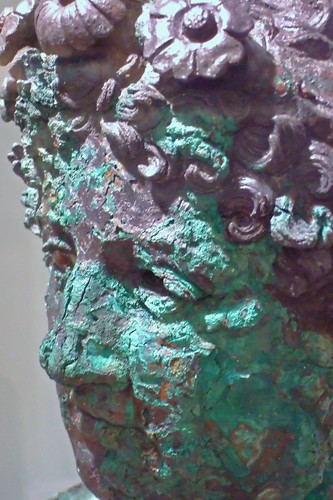
This bronze sculpture of Eros is contorted
by the heat from the volcanic blast of
Vesuvius.  Photographed at Boscoreale
by Mary Harrsch.
I had never seen any of the casts myself until only recently when I attended the "Pompeii: Stories From An Eruption" exhibit at the Smithsonian in Washington D.C. It included a number of casts, the most poignant being that of a child killed when a staircase collapsed in the House of the Golden Bracelet. 

When I finally got a chance to visit Italy for the first time in 2005, my friends and I rented a car and drove down to Pompeii for a day of exploration.  We entered through the main gate and began exploring the necropolis before we got to the remains of the villas.  Most of the artwork I had read about had been removed for conservation and display, much of it in the Museo Archaeologico di Napoli in downtown Naples so it was a bit of a treasure hunt searching for any small frescoes or particularly interesting mosaics that had been left behind.  

The bronze sculptures of a wild boar surrounded by hunting hounds that you see in the courtyard of the House of the Citharist as well as the bronze faun that you see in situ at the House of the Faun are actually reproductions but they help you envision the respective villas in their original state.


The infamous fresco of the well-endowed Priapus is still there though (or it was at least as late as 2005). It was smaller than I thought since most television programs that feature it normally zoom in for a startling closeup. Apparently, it was plastered over at one point by excavators for modesty's sake and was not rediscovered until 1998 when it was revealed by a heavy rain.  As for human casts, I saw only two victims on display in the site itself at the time.


When I returned to Naples in 2007, I entered Pompeii through a side entrance and quickly found myself exploring one of the public baths.  Somehow I had missed it on my first visit.  I also had a chance to visit Boscoreale, a neighborhood about a kilometer north of Pompeii where aristocrats lived in luxurious villas and a villa rustica is being currently excavated.  The museum at Boscoreale is small but quite interesting.  There I saw casts of a poor watch dog and a boar caught by Vesuvius' blast as well as a round loaf of Roman bread burnt to charcoal. 


In 2009, I was thrilled to attend the exhibit "Pompeii and the Roman Villa: Art and Culture Around The Bay of Naples" at the Los Angeles County Museum of Art.  I learned about the resurgence of archaism in Roman art that was discovered in Pompeii and the other villas surrounding Vesuvius and wrote an article about it for Heritage Key.  If that exhibit is still making the rounds I would highly recommend visiting it if it should make an appearance in a museum near you.


I am sure the new lecture series will point out even more details that I've probably overlooked and give me background information on the structures I admired there.  The lectures are presented by Dr. Steven Tuck, Associate Professor of the Classics and Art History at Miami University.


"After earning his B.A. in History and Classics at Indiana University, he received his Ph.D. in Classical Art and Archaeology from the University of Michigan. He held the postdoctoral Arthur and Joyce Gordon Fellowship in Latin Epigraphy at The Ohio State University.

An esteemed teacher, Professor Tuck was named a University Distinguished Scholar in 2005 and an Outstanding Professor in 2007, 2008, and 2009 at Miami University. He has served as a national lecturer for the Archaeological Institute of America and was a regular lecturer for the Continuing Education program at the University of Evansville, presenting lectures on topics including ancient social and political history, and archaeology.

Professor Tuck is the author of many articles featured in international journals on topics such as the spectacle schedule at Pompeii, the decorative program of the amphitheater at Capua, and triumphal imagery across the ancient Roman world. He is the author of Latin Inscriptions in the Kelsey Museum: The Dennison and De Criscio Collections." - The Teaching Company

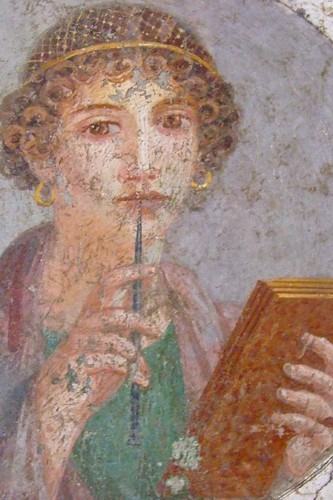
The lectures cover the history of the area clear back to its early settlement by the Etruscans, as well as the region's geology and commercial development including Pompeii's thriving wool industry and viticulture.  Dr. Tuck explores the upper class homes including the Villa of the Papiri as well as the House of the Vettii and the House of the Tragic Poet.  He also spends one lecture on the Praedia of Julia Felix, a collection of gardens, baths and shops that served as sort of a Roman country club of the period.  These remains are some of the most complete that I saw in Pompeii and some of the gardens have now been replanted by site restorationists.  When I saw the fresco of a thoughtful Roman woman (above) from the Villa di Guilia Felice in Pompeii at the Museo Archaeologico di Napoli, I wondered if it was a portrait of Julia herself thinking about all the money she was making with her various enterprises!

A slideshow of my images from Pompeii and the art recovered from Vesuvian ash:


Learn more about Pompeii!

The Complete Pompeii   Pompeii: The History, Life and Art of the Buried City   Pompeii (The Roman World)   Ancient Mysteries - Pompeii: Buried Alive   The Fires of Vesuvius: Pompeii Lost and Found    Pompeii: The Living City  Bodies From the Ash: Life and Death in Ancient Pompeii   Pompeii: Public and Private Life (Revealing Antiquity)   Pompeii: The Life of a Roman Town   Pompeii - The Last Day/Colosseum - A Gladiator's Story
If you enjoyed this post, never miss out on future posts by following me by email!


Saturday, October 18, 2008

Naples Archaeological Museum Exhibit to Feature Ancient Roman Fabrics

Some of the greatest discoveries pulled from the ruins of the ancient Vesuvian town of Herculaneum have been reunited under one roof for the first time for a major new exhibition that opens here today.

Statues, skeletons, artefacts and textiles go on show from the small seaside town south of Naples, which was destroyed in the same eruption that buried Pompeii on August 24, 79 AD.

''It's an extraordinary collection of 150 works that restores to the world the richest existing testimony of the classical age,'' said Campania President Antonio Bassolino at the show's inauguration.

While Pompeii was covered by hot ash and lava, its less famous neighbour disappeared under an avalanche of molten rock, which mingled with mud and earth and solidified, allowing fragile organic matter like wood, fabrics, wax tablets and papyrus rolls to survive.

Archaeologists began digging at the site at the beginning of the 1700s and continue to make discoveries today. Among the highlights of the show are sacks, little bags, and pieces of material thought to have belonged to tunics and cloaks that were dug from the town and which form part of the museum's little-known collection of 180 ancient Roman fabrics - the largest in the world.

On display for the first time ever is fabric from a mass of organic material discovered in July 2007 on what was once the terrace of a large thermal bath complex. A fragment of cloth made from hemp was among the material, discovered alongside a leather bag, carbonised wood belonging to a boat and a fishing net with lead weights. - ansa.it

The biggest crowd-puller is likely to be the skeletons of ancient Romans in the act of fleeing the town - one of the most extraordinary archaeological discoveries of the last few decades.

Men, women and children were fleeing to the ancient beach when the first volcanic surge hit.

While at Pompeii bodies decomposed in the ash (allowing archaeologists to make plaster casts of the spaces left by the bodies), Herculaneum's solidified mud preserved the skeletons intact, providing a rare treat for researchers because of how frequently ancient Romans cremated their dead.

The exhibition is divided into three sections, focusing first on the magnificent statues of gods, heroes and emperors found among the ruins.

The second section is dedicated to the noble Herculaneum families such as that of the proconsul Marcus Nonius Balbus, one of the town's main benefactors, and showcases many statues found at the Villa of the Papyri.

The villa, the largest and most sumptuous found outside Rome, is thought to have belonged to Lucius Calpurnius Piso, father of Calpurnia, Julius Caesar's wife.

Only partially excavated, the villa has so far yielded 1,800 papyri, half of which have been deciphered to reveal Epicurean philosophy, and some experts say there may still be lost literary treasures of antiquity hidden in the ruins.

In the third section, the skeletons of fleeing townspeople are on show with other objects putting the daily life of the common people under the microscope, while fabrics go on display in the final section.

Herculaneum: Three Centuries of Discoveries runs at the Naples Archaeological Museum until April 2009.Technorati Tags: , , , , , , , , ,
If you enjoyed this post, never miss out on future posts by following me by email!