Showing posts with label lecture. Show all posts

Monday, September 13, 2010

Pompeii focus of new lectures series from The Teaching Company

When I received the latest catalog of courses from The Teaching Company I saw that they are now offering the 24-lecture series "Pompeii: Daily Life in an Ancient Roman City".  Pompeii has intrigued me since I was a young girl back in the 50s.  I don't even remember when I first learned about it since classical history was not covered in the school curriculum of my small hometown.  Besides being mesmerized by images of the beautiful frescoes, mosaics and sculptures that had been recovered from the site, I was admittedly rather morbidly drawn to the images I had seen of the plaster casts made of the hapless residents who met tortuous deaths that fateful day in 79 CE.  

For some time I thought Pompeii was a recent archaeological discovery, not realizing that it was actually rediscovered clear back in 1599 CE. I could hardly believe that despite the more enlightened thinking of the Renaissance period, architect Domenico Fontana, appointed to resume excavations in Pompeii, after working on St. Peter's under Pope Sextus V and erecting the massive Egyptian obelisk in front of the cathedral, actually chose to cover the find near Naples back over because of the "shocking" nature of the sexually explicit images and artifacts that he found there.  Wholesale plundering of the site began in 1748 under the auspices of  the King of Naples, Charles of Bourbon.

It was not until Giuseppe Fiorelli took charge of the excavations  in 1860, though, that techniques were developed to create those casts of the victims of Pompeii by pouring plaster into voids in the ash layer that were found to contain human bones.  
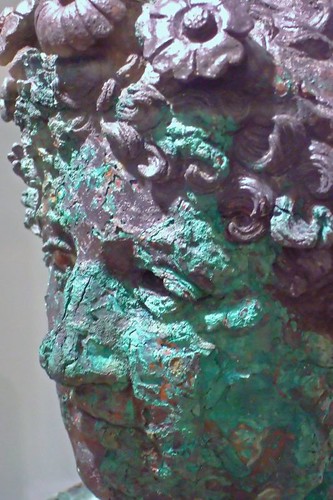
This bronze sculpture of Eros is contorted
by the heat from the volcanic blast of
Vesuvius.  Photographed at Boscoreale
by Mary Harrsch.
I had never seen any of the casts myself until only recently when I attended the "Pompeii: Stories From An Eruption" exhibit at the Smithsonian in Washington D.C. It included a number of casts, the most poignant being that of a child killed when a staircase collapsed in the House of the Golden Bracelet. 

When I finally got a chance to visit Italy for the first time in 2005, my friends and I rented a car and drove down to Pompeii for a day of exploration.  We entered through the main gate and began exploring the necropolis before we got to the remains of the villas.  Most of the artwork I had read about had been removed for conservation and display, much of it in the Museo Archaeologico di Napoli in downtown Naples so it was a bit of a treasure hunt searching for any small frescoes or particularly interesting mosaics that had been left behind.  

The bronze sculptures of a wild boar surrounded by hunting hounds that you see in the courtyard of the House of the Citharist as well as the bronze faun that you see in situ at the House of the Faun are actually reproductions but they help you envision the respective villas in their original state.


The infamous fresco of the well-endowed Priapus is still there though (or it was at least as late as 2005). It was smaller than I thought since most television programs that feature it normally zoom in for a startling closeup. Apparently, it was plastered over at one point by excavators for modesty's sake and was not rediscovered until 1998 when it was revealed by a heavy rain.  As for human casts, I saw only two victims on display in the site itself at the time.


When I returned to Naples in 2007, I entered Pompeii through a side entrance and quickly found myself exploring one of the public baths.  Somehow I had missed it on my first visit.  I also had a chance to visit Boscoreale, a neighborhood about a kilometer north of Pompeii where aristocrats lived in luxurious villas and a villa rustica is being currently excavated.  The museum at Boscoreale is small but quite interesting.  There I saw casts of a poor watch dog and a boar caught by Vesuvius' blast as well as a round loaf of Roman bread burnt to charcoal. 


In 2009, I was thrilled to attend the exhibit "Pompeii and the Roman Villa: Art and Culture Around The Bay of Naples" at the Los Angeles County Museum of Art.  I learned about the resurgence of archaism in Roman art that was discovered in Pompeii and the other villas surrounding Vesuvius and wrote an article about it for Heritage Key.  If that exhibit is still making the rounds I would highly recommend visiting it if it should make an appearance in a museum near you.


I am sure the new lecture series will point out even more details that I've probably overlooked and give me background information on the structures I admired there.  The lectures are presented by Dr. Steven Tuck, Associate Professor of the Classics and Art History at Miami University.


"After earning his B.A. in History and Classics at Indiana University, he received his Ph.D. in Classical Art and Archaeology from the University of Michigan. He held the postdoctoral Arthur and Joyce Gordon Fellowship in Latin Epigraphy at The Ohio State University.
An esteemed teacher, Professor Tuck was named a University Distinguished Scholar in 2005 and an Outstanding Professor in 2007, 2008, and 2009 at Miami University. He has served as a national lecturer for the Archaeological Institute of America and was a regular lecturer for the Continuing Education program at the University of Evansville, presenting lectures on topics including ancient social and political history, and archaeology.

Professor Tuck is the author of many articles featured in international journals on topics such as the spectacle schedule at Pompeii, the decorative program of the amphitheater at Capua, and triumphal imagery across the ancient Roman world. He is the author of Latin Inscriptions in the Kelsey Museum: The Dennison and De Criscio Collections." - The Teaching Company

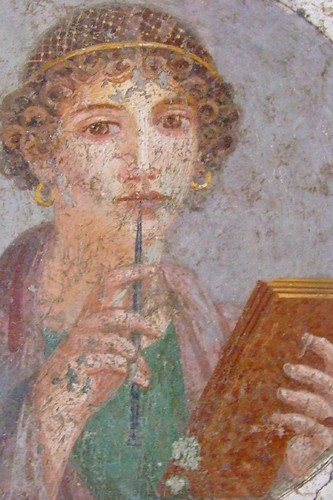
The lectures cover the history of the area clear back to its early settlement by the Etruscans, as well as the region's geology and commercial development including Pompeii's thriving wool industry and viticulture.  Dr. Tuck explores the upper class homes including the Villa of the Papiri as well as the House of the Vettii and the House of the Tragic Poet.  He also spends one lecture on the Praedia of Julia Felix, a collection of gardens, baths and shops that served as sort of a Roman country club of the period.  These remains are some of the most complete that I saw in Pompeii and some of the gardens have now been replanted by site restorationists.  When I saw the fresco of a thoughtful Roman woman (above) from the Villa di Guilia Felice in Pompeii at the Museo Archaeologico di Napoli, I wondered if it was a portrait of Julia herself thinking about all the money she was making with her various enterprises!

A slideshow of my images from Pompeii and the art recovered from Vesuvian ash:


Learn more about Pompeii!

The Complete Pompeii   Pompeii: The History, Life and Art of the Buried City   Pompeii (The Roman World)   Ancient Mysteries - Pompeii: Buried Alive   The Fires of Vesuvius: Pompeii Lost and Found    Pompeii: The Living City  Bodies From the Ash: Life and Death in Ancient Pompeii   Pompeii: Public and Private Life (Revealing Antiquity)   Pompeii: The Life of a Roman Town   Pompeii - The Last Day/Colosseum - A Gladiator's Story
If you enjoyed this post, never miss out on future posts by following me by email!


Friday, March 12, 2010

Wallace-Hadrill to present Herculaneum: Living with Catastrophe in Lexington, VA

I see that Dr. Andrew Wallace-Hadrill will present Herculaneum: Living with Catastrophe at Washington and Lee University, Lexington, Virginia on Tuesday, March 23, at 7 p.m. in the Stackhouse Theater.  Oh how I wish I could attend that lecture.  I love living on the west coast but up here in the Pacific Northwest we seldom get the opportunity to hear such world class presentations from classical scholars like Dr. Wallace-Hadrill.

[Image of  Dr. Wallace-Hadrill courtesy of  The Alleghany Journal]

Roman Mosaic found in the ruins of Herculaneum 1st century CE (1)I always enjoy his insight that he has shared in numerous History Channel programs.  Even after all of the years he has spent studying ancient Rome, he still talks about it with such marvelous enthusiasm.  I had hoped to catch a glimpse of him when I visited Herculaneum in October 2007, but no such luck. I did watch some of his researchers working on this beautiful mosaic in a bath complex:

[Image: 1st century CE Roman mosaic found in the ruins of Herculaneum.  Photographed by Mary Harrsch]


Herculaneum is a rather small excavation compared to Pompeii so I was able to explore it in about half a day.  There is much more of the site as yet unexplored but it has been covered by the modern city of Naples so it is doubtful any more of the ancient complex will be unearthed (except perhaps, sadly, by tunneling looters). Much of the artwork originally found in Herculaneum has been removed and placed in the Museo Archaeologico di Napoli but there are still a few pieces in situ.

The day I was there, the Villa di Papiri was closed because of ongoing excavations there.  I would have loved to have seen it, too, so I could compare the layout to the Getty Villa in Malibu that is based upon it.

Herculaneum: Italy's Buried Treasure   Secrets of the Dead - Herculaneum Uncovered   The Library of the Villa dei Papiri at Herculaneum   Vesuvius, A.D. 79: The Destruction of Pompeii and Herculaneum   Antiquity Recovered: The Legacy of Pompeii and Herculaneum (J. Paul Getty Museum)   Houses and Society in Pompeii and Herculaneum   An Introduction to Wall Inscriptions from Pompeii and Herculaneum (From Pompeii and Herculaneum)
If you enjoyed this post, never miss out on future posts by following me by email!


Saturday, April 26, 2008

Greece and Rome: An Integrated History new course at the Teaching Company


I'm currently enjoying the Teaching Company Course "The Emperors of Rome" taught by Professor Garrett Fagan and I see they have announced another course taught by Professor Robert Garland that sounds equally fascinating.


Greece and Rome: An Integrated History of the Ancient Mediterranean
explores the many ways in which two very different cultures intersected, coincided, and at times collided. The relationship between Greeks and Romans has virtually no parallel in world history. Their contact created the extraordinary fusion that we call Greco-Roman—a unique marriage of civilizations that encompasses statecraft, mythology, language, philosophy, literature, fine arts, architecture, science, and much else.

Yet there is truth to the traditional view that parts of our cultural heritage derive specifically from Greece or from Rome. For example, the West owes its law codes to the legally oriented outlook of the Romans. By contrast, drama, which never caught on in Roman circles, is a wholly Greek invention. This is an example of how the relationship between these two cultures was like a marriage: two distinct personalities, competing in some areas, sharing in others, and creating a completely new synthesis in a third realm.

This cultural partnership began almost with the first recorded contact of Greeks and Romans in the 4th century B.C. and continued for almost 1,000 years. Consider these revealing clues:

  • Much of what we think of today as Classical Greek art is, in fact, copies commissioned by wealthy Roman connoisseurs. The common museum label "Roman copy of a lost Greek original" attests to this fusion of Roman taste and Greek artistry.
  • Romans displayed a love–hate relationship with Greece, epitomized by the Roman politician Cato the Elder, who was deeply immersed in Greek culture but who publicly denounced its corrupting influence.
  • Educated Romans were predominately bilingual in Greek. Caesar's dying words were not the Latin "Et tu, Brute?" as Shakespeare has it in Julius Caesar, but reportedly the Greek "Kai su, teknon?" meaning "You too, child?"
  • Christianity flourished and spread in the unsurpassed infrastructure of the Roman Empire. But the language of the New Testament is Greek, as is the philosophical outlook of Christianity's earliest theologians.
If you enjoyed this post, never miss out on future posts by following me by email!