Showing posts with label Neptune. Show all posts

Friday, May 21, 2021

Dolphins in Greco-Roman Art

Dolphins have a rich background in Greek and Roman mythology. Not only are they frequently the companions of Venus serving as symbols of romance and reminders of the  myth that Venus was born from the sea, but in the Homeric Hymns, they play a key role when Dionysus (Roman Bacchus) was kidnapped by pirates. The god of wine turned himself into a lion to punish the kidnappers and, terrified, they jumped overboard whereupon Dionysus turned them into dolphins.  The also describe instances where the god Apollo transformed into a dolphin to guide a ship into harbor.  nother myth tells that Apollo’s son, Eikadios, was shipwrecked and carried to shore by a dolphin. This is one of many myths about dolphins rescuing drowming men, or bringing bodies back to shore for burial.

The Roman author Statius tells us in his 1st century CE work, "Achilleid" that the sea-nymph Thetis rode a chariot through the sea that was pulled by two dolphins. Philostratus’ ‘Imagines’ also describes a scene in which the one-eyed cyclops Polyphemus falls in love with the sea-nymph Galatea while she is riding four dolphins.

"Many dolphin stories can also be found in Greek and Roman folklore from small coastal towns, observes Emily Tilley, University of Leicester,  "In the first century A.D. Pliny the Elder recorded in his ‘Natural History’ the story of a young Roman boy who befriended a dolphin. Every day when the boy needed to cross the bay to get to school, he would call on his dolphin friend to carry him across the water. A second century A.D. story tells the tale of an elderly couple who rescued a young, injured dolphin and trained it to catch fish for them."

Statue of Venus (the Mazarin Venus), Roman, 2nd century CE, now on view at the Getty Villa in Gallery 106 Basilica. Image courtesy of the J. Paul Getty Museum

Early Imperial Portrait Roman 27 BCE-68 CE from the Farnese Collection in Naples that I photographed at "Pompeii: The Exhibit" at the Pacific Science Center in Seattle Washington.

Roman mosaic frieze depicting dolphins from Halicarnassus 4th century CE that I photographed at The British Museum.

Ovoid ceramic rhyton depicting a dolphin Pseira Crete Late Minoan 1B that I photographed at the University of Pennsylvania Museum of Archaeology and Anthropology

Frescoes of Marine Life including a dolphin found on a wall along the via La Portuense in the river port of San Paolo that I photographed at the Palazzo Massimo in Rome 125-150 CE

Mosaic pavement depicting a dolphin that I photographed in the Piazzale delle Corporazioni in Ostia Antica 1st century BCE-4th century CE.

Basilica of Neptune, Rome (Dolphin Frieze) Detail of Dolphins, a shell, and an upright trident from the frieze course of the entablature of the Basilica of Neptune, Rome, Hadrianic. (Hadrian r. 117-138 CE). The motif was popular for public buildings in Rome of the late first century (and the maritime theme is not necessarily associated with the function of the structure, such as a bath building). Image courtesy of Roger Ulrich (CC BY-NC-ND 2.0)

Detail of mosaic on the podium wall in the water sanctuary showing marine fauna, including a dolphin and urchins, Roman Ruins of Milreu, a luxurious rural villa transformed into a prosperous farm in the 3rd century, Portugal, courtesy of Carole Raddato.

Roman mosaic depicting the mask of Oceanus with lobster claws protruding from the head and dolphins and fish escaping from his beard, 2nd - 3rd century CE, found in 1959 at the Plaza de la Corredera, Salón de los Mosaicos (Hall of Mosaics) Alcazar of the Christian Monarchs, Cordoba, courtesy of Carole Raddato.

The Oceanus Mosaic from Bad Vilbel, it originally belonged to a Roman thermal bath facility, end of 2nd century AD, Hessisches Landesmuseum Darmstadt, Germany. The mosaic was found in 1849 during construction work of the Southern Railway Station in the remains of a Roman thermal spa. This bath complex was probably part of an estate (Villa rustica). Image courtesy of Carole Raddato.

Thalassa (spirit of the sea) with crab-claw horns, holding a ship's oar and a dolphin, late 5th century AD, found in the village of Yakto near Daphne, Hatay Archaeology Museum, Antakya, Turkey courtesy of Carole Raddato (perspective adjusted)


If you enjoyed this post, never miss out on future posts by following me by email!


Tuesday, April 6, 2021

The Roman nature of Neptune

Some scholars argue that Indo-European people, having no direct knowledge of the sea as they originated from inland areas, reused the theology of a deity originally either chthonic or wielding power over inland freshwaters for the god of the sea as contact was made with seafaring peoples. They then paired him with Salacia, the goddess of saltwater who subsequently came to represent the virile force of Neptune.  This conclusion was arrived at by the numerous findings of inscriptions mentioning Neptune in the proximity of such locations. Servius the grammarian also explicitly identified Neptune as the deity in charge of all the rivers, springs, and waters.

Before the 1st century BCE, the Romans thanked the god Portunus or Fortunus for naval victories, but Neptune supplanted him in this role by at least the first century BCE when Sextus Pompeius, younger son of Pompey Magnus, called himself "son of Neptune." 

Like Poseidon, Neptune was also worshipped by the Romans as a god of horses, under the name Neptunus Equester, a patron of horse-racing.  This may account for the marine-themed sculptures, such as dolphins, in the circus that were used to mark laps during each race. In Roman mythology, Neptune worked with Minerva to create the chariot.

Neptune was also considered the legendary progenitor god of a Latin stock, the Faliscans, who called themselves Neptunia proles. In this respect he was the equivalent of Mars, Janus, Saturn and even Jupiter among Latin tribes. 

The Neptunalia was the festival of Neptune celebrated by the Romans on July 23, at the height of summer. The festival included free and unrestrained merrymaking, and outings in the wood between the Tiber and the Via Salaria where springwater and wine were drunk to escape the heat. Neptune is one of only four Roman gods to whom it was appropriate to sacrifice bulls, the other three being Apollo, Mars and Jupiter, although Vulcan was also allowed the offering of a red bull and a red bull calf which symbolized the force of his forge.

Neptune is often depicted with two paredrae (accompanying deities), Salacia and Venilia, who represent the overpowering and the tranquil aspects of water. Salacia would impersonate the gushing, overbearing waters and Venilia the still or quietly flowing waters.

Neptune, the god of the sea, stands completely nude with his weight on his right leg. Originally, his raised right hand would have supported a trident, and he may have held a dolphin or ship's ornament in his left. Even with these attributes missing, the figure's unkempt hair, spiky crown of water plants, and mobile, restless-looking pose identify him as the sea god.

The elongated but muscular physique, small head, and majestic stance, as well as the way in which the figure’s arms extend into the space around it, derive from the innovations of the Greek sculptor Lysippos in the late 300s B.C.E. The mannered and almost playful exaggeration of the traits in this statuette, however, typifies a Roman revival of the style in the late 100s B.C.E. Image courtesy of the J. Paul Getty Museum.

Neptune in the caves of the gardens of the Château de Vaux-le-Vicomte in Maincy, France courtesy of Wikimedia Commons contributor Velvet.

Fountain of Neptune by Antonio Della Bitta (1878) that I photographed in the Piazza Navona in Rome, Italy.


If you enjoyed this post, never miss out on future posts by following me by email!


Tuesday, March 2, 2021

Earth Shaker

 In pre-Olympian Bronze Age Greece, Poseidon was venerated as a chief deity at Pylos and Thebes. He had also the cult title "earth shaker". In the myths of isolated Arcadia he is related with Demeter and Persephone and he was venerated as a horse, however it seems that he was originally a god of the waters. He is often regarded as the tamer or father of horses, and he could create springs with a strike of his trident.

 Homer and Hesiod suggest that Poseidon became lord of the sea following the defeat of his father Cronus, when the world was divided by lot among his three sons: Zeus was given the sky, Hades the underworld, and Poseidon the sea, with the Earth and Mount Olympus belonging to all three. In Homer's Iliad, Poseidon supports the Greeks against the Trojans during the Trojan War and in the Odyssey, during the sea-voyage from Troy back home to Ithaca, the Greek hero Odysseus provokes Poseidon's fury by blinding his son, the Cyclops Polyphemus, resulting in Poseidon punishing him with storms, the complete loss of his ship and companions, and a ten-year delay. In Plato's "Timaeus and Critias", the legendary island of Atlantis was Poseidon's domain.

Poseidon was named Neptune by the Romans and held a special place in their pantheon of deities because in Book XX of the Iliad, even though Poseidon (Neptune) favored the Greeks, he rescues Aeneas from Achilles.  In Virgil's Aeneid, Neptune is still resentful of the wandering Trojans, but is not as vindictive as Juno, and in Book I he rescues the Trojan fleet from the goddess's attempts to wreck it, although his primary motivation for doing this is his annoyance at Juno's having intruded into his domain.

Poseidon. National Archaeological Museum of Athens courtesy of Wikimedia Commons contributor Ricardo André Frantz

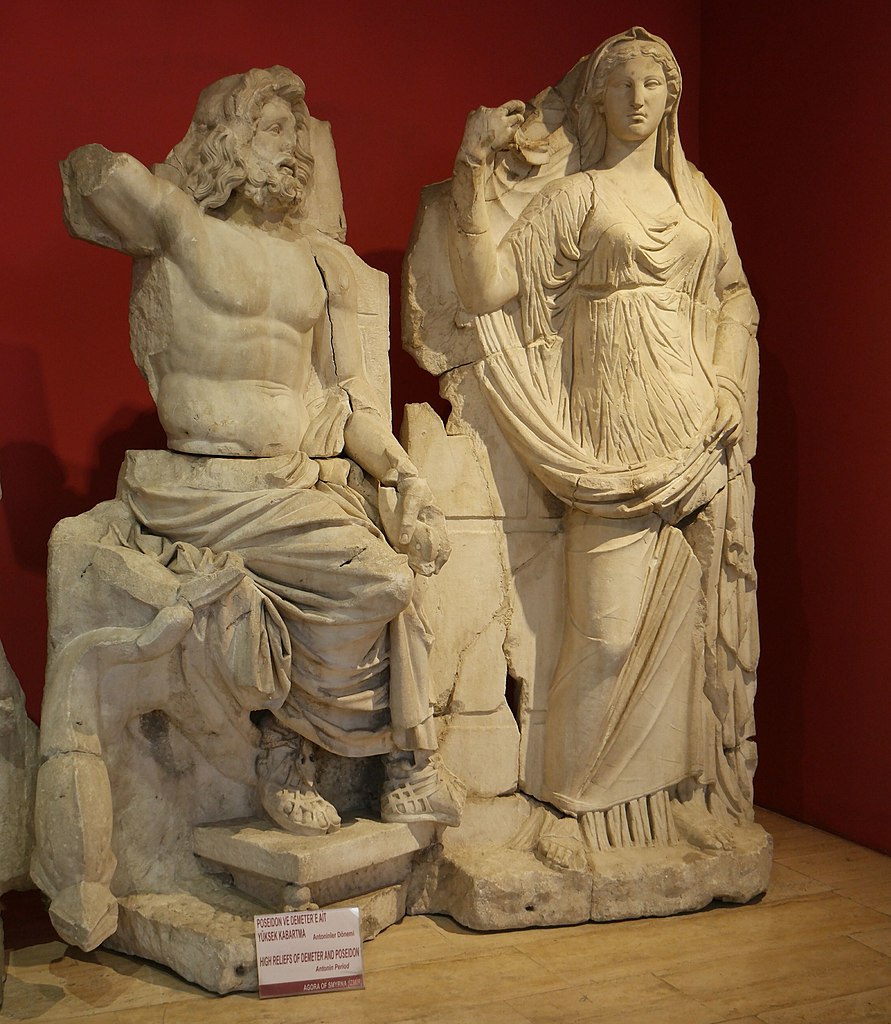
High reliefs of Poseidon and Demeter, from the Nerva–Antonine dynasty period, found in the Agora of Smyrna, now on display in the Izmir's History and Culture Museum Athens courtesy of Wikimedia Commons contributor Isabeau

Closeup of Neptune by Adam Lambert-Sigisbert 1725-1727 CE that I photographed at the Los Angeles County Museum of Art.

Bronze statuette of Poseidon, found in the Gulf of Livadostra, c. 480 BCE, courtesy of Wikimedia Commons contributor Sailko.

Roman mosaic depicting the Triumph of Neptune, 2nd century CE, at the Bardo National Museum in Tunisia courtesy of Wikimedia Commons contributor Tony Hisgett.

Mosaic depicting Neptune and Amphitrite, 1st century CE, that I photographed in the House of Neptune and Amphitrite in Herculaneum in 2007.

Reproduction of a frieze depicting an archaic style Neptune decorating the sacred area in Herculaneum that I photographed in 2007.

Sculpture of Neptune that I photographed at Huntington Gardens in Pasadena, California.

Neptune with a Hippocamp by Michel Anguier French 1652 CE Bronze that I photographed at the National Gallery of Art in Washington D.C. in 2015.

Triumph of Neptune and Amphitrite", a Roman mosaic from Cirta, now in the Louvre courtesy of Wikimedia Commons.

Neptune (with Cosimo I's head) on his chariot by Bartolomeo Ammannati II that I photographed in the Piazza della Signoria in Florence in 2005.

The Lateran Poseidon is a 2nd century CE colossal statue which derived from the lost bronze sculpture made by Lysippos (IV century BCE) for the Temple of Isthmia, on the Isthmus of Corinth, dedicated to the god Poseidon. The statue was originally in the Lateran Museum in Rome (then suppressed) and is probably the most significant evidence of the lost masterpiece of Lysippos.

Roman mosaic of Neptune from Monastir, Tunisia courtesy of Wikimedia Commons contributor Touzrimounir

Terracotta lekythos (oil flask), ca. 440 B.C.E. attributed to the Phiale Painter at the Metropolitan Museum of Art. Poseidon, the god of the sea and the brother of Zeus and Hades is said to have created fresh water springs including the great springs at Lerna in the southern Peloponnesos which gushed forth as a result of his pursuit of Amymone, the daughter of the king of Argos.

Detail of Neptune from the Roman "Mosaic of the Seasons" from Palermo in the Regional Archaeological Museum of Palermo courtesy of Wikimedia Commons contributor Giovanni Dall'Orto.


If you enjoyed this post, never miss out on future posts by following me by email!