Showing posts with label Sparta. Show all posts

Monday, May 3, 2021

The aspis and rise of the Argives

The ancient city of Argos was inhabited as far back as 7,000 years ago.   Argos experienced its greatest period of expansion and power, though, under the energetic 7th century BCE ruler, King Pheidon.  Pheidon was said to have been a descendant of Heracles through Temenus. Pheidon seized the throne from the reigning aristocracy with the support of the lower classes.  He was a vigorous and energetic ruler and greatly increased the power of Argos.

Under Pheidon, Argos regained sway over the cities of the Argolid and challenged Sparta’s dominance of the Peloponnese. Spartan dominance is thought to have been interrupted following the Battle of Hyssiae in 669-668 BCE, in which Argive troops defeated the Spartans in a hoplite battle. The Argive army was already equipped at the time with a deeply dished wooden shield called the aspis which is thought to have given the Argives an advantage over the Spartans.  The revolutionary part of the shield was, in fact, the grip. Known as an Argive grip, it placed the handle at the edge of the shield and was supported by a leather fastening for the forearm at the center. This allowed hoplites more mobility with the shield, as well as the ability to capitalize on their offensive capabilities and better support the phalanx. The convex shape of the shield allowed it to be supported comfortably on the shoulder and made it possible for warriors to use it as a flotation device for crossing rivers and to be used for hauling the bodies of the dead from the battlefield.


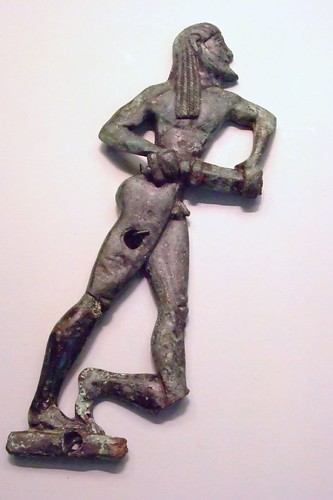
Image: Statuette of a Warrior thought to be an Argive, Greek, 470-460 BCE, Bronze, now in the collection of the J. Paul Getty Museum.  A standing male figure. Both feet are missing. He raises his right hand to his right shoulder and rests the left hand against his chest. He wears a short tunic underneath a cloak pinned over the right shoulder and slanting underneath the left arm. Straps cross over his shoulders at the chest and between the shoulders at the back. He is bearded and wears a cap or helmet. The eye sockets are empty and were perhpas once inlaid. The hair is cut away at the back of the head leaving a rectangular depression and the right hand is pierced for an attachment.


If you enjoyed this post, never miss out on future posts by following me by email!


Friday, January 15, 2021

The Anthropological Implications of Laconian Art

When scholars seek to show the role of Spartan austerity in the evolution of artistic production, they often limit themselves to objects of luxury and high prestige, supposedly condemned by the egalitarian civic ideology of the homoioi.  This raises the question, then,  of who among Spartan citizens actually produced the art.  Did Spartan citizens participate or was the art produced by the "perioikoi," a group of residents, sometimes referred to as mercenaries, living within the body of Lacedaemonians but not equal to Spartiates and yet distinct from the oppressed helots. Classicist Conrad M. Stibbe thinks we should also consider a third possibility, that Laconian art production was not a privilege of one social class or another but rather a branch of artistic industry open to all inhabitants of Laconia, whether free, less free, or unfree.

Stibbe poses that archaic Sparta of the seventh and sixth centuries BCE was an open society in which artists of all kinds could freely move and produce whatever art objects they wished with no other social restrictions than those which applied to all other aristocratic societies of Greece at the time. In the latter half of the sixth century to the middle of the fifth century, however, a hero-cult developed in Laconia and began to be reflected in both sculpture and vase painting.

Among distinctive art objects produced in Laconia were both hand and stand mirrors.  Sixth century mirrors feature figures associated with religious ritual while figural decoration of the fifth century are less religious in character.  Sixth century mirrors are embellished with sculptures of prepubescent girls wearing ritual sashes or gymnastic garb sometimes with castanets identifying them as temple dancers, acrobats or officiants possibly connected with shrines such as Artemis Orthia's in Sparta or robed, powerful women with idealized features whose bearing and attributes, including doves, pomegranates, sirens, and sphinxes, identify them as goddesses,  such as Aphrodite in the form of the Oriental Earth Mother, or priestesses.  Were these, then, produced by craftsmen employed in religious sanctuaries, or individuals otherwise exalted but separate from the aristocratic power structure? 

In the fifth century BCE, however, the idealized features were replaced with individualized women accompanied by an assortment of creatures such as rabbits, roosters, dogs, frogs and foxes around the rim or on the base.  Art historian Lenore O. Keene Congdon thinks this evolution appears to point toward owners that were preoccupied with love, beauty, and all that Aphrodite represented. Complex stand mirrors produced during this time required experts in miniature sculpting as well as casting and joining separately casted pieces, up to fifteen or more in a single mirror.  Mirror disks were also precisely crafted - convex on the front and concave on the back to make enlarging or diminishing images. This all points to a non-warrior, highly trained social class no longer associated with religious centers but was probably not part of the hero-worshiping, martial elites.

By the late fifth century, though, possibly as a result of the financial drain of the Peloponnesian Wars, these complex mirrors disappeared and were replaced by more utilitarian handleless box mirrors decorated with less demanding repoussé motifs. These mirrors proliferated throughout the Hellenistic period and even through the Roman period. This makes you wonder if the social class of highly-skilled craftsmen also diminished, perhaps due to a new emphasis on military service.


Bronze mirror with a support in the form of a nude girl, Laconian, 2nd half of the 6th century B.C.E. at the Metropolitan Museum of Art in New York. The girl stands on a curled-up lion, and griffins springing from her shoulders help support the mirror disk. She holds a pomegranate in her left hand and is nude except for a necklace and a strap from which hang a crescent-shaped amulet and a ring. Her nudity and the animals that surround her bring to mind images of the Mistress of Animals, an ancient Near Eastern deity who contributed characteristics to two Olympian goddesses, Aphrodite and Artemis. As a mirror handle, the figure may simply evoke the powers of Aphrodite, goddess of love and beauty; alternatively, she might be connected with Artemis Orthia, whose cult was important at the Laconian city of Sparta.
Bronze mirror support in the form of a nude girl, Laconian, ca. 540–530 B.C.E. at the Metropolitan Museum of Art in New York.  The girl stands on a frog, and the traces of feline feet at her shoulders must have belonged to animals that helped in the support of the mirror disk. She wears a band decorated with a ring and amulets and holds cymbals in her hands. 
Bronze mirror of the Caryatid type, from ancient city of Halieis, 490-470 BC. Archaeological Museum of Nafplion courtesy of Wikimedia Commons contributor Zde (digitally enhanced)


Greek mirror possibly from Sicyon, 470-460 BCE, at the Cleveland Museum of Art courtesy of Wikimedia Commons contributor Daderot.


Mirror with Siren, about 450-400 BCE, Greek, Locri Epizephirii, necropolis, Lucifero district, bronze at the Cleveland Museum of Art courtesy of Wikimedia Commons contributor Daderot.


Box mirror cover with relief of Pan late 4th century BCE at the Metropolitan Museum of Art courtesy of Wikimedia Commons.


Greek mirror depicting Aphrodite (?) with flanking Erotes (cupids) said to be from an Etruscan tomb 465-450 BCE Bronze that I photographed at the Nelson Atkins Museum of Art in Kansas City Missouri


The handle of this mirror is the goddess Aphrodite, a logical choice for an object where beauty is the central theme. The goddess is accompanied by two flying Erotes, gods of love. Surrounding the mirror flowers and pigeons adorn it, they are symbols befitting Aphrodite. Bronze, Peloponnesus (?), c. 460 BCE (inv. 566) at the Allard Pierson Museum courtesy of Wikimedia Commons contributor Dick Osseman.


Greek mirrors and handle attachments from the mid 5th century BCE. 7565- Bronze statuette of a female figurine wearing a heavy tunic (peplophoros). From the sanctuary of Demeter and Kore Karpophorol at Agios Sostis, Arcadia. Probably represents Artemis with a torch. Peloponnesian work with attic influence. About 450-425 BCE. National Archaeological Museum, Athens, Greece. --- 6197. Bronze statuette of a female figurine wearing a heavy tunic (peplophoros). From Elis. The figure supported a mirror. Argive workshop. About 455 BCE. 15226. Bronze mirror. Provenance unknown. The mirror is supported by a female figurine wearing a heavy tunic (peplophoros) with a bird. Figurines of cocks and a hare at the top of the disk. Local variant of the Argive-Corinthian type. About 470-460 BCE. --- 12449. Bronze mirror. From Ioannina. The mirror is supported by a female figurine wearing a heavy tunic (peplophoros) with a bird. Disk with attached figurines of a hare and a dog. Work of a Corinthian workshop. About 465-460 BCE. At the National Archaeological Museum in Athens courtesy of Wikimedia Commons contributor Tilemahos Efthimiadis (digitally enhanced).
If you enjoyed this post, never miss out on future posts by following me by email!


Saturday, October 10, 2020

Not all Spartans were warriors

 Although Sparta is renowned for its military prowess, there were Spartan poets, sculptors, magistrates, ambassadors, and governors as well as soldiers.  Originally, however, full citizen Spartiates were barred by law from trade or manufacture, which consequently rested in the hands of the Perioikoi, free peoples who did not enjoy full citizen-rights but were not subjected to the restrictions of helots.  Perioikoi served partly as a kind of military reserve, partly as skilled craftsmen and partly as agents of foreign trade - actually rather similar to the roles of freedmen in Roman society.

Spartans were prohibited from possessing gold and silver coins, and according to legend Spartan currency consisted of iron bars to discourage hoarding. It was not until the 260s or 250s BCE that Sparta began to mint its own coins. Though the conspicuous display of wealth appears to have been discouraged, this did not preclude the production of very fine decorated bronze, ivory and wooden works of art as well as exquisite jewelry.

Allegedly as part of the Lycurgan Reforms in the mid-8th century BCE, a massive land reform divided property into 9,000 equal portions. Each citizen received one estate, a kleros, which was expected to provide his living. The land was worked by helots who retained half the yield. From the other half, the Spartiate was expected to pay his mess (syssitia) fees, and the agoge fees for his children. However, we know nothing of matters of wealth such as how land was bought, sold, and inherited, or whether daughters received dowries. However, from early on there were marked differences of wealth within the state, and these became more serious after the law of Epitadeus some time after the Peloponnesian War, which removed the legal prohibition on the gift or bequest of land. By the mid-5th century, land had become concentrated in the hands of a tiny number of elite, and the notion that all Spartan citizens were equals had become an empty pretence. By Aristotle's day (384–322 BCE) citizenship had been reduced from 9,000 to less than 1,000, then further decreased to 700 at the accession of Agis IV in 244 BCE.  In late Classical Sparta, when the male population was in serious decline, women were the sole owners of at least 35% of all land and property in Sparta.


Image: Bronze banqueter from the tripod-support of a bronze bowl thought to be Laconian (Spartan) 530-500 BCE from Dodona that I photographed at the British Museum in 2016.


If you enjoyed this post, never miss out on future posts by following me by email!


Saturday, October 3, 2020

The mingling of Greco-Roman and Celtic mythology

 As I was looking through the images I took at the British Museum in 2016, I saw this drinking cup and wondered about the symbolism depicted on it.  Although the horseman could be just any mounted warrior and not a mythical hero, that would be unusual during the 6th century.  Although the Spartan kings during this time period were accompanied by 300 royal guards called hippeis (cavalrymen),  they were actually infantry hoplites like all Spartiatai. The Spartans did not utilize a cavalry of their own until late into the Peloponnesian War (431-404 BCE), when small units of 60 cavalrymen were attached to each mora (unit of 576 men composed of four lochoi of 144 men each). 

This cup was produced, though, about the time of earliest contact between the Greeks and the Celts which occurred around the Greek colony of Massalia in 600 BCE. Celtic elites traded for wine, drinking vessels, and other status symbols with merchants from Greece and Etruscan Italy. Perhaps Celtic mythology would provide a clue.

In 2007, I was researching a bronze head of a bull with three horns found in Octodurus and came across research focused on Celtic mythology related to sacred bulls and cranes and epigraphic evidence on the Pillar of the Boatmen, a monumental Roman column erected in Lutetia (modern Paris) in honor of Jupiter by the guild of merchant boatmen in the 1st century CE. Although dedicated to Jupiter and Tiberius Caesar Augustus, the column is thought to also depict the Celtic god Esus (also spelled Esos) pruning or chopping down the tree of life on one side and the deity Tarvos Trigaranos, a bull with three cranes sitting on its back, on an adjacent side.  Scholars of Celtic mythology each have their own interpretation of the symbolism represented, including that of the three cranes.  They point out that a similar relief was found in Treves where Esus is cutting a tree that contains three birds and the head of a bull sitting in its branches. It has been speculated that the three cranes appear to be a mystical grouping to the Celts.  Scholar Mary Jones points out in Welsh mythology there are the three birds of Rhiannon, mother of the Celtic hero Pryderi and related to the Gaulish horse goddess Epona.  As told in the Celtic compilation, the Mabinogion, Rhiannon's birds were sent to show the seven survivors of Prydein the way to the Otherworld.  Although the Mabinogion was compiled in the 12th-13th centuries CE, it is thought to have been based on much earlier oral traditions. 

In his text, "Birds in the Ancient World,"  Jeremy Mynott points out that in Greco-Roman folklore, a gathering of cranes indicate an impending attack by enemy forces. So if we consider all of these sources, this depiction of a horseman riding amidst three cranes could represent a hero like Pryderi with portentious goddesses in bird form riding to battle, or even a Greco-Roman version of the Celtic god Esus (associated in Greco-Roman folklore to Mercury or Mars) wearing a tree of life headdress, with his accompanying cranes, riding to victory, as represented by Nike. (I'm still not sure what the bird riding on the horse's neck or the eagle-like raptor may symbolize).

This is just my own attempt at suggesting what the symbolism represented here might be.  I'd be interested in hearing what some of you think the iconography represents.

Spartan black-figured kylix with horseman, birds, and a winged figure, possibly Nike (Victory), attributed to the Rider Painter, 550-530 BCE that I photographed at the British Museum in 2016.


If you enjoyed this post, never miss out on future posts by following me by email!


Tuesday, April 28, 2020

Before the Gracchi - Lycurgus of Sparta: Early Land Reformer and the Father of the Great Rhetra

Image: Lycurgus, his arm bearing his shield raised above his head enters the city in a gold chariot pulled by white bulls, his soldiers around him, and a young man running with white hounds in the left foreground. This graphite, pen and grey ink detailed watercolor heightened with touches of white bodycolor and gum arabic was produced in 1797. Image courtesy of the Trustees of the British Museum.
Lycurgus was the quasi-legendary lawgiver of Sparta who established the military-oriented reformation of Spartan society in accordance with the Oracle of Apollo at Delphi. All his reforms promoted the three Spartan virtues: equality (among citizens), military fitness, and austerity and were contained in an oral constitution known as the Great Rhetra.

According to Herodotus, at some time before the reigns of Leon of Sparta and Agasicles about 590 BCE, the Spartans "had been the very worst governed people in Greece" until Lycurgus consulted the Delphic oracle and was provided with an entire constitution which Lycurgus took back and implemented. Lycurgus was the younger son of the Eurypontid king, Eunomus. He was thus passed over for the throne in favor of his brother, Polydectes, but the latter died. Although Lycurgus was offered the throne, his dead brother's wife was pregnant so Lycurgus became regent for the child when it was born. But Polydectes' wife and her relatives envied and hated Lycurgus and accused him of plotting the death of the infant, Charilaus.

So Lycurgus surrendered his position of authority and went on a legendary journey to Crete where he studied the laws of Minos and met the celebrated composer Thales, who, like Orpheus, could sooth the masses and inspire his listeners to become better people. From Crete, Lycurgus traveled to Asia Minor, Egypt, Spain, and, some say, even India. In Ionia he studied the lessons of statecraft and morality in the works of Homer and compiled fragments of them and expounded the lessons widely. According to Plutarch, Lycurgus was inspired by the Egyptians with the idea to separate the military from common laborers and this was the reason later Spartan warriors were not allowed to practice manual crafts. When Lycurgus was finally recalled to Sparta, he, like the Gracchi centuries later in Rome, prescribed land reforms to redistribute wealth more equally among Spartan citizens.

"For there was an extreme inequality among them, and their state was overloaded with a multitude of indigent and necessitous persons, while its whole wealth had centered upon a very few. To the end, therefore, that he might expel from the state arrogance and envy, luxury and crime, and those yet more inveterate diseases of want and superfluity, he obtained of them to renounce their properties, and to consent to a new division of the land, and that they should all live together on an equal footing; merit to be their only road to eminence." — Plutarch, Lycurgus.

Lycurgus was also credited with the development of the agoge for the education of children and the institution of common mess halls, the sussita, that required all Spartan men to eat together and provide the shared meals through the monthly contribution of a bushel of meal, eight gallons of wine, five pounds of cheese, two and half pounds of figs, and a small amount of money to purchase meat or fish. Even kings were not exempt from the daily ritual and expected contributions.


If you enjoyed this post, never miss out on future posts by following me by email!


Friday, February 17, 2017

Ancient Eugenics: Much more than just selective infanticide

A history resource article by Mary Harrsch © 2017

Recently, I received a review copy of a new release from Oxford University Press entitled "A Cabinet of Ancient Medical Curiosities: Strange Tales and Surprising Facts from the Healing Arts of Greece and Rome by J. C. McKewon.  I had just enrolled in a new course on FutureLearn, "Health and Well-being in the Ancient World" so I thought the arrival of the Oxford text was quite well-timed.

As I began to read it, I came across a quote from Plato's Republic:

"Asclepius displayed his medical skill only for the benefit of those who were suffering from a specific disease but were otherwise healthy both in their constitution and in their manner of living.  Such people he cured with drugs and surgery, instructing them to carry on with their customary lifestyle....But when it came to people whose bodies were permeated with disease, he did not attempt to extend their useless lives...and have them producing children who would probably be just like them. Asclepius did not think that he should treat people whose habits rendered them incapable of living, since treating them did no good either for the patients themselves or for the state." - Plato, The Republic, 407.

I was astounded by this statement from such a revered Greek philosopher.  I am, of course, well aware of the practice of infanticide in the ancient world and have even written about it in my post "Widespread Roman infanticide not substantiated by Hambleden studies" back in 2011.

But I had no idea that ancient Greek philosophers like Plato had also advocated withholding medical care from those "permeated with disease" or who practiced unsavory habits!

So, I decided to research this phenomenon that I would describe as ancient eugenics further.  On JSTOR I found an essay written by Allen G. Roper, who would eventually become a faculty member of Oxford University, on this very topic.  In fact, Roper's essay was winner of the coveted Arnold Prize in 1913.

In his award-winning paper "Ancient Eugenics", Roper pointed out that eugenics in some form has been around since humans spread out across the earth.  He points out that early groups of humans probably disposed of deformed or weak newborns and, in times of famine, may have disposed of the injured, aged, and feeble minded to ensure food was provided to those most likely to survive.  He states that in extreme circumstances, even non-combatants (i.e. females and healthy children) may have been abandoned.  This may not have always been the case, however, as we have since recovered skeletons of prehistoric men indicating long-term care of individuals with fractured limbs.  But forensic archaeology was not yet widely used in 1913 when Roper's paper was published.

Roper says infanticide was used by many ancient civilizations to solve problems of societies dependent upon limited food and other resources.  The Minoans of Crete forbade celibacy to encourage population growth but were known to practice female infanticide. The Spartans' physical regimen for their youth coupled with laws regulating disposal of infirm offspring is one of the most documented.

Spartan King Menelaus supporting the slain Patroclus.
Roman copy of a Greek origiinal.  Photographed in Florence,
Italy by Mary Harrsch © 2005
"The Spartans were a small immigrant band, face to face with an extensive and powerful autochthonous population - a camp in the centre of a hostile country.  'We are few in the midst of many enemies' was the warning spoken by Brasidas (Thucidydes Iv. 126.) and this position of constant danger affected the problem in two ways.  There must be no falling birth-rate among the Spartans, no unchecked fertility among their subjects.

Three measures were employed to maintain the number of the Spartans: prevention of emigration, penalties for celibacy, and rewards for fertility.  The man with three children was to be excused the night watch, the man with four was to be immune from taxation.  A third measure known to the ancient world, the enfranchisement of aliens, though adopted at times under the ancient kings, was rendered impossible by the later exclusion of every foreigner from the land.  Avoidance of moral or physical corruption was set before preservation of numbers.  The alien is a disturbing element in any Eugenic scheme." - Allen G. Roper, Ancient Eugenics,

The problem of productivity of the lower classes (Helots) was apparently checked by the occasional indiscriminate and covert massacre of large numbers on the vague pretext of fear or suspicion.

"On one occasion more than 2,000 were slaughtered 'on account of their youth and great numbers.'" - Lycurgus XXXi. 25.

Sparta was proclaimed the only state in which the physical improvement of the race was undoubted, while chastity and refinement of both sexes remained unimpaired.

"It is easy to see," declared Xenophon, "that these measures with regard to child-bearing, opposed as they were to the customs of the rest of Greece, produced a race excelling in size and strength.  Not easily would one find people healthier or more physically useful than the Spartans." - Xenophon, Constitution of the Lacedaimonians i.10; v.9.

The Spartans, however, were not the only culture focused on raising tall, strong warriors. The warrior society in Germania Transrhenane took a far different approach, though. Infanticide was repugnant to them.  Instead, they chose positive reinforcement to accomplish their goals of a more formidable warrior society.  They placed emphasis on stature and strength as traits for a suitable mate.  Early marriage was forbidden to ensure only properly mature females were child bearers and celibacy was encouraged to limit the number of children.  Polygamy was only allowed on a limited scale for the few of noble birth.

This strategy was apparently so effective that during the Year of the Four Emperors it was assumed that anyone of exceptional stature was a Vitellianist and a German.

Tacitus claims, though, that the Germans lacked moral strength because the children grew to manhood naked and uncared for with no distinction between master and slave.

Tacitus says they were incapable of enduring hardships.  "Their frames were huge but vigorous only for attack; their strength was great for sudden effort, but they could not endure wounds.  Their courage was the frenzy of the Berserk, not the disciplined valour of the Spartan hoplite." - Tacitus, Annals, ii. 14

So even the Romans still admired the warrior ethos of Sparta six centuries later!

Surprisingly, though, eugenics movements of the late 19th and early 20th century point to the philosophers of 5th century Athens as their founding fathers.

A fresco depicting Dido embracing Aeneas from the House
of the Citharist in Pompeii, Italy.  Image courtesy of
Wikimedia Commons.
The great Greek philosophers as far back as Socrates pondered strategies to ensure the human race would develop the most desirable traits.  They thought arranging matches between healthy, well-made, and attractive individuals were the first step.  But, Socrates pointed out that good stock is not everything and that both parents must be equally in their prime.  This maxim, however, proved at odds with the prevailing practice of marrying girls at the earliest possible age to older wealthy men to advance a family politically and socially.

"We seek well-bred rams and sheep and horses and one wishes to breed from these.  Yet a good man is willing to marry an evil wife, if she bring him wealth; nor does a woman refuse to marry an evil husband who is rich.  For men reverence money, and the good marry the evil, and the evil the good.  Wealth has confounded the race." - Stobaeus, Anthology, lxxxviii. 14

"The apparent anomalies which children present in not reproducing the qualities of their parents only serve to reveal the presence of particular conditions," warned Socrates, "and among those conditions must be included the changes which organism undergoes by reason of advancing age." - Socrates, Memorabilia, ii. 4.

The evils of age disparity were also themes addressed by Hesiod, Pythagoras, and Sappho.  Solon attempted to legislate it. Even famous physicians weighed in on the subject. Soranus said girls weren't ready for conception until their 15th year.  Rufus, who had at one time stated there was a threat of illness to girls who stayed virgins too long, later approved a maxim of Hesiod advising girls to marry at 18, admitting it was too late for girls of his own generation, though.

But, were these graybeards' admonitions enough to overcome aristocratic greed for wealth and power? Apparently not entirely neither in classical Greece nor later in the Roman world.

Once again I turned to JSTOR and found ancient marriage age has been studied using both literary sources and inscriptions on funerary monuments, predominantly Roman.

Ancient sources record that Octavia, the daughter of Claudius was married at the tender age of 11. Agrippina the Younger, the mother of Nero, married at 12, and Agricola's daughter married Tacitus at 13.

Were such marriages consummated?

Suetonius commented that for political reasons Augustus married a young girl who was "hardly nubile", and later, because of a quarrel, sent her back "still a virgin"...

The emperor Honorius successively married the two very young daughters of Stilicho for political reasons, and again the sources remark on the girls' preserved "virginity."

"Consummation was not required for legitimacy.  Roman law confirmed the legitimacy of a marriage with cohabitation without intercourse.  The prominent Roman jurist Ulpian (170-223 CE) opined "It is not intercourse but agreement (consensus) which makes a marriage." - M. K. Hopkins, The Age of Roman Girls at Marriage

But Hopkins points out that failure to consummate a marriage seemed to be unusual and thus commented upon in the ancient sources. So he explains scholars think most marriages were consummated immediately.

The pressure to marry young was also so great, the Romans had to introduce legislation to stipulate a legal marriage age of at least 12 for girls (14 for boys) as early as the reign of Augustus.  This legislation remained in force until 530 CE.

"The law relating to age of marriage was similar then to that category of Roman laws called leges imperfectae, that is, laws which neither threatened their violators with penalties nor invalidated their transgression.  The sole limitations placed on illegally early marriages was that none of the legal consequences of marriage followed until the girl was 12.  Nevertheless, even before then, these marriages could form the basis of inter-family alliances, since gifts from the husband to the girl were valid, while the dowry could be secured by a stipulation to pay. "  - M. K. Hopkins, The Age of Roman Girls at Marriage

During the second century CE, these laws were further reinforced by laws stipulating alimentary provisions by the state.  Hadrian said girls should receive state assistance until they were 14 and boys until 18.  During the reign of Marcus Aurelius girls were to be given assistance until they were 13 and boys until they were 15. Scholars assume these laws are based on the prevailing marriage ages.

Equestrian Statue of the Roman emperor Marcus Aurelius photographed at the Capitoline
Museum in Rome by Mary Harrsch © 2009
But what does archaeology tell us?  I took a FutureLearn course "Hadrian's Wall: Life on the Roman Frontier" last year and used a database of Roman inscriptions, many of them funerary monuments.  I wondered if funerary inscriptions could provide insight into actual recorded marriage ages of people other than the aristocracy.

I found there have been several studies of funerary inscriptions with this type of goal in mind.  As far back as 1896, A.G. Harkness researched what was known as the Corpus of Latin Inscriptions then available and discovered 171 funerary inscriptions provided either age at marriage or age at marriage could be calculated from age at death and length of marriage (Two additional inscriptions were rejected as outliers because they indicated a marriage age of 6 and 7).  Harkness concluded the average age at marriage of this sample of Roman females was 18.  But Hopkins points out that, in his opinion, this figure is too high.  Hopkins says there is no way to know if some of the later ages given were actually first marriages and not subsequent marriages.

Funerary Portrait of Balya Daughter of Yarkhai from Palmyra in Roman Syria 150-200 CE Limestone
Photographed at the Portland Art Museum by Mary Harrsch © 2012
"The average is only representative when there is an evenly distributed curve. Setting aside the great probability that the odd marriages at 56, 38, etc., are not first marriages, their inclusion in Harkness's calculation of the average, since they are isolated cases, leads to distortion. The figures are surely better summarized in the statement that over half of all the girls recorded in these inscriptions were married by the age of I5 (inclusive) or that the modal marriage age lay between 12 and 15." -  M. K. Hopkins, The Age of Roman Girls at Marriage

Hopkins also points out that the inscription sample may not be representative of the general population either. Harkness thought the inscriptions represented lower to middle-class individuals since the majority were commissioned by ex-slaves (freedman) but Hopkins disagrees.

"The minimum cost of a stone inscription was about IOO sesterces, which might have equaled three months' wages for an artisan. Even allowing for the existence of guilds which would defray funeral costs, the cost precludes adequate representation of the lower classes." -  M. K. Hopkins, The Age of Roman Girls at Marriage

Another bias that may have affected study results is the possibility that very young wives who died very young (probably in childbirth) may not have been commemorated at all.  This issue is raised in a similar study of Roman funerary monuments evaluated by Walter Scheidel in his paper "Roman Funerary Commemoration and the Age at First Marriage" published in October 2007 in the journal Classical Phiology.

Scheidel's paper deals mostly with a theory put forth in 1987 known as the Saller-Shaw Hypothesis in which age-specific shifts in the identity of funerary commemorators serve as proxy evidence for changes in marital status.  In other words, epitaphs erected by parents rather than spouses served to indicate the unmarried status of the deceased.  Using this hypothesis, Saller and Shaw came up with a marriage age of 20 for Roman women and 30 for Roman men (which would have been much more amenable to physicians and philosophers!).  However, as I read that paper, I became convinced that making an assumption like that was fraught with too many variables to prove the theory convincingly despite all of the computer models produced in the effort.  Perhaps a woman was widowed and had not remarried so her pater familias paid for her funerary monument.  Perhaps the couple had suffered a financial setback right before the death so the woman's parents paid for the monument or perhaps both husband and wife died due to pestilence and one of the deceased's parents paid for their monument  I did notice, though, that way back in 1965 even Hopkins had pointed out, as collaborating evidence to Harkness' study, that there was a sharp drop in the parents' memorials to daughters aged 15 to 19 and an even more precipitous drop after the age of 19.

So far most of our discussion has focused on Roman wives.  Remember, Socrates said both parents needed to be in their prime.  What about the men?

Hopkins records one study in which a collection of 86 pagan and 90 Christian funerary inscriptions revealed the modal age at marriage was 17 to 20 (36 percent) for pagan men  The modal age at marriage was  20 to 23 (26 percent) for Christian men. Hopkins points out that the mode is misleading, though, since men's marriages were much more evenly distributed and cover a wider age-span than girls' ages at marriage. Hopkins says the overall average age was 26 for pagan men and 27 for Christian men.  The median was 24 for pagans and 26 for Christians.

From my viewpoint, this marriage age for men was much younger than I expected (thinking of such aristocratic marriages as Julius Caesar's daughter marrying Pompey the Great who was even older than her father). However, these memorials were not those of aristocrats so that may be the mitigating element.

Moving on from marriage age, there were other considerations Greek philosophers thought important in the improvement of the human race as well.

Roper points out that the 5th-century thinkers were also obsessed with the relative influence of nature and nurture.  A number of philosophers from Zopyrus to Aristotle ascribed to the tenants of physiognomy, the assessment of a person's character or personality from his or her outer appearance, especially the face.

"It is possible to infer character from features, if it is granted that the body and the soul are changed together by the natural affections: I say "natural", for though perhaps by learning music a man has made some change in his soul, this is not one of those affections natural to us; rather I refer to passions and desires when I speak of natural emotions. If then this were granted and also that for each change there is a corresponding sign, and we could state the affection and sign proper to each kind of animal, we shall be able to infer character from features." - Aristotle, Prior Analytics 2.27 (Trans. A.J. Jenkinson)

In fact, the first systematic physiognomic treatise to survive to the present day is Physiognomonica, attributed to Aristotle but now thought to be a product of his school rather than the philosopher himself.

These theorists sought to influence potential mates to prioritize physical comeliness as well as such attributes as stature, physical proportion, and strength.  Fifth-century Greek scholar, Stobaeus, encapsulates this idea in a simple quote, "If thou art unpleasing to look upon, thy character is like to thy form."

Diogenes by John William Waterhouse, 1882.

Even the often recalcitrant Diogenes admonished his fellow Greeks, "The wise man will marry for the sake of children, associating with the most comely."  (Hmmm... I wonder if he was able to find a comely woman to live in that barrel with him?)

Both Socrates and Plato, though, cautioned parents that looks weren't everything and both moral and physical training was essential to building an outstanding character.

"Leave him untrained, and he will become, not merely evil, but degenerate beyond hope of reclaim." - Plato, The Republic

However, Roper says the Greeks, except in the dramatic conception of an ancestral curse, or in the inherited pollution of ancient sacrilege, never traced causes back beyond the immediate progenitors. If the Romans adopted their ideas about eugenics from the Greeks, however, I would take issue with this conclusion.  The Romans placed much value on ancestry that included many consuls.  This would indicate to me that the qualities of offspring are viewed as the product of multiple superior generations.

Aesclepius (Aesculapius) with the head of Homer.
Photographed at the Palazzo Altemps venue of the
National Museum of Rome in Rome, Italy by
Mary Harrsch © 2009
So far we have examined ancient eugenics from the viewpoint of controlling marriage and, if all else fails, resorting to infanticide to eliminate weak or deformed offspring.  However, Plato extended this purification of society to aged and infirm adults as well.  In his treatise, The Republic, Plato said the chronically ill should be left to die because "he is incapacitated from fulfilling his appointed task and will beget children in all probability as diseased as himself if his miserable existence is protracted by the physician's skill."  Plato extends this advice to even wealthy individuals saying "It is no part of the physician's task to pamper a luxurious valetudinarianism (someone who is obsessed with their poor health) claiming the art of Asclepius is only for those who are suffering from a specific complaint.

In addition to those suffering from constitutional ill-health, Plato would also condemn the victims of self-indulgence.  Plato points out that there is no place in his Republic for the "unkempt" man glorying in a pedigree of congenital ailment. Plato said a moral degenerate is not only an encumbrance to society but an active force for evil; "therefore, like the lower desires of the soul which cannot be tamed to service under the higher self, his growth must be stopped."

A mosaic depicting Plato and his students at his Academy from the House of
T. Siminius Stephanus Pompeii 1st century CE.  Photographed at the National
Archaeological Museum in Naples, Italy by Mary Harrsch © 2007
Plato also proposed segregation of the mentally ill and expulsion of the pauper.

"The madman is not to be seen in the city, but the responsibility rests upon the relatives, not upon the state.  If they fail in their duty, the law will punish them." - Plato, "Laws"

Plato felt that mental or physical defects should bar the individual's right to marry and beggars should be driven away.

"In a properly constituted state the righteous man will not be allowed to starve; there is no excuse for the beggar. If such a one be found, he shall be driven out of the marketplace, out of the city, out of the land, that the state may be purged of such a creature," - Plato, "Laws".

I'm sure modern advocates for the homeless would be appalled.

So, it appears the ancient philosophers were not as benign as I had always imagined.


If you enjoyed this post, never miss out on future posts by following me by email!


Wednesday, October 19, 2011

Were Sparta's "Happy Helots" a template for Roman slavery?

Lacedaemonian furniture appliqué depicting
a nude swordsman 550 - 525 BCE, Bronze.
Photographed at the Getty Villa in Malibu, CA
by Mary Harrsch.
While doing some housekeeping up on Blogger I happened to notice a post by historian Helen P. Schrader entitled "Sparta's Happy Helots: A Closer Look at Helot Society".  Of course I was intrigued because I have always envisioned Sparta's helots as a generally downtrodden lot always looking over their shoulder for an up and coming Spartan youth out to make his first kill.  But Schrader paints a much different picture of helot society and as I read the article I immediately recognized similarities in the slavery practiced by the Spartans in comparison to Roman slavery.

Although there were obvious differences such as the fact that in Sparta the state owned all slaves that in turn were attached to particular governmental activities or particular parcels of land managed by a Spartiate elite while Roman slaves were the property of individual Roman patriarchs, I was astonished to learn that the ancient sources report that some helots became wealthy and were able to purchase their freedom just as in Roman society.

I have studied Greek history to some degree but this is the first time I had heard this.  Schrader explains that Spartan helots, although unable to own land, were often entitled to up to 50% of the produce from the land that they worked.  She also pointed out that helots were able to maintain a family unit and may have benefited from inheritance laws that channeled family wealth to the "tenant-in-chief" who in turn passed it on to a single recognized heir.  If a helot had more than one son, the younger sons were forced to seek employment elsewhere within the boundaries of Lacedaemon to support themselves and their families.

"Some younger sons would have been apprenticed to learn crafts scorned by the perioikoi and prohibited to the Spartiates. Through apprenticeship to those that had taken this path before them, they would have become tanners and tinkers, cobblers and coopers, masons and dyers. As a master craftsman, able to retain 100% of their earnings, these helots would have been in a position to found families, build houses and accumulate wealth." 
"Other young men unable or unwilling to embark on such a slow, hard career, would have sought employment as laborers for the Spartan army or state, or to individuals. Thus they could have become the personal attendants to Spartan hoplites or agricultural day-laborers, going from estate to estate.  Others would have worked for wages as teamsters and mule-drivers for the Spartan army or as construction workers, bath attendants, gardeners and repairmen for the Lacedaemonian government. Still other could have found employment in perioikoi factories and business - as miners, quarry workers, rowers, etc." - Helen Schrader, Sparta's Happy Helots: A Closer Look at Helot Society
This ability for helots to accumulate wealth and purchase their freedom is clearly reflected in the Roman approach to slavery and manumission.  Schrader did not delve into Spartan laws that may have regulated such manumissions, however.  The Romans, being consummate legislators, developed over time an exhaustive body of laws regulating not only when manumission could be granted but the social status of those manumitted.  One such law was the Lex Aelia Sentia of 4 CE.  Portions of it were cited in a textbook written by an unknown jurist named Gaius in the 2nd century CE.  I found the sections on the manumission of gladiators and former gladiators particularly interesting:

   
"The Lex Aelia Sentia requires that any slaves who had been put in chains as a punishment by their masters or had been branded or interrogated under torture about some crime of which they were found to be guilty; and any who had been handed over to fight as gladiators or with wild beasts, or had belonged to a troupe of gladiators or had been imprisoned; should, if the same owner or any subsequent owner manumits them, become free men of the same status as subject foreigners (peregrini dediticii)."

" 'Subject foreigners' is the name given to those who had once fought a regular war against the Roman People, were defeated, and gave themselves up."
"We will never accept that slaves who have suffered a disgrace of this kind can become either Roman citizens or Latins (whatever the procedure of manumission and whatever their age at the time, even if they were in their masters' full ownership); we consider that they should always be held to have the status of subjects."

Citizens

"But if a slave has suffered no such disgrace, he sometimes becomes a Roman citizen when he is manumitted, and sometimes a Latin."
"A slave becomes a Roman citizen if he fulfils the following three conditions. He must be over thirty years of age; his master must own him by Quiritary right; and he must be set free by ajust and legitimate manumission, i.e. by the rod (vindicta) or by census or by Will. If any of these conditions is not met, he will become a Latin." - Gaius, 2nd century CE, - More 
It would be interesting to compare and contrast the development of manumission over time between the Spartans and the Romans!


Enhanced by Zemanta
If you enjoyed this post, never miss out on future posts by following me by email!


Monday, December 17, 2007

No newborns found in Spartan Pit

"The Greek myth that ancient Spartans threw their stunted and sickly newborns off a cliff was not corroborated by archaeological digs in the area, researchers said Monday.

After more than five years of analysis of human remains culled from the pit, also called an apothetes, researchers found only the remains of adolescents and adults between the ages of 18 and 35, Athens Faculty of Medicine Anthropologist Theodoros Pitsios said.

"There were still bones in the area, but none from newborns, according to the samples we took from the bottom of the pit" of the foothills of Mount Taygete near present-day Sparta.

"It is probably a myth, the ancient sources of this so-called practice were rare, late and imprecise," he added.

Meant to attest to the militaristic character of the ancient Spartan people, moralistic historian Plutarch in particular spread the legend during first century AD.

According to Pitsios, the bones studied to date came from the fifth and sixth centuries BC and come from 46 men, confirming the assertion from ancient sources that the Spartans threw prisoners, traitors or criminals into the pit.

The discoveries shine light on an episode during the second war between Sparta and Messene, a fortified city state independent of Sparta, when Spartans defeated the Messenian hero Aristomenes and his 50 warriors, who were all thrown into the pit, he added."
If you enjoyed this post, never miss out on future posts by following me by email!