Showing posts with label British Museum. Show all posts

Saturday, April 24, 2021

Nero: The Man Behind the Myth to open at the British Museum May 27, 2021

An exhibition that will examine the misogynistic treatment of women under the reign of the emperor Nero is slated to open at the British Museum on May 27, 2021.  It will be on display until October 24, 2021.

This "fresh look" at one of Rome's most notorious emperors will include more than 200 objects from the imperial palace in Rome to the streets of Pompeii that appear to contradict the traditional depiction of the “tyrant”, which is based on a “narrow range” of “brutally biased and partisan” sources. Part of the exhibition will also explore the role of imperial Roman women who were portrayed as adulterous and incestuous.

Visitors will be able to see sculpture, manuscripts, objects destroyed in the 64 CE Great Fire of Rome, jewelry and even slave chains from Wales.  The Fenwick Hoard, a treasure discovered in 2014 beneath the floor of a shop in Colchester, will also be on display.

Drawing on the latest research, this major exhibition questions the traditional narrative of the ruthless tyrant and eccentric performer, revealing a different Nero, a populist leader at a time of great change in Roman society.  Was Lucius Domitius Ahenobarbus a young, inexperienced ruler trying his best in a divided society, or the merciless, matricidal megalomaniac history has painted him to be?

Read more about it: https://blog.britishmuseum.org/who-was-nero/

Marble bust of Nero. Italy, around AD 55. Photo by Francesco Piras. With permission of the Ministero per i Beni e le Attività Culturali e per il Turismo ̶ Museo Archeologico Nazionale di Cagliari.

Portrait bust of the younger Agrippina, the mother of Nero. 37–39 AD.


Marble statue of young Nero, AD 50–54. Photo © RMN-Grand Palais (Musée du Louvre) / Hervé Lewandowski.

Copper head of the emperor Nero, found in England, AD 54–61.

Copy of a doodle scratched into the wall of a shop or tavern on the Palatine Hill in Rome, probably representing the emperor Nero.

The recently excavated Fenwick Hoard was buried for safekeeping during Boudica’s attack on Colchester. The owners of these objects, a Roman veteran and his wife, never managed to retrieve them. AD 60-61 © Colchester Museums.

Marble relief with soldiers of the Praetorian Guard, who served as personal guards to the emperor. Rome, Italy, AD 51–2. Photo © RMN-Grand Palais (Musée du Louvre) / Hervé Lewandowski.

Marble portrait, possibly of Claudia Octavia. Italy, Julio-Claudian. With permission of the Ministero della Cultura ̶ Museo Archeologico Nazionale di Napoli.

Copy of a doodle scratched into the wall of a shop or tavern on the Palatine Hill in Rome, probably representing the emperor Nero.

If you enjoyed this post, never miss out on future posts by following me by email!


Thursday, October 15, 2020

The Duality of Aphroditus

Youth or Aphroditus statuette from Boeotia,
Greece 4th century BCE photographed at the
British Museum.
While looking through my images of artifacts in the British Museum this morning, I came across this terracotta figurine from Boeotia dated to around 400 BCE.  It is identified as merely a youth crowned with a wreath holding a puppy while another dog stands beside him.  As I studied the image, though, I wondered about the identification of it as just a youth.  The broad hips and thighs are reflective of a female form although it is clearly male.  I wondered if it may be a type of Aphroditus statue.  The deity is thought to have arrived in Athens from Cyprus in the 4th century BCE although there have been some Aphroditus herms dated to the 5th century BCE.  Aphroditus was later renamed  Hermaphroditos to reflect its parentage from Aphrodite and Hermes. The deity makes an appearance in the work, On Moral Characters, penned by Theophrastus.  A native of the island of Lesbos, Theophrastus succeeded Aristotle in the Peripatetic school. His given name was Tyrtamus, but Aristotle nicknamed him Theophrastus because of his "divine style of expression." 

Theophrastus came to Athens at a young age and initially studied in Plato's school. After Plato's death, he attached himself to Aristotle until Aristotle fled Athens then Theophrastus took over as head of the Lyceum and served in that role for 36 years. His wide-ranging interests ranged from biology, physics, philosophy, and ethics to metaphysics and he is often considered the father of botany. Perhaps he found the unique biology of Aphroditus, which does occur in nature, particularly interesting.

The British Museum points out Boeotians had their own artistic traditions and were especially prolific in the production of terracotta statuettes.  These were mostly made for dedication at shrines, another factor, along with the almost diadem-like wreath, pointing to the figurine being a divinity rather than a normal youth. Aphroditus is more commonly represented as a female lifting her skirt to reveal her male attributes.  But, as the museum points out, the Boeotians prided themselves on their difference from their hostile maritime neighbor.  

I also think the presence of the mother dog and puppy point to a reference to fertility associated with this deity.  Early 20th century scholars thought the combination of male and female in one divinity and its association with the moon, were both regarded as fertilizing powers, having an influence over the entire animal and vegetable creation process. But, these are just my own speculations. Perhaps I've studied too many treatises on Amarna art!

If you enjoyed this post, never miss out on future posts by following me by email!


Sunday, October 11, 2020

The revolutionary Orientalizing Period in Mediterranean art

These gold plaques depicting a winged goddess flanked by lions were created on the island of Rhodes during the so-called "orientalizing period."  This reference in art history is used to describe a development in western art beginning in the latter part of the 8th century BCE when there was a heavy influence from the art of the eastern Mediterranean including Assyria, Phoenicia, and Egypt.  During this time Greek motifs began to shift from geometric designs to the depiction of deities, animals, and mythological creatures. 

Two schools of thought exist regarding the question of whether or not Geometric art itself was indebted to eastern models. In Attic pottery, the distinctive Orientalizing style known as "proto-Attic" was marked by floral and animal motifs. It was the first time discernibly Greek religious and mythological themes were represented in vase painting. The bodies of men and animals were depicted in silhouette, though their heads were drawn in outline. Women were drawn completely in outline. In Corinth, the orientalizing influence started earlier, though the tendency there was to produce smaller, highly detailed vases in the "proto-Corinthian" style that prefigured the black-figure technique.

These changes were triggered by population shifts brought about by both conquest and colonization.  During this period, the Assyrians advanced along the Mediterranean coast, accompanied by Greek and Carian mercenaries, who were also active in the armies of Psamtik I in Egypt.  Phoenicians settled in Cyprus and in western regions of Greece, Greeks established trading colonies at Al Mina, Syria, and in Ischia (Pithecusae) off the Tyrrhenian coast of Campania in southern Italy. The new groups started to compete with established Mediterranean merchants.

The period from roughly 750 to 580 BCE also saw a comparable Orientalizing phase of Etruscan art, as a rising economy encouraged Etruscan families to acquire foreign luxury products incorporating Eastern-derived motifs. Similarly, areas of Italy—such as Magna Grecia, Sicily, the Picenum, Latium vetus, Ager Faliscus, the Venetic region, the Nuragic civilization of Sardinia, and the Iberian peninsula, in particular in the city-state of Tartessos, also experienced an Orientalizing phase at this time. 

Classicist Walter Burkert described the new movement in Greek art as a revolution: "With bronze reliefs, textiles, seals, and other products, a whole world of eastern images was opened up which the Greeks were only too eager to adopt and adapt in the course of an 'orientalizing revolution."


Image: Gold plaques with winged goddesses flanked by lions and dangling pomegranates, a fruit originating within a region from Iran to northern India, Greek from Kamiros, Rhodes, Orientalizing Period 700-600 BCE probably worn as a collar around the neck of clothing, that I photographed at the British Museum in 2016.


If you enjoyed this post, never miss out on future posts by following me by email!


Saturday, October 10, 2020

Not all Spartans were warriors

 Although Sparta is renowned for its military prowess, there were Spartan poets, sculptors, magistrates, ambassadors, and governors as well as soldiers.  Originally, however, full citizen Spartiates were barred by law from trade or manufacture, which consequently rested in the hands of the Perioikoi, free peoples who did not enjoy full citizen-rights but were not subjected to the restrictions of helots.  Perioikoi served partly as a kind of military reserve, partly as skilled craftsmen and partly as agents of foreign trade - actually rather similar to the roles of freedmen in Roman society.

Spartans were prohibited from possessing gold and silver coins, and according to legend Spartan currency consisted of iron bars to discourage hoarding. It was not until the 260s or 250s BCE that Sparta began to mint its own coins. Though the conspicuous display of wealth appears to have been discouraged, this did not preclude the production of very fine decorated bronze, ivory and wooden works of art as well as exquisite jewelry.

Allegedly as part of the Lycurgan Reforms in the mid-8th century BCE, a massive land reform divided property into 9,000 equal portions. Each citizen received one estate, a kleros, which was expected to provide his living. The land was worked by helots who retained half the yield. From the other half, the Spartiate was expected to pay his mess (syssitia) fees, and the agoge fees for his children. However, we know nothing of matters of wealth such as how land was bought, sold, and inherited, or whether daughters received dowries. However, from early on there were marked differences of wealth within the state, and these became more serious after the law of Epitadeus some time after the Peloponnesian War, which removed the legal prohibition on the gift or bequest of land. By the mid-5th century, land had become concentrated in the hands of a tiny number of elite, and the notion that all Spartan citizens were equals had become an empty pretence. By Aristotle's day (384–322 BCE) citizenship had been reduced from 9,000 to less than 1,000, then further decreased to 700 at the accession of Agis IV in 244 BCE.  In late Classical Sparta, when the male population was in serious decline, women were the sole owners of at least 35% of all land and property in Sparta.


Image: Bronze banqueter from the tripod-support of a bronze bowl thought to be Laconian (Spartan) 530-500 BCE from Dodona that I photographed at the British Museum in 2016.


If you enjoyed this post, never miss out on future posts by following me by email!


Thursday, July 16, 2020

The Oxus Treasure and the challenges of provenance

The Oxus Treasure is a collection of about 180 surviving pieces of metalwork in gold and silver from the Achaemenid Persian period which were found by the Oxus river about 1877-1880.  The metalwork is believed to date from the sixth to fourth centuries BCE and is thought to belong to a temple where votive offerings were deposited over a long period. Sculptural objects include two model chariots in gold, one incomplete, plus figures of a horse and a rider that may belong to this or other model groups, as may two other horses cut out from sheet gold. The wheels of the complete chariot would originally have turned freely, and it had received at least one repair in antiquity. It is pulled by four horses (rather small, and with only nine legs surviving between them) and carries two figures, a driver and a seated passenger, both wearing torcs. The chariot has handrails at the open rear to assist getting in and out, while the solid front carries the face of the protective Egyptian dwarf-god Bes.  Another exceptional piece is thought to be a gold cap ornament (aigrette) that reflects Scythian influence in the folded legs of the recumbent lion-griffin with wings, straight horns, long pointed ears, and a curled tail. There are cavities for inlay on the flank and shoulder. At the back of the plaque are two long prongs for attachment. The two griffin-headed bracelets or armlets recovered from the site are considered by some the most spectacular pieces, despite lacking their stone inlays. There are a number of other bracelets, some perhaps torcs for the neck, several with simpler animal head terminals variously depicting goats, ibex, sheep, bulls, ducks, lions, and fantastic creatures. Many have inlays, or empty cells for them. It used to be thought that this technique was acquired from Ancient Egyptian jewelry (as in some of Tutankhamun's grave goods), but Assyrian examples are now known.

The circumstances of the discovery and trading of the pieces, and their variety of styles and quality of workmanship, cast some doubt on their authenticity from the very beginning.  Indian dealers initially made copies of items and tried to pass them off to Franks, who though not deceived, bought some "at a small percentage over the gold value" and then received the genuine objects, which were easily distinguished.  Since then later  Achaemenid finds of jewelry including armlets and torcs in a tomb at Susa by a French expedition from 1902 , excavated under proper archaeological conditions, closely resemble objects found in the Oxus Treasure and are considered contemporary evidence of their ancient source.

Gold four horse chariot model, Achaemenid Period 5th-4th centuries BCE, Oxus Treasure at the British Museum
courtesy of Wikimedia Commons contributor Cristian Bortes

Lion-griffin hat ornament (aigrette), gold, Achaemenid Period, 5th-4th centuries BCE, Oxus Treasure at the British Museum
courtesy of the museum

Griffin-embellished gold armlets, Achaemenid Period, 5th-4th centuries BCE courtesy of Wikimedia Commons contributor Marie-Lan Nguyen.


If you enjoyed this post, never miss out on future posts by following me by email!


Friday, July 10, 2020

The cornucopia in Greco-Roman mythology


Bronze repoussé relief  from a hydria (water jar), fragments of which were found with the relief 325-300 BCE from Chalke, near Rhodes. Dionysos holds a cornucopia as an offering to Ariadne of prosperity and abundance while Ariadne signals her acceptance by holding back her veil. Photographed at the British Museum.
Mythology offers multiple explanations of the origin of the cornucopia. One of the best-known involves the birth and nurturance of the infant Zeus, who had to be hidden from his devouring father Cronus. In a cave on Mount Ida on the island of Crete, baby Zeus was cared for and protected by a number of divine attendants, including the goat Amaltheia ("Nourishing Goddess"), who fed him with her milk. The suckling future king of the gods had unusual abilities and strength, and in playing with his nursemaid accidentally broke off one of her horns, which then had the divine power to provide unending nourishment, as the foster mother had to the god.

In another myth, the cornucopia was created when Heracles (Roman Hercules) wrestled with the river god Achelous and ripped off one of his horns (river gods were sometimes depicted as horned).

The cornucopia became the attribute of several Greek and Roman deities, particularly those associated with the harvest, prosperity, or spiritual abundance, such as personifications of Earth (Gaia or Terra), the child Plutus, god of riches and son of the grain goddess Demeter, the nymph Maia, and Fortuna, the goddess of luck, who had the power to grant prosperity. In Roman Imperial cult, abstract Roman deities who fostered peace (pax Romana) and prosperity were also depicted with a cornucopia, including Abundantia, "Abundance" personified, and Annona, goddess of the grain supply to the city of Rome. Even Hades, the classical ruler of the underworld in the mystery religions, was a giver of agricultural, mineral and spiritual wealth, and in art often holds a cornucopia.


If you enjoyed this post, never miss out on future posts by following me by email!


Tuesday, July 7, 2020

Sirens in ancient mythology and beyond

In Greek mythology, the Sirens were dangerous creatures who lured nearby sailors to their deaths by enchanting them with music and singing voices which resulted in their shipwreck on the rocky coast of the sirens' island. Roman poets placed them on some small islands called Sirenum scopuli. Later, their "flowery" island of Anthemoessa, or Anthemusa, was considered to be  Cape Pelorum or the Sirenuse, near Paestum.  Plato said there were three kinds of Sirens: the celestial, creatures of Zeus,  the generative of Poseidon, and the cathartic of Hades. Originally, Sirens were shown to be male or female, but the male Siren disappeared from art around the fifth century BCE.

In addition to their role in menacing seamen, sirens were also thought to accompany souls on the journey to the afterlife, hence their portrayal on funerary art.  Sirens were first believed to look like a combination of women and birds in various  forms in ancient Greek, Etruscan, and Roman art. With their legendary male attraction, sirens were a popular motif for perfume vessels where they were often depicted as birds with large women's heads, wings, feathers and scaly feet. Later, they were represented as female figures with the legs of birds, with or without wings, playing a variety of musical instruments, especially harps and lyres. By the Middle Ages, however, they began to take on the attributes of mermaids.

Some of my favorite portrayals of sirens are on display at the Getty Villa in Pacific Palisades, California.  Dating to 350-300 BCE, these almost life-sized sculptures  were found in a funerary context in Tarentum in southern Italy along with a musician thought to be Orpheus. In another funerary context, sirens are portrayed on a relief that once adorned a Lycian sepulchral tower now in the collections of the British Museum.  Of course I find the smaller perfume vessels and other objects depicting sirens endearing as well.

Images: Some of the images I have taken of sirens at the Getty Villa, British Museum, and the Walters Art Museum as well as other images from the British Museum, National Archaeological Museum in Athens, and the Metropolitan Museum of Art.

Perfume bottle in the form of a siren Greek mid-4th century BCE photographed at the British Museum

Terracotta flask in the form of a siren, Greek, made in Kythera, Crete 600 BCE photographed at the British Museum

Funerary sculpture of a siren from Tarentum in southern Italy 350-300 BCE photographed at the Getty Villa

Funerary sculpture of a siren from Tarentum in southern Italy 350-300 BCE photographed at the Getty Villa

Funerary sculpture group of two sirens and a musician thought to be Orpheus from Tarentum in southern Italy 350-300 BCE courtesy of the Getty Villa

Funerary sculpture of a siren's feet from Tarentum in southern Italy 350-300 BCE photographed at the Getty Villa
Attic Black figure plate with Gorgon's head and bands of animals and sirens ceramic 600 BCE photographed at the Walters Art Museum

Ceramic Vase in the form of a siren Greek 540 BCE photographed at the Walters Art Museum in Baltimore, Maryland.

Etruscan bronze weight in the form of a siren with loop 475BC-425BCE courtesy of the British Museum

Marble Siren found in the Necropolis of Ceramics in Athens beside the stele of Athenian warrior Dexileo who fell in combat in 394 or 393 BCE courtesy of Wikimedia Commons and the National Archaeological Museum in Athens

Gold earring in the form of a siren, Greek, mid-4th century BCE courtesy of the Metropolitan Museum of Art

Harpy tomb originally part of a Lycian sepulchral tower 480-470 BCE courtesy of the British Museum

Oil Jar (Askos) in the shape of a Siren Greek from South Italy 480-450 BCE Bronze photographed at the Getty Villa

The Siren of Canosa, south Italy, Greek, 4th century BCE courtesy of Wikimedia Commons contributor Luis Garcia.

Water Jar Handle (Kalpis) with a Siren Greek 450-425 BCE Bronze photographed at the Getty Villa


If you enjoyed this post, never miss out on future posts by following me by email!


Saturday, July 4, 2020

Horse trappings in the time of Alexander the Great

The power of mobility  given by mounted units in warfare was recognized early on, but was offset by the difficulty of raising large forces and by the inability of horses (then mostly small) to carry heavy armor. Nonetheless, there are indications that, from the 15th century BCE onwards, horseback riding was practiced amongst the military elites of the great states of the ancient Near East, most notably those in Egypt, Assyria, the Hittite Empire, and Mycenaean Greece. Cavalry techniques, and the rise of true cavalry, were an innovation of equestrian nomads of the Central Asian and Iranian steppe and pastoralist tribes such as the Iranic Parthians and Sarmatians.  Initially, riders had no spurs, saddles, saddle cloths, or stirrups. Fighting from the back of a horse was much more difficult than mere riding. The cavalry acted in pairs. The reins of the mounted archer were controlled by his neighbor's hand. Even so, at this early time, cavalry used swords, shields, spears, and bows.

During the classical Greek period cavalry were usually limited to those citizens who could afford expensive war-horses. Three types of cavalry became common: light cavalry, whose riders, armed with javelins, could harass and skirmish, heavy cavalry, whose troopers, using lances, had the ability to close in on their opponents, and finally those whose equipment allowed them to fight either on horseback or foot. The role of horsemen did however remain secondary to that of the hoplites or heavy infantry who comprised the main strength of the citizen levies of the various city states. However, Thebes produced Pelopidas, their first great cavalry commander, whose tactics and skills were absorbed by Phillip II of Macedon when Phillip was a guest-hostage in Thebes. Thessaly was widely known for producing competent cavalrymen, and later experiences in wars both with and against the Persians taught the Greeks the value of cavalry in skirmishing and pursuit. The Athenian author and soldier Xenophon in particular advocated the creation of a small but well-trained cavalry force; to that end, he wrote several manuals on horsemanship and cavalry operations.

Phillip and later, his son, Alexander, went on to develop both the heavy Companion cavalry as well as lighter horsemen, the prodromoi, for scouting and screening. Alexander also employed the Ippiko, a heavy cavalry armed with a kontos (cavalry lance) and sword who wore leather armor or mail and a helmet.

Images: Horse trappings dating to the time of Alexander the Great I photographed at the British Museum.  The fierce faces on the roundels depicting satyrs and a bearded man were meant to intimidate the enemy:


If you enjoyed this post, never miss out on future posts by following me by email!


Wednesday, July 1, 2020

Herms of Herakles

This type of bronze pillar herm of Herakles wrapped in a lion skin  and wearing an ivy wreath, found in the sea off the coast of Halikarnassos, was often used as a boundary marker for gymnasia and palaestrae (exercise yards).  Marble examples have been found on the island of Delos.  Similar reliefs of Herakles have also been found  in east Greece on Hellenistic graves.

I photographed this herm on my last visit to the British Museum in 2016.  It is dated between 200-100 BCE.

Bronze herm of Herakles Greek 200-100 BCE Halikarnassos.  Photographed at
The British Museum in London.

If you enjoyed this post, never miss out on future posts by following me by email!


Sunday, May 24, 2020

Condemn those who squander their patrimony

Condemn all those persons who have made a habit of squandering both their patrimony and whatever they can get from elsewhere on the most disgraceful pleasures.  Lysias.  On The Property of Aristophanes.  Speech 19.  Section 10.


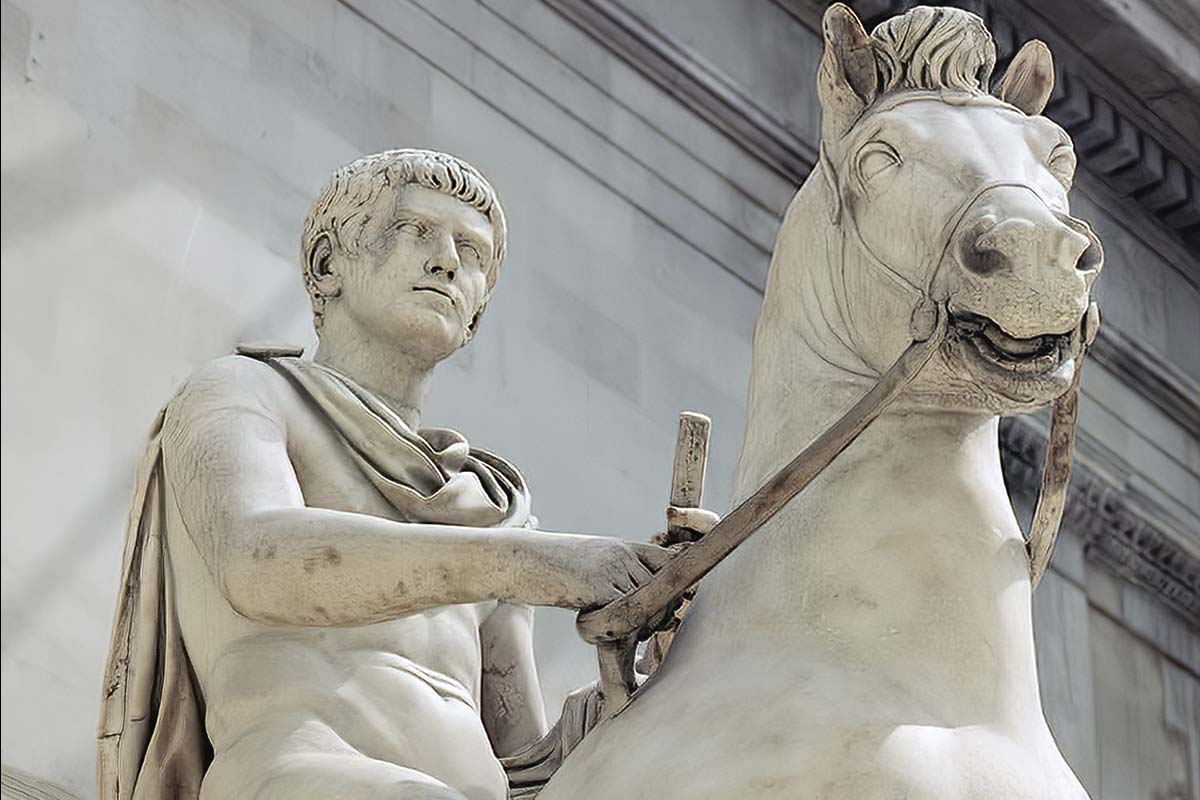
Image: Young Julio-Claudian on horseback at the British Museum, 1st century CE, courtesy of Wikimedia Commons.
If you enjoyed this post, never miss out on future posts by following me by email!


Saturday, May 2, 2020

Bes: Egyptian God in a Roman Context

Bes together with his feminine counterpart Beset, is an Ancient Egyptian deity worshipped as a protector of households and, in particular, of mothers, children and childbirth. Bes may have been a Middle Kingdom import from Nubia or Somalia, and his cult did not become widespread until the beginning of the New Kingdom.  Bes was responsible for such varied tasks as killing snakes, fighting off evil spirits, watching after children, and aiding women in labour by fighting off evil spirits, and thus present with Taweret at births.

Since he drove off evil, Bes also came to symbolize the good things in life – music, dance, and sexual pleasure. In the New Kingdom, tattoos of Bes could be found on the thighs of dancers, musicians and servant girls. Many instances of Bes masks and costumes from the New Kingdom and later have been uncovered. These show considerable wear, thought to be too great for occasional use at festivals, and are therefore thought to have been used by professional performers, or given out for rent. 

Worship of Bes spread as far north as the area of Syria, and later into the Roman and Achaemenid Empires. While the female variant was more popular in Minoan Crete, the male version would prove popular with the Phoenicians and the ancient Cypriots. The Balearic island of Ibiza derives its name from the god's name, brought along with the first Phoenician settlers in 654 BCE. These settlers, amazed at the lack of any sort of venomous creatures on the island, thought it to be the island of Bes. Later the Roman name Ebusus was derived from this designation.

During the Ptolemaic period,  chambers were constructed, painted with images of Bes and his wife Beset, thought by Egyptologists to have been for the purpose of curing fertility problems or general healing rituals.  Because of his defensive nature, Bes was sometimes depicted in a soldier's tunic including the garb of a Roman soldier during the Roman Period.

 Bronze Bell in the form of Bes also from the Roman Period of Egypt at the British Museum courtesy of the British Museum.
Relief of Bes dressed as a Roman Soldier from The Petrie Museum in London, from the Roman Period courtesy of Wikimedia Commons contributor Osama Shukir Muhammed Amin FRCP(Glasg). 
If you enjoyed this post, never miss out on future posts by following me by email!


Friday, May 1, 2020

Pottery askos in the form of a lion preparing to spring, Etruscan, 340-300 BCE at the British Museum

An askos was a vessel used to dispense small quantitites of liquids such as oil. They were used most commonly for refilling oil lamps. The original meaning of askos was wineskin. This example, thought to have been made in Chiusi, Italy has a base of irregular outline that has been cut away inside so as to leave only a narrow support, has a glazed black, and is decorated with a wavy pattern. The motif of the lion drawing back and snarling was popular in the art of both Etruria and southern Italy in the second half of the 4th century BC. It is frequently found on Greek vases and is also common in Etruscan funerary sculpture, particularly in Tuscania and Vulci, and most notably on the frieze of the Tomba François itself where this askos was probably found. All the examples pre-suppose an opponent: one is rarely shown. Buranelli suggests that the opponent may originally have been Herakles, and that the lion is the Nemean lion, shown at the moment before the hero seizes it. In support of a single original for the derivation of many of the examples Buranelli notes the disproportionately small head which all share, though many Greek depictions of lions in the classical period also characteristically have small heads.

The tail is laid back against the right flank, and beside it a spout rises vertically, adjoining an arching handle over the spine. The hide of the lion is represented by rows of small hatched marks in brown on the natural clay; the mane is conventionally modelled in rows of tongue-shaped locks. The mouth is open and forms a second spout communicating with the interior. The mask and feet have been painted yellow on a white engobe, but these colours have mostly faded. The tail appears to have been coloured vermilion. The belly is left unpainted. Around the lip of the vertical spout is a band of herring-bone pattern,  around its neck, a loop pattern.


Image courtesy of the British Museum.
If you enjoyed this post, never miss out on future posts by following me by email!


Tuesday, April 28, 2020

Before the Gracchi - Lycurgus of Sparta: Early Land Reformer and the Father of the Great Rhetra

Image: Lycurgus, his arm bearing his shield raised above his head enters the city in a gold chariot pulled by white bulls, his soldiers around him, and a young man running with white hounds in the left foreground. This graphite, pen and grey ink detailed watercolor heightened with touches of white bodycolor and gum arabic was produced in 1797. Image courtesy of the Trustees of the British Museum.
Lycurgus was the quasi-legendary lawgiver of Sparta who established the military-oriented reformation of Spartan society in accordance with the Oracle of Apollo at Delphi. All his reforms promoted the three Spartan virtues: equality (among citizens), military fitness, and austerity and were contained in an oral constitution known as the Great Rhetra.

According to Herodotus, at some time before the reigns of Leon of Sparta and Agasicles about 590 BCE, the Spartans "had been the very worst governed people in Greece" until Lycurgus consulted the Delphic oracle and was provided with an entire constitution which Lycurgus took back and implemented. Lycurgus was the younger son of the Eurypontid king, Eunomus. He was thus passed over for the throne in favor of his brother, Polydectes, but the latter died. Although Lycurgus was offered the throne, his dead brother's wife was pregnant so Lycurgus became regent for the child when it was born. But Polydectes' wife and her relatives envied and hated Lycurgus and accused him of plotting the death of the infant, Charilaus.

So Lycurgus surrendered his position of authority and went on a legendary journey to Crete where he studied the laws of Minos and met the celebrated composer Thales, who, like Orpheus, could sooth the masses and inspire his listeners to become better people. From Crete, Lycurgus traveled to Asia Minor, Egypt, Spain, and, some say, even India. In Ionia he studied the lessons of statecraft and morality in the works of Homer and compiled fragments of them and expounded the lessons widely. According to Plutarch, Lycurgus was inspired by the Egyptians with the idea to separate the military from common laborers and this was the reason later Spartan warriors were not allowed to practice manual crafts. When Lycurgus was finally recalled to Sparta, he, like the Gracchi centuries later in Rome, prescribed land reforms to redistribute wealth more equally among Spartan citizens.

"For there was an extreme inequality among them, and their state was overloaded with a multitude of indigent and necessitous persons, while its whole wealth had centered upon a very few. To the end, therefore, that he might expel from the state arrogance and envy, luxury and crime, and those yet more inveterate diseases of want and superfluity, he obtained of them to renounce their properties, and to consent to a new division of the land, and that they should all live together on an equal footing; merit to be their only road to eminence." — Plutarch, Lycurgus.

Lycurgus was also credited with the development of the agoge for the education of children and the institution of common mess halls, the sussita, that required all Spartan men to eat together and provide the shared meals through the monthly contribution of a bushel of meal, eight gallons of wine, five pounds of cheese, two and half pounds of figs, and a small amount of money to purchase meat or fish. Even kings were not exempt from the daily ritual and expected contributions.


If you enjoyed this post, never miss out on future posts by following me by email!


Saturday, April 4, 2020

Tanagra Figurines: From Elegant to Whimsical

Tanagra Figurines: From Elegant to Whimsical.

Note:  This is a crosspost from my blog "Antiquities Exhibits."
Tanagra figurines are mold-cast Greek terracotta figurines produced from the later fourth century BCE up to the 1st century BCE, primarily in the Boeotian town of Tanagra, which has given its name to the whole class but also in Alexandria, Tarentum in Magna Graecia, Centuripe in Sicily and Myrina in Mysia. The vast majority of the figures depict women in everyday apparel with acceessories like hats, wreaths, or fans. But men and boys, Eros, Aphrodite, and grotesques were also subjects. Some character pieces may have represented stock figures from the New Comedy of Menander and other writers. Others continued an earlier tradition of molded terracotta figures used as cult images or votive objects. Researchers think some Tanagra figurines were religious in purpose, but most seem to have been entirely decorative. However, those placed in tombs as grave goods are not thought to have served the deceased in the afterlife in any way unlike figurines in Egyptian funerary practice. The "coraplasters", or sculptors of the models that provided the molds, delighted in revealing the body under the folds of a himation thrown round the shoulders like a cloak and covering the head, over a chiton, and the movements of such drapery in action. They were coated with a liquid white slip before firing and were sometimes painted afterwards in naturalistic tints with watercolors and even accented with gilding in some cases. The figures appealed to 19th century middle-class ideals of realism so became wildly popular during the Victorian Period, so much so Tanagra figurines began to be faked.

Terracotta maiden from Tarentum, Italy 3rd century BCE. The willowy shape and draping of the fabric on top of the maiden's high, "melon" hairstyle are typical ly south Italian. Photographed at the Walters Art Museum in Baltimore, Maryland.

Closeup of Terracotta maiden from Tarentum, Italy 3rd century BCE. The willowy shape and draping of the fabric on top of the maiden's high, "melon" hairstyle are typical ly south Italian. Photographed at the Walters Art Museum in Baltimore, Maryland.

Female Figurine from a vessel Greek (Canosa in southern Italy) 3rd century BCE. This figure is from a type of vase that occasionally took the form of a female head. South Italian artists frequently applied spearately molded figurines to pottery and depicted faces with heavy jaws and prominently lidded eyes. Photographed at the Walters Art Museum in Baltimore, Maryland.

Aphrodite possibly a Roman copy after a Hellenistic type of the 2nd-1st century BCE. The elongated proportions, narrow torso, and high, close-set breasts are typical of the Hellenistic decorative statuary of the island of Rhodes. Photographed at the Walters Art Museum in Baltimore, Maryland.

Terracotta figurine of a seated maiden with "melon" hairstyle Greek 230 BCE photographed at the Walters Art Museum in Baltimore, Maryland.

Terracotta Standing Maiden with Kerchief Greek, 300-275 BCE photographed at the Walters Art Museum in Baltimore, Maryland.
Terracotta Boy with grapes and a predatory cockerel from Myrina, 1st century BCE photographed at the British Museum in London.

Terracotta Tanagra-style figurine of a woman with a child photographed at the British Museum in London.

Terracotta figure of a stooped old nurse holding a baby made in Athens about 300 BCE photographed at the British Museum in London.

Terracotta woman holding a now headless baby made in Kyme, Turkey 200-130 BCE. She wears a folded kerchief on her head of a type sometimes worn by nurses, although they are usually represented as elderly. Photographed at the British Museum in London.

Terracotta figure of a little girl carrying a bag of knucklebones made in Boeotia about 300-250 BCE photographed at the British Museum in London.

Tanagra figurine 325-150 BCE at the Altes Museum courtesy of Wikimedia Commons contributor Ophelia2.

Lady with blue and gilt garment, fan and sun hat, from Tanagra 325-300 BCE from the Altes Museum in Berlin, Germany courtesy of Wikimedia Commons contributor Capillon.
Terracotta figure of a small boy wearing a long mantle and wreath made in Boeotia about 300-250 BCE photographed at the British Museum in London.

If you enjoyed this post, never miss out on future posts by following me by email!