Showing posts with label history. Show all posts

Wednesday, March 31, 2021

The Muses

 According to Pausanias, who wrote in the later second century CE, there were originally three Muses, worshipped on Mount Helicon in Boeotia: Aoide ("song" or "tune"), Melete ("practice" or "occasion"), and Mneme ("memory").  The earliest known records of the Muses come from Boeotia and some ancient authorities point to Thrace as the origin of this myth.  

Writing in the first century BCE, Diodorus Siculus claims Homer and Hesiod state there are actually nine Muses, though.  According to Hesiod's account (c. 600 BCE), generally followed by most writers of antiquity, the Nine Muses were the nine daughters of Zeus and Mnemosyne (i.e., "Memory" personified), which represented personifications of knowledge and the arts, especially poetry, literature, dance and music.  Ironically, Hesiod says the Muses brought to people forgetfulness, that is, the forgetfulness of pain and the cessation of obligations, though.

For poet and "law-giver" Solon, the Muses were "the key to the good life", since they brought both prosperity and friendship. Solon sought to perpetuate his political reforms by establishing recitations of his poetry—complete with invocations to his practical-minded Muses—by Athenian boys at festivals each year. He believed that the Muses would help inspire people to do their best.

Distinguished ancient authors would invoke the Muses when writing poetry, hymns or epic history to comply with established poetic tradition.  Such invocations can be found in the works of Homer, Virgil, Catullus, and Ovid.

An example from Virgil's Aeneid:

O Muse! the causes and the crimes relate

What goddess was provok'd, and whence her hate

For what offense the Queen of Heav'n began

To persecute so brave, so just a man

—Virgil (c. 29 - 19 BCE), in Book I of the Aeneid 

Muse Roman from Cremna in present-day Turkey about 200 CE Marble gold that I photographed at the Getty Villa in Pacific Palisades, California. These statues of the muses are among my favorites because of their softer features.

Muse Roman from Cremna in present-day Turkey about 200 CE Marble gold that I photographed at the Getty Villa in Pacific Palisades, California. These statues of the muses are among my favorites because of their softer features.

Muse Euterpe Roman from Cremna in present-day Turkey about 200 CE Marble pigment and gold that I photographed at the Getty Villa in Pacific Palisades, California.

Muse Euterpe Roman from Cremna in present-day Turkey about 200 CE Marble pigment and gold that I photographed at the Getty Villa in Pacific Palisades, California.

Muse of love poetry or dance, Roman, from Cremna in present day Turkey 200 CE Marble pigment and gold that I photographed at the Getty Villa in Pacific Palisades, California. These statues of the muses are among my favorites because of their softer features.

Muse of love poetry or dance, Roman, from Cremna in present day Turkey 200 CE Marble pigment and gold that I photographed at the Getty Villa in Pacific Palisades, California. These statues of the muses are among my favorites because of their softer features.

Terpsichore, Muse of the dance. Marble, Roman artwork from the 2nd century CE. The head is ancient but does not belong to the body. From the Villa of Cassius near Tivoli, now in the collections of the Vatican Museums, courtesy of Wikimedia Commons contributor Marie-Lan Nguyen 

Part of a pavement mosaic with the bust of a muse. Roman artwork of the second half of 2nd - early 3rd century CE from the Villa dei Severi now at the Palazzo Massimo alle Terme in Rome, Italy courtesy of Wikimedia Commons contributor Jean Pol Grandmont. 

Roman mosaic depicting the Muses dating between 2nd and 4th centuries CE, excavated at Antioch, Turkey, now in the collections of the Worcester Art Museum in Worcester, Massachusetts, courtesy of Wikimedia Commons contributor Daderot 

The fragmentary front of a large sarcophagus with a seated woman surrounded by Muses. The muse to the left is Terpsichore. She wears a chiton completely enveloped by a himation, and holds a lyre in her left hand. She turns toward a seated woman (probably the deceased) who wears a himation and whose foot rests on a foot-stool. She reaches to touch the strings of Terpsichore's lyre. Beside her is Thalia, wearing a close-fitting netlike garment with a mantle wrapped around her lower body. A bulla is around her neck and she wears open-toed shoes. In her left hand, she holds a lagobolon concealed by her cloak, and in her right, a comic mask. At the end, Euterpe holds the tibiae (pipes) with both hands. She wears a sleeved chiton trimmed with tassels at the hem. A short mantle is wrapped around her shoulders and tucked under her belt. To the right of Euterpe are the remains of a pillar. Courtesy of the Getty Villa

Clio the Roman Muse of History from Cremna in present-day Turkey about 200 CE Marble pigment and gold that I photographed at the Getty Villa in Pacific Palisades, California.

Clio the Roman Muse of History from Cremna in present-day Turkey about 200 CE Marble pigment and gold that I photographed at the Getty Villa in Pacific Palisades, California.

Clio the Roman Muse of History from Cremna in present-day Turkey about 200 CE Marble pigment and gold that I photographed at the Getty Villa in Pacific Palisades, California.

Urania (astronomy) 1, Euterpe (flutes and lyric poetry) 2, Polyhymnia (sacred poetry) 3, Erato (love poetry) 4 but name to other side of Kleio (Kleio In Greek mythology, Clio (traditionally /ˈklaɪoʊ/, but now more frequently /ˈkliːoʊ/; Greek: Κλειώ, Kleiṓ; "made famous" or "to make famous"), also spelled Kleio, is the muse of history, or in a few mythological accounts, the muse of lyre playing, 5, Terpsichore (dance) 6, Melpomene (tragedy) 7, Thalia (comedy and pastoral poetry) 8. The ninth is not in this group, as she is Calliope who is shown in a frame of her own, handing a paper (“inspiration”?) to Hesiod. 2nd century CE Roman mosaic courtesy of Wikimedia Commons contributor Dick Osseman. 

The Muse Terpsichore, Roman statue based on an Attic model from 150–100 BCE found in the Villa Adriana in Tivoli, Italy, now in the collections of the Prado Museum, courtesy of Wikimedia Commons contributor na Belén Cantero Paz. 


If you enjoyed this post, never miss out on future posts by following me by email!


Sunday, July 21, 2019

Review: Army of the Roman Emperors: Archaeology and History by Thomas Fischer


History resource article by Mary Harrsch © 2019

Casemate Academic Publishing recently sent me a reference text to examine entitled "Army of the Roman Emperors: Archaeology and History" by Thomas Fischer.  This comprehensive  work is divided into six parts.

Part I, written by Dietrich Boschung,  examines "Iconographic sources for the Roman military" from the Republican period through Late Antiquity.  I found its in-depth descriptions of some famous Roman imagery very revealing.  Furthermore, some of the astonishing pieces I had not seen before either.  One such piece was the Gemma Augusta, a low-relief cameo cut from Arabian onyx attributed to Dioscurides or one of his disciples created in the second or third decade of the 1st century CE. It is currently housed in the Kunsthistorisches Museum in Vienna, Austria.  The text explains the significance of each major figure on the piece, something you rarely get with a museum identification card, and speculates on the purpose for which the piece was created.

1st century CE Roman cameo depicting Tiberius and Augustus with various deities and prisoners
courtesy of Wikimedia Commons contributor Carole Raddato
 It peaked my interest so much that I researched the cameo further and discovered there are also alternative explanations for some of the figures, particularly those in the lower register where captives are shown awaiting the erection of a tropaion.  It was interesting to read how various art historians use slight clues from hairstyles and attire in combination with a knowledge of political and military history of the period to determine who is actually represented and for what purpose.

Part II explores the changes that occurred over time in the armament and equipment of the Roman army, a result of the development of more advanced weapons and fluctuations in the procurement of raw materials.  It also discusses archaeological finds made in different contexts such as battlefield and siege finds, objects recovered from camps, forts and other military sites, those found in civilian settlements, and artifacts recovered from water deposits, hoards, and grave sites.

Part III examines all of the costumes, weapons, and equipment from original archaeological finds. This was my favorite section since I am a visually-oriented person and it was full of photographs, drawings, and reconstructions of objects actually recovered from the field.  I was particularly impressed with the condition of some of the artifacts, especially ornate pugio scabbards and cavalry helmets, many of them, I noticed, in private collections.  I was also surprised by the variety of different helmet designs and the degree of ornamentation on some accessories like a privately-owned collection of cheek pieces. I really appreciated the drawings showing the placement of some items of a legionary's kit and those used with horses, too.

Part IV explored the details of Roman army constructions and architecture from marching camps to vexillation fortresses and how defensive structures changed through the centuries.  There is even a discussion of the various military structures in Rome itself from the Castra Praetoria to the accommodation for the vigiles.

Part V wraps up the army portion with a chronological look at military conflicts and the armament and equipment used in each historical period beginning with the Republic.

Then Part VI discusses the development of the Roman navy from the arming and equipping of the marines to locations of naval installations including those along major rivers and tributaries.  A wealth of illustrations, informed by not only iconographic sources but the recovery of actual vessels, depict various ships and smaller craft as well as harbor installations.

I think this book would be an invaluable reference work for not only Roman history enthusiasts and re-enactors but aspiring novelists as well.  Its extensive bibliography serves as a stepping stone to more research sources and it offers a thorough index as well.
If you enjoyed this post, never miss out on future posts by following me by email!


Sunday, January 7, 2018

Illustrated historical timelines can now be developed online with eStory!

History resource article by Mary Harrsch © 2017

Years ago I participated in a workshop about the development of effective data graphics. The instructor used Charles Joseph Minard's classic timeline of events that occurred during Napoleon's invasion of Russia in 1812 as his primary example. This historic data graphic not only relayed dates and events but, through the thickness of the line, represented the catastrophic losses in Napoleon's army  suffered in that brutal winter campaign.

Charles Joseph Minard's classic timeline of Napoleon's invasion of and retreat from Russia in 1812.
"From the most ancient images to the contemporary, the line has served as the central figure in the representation of time. The linear metaphor is ubiquitous in everyday visual representations of time—in almanacs, calendars, charts, and graphs of all sorts. Even our everyday speech is filled with talk of time having a "before" and an "after" or being "long" and "short." The timeline is such a familiar part of our mental furniture that it is sometimes hard to remember that we invented it in the first place." - Anthony Grafton and Daniel Rosenberg, Cartographies of Time: A History of the Timeline

I have always found timelines to be excellent tools for providing structure for historical events and the ability to compare both events and technological developments of different cultures over a similar time period. So when Jonathan Pinet contacted me last month and described the new timeline tool he and Jean Benoit Malzac were developing, I became quite interested in their efforts. Jonathan had read some of my posts on "Roman Times" and wondered if I would develop several timelines focused on Roman History for their new timeline website Estory. So I spent several days compiling a list of dates and events for the Gallic Wars then finding images on the web I could use for illustration.

As my timeline was quite detailed, Jean Benoit asked me to break it into three parts to limit each timeline to 15 - 20 events so I did so and the following three timelines are the result. (click on the linked captions to view the timeline)

Gallic Wars Timeline Pt 1: The Helvetii


Gallic Wars Timeline Pt 2: Pirates and Britons
Gallic Wars Timeline Pt 3: Roman victory at Alesia

The eStory tool allows you to use either still images, animated GIFs, or video clips to illustrate each information slide. At present there is no intermediate save function, though,  so I recommend you compile your list of dates, events and the URLs for illustrations using a spreadsheet first then login to eStory and enter your data.  Once you save your timeline you will no longer be able to edit it (at the moment). However, if you wish to make changes or additions after you have published it, Estory has an online chat feature where you can provide information to Jean Benoit and he will make the changes for you.  Hopefully, online editing of an existing timeline will be added soon.

The timeline tool also has features to provide links to recommended movies, books, and related articles to enrich your timeline.  If you provide the titles to the movies and books, Jean Benoit will look them up on Amazon and enter the appropriate links after you publish your timeline. Articles can be linked by providing their URLs.

I have asked Jonathan and Jean Benoit to consider adding the ability to display two timelines, one above the other, so cultures and political developments can be easily compared across the same time period. Hopefully, this feature will make it into the development schedule.

I would also like to see the development of a collaborative environment so group members could work on timelines together. I really enjoyed the history of sailboats timeline developed by Aurélien Ferré but wished I could have added some slides about ship development in the Greco-Roman period between his slides of 5000 BCE and the 9th century CE.

I encourage you to visit eStory and check out some of the interesting timelines that have been created there. Then set up a free account of your own and develop a timeline about a subject that interests you!


If you enjoyed this post, never miss out on future posts by following me by email!


Monday, January 16, 2012

Romano Britain website resurrected!


I just received word that the website Romano Britain (http://www.romanobritain.org) has been resurrected by Marsh Wise, aka Decimus Mercatius Varianus of LEGIO IX HISPANA on the east coast of the U.S.  Apparently the original webmaster developed serious medical issues some time ago and the original website disappeared .  Fortunately, Marsh had stored a copy of the website for reference purposes and decided to resurrect the site so the Roman history community would not lose it as a valuable online resource.

Kudos to Marsh!

Related articles
Enhanced by Zemanta
If you enjoyed this post, never miss out on future posts by following me by email!


Monday, May 23, 2011

Devouring Gibbon's Decline and Fall of the Roman Empire 5 minutes at a time

Portrait, oil on canvas, of Edward Emily Gibbo...Image via Wikipedia
PORTRAIT, OIL ON CANVAS, OF EDWARD EMILY GIBBON
 (1737–1794) BY SIR JOSHUA REYNOLDS (1723–1792)
The masters of the fairest and most wealthy climates of the globe [The Romans] turned with contempt from gloomy hills, assailed by the winter tempest, from lakes concealed in a blue mist, and from cold and lonely heaths, over which the deer of the forest were chased by a troop of naked barbarians [Scotland]. - Edward Gibbon, Decline and Fall of the Roman Empire


18th century historians like Edward Gibbon (April 27, 1737 – January 16, 1794) write such stilted prose that I have found myself hesitant to tackle his Decline and Fall of the Roman Empire for fear that I would toss my hard-bound collection of this classic work into some cob-webbed abyss in the attic in frustration before I even finished Volume 1.  But, despite its errors that have been revealed by research in the last 300 years, Gibbon's work is considered one of those sources that a well read Roman scholar should have studied in the course of their career.

Lately, though, I have found a technical solution to my dilemma.  I read about a new service called Daily Lit that offers to email you five minutes worth of any work in their fairly extensive library of mostly public domain titles each day so you can "eat your vegetables" in tiny little bites.

I must admit trying to digest Gibbon's preface was a challenge, even at five minutes a day!  But now I'm finally into the meat of his first chapter and found the quote above that made me smile at the flourishes in his description.

Daily Lit also offers to email you free video lectures from Khan Academy that run between 10 and 25 minutes long.  Although Khan Academy's lectures are predominately math, they have begun offering history lectures too.  I'm presently subscribed to their lecture series on The French Revolution.

Instructor Sal Khan, a graduate of MIT, uses a virtual blackboard overlaid with images on which he writes and draws as he lectures in a very laid back manner, referring to Napoleon Bonaparte as a "dude who really knew what he was doing!"  His conversational style is so natural that you quickly become immersed in the topic and it doesn't feel like a formal lecture at all.  I was so excited by their efforts to offer free educational experiences that I sent them an e-mail offering the free use of my image archive.  I would love to have Sal explain the decline and fall of the Roman Empire!  His efforts even drew the attention of Google who gave him a $2 million grant to further develop his courses. I encourage you to check him out!


Related articles
The History of the Decline and Fall of the Roman Empire (Penguin Classics) 


If you enjoyed this post, never miss out on future posts by following me by email!


Tuesday, April 19, 2011

Aqueducts that enabled an empire

Aqueducts map courtesy of http://www.aqueducthunter.com
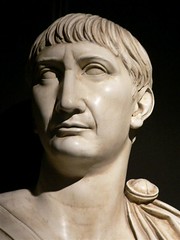
The second century Roman
Emperor Trajan.  Photo by
Mary Harrsch.
Although remnants of some of the first aqueducts dating to the early Iron Age have been found in the Middle East, the Romans brought aqueduct engineering to an art form beginning with the  Aqua Appia, built in 312 BCE.  At the height of the Roman Empire, the city of Rome, with inhabitants numbering an estimated one million people, was served by over 500 miles of aqueducts.  But, by the time of Trajan, the so-called "Optimus Princeps", the Romans' complex system of water delivery was falling into disrepair. 


 "... the existing aqueducts at that time came from the east of Rome, the sources were from rivers or springs providing water that carried dissolved salts that were deposited inside and eventually blocked the pipes and ducts, and also sometimes carried very large amounts of silt that blocked the ducts and reduced the water flow." - AqueductHunter.com


So Trajan commissioned his magistrate of public works, Sextus Julius Frontinus, to construct a new aqueduct sourced by  fresh water springs distributed in the mountains around the volcanic lake known as the Lacus Sabatinus, known today as Lake Bracciano. 


 The Aqua Traiana was inaugurated in 109 CE and is thought to have supplied water to Trajan's new bath 
The southwestern exedra of the Baths of Trajan...Remains of the Baths of Trajan.  Image via Wikipediacomplex, a naumachia (entertainment complex where mock naval battles were reenacted)  in the area that would become later known as the Vatican and grain mills high on the Janiculum Hill.  


The Aqueduct arrives in Rome at the top of the Janiculum Hill at a high level above the city. In order to reach Trajan's Baths on the top of the Colle Oppio and the storage cisterns known as the Sette Sale, the aqueduct probably crossed the river Tiber on a large stone bridge or just possibly under the river in a syphon made with lead pipes. 
The archaeologist Prof. Rabun Taylor from the University of Texas proposes that the aqueduct crossed the tiber on a high stone structure close to the Children's Hospice building at the Porto di Ripa Grande, and curved around the Aventine Hill before turning north towards the Colle Oppio, the hill adjacent to the Colosseum, and the site of Trajan’s baths. Some evidence of the structural arches can be seen on the 1551 map of Leonardo Buffalini. - AqueductHunter.com
The system would serve Rome, despite sporadic damage from various barbarian incursions, until the 9th or 10th centuries.  Later, it would be restored in 1612 by Pope Paulo V (Borgese) and renamed the Aqua Paola.  
 "Various Cardinals were sent to the Lake Bracciano area to investigate the strength and value of the local water sources throughout the sixteenth century, and the result was the deed of purchase by Pope Paul V of most of the sources which had comprised the Aqua Traiana." 
"However some veins of the aqueduct were specifically excluded from the purchase because by then they were supplying water for other purposes. Specifically the Aqua della Fiora was being used to supply the Bracciano grain mill which the local Duke, Paolo Giordano Orsini had caused to be constructed at Vigna Grande in 1578...The result was an aqueduct with a significantly lower yield than in Trajan’s day."
 "...in its first incarnation [the Aqua Paola] was not nearly as copious as in Trajan's time, and by 1673, it was supplemented instead by dirty lake water. 
For this reason, in modern Roman slang, something or someone of dubious worth is sometimes referred to as 'as good as the Acqua Paola'. " - AqueductHunter.com


At some point a small church was built over one of the primary sources of water for the Aqua Traiana near Lake Bracciano and obscured the Roman constructions beneath it.  But it was shown on a map from the year 1718 and it was this map found in the state archives, that peaked the interest of modern day aqueduct hunters, UK filmmakers Ted and Mike O'Neill, Lorenzo Quilici, Professor of Topography at the University of Bologna,  professor and historical map scholar Allan Ceen, archaeologist Raybun Taylor and Katherine W. Rinne, adjunct professor of architecture at the California College of the Arts. The group then decided to collaborate on a project to explore and film the second century Roman remains.


They have published much of their findings and images of their discoveries on their website AqueductHunter.com.  It's a fascinating read and I encourage you to explore the site fully.  The team is not sponsored by any particular institution so if you wish to become involved in their work, they welcome contributions or corporate or academic sponsorship.  


Their initial explorations are also documented in the film clip below.


The Emperor's Sacred Spring - 7 minute HD trailer from MEON HDTV PRODUCTIONS on Vimeo.


Roman Aqueducts and Water Supply (Duckworth Archaeology)   History -- Modern Marvels Aqueducts: Man Made Rivers of   Guide to the Aqueducts of Ancient Rome   Trajan: Optimus Princeps (Roman Imperial Biographies)


Enhanced by Zemanta
If you enjoyed this post, never miss out on future posts by following me by email!