Showing posts with label hunt. Show all posts

Thursday, June 24, 2021

Tigers and Roman bestial entertainment

Unlike lions, leopards, and bears, tigers appear relatively rarely in Roman art, with the tigress seen more frequently than her male counterpart. - Cleveland Art Museum

Apparently, the emperor Titus was the first ruler to introduce tigers to the crowds in the Flavian Amphitheater (Colosseum), among the 9,000 beasts killed over the course of its 100 day inauguration. I found a reference to the book "Rome beyond the Empire" by Mortimer Wheeler published in 1954 that describes Roman trading posts around the coast of India and how a Greek merchant sailed as far as the Bay of Bengal about 60 CE. Perhaps he established some trading relationships that resulted in the acquisition of those tigers.

"The Scriptores Historiae Augustae explicitly praised the emperor Antonius Pius for his munificence in staging a games featuring ‘all the animals of the whole earth,’ and it seems such claims were scarcely an exaggeration: lions, rhinos, crocodiles, hippos, cheetahs, rhinoceroses, monkeys and elephants were all transported from Africa to the capital. Tigers, leopards, panthers, and cheetahs made the perilous journey from Asia, whilst bears were captured and taken to Rome from the highlands of Scotland..." - Lions and Tigers and Bears, Oh My! Wild animals in the Colosseum, througheternity.com 

Elephants were actually the first animal used for a public spectacle in Rome in 251 BCE when 142 elephants appeared in a victory celebration of the Roman legions over Carthaginians riding the beasts. Sadly, the animals were slaughtered afterwards.

"With the passage of the centuries things got a lot more sophisticated. In 186 B.C. the Roman consul and general Marcus Fulvius Nobilior staged the first known example of lions and panthers being hunted down in the arena for sport, and his innovation caused a sensation. Such venationes quickly became a staple of the Roman games, known as ludi circenses, and in 46 BC Julius Caesar built a dedicated wooden amphitheater where such spectacles could be staged."  - Lions and Tigers and Bears, Oh My! Wild animals in the Colosseum, througheternity.com

The result of all of this carnage? Hippos disappeared from the Nile and lions no longer roamed through Mesopotamia, whilst the north African elephant, aurochs, European wild horses, great Auks and Eurasian lynxes were all wiped out entirely. 

Read more about it: https://www.througheternity.com/en/blog/history/wild-animals-in-the-colosseum.html# 


Image: Roman mosaic of Tigress and cubs, 300s CE, estern Roman Empire, now in the collections of the Cleveland Art Museum, image courtesy of the museum. 

If you enjoyed this post, never miss out on future posts by following me by email!


Sunday, February 7, 2021

Sasanian royal gifts of silver

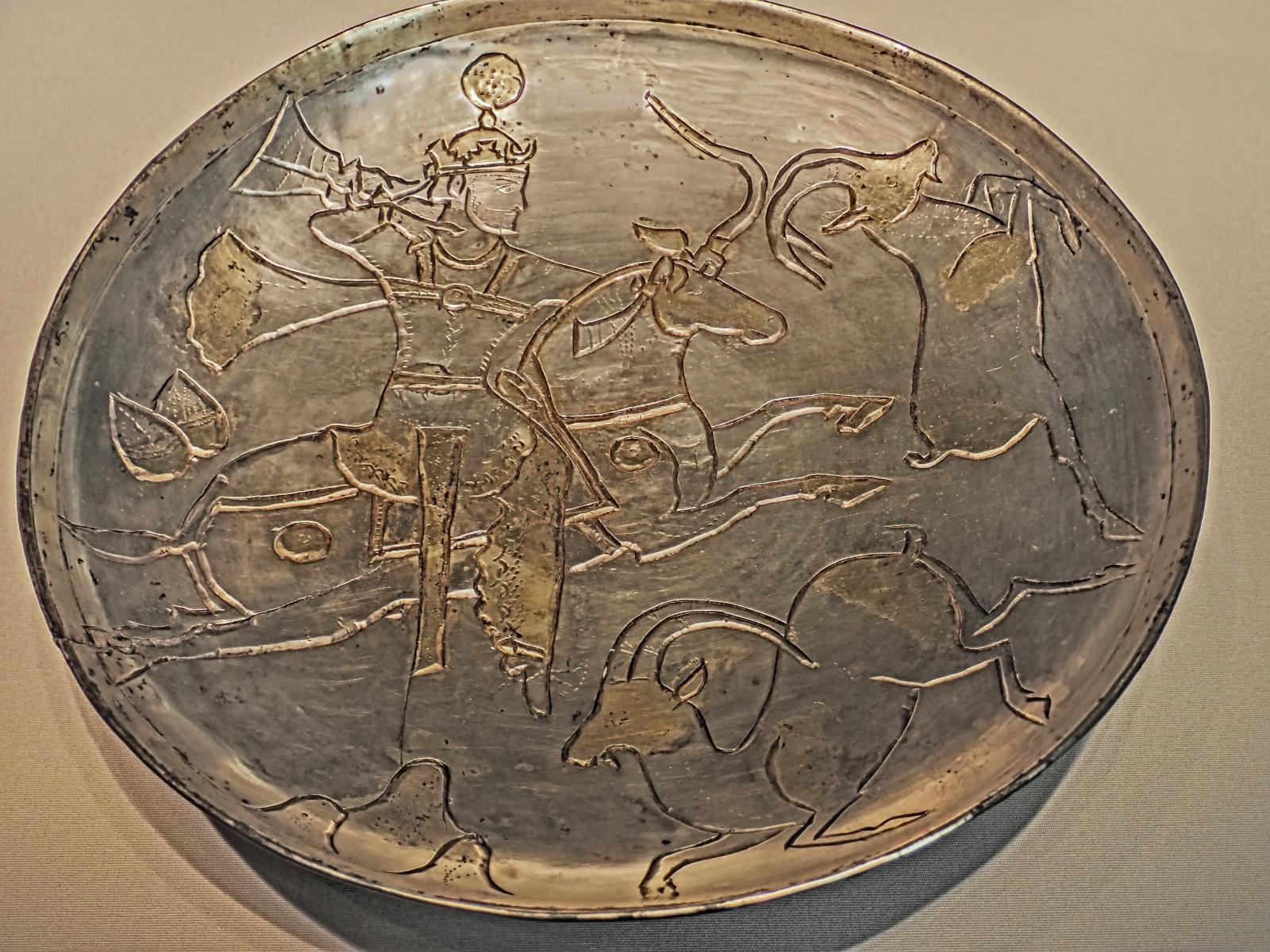
Sasanian silver plates were usually hammered into shape and then decorated using a variety of complex techniques.  Gilding was often used to highlight the hunter, usually the king, and sometimes extra pieces of metal were added to create high relief.

The king as hunter became a standard image on silver plates during the reign of Shapur II (r. 310–379 CE). The motif symbolizes the prowess of Sasanian rulers, and these royal plates were often sent as gifts to neighboring and vassal courts.  Some plates included inscriptions with the king's name and the plate's weight.  With other plates, art historians must attempt to identify the king by his distinctive apparel or shape of the crown he wears.  Each Sasanian king wore a different personal crown, which became more and more elaborate during the four centuries of the dynasty. Fortunately, the different crowns have been identified from coins or sometimes compared with existing rock reliefs with inscriptions such as those at Ṭāq-e Bostān or Naqš-e Rostam, Iran.

"In a few cases identification by crown can be reinforced by the presence of contemporary inscriptions. The best instance of this – and a very important example - is the Investiture of Ardašir I at Naqš-e Rostam. This magnificent relief shows two mounted horsemen, one handing the ribboned diadem or symbol of kingship to the other, and both with defeated enemies lying dead beside them. The left hand figure is wearing the skull-cap surmounted by korymbos, the final version of his personal crown developed by Ardašir (224-241 CE), seen on both his gold and silver coins. The figure on the right wears the mural crown, his hair arranged in a top-knot as well as falling in luxuriant curls to his shoulders." - iranicaonline.org 


King Hunting Plate, Sasanian period 4th-5th century CE silver and gilt courtesy of Wikimedia Commons contributor Daderot

Closeup of a Plate depicting a boar hunt Persia (Iran) Sasanian Period 4th century CE Silver and Gilt that I photographed at the Smithsonian's Sackler Gallery of Asian Art in Washington D.C.

Plate depicting a boar hunt Persia (Iran) Sasanian Period 4th century CE Silver and Gilt that I photographed at the Smithsonian's Sackler Gallery of Asian Art in Washington D.C.

Silver and gilt plate depicting winged horses Persian Sasanian Period 7th century CE that I photographed at the Smithsonian's Sackler Gallery of Asian Art in Washington D.C.

Sasanian Silver and Gilt Plate depicting a royal hunt Persia 7th century CE that I photographed at the Smithsonian's Sackler Gallery of Asian Art in Washington D.C.

Sasanian Silver plate with Shapur killing a deer, 4th century CE courtesy of Wikimedia Commons contributor Sailko.

Hunting scene depicting King Chosroes II. 7th century CE Sassanid, Cabinet des Medailles, Paris courtesy of Wikimedia Commons

The scene on this example is striking: the king is depicted standing and slaying a rearing stag, whose protruding tongue indicates that he is either dying or already dead. The king is identifiable as Yazdgard I (r. 399-420) due to his crown, although it is topped with a striated globe rather than the cloth-covered one with which he is normally represented. His beaded skirt resembles those shown on the rock reliefs of Shapur II (r. 310-379), Shapur III (r. 383-388) and Ardashir II (r. 379-383) at Taq-i Bustan, Iran. The crescent-tipped spear with a counterweight in the form of a human fist is unique amongst weapons represented on Sasanian silver plates. Image courtesy of the Metropolitan Museum of Art in New York.

Sivler Plate of Peroz I hunting argali, Sasanian, courtesy of the Hermitage Museum and Wikimedia Commons

King Hunting Plate, 303-309 CE, Sasanian, Iran, silver and gilt courtesy of the Cleveland Museum of Art


Hunting with a bowl Sasanian Great King; Iran; 7 Century, Museum of Islamic Art in Berlin (Pergamon Museum) courtesy of Wikimedia Commons contributor Anagoria

Sasanian Silver and Gilt Plate portraying a royal ibex hunt Persia 7th century CE that I photographed at the Smithsonian's Sackler Gallery of Asian Art in Washington D.C.


If you enjoyed this post, never miss out on future posts by following me by email!