Showing posts with label crown. Show all posts

Wednesday, July 7, 2021

Meroitic Period and retainer sacrifice in ancient Nubia

Meroë in ancient Nubia, superseded Napata as the capital of the Kingdom of Kush under King Aspelta in about 591 BCE. Meroe's wealth was centered around a strong iron industry, as well as international trade in jewelry, pottery and textiles involving India and China. Meroitic metal workers engaged in both iron and Nubia's longstanding gold production were considered among the best in the world. The kingdom thrived until the 4th century CE and numerous kings and queens were buried in Meroë's royal cemeteries. 

The remains of Meroë were rediscovered by a French mineralogist Frédéric Cailliaud who published an illustrated folio in 1821. The first formal expedition led by Giuseppe Ferlini was launched in 1834. Ferlini primarily recovered mostly jewelry items which are now in the collections of museums in Berlin and Munich.  Then in 1844, C.R. Lepsius examined the ruins and produced plans and sketches of the site. These inspired E. A. Wallis Budge to lead an expedition to Meroë in 1902 and 1905. His finds were transferred to the British Museum. This was followed by excavations led by John Garstang of the University of Liverpool in 1910.

In 1931, British Egyptologist Walter Bryan Emery excavated the Ballana cemetery in Lower Nubia and uncovered 122 tombs dating from 350 to 600 CE.  In addition to objects of Nubian origin, there were many objects imported from Byzantine Egypt and other trading centers around the Mediterranean. His team found  royal crowns, horses, and servants buried with their masters.  

One of the most lavish burials was found in tomb 118 which consisted of a main burial chamber and two storage rooms.  Fortunately, the tomb's roof had collapsed so was apparently overlooked by looters. The body of the person buried there was found on a bier. It was most likely that of a king. Upon his head was found a crown. Under the bier, were the remains of a large wooden gaming board, weapons and an iron folding chair. There were also skeletons of a young male servant and a cow. In the two storerooms, more skeletons of servants, as well as pottery and several bronze lamps were discovered.

Human sacrifice was a longstanding tradition of Nubian civilization.  During the Classic Kerma Period (1700–1550 BCE), funerary monuments of Kerman kings could be up to one hundred meters long and included hundreds of sacrificed individuals.  One of the largest Kerma burials contained the remains of 322 individuals, most them female.  Archaeologist George Reisner speculated that the women could have been members of the royal harem.

The practice of retainer sacrifice appears to have abated while Nubia was under the rule of Egypt during the New Kingdom period and the reign of the 25th dynasty during the Third Intermediate Period.  But the sacrifice of retainers was revived when the royal cemetery was moved south to Meroë during the reign of Arkamaniqo (270-260 BCE).  At least 16 royal tombs including those of five kings, a queen, a prince, and eight of unknown status dating to as late as the 1st century BCE contained human sacrificial victims. I hope none of them were members of Gaius Petronius' retaliatory force!


Image: Nubian royal crown from the royal cemetery at Ballana Tomb 118 courtesy of Wikimedia Commons contributor John Campana (digitally enhanced)


If you enjoyed this post, never miss out on future posts by following me by email!


Sunday, February 7, 2021

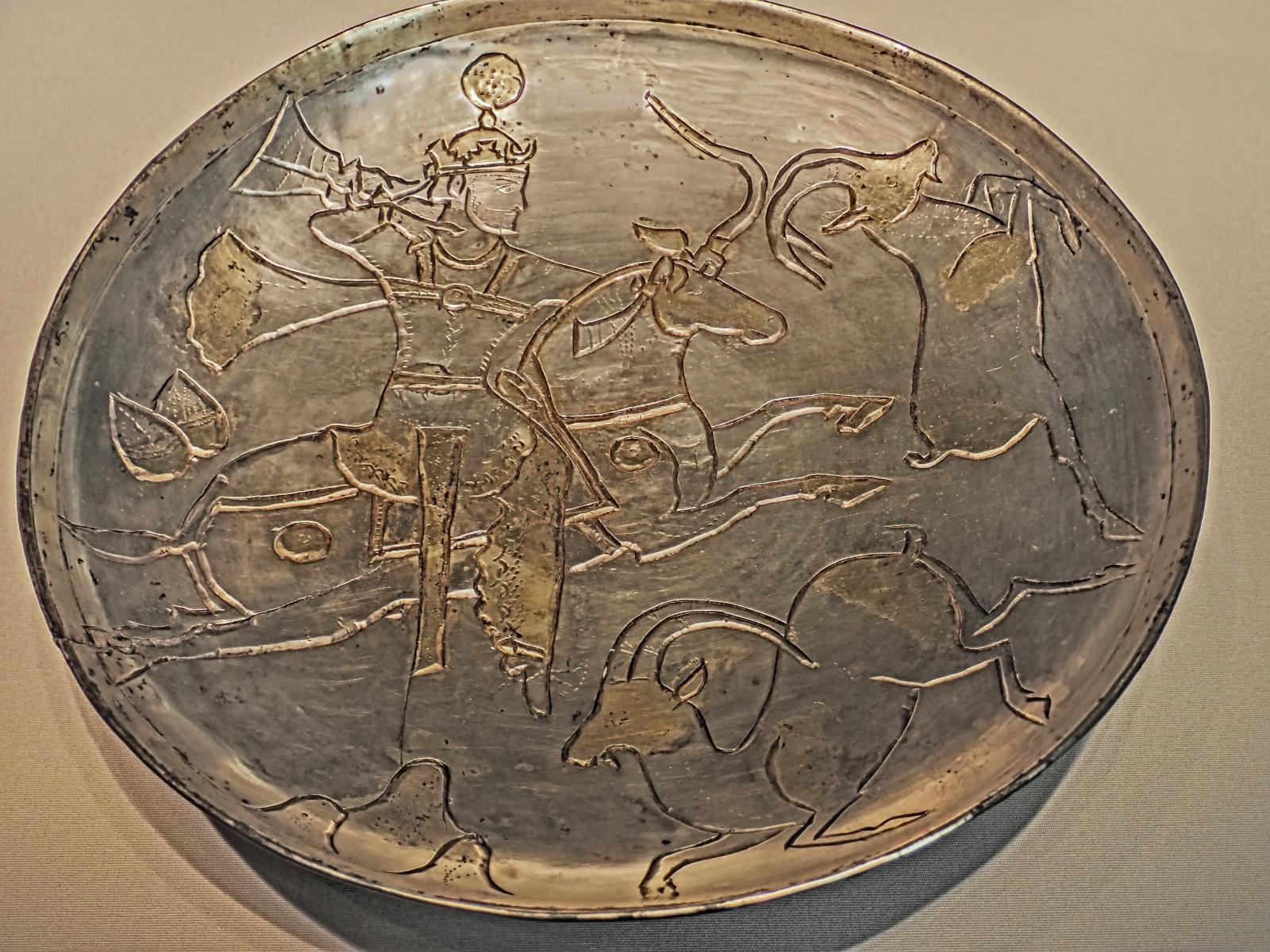
Sasanian royal gifts of silver

Sasanian silver plates were usually hammered into shape and then decorated using a variety of complex techniques.  Gilding was often used to highlight the hunter, usually the king, and sometimes extra pieces of metal were added to create high relief.

The king as hunter became a standard image on silver plates during the reign of Shapur II (r. 310–379 CE). The motif symbolizes the prowess of Sasanian rulers, and these royal plates were often sent as gifts to neighboring and vassal courts.  Some plates included inscriptions with the king's name and the plate's weight.  With other plates, art historians must attempt to identify the king by his distinctive apparel or shape of the crown he wears.  Each Sasanian king wore a different personal crown, which became more and more elaborate during the four centuries of the dynasty. Fortunately, the different crowns have been identified from coins or sometimes compared with existing rock reliefs with inscriptions such as those at Ṭāq-e Bostān or Naqš-e Rostam, Iran.

"In a few cases identification by crown can be reinforced by the presence of contemporary inscriptions. The best instance of this – and a very important example - is the Investiture of Ardašir I at Naqš-e Rostam. This magnificent relief shows two mounted horsemen, one handing the ribboned diadem or symbol of kingship to the other, and both with defeated enemies lying dead beside them. The left hand figure is wearing the skull-cap surmounted by korymbos, the final version of his personal crown developed by Ardašir (224-241 CE), seen on both his gold and silver coins. The figure on the right wears the mural crown, his hair arranged in a top-knot as well as falling in luxuriant curls to his shoulders." - iranicaonline.org 


King Hunting Plate, Sasanian period 4th-5th century CE silver and gilt courtesy of Wikimedia Commons contributor Daderot

Closeup of a Plate depicting a boar hunt Persia (Iran) Sasanian Period 4th century CE Silver and Gilt that I photographed at the Smithsonian's Sackler Gallery of Asian Art in Washington D.C.

Plate depicting a boar hunt Persia (Iran) Sasanian Period 4th century CE Silver and Gilt that I photographed at the Smithsonian's Sackler Gallery of Asian Art in Washington D.C.

Silver and gilt plate depicting winged horses Persian Sasanian Period 7th century CE that I photographed at the Smithsonian's Sackler Gallery of Asian Art in Washington D.C.

Sasanian Silver and Gilt Plate depicting a royal hunt Persia 7th century CE that I photographed at the Smithsonian's Sackler Gallery of Asian Art in Washington D.C.

Sasanian Silver plate with Shapur killing a deer, 4th century CE courtesy of Wikimedia Commons contributor Sailko.

Hunting scene depicting King Chosroes II. 7th century CE Sassanid, Cabinet des Medailles, Paris courtesy of Wikimedia Commons

The scene on this example is striking: the king is depicted standing and slaying a rearing stag, whose protruding tongue indicates that he is either dying or already dead. The king is identifiable as Yazdgard I (r. 399-420) due to his crown, although it is topped with a striated globe rather than the cloth-covered one with which he is normally represented. His beaded skirt resembles those shown on the rock reliefs of Shapur II (r. 310-379), Shapur III (r. 383-388) and Ardashir II (r. 379-383) at Taq-i Bustan, Iran. The crescent-tipped spear with a counterweight in the form of a human fist is unique amongst weapons represented on Sasanian silver plates. Image courtesy of the Metropolitan Museum of Art in New York.

Sivler Plate of Peroz I hunting argali, Sasanian, courtesy of the Hermitage Museum and Wikimedia Commons

King Hunting Plate, 303-309 CE, Sasanian, Iran, silver and gilt courtesy of the Cleveland Museum of Art


Hunting with a bowl Sasanian Great King; Iran; 7 Century, Museum of Islamic Art in Berlin (Pergamon Museum) courtesy of Wikimedia Commons contributor Anagoria

Sasanian Silver and Gilt Plate portraying a royal ibex hunt Persia 7th century CE that I photographed at the Smithsonian's Sackler Gallery of Asian Art in Washington D.C.


If you enjoyed this post, never miss out on future posts by following me by email!


Monday, September 28, 2020

Diadems symbols of wealth, victory, and royalty

 The diadem, an ornamental headband worn by monarchs as a symbol of royalty and sometimes by others, such as victorious athletes in the classical world, may have had its origins in central Asia.  One of the oldest examples of a diadem worn by a priest king of the Indus Valley Civilization dates to approximately 3000 BCE.  Originally the term referred to an embroidered white silk ribbon but was later replaced by a circlet of precious metal, sometimes in the shape of a wreath.

During the Hellenistic period, High-ranking or wealthy Greek women often wore elaborate diadems and hairnets of gold and gemstones as part of their jewelry.  Greek and Macedonian diadems were sometimes adorned with a large Hercules knot, inspired by the one the hero used to tie the paws of the lion skin he wore. Due to its protective quality, the Hercules knot also became important in marriage symbolism and was a common motif for women's jewelry of the Hellenistic period, and in royal Macedonian art more generally. The Roman author Pliny (23-79 CE) even attributed healing qualities to the Hercules knot. 

Roman emperors from the time of Diocletian onwards wore a diadem and it was this object that the Foederatus general Odoacer returned to Emperor Zeno (the Emperor of the Eastern Roman Empire) after his expulsion of the usurper Romulus Augustus from Rome in 476 CE.

Two segments of a Diadem Greek late 3rd-2nd century BCE Gold that I photographed at the Dallas Museum of Art in Dallas, Texas.

Gold and garnet strap diadem with Herakles knot Greek 3rd-2nd century BCE that I photographed at the Metropolitan Museum of Art

Closeup of Gold Diadem with Rams' heads possibly Hyksos Egypt or southern Levant 2nd Intermediate Period Dynasties 15-16 1640-1550 BCE that I photographed at the Metropolitan Museum of Art in New York.

A reproduction of A diadem of King Tutankhamun New Kingdom 18th Dynasty 1332-1323 BCE that I photographed at the "Discovery of King Tut" exhibit in New York City.

Gold Diadem featuring Dionysos and Ariadne from a tomb at Madytos on the European side of the Hellespont Greek 330-300 BCE that I photographed at the Metropolitan Museum of Art

The centerpiece of this Hellenistic diadem is a Herakles knot, known for its apotropaic powers and its status as a symbol of fertility. Walters Art Museum, c. 3rd – 2nd century BCE courtesy of the museum and Wikimedia Commons.

Funerary diadem produced around 150 BCE from the Crimean Peninsula at the Glyptotek Munich courtesy of the museum.

Gold diadem. Greek, probably made in Alexandria, Egypt, and belonging to a noblewoman of the Ptolemaic dynasty (220–100 BCE): the clasp is shaped as a Herakles knot now in the Getty Villa courtesy of Wikimedia Commons contributor Wolfgang Sauber

Diadem Greek 2nd century BCE Gold and glass that I photographed at the Dallas Museum of Art in Dallas, Texas

Diadem with Ornamental Frieze Greek 4th century BCE Gold that I photographed at the Dallas Museum of Art in Dallas, Texas.


If you enjoyed this post, never miss out on future posts by following me by email!


Wednesday, April 29, 2020

Featured Antiquity: Gold Diadem from the Black Sea Region, 2nd century BCE, at the Glyptothek Museum in Munich, Germany

Produced in around 150 BCE, this headdress from the Crimean Peninsula probably served as a burial object. It is composed of multiple separately crafted pieces: The lower part is dominated by a Hercules knot made up of garnet and gold elements. The ends on both sides are encased in sheaths made of gold plating to which the two half-arches of the diadem are attached by means of hinges. The half-arches are covered with a meshed scaly pattern made up of engraved leaf ornaments the edges of which are decorated with gold wires and beads. Inlaid garnets present a sensational play of colours. On the right and the left, the half-arches are finished off with decorative capsules with rich scrolled and cord trimmings. The front section of the headdress is decorated with tasselled pendants, all of which have the same structure: an array of rosette-studded discs, garnet pearls flanked with hemispheric flower bowls, and bundles of chains, to which gold beads and garnet, carnelian and white-banded sardonyx pearls set in gold are attached. The goldsmith created the figures that were soldered to the centre section of the diadem in one distinct design stage. Here you see two sea dragons, one on either side of the winged goddess of victory, Nike, who is wearing a girdled garment, a chiton, and is carrying an offering cup or a wreath in her right hand.


Image courtesy of the museum.
If you enjoyed this post, never miss out on future posts by following me by email!