Showing posts with label ruler. Show all posts

Wednesday, July 7, 2021

Meroitic Period and retainer sacrifice in ancient Nubia

Meroë in ancient Nubia, superseded Napata as the capital of the Kingdom of Kush under King Aspelta in about 591 BCE. Meroe's wealth was centered around a strong iron industry, as well as international trade in jewelry, pottery and textiles involving India and China. Meroitic metal workers engaged in both iron and Nubia's longstanding gold production were considered among the best in the world. The kingdom thrived until the 4th century CE and numerous kings and queens were buried in Meroë's royal cemeteries. 

The remains of Meroë were rediscovered by a French mineralogist Frédéric Cailliaud who published an illustrated folio in 1821. The first formal expedition led by Giuseppe Ferlini was launched in 1834. Ferlini primarily recovered mostly jewelry items which are now in the collections of museums in Berlin and Munich.  Then in 1844, C.R. Lepsius examined the ruins and produced plans and sketches of the site. These inspired E. A. Wallis Budge to lead an expedition to Meroë in 1902 and 1905. His finds were transferred to the British Museum. This was followed by excavations led by John Garstang of the University of Liverpool in 1910.

In 1931, British Egyptologist Walter Bryan Emery excavated the Ballana cemetery in Lower Nubia and uncovered 122 tombs dating from 350 to 600 CE.  In addition to objects of Nubian origin, there were many objects imported from Byzantine Egypt and other trading centers around the Mediterranean. His team found  royal crowns, horses, and servants buried with their masters.  

One of the most lavish burials was found in tomb 118 which consisted of a main burial chamber and two storage rooms.  Fortunately, the tomb's roof had collapsed so was apparently overlooked by looters. The body of the person buried there was found on a bier. It was most likely that of a king. Upon his head was found a crown. Under the bier, were the remains of a large wooden gaming board, weapons and an iron folding chair. There were also skeletons of a young male servant and a cow. In the two storerooms, more skeletons of servants, as well as pottery and several bronze lamps were discovered.

Human sacrifice was a longstanding tradition of Nubian civilization.  During the Classic Kerma Period (1700–1550 BCE), funerary monuments of Kerman kings could be up to one hundred meters long and included hundreds of sacrificed individuals.  One of the largest Kerma burials contained the remains of 322 individuals, most them female.  Archaeologist George Reisner speculated that the women could have been members of the royal harem.

The practice of retainer sacrifice appears to have abated while Nubia was under the rule of Egypt during the New Kingdom period and the reign of the 25th dynasty during the Third Intermediate Period.  But the sacrifice of retainers was revived when the royal cemetery was moved south to Meroë during the reign of Arkamaniqo (270-260 BCE).  At least 16 royal tombs including those of five kings, a queen, a prince, and eight of unknown status dating to as late as the 1st century BCE contained human sacrificial victims. I hope none of them were members of Gaius Petronius' retaliatory force!


Image: Nubian royal crown from the royal cemetery at Ballana Tomb 118 courtesy of Wikimedia Commons contributor John Campana (digitally enhanced)


If you enjoyed this post, never miss out on future posts by following me by email!


Saturday, February 13, 2021

Bust of a Priest with Silver Inlaid Eyes, Roman or Sasanian?

While I was researching the Cypriot ear spirals yesterday, I noticed this bronze bust of a priest with silver inlaid eyes dated from the 3rd - 4th century CE at the Miho Museum.  The museum identified it as late Roman but the museum's image had been shared on Flickr and I noticed that someone with the username eternal persia commented on the piece and insisted it was Sasanian.  He/she pointed to the monogram on the hat, clothes, hair design and leaves that decorate the bust and insisted these are Sasanian elements.

Intrigued, I researched the item a little further.  At first, most Sasanian portrait sculptures I reviewed were all bearded.  Then I saw an image of a relief depicting Kartir, a high priest and vizier serving during the reigns of Shapur I, Hormizd I, Bahram I, and Bahram II. Not only is Kartir clean shaven, he sports the corkscrew curls and crested hat worn by the priest of the bust at the Miho Museum.

Some scholars think Kartir may have been a eunuch, due to being depicted without a beard in the Sasanian reliefs. He first appears in historical records in Shapur I's inscription at the Ka'ba-ye Zartosht, which was most likely created between 260–262 CE. Kartir is the only religious bureaucrat mentioned in the inscription. Shapur I, termed a "lukewarm Zoroastrian", was known for his tolerance towards other religions. Although admiring the teachings of his own religion and encouraging the Zoroastrian clergy, Shapur I allowed the Jews, Christians, Buddhists, and Hindus to freely practice their religion. He was also friendly towards the founder of Manichaeism, Mani, whom he allowed to preach freely and even to be an escort in his military expeditions.

Shapur I's religious practices seems to have been somewhat unusual, though, with animal sacrifice being made for the soul of the kings and queens of the Sasanian family. Kartir, who "abhorred animal sacrifice" was unable to stop Shapur I from performing them. Shapur I died in 270 CE, and was succeeded by Hormizd I, who gave Kartir clothes that were worn by the upper class including the cap and belt (kulāf ud kamarband) and appointed him as the chief priest (mowbed).

Hormizd I died the following year and Bahram I, who was never considered a candidate for succession of the throne by his father, ascended the throne with the aid of Kartir, whose authority and influence had greatly increased. Bahram I then made a settlement with his brother Narseh who he asked to give up his entitlement to the throne in return for the governorship of the important frontier province of Armenia, which was constantly the subject of war between the Roman and Sasanian Empires.  Although Narseh held the title of Vazurg Šāh Arminān ("Great King of Armenia"), scholars think he probably still viewed Bahram I as a usurper.

Although previous Sasanian shahs had pursued a policy of religious tolerance towards the non-Zoroastrian minorities in the empire, with Bahram I's accession to the throne, and the rise of the authority of the Zoroastrian priesthood under the leadership of Kartir, this changed. When Mani, still the leader of the Manichaeists, arrived in the city of Gundishapur, Kartir and his cadre of Zoroastrian priest protested, viewing Mani as a threatening heterogeneous philosopher who presented an obscure perception of Zoroastrianism tainted by Jewish, Buddhist, and Christian ideas. Kartir pressured Bahram I to have Mani imprisoned and sentenced to death in 274 CE. Mani's death was followed by the persecution of his followers by Kartir and the Zoroastrian clergy, who used the persecution of religious minorities as a method to increase and spread their vast influence.  With the backing of Bahram I, Kartir laid foundations for Zoroastrianism's adoption as the state religion.

When Bahram I died, his son viewed Kartir as a mentor and granted him the rank of grandee (wuzurgan), and appointed him as the supreme judge (dadwar) of the whole empire.  Thereafter, Zorastrian priests were given the office of judge. Kartir's intolerance continued and his inscription at  Ka'ba-ye Zartosht boasts that he "struck down" non-Zoroastrian minorities, although modern scholars point out that Jewish and Christian sources makes no mention of persecutions during this period.

When Bahram III succeeded his father, Bahram II, something changed, however, in Kartir's relationship with the royal family.  Kartir inexplicably threw in his lot with Narseh and, along with a group of Sasanian nobles, supported Narseh's overthrow of Bahram III. But Narseh's reign  marked the return to the policy of religious tolerance which had been practiced by his father, Shapur I, all those years ago, and Kartir finally fades from history. 

Bust of a Priest with Silver Inlaid Eyes, Bronze and sliver, 3rd-4th century C.E., courtesy of the Miho Museum in Kyoto, Japan.


Relief of Kartir, the Zoroastrian high priest at Naqsh-e Rajab courtesy of Wikimedia Commons contributor درفش کاویانی.


If you enjoyed this post, never miss out on future posts by following me by email!


Sunday, February 7, 2021

Sasanian royal gifts of silver

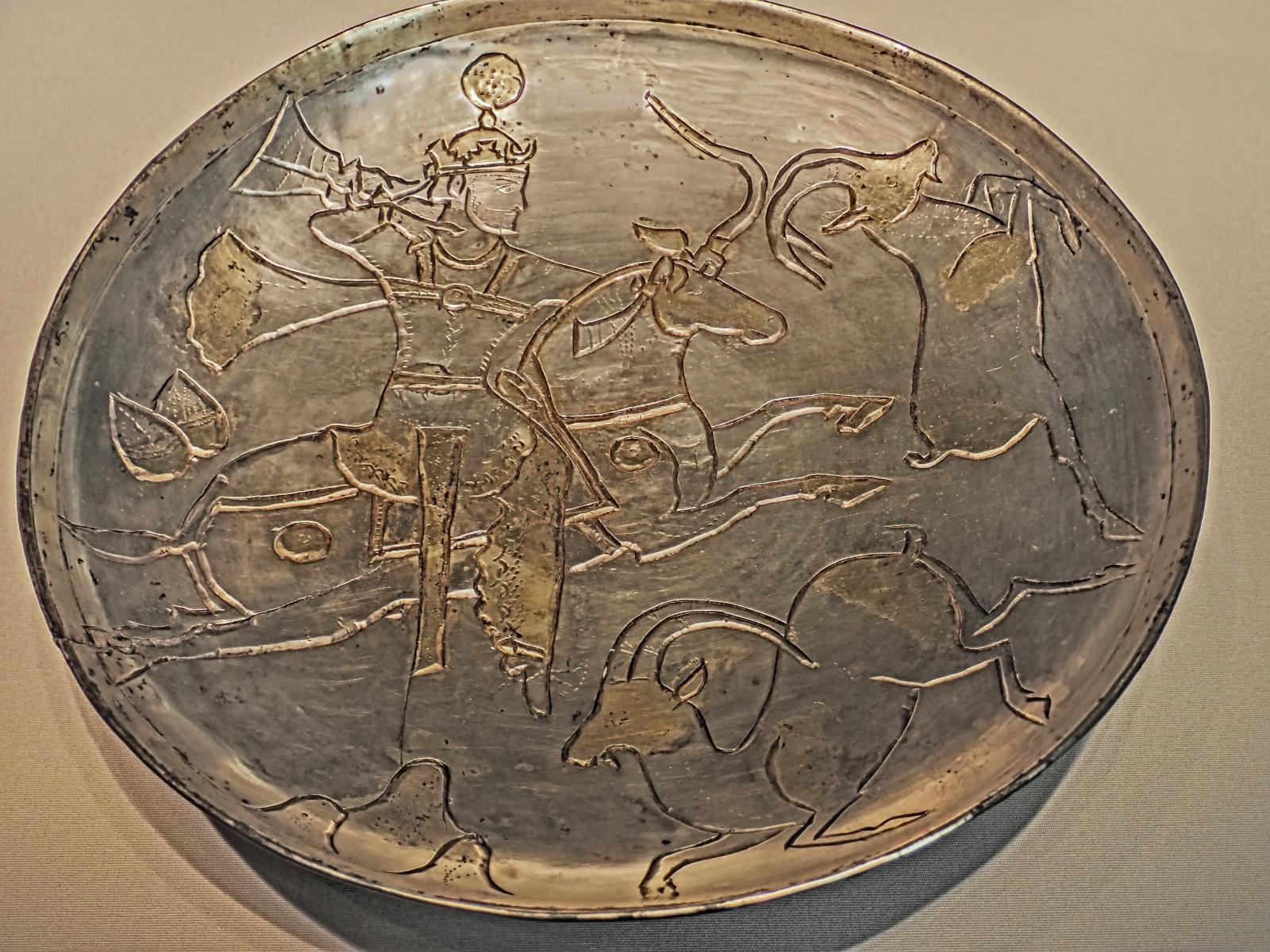
Sasanian silver plates were usually hammered into shape and then decorated using a variety of complex techniques.  Gilding was often used to highlight the hunter, usually the king, and sometimes extra pieces of metal were added to create high relief.

The king as hunter became a standard image on silver plates during the reign of Shapur II (r. 310–379 CE). The motif symbolizes the prowess of Sasanian rulers, and these royal plates were often sent as gifts to neighboring and vassal courts.  Some plates included inscriptions with the king's name and the plate's weight.  With other plates, art historians must attempt to identify the king by his distinctive apparel or shape of the crown he wears.  Each Sasanian king wore a different personal crown, which became more and more elaborate during the four centuries of the dynasty. Fortunately, the different crowns have been identified from coins or sometimes compared with existing rock reliefs with inscriptions such as those at Ṭāq-e Bostān or Naqš-e Rostam, Iran.

"In a few cases identification by crown can be reinforced by the presence of contemporary inscriptions. The best instance of this – and a very important example - is the Investiture of Ardašir I at Naqš-e Rostam. This magnificent relief shows two mounted horsemen, one handing the ribboned diadem or symbol of kingship to the other, and both with defeated enemies lying dead beside them. The left hand figure is wearing the skull-cap surmounted by korymbos, the final version of his personal crown developed by Ardašir (224-241 CE), seen on both his gold and silver coins. The figure on the right wears the mural crown, his hair arranged in a top-knot as well as falling in luxuriant curls to his shoulders." - iranicaonline.org 


King Hunting Plate, Sasanian period 4th-5th century CE silver and gilt courtesy of Wikimedia Commons contributor Daderot

Closeup of a Plate depicting a boar hunt Persia (Iran) Sasanian Period 4th century CE Silver and Gilt that I photographed at the Smithsonian's Sackler Gallery of Asian Art in Washington D.C.

Plate depicting a boar hunt Persia (Iran) Sasanian Period 4th century CE Silver and Gilt that I photographed at the Smithsonian's Sackler Gallery of Asian Art in Washington D.C.

Silver and gilt plate depicting winged horses Persian Sasanian Period 7th century CE that I photographed at the Smithsonian's Sackler Gallery of Asian Art in Washington D.C.

Sasanian Silver and Gilt Plate depicting a royal hunt Persia 7th century CE that I photographed at the Smithsonian's Sackler Gallery of Asian Art in Washington D.C.

Sasanian Silver plate with Shapur killing a deer, 4th century CE courtesy of Wikimedia Commons contributor Sailko.

Hunting scene depicting King Chosroes II. 7th century CE Sassanid, Cabinet des Medailles, Paris courtesy of Wikimedia Commons

The scene on this example is striking: the king is depicted standing and slaying a rearing stag, whose protruding tongue indicates that he is either dying or already dead. The king is identifiable as Yazdgard I (r. 399-420) due to his crown, although it is topped with a striated globe rather than the cloth-covered one with which he is normally represented. His beaded skirt resembles those shown on the rock reliefs of Shapur II (r. 310-379), Shapur III (r. 383-388) and Ardashir II (r. 379-383) at Taq-i Bustan, Iran. The crescent-tipped spear with a counterweight in the form of a human fist is unique amongst weapons represented on Sasanian silver plates. Image courtesy of the Metropolitan Museum of Art in New York.

Sivler Plate of Peroz I hunting argali, Sasanian, courtesy of the Hermitage Museum and Wikimedia Commons

King Hunting Plate, 303-309 CE, Sasanian, Iran, silver and gilt courtesy of the Cleveland Museum of Art


Hunting with a bowl Sasanian Great King; Iran; 7 Century, Museum of Islamic Art in Berlin (Pergamon Museum) courtesy of Wikimedia Commons contributor Anagoria

Sasanian Silver and Gilt Plate portraying a royal ibex hunt Persia 7th century CE that I photographed at the Smithsonian's Sackler Gallery of Asian Art in Washington D.C.


If you enjoyed this post, never miss out on future posts by following me by email!


Wednesday, February 3, 2021

Thracian funerary silverware

"From the mid-first millennium, such objects as ceremonial helmets, armor, cups, and ornamental gear for horses—worked from silver and sometimes gilded—have been discovered in graves and in finds that must have been the buried hoards of Thracian princes and chiefs. This silver beaker is a fine example of fourth century B.C. Thracian workmanship. It probably was made in the region of present-day Romania or Bulgaria, as similar beakers have been found in a princely tomb at Agighiol, near the delta of the Danube in eastern Romania. The beaker is raised from a single piece of silver with a stamped, chased, and repoussé design." - The Metropolitan Museum of Art  

This view of the beaker features a stag-like creature with eight legs, although it may indicate the presence of two stags side by side. Its antlers extend into a border of tines ending in bird heads that circle the upper portion of the cup. The opposite side of the beaker depicts a horned bird of prey holding a fish in its beak and clutching what seems to be a hare in its claws. The bird is flanked by one horned and two antlered animals, and, facing the large bird, a tiny bird of prey hovers over the horned animal.  The museum also describes a winged, griffin-like monster chewing an animal leg and grasping a small beast in its clawed feet on the bottom of the vessel that is visible when the beaker is used but unfortunately the museum did not include images from these viewpoints.

"Although certain contemporary Scythian and Iranian stylistic influences can be seen, the iconography of these scenes is clearly Thracian and probably refers to a native myth or legend. The monstrous bird of prey with land and water creatures in its grasp appears to symbolize dominance over land and water. Though a precise interpretation of the iconography remains uncertain, scholars have suggested that these animals were symbols associated with a heroic ruler and served as protective spirits, avatars, and tribal totems." - The Metropolitan Museum of Art 


Image: Silver Beaker with birds and animals, Thracian, 4th century BCE, courtesy of the Metropolitan Museum of Art in New York.


If you enjoyed this post, never miss out on future posts by following me by email!