Showing posts with label Sasanian. Show all posts

Sunday, March 7, 2021

The David Plates Plus One

 In 628–29 CE the Byzantine emperor Herakleios (also spelled Heraclius) (r. 610–41) successfully ended a long, costly war with Persia and regained Jerusalem, Egypt, and other Byzantine territory. Silver stamps dating to 613–29/30 on the reverse of these masterpieces place their manufacture in Herakleios’s reign. The biblical figures on the plates wear the costume of the early Byzantine court, suggesting to the viewer that, like Saul and David, the Byzantine emperor was a ruler chosen by God. Elaborate dishes used for display at banquets were common in the late Roman and early Byzantine world; generally decorated with classical themes, these objects conveyed wealth, social status, and learning. This set of silver plates may be the earliest surviving example of the use of biblical scenes for such displays. Their intended arrangement may have closely followed the biblical order of the events, and their display may have conformed to the shape of a Christogram, or monogram for the name of Christ. - Metropolitan Museum of Art

An early Sasanian silver gilt shield boss with a lion's head dated to the 4th century CE found in Iran was identified by British scholars as Sasanian partially because the Sasanian "Goliath" depicted on one of the David plates carries a shield decorated with a lion head boss similar to the one they were researching, that is now in the collections of the British Museum.

At the top of this magnificent plate, David confronts Goliath, and between them is a personification of the river from which David gathered stones for his sling. The major scene shows the decisive battle. Although David appears to be on the defensive, his men move forward, forcing Goliath’s soldiers into retreat. At the bottom, the victorious David beheads the giant. Image courtesy of the Metropolitan Museum of Art in New York

Closeup of David fighting a (Sasanian) Goliath wielding a shield with a lion head boss on one of the "David" plates, 7th century CE, that I photographed at the Metropolitan Museum of Art in New York.

Early Sasanian silver gilt shield boss (?) with lion's head dated to the 4th century CE found in Iran. Image courtesy of the British Museum.

In order to prove that he can kill Goliath, David describes to Saul how he killed a lion (1 Samuel 17:34–37). The accomplished naturalism of David’s flowing cape and the lion’s fur and mane demonstrates a conscious reference to and continuity of the traditions of Greco-Roman art. Image courtesy of the Metropolitan Museum of Art in New York.

While the theme of the set of plates is clear, the subject of each individual plate is sometimes difficult to determine. The scene here has been identified as showing David’s eldest brother, Eliab, accusing David of neglecting his duty as a shepherd to watch the battle with Goliath (1 Samuel 17:28–30). It may also portray Goliath’s challenge to David (1 Samuel 17:41–45) or David’s meeting with the Egyptian soldier (1 Samuel 30:11–15). Image courtesy of the Metropolitan Museum of Art in New York.

The prophet Samuel, recognizing David as God’s chosen one, anoints him (1 Samuel 16:13). David’s father, Jesse, and two of his brothers watch. The calf, knife, and altar below Samuel refer to the sacrifice he was supposed to offer in Bethlehem (1 Samuel 16:1–3); the ram and staff below David signify his role as keeper of his family’s flock (1 Samuel 16:11). Image courtesy of the Metropolitan Museum of Art in New York.

David is shown receiving Saul’s armor for his battle with Goliath (1 Samuel 17:38). He stands under an arcuated lintel. In late Roman and early Byzantine art, this architectural structure, suggesting a palace, was used to distinguish the emperor and here implies David’s future role as king. The armor is Roman, a metal breastplate over a short tunic. To David’s right is Saul, who wears a chlamys, or cloak, over a short-sleeved tunic, which covers another tunic with embroidered cuffs, a standard feature of Byzantine courtly dress. Image courtesy of the Metropolitan Museum of Art in New York.

David, brought before Saul, says he is willing to battle Goliath (1 Samuel 17:32–34). Saul is dressed as member of the Byzantine court. His chlamys, or cloak, worn over a long-sleeved tunic, is fastened with a cruciform fibula, or brooch, the sign of a high-ranking state official. The chlamys is adorned with a tablion, a rectangular embroidered panel indicating the wearer’s rank. The man at the far left wears the Persian costume fashionable at court during the early Byzantine period: short tunic with long sleeves, girdle, long trousers, and boots. Here again the arcade suggests a palatial setting. Image courtesy of the Metropolitan Museum of Art in New York.


If you enjoyed this post, never miss out on future posts by following me by email!


Thursday, February 25, 2021

Winged deities of Greco-Roman mythology

Winged male figures that are distinct from Hermes appear quite frequently in Attic art of the mid-sixth century B.C.E. Without inscriptions they are difficult to identify. In all of Greek art, the distinction between the human and the divine, the tangible and intangible, is elusive. Although we do not know all of their names, these figures surely move between various orders of reality.  - Metropolitan Museum of Art

Besides Hermes, one of the best known of these winged deities is Morpheus, the son of sleep and associated with sleep and dreams.   In Ovid's Metamorphoses, he is one of the thousand sons of Somnus and he appears in dreams in human form.   According to Ovid "no other is more skilled than he in representing the gait, the features, and the speech of men. The clothing also and the accustomed words of each he represents."

Ovid gives names to two more of these sons of Sleep. One called Icelos ('Like'), by the gods, but Phobetor ('Frightener') by men, "takes the form of beast or bird or the long serpent", and Phantasos ('Fantasy'), who "puts on deceptive shapes of earth, rocks, water, trees, all lifeless things". The three brothers' names are found nowhere earlier than Ovid, and are perhaps Ovidian inventions although other scholars suggest they may have been of Hellenistic origin.

Of winged female figures, Nike, daughter of the Titan Pallas and the goddess Styx, is probably the most common depicted in ancient Greek art and even on a Sasanian arch built in the 4th century CE at Taq-e Bostan. She retains her wings although most other winged deities in the Greek pantheon had shed their wings by Classical times. Nike assumed the role of the divine charioteer when her mother brought her to Zeus when he was assembling allies for the Titanomachy.  Thereafter Nike flew around battlefields rewarding the victors with glory and fame, symbolized by a wreath of laurel leaves.

Terracotta lekythos (oil flask), ca. 550 B.C.E. attributed to the Affecter painter at the Metropolitan Museum of Art. To me it appears to have a Near East influence in the dress of the being and his attendants.

A very Greek-looking Nike on a 4th century CE Sasanian arch in Taq Bostan, Iran courtesy of Wikimedia Commons contributor mehdi hosseini.

Roman bronze sculptural fragment depicting a winged satyr courtesy of Christie's

Bone plaque with Winged Victory and Autumn, circa 3rd c. CE, at the Walters Arts Museum.

Roman mosaic with winged Eros 2nd-3rd century CE (PD)

Winged Victory, Bronze with traces of gilding. 1st century CE. Height 200 cm. courtesy of Brescia, Santa Giulia Civic Museum.

Another fresco of winged victory from the Villa Moregine in Pompeii, 1st century CE. (PD)

18th century sculpture of Morpheus by Jean-Antoine Houdon at the Musee du Louvre, 1777, courtesy of Wikimedia Commons contributor Shonagon.

Morpheus, painted by Jean-Bernard Restout at the Cleveland Art Museum courtesy of Wikimedia Commons.

Winged Nike, a 4th Pompeian style fresco, 64 BCE (PD)


If you enjoyed this post, never miss out on future posts by following me by email!


Saturday, February 13, 2021

Bust of a Priest with Silver Inlaid Eyes, Roman or Sasanian?

While I was researching the Cypriot ear spirals yesterday, I noticed this bronze bust of a priest with silver inlaid eyes dated from the 3rd - 4th century CE at the Miho Museum.  The museum identified it as late Roman but the museum's image had been shared on Flickr and I noticed that someone with the username eternal persia commented on the piece and insisted it was Sasanian.  He/she pointed to the monogram on the hat, clothes, hair design and leaves that decorate the bust and insisted these are Sasanian elements.

Intrigued, I researched the item a little further.  At first, most Sasanian portrait sculptures I reviewed were all bearded.  Then I saw an image of a relief depicting Kartir, a high priest and vizier serving during the reigns of Shapur I, Hormizd I, Bahram I, and Bahram II. Not only is Kartir clean shaven, he sports the corkscrew curls and crested hat worn by the priest of the bust at the Miho Museum.

Some scholars think Kartir may have been a eunuch, due to being depicted without a beard in the Sasanian reliefs. He first appears in historical records in Shapur I's inscription at the Ka'ba-ye Zartosht, which was most likely created between 260–262 CE. Kartir is the only religious bureaucrat mentioned in the inscription. Shapur I, termed a "lukewarm Zoroastrian", was known for his tolerance towards other religions. Although admiring the teachings of his own religion and encouraging the Zoroastrian clergy, Shapur I allowed the Jews, Christians, Buddhists, and Hindus to freely practice their religion. He was also friendly towards the founder of Manichaeism, Mani, whom he allowed to preach freely and even to be an escort in his military expeditions.

Shapur I's religious practices seems to have been somewhat unusual, though, with animal sacrifice being made for the soul of the kings and queens of the Sasanian family. Kartir, who "abhorred animal sacrifice" was unable to stop Shapur I from performing them. Shapur I died in 270 CE, and was succeeded by Hormizd I, who gave Kartir clothes that were worn by the upper class including the cap and belt (kulāf ud kamarband) and appointed him as the chief priest (mowbed).

Hormizd I died the following year and Bahram I, who was never considered a candidate for succession of the throne by his father, ascended the throne with the aid of Kartir, whose authority and influence had greatly increased. Bahram I then made a settlement with his brother Narseh who he asked to give up his entitlement to the throne in return for the governorship of the important frontier province of Armenia, which was constantly the subject of war between the Roman and Sasanian Empires.  Although Narseh held the title of Vazurg Šāh Arminān ("Great King of Armenia"), scholars think he probably still viewed Bahram I as a usurper.

Although previous Sasanian shahs had pursued a policy of religious tolerance towards the non-Zoroastrian minorities in the empire, with Bahram I's accession to the throne, and the rise of the authority of the Zoroastrian priesthood under the leadership of Kartir, this changed. When Mani, still the leader of the Manichaeists, arrived in the city of Gundishapur, Kartir and his cadre of Zoroastrian priest protested, viewing Mani as a threatening heterogeneous philosopher who presented an obscure perception of Zoroastrianism tainted by Jewish, Buddhist, and Christian ideas. Kartir pressured Bahram I to have Mani imprisoned and sentenced to death in 274 CE. Mani's death was followed by the persecution of his followers by Kartir and the Zoroastrian clergy, who used the persecution of religious minorities as a method to increase and spread their vast influence.  With the backing of Bahram I, Kartir laid foundations for Zoroastrianism's adoption as the state religion.

When Bahram I died, his son viewed Kartir as a mentor and granted him the rank of grandee (wuzurgan), and appointed him as the supreme judge (dadwar) of the whole empire.  Thereafter, Zorastrian priests were given the office of judge. Kartir's intolerance continued and his inscription at  Ka'ba-ye Zartosht boasts that he "struck down" non-Zoroastrian minorities, although modern scholars point out that Jewish and Christian sources makes no mention of persecutions during this period.

When Bahram III succeeded his father, Bahram II, something changed, however, in Kartir's relationship with the royal family.  Kartir inexplicably threw in his lot with Narseh and, along with a group of Sasanian nobles, supported Narseh's overthrow of Bahram III. But Narseh's reign  marked the return to the policy of religious tolerance which had been practiced by his father, Shapur I, all those years ago, and Kartir finally fades from history. 
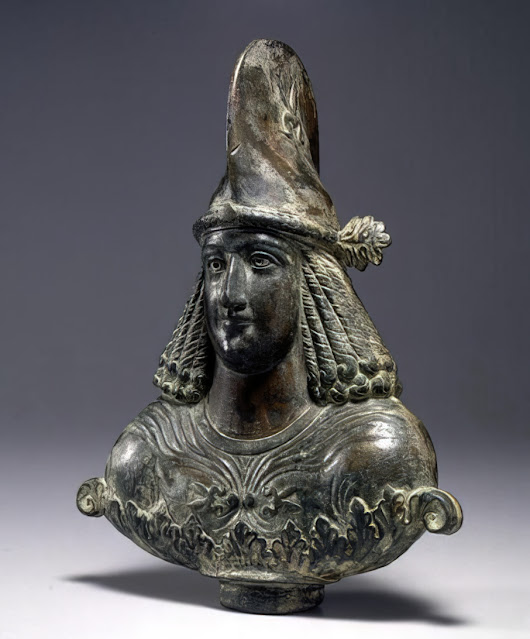
Bust of a Priest with Silver Inlaid Eyes, Bronze and sliver, 3rd-4th century C.E., courtesy of the Miho Museum in Kyoto, Japan.


Relief of Kartir, the Zoroastrian high priest at Naqsh-e Rajab courtesy of Wikimedia Commons contributor درفش کاویانی.


If you enjoyed this post, never miss out on future posts by following me by email!


Sunday, February 7, 2021

Sasanian royal gifts of silver

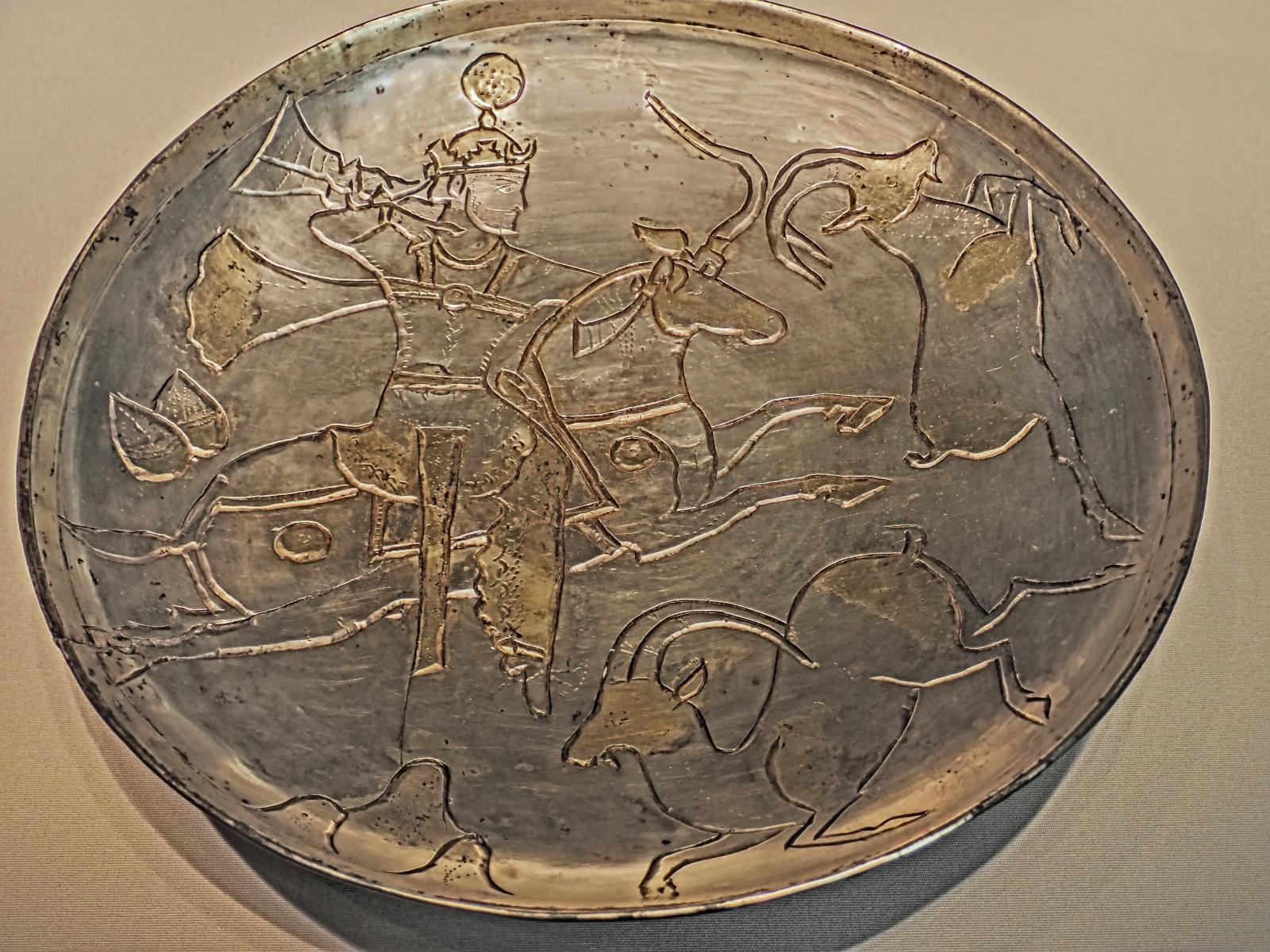
Sasanian silver plates were usually hammered into shape and then decorated using a variety of complex techniques.  Gilding was often used to highlight the hunter, usually the king, and sometimes extra pieces of metal were added to create high relief.

The king as hunter became a standard image on silver plates during the reign of Shapur II (r. 310–379 CE). The motif symbolizes the prowess of Sasanian rulers, and these royal plates were often sent as gifts to neighboring and vassal courts.  Some plates included inscriptions with the king's name and the plate's weight.  With other plates, art historians must attempt to identify the king by his distinctive apparel or shape of the crown he wears.  Each Sasanian king wore a different personal crown, which became more and more elaborate during the four centuries of the dynasty. Fortunately, the different crowns have been identified from coins or sometimes compared with existing rock reliefs with inscriptions such as those at Ṭāq-e Bostān or Naqš-e Rostam, Iran.

"In a few cases identification by crown can be reinforced by the presence of contemporary inscriptions. The best instance of this – and a very important example - is the Investiture of Ardašir I at Naqš-e Rostam. This magnificent relief shows two mounted horsemen, one handing the ribboned diadem or symbol of kingship to the other, and both with defeated enemies lying dead beside them. The left hand figure is wearing the skull-cap surmounted by korymbos, the final version of his personal crown developed by Ardašir (224-241 CE), seen on both his gold and silver coins. The figure on the right wears the mural crown, his hair arranged in a top-knot as well as falling in luxuriant curls to his shoulders." - iranicaonline.org 


King Hunting Plate, Sasanian period 4th-5th century CE silver and gilt courtesy of Wikimedia Commons contributor Daderot

Closeup of a Plate depicting a boar hunt Persia (Iran) Sasanian Period 4th century CE Silver and Gilt that I photographed at the Smithsonian's Sackler Gallery of Asian Art in Washington D.C.

Plate depicting a boar hunt Persia (Iran) Sasanian Period 4th century CE Silver and Gilt that I photographed at the Smithsonian's Sackler Gallery of Asian Art in Washington D.C.

Silver and gilt plate depicting winged horses Persian Sasanian Period 7th century CE that I photographed at the Smithsonian's Sackler Gallery of Asian Art in Washington D.C.

Sasanian Silver and Gilt Plate depicting a royal hunt Persia 7th century CE that I photographed at the Smithsonian's Sackler Gallery of Asian Art in Washington D.C.

Sasanian Silver plate with Shapur killing a deer, 4th century CE courtesy of Wikimedia Commons contributor Sailko.

Hunting scene depicting King Chosroes II. 7th century CE Sassanid, Cabinet des Medailles, Paris courtesy of Wikimedia Commons

The scene on this example is striking: the king is depicted standing and slaying a rearing stag, whose protruding tongue indicates that he is either dying or already dead. The king is identifiable as Yazdgard I (r. 399-420) due to his crown, although it is topped with a striated globe rather than the cloth-covered one with which he is normally represented. His beaded skirt resembles those shown on the rock reliefs of Shapur II (r. 310-379), Shapur III (r. 383-388) and Ardashir II (r. 379-383) at Taq-i Bustan, Iran. The crescent-tipped spear with a counterweight in the form of a human fist is unique amongst weapons represented on Sasanian silver plates. Image courtesy of the Metropolitan Museum of Art in New York.

Sivler Plate of Peroz I hunting argali, Sasanian, courtesy of the Hermitage Museum and Wikimedia Commons

King Hunting Plate, 303-309 CE, Sasanian, Iran, silver and gilt courtesy of the Cleveland Museum of Art


Hunting with a bowl Sasanian Great King; Iran; 7 Century, Museum of Islamic Art in Berlin (Pergamon Museum) courtesy of Wikimedia Commons contributor Anagoria

Sasanian Silver and Gilt Plate portraying a royal ibex hunt Persia 7th century CE that I photographed at the Smithsonian's Sackler Gallery of Asian Art in Washington D.C.


If you enjoyed this post, never miss out on future posts by following me by email!


Wednesday, January 6, 2021

Sasanian military organization

 When Ardashir I (r. 224-241 CE) founded the Sasanian Empire, he created a  standing army which was under his personal command and whose officers were separate from satraps, local princes and nobility. He restored the Achaemenid military organizations, retained the Parthian cavalry model, and employed new types of armor and siege warfare techniques. 

Organizationally, the Shahanshah (the King of Kings) served as the head of the military and there were four military commanders under his authority. Initially, the offices of the Great King of Armenia, King of Meshan, King of Gilan, and King of Sakastan fulfilled these roles. After the reforms of Khosrow I, there were four spahbeds (Army Commanders), each for a cardinal direction.

In the character of their warfare, the Persians of the Sasanian period differed greatly, though, from their forebears under the Achaemenid kings. The war chariot was no longer used, the  elephant corps was advanced to a very prominent and important position, and cavalry on the Parthian model, including both heavy cataphracts and horse-archers became pre-eminent. Therefore, the strategic components became the elephants, the horse, the archers, and the ordinary footmen.

The Sasanian army employed foreign mercenary troops from many different regions. The most frequently used types of mercenaries were Kurdish mercenaries from the northern boundary of the Zagros, who begin to appear in 6th-century sources, tribal people from Gilan and Daylam, Caucasian Albanians (regarded as elite soldiers equal to Huns in the 4th-century), and Sakastanis.

The Parthian Azadan nobility continued to serve the Sasanian state, forming a minor aristocracy of lower-ranking administrators, mostly living on their small estates and providing the cavalry backbone of the Sasanian army. Most prestigious among them were the armored Asvaran, sometimes referred to as Savaran, who were the forerunners of  the later Arabian Faris, the Caucasian horsemen, the Indian Sowar (derived from Persian Savar), and the Turkish Tarkhans.

During the early Sasanian period, these fiercesome warriors battled forces of the Roman emperors Valerian, Galerius, and Julian and later the forces of the Byzantine emperors Justin I and II and Justinian directed by his famous general Belisarius.

Sasanian helmet, 4th century CE at the Metropolitan Museum of Art. Surviving examples of Sasanian armor are extremely rare, particularly in such stunning condition as this helmet. It consists of a bronze band forming a rim and supporting two arched bands that cross over the top. Between these arched bands there are triangular plates of iron that are overlaid with sheets of silver worked in scale patterns. Sasanian silversmiths were renowned for their craftsmanship.

Iranian Bronze Silver and Iron Helmet 225 to 650 CE that I photographed at the Los Angeles County Museum of Art in Los Angeles, California

Reconstruction of a Sasanian cataphract in Oxford courtesy of Wikimedia Commons contributor John Tremelling

Remnants of a Sasanian gold sword with two-point suspension, 600-650 CE at the Sackler Gallery of Asian Art at the Smithsonian in Washington D.C. courtesy of Wikimedia Commons contributor Quadell.

Sasanian silver plate depicting an equestrian single combat scene at the Azerbaijan Museum in Tabriz, Iran courtesy of Wikimedia Commons contributor Alborz Fallah.  Some scholars think this plate, although in the style of Sasanian plates usually featuring hunt scenes, was likely  manufactured in the late 1920s or 1930s when Iranian national awareness was enhanced by modern archaeological research.

Shahnameh illustration of the Sasanian general Sukhra fighting the Hephthalites (484 CE) attributed to Bashdan Qara ca. 1530-35, courtesy of Wikimedia Commons contributor Abu'l Qasim Firdausi.


If you enjoyed this post, never miss out on future posts by following me by email!


Thursday, August 13, 2020

Wild boars in ancient art

 The wild boar features prominently in the cultures of Indo-European people, many of which saw the animal as embodying warrior virtues. Cultures throughout Europe and Asia Minor saw the killing of a boar as proof of one's valor and strength. Neolithic hunter gatherers depicted reliefs of ferocious wild boars on their temple pillars at Göbekli Tepe some 11,600 years ago. Virtually all heroes in Greek mythology fight or kill a boar at one point. The demigod Herakles' third labor involves the capture of the Erymanthian Boar, Theseus slays the wild sow Phaea, and a disguised Odysseus is recognised by his handmaiden Eurycleia by the scars inflicted on him by a boar during a hunt in his youth. To the mythical Hyperboreans, the boar represented spiritual authority. Several Greek myths use the boar as a symbol of darkness, death and winter. One example is the story of the youthful Adonis, who is killed by a boar and is permitted by Zeus to depart from Hades only during the spring and summer period. This theme also occurs in Irish and Egyptian mythology, where the animal is explicitly linked to the month of October, therefore autumn. This association likely arose from aspects of the boar's actual nature. Its dark colour was linked to the night, while its solitary habits, proclivity to consume crops and nocturnal nature were associated with evil. The foundation myth of Ephesus has the city being built over the site where Prince Androklos of Athens killed a boar. Boars were frequently depicted on Greek funerary monuments alongside lions, representing gallant losers who have finally met their match, as opposed to victorious hunters as lions are. The theme of the doomed, yet valorous boar warrior also occurred in Hittite culture, where it was traditional to sacrifice a boar alongside a dog and a prisoner of war after a military defeat.

The boar as a warrior also appears in Scandinavian, Germanic and Anglo-Saxon culture, with its image having been frequently engraved on helmets, shields and swords. According to Tacitus, the Baltic Aesti featured boars on their helmets and may have also worn boar masks. The boar and pig were held in particularly high esteem by the Celts, who considered them to be their most important sacred animal. Some Celtic deities linked to boars include Moccus and Veteris. It has also been suggested that some early myths surrounding the Welsh hero Culhwch involved the character being the son of a boar god.

Here is a selection of ancient art I have photographed depicting wild boars:

Amulet depicting a boar between two lion heads Italic 500-400 BCE Amber Getty Villa, Pacific Palisades, California


Closeup of Plate depicting a boar hunt Persia (Iran) Sasanian Period 4th century CE Silver and Gilt Smithsonian Sackler Gallery, Washington D.C.


Boar Corinthian-style Etruscan helmet incised with images of boars Bronze 5th century BCE at the Dallas Museum of Art in Dallas, Texas


Boar attacked by two dogs from the peristyle garden of the House of the Citharist Pompeii 1st century CE


Boar fresco in the House of the Ceii in Pompeii 1st century CE


Mosaic depicting a boar confronting a hunting dog from 5th-6th century CE Carthage at the British Museum


Boar in a Roman mosaic of Orpheus Taming the Animals 204 CE at the Dallas Museum of Art in Dallas, Texas


Closeup of Sarcophagus depicting the Calydonian hunt, representing the hero Meleager and the goddess Artemis. Proconnesian marble, Roman, (2nd century CE?) at the Capitoline Museum in Rome, Italy.


If you enjoyed this post, never miss out on future posts by following me by email!


Friday, May 8, 2020

Roman trading partners: The Kushans

Gandhāra was an ancient region in the Peshawar basin in the north-west of the ancient Indian subcontinent, corresponding to present-day north-west Pakistan and north-east Afghanistan. The centre of the region was at the confluence of the Kabul and Swat rivers, bounded by the Sulaiman Mountains on the west and the Indus River on the east.
Gandhara was conquered by the Achaemenid Empire in the 6th century BCE. Conquered by Alexander the Great in 327 BCE, it subsequently became part of the Maurya Empire and then the Indo-Greek Kingdom. The region was a major centre for Greco-Buddhism under the Indo-Greeks and Gandharan Buddhism under later dynasties. Gandhara attained its height from the 1st century to the 5th century CE under the Kushan Empire.
The Kushans moved into Gandhāra from Central Asia after the fall of the Parthian dynasty about 75 CE. The Kushan dynasty had diplomatic contacts with the Roman Empire, Sasanian Persia, the Aksumite Empire and the Han dynasty of China and was at the center of trade relations between the Roman Empire and China.
Ambassadors from the Kushans who met with the Roman Emperor Hadrian are described in the Historia Augusta. According to Aurelius Victor and Appian, Hadrian's successor, Antoninus Pius also received Bactrian, Indian, and Hycanian ambassadors thought to be from Kushan. Archaeologists who uncovered the famous Begram Treasure in the summer capital of the Kushan Empire reported finding a considerable amount of goods imported from the Roman Empire especially various types of glassware.
The Kushan empire fragmented into western and eastern kingdoms in 225 CE. The Western Kushans (in Afghanistan) were soon subjugated by the Persian Sasanian Empire and lost Sogdiana, Bactria, and Gandhara to them. The Sassanian king Shapur I (240–270 CE) claims in his Naqsh-e Rostam inscription possession of the territory of the Kushans as far as "Purushapura" (Peshawar), suggesting he controlled Bactria and areas as far as the Hindu-Kush or even south of it. The Sasanians replaced the Persian vassals with their own administrators. But, Hormizd I Kushanshah, the brother of a ruling Sasanian satrap, led a rebellion against the Sasanians and reestablished an independent kingdom under his rule.
Then in the 4th century CE, the Guptas, an Indian dynasty pressed from the east and Shapur II regained control of large territories in the areas as well. The last of the Kushan and Kushano-Sasanian kingdoms were eventually overwhelmed by invaders from the north, known as the Kidarite Huns. The remnants of Kushan culture under the Kidarites in the northwest were ultimately wiped out in the end of the 5th century by the invasions of the Alchon Huns (sometimes considered as a branch of the Hephthalites), and later the Nezak Huns.
This door guardian or Dvarapala, is interesting because of its more realistic depiction of a warrior instead of the majority of idealized or mythological figures used as guardians in Hindu, Buddhist and Jaina shrines. Perhaps this is a result of earlier exposure to Hellenistic art. The Metropolitan Museum of Art said similar armored guardian figures were found flanking a doorway of a monastery at the Gandharan site of Thareli. They found it interesting that the monks chose to integrate such non-Buddhist deities into the embellishment of their monastic residences. The appearance of such protectors probably can be linked to the growing importance of the war god Skanda in the late Gandharan tradition.

Image: Door Guardian (Dvarapala), 4th century CE, ancient Gandhāra (modern Pakistan) courtesy of the Metropolitan Museum of Art.
If you enjoyed this post, never miss out on future posts by following me by email!


Tuesday, April 7, 2020

The Royal Nisean Horse of Ancient Persia

The horse was a favorite artistic subject in ancient Iran, where horsebreeding flourished. This muscular Sasanian stallion was descended from the royal and sacred Nisean breed of the Achaemenian Persians. Although now extinct, Nisean horses were highly sought after in the ancient world. The ancient Greeks called him the Nisean after the town Nisa, where he was bred but the Chinese called him the Tien Ma – Heavenly Horse or Soulon-Vegetarian dragon. The horse came in a variety of colors including the more common dark bay, chesnut and seal brown but also the more rare black, roan, palomino, and various spotted patterns. The royal Nisean was the mount of the nobility in ancient Persia. Two gray Nisean stallions pulled the King of Kings’ royal chariot, while four of the regal animals pulled the chariot of Ahura Mazda, the supreme god of Persia and Medea. Cyrus the Great was so distraught when one of his stallions was drowned while crossing a river, he had the river where the horse was drowned drained. He did not believe that anything could kill a horse so beautiful.
The Greeks (mainly, the Spartans) imported Nisean horses and bred them to their native stock. The Romans had their first encounter with the Nisean and the Parthian cataphract at the disastrous Battle of Carrhae. Later, when Marc Antony avenged Marcus Licinius Crassus and his legions lost at Carrhae by ravaging Armenia, his plunder included the first Nisean horses in Rome. Later, when Antony died in Egypt, Augustus seized the horses. The Nisean became extinct with the conquest of Constantinople in 1204.
Although Sasanian horse-trappings were elaborate, they did not include stirrups for mounting. In this rendition, the steed lies still, as camels in the Near East do today, waiting for its rider to mount. The medallions on each shoulder contain busts, perhaps of rulers of different parts of the Sasanian Empire, holding their rings of authority. Images courtesy of the museum.

Silver Sasanian Horse-Shaped Drinking Vessel 200-325 CE at the Cleveland Art Museum in Cleveland, Ohio

Silver Sasanian Horse-Shaped Drinking Vessel 200-325 CE at the Cleveland Art Museum in Cleveland, Ohio

If you enjoyed this post, never miss out on future posts by following me by email!