Wednesday, June 27, 2007

Brennus and the First Sack of Rome


I'm about two-thirds of the way through Steven Saylor's latest epic novel, "Roma", and am enjoying it very much. I just finished a section about the first sack of Rome by the Gauls under the command of Brennus. Most of my study has concentrated on the Late Republic so I didn't know much about this first sack other than when it occurred and it was the Gauls who did it.

However, Steven's characters are among the defenders that fortified themselves up on top of the Capitoline and held off the Gauls for seven months. I always assumed the sack was over in a few days like most sacks but it went on for quite a prolonged period. I also did not realize that the Veii question was so disruptive. I knew the Romans had conquered Veii but I assumed they simply added its people to the expanding Republic. I didn't realize the people were sold away into slavery and the city was left abandoned. Perhaps its people were treated so harshly because of the legendary massacre of the 300 Fabii at Cremora.

"Within a year of the victory at Cremora, the Etruscan navy, in conflict with Greece, was destroyed by Hieron of Syracuse, off of Cumae. The result was a military disaster for the Etruscans that they never really seemed to recover from. The various city states of the Etruscan league, including Veii, devolved more and more into separate unrelated entities, thereby losing the strength of mutual protection. Veii, despite its recent upper hand at Cremora, was forced to make a treaty with Rome.

Within this time frame a more consequential series of events were taking place, however. Celtic Gauls had been migrating into northern Italy from the 6th century BC and establishing themselves at or near Etruscan territory. Raids and warfare with these people would have a debilitating effect on the Etruscans and play directly into the growing strength of Rome. The Gauls so weakened the Etruscans that the Romans, between 406 and 396 BC, went on the offensive.

It's about this period in history that Livy tells us of the legendary Roman hero M. Furius Camillus. Under his command Fidemae was retaken from Veii, and then the city of Veii itself came under siege. According to the legend, the Siege of Veii lasted 10 years, but its description is so closely paralleled to the Homeric Siege of Troy, that we must take into account the propaganda used by ancient sources to inflate the glory of Rome. The actual siege probably lasted considerably less time, though the introduction of a paid professional legion during this course of events indicates that it was a protracted campaign. The siege was finally broken, in 396 BC, when the Romans supposedly drained Alban Lake. This not only would divert water supplies from the city but allowed access for Roman soldiers to sneak under the walls through empty stream beds. In the end, whatever the truth behind the legend may be, Camillus was credited with saving Rome and bestowed with the unending admiration of the Romans throughout its history.

Gaining Veii, the Romans, in stark contrast to their general conquest policies of incorporation, destroyed much of the city and drove out many of the Etruscan residents. The territory was allotted to Roman citizens, and four new tribes were created: the Stellatine, Tromentina, Sabatina and Aniensis." - Veii and the Etruscans, UNRV.com

Therefore, when the Gauls practically destroyed Rome, the hotly debated question became whether to rebuild Rome or to transfer her entire population to the empty city of Veii only twelve miles away. The hero Camillus was instrumental in persuading the people to rebuild Rome although those jealous of his success constantly complained that he was enriching himself through building contracts since he controlled most of the spoils and property from the Veii conquest.
If you enjoyed this post, never miss out on future posts by following me by email!


Saturday, June 16, 2007

Gallic-Romano mythology - Tarvos Trigaranus

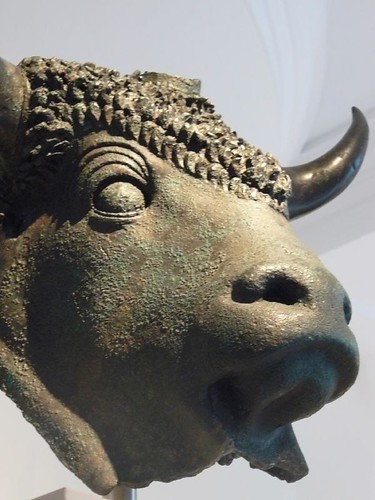
I uploaded some more images from the Met today and among them are several images of a bronze three-horned bull (unfortunately the center horn is missing) that was recovered from Octodurus, a city founded by the Emperor Claudius, in Switzerland.

It's a wonderful sculpture and I'm so glad the piece was not melted down as it appears to be part of a statue that had been rendered apart in preparation for scrapping. It made me curious about the worship of a three-horned bull so I researched it further and learned that the three-horned bull, sometimes called Tarvos Trigaranus, was worshiped by the Celts in Gaul and Britain.

According to an article by Susan Read, Martin Henig, and Leslie Cram that appeared in the journal Brittania, art depicting three-horned bulls was common in northeastern Gaul. They said it seems to have been derived from statues of two-horned bulls from Campania that were constructed with a crescent between their horns. They mention four such statues found in Britain - one in Maiden Castle at Dorset, one from the Jewry Wall Site in Leicester, one from Southbroom near Devizes in Wiltshire, and the last a pipeclay figurine, "certainly an import from Gaul", found at Colcester.

I also read an interesting description of a divination to determine a new Celtic king using a bull.

"Bulls were used in divination in both Ireland and Scotland. At Tara a new king might be chosen in the tarbfheis, `bull-feast' or `bull-sleep', in which a bull was killed and a man ate his fill of its flesh, drank its broth, and then lay down to sleep. After an incantation had been chanted over him by four druids, the dreamer would know the new king in his dream. In Scotland a person might answer an important question about the future (no king was to be selected) by wrapping himself in the warm, smoking hide of a newly slain bull in a remote place, such as near a waterfall. Upon going into a trance the person would have the answer. This method was known as taghairm." - Celtic Mythology, Oxford University Press.

Apparently the three-horned bull even found its way to the standards of the Roman Legions:

"...standards of ala Longiniana (CIL XI11 8094) and cohors I Gallica (ILS 9127) appear to have been adorned with animals popular in Gallic religious
iconography - respectively, a three-horned bull (Green 1976, 13) and a small boar.6 Such animals almost certainly appeared on signa of the type referred to by Tacitus (Germ. 7; Hist. 4.22), borne by the pagi and tribal groupings of the Gauls (Royrnans 1990,19). They appear open to different symbolic interpretations: depending on the cultural perspective of the viewer, they could have been seen primarily as traditional Gallic tribal totems or as Roman military regimental standards." - The Roman Army As A Community .
If you enjoyed this post, never miss out on future posts by following me by email!


Thursday, June 14, 2007

After 10 Years Curtain Rises on Rome Reborn


There's been quite a bit of publicity about the newly announced website for the Rome Reborn project at the University of Virginia this week. Naturally, I had to go up and take a look. This project originated way back in 1996.

Almost eleven years have passed and, although I commend Dr. Frischer's vision and efforts, I must admit to being a bit disappointed upon viewing the VR models presented on the website. I have seen more realistic models built by game companies in a fraction of the time. I think a collaboration with professional graphic artists would yield much better results much more quickly. Unfortunately, collaboration between game companies and educators has been very slow in coming. The Rome Reborn project is a prime example of a worthy activity that could benefit greatly from such a cooperative effort. Check out my full post in the "Academic Presentations on the Roman Empire" section below.
If you enjoyed this post, never miss out on future posts by following me by email!


Monday, June 11, 2007

Boscoreale Wall Paintings Featured in Renovated Greco-Roman Galleries at the Met

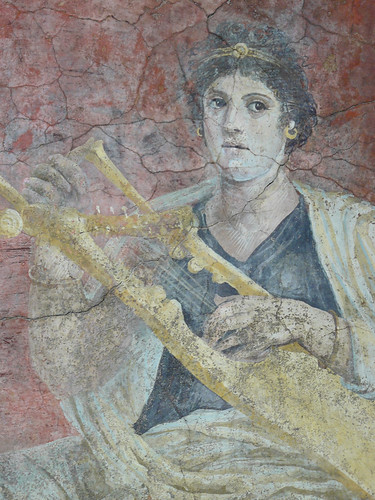
I am heading home today from my first visit to New York City and the Metropolitan Museum of Art. To say I almost suffered an art meltdown is an understatement! I spent two full days at the Metropolitan Museum of Art (and still only saw a fraction of the art there!) and was thrilled to discover they have a number of wall frescoes from villas in Boscoreale. They're quite stunning and I notice the women in them were painted with the wide eyes seen in many Greco-Roman mummy portraits from Egypt. They made me even more excited about seeing Boscoreale in person in October!

"Boscoreale, an area about a mile north of Pompeii, was notable in antiquity for having numerous aristocratic country villas. This tradition endured into the time of the Bourbon kings, as is attested by the region's name, the "Royal Forest," which implies that Boscoreale was a hunting preserve. Some of the most important wall paintings surviving from antiquity come from a Roman villa at Boscoreale built shortly after the middle of the first century B.C. The villa, which was buried by the eruption of Vesuvius in 79 A.D., is referred to as the Villa of P. Fannius Synistor, one of its owners during the first half part of the first century A.D. Excavated in the early 1900s, the villa's frescoes are among the most important to be found anywhere in the Roman world.

The villa at Boscoreale is a variant of the so-called villa rustica, a country house of which only a small part functioned as a farmhouse (pars rustica). The majority of the villa served as a residence for the owner, a member of that class of wealthy Roman citizens who owned more properties of this kind and used them as country houses. The painted decoration of the villa at Boscoreale, which was executed sometime around 40–30 B.C., attests to the original owner as a rich man with exquisite taste. The fact that the mid-first-century B.C. decoration was not replaced by another, more contemporary, decoration in the first century A.D. is a clear indication that there was already an awareness of the quality of the frescoes in antiquity.

The surviving paintings are extremely fine examples of the late Second Style, the most renowned style in Roman wall painting. Throughout the frescoes from the villa at Boscoreale there are visual ambiguities to tease the eye, including architectural details painted to resemble real ones, such as rusticated masonry, pillars, and columns that cast shadows into the viewer's space, and more conventional trompe l'oeil devices, such as three-dimensional meanders. Objects of daily life were depicted in such a way as to seem real, with metal and glass vases on shelves and tables appearing to project out from the wall. Cumulatively, these trompe l'oeil devices reveal the Republican owner's evident pleasure in impressing guests at his comfortable summer retreat." - The Metropolitan Museum of Art

If you enjoyed this post, never miss out on future posts by following me by email!


Tuesday, October 4, 2005

Review: The Iron Hand of Mars by Lindsey Davis

A historical fiction review by  © 2005


I first listened to an unabridged version of Lindsey Davis' "Iron Hand of Mars" back in 2005 and wrote an article about the historical context then. But, I've incorporated and rewritten much of that information in this review following my current review format.

Of all of the Falco novels, this one turned out to be one of my favorites, probably because it included more military adventures than other Falco books and swordplay.

This tale of intrigue is set in Germania where Falco, Vespasian's agent, is tasked with attempting to derail a rebellion led by the Batavian leader Civilis and win over a mysterious prophetess. Since most of my study of Rome has concentrated on the late Republican period, I was not familiar with this major insurgency that arose during the reign of Vespasian. So, I did a little research.

Gaius Julius Civilis was the leader of the Batavian rebellion against the Romans in 69 AD. Although his name indicates he was Romanized by Augustus or one of the other Julian emperors, Civilis was twice imprisoned on a charge of rebellion, and narrowly escaped execution. During the tumult that followed the death of the emperor, Nero, Civilis took up arms under the pretense of siding with the Flavian emperor, Vespasian, and induced the inhabitants of his native country to rebel.

The Batavians, who had rendered valuable aid under the early emperors, had been well treated by subsequent emperors. They were exempt from tribute, but were obliged to supply a large number of men for the army. This conscription and the oppression of provincial governors, however, ultimately led to revolt. The Batavians were immediately joined by several neighboring German tribes, the most important of whom were the Frisii.

The Roman garrisons near the Rhine were driven out, and twenty-four ships captured. Two legions under Mummius Lupercus were defeated at Castra Vetera (near modern Xanten) and surrounded. Eight cohorts of Batavian veterans joined their countrymen, and the troops sent by Vespasian to the relief of Vetera threw in their lot with them as well.

The result of these accessions to the forces of Civilis was another uprising in Gaul. There, the Roman commander, Hordeonius Flaccus, was murdered by his troops and the remaining Roman forces were induced by two commanders of the Gallic auxiliaries--Julius Classicus and Julius Tutor--to revolt from Rome and join Civilis in a new independent kingdom of Gaul.

The conspiracy of the Batavians under Civilis by Rembrandt 1661-1662 CE.
Image courtesy of Wikimedia Commons
The prophetess Veleda predicted the complete success of Civilis and the fall of the Roman Empire.   Veleda was a virginal holy woman of the Germanic tribe of the Bructeri.

"The ancient Germanic peoples discerned a divinity of prophecy in women and regarded prophetesses as true and living goddesses. In the latter half of the 1st century CE Veleda was regarded as a deity by most of the tribes in central Germany and enjoyed wide influence. She lived in a tower near the Lippe River, a tributary of the Rhine. The inhabitants of the Roman settlement of Colonia Claudia Ara Agrippinensium (now Cologne) accepted her arbitration in a conflict with the Tencteri, an unfederated tribe of Germany." - Wikipedia


Veleda by Laurent-Honoré Marqueste.
Image courtesy of Wikimedia Commons.
Like the pythia of ancient Greece, envoys were not admitted to her presence; an interpreter conveyed their messages to her and reported her pronouncements. So, it is not known whether Veleda just prophesied the victory or actively incited the rebellion.

But, ultimately, tribal disputes ended any chance for success and Vespasian was able to put down the rebellion with the arrival of Quintus Potillius Cerealis and a strong force. Civilis, himself, was defeated at Augusta Treverorum (modern Trier) and Vetera, and forced to withdraw to the island of Batavia. It is thought Civilis negotiated an agreement with Cerialis whereby his countrymen obtained certain advantages, and resumed amicable relations with Rome, although Civilis disappears from the historical record at this point, an ominous sign.  However, Cerialis, like Julius Caesar, was known for his clementia so the outcome may not have been dire after all.

As for Veleda, she was either captured by Rutillius Gallicus or "offered asylum" in 77 CE.  She is thought to have negotiated the acceptance of a pro-Roman king by her tribe, the Bructeri, in 83 or 84 CE.

Note: The chief authority for the history of the insurrection is Tacitus, Histories, iv and v, and Josephus, Bellum Judaicum, vii. 4.

So, there is quite an opportunity for Falco to strut his stuff on a scale far greater than his usual sleuthing in  back alleys.  I think that is why I was drawn into this story more than some of his other adventures.  Although I knew Falco had once served in the legions, he was far more physical in this tale than the others and his sardonic personality was kept relatively in check because of the heightened danger of his circumstances.  I highly recommend it!


If you enjoyed this post, never miss out on future posts by following me by email!