An online magazine about current archaeology and classical research into the lives of inhabitants of the Roman Empire and Byzantium and the civilizations around them.
A fragmented bust of Jupiter, estimated to be about 2,000 years old, has been rediscovered at Fountains Abbey in the UK among the remains of the estate of the Earl of Arundel. Unfortunately, little is known about the piece like many works collected by wealthy patrons of the 17th century. It was given to the Earl as a gift in the 1660s. It was among the antiquities in his collection dispersed about 100 years later. It ended up in a temple in Fountains Abbey until it was stored away so the temple could be rennovated. It may have been damaged at that time.
English Heritage is cleaning it up and visitors can request to see it by calling the archaeology store at Helmsley after April 21, 2010.
[Image courtesy of English Heritage]
If you enjoyed this post, never miss out on future posts by following me by email!
Ever since the U.S. became involved in Iraq, I have seen a plethora of articles and books comparing "America" with the Roman Empire. Now, the National Constitution Center in Philadelphia has teamed up with ten Italian museums to produce a new exhibit "Ancient Rome and America" that will be on display at the center in Philadelphia until August 1, 2010. It sounds quite interesting and will include over 300 ancient Roman artifacts including this 1st century CE cavalry mask shaped like the face of the god Dionysos [Image Courtesy of the Museo Archeologico Nazionale, Florence] , a bronze citizenship tablet issued to a soldier by the emperor Domitian in 93 CE and the head of an eagle from a Roman military standard. The exhibit will even include a beautifully preserved example of a gladiator helmet [Image Courtesy of the Museo della Civilità Romana, Rome] Objects from over 40 lending institutions in the United States will also populate the exhibit.
"Ancient Rome & America" showcases the cultural, political, and social connections between the lost world of ancient Rome and modern America...Covering over 8,000 square feet, Ancient Rome and America is organized into five galleries: Introduction, Building a Republic, A Classical Revival, Expansion and Empire, and Epilogue." - Ancient Rome and America, National Constitution Center
My husband wants to drive to Topeka, Kansas in June to attend the national Military Vehicles Preservation Association conference. Afterwards, we'll probably swing up to Chicago to visit my son and his family so I'll point out that its not that much farther to head on over to Pennsylvania to visit my daughter. She and her family live only about 1 1/2 hours from Philadelphia so maybe I'll get to see this fascinating exhibit!!
If you enjoyed this post, never miss out on future posts by following me by email!
Original star Andy Whitfield as Spartacus in the STARZ series Spartacus: Blood and Sand.
Image courtesy of STARZ.
In just a little over two weeks I will need to resubscribe to Starz on my Dish satellite account so I can watch the new series Spartacus: Blood and Sand. The images that have been released - gritty sweating heavily armored men with the stereotypical buxom, lascivious women - appear to be targeting the coveted testosterone-sated young male market but I'm always so desperate for any kind of historical programming I will tune in as well.
Of course, no reincarnation of Spartacus could replace the classic performance of Kirk Douglas. But, I do wish some attention would be directed towards more historical accuracy, which even Stanley Kubrick ignored in his film adaptation (and I'm not just referring to Roman soldier extras wearing wrist watches!) I realize Kubrick was attempting to produce a film intended to direct attention to the civil rights issues of the day but using Howard Fast's novel as the basis introduced a very one-sided view of the story and presented Roman culture in almost an entirely negative light. Hollywood, with its fundamentalist take on sword and sandal epics of the period, did nothing to level the playing field either.
I read Fast's novel Spartacus some years ago and found it so irritating with its uncompromising interpretations of good and "evil" that I actually had to force myself to finish it. Almost all the Romans were presented as arrogant, sexually debauched and greedy while the slaves were depicted as all innocent, true-hearted and loyal (with the exception, perhaps, of Crixus). Fast carefully omitted less admirable historical information about the brutality of Spartacus' own plunder of the Roman countryside or use of crucifixion to taunt the Romans.
Furthermore, Spartacus was not a simple Thracian slave or merely a Roman army deserter. Plutarch tells us Spartacus' wife was a prophetess of the cult of Dionysos. In the tribal societies of Thrace, a prophetess would not have married a simple villager or common warrior. Spartacus must have been a nobleman who became an officer in the Roman auxiliaries where he learned military tactics and strategies. The name Spartacus (Spartocus) is found in references to archons and tribal leaders for the kingdom of Cimmerian Bosporus, a Greek colony settled by the Milesians in the 7th or early 6th century BCE on the shores of the Black Sea. According to Diodorus Siculus, the kingdom was taken over by a Thracian tyrant, Spartocus, in 438 BCE.
Thracian peltast 5-4th century BCE. Drawing - ballpen on the white paper by Dariusz t. Wielec.
Courtesy of Wikimedia Commons.
The Spartocid dynasty endured until 110 BCE with several successive rulers called Spartocus. The last Spartocid, named Paerisades V, offered to hand over the kingdom to Mithridates the Great of Pontus in exchange for help with warring tribal factions. Mithridates appointed his son, Machares, to administer the then Thracian kingdom but Machares allied with the Romans against his own father. Spartacus could have very easily been involved in these machinations as a member of the formerly noble house. The real irony in all of this is that the kingdom of Cimmerian Bosporus gained much of its prosperity from the sale of slaves. As a nobleman, Spartacus himself probably had household slaves.
Of course, the big question is what on earth did he do to get sold into slavery himself? If we think about Arminius, who dealt with similar circumstances a century later in Germania, we can speculate that perhaps Spartacus attempted to lead a tribal rebellion against the Pontic usurper, even though Machares was a Roman ally at the time. This might account for Spartacus being referred to by Appian as a man who had once served as a soldier with the Romans. This might also account for evidence discussed by Barry Strauss in his book "The Spartacus War" that Spartacus was not reviled by later Roman historians.
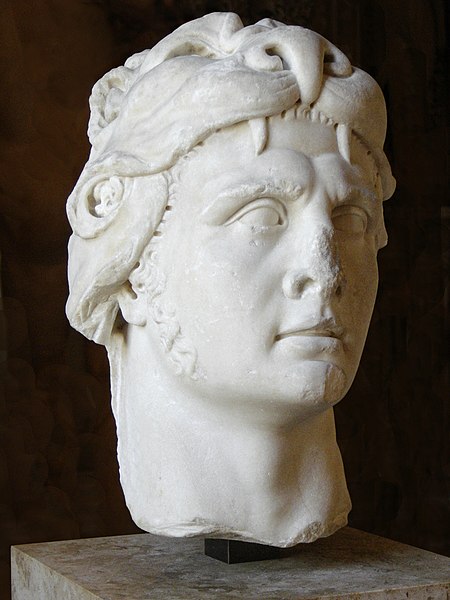
[Image - Mithradates VI of Pontus. Photographed by Eric Gaba at the Louvre in Paris, France.]
“Enemies were usually portrayed as monsters,” Strauss explains. “Take Hannibal. He was called untrustworthy, obsessed and bloodthirsty. But Spartacus was called patriotic.” Strauss continues, “I was personally struck by the degree to which later Roman writers presented him as a good guy. They respected him and blamed themselves for the war."
So the famous escape from the gladiator school in Capua was probably just that - an escape. Not a slave revolt. As it turns out, however, Spartacus and his initial conspirators started plundering the countryside to gain needed resources. Human nature being what it is, a chance to grab "a piece of the pie", so to speak, was probably the main reason so many other slaves and the poor joined him. His initial victories created even more excitement and having a prophetess for a wife probably didn't hurt either.
I just finished reading Harry Turtledove's "Give Me Back My Legions!". In it, he has Arminius ponder the reason so many of his countrymen joined with him in the massacre of the Roman legions in the Teutoburg Forest. Arminius realizes that most of the warriors took part for merely the chance to grab the prized Roman goods in the baggage train and not for any higher sense of desire for independent nationhood. Although the book is fiction, I think Turtledove hits the nail squarely on the head. Plunder was viewed in ancient society as a bona fide "right" of the strong over the weak and did not appear to have any particular moral implications. Plunder was even recognized by conquering armies as an accepted method used to pay their soldiers. So the slaves and poor attracted to Spartacus would have had no qualms about depriving other people of their possessions (or their lives) and, in fact, would view it as a fortuitous change of events, not the social class struggle implied in Kubrick's film.
Now that we've looked more closely at Howard Fast's Spartacus, let's examine Fast's treatment of his novel's antagonist, Marcus Licinius Crassus. To maintain a crisp demarcation between the noble Spartacus and the reviled Roman general Crassus, Fast did not include any sympathetic information about Crassus' background either such as the loss of his family and fortune in the Marian purges in December 87 BCE.
[Image - Sculpture of Marcus Licinius Crassus. Photographed by cjh1452000 at The Louvre in Paris, France. Courtesy of Wikimedia Commons.]
Crassus was descended from a consul and censor, Publius Licinius Crassus Dives, best known for being Pontifex Maximus (from 212 BC to his death 183 BC) and consul (in 205 BC) and political ally of the Roman general and statesman Scipio Africanus (the general who defeated Hannibal). So Crassus could claim a distinguished lineage. His father had inherited immense wealth, although he kept his family, that included Crassus and his two older brothers along with all of their wives and children in a very small modest house. One of Crassus' brothers died during the Social War between Rome and other peoples of the Italian peninsula. Crassus dutifully stepped forward and married his brother's widow.
Gaius Marius and Lucius Cornelius Sulla were two very successful Roman generals who were competing for control of the Roman state in the late Republican Period. Crassus' father and brothers supported Sulla, a fellow patrician who favored a return to a patrician-controlled Senate. Unfortunately, the forces of Gaius Marius gained control at one point and Marius' co-consul Cinna ordered proscriptions of many of the supporters of Sulla. Proscription lists were issued and entire families named on the lists were hunted down and murdered and their goods confiscated. Crassus' father and remaining brother were killed or committed suicide to evade capture . Crassus narrowly escaped death himself and had to hide in a dank seaside cave in Hispania (Spain), living off of provisions clandestinely supplied by a family friend.
[Image- Lucius Cornelius Sulla Felix. Photographed by Wikipedia user Bibi Saint-Pol]
After Cinna's death in 84 BC, Crassus joined Sulla when Sulla invaded Italy to retake the Roman capital. After Sulla regained power, he gave Crassus command of the right wing in the Battle of the Colline Gate when remaining pro-Marian supporters marched on Rome in one last attempt to oust Sulla. Crassus and his troops ensured Sulla's ultimate victory and Crassus demonstrated he had military leadership capabilities.
If there was one lesson Crassus learned, though, from his early political experiences was that family name or aristocratic lineage alone could not protect you from fickle Roman politics. But money, if you had enough of it, could. From that point on, Crassus' entire life seemed to have been a series of choices to not only restore his families wealth but increase that wealth to a point where he and his family would no longer be vulnerable to the political winds of change.
The ancient sources tell us Crassus garnered much of his wealth when the tables turned and Sulla came to power and ordered his own proscriptions. As one of Sulla's lieutenants, Crassus took full financial advantage of this sudden turn of fortune. Crassus also engaged in a "fire sale" scheme where he would send his clients equipped to fight fire to the site of a burning building then ask the owners of surrounding properties if they wanted to sell their endangered properties (at a distressed price) or watch them burn as well. This may sound like a Mafia-style protection racket but as a wealthy man, Crassus would have had large numbers of clients obligated to do his bidding. The fact that he chose to purchase endangered properties rather than offer the services of his clients to extinguish the blaze was his prerogative. Although some rumors spread at the time that his client firefighters got overzealous and actually started fires near choice properties, no convincing evidence was ever presented in the Roman law courts to prove this accusation and quite honestly, fire was such a hazard in Republican Rome (remember it did not become a city of marble until the reign of Augustus) that fires were commonplace because of the cheap construction, especially in the Sburra district.
"The danger from fire in Rome inherent in a large-scale utilization of easily combustible building materials was greatly increased by negligent and imprudent methods of building. Owing to limitations in the building area selected and a tendency to follow lines of least resistance at the lower levels between and around the hills, houses and shops were built close together on narrow, tortuous streets and alleys •from ten to twenty feet wide. Moreover, a population much too dense for the area occupied led to a great increase in the height of houses (Vitruvius II.8.17), with their huge upper timbers, balconies, bow windows, and other projections, which with frightful quickness caught the flames and communicated them. Thus fires were trebly dangerous, on account of the materials used for building, the height to which these were elevated (so high that water could not be raised by the firemen to the upper stories), and the narrowness of the streets on which the buildings stood. Narrow streets, of course, allowed little protection against the spread of flames, whether the building was low or high; but the tenement houses of many stories, with their small rooms, thin partition walls, wooden panels, and lattice work, were especially liable to burst into a blaze from exposure to any near-by fire." - Conflagrations in Ancient Rome By H. V. Canter University of Illinois
Rome had a city fire department of sorts, whose members were called the vigiles, that was established during the early Republic. But as time went on and the city grew so haphazardly, the servi publici were unable to cope with the huge number of fires and companies of familiae privatae were used to assist, although these assistants were not always paid - a woefully inadequate approach to a serious problem.
Crassus also engaged in silver mining ventures and the slave trade. But he found that wealth alone would not buy him back the lost respect he craved, especially in view of some of the dubious ways he acquired it. Also even though most aristocratic families had indirect connections with business ventures, it was considered inappropriate for members of the elite to openly engage in business and Crassus had wantonly crossed the line on this social taboo as well. So he searched for a way to prove once and for all that he possessed the civic virtue required of the First Man in Rome.
Although he had the family lineage to assure progress up the coursus honorum, the top leadership positions were usually reserved for men with demonstrated military achievements. Crassus had commanded troops under Sulla but engagements against fellow Romans were viewed with rancor. Furthermore, experienced field commanders like Lucius Licinius Lucullus and Pompey the Great had managed to corner most of the action fighting Mithridates in the East and Quintus Sertorius, a Marian general who had sought to establish an independent Roman Republic, in Hispania.
Initially, little attention was given to Spartacus' escape from Capua, even though he and his followers ravaged the surrounding countryside. At the time, most of the legions were engaged elsewhere. So Rome dispatched a quickly recruited militia under the command of a praetor to handle what was considered a "policing" matter. When that force was surprised and nearly annihilated, a second praetorian expedition was ordered to the scene. Spartacus, with more tactical experience than the Senate realized, again defeated the second group and more importantly, captured their supplies and military equipment. With plunder to be had, more slaves, as well as local herdsmen and shepherds, flocked to Spartacus, swelling his ranks to almost 70,000 men.
As Dr. Barry Strauss pointed out in his recent book, "The Spartacus War", Capua was also filled with descendants of people who had actually abandoned their support of Rome and allied with Hannibal in 212 BCE during the second Punic War. When Hannibal finally withdrew, Rome had punished Capua by eliminating its local governance and placing it under the administration of a Roman governor. So anti-Roman sentiment was fairly widespread there.
In the Spring of 72 BCE, when this sizable force came out of winter quarters and headed north, Rome flew into a panic. Two consular legions were quickly dispatched and met initial success with the defeat of Crixus and about 30,000 slaves near Mount Garganus. But the remaining group of slaves under Spartacus once more routed the Romans.
Finally, Crassus' historic opportunity had arrived. Not only did the Senate need a victory but they needed manpower that they didn't have currently available and couldn't afford. Crassus not only volunteered for the command (the only volunteer I might add), but he personally recruited and paid for eight legions (some sources say six) - approximately 40,000-50,000 trained soldiers.
We've considered the effect of Spartacus having a wife who was a prophetess of the god Dionysos. Now let's look at the religious affiliation of Crassus. Although Crassus was extremely rich, he also quite dutifully donated one-tenth of his earnings to a local temple. But it wasn't Jupiter Optimus Maximus or Dionysos. According to Plutarch, Crassus donated a significant portion of his substantial wealth to the temple of Hercules. In other words, Crassus worshiped the ultimate hero.
Initially, Crassus and Spartacus clashed in a series of running battles, forcing Spartacus further and further south. Crassus only suffered one major setback when his overzealous legate Mummius, against orders, engaged Spartacus and was routed.
Much has been made out of Crassus' subsequent brutality when he ordered 500 men from Mummius' failed attack, who were deemed to have shown cowardice, to select by lot one in ten of their number to be beaten to death by their comrades. This ancient form of discipline called decimation was first described by Livy in reference to disciplinary action taken in 471 BCE during the early wars against the Volsci. It was also used in the 3rd century BCE and recorded by Polybius. Plutarch claims decimation was also used later by Marc Antony and Suetonius claims even the noble Augustus used it to discipline troops in 17 BCE. The last recorded Roman use of the practice was 20 CE when Lucius Apronius used decimation to punish a full cohort of the III Augusta after their defeat by Tacfarinas, according to Tacitus. So it was not unheard of by any means and was probably accepted at the time as an extreme measure taken to cope with an extreme situation. It is also credited by some historians as one of the primary reasons for Crassus' ultimate victory so it obviously had the desired effect.
As for crucifying 6,000 slaves along the Via Appia? I think this action accomplished three important objectives. First, Crassus used this horrific sight as a visual deterrent to the largely illiterate people inhabiting the rural farms and villages between Capua and Rome. Remember it was not just slaves who had joined Spartacus but the rural poor and disaffected peoples around Capua. Secondly, at the time, about 20% of the Roman population were slaves. Even though Spartacus had made no effort to free urban slave populations, the Roman public had equated his struggle with slave disobedience. The rotting corpses lent assurance to the free population that the Roman state had the resources and determination to ultimately protect them and their homes and property. Lastly, this memorable demonstration would serve as visual proof of who actually quelled the rebellion and brought the overall threat to an end.
Towards the end of the revolt, Pompey the Great had returned from Spain and had intercepted a group of Spartacus' followers that had broken away from the main body of men. However, since the altercation took place closer to Rome than the last great battle between Spartacus and Crassus, Pompey's victory occurred sooner and was more readily visible. Pompey did not hesitate to capitalize on this fact with the "press".
As for Crassus' taste for both "snails and oysters," as it was so delicately put in the director's cut of the Kubrick film that was released on DVD, there was no indication in the sources that Crassus had any homosexual tendencies. Even if he did, I don't understand why using that type of innuendo to further make Crassus seem more villainous is an acceptable choice by the director. It seems incongruous to me for Kubrick to use the disparagement of one minority group to promote the agenda of another.
In conclusion, I'm not saying I particularly admire Crassus, I'm only saying I think I understand some of the factors that motivated him. I think Crassus viewed putting down the Spartacan revolt as simply an urgent necessity and a career builder but not as some glorious definitive statement of Roman superiority.
I'm sure none of these more subtle issues will be explored in the new miniseries. But I do hope an entire culture is not vilified in an attempt to simply generate profitable ratings by resurrecting old stereotypes.
Update: "Spartacus: Blood and Sand" was wildly popular and the series continued for three more years despite the death of its star, Andy Whitfield in 2011 from non-Hodgkin lymphoma. I found this composite of most spectacular battle sequences from the series up on YouTube:
Suggested reading (A Kindle preview):
More suggested reading:
If you enjoyed this post, never miss out on future posts by following me by email!
I received a touristy little news item about the northern Italian town of Brescia that caught my interest. The article mentioned that the area contained the largest Roman excavation in northern Italy so, of course, I had to read more about it. I learned that Brescia, was once known as Brixia.
[Image: Mosaic floor of a 1st - 4th century Roman villa preserved at the Brescia Musei, Brescia, Italy.]
"Different mythological versions of the foundation of Brescia exist: one assigns it to Hercules, while another attributes its foundation to Altilia ("the other Ilium") by a fugitive from the siege of Troy. According to a further myth, the founder was the king of the Ligures Cidnus, who had invaded the Padan Plain in the late Bronze Age. Scholars attribute the foundation to the Etruscans." - Wikipedia
The Etruscans fell to the GallicCenomani, allies of the Insubres, in the 4th century BCE. The Celts succumbed to the Romans in 225 BCE. But the Celts were not all satisfied with Roman rule and became part of a Celtic confederation allied with the Carthaginians in 202 BCE during the 2nd Punic War.
"...but, after a secret agreement, [Brixia] changed side and attacked the Insubres by surprise, destroying them. Subsequently the city and the tribe entered the Roman world peacefully as faithful allies, maintaining a certain administrative freedom. In 89 BC Brixia was recognized as civitas ("city") and in 41 BC its inhabitants received Roman citizenship. Augustus founded a civil (not military) colony there in 27 BC, and he and Tiberius constructed an aqueduct to supply it. The Roman Brixia had at least three temples, an aqueduct, an amphitheater, a forum with another temple built under Vespasianus, and some baths.
When Constantine advanced against Maxentius in 312, an engagement took place at Brixia in which the enemy was forced to retreat as far as Verona. In 402 the city was ravaged by the Visigoths of Alaric I. During the invasion of the Huns under Attila, the city was again besieged and sacked in 452 while, some forty years later, it was one of the first conquests of the Gothic general Theoderic the Great in his war against Odoacer." - Wikipedia
Republican-era buildings were discovered there in the 19th century under the remnants of the Capitolium, the temple built by the Emperor Vespasian. Artifacts recovered from these excavations include Celtic arms, Roman portrait sculpture, frescoes and mosaics. The Santa Giulia City Museum houses these discoveries as well as a collection of preserved Roman townhouses from the 1st to 4th century CE.
I'm also a big fan of armor collections and I see that the castle portion of the Museum houses an arms collection in the keep. Over 580 swords, firearms and suits of armour, over half of the 1090 items bequeathed by industrialist Luigi Marzoli, are displayed in ten exhibit rooms. The oldest item is a sword from the 13th century and one of the rarest is a large Venetian helmet and under-helmet with visor in the shape of a dog’s muzzle.
I had a wonderful time photographing the extensive armor collection at the Metropolitan Museum of Art in New York several years ago. I would love to add images of Brescia's marvelous collection to my Flickr set! I haven't yet visited Venice and I was really anxious to explore Ravenna someday too. It looks like I need to plan a major expedition to northern Italy!
If you enjoyed this post, never miss out on future posts by following me by email!
Although mosaics of ancient Pompeii proclaim the Roman equivalent of "Beware of Dog", I found the current canine residents of the remains of Pompeii to be rather docile creatures who prefer to snooze on the warm ancient paving stones of the archaeological site rather than chase away tourists. So, I was glad to read that the superintendent of the Pompeii has launched an effort to not only care for the dogs, but actively seek "forever" homes for them.
"They sleep under ancient Roman frescoes and walk on priceless mosaic floors, but they are far from living a privileged life. They are the dogs of Pompeii -- sick, starving, dirty and scruffy stray dogs who wander through the ruins of the volcano stricken Roman town.
[Image: A canine resident of Pompeii still waits patiently for someone to take them home. Photo by Mary Harrsch.]
The poor animals have been living in the ancient Roman town for decades, marking the territory by urinating on the ancient walls, and relying on compassionate tourists for food and water.
"Stray dogs have given Pompeii a bad image, but things are going to change. From now on, dogs will have their own identity and dignity and will be taken care of," Pompeii's emergency commissioner Marcello Fiori said at a press conference on Monday. - More: Discovery News
If you enjoyed this post, never miss out on future posts by following me by email!


 some years ago and found it so irritating with its uncompromising interpretations of good and "evil" that I actually had to force myself to finish it. Almost all the Romans were presented as arrogant, sexually debauched and greedy while the slaves were depicted as all innocent, true-hearted and loyal (with the exception, perhaps, of Crixus). Fast carefully omitted less admirable historical information about the brutality of Spartacus' own plunder of the Roman countryside or use of crucifixion to taunt the Romans.

 " that Spartacus was not reviled by later Roman historians.
 Give Me Back My Legions!
 ". In it, he has Arminius ponder the reason so many of his countrymen joined with him in the massacre of the Roman legions in the Teutoburg Forest. Arminius realizes that most of the warriors took part for merely the chance to grab the prized Roman goods in the baggage train and not for any higher sense of desire for independent nationhood. Although the book is fiction, I think Turtledove hits the nail squarely on the head. Plunder was viewed in ancient society as a bona fide "right" of the strong over the weak and did not appear to have any particular moral implications. Plunder was even recognized by conquering armies as an accepted method used to pay their soldiers. So the slaves and poor attracted to Spartacus would have had no qualms about depriving other people of their possessions (or their lives) and, in fact, would view it as a fortuitous change of events, not the social class struggle implied in Kubrick's film.


