Showing posts with label Aeneas. Show all posts

Tuesday, June 8, 2021

Triton and the fate of Misenus

This morning while browsing artifacts in the collections of the Getty Villa, I came across this exquisite gilded silver sculpture of a Triton forming the handle of an oinochoe.  As I described in a post a couple of years ago, the original sea god, Triton, was the son of Poseidon and Amphitrite according to Hesiod's Theogony. Triton is usually represented as a merman, with the upper body of a human and the tailed lower body of a fish. At some time during the Greek and Roman era, Tritons became a generic term for mermen in art and literature. A female version (tritoness) was eventually introduced as well.

Triton was said to dwell with his parents in  a golden palace claimed to be located at Aegae on the island of Euboea in a passage from book 5 of Homer's Iliad. It describes how  Poseidon "lashed his long-maned horses and drove to Aegae, where he had his famous palace" after having destroyed Odysseus' raft with a storm. Later in Book 13 of the Iliad, Poseidon "took three strides, and with the fourth he reached his goal—Aegae, where is his glittering golden palace, imperishable, in the depths of the sea."

Only in later times was Triton associated with possessing a conch shell, which he blew like a trumpet to calm or raise the waves. He was "trumpeter and bugler" to Oceanus and Poseidon. Its sound was so cacophonous that when loudly blown, it was said to put the giants to flight, who imagined it to be the roar of a dark wild beast.

in Virgil's epic poem the Aeneid, Misenus, a brother-in-arms of Hector and, after Hector's death, Aeneas' trumpeter, challenged the gods to a musical contest on a conch shell. He, like Marsyas, was punished for his hubris when he was drowned by Triton.  Aeneas was told by the Cumaean Sibyl at that time that Misenus's body had to be buried before he could enter the Underworld and detailed the necessary funeral rites required that were later adopted by the Romans. Cape Misenum, the headland that marks the northwestern limit of the Gulf of Naples as well as the Bay of Pozzuoli in southern Italy and supposedly named for Misenus,  was important to the Romans since it was a natural shelter for passage into the inner harbor of Portus Julius, the home port for the Roman western imperial fleet.


Image: Gilded silver oinochoe handle depicting Triton from Macedonia or Illyria, 100-1 BCE, at the Getty Villa in Gallery 111, Pacific Palisades, California. Now detached from the vessel of which it was once part, Triton’s scaly lower body serves as the functional part of the handle, and the acanthus leaves from which the torso rises would have hidden the join at the rim. Triton's torso would have projected as a decorative element above the mouth, and gilding elaborates much of its surface. The figure probably held a trident in its left hand, a frequent attribute of sea beings. Such an elaborate pouring vessel would have been part of an ornate set of serving and drinking vessels used at banquets or symposia.

If you enjoyed this post, never miss out on future posts by following me by email!


Tuesday, April 27, 2021

The Flight of Aeneas

While browsing the Getty's collections today I saw yet another intricately sculpted Roman cornelian gemstone from the 1st century BCE.

"The gem captures the moment when Aeneas, son of the Trojan prince Anchises and the goddess Venus, escapes with his family from Troy at the end of the Trojan War. Aeneas climbs up the steps to a waiting ship, with his father over his right arm and his son, Ascanius, holding his left hand. Aeneas wears a corselet but no other armor. His father wears robes with a mantle pulled over his head. Ascanius, shown just at the moment of leaving the gates of the city, wears a Phrygian cap, a chiton, and cloak while holding a pedum (a hunter's throwing stick) over his left shoulder. Anchises holds a cylindrical box with an X pattern on the side. Behind them, the walls of Troy rise up, and a Greek solider in a crested helmets looks towards them from the battlements while holding a lit torch aloft in his raised right arm, a spear upright in his left. Three Trojans await them on the ship, all wearing Phrygian caps: one works the rudder, another the still-furled rigging of the ship, and the third raises a trumpet or other horn-shaped object. Above them, a single star." - J. Paul Getty Museum

I noticed the similarities between the scene on the gem and a 1st century CE sculpture of the flight of Aeneas from the Sebasteion, an imperial cult temple of the Julio-Claudian dynasty and Aphrodite (Venus) in ancient Aphrodisias.  The three-storey complex was embellished with richly carved panels depicting mythological scenes, heroes, and gods surrounded by the emperors Augustus, Tiberius, Claudius, and Nero and their spouses, children and  a series of personified ethne or 'nations' of Augustus' world empire, from the Ethiopians of eastern Africa to the Callaeci of western Spain. The temple was excavated beginning in 1979.  Of the original 200 reliefs, 80 were recovererd.

Read more about the excavations and see more images of the temple here:

http://aphrodisias.classics.ox.ac.uk/sebasteion.html


Intaglio with Scene of Aeneas and his Family Escaping from Troy, Carnelian, Roman, 20 BCE now in the collections of the J. Paul Getty Museum in Pacific Palisades, California
Roman relief of the Flight of Aeneas with his father Anchises and son Ascanius helped by Aphrodite, 20 - 60 CE. The Trojan hero, Aeneas was the son of the prince Anchises and the goddess Aphrodite. His father was the second cousin of King Priam of Troy. The journey of Aeneas from Troy (with help from Aphrodite), which led to the founding of the city Rome, is recounted in Virgil's Aeneid. The 1st century CE relief is now in the Aphrodisias Museum in Turkey, image courtesy of Wikimedia Commons contributor Dick Osseman.


If you enjoyed this post, never miss out on future posts by following me by email!


Monday, March 22, 2021

Tabula Iliaca

A Tabula Iliaca ("Iliadic table") is a generic label for a calculation of the days of the Iliad, probably by Zenodotus, of which twenty-two fragmentary examples are now known. The Tabulae Iliacae are pinakes of early Imperial date, which all seem to have come from two Roman workshops.  The marble panels are carved in very low relief in miniature rectangles with labeling inscriptions typically surrounding a larger central relief. 

The border scenes, where they can be identified, are largely derived from the Epic Cycle, a collection of ancient Greek epic poems, composed in dactylic hexameter and related to the story of the Trojan War, including the Cypria, the Aethiopis, the so-called Little Iliad, the Iliupersis, the Nostoi, and the Telegony. Eleven of the small marble tablets are pictorial representations of the Trojan War portraying episodes from the Iliad, including two circular ones on the Shield of Achilles. Another six panels depict the sack of Ilium.

One of the most complete examples surviving is the Tabula Iliaca Capitolina, which was discovered around Bovillae, near Rome. The tablet dates from the Augustan period, around 15 BCE. The carvings depict numerous scenes of the Trojan War, with captions, including an image of Aeneas climbing aboard a ship after the sacking of Troy. The carving's caption attributes its depiction to a poem by Stesichorus in the 6th century BCE.

Tabula Iliaca: relief with illustrations drawn from the Homeric poems and the Epic Cycle–here from the Ilioupersis, the Iliad, the Little Iliad and the Æthiopis. Limestone, Roman artwork, 1st century BCE courtesy of the Capitoline Museum. 

A "Tabula iliaca" in the National Museum in Warsaw, the so-called "Tabula Rondanini", Roman, 1st century BCE - 1st century CE, now in the National Museum of Warsaw, courtesy of museum photographer Cyfrowe and Wikimedia Commons.


If you enjoyed this post, never miss out on future posts by following me by email!


Thursday, August 19, 2010

Turkish documentary to retrace sea voyage of Aeneas

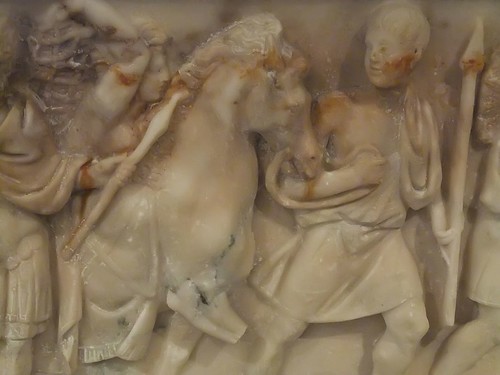
Roman Sarcophagus Depicting Scenes from the Aeneid
2nd century CE from the Giustiniana area along the
Via Cassia Rome.  Photographed at the National Museum
in Rome, Italy by Mary Harrsch.
In an effort to promote the parallel study of the post- Trojan period in Turkey and Italy, Turkish archaeologists are planning to produce a documentary film about the sea journey of Aeneas  from Antandrus in Turkey to the Latium region of Italy.

“A ship, which we’ll name ‘Tempest,’ will set off from Altınoluk and follow the route that was taken by Aeneas’ band in 700 B.C. using sails and oars only,” said Excavation Chairman Gürcan Polat in detailing the plans for the journey from the northwestern Turkish province to Italy.

The ship to be used in re-creating Aeneas’ journey will be built in the style of the post-Trojan period, the excavation coordinator said.

“Aeneas’ experiences in every place he passed will be dramatically re-created and documented. In this way, we will have a very significant historical documentary,” said Polat, detailing plans for a documentary film to accompany the seafarers. “I hope it will also contribute to the promotion of both Antandrus and Turkey abroad.” - Turkey Daily News & Economic Review
Homer tells us that Antandrus was among the 11 cities and 12 islands conquered by Achilles during the Trojan War.


Aristotle states that Antandrus was occupied by the Cimmerians about 700 BCE and was referred to as Kimmeris for a hundred years during their occupation.


Antandrus was later colonized by the Greeks on the north side of the Adramyttian Gulf in the Troad region of Anatolia, near the modern village of Avcilar in Turkey in the 5th century BCE but scholars disagree on the founders.

"Strabo, quoting the poet Alcaeus, mentions the Leleges (Geography, 13.1.51), Herodotus believed the first settlers were Pelasgians (Histories, 7.42), and Thucydides mentions the Aeolians (History of the Peloponnesian War, 8.108)." - Livius.org

After participating in the Ionian Revolt, Antandrus later joined the Delian League.

During the Peloponnesian War, exiles from Lesbos captured the city, used it as base to recapture Mytilene, but were expelled by the Athenians, who garrisoned the place (Diodorus, World History, 12.72.2). - Livius.org

During the Corinthian War, it was used as a strategic naval base. 

The economy of Antandrus was based on the sale of timber from Ida Mountains.

In Search of a Homeland: The Story of the Aeneid   Vergil's Aeneid: Hero War Humanity   Art of the Aeneid (Bristol Classical Paperbacks.)   In Search of the Trojan War, Updated edition   Troy and its Remains: A Narrative of Researches and Discoveries Made on the Site of Ilium, and in the Trojan Plain (Cambridge Library Collection - Archaeology)   The Modern Scholar Archaeology and the Iliad: The Trojan War in Homer and History   The Trojan War: Literature and Legends from the Bronze Age to the Present
If you enjoyed this post, never miss out on future posts by following me by email!