Showing posts with label The Aeneid. Show all posts

Tuesday, June 8, 2021

Triton and the fate of Misenus

This morning while browsing artifacts in the collections of the Getty Villa, I came across this exquisite gilded silver sculpture of a Triton forming the handle of an oinochoe.  As I described in a post a couple of years ago, the original sea god, Triton, was the son of Poseidon and Amphitrite according to Hesiod's Theogony. Triton is usually represented as a merman, with the upper body of a human and the tailed lower body of a fish. At some time during the Greek and Roman era, Tritons became a generic term for mermen in art and literature. A female version (tritoness) was eventually introduced as well.

Triton was said to dwell with his parents in  a golden palace claimed to be located at Aegae on the island of Euboea in a passage from book 5 of Homer's Iliad. It describes how  Poseidon "lashed his long-maned horses and drove to Aegae, where he had his famous palace" after having destroyed Odysseus' raft with a storm. Later in Book 13 of the Iliad, Poseidon "took three strides, and with the fourth he reached his goal—Aegae, where is his glittering golden palace, imperishable, in the depths of the sea."

Only in later times was Triton associated with possessing a conch shell, which he blew like a trumpet to calm or raise the waves. He was "trumpeter and bugler" to Oceanus and Poseidon. Its sound was so cacophonous that when loudly blown, it was said to put the giants to flight, who imagined it to be the roar of a dark wild beast.

in Virgil's epic poem the Aeneid, Misenus, a brother-in-arms of Hector and, after Hector's death, Aeneas' trumpeter, challenged the gods to a musical contest on a conch shell. He, like Marsyas, was punished for his hubris when he was drowned by Triton.  Aeneas was told by the Cumaean Sibyl at that time that Misenus's body had to be buried before he could enter the Underworld and detailed the necessary funeral rites required that were later adopted by the Romans. Cape Misenum, the headland that marks the northwestern limit of the Gulf of Naples as well as the Bay of Pozzuoli in southern Italy and supposedly named for Misenus,  was important to the Romans since it was a natural shelter for passage into the inner harbor of Portus Julius, the home port for the Roman western imperial fleet.


Image: Gilded silver oinochoe handle depicting Triton from Macedonia or Illyria, 100-1 BCE, at the Getty Villa in Gallery 111, Pacific Palisades, California. Now detached from the vessel of which it was once part, Triton’s scaly lower body serves as the functional part of the handle, and the acanthus leaves from which the torso rises would have hidden the join at the rim. Triton's torso would have projected as a decorative element above the mouth, and gilding elaborates much of its surface. The figure probably held a trident in its left hand, a frequent attribute of sea beings. Such an elaborate pouring vessel would have been part of an ornate set of serving and drinking vessels used at banquets or symposia.

If you enjoyed this post, never miss out on future posts by following me by email!


Thursday, August 19, 2010

Turkish documentary to retrace sea voyage of Aeneas

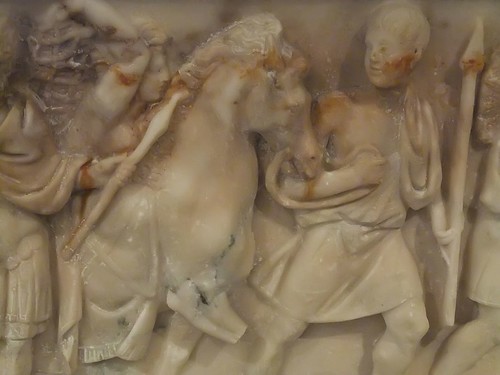
Roman Sarcophagus Depicting Scenes from the Aeneid
2nd century CE from the Giustiniana area along the
Via Cassia Rome.  Photographed at the National Museum
in Rome, Italy by Mary Harrsch.
In an effort to promote the parallel study of the post- Trojan period in Turkey and Italy, Turkish archaeologists are planning to produce a documentary film about the sea journey of Aeneas  from Antandrus in Turkey to the Latium region of Italy.

“A ship, which we’ll name ‘Tempest,’ will set off from Altınoluk and follow the route that was taken by Aeneas’ band in 700 B.C. using sails and oars only,” said Excavation Chairman Gürcan Polat in detailing the plans for the journey from the northwestern Turkish province to Italy.

The ship to be used in re-creating Aeneas’ journey will be built in the style of the post-Trojan period, the excavation coordinator said.

“Aeneas’ experiences in every place he passed will be dramatically re-created and documented. In this way, we will have a very significant historical documentary,” said Polat, detailing plans for a documentary film to accompany the seafarers. “I hope it will also contribute to the promotion of both Antandrus and Turkey abroad.” - Turkey Daily News & Economic Review
Homer tells us that Antandrus was among the 11 cities and 12 islands conquered by Achilles during the Trojan War.


Aristotle states that Antandrus was occupied by the Cimmerians about 700 BCE and was referred to as Kimmeris for a hundred years during their occupation.


Antandrus was later colonized by the Greeks on the north side of the Adramyttian Gulf in the Troad region of Anatolia, near the modern village of Avcilar in Turkey in the 5th century BCE but scholars disagree on the founders.

"Strabo, quoting the poet Alcaeus, mentions the Leleges (Geography, 13.1.51), Herodotus believed the first settlers were Pelasgians (Histories, 7.42), and Thucydides mentions the Aeolians (History of the Peloponnesian War, 8.108)." - Livius.org

After participating in the Ionian Revolt, Antandrus later joined the Delian League.

During the Peloponnesian War, exiles from Lesbos captured the city, used it as base to recapture Mytilene, but were expelled by the Athenians, who garrisoned the place (Diodorus, World History, 12.72.2). - Livius.org

During the Corinthian War, it was used as a strategic naval base. 

The economy of Antandrus was based on the sale of timber from Ida Mountains.

In Search of a Homeland: The Story of the Aeneid   Vergil's Aeneid: Hero War Humanity   Art of the Aeneid (Bristol Classical Paperbacks.)   In Search of the Trojan War, Updated edition   Troy and its Remains: A Narrative of Researches and Discoveries Made on the Site of Ilium, and in the Trojan Plain (Cambridge Library Collection - Archaeology)   The Modern Scholar Archaeology and the Iliad: The Trojan War in Homer and History   The Trojan War: Literature and Legends from the Bronze Age to the Present
If you enjoyed this post, never miss out on future posts by following me by email!