Showing posts with label Caligula. Show all posts

Wednesday, January 13, 2021

Remnants of Caligula's Horti Lamiani now on display

During the four years that Caligula occupied the Roman throne, his favorite hideaway was an imperial pleasure garden called Horti Lamiani. The vast residential compound spread out on the Esquiline Hill, one of the seven hills on which the city was originally built, in the area around the current Piazza Vittorio Emanuele II.

There, just on the edge of the city, villas, shrines and banquet halls were set in carefully constructed “natural” landscapes. An early version of a wildlife park, the Horti Lamiani featured orchards, fountains, terraces, a bath house adorned with precious colored marble from all over the Mediterranean, and exotic animals, some of which were used, as in the Colosseum, for private circus games. 

Now, relics from the Horti Lamiani have been recovered and put on display by archaeologists. The objects and structural remnants on display in the museum paint a vivid picture of wealth, power and opulence including elaborate mosaics and frescoes, a marble staircase, capitals of colored marble and limestone, and an imperial guard’s bronze brooch inset with gold and mother-of-pearl.

Read more about it here:  

https://www.nytimes.com/2021/01/12/science/caligula-archaeology-rome-horti-lamiani.html


Image:  A theatrical mask in marble dust, recovered from the Horti Lamiani, the pleasure garden of the Roman emperor Caligula courtesy of the New York Times.

If you enjoyed this post, never miss out on future posts by following me by email!


Friday, May 22, 2020

A lesson from Lysias: Men who have spent their lives committing serious offences acting like they performed a great service

 Men, having spent their lives in committing serious offences and incurring a variety of troubles, make their speeches today with an air of having performed a great service.  Lysias.  For Callias.  Speech 5.  Section 3.


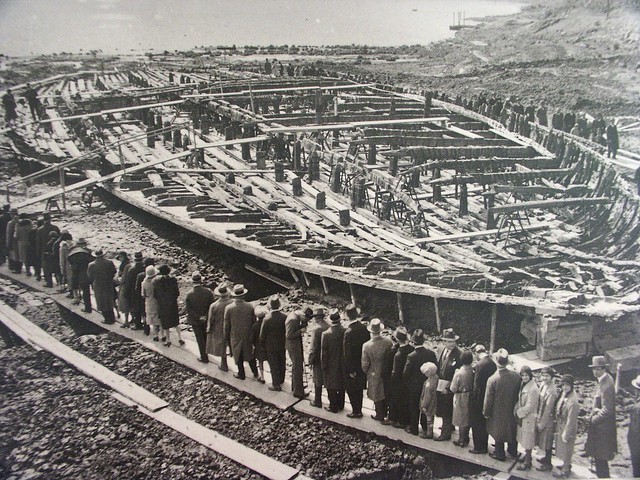
Image:  A colorized version of a 1906 artist's imaginative recreation of one of Caligula's Nemi ships, sadly destroyed in World War II.  The image originally appeared as an antique halftone photographic print in "Scientific American." (PD)

A rather concise list of Caligula's shortcomings:

https://bootheglobalperspectives.com/article/1503867119WBG188242364/what-we-can-learn-from-history-caligula-emperor-of-the-roman-empire

A nice summary article with pictures of objects recovered from the Nemi ships

https://hubpages.com/education/Roman-Emperor-Caligula-and-the-Nemi-Barges
If you enjoyed this post, never miss out on future posts by following me by email!


Sunday, April 8, 2012

Review: Caligula by Douglas Jackson


Several months ago when I began reading "Claudius" by Douglas Jackson, I didn't realize that it was actually the sequel to "Caligula".  Finding "Claudius" well researched with vibrant characters and taut action, I resolved to read "Caligula" as well.

"Caligula" fleshed out the backstory for Rufus, the young animal trainer who eventually became the emperor's elephant handler.  Rufus is the central character in "Caligula", just as he was in "Claudius" and we experience the reign of the emperor Caligula as reflected in the interactions he has with Rufus and with those Rufus holds dear including Fronto, a procuror of beasts for the Roman games who purchases Rufus from a kindly baker, a rebellious gladiator named Cupido who becomes Rufus' best friend, the gladiator's beautiful sister and a diminutive woman chosen by the emperor to be Rufus' wife.

In the opening prologue, Jackson portrays Caligula as an already psychologically disturbed child who tortures little animals as he seeks to learn the limits of physical brutality.   To the best of my knowledge, this is not documented in any ancient sources but it is effective to prepare the reader for some of the scenes of brutality that will follow as the scope of Caligula's brutaliy only increases with the power he acquires as the successor to the dour emperor Tiberius.
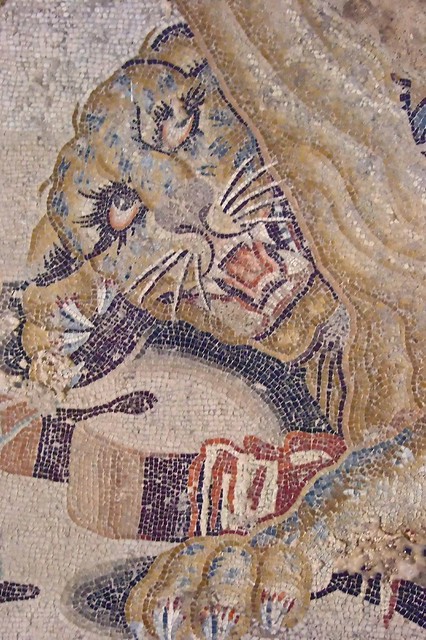
Lion and Leopard Mosaic Detail from 
the House of Doves Pompeii Roman
1st century CE photographed by
Mary Harrsch.

As the novel begins, we learn Rufus was initially sold into slavery by his own father, a former Spanish auxiliary who fails miserably at trying to scratch a living out of a plot of land in North African given to him as part of his discharge compensation from the Roman Army.  Fortunately for Rufus, he is purchased by a kindly Roman baker who teaches him the trade.  But Rufus' real calling is made clear one day when he saves a young girl from a rampaging beast who has escaped from the holding pens of one of the arenas where beast hunts are held to entertain the Roman mob.  His courage in confronting the animal is noticed by Fronto, a procuror and trainer of beasts, who offers to teach Rufus the arts of his trade.  The baker agrees to sell Rufus to Fronto and Rufus' career as an animal trainer begins.

Fronto is a hard task master and Rufus learns some very painful lessons (that, as an animal lover, I found difficult to read).  But Rufus is gifted, both in understanding the nature of the animals he is asked to develop and in recognizing business opportunities in the ever shifting world of the Roman public's imagination.  His gifts do not go unnoticed, however, and soon Fronto, who is childless and had planned to adopt Rufus, is forced to sell him to the new emperor, Gaius Julius Caesar Augustus Germanicus, known behind his back as "Little Boots" (Caligula).

Jackson portrays the mature Caligula as someone who appears to be not openly maniacal but definitely psychologically unstable.  Rufus finds him at times friendly and genuinely interested in the people and events around him.  But these brief periods of lucidity can vanish without warning and then Rufus finds Caligula as dangerous as any beast he has ever faced in the arena.  I think this is a far more realistic portrayal than many past efforts who have presented Caligula as evil incarnate.  My blog post, "Sexual innuendo and character assasination in the ancient world", explains my reasoning on this point.

Jackson does a wonderful job of weaving actual events detailed by Suetonius in his biography of Caligula into the narrative including the construction of a bridge from the Palatine Hill across the forum to the Capitoline which I was unaware of until I read Caligula's biography.  Unfortunately, Fronto's grisly fate is also based on an actual incident detailed by Suetonius as well.  See "The Twelve Caesars" by Suetonius, "The Life of Caligula", Section 27, p449.

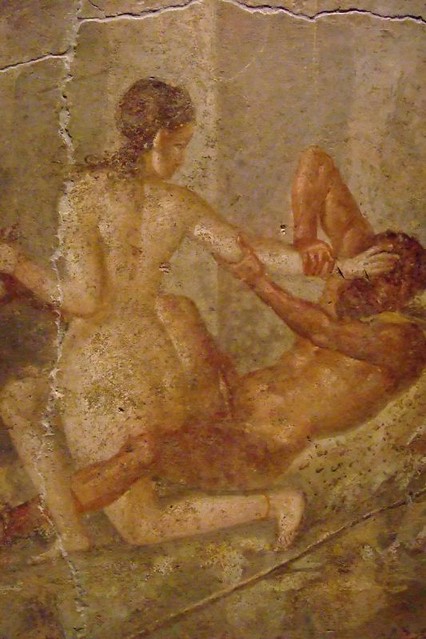
Erotic fresco from Pompeii displayed
 in "The Secret Room" in the Museo 
Archaeologico di Napoli in Naples, Italy. 
Photo by Mary Harrsch.
We also gain insight into the perverse nature of Caligula's sister Druscilla, who summons Rufus to her private chambers, dubbing him her "puppy dog".  Rufus has heard the rumors of an incestuous relationship between Druscilla and her brother and must now fear Caligula's jealous wrath if he discovers Rufus' unwanted nocturnal liaison .

Rufus also learns how everyone in the imperial court becomes players in the "game of thrones" as he is alternately threatened and cajoled by Narcissus, the freedman of Gaius' uncle Claudius, who deftly weaves a web of deceit to entrap any who may become an obstacle to his master's ultimate ascension to the purple.

Through Rufus, Jackson gives us a balanced look at life during the reign of Caligula without resorting to Hollywood-esque over-the-top scenes of licentiousness and bestiality. Jackson clearly illustrates the sense of helplessness, though, that so many slaves in the empire endured when under the control of ruthless and unscrupulous masters.   This helplessness, however, may be frustrating for some readers.

Last year I attended a media arts conference and at a presentation on screenwriting, Sara and Gregory Bernstein emphasized that a compelling protagonist should always be a person who is in control or has the capability to control the events in the plotline.  Rufus, as an imperial slave, however, has absolutely no control over his life or ultimately the lives of most of the significant people in his life.  This may be the reason Jackson's publisher asked Jackson to shift gears a little and develop a totally different character for the  books planned after the publication of "Claudius" even though Jackson's "emperor" series was initially announced as a trilogy and was well received.  (I must point out, though, this is just speculation on my part. )

I do think "Caligula" and "Claudius" vividly demonstrate the high caliber of Jackson's skill as a storyteller and I look forward to reading about the exploits of his new "Hero of Rome",  Tribune Gaius Valerius Verrens. Verrens, commander of the veteran legions at Colonia, must face one of Roman Britain's fiercest rebel leaders, Boudicca of the Iceni.  Judging from the title of the book, he must emerge victorious.  That definitely sounds like a protagonist that can handle whatever a plotline can throw at him.

Related articles:

Blogosphere ~ The Madness of the Emperor Caligula (rogueclassicism.com)
If you enjoyed this post, never miss out on future posts by following me by email!


Monday, February 20, 2012

Sexual innuendo and character assassination in the ancient world


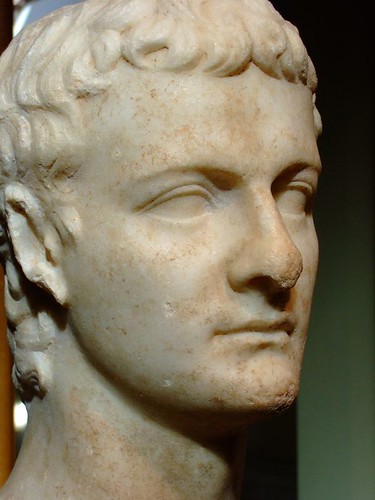
Portrait of Caligula. Photographed at theGetty Villa in Malibu, California by Mary Harrsch.    

Whenever I review a novel set in the ancient world I always read up on the history behind the novel before I prepare my review of the work.  I just finished reading "Caligula", a novel by Douglas Jackson, and I remembered that years ago I had picked up a slim "history" text entitled "Caligula Devine Carnage: Atrocities of the Roman Emperors" by Stephen Barber and Jeremy Reed. So I thought I would begin my research with it.  Fortunately, for me, the reign of Caligula was covered in Chapter 1 of Barber and Reed's little tome so I didn't have to slog through any more sewage than was absolutely necessary.

The foreward in this historical travesty, subtitled "Orgy of Death" proclaims:

"Ever since the cinematic holocaust of Tinto Brass' blood-splattered porno epic Caligula in 1980, connoisseurs of visceral history have thirsted for more information and details on the pleasuredomes and necrodromes of Ancient Rome.  Yet the true glories of the Roman Empire - the slaughter, the sexual depravity, the insanity - were virtually impossible to glean from the handful of arid, academic texts available.  Finally, here is a book which counts - a book which pointedly eschews the mind-numbing minutiae of politico-military history and instead brings the glorious, often shocking decadence of Ancient Rome to bloody, pulsating life. "
"Here are the incredible cruelties, vices and vanities of emperors such as Caligula and Claudius [see Chapter One], Nero [see Chapter Four], Commodus [see Chapter Three] and Heliogabalus [see Chapter Four] in uncensored and vivid relief.", James Havoc, Caligula Divine Carnage: Atrocities of the Roman Emperors.

In my opinion, I have never read such trash pawned off as history in my entire life! Perhaps I'm just not a "connoisseur of visceral history!"  For those of you thirsting for more details on the slaughter and depravity of the Roman Empire, however, I can share some choice morsels.


Did you know that early in his reign, Caligula supposedly had a lavish amphitheater built where he and Drusilla fornicated publicly for the mob's enjoyment? Well, neither did I.   Just to be sure I haven't become senile in my retirement, though, I double checked Suetonius' bio of Caligula, one of the few ancient sources still available on the topic and probably the most salacious of the bunch.  Suetonius, despite the fact that Pliny the Elder claims he was a serious, studious type, seemed to enjoy inserting sexual entendres in his discourse and was not above embellishing his accounts with delicious details that he could not have possibly known - especially considering that he wrote his biography of Caligula almost 80 years after Caligula's reign.

In p441 of Thayer's translation, Suetonius begins with a general undocumented statement that Caligula engaged in incestuous relations with his sisters (a common slur between Roman political rivals) then it reads " and at a large banquet he placed each of them in turn below him, while his wife reclined above."

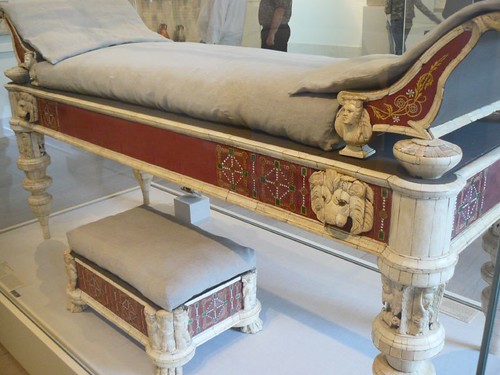
Roman couch and footstool with bone carvings and glass inlays
 possibly from the villa of co-emperor Lucius Verus 161-169 CE.
Photographed at the Metropolitan Museum of Art by Mary Harrsch.


In modern terms this sounds like he was having a public "threesome" with them, although a banquet would hardly qualify as an amphitheater seating thousands of leering spectators.   However, good scholars consider the context of the period and realize that it could have been merely a criticism of the reclining arrangements on the dining couches since Roman society was tightly controlled by rank and position. Thayer's translation is also a bit awkward which doesn't help. But using the word reclining in the passage, especially since the activity is stated to have taken place at a banquet, makes me think that Suetonius is trying to make a rather ludicrous play on words to infer a sexual liaison from a situation where one did not really exist.

Barber and Reed also claim Drusilla, Caligula's sister and rumored paramour, actually died from too much fornication rather than a fever.  Even Suetonius doesn't go that far.

Barber and Reed go on to describe a wild orgy aboard the famous Nemi ships that ended with the sexually sated participants being burned alive when the ships were set ablaze in the conclusion of an orgiastic spectacle that Caligula conceived in his demented mind. That's funny. If the ships were set ablaze how were they recovered intact from the lake bed by Mussolini just before WWII? Maybe Barber and Reed got their timing all mixed up when he read about the ships being burned by the Nazis as they retreated from Italy?


Historical photo of Caligula's "Nemi" ships courtesy of Joe Geranio.


The climax of chapter one (if you'll excuse the pun) described how Caligula planned his own assassination to be staged in front of the crowd in a gold and silver appointed amphitheater. In the center of the arena Caligula placed a golden altar and when Cassius Chaerea struck off Caligula's head it was so artfully done that his head bounced perfectly up onto the altar just as Caligula had planned it!

I can't believe that when you Google Stephen Barber he is hailed as an "award-winning" writer. Whoever wrote the reviews for his book about Caligula (or should I say chapter)  either knew absolutely nothing about history or never read the book at all.

Sadly, I guess that happens a lot. I read an article written by a woman trying to convince people that they could make a living writing reviews based on book dust covers and, considering a number of reviews I have read on line, apparently there are a number of people doing precisely that!
Of course Barber included no footnotes.  In his book where the bibliography should have been he gives us a general statement about his sources:

"This account is drawn from contemporary sources, biographies, manuals, polemics and newly-excavated documents (notably the "Butrinte Caligula"), as well as from works of the following centuries, from the golden era of Roman scholarship in Germany in the 1900s-1910s, and - least usefully by a wide margin - from recent biographies of Caligula and Commodus.  All material of every kind written on the Roman era, whatever its date of composition, reflects the structures and gaps and limitations of its time, and it would require the most omniscient oracle to say definitely what was authentic." - Stephen  Barber, Caligula Divine Carnage: Atrocities of the Roman Emperors

This certainly sounds like a cop out to me.

But, how reliable are even the ancient sources covering the reigns of Caligula and his predecessor Tiberius?  What political motivations could have influenced their sources?  I pose this last question because our most complete source on Caligula is Suetonius who was at one time an imperial secretary for Hadrian, decades after the actual reign of Caligula.  Therefore Suetonius had to have relied upon much earlier sources.

Some scholars have speculated that this earlier source material may have included a significant amount of political propaganda put forward by the power base that brought the emperor Claudius to the throne.  Caligula was actually popular with the Roman mob who probably needed to be assuaged after his assassination. I would take this suggestion a step further and speculate that not only was the material about Caligula politically manipulated but that even the end of Tiberius' reign suffered collateral damage in an effort to lay the groundwork for Caligula's reputed maniacle behavior.

The emperor Tiberius wearing the
Corona Civica.  Photographed at the
Museo Archaeologico Nazionale di Napoli
 in Naples, Italy by Mary Harrsch
Tiberius, through most of his reign, demonstrated that he was a competent administrator and militarily gifted general.  His serious demeanor did not endear him to the Roman populace, unlike Germanicus, and, apparently, he was not well-liked by Augustus and ended up as successor simply because there was nobody else left in the line of succession.  He seemed to be a reluctant ruler  who disliked the mud-wrestling nature of Roman politics and after the particularly nasty business of Germanicus' suspicious death and the subsequent suicide of the suspected assassin procurer, Gnaeus Calpurnius Piso (who it is reported was about to implicate Tiberius), Tiberius retreated to the island of Capri and left Sejanus in charge.

One thing I have realized over the years as I have studied ancient Rome is that the basic nature of humankind, despite all of the technological advances, has not really changed.  As social creatures, we become suspicious of individuals who separate themselves from the community and attempt to live an isolated existence.  The ancient Romans were no different.  Rumors spread that Tiberius must have been involved in unnatural activities on his island retreat and these rumors blossomed into tales of sexual depravity reported many years later by Suetonius.  But were these stories simply a result of purient speculation or an orchestrated effort by Claudian propagandists to point out how unworthy Caligula was as Tiberius' successor?

Most of the stories revolved around pederasty, detailing how Tiberius imported children and young men to satisfy his sexual appetites.  This included having the youngsters swim around in the palace's pools, nibbling on Tiberius.   Hence, the reference to his little "minnows", of which Caligula was one (although Caligula was not a child but a young man of 19 when he was asked to join Tiberius on Capri after the deaths of Livia and Octavia).

But what was the actual Roman attitude toward pederasty?

"Preeminent among Roman biases was a conviction that Greeks were excessively self-indulgent and inordinately fond of a life of luxury.  One might, then, have expected Roman writers to make use of pederasty as a major weapon in their assault against Greek cultural traditions, but they quite noticeably fail to do so.  And while we might conjecture that the influence of Greek culture encouraged an increased tolerance of pederastic relationships, ancient writers themselves give us little reason to do so, for they most often associate the influence of Hellenism with an increased tolerance of traditionally discouraged heterosexual practices, such as the poetic celebration of adulterous affairs or a luxurious overindulgence in female prostitutes.  In fact, the verb graeccari ("to act like a Greek") and its compounds, far from suggesting pederasty, evoke a hedonistic indulgence in food, drink and love, often in the company of female prostitutes; Festus for example, defines pergraecari as "being devoted to banquets and drinking-parties."  Likewise, in one after another condemnation of Greek decadence we hear not of pederasty but of a general levitas, hedonism or luxuriousness."  - Roman homosexuality by Craig Arthur Williams

Historically, gender or age of a sexual partner was considered irrelevant if the dominant sexual partner was Roman, especially if the submissive partner was a slave.  Procured participants would fall into that category.
However, Rome's martial society frowned upon a freeborn Roman male assuming a submissive role in any sexual encounter, hence, the implication that Caligula had done so would be, by far, the most scandalous part of the stories recorded as part of Tiberius' bio.

If Caligula, Tiberius' adopted heir, was involved in these aquatic escapades, Tiberius would only be viewed by traditionalists as violating an ancient custom that forbade the co-mingling of a father and son in the baths.

"According to Plutarch, Cato observed that his son's presence encouraged him to speak as decently as if he were in the presence of Vestal Virgins, and indeed he refused to bathe with his son.  Plutarch adds that this corresponded to an old Roman tradition: even fathers-in-law avoided bathing with their sons-in law. " - Roman homosexuality by Craig Arthur Williams

So the scandalous issue was not Tiberius' involvement in pederasty, if it even took place, but that he may have bathed with his adopted son.

"The resistance to nudity among traditionalist Romans (apparently an uphill battle) was not connected to questions of acceptable or unacceptable sexual desires but rather to more general questions of decent behavior among Roman citizens." - Roman homosexuality by Craig Arthur Williams
But according to Tacitus, Tiberius was so traditionally proper that he issued a written reprimand in 29 CE chastening the young Caligula for "love affairs with young men and unchastity not in accordance with ancestral traditions" shortly after Tiberius' mother Livia died - less than 8 years before Tiberius himself died.  As there was no reported episodes of stroke or illness in connection with Tiberius, how could such a traditionalist degenerate in such a short time into an individual who sexually frolicked with children in the baths?

Mosaic in bath complex in Herculaneum.
Photographed by Mary Harrsch
Furthermore, Suetonius himself says Caligula could not swim so if Caligula had been involved in water "sports", it would have had to have been in shallow water. Caligula was also said to have suffered from "the falling sickness," like Julii before him, so it would have been imprudent for Tiberius to risk his heir by exposing Caligula to the potential hazard of a seizure in the water.

When you read Suetonius, you must also stop and ask yourself, how did he know (or his sources know) about activities going on in the emperor's private apartments?  Ancient historians and philosophers existed on the patronage of emperors and other ultra-wealthy citizens.  Unlike today's yellow journalists, they would not take the risk of interviewing body servants of the imperial family to get the latest gossip.  They would not even consider interrogating imperial slaves (if they wanted to keep a luxurious roof over their heads and food on the table).  So, I tend to dismiss details of sexual adventures that supposedly occurred behind closed doors since  there would always be a big question mark as to how such information was acquired and it was a common ploy in elite Roman society to use sexual innuendo to damage the dignitas of a political rival.

I place more credance, however, in descriptions of behavior that were observed at public gatherings.  In the case of Caligula, it was not his private sexual behavior that is most disturbing, but his public brutality that is far more appalling and I have little doubt that the brutality he suffered in his formative years as his family was decimated (I use this word in the modern sense not the literal ancient sense) by power politics produced a man capable of extreme brutality himself.

"He forced parents to attend the executions of their sons, sending a litter for one man who pleaded ill health, and inviting another to dinner immediately after witnessing the death, and trying to rouse him to gaiety and jesting by a great show of affability. He had the manager of his gladiatorial shows and beast-baitings beaten with chains in his presence for several successive days, and would not kill him until he was disgusted at the stench of his putrefied brain. He burned a writer of Atellan farces alive in the middle of the arena of the amphitheatre, because of a humorous line of double meaning. When a Roman knight on being thrown to the wild beasts loudly protested his innocence, he took him out, cut off his tongue, and put him back again." - Suetonius, The Life of Caligula from The Lives of the Caesars

Much is made of Suetonius' reports that Caligula often selected sexual partners from his dinner guests then reported back to their husbands about the unfortunate woman's performance.  I would not be surprised if these charges were true.  However, Caligula is not the first powerful Roman to use sex to demean those who may be viewed as political rivals.  Julius Caesar was notorious for seducing the wives of his political opponents, although he was far more clandestine about it than Caligula, preferring his opponents to appear to be so politically impotent that they could be cuckolded by a rival.

Detail from "Romans of the Decadence" by Thomas Couture, 1847 CE.
Photographed at the Musee d'Orsay in Paris, France by Mary Harrsch.


Caligula's behavior seems consistent with the "I'll show you" attitude that Caligula apparently possessed.  Caligula used overt demonstrations of his unlimited power throughout his brief 3 1/2 year reign, such as the building of the bridge across the Bay of Naples, to convince the Roman populace and, in my opinion, even himself, that he could do whatever he could imagine and he appeared to have a very fertile imagination.  Did this confirm that he was clinically insane?  No, I don't think so.  I think it is just an example of absolute power corrupting absolutely.   I just know I wouldn't want to be a member of his imperial court.

Whenever I read an account of a Roman who is described as "way out there", I also ask myself about later motivations of those involved in the transcription of ancient source documents as well as ancient authors.  I find it interesting that the colorful and demeaning biography of Caligula by Suetonius has come down to us almost totally intact while almost the entire section of Tacitus' Annals dealing with Caligula's reign, with the exception of a few derogatory statements, has been "lost".  Most ancient manuscripts were copied and recopied over the centuries by monks who belonged to a religion that had its own axes to grind.  When Christianity became the state religion after the reign of Constantine, pagans were actively persecuted and the Roman elite during the predominately pagan period of Roman history were vilified in efforts to convert remaining pagans to monotheism. See Persecution of Pagans by the Christian Roman Empire.

Having watched the ever-popular History Channel series "The History of Sex", I also can't help but wonder about those lewd illustrations found in the margins of medieval manuscripts and consider the possibility that the same apparently sexually-deprived individuals that were copying the ancient texts may have inserted some of their own fantasies in the process.  Unfortunately, it's something we probably will never know unless we discover something other than philosophy in the remaining charred papyri from the Villa dei Papyri in Herculaneum.


If you enjoyed this post, never miss out on future posts by following me by email!


Tuesday, November 1, 2011

Review: Claudius by Douglas Jackson


"Claudius" by Douglas Jackson really isn't about the emperor Claudius but about his invasion of Britain as seen through the eyes of his elephant handler, a slave named Rufus and the opposing chieftain of  of the Catuvellauni tribe, Caratacus.

The story begins shortly before one of the decisive battles at a crossing of the River Medway near present-day Rochester.  We learn that Rufus is not just an experienced slave but an animal trainer for the arena once mentored by one of Rome's most famous gladiators, Cupido.  His skill attracted the attention of the Roman emperor, Caligula who gives Rufus the task of caring for the emperor's elephant.  A position he was allowed to retain after Caligula is assassinated and the emperor Claudius ascends the throne.

After I had already started  reading "Claudius", I discovered it had a prequel, "Caligula".  However, enough of Rufus' back story is provided so "Claudius" can be read stand alone without any lapses in story continuity. (I was suitably impressed by "Claudius" and have now purchased "Caligula" so will review it in the near future.)

Rufus winds up in Britain along with Beersheba (the elephant) when Claudius' freedman, Tiberius Claudius Narcissus, develops an invasion strategy to provide Claudius with a crucial military victory to strengthen his hold on the imperial purple. As part of the invasion force, however, Rufus is viewed with disdain by some of the legion's veterans.  Although his position shields him from such mundane camp chores as digging defensive ditches, a disgruntled centurion assigns him to a foraging party that is subsequently ambushed by the Britons.  Rufus is knocked senseless in the fighting and wakes up in the belly of a dreaded wicker man.
A Wicker Man photographed at the 2011 Beltain festival
by AngusKirk 

But before he can be consumed by the flames made sacred by the wild gestures of a demonical Druid, he is spotted by Caratacus, recognizing Rufus as the handler of the beast so feared by his fellow tribesmen, and is wrenched from certain death.

We find Caratacus is a thoughtful leader consumed with intellectual curiosity.  Although Caratacus doubts he can learn much about the impending battle from Rufus, he questions him for hours about the Romans, particularly the Roman emperor, in an effort to learn as much as he can about his enemy.
We also discover Caratacus' position as war leader is a tenuous one with other tribal kings jockeying for position to ensure a generous portion of any spoils that might result from future clashes.  One of the most troublesome of his coalition is his own brother, Togodumnus.

In this novel Togodumnus is in an inferior position to his brother Caratacus but historically Togodumnus is thought by some scholars to have been the king of the Catuvellauni and the kingship only passed to Caratacus after Togodumnus was killed early in the invasion.  Caratacus is shrewd and calculating here where his brother, Togodumnus, is painted as brashly impulsive, thinking little of strategy. Placing little value on unit discipline and group tactics, Togodumnus is convinced that brute force alone will ensure victory.  So Caratacus must use every relationship with other tribal chieftains he can call upon to restrain the Britons until a plan can be set into motion that will give the Britons the edge they need to overcome the Roman war machine.

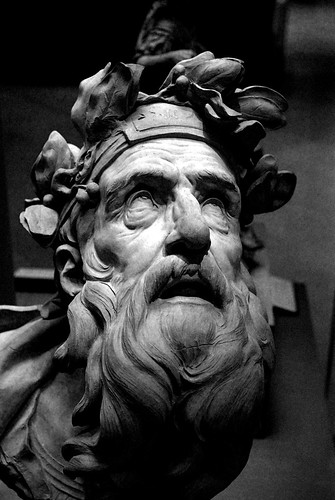
Sculpture of a Druid photographed at the Louvre
by Paul Kohler 


Jackson also portrays Caratacus as politically forced to tolerate the blood-thirsty Druid priests because of their influence with many tribesman, but not particularly superstitious or appreciative of their ritual sacrifices.  This may be Jackson's way of incorporating the fierce Druids into the narrative without giving them much sway with Caratacus since there are persistent legends about Caratacus' conversion to Christianity before he is ultimately taken to Rome.

The legend with the most historical evidence surrounds one Claudia Rufina, a historical British woman known to the poet Martial ( Martial, Epigrams, XI:53 (ed. & trans. D. R. Shackleton Bailey, Harvard University Press, 1993).  Martial describes Claudia's marriage to a man named Pudens thought to be Aulus Pudens, a friend of Martial's.  Since the 17th century, this pair have been identified with the Claudia and Pudens mentioned as members of the Roman Christian community in 2 Timothy of the New Testament (2 Timothy 4:21 - "Eubulus saluteth thee, and Pudens, and Linus, and Claudia, and all the brethren.") . Some biblical scholars have further claimed Claudia was Caratacus' daughter, and that the historical Pope Linus, described in an early church document as the "brother of Claudia" was Caratacus' son. These scholars point to the basilica of Santa Pudenziana in Rome, and with which St. Pudens is associated, which they say was once called the Palatium Britannicum and was the home of Caratacus and his family.

Anyway, back to our story.  Caratacus decides Rufus will best serve the Britons by setting Rufus free to return to the Roman lines so he can report the strength of the tribes in the hope that the sheer numbers will convince  Aulus Plautius, the Roman commander, to withdraw.  But Plautius does not give withdrawal a second thought and formulates a master plan with his legates the Flavian brothers, Vespasian and Sabinus.  Rufus, as a slave,  is not privy to any of the strategy and is once more subject to the whims of Narcissus who decides Rufus and Beersheba will be part of a "river rat" Batavian cohort that is being sent upriver to outflank the Britons.  Beersheba is the lynch pin in a dangerous river crossing where she will pull leather leads tied to rafts bearing the Batavian armor and equipment.  Obviously the author decided to use a ploy mentioned by Vegetius (De re militari III.7) in the 4th century describing how the Batavians were able to ford rivers with full armor (although an elephant was not mentioned).

A Batavian cavalry mask in the collections of
the Nijmegen Museum.
The flanking maneuver was to be supported by Vespasian's Legio II Augusta but Vespasian is delayed by  fierce resistance and Rufus must join the battle line as the Batavians numbers dwindle after repeated assaults.  [SLIGHT SPOILER AHEAD] Fortunately, Rufus is a skilled swordsman thanks to his earlier friendship with the gladiator Cupido and he not only stands firm but kills Togodumnus.

As for the actual historical record, there is some confusion about the fate of Togodumnus.  Cassius Dio says Togodumnus was killed in a battle along the Thames River.  Other scholars, including Barry Cunliffe of Oxford University, point to references in Tacitus that indicate a war leader with a similar name submitted to the Romans and became a client king over the territories of the Regini, the Atrebates, the Belgae and the Dobunni with a headquarters at Chichester, the site of Fishbourne Roman Palace.  (I've actually visited the Roman remains in Fishbourne and they are very impressive!) Jackson handles this discrepency by having another British leader who sided with the Romans against Togodumnus and Caratacus formally take the name Cogidumnus as part of his alliance pact.

Claudius finally makes his appearance and symbolically leads the legions in a string of followup skirmishes where he is hailed imperator and seals his place in history.  In Jackson's story, Claudius is not the drooling, stammering, frail individual portrayed in other tales.  Claudius actually assumes an imposing military posture, looking every bit the brother of the famous general Germanicus.  Jackson also portrays Claudius as able to address the Senate without a hint of a stammer and easily able to bend the assembly to his will.

The emperor Claudius photographed at
the Museo Archaeologico di Napoli by
Mary Harrsch.
Apparently, Jackson has chosen to take Suetonius' description of Claudius with a major dose of salt and instead present a character capable of drafting authoritative legislation regulating commerce, slavery, taxes and marriage, envisioning comprehensive public works such as the development of the port of Ostia  as  well as roads, canals and tunnels and utlimately dodging numerous assassination attempts while maintaining a firm grip on the reins of power.

However,  Jackson is not as generous in his portrayal of Claudius' freedman, Narcissus, who is revealed as cunning, manipulative and utterly. The ambitious courtier uses everyone around him, including Rufus, to promote his own ends although he protests that such actions are ultimately for the good of Rome.   This portrait of Narcissus as essentially faithless to all except Claudius is consistent with his behavior reported in the ancient sources.

The ancient sources say that Narcissus conspired with Messalina to convince Claudius to execute certain individuals that Narcissus may have deemed too powerful or too influential.  But later Narcissus turned on Messalina, reporting her infidelity to Claudius and when Claudius wavered about her punishment, gave the order for her execution himself.  Afterward, fearing Messalina's son, Britannicus, Narcissus tried to convince Claudius to remarry the emperor's second wife, Aelia Paetina, so Claudius would name Faustus Cornelius Sulla Felix, the husband of Claudius' daughter with Aelia, Claudia Antonia, as heir instead of Britannicus.  But when Claudius chose to marry Agrippina instead and named her son Nero to be his heir, then Narcissus allied with Britannicus against Agrippina and Nero.  So, as in this novel, he was truly a friend to no one, only an opportunistic courtier ultimately concerned only with his own future.

Jackson employs and interesting literary device in his story that I had never seen before, too.  Narcissus betrays a minor character in the novel and the way that the plot point is injected into the story reminded me of the execution of Anne Boleyn.  I have read that when the French swordsman prepared to cut off Boleyn's head, he signaled to an assistant who made a small commotion that caused Anne to turn her head in the direction of the disturbance therefore (mercifully?) distracting her at the moment the fatal blow was administered.   In this book, the author distracts the reader with a minor little battlefield drama just before assassins deal the death blow to a character not involved in the mini-drama, jarring the reader with its unexpected suddeness.  I'll have to remember that tactic if I ever write a novel myself!

The book closes with an epilogue describing Caratacus' entry into Rome.  A passage from an epic poem by William Mason came to mind:

I was born A king and 
Heav'n who bade these warrior oaks 
Lift their green shields against the fiery sun 
To fence their subject plain did mean that I 
Should with as firm an arm protect my people 
Against the pestilent glare of Rome's ambition 
I fail'd and how I fail'd thou know'st too well 
So does the babbling world and therefore 
Druid I would be any thing save what I am
Caractacus by William Mason, 1759


Despite years of defeat by superior forces and betrayal by a queen many thought may have been his former lover, Caratacus still walks proudly among the shouting crowds, awestruck by the magnificent architecture and opulence.  He courageously approaches the palace where he expects to be ritually strangled like the hapless Vercingetorix all those years before.  There he finally meets the emperor Claudius, and is surprised to find a rather frail-looking old man.   He must have thought:

Ye never felt the sharp vindictive spur 
That goads the injur'd warrior the hot tide 
That flushes crimson on the conscious cheek  
Of him who burns for glory
- Caractacus by William Mason, 1759

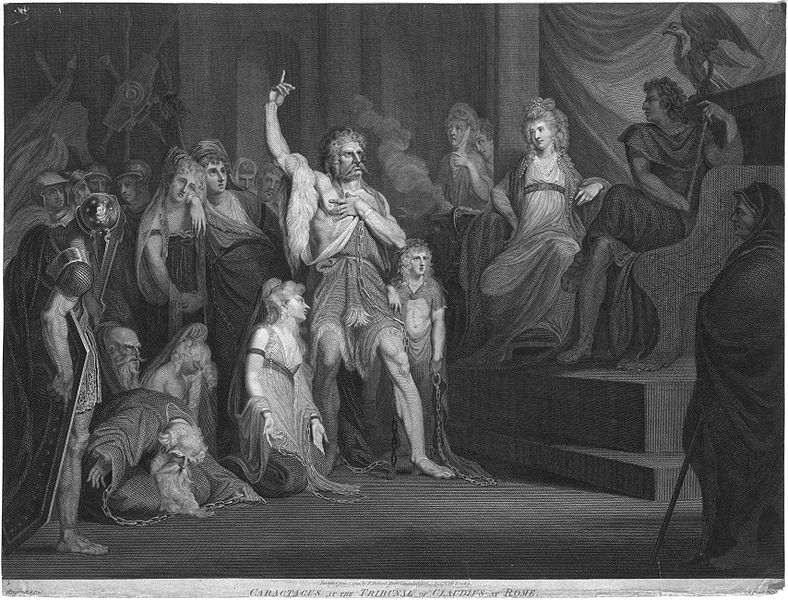
But this old man holds a defeated enemy's life in his withered hands and Caratacus has no doubt that a signal will be given to end his.   Instead Claudius gives him a chance to address the crowd expecting him to plead for his life.  But, Caratacus  simply asks "With all of this,  you covet our  huts?"

 Caractacus at the Tribunal of Claudius at Rome
Engraving by Andrew Birrell of a painting by Henry Fuseli, 1792
Historically, Caratacus was brought before the Senate where he made such an impression he was pardoned and allowed to live out his life peacefully in Rome after saying:

"If the degree of my nobility and fortune had been matched by moderation in success, I would have come to this City as a friend rather than a captive, nor would you have disdained to receive with a treaty of peace one sprung from brilliant ancestors and commanding a great many nations. But my present lot, disfiguring as it is for me, is magnificent for you. I had horses, men, arms, and wealth: what wonder if I was unwilling to lose them? If you wish to command everyone, does it really follow that everyone should accept your slavery? If I were now being handed over as one who had surrendered immediately, neither my fortune nor your glory would have achieved brilliance. It is also true that in my case any reprisal will be followed by oblivion. On the other hand, if you preserve me safe and sound, I shall be an eternal example of your clemency." - Tacitus, The Annals, translated by A. J. Woodman, 2004;

However, after he was freed, Cassius Dio says the famous Briton asked, "And can you, then, who have got such possessions and so many of them, covet our poor tents?" - Dio Cassius, Roman History, Epitome of Book LXI, 33:3c

Obiviously, the author thought a paraphrase of just the last quote would make a more elegant ending and I agree.

A note about the author:  Douglas Jackson is the assistant editor of The Scotsman in Edinburgh, Scotland.  He has spent 30 years working for various local and national newspapers around the UK.  His first up-close-and-personal experience with the Roman Empire came to him while he was a young student and spent a summer restoring a Roman marching camp at Pennymuir in the Cheviot Hills.  He has followed "Caligula" and "Claudius" with a series featuring Gaius Valerius Verrens, a tribune of the 20th Legion who faces off against Boudicca in "Hero of Rome".   In Jackson's latest novel,  "Defender of Rome,"   then Verrens is charged by Nero with capturing the leader of a new religious sect, the followers of Christus.
Enhanced by Zemanta
If you enjoyed this post, never miss out on future posts by following me by email!


Monday, July 6, 2009

Romans capture most slots on 10 most extravagant emperors list


I see that Roman emperors captured six of the 10 slots for Times Online's list of ten most extravagant emperors. I do wish professional journalists would at least get the facts straight, though.

[Image - Bust of Commodus dressed as Hercules in the Capitoline Museum in Rome. Photo by Mary Harrsch]

In the brief recap on Caligula, the Times repeated the myth that Caligula made his horse a consul. But classicist Michael Grant disavowed this oft quoted tale:

"Since the beginning of his reign Caligula had spent lavishly on public shows, games, and displays (sometimes even participating in them himself); in the most extravagant of these, he had hundreds of ships tied together to make a temporary floating bridge so that he could ride across the Bay of Naples on horseback. By 39, the public treasury was near bankruptcy. Therefore, at the beginning of the year Caligula revived the treason trials that had become so unpopular under Tiberius; he also began other methods of raising public money, including the auctioning off of public properties left over from shows. Many of these revealed his strange sense of humor (e.g., at one of these auctions a senator fell asleep and Caligula took each of his nods as bids, selling him 13 gladiators for a huge sum). In the words of historian Michael Grant, “Caligula had an irrepressible, bizarre sense of the ridiculous, deliberately designed to shock, but frequently taken by his alarmed subjects too seriously. Notoriously absurd traditions . . . such as the story that he intended to give a consulship to his favorite horse Incitatus no doubt originated from his continual stream of jokes. Probably he remarked that Incitatus would do the job as well as most of the recent incumbents; and meanwhile he ordered silence in the entire neighborhood, to prevent the horse from being disturbed” (The Twelve Caesars, [New York: Scribner, 1975], 113). Some of his jokes were more sadistic, as when he arranged an oratory competition in which all the losers had to erase their wax tablets with their tongues." - More: Vroma.org

The Times also mentioned how Nero was famous for fiddling (playing the lute) while Rome burned - another myth circulated at the time by his political enemies. They also portrayed him as obese. His appearance was certainly bizarre for the head of a militarily-based empire:

“He was of average height, fair-haired, with features that were pretty rather than handsome, weak blue eyes, a fat neck, pot belly, skinny legs, and a body which smelt and was covered with spots. . . . He was so insensitive about his appearance that he used to wear his hair in rows of curls, and when he was on his Greek trip he let it grow down his back. He usually appeared in public in a dressing-gown without a belt, a scarf round his neck, and no shoes.” (Suetonius, Nero 51)

I don't think I would classify him as "pretty" if he looked anything like this digital recreation by Richard Sebring though.

[Image courtesy of The Romans]

The summary for Commodus mentioned that he battled gladiators in the nude in public. I don't think I had ever heard of that before so I checked the Historia Augusta and all I could find there were references to his impropriety, so charged for dressing as a woman:

"Such was his prowess in the slaying of wild beasts, that he once transfixed an elephant with a pole, pierced a gazelle's horn with a spear, and on a thousand occasions dispatched a mighty beast with a single blow. 4 Such was his complete indifference to propriety, that time and again he sat in the theatre or amphitheatre dressed in a woman's garments and drank quite publicly." - Historia Augusta

Commodus had some really nasty dining habits, however:

"It is claimed that he often mixed human excrement with the most expensive foods, and he did not refrain from tasting them, mocking the rest of the company..." - Historia Augusta

and he did not shy away from humiliating his his praetor prefect:

"He pushed into a swimming-pool his praetor prefect Julianus,85 although he was clad in his toga and accompanied by his staff; and he even ordered this same Julianus to dance naked before his concubines, clashing cymbals and making grimaces." - Historia Augusta

Although the Historia Augusta is considered severely biased, the list it provides of Commodus' offenses would certainly place Commodus above Caligula in brutality in my book.

The Times list also includes Hadrian, one of the five "good" emperors, apparently for his lavish construction of his 250-acre villa in Tivoli.

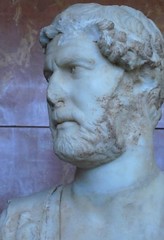
[Image -Bust of the Roman Emperor Hadrian found at Heraklion on Crete 127-128 CE now in the permanent collection of The Louvre. Photo by Mary Harrsch]

However, it should be pointed out that Hadrian did not accumulate his wealth by butchering other wealthy Romans like Commodus. On the contrary, Hadrian was known for his generosity:

Hadrian gave large sums of money to communities and individuals. He allowed the children of proscribed individuals to inherit part of the estate. The Augustan History says he wouldn't take legacies from people he didn't know or from people with sons who could inherit. He wouldn't allow maiestas (treason) charges. He tried in many ways to live unassumingly, like a private citizens. - More: About.com

Hadrian even paid 900,000,000 sesterces in back taxes to the Roman treasury.

"He remitted to private debtors in Rome and in Italy immense sums of money owed to the privy-purse,66 and in the provinces he remitted large amounts of arrears; and he ordered the promissory notes to be burned in the Forum of the Deified Trajan,67 in order that the general sense of security might thereby be increased. 7 He gave orders that the property of condemned persons should not accrue to the privy-purse, p25and in each case deposited the whole amount in the public treasury. 8 He made additional appropriations for the children to whom Trajan had allotted grants of money.68 9 He supplemented the property of senators impoverished through no fault of their own, making the allowance in each case proportionate to the number of children, so that it might be enough for a senatorial career;69 to many, indeed, he paid punctually on the date the amount allotted for their living. 10 Sums of money sufficient to enable men to hold office he bestowed, not on his friends alone, but also on many far and wide, 11 and by his donations he helped a number of women to sustain life. 12 - Historia Augusta

As commander in chief he also ensured that the army was properly equipped and money wasn't squandered on poorly made equipment or tainted supplies:

"...he strove to have an accurate knowledge of the military stores, and the receipts from the provinces he examined with care in order to make good any deficit that might occur in any particular instance. But more than any other emperor he made it a point not to purchase or maintain anything that was not serviceable." - Historia Augusta

So, although Hadrian spent a lot of money on innumerable projects, he apparently spent his own money - not money confiscated from his fellow Romans like Commodus or Caligula. I couldn't find any references to how Hadrian accumulated his wealth. It must have been a combination of inherited wealth and tribute paid by conquered tribes either to Hadrian himself or to Trajan that was then passed on to Hadrian upon his adoption.
If you enjoyed this post, never miss out on future posts by following me by email!