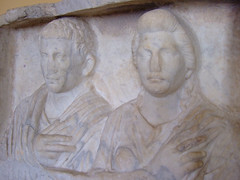
When I glanced at the images of some of the sculptures in the new exhibit, "An Antiquity of Imagination: Tullio Lombardo and Venetian High Renaissance Sculpture" at the National Gallery of Art in Washington D.C., I could hardly believe I was looking at Renaissance sculpture and not Roman funerary art (except for the bared breasts - the ancient Romans were a little more modest than that!).
"Carved from a single block of marble in high relief, this double portrait is so deeply undercut that the two figures appear almost in the round. Traces of applied color survive on the eyes, the lips, and the background, which was once black. The intense emotions of the pair, who do not look at each other, remain a mystery. Was this work a memorial, emulating Roman funerary reliefs of married couples? An ancient love story, perhaps with a tragic conclusion? A pair of idealized contemporary portraits in antique guise? At a time when even formal portrait busts were rare in Venice, this ambiguity may have been part of Tullio’s appeal. The prominent signature was inscribed at a point perhaps meant to be at the viewer’s eye level." - National Gallery of Art.
This tomb sculpture

would have looked quite natural along side the collection of ancient funerary art I saw this past spring displayed in the new tunnel gallery of the Capitoline Museum in Rome or in the halls of the Getty Villa like the first century CE grave monument of the freedman Popillius and wife Calpurnia [right] I photographed there.
Grieving was actually regulated by the Roman state.
Pompilius Numa, the legendary second king of Rome (c. 715-673 BC), was credited with creating the basic framework for Roman public religion and the grief process.
Numa himself set out rules for the periods of mourning according to age and time. So, for xample, there was to be no mourning at all for a child of less than l year; for a child older than that, up to 10 years old, the mourning was not to last more months than it had lived years; and the longest time of mourning for any person was not to exceed 10 months. This was also the time set for
widowhood for women who had lost their husbands, and any woman who took another husband before this time was out was obliged by the laws of Numa to sacrifice a cow with calf. - Plutarch, Numa 12.
Paulus further interpreted the mourning laws of the Twelve Tables in a legal opinion in the late 2nd c. or early 3rd c. AD.
"Parents and children over 6 years of age can be mourned for a year, children under 6 for a month. A husband can be mourned for 10 months, close blood relatives for 8 months. Anyone who acts contrary to the restrictions is placed in public disgrace. Anyone in mourning ought to refrain from dinner parties, jewellery and other adornments, and purple and white clothing." - Paulus, Opinions 1.21.2-5
Although Roman males were expected to keep a "stiff upper lip" when it came to mourning one's lost loves, I could easily imagine an inscription quoting a line from the Roman poet Tibullus, "May I look on you when my last hour comes; as I die, may I hold your hand in my failing grasp."

The exhibit also features the bust of a grieving heroine, with head tilted slightly, by Antonio di Giovanni Minello, a great admirer of Tullio Lombardo [left]. It reminded me of a Roman Imperial Period sculpture of a goddess at the Palazzo Altemps, Museo Nazionale Romano [below right].
"The sculptor’s admiration for Tullio is suggested by the tragic expression, seminude treatment, and intricately  winding hair, which is raised in relief in some places and incised into the marble in others. The medallion above her forehead is based on a famous ancient gem. The Trojan hero Aeneas is among the identities proposed for the seated figure in Minello’s version. If it is he, the woman would be his grief-stricken lover Dido, queen of Carthage, whom he abandoned." - National Gallery of Art.

A relief of Mars (left) by Tullio's younger brother, Antonio Lombardo, seems to have been inspired by the Ludovisi Ares or the seated warrior thought to be the pendant to the Ludovisi Ares [below right], a second century BCE copy of a Greek original, also on display at the Palazzo Altemps in Rome.

"This deeply undercut high relief reflects a type of small sculpture developed by Tullio Lombardo’s younger brother Antonio for the luxurious private chambers of the Duke of Ferrara. Reliefs like this one, with single figures based on ancient myth, history, or philosophy, soon gained popularity among collectors. Here, the ancient Roman god of war, full of an energy echoed by his windblown drapery, appears amid his divested armor. Some believe this relief was made to be paired with a marble version of the bronze
Peace. Others argue that the inscription refers to Mars’ amorous exploits and that a more likely pendant would be Venus, the goddess of love." -
National Gallery of ArtTullio Lombardo, also known as Tullio Solari, was born into a family of sculptors in 1460. After studying in Rome, he returned to the family business that had been established in Venice after a short sojourn in Padua. Building upon his father's style, Tullio developed a more natural form with fluid lines.
The Lombardo family branched out into architecture as well, building the Church of S. Maria dei Miracoli, and contributing to numerous other structures, including the Church of S. Giobbe and the Scuola di S. Giovanni Evangelista.
In Venice the Church of SS. Giovanni e Paolo [Zanipolo] contains two sculptural works of Tullio: the Monument to Doge Pietro Mocenigo, executed with his father and brother, and the Monument to Doge Andrea Vendramin, an evocation of a Roman triumphal arch encrusted with decorative figures, which appears to be Tullio's work alone. To Tullio are also attributed the Funeral Monument of Cav. Marco Cornaro in the Church of SS. Apostoli and the frieze in the Cornaro Chapel of the Church S. Maria Gloriosa dei Frari. - More: Boglewood.com
"The Lombardos' church monuments reflected the latest Florentine ideas about reviving classical antiquity through statues inspired by archaeological finds. The exhibit displays only four sculptures known to be solely carved by Tullio, but these are enough to demonstrate his enormous talent. The most striking are marble reliefs portraying two couples, each figure carved so deeply as to resemble a freestanding bust set against a block of stone.
With its rounded faces, glancing eyes and curly hair, the earlier work from around 1490-1495 reveals Tullio's close study of Roman funerary reliefs and other ancient sculptures. However, its depiction of a toga-clad man and bare-breasted woman isn't just a dry copy but is infused with the psychological intrigue of a Giorgione or a Titian.
The pairing suggests a bridal couple doomed to separation, since the figures seem to occupy different worlds. They do not face one another but stare in opposite directions, their full lips parted as if sighing at an unseen presence. - More: The Washington Post
The exhibit is tiny - only a dozen sculptures - but well worth a look if you are planning a visit to the National Gallery anytime soon. The exhibit will be on display until October 31, 2009.
Read more about it!


If you enjoyed this post, never miss out on future posts by following me by email!