Showing posts with label statue. Show all posts

Wednesday, March 24, 2021

Rome's integration of Isis

In the first millennium BCE, Osiris and Isis became the most widely worshipped Egyptian deities, and Isis absorbed traits from many other goddesses. Rulers in Egypt and its neighbor to the south, Nubia, built temples dedicated primarily to Isis, and her temple at Philae was a religious center for Egyptians and Nubians alike. Her reputed magical power was greater than that of all other gods, and she was said to protect the kingdom from its enemies, govern the skies and the natural world, and have power over fate itself.

In the Hellenistic period (323–30 BCE), when Egypt was ruled and settled by Greeks, Isis was worshipped by Greeks and Egyptians, along with a new god, Serapis. Their worship diffused into the wider Mediterranean world. Isis's Greek devotees ascribed to her traits taken from Greek deities, such as the invention of marriage and the protection of ships at sea, and she retained strong links with Egypt and other Egyptian deities who were popular in the Hellenistic world, such as Osiris and Harpocrates. As Hellenistic culture was absorbed by Rome in the first century BCE, the cult of Isis became a part of Roman religion. Her devotees were a small proportion of the Roman Empire's population but were found all across its territories. Her following developed distinctive festivals such as the Navigium Isidis, as well as initiation ceremonies resembling those of other Greco-Roman mystery cults. Some of her devotees said she encompassed all feminine divine powers in the world.

Authorities in the Republic tried to define which cults were acceptable and which were not, as a way of defining Roman cultural identity amid the cultural changes brought on by Rome's expansion. In Isis's case, shrines and altars to her were set up on the Capitoline Hill, at the heart of the city, by private persons in the early first century BCE. The independence of her cult from the control of Roman authorities made it potentially unsettling to them. In the 50s and 40s BCE, when the crisis of the Roman Republic made many Romans fear that peace among the gods was being disrupted, the Roman Senate destroyed these shrines, although it did not ban Isis from the city outright.

Egyptian cults faced further hostility during the Final War of the Roman Republic (32–30 BCE), when Rome, led by Octavian, the future emperor Augustus, fought Egypt under Cleopatra VII. After Octavian's victory, he banned shrines to Isis and Serapis within the pomerium, the city's innermost, sacred boundary, but allowed them in parts of the city outside the pomerium, thus marking Egyptian deities as non-Roman but acceptable to Rome. Despite being temporarily expelled from Rome during the reign of Tiberius (14–37 CE), the Egyptian cults gradually became an accepted part of the Roman religious landscape. The Flavian emperors in the late first century CE treated Serapis and Isis as patrons of their rule in much the same manner as traditional Roman deities such as Jupiter and Minerva. The cults also expanded into Rome's western provinces, beginning along the Mediterranean coast in early imperial times. At their peak in the late second and early third centuries CE, Isis and Serapis were worshipped in most towns across the western empire, though without much presence in the countryside.[145] Their temples were found from Petra and Palmyra, in the Arabian and Syrian provinces, to Italica in Spain and Londinium in Britain.

My closeup of the Marble statue of Isis found at Hadrian's Villa that I photographed at the Capitoline Museum in 2005.

Marble statue of Isis, the goddess holds a situla and sistrum, ritual implements used in her worship, from 117 until 138 CE, found at Hadrian's Villa (Pantanello), Palazzo Nuovo, Capitoline Museums, courtesy of  Wikimedia Commons contributor Carole Raddato.

Statue of Isis-Persephone holding a sistrum. Temple of the Egyptian gods, Gortyn. Roman period ( 180-190 CE) at the Archaeological Museum in Herakleion, courtesy of Wikimedia Commons contributor Wolfgang Sauber.

Bust of Isis-Sothis-Demeter. White marble, Roman artwork, second part of Hadrian's reign, ca. 131–138 CE. From the gymnasium in the Villa Adriana, near Tivoli, courtesy of Wikimedia Commons contributor Marie-Lan Nguyen.

Roman statue of Isis at Kunsthistorisches Museum in Vienna, Austria courtesy of Wikimedia Commons contributor Manfred Werner. 

Head of divinity, possibly Isis, 2nd century CE, at the Musée Saint-Raymond courtesy of Wikimedia Commons contributor Daniel Martin.

Roman statue of Isis from the 1st - 2nd century CE at the Museo Nazionale Romano, Terme di Diocleziano, courtesy of Wikimedia Commons contributor Szilas.


If you enjoyed this post, never miss out on future posts by following me by email!


Tuesday, March 23, 2021

Mars and the Roman celebration of war


Statue of the Roman emperor Hadrian as Mars, God of War, 117–125 CE, that I photographed at the Capitoline Museums, Rome, Italy

In ancient Roman religion and myth, Mars was the god of war and also an agricultural guardian, a combination characteristic of early Rome. He was the son of Jupiter and Juno, and he was the most prominent of the military gods in the religion of the Roman army. 

Under the influence of Greek culture, Mars was identified with the Greek god Ares, whose myths were reinterpreted in Roman literature and art under the name of Mars. But the character and dignity of Mars differed in fundamental ways from that of his Greek counterpart, who is often treated with contempt and revulsion in Greek literature. Mars' altar in the Campus Martius, the area of Rome that took its name from him, was supposed to have been dedicated by Numa, the peace-loving semi-legendary second king of Rome. Although the center of Mars's worship was originally located outside the sacred boundary of Rome (pomerium), Augustus made the god a renewed focus of Roman religion by establishing the Temple of Mars Ultor in his new forum.

Although Ares was viewed primarily as a destructive and destabilizing force, Mars represented military power as a way to secure peace, and was a father (pater) of the Roman people. In the mythic genealogy and founding myths of Rome, Mars was the father of Romulus and Remus by his rape of Rhea Silvia. His love affair with Venus symbolically reconciled the two different traditions of Rome's founding; Venus was the divine mother of the hero Aeneas, celebrated as the Trojan refugee who "founded" Rome several generations before Romulus laid out the city walls.

Most of Mars' festivals were held in March, the month named for him (Latin Martius), which began the season for military campaigning and October, that ended the season for campaigning and farming.  

The Tubilustrium was the ceremony held using tubae, sacred trumpets,  to make the army fit for war. The ceremony was held on March 23, the last day of the Quinquatria festival held in tribute to the Roman God Mars and Nerine, a Sabine goddess. The Salii, the "leaping priests" (from the verb saliō "leap, jump") of Mars supposed to have been introduced by King Numa Pompilius, danced through the streets. They were twelve patrician youths, dressed as archaic warriors: an embroidered tunic, a breastplate, a short red cloak (paludamentum), a sword, and a spiked headdress called an apex. They were charged with the twelve bronze shields called ancilia, which, like the Mycenaean shield, resembled a figure eight. One of the shields was said to have fallen from heaven in the reign of King Numa and eleven copies were made to protect the identity of the sacred shield on the advice of the nymph Egeria, consort of Numa, who prophesied that wherever that shield was preserved, the people would be the dominant people of the earth.

If you enjoyed this post, never miss out on future posts by following me by email!


Wednesday, November 25, 2020

Small Etruscan bronzes

 The Etruscans had a strong tradition of working in bronze from very early times, and their small bronzes were widely exported. Ancient sources reveal accounts of large numbers of statues sent to Rome after their conquest.  According to Pliny, the Romans looted 2,000 bronze statues from the city of Volsinii alone after capturing it.

The Etruscans excelled in portraying humans. In the 7th century BCE they started depicting human heads on canopic urns and when they started burying their dead in the late 6th century BCE they began portraying full figures on terracotta sarcophagi and funerary urns, often reclining as if at the funeral banquet.

Apart from cast bronze, the Etruscans were also skilled at the engraving of cast pieces with complex linear images, whose lines were filled with a white material to highlight them.  This technique was used primarily on mirrors and cistae. Sadly, few pieces survive with the defining filling still intact.


Image: Bronze statuette of a youth, late 5th century BCE, Etruscan, thought to be from Veii. This exquisite statue depicts a nude young man with hands raised in the ancient prayer gesture. The facial features, hair, and musculature are all precisely and accurately modeled. The stance and even the hairstyle with long wavy locks parted at the center owe much to Greek sculptures by Polykleitos, especially his Doryphoros and Diadoumenos. However, the slightly almond-shaped eyes reflect a hint of the Etruscan origin.  Courtesy of the Metropolitan Museum of Art.

If you enjoyed this post, never miss out on future posts by following me by email!


Wednesday, April 15, 2009

Yes We Can! salute to Caesar on the Ides


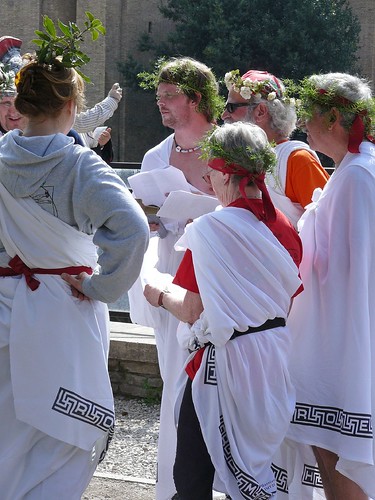
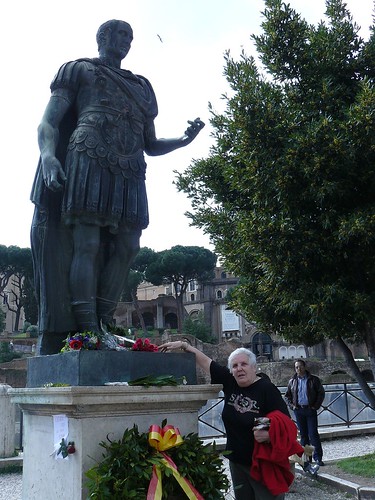
When I was in Rome on the Ides of March this year and went to pay my respects to Caesar's statue that stands along the Via Foro Imperiali, my friend and I saw a huge wreath at the foot of the bronze sculpture of him. This must have been the one referred to in this article. It's too bad we had not been there just a little sooner! As it was, we got to witness a group of American college students dressed in make-shift togas and adorned with wreaths made from plants probably pilfered from a nearby hotel or park. They sang bawdy songs that I'm sure Caesar's tenth legion would have been proud of then gave their somewhat altered rendition of the death scene from Shakespeare's play "Julius Caesar" complete with shouts of "Yes We Can!"

"Recently, residents and tourists around the Coliseum watched in awe as a legion of Roman soldiers marched in unison down Rome’s Imperial Avenue.

“Caesar!” called out the commander in Latin as the legion came to a stop. “I, Centurion Lucius Valerius Seianus, have brought your favorite legion here to return the scepter of command to your hands!”

A horn blared as the Centurion placed a large laurel crown on the pedestal of the statue of Julius Caesar, the great Roman general who was stabbed to death in the Forum 2,053 years that day — March 15, or the "Ides of March." - More: Global Post.com

My friend, Patricia Hunter, author of "Immortal Caesar", always brings roses to lay on Caesar's funeral pyre and on his statue whenever she visits Rome. Here, she places this year's offering.

While we were at the statue of Caesar a Roman family approached the statue and the father of the family took out some sheets of paper, held his hand up in salute and began reading a memorial to Caesar while his son respectfully placed his hand on his father's shoulder and raised a salute as well. It was very touching even though I couldn't understand what he was saying. After fifteen minutes or so, though, I told Pat that the man must have decided to recite the entire Commentarii de Bello Gallico so we moved on!

[Photo credits: Top left: Image courtesy of Fulvio Paolocci]; Other photos by Mary Harrsch]

If you enjoyed this post, never miss out on future posts by following me by email!


Saturday, October 18, 2008

A God From Dresden


I found the following article very interesting. Having photographed hundreds of statues in some of the world's finest museums, including the Getty Villa, I often marvel at the subtle clues scholars use to identify art that is often unearthed in fragments with no inscriptions to provide a hint of identify. Often it is the hairstyle, fashion or degree of sensuousness and comparisons to existing identified statues from the time period (if period can be ascertained) that often determine the description presented to the public.

In this case, a headless statue from a Dresden museum collection, is being studied by modern conservators at the Getty to see if some agreement can be reached as to how to present this work of art. I found it amusing that conservators across the centuries have identified it as Alexander the Great (adding suitable accessories), Antinous and, ultimately, Bacchus at different points in time. At a Getty colloquium in August, attendees generally expressed their leanings toward Bacchus, but the Getty has decided to make the conservation of the statue (to be exhibited headless), rather than a predetermined identity, the focus for its upcoming premiere at the Getty in December.

"On a recent sunny Saturday, while most Southern Californians were deployed somewhere enjoying a weekend hiatus, 20 art historians, conservators and museum officials shifted in their chairs around a long, U-shaped table in an air-conditioned conference room at the Getty Villa in Malibu, theorizing, listening and pondering out loud whose head to put on a headless 1,800-year-old Roman statue.

The result of their scholarly exchanges and deliberations would determine whether the future identity of the monumental white marble semi-nude, 2nd century male being reassembled in the Getty's workshop would be the Roman god Bacchus or the real-life boy lover of the Emperor Hadrian, known as Antinuous, or the Greek conqueror Alexander the Great.

Imagine such a group in future millenniums trying to decide whether a headless torso dating from 20th century America was originally a likeness of Elvis Presley, Truman Capote or Dwight D. Eisenhower.

Such challenges have faced collectors and curators of classical antiquity since Roman statuary began being unearthed by archaeologists in the 17th century, often missing heads and limbs and conclusive identities. The decisions made by museums through the years regarding how best to present and display these precious remains of the Greek and Roman past have reflected changing attitudes toward conservation and its purposes, aligned with improved methods and techniques.

The Saturday workshop convened by the Getty's Antiquities Conservation Department offered a case study in the current state of the rarefied craft. It wasn't until the mid-20th century that conservation became a profession and the custom of restoring damaged statues by whatever means was supplanted by the desire to display them closer to the state in which they were found.

"How comfortable are we, after all these restorations, to show a statue without a head?" Jens Daehner, the German-born assistant curator of antiquities at the Getty, asked during his own formal remarks that reviewed the statue's various incarnations since its first known display in Rome in 1704, when it carried an ancient female head (not original to it), probably a likeness of Athena but restored with a helmet so as to match an image of Alexander the Great seen on Greek coins. Though this sounds contrived by today's standards of archaeology, during the Baroque era a preference for complete sculptures allowed and encouraged such improvisation.

After the statue was removed from Italy in 1733 by a Saxon prince and brought to Dresden, it was modified again to include a fig leaf and a spear, still identified as Alexander. Then in 1804, according to a contemporary catalog of the museum's collection, it became Bacchus (Dionysus to the Greeks), a result of prevailing notions about its body type and drapery style, but retained the previous head and helmet associated with Alexander -- while losing the earlier restored right arm along with the fig leaf and spear.

Changing parts

WHAT Podany referred to as "the unrecognized power of the restorer" was demonstrated when, during the tenure of the sculptor Emil Cauer the Elder as a restorer in the Dresden antiquities collection, the statue became "Antinuous in the guise of Bacchus," with a new head made of plaster and a new plaster right arm attached.

Then, in 1894, a new director of the museum replaced Cauer's Antinuous head with a plaster cast of another Antinuous on display in the British Museum. The right arm was again removed, and this was the state of the statue when it was placed in storage during the Dresden museum's closure due to World War II. It was not damaged during the bombing of Dresden but in June 1945 was shipped to Moscow along with the rest of the collection, regarded as the spoils of war.

By the time it was returned to Dresden by train in 1958, the statue had suffered extensive damage in transit and had broken into 158 pieces. It remained out of sight, stored in four wooden crates until those crates were air-freighted to the Getty in November.

In his remarks, Daehner mentioned the "high, wide chest" to be a signifier of Antinuous, yet the absence of long hair on the shoulders pointed again to the god of wine. "I am convinced we are dealing with a statue of Dionysus," the curator said. He also noted that a piece of paper plugged into a plastered hole turned out to be a page from a book published in 1894, but this detail did not aid the investigation.

After Marc Walton, a scientist at the Getty Conservation Institute, showed a microscopic slide of the statue's Carrara marble exterior that looked like the surface of the moon and revealed "multiple plasters, referring to different campaigns of restoration," the group adjourned to the studio to see the statue itself, headless but otherwise impressive. It rose somewhat larger than life (6 feet, 8 inches) from a wood pallet, its white torso supported temporarily by a heavy chain hoist. Seeing the statue reassembled for the first time in their lifetimes, the scholars and conservators circled it and examined the details of its drapery; the pitch, or attitude, of its interface with the platform; the fissures and lines revealing where the fragments had been attached." - More
If you enjoyed this post, never miss out on future posts by following me by email!


Tuesday, April 15, 2008

Statue of Lucius Verus recovered in Rome


"A statue of Lucius Verus, who ruled ancient Rome alongside his more famous adopted brother Marcus Aurelius, was recently recovered among a cache of looted artifacts, Italian officials say.

Investigators found the intricately carved marble head in a boathouse near Rome, saying the find was particularly significant because Lucius was reluctant to pose for official portraits. Only four other depictions of Lucius are known to exist, experts said.

The likeness will prove useful to scholars studying the mysterious ruler, whose family saga was complex enough to rival most prime-time soaps.

Lucius was the son of a Roman senator who was in line to succeed the emperor Hadrian. When the emperor died, Hadrian selected another successor and ordered him to adopt both Lucius and Hadrian's own nephew, Marcus Aurelius, as his sons.

The brothers rose to power as co-emperors in A.D. 161. But Marcus reportedly arranged to be sole bearer of the title pontifex maximus, or high priest, giving him more authority.

Whether the "other" emperor was shy or merely overshadowed, Lucius will take on a very public profile later this month, when the newfound statue goes on display in a Roman museum."

If you enjoyed this post, never miss out on future posts by following me by email!


Sunday, April 13, 2008

Equestrian Statue Fragment Found Near Colosseum


"A fragment of an ancient Roman equestrian statue that once adorned the Colosseum has been found during excavations near the world famous Italian landmark.

According to the Italian daily, Il Messaggero, the fragment was discovered among the remains of an ancient pavement that once surrounded the amphitheatre.

"A marble fragment measuring one metre by a metre and a half, is from an equestrian statue, probably a statue that embellished the arches of the Colosseum," said archaeologist Silvana Rizzo, advisor to the minister of culture and tourism, Francesco Rutelli.

"The left flank of a rider with the detail of a leg, bridle and harness of a horse, as well as a part of a dagger scabbard are perfectly visible from the fragment," said Rizzo, who has spent his life doing Roman excavations.

"They are details that suggest the statue of an emperor and left us with the hope that we could find the entire statue."

Update: "Two days later the head of a male statue was discovered, both of which had been only 50cm below the surface. According to archaeologists the piece of the equestrian statue suggests one of an emperor due to its size and most likely adorned the arch over the imperial entrance. The head is too small to be that of the rider of the horse in the equestrian statue."
If you enjoyed this post, never miss out on future posts by following me by email!


Sunday, January 13, 2008

Colossal statue of Hadrian found at Sagalassos, Turkey to be highlight of new British Museum exhibition

Two thousand years after he built a wall across Britain to keep out the barbarians, Hadrian is returning to this part of his empire. More than 200 treasures relating to the Roman Emperor will go on display in a block-buster exhibition this summer, the British Museum announced yesterday.

Spectacular artefacts that have only just been found will be among loans from 31 countries - a reflection of the global scale of Hadrian’s empire. It extended from Scotland to the Sahara, and from the Nile to the Danube.

Negotiations are now under way to bring to London a colossal marble statue of Hadrian that was found only a few months ago at Sagalassos, Turkey.

Archaeologists were excavating the site of a huge Roman bath complex, whose construction began under Hadrian, when they found the lower part of a leg and a foot with an exquisitely decorated sandal. The foot alone is about 0.8 metres (2.6ft) long. The complete statue, topped by an imposing head, was originally nearly five metres high. Traces of red paint have survived on both the hair and sandal...

The exhibits will include a sculpture of Hadrian’s wife, created with a beauty that, according to Thorsten Opper of the British Museum, “would have had Michelangelo in raptures, if he had seen it”.

There will also be exquisite bronzes, including an extraordinary statue found in Israel in the 1970s and a silver bowl bearing an intricate portrait of his young Greek lover, Antinous, who accompanied him on his travels around the empire.

A papyrus fragment will give an insight into the man himself as the only surviving section of Hadrian’s autobiography. Its contents are particularly touching in that Hadrian described the loss of his father at the age of 9.

The show also includes objects from the museum’s own collection such as the famous Vindolanda wooden tablets, the oldest surviving examples of handwriting in Britain, which were discovered near Hadrian’s Wall.

Before the exhibition, a bronze head of the emperor from the 2nd century AD will travel to both ends of the wall, which extends 80 miles from the Solway Firth to the Tyne at Wallsend. The head, one of the rare remaining bronzes from Roman times, has never left the museum since its discovery in the Thames in 1834."

This sounds like a fantastic exhibit. If the blood clot in my leg dissolves in time, maybe I can pop over to London and have a look!


If you enjoyed this post, never miss out on future posts by following me by email!