Monday, July 19, 2010

Viewing Frescoes from Agrippa's Villa Farnesina Like The Ancient Romans

I see that the National Museum at the Palazzo Massimo has added a new dynamic lighting system to the display of the frescoes recovered from the Villa Farnesina, thought to have been one of the residences of Augustus' friend, general and admiral, Agrippa.

"A sophisticated and unique lighting system that recreates daylight hours from dusk to dawn in 100-second cycles lets visitors hone in on the details of the frescoes and vault stuccoes, which depict mythological scenes as well as more mundane activities. “It’s akin to seeing through the eyes of ancient Romans,” said Stefano Cacciapaglia, one of the architects who worked on the project." - More: New York Times

I wish I could have examined the frescoes with the new system when I visited the National Museum back in March 2009.   I was particularly impressed with the detail the artist captured in the faces, still discernible after more than 2000 years.

If you enjoyed this post, never miss out on future posts by following me by email!


Sunday, July 18, 2010

Don't miss my review of Steven Saylor's "Empire"!!

Empire: The Novel of Imperial Rome (Novels of Ancient Rome)I just finished an extensive review of Steven Saylor's new novel "Empire" and posted it to my Books and Novels of the Ancient World blog.    The novel follows the fictional patrician Pinarii family from the late Augustan Age to the reign of Hadrian with particularly fascinating "behind the scenes" exploration of the reigns of Nero and Domitian.  I found the novel so fascinating that I spent hours on supplemental research after I finished reading it to learn more about some of the personalities introduced in the novel that I knew very little about.  I highly recommend it!  Five Stars!!
If you enjoyed this post, never miss out on future posts by following me by email!


Thursday, July 8, 2010

One Time Gallic Emperor Defeated by Aurelian depicted on coins in British Hoard

News of the discovery of over 52,000 Roman coins in southwest England near the town of Frome, many depicting Tetricus, really excited me.  There were even a few depicting Marcus Aurelius Carausius a military commander who seized power in the late third century and proclaimed himself emperor of Britain and northern Gaul. I had to do a little research since most of my study has focused on the Roman Republic and the early Empire so I was unfamiliar with Tetricus although Carausius appeared in  "The Silver Branch" one of my favorite novels by Rosemary Sutcliff .

Caius Pius Esuvius Tetricus is one of the so-called thirty tyrants listed in the Historia Augusta of the secessionist Gallic Empire, a breakaway realm founded by Postumus, a one-time governor of Germania, in 260 CE  after repeated barbarian invasions brought instability to the Roman Empire.  At its height the Gallic Empire encompassed the territories of Germania, Gaul, Britannia, and Hispania.

[Coin depicting Tetricus I.  Image from Rasiel's Roman Imperial Type Set courtesy of Wikimedia Commons.]  

Although Postumus was assassinated in 268 CE and the empire lost much of its territory, it continued under a succession of emperors including the last, Tetricus, until he was defeated by the  Roman Emperor Aurelian at the Battle of Châlons in 274 CE.

 Surprisingly, Aurelian did not execute Tetricus or his son, Tetricus II.after they were forced to march in Aurelian's triumph.  In fact Aurelian gave Tetricus the title of corrector Lucaniae et Bruttiorum, governor of a southern region of Italia.  Aurelian may have rewarded Tetricus because Tetricus fought off Germanic barbarians who had begun ravaging Gaul after the death of Victorinus, and retook Gallia Aquitania and western Gallia Narbonensis, thereby laying the groundwork for a complete restoration of these territories to the Roman Empire.

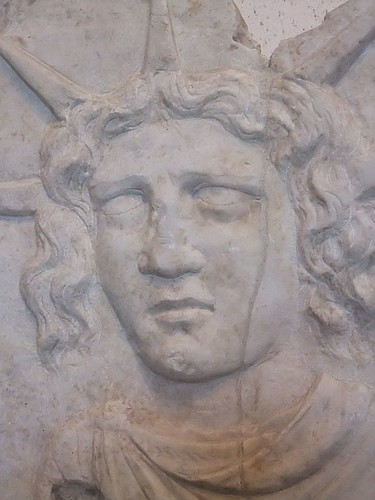
A slab dedicated to Sol Invictus and to the
Genius of the Emperors Chosen Horse Guards
- Equites Singulares.  Photographed at the
National Museum of Rome galleries in the remains
of the Baths of Diocletian, Rome, Italy by
Mary Harrsch.
Aurelian's act of clemency not only served the Empire but perhaps was an expression of his deeper spiritual beliefs  He also did not execute Queen Zenobia of Palmyra when he defeated her troops in the east following their rebellion.  It's too bad his own troops didn't harbor as much clemency for him as he was murdered by his own staff on his way to Persia.  Especially ironic considering that Aurelian laid the foundation for "one god, one empire",  proclaiming the god Sol Invictus as the central figure in the Roman Pantheon.  Constantine managed to garner all the glory for adopting one god for the Roman Empire but Aurelian was there first.  Religious scholars will argue that Constantine adopted Christianity not a pagan god but there were times when Constantine referred to Sol Invictus in his iconography and scholars still argue if Constantine was truly promoting Christianity or unification of the empire through the worship of a single god as Aurelian had tried to do.

" Statuettes of Sol Invictus, carried by the standard-bearers, appear in three places in reliefs on the Arch of Constantine. Constantine's official coinage continues to bear images of Sol until 325/6. A solidus of Constantine as well as a gold medallion from his reign depict the Emperor's bust in profile twinned ("jugate") with Sol Invictus, with the legend INVICTUS CONSTANTINUS[29]
Constantine decreed (March 7, 321) dies Solis—day of the sun, "Sunday"—as the Roman day of rest [CJ3.12.2]:
On the venerable day of the Sun let the magistrates and people residing in cities rest, and let all workshops be closed. In the country however persons engaged in agriculture may freely and lawfully continue their pursuits because it often happens that another day is not suitable for grain-sowing or vine planting; lest by neglecting the proper moment for such operations the bounty of heaven should be lost.[30]
Constantine's triumphal arch was carefully positioned to align with the colossal statue of Sol by the Colosseum, so that Sol formed the dominant backdrop when seen from the direction of the main approach towards the arch.[31]" - Wikipedia
 Back in October 2009, a couple of researchers argued in the Proceedings of the National Academy of Science that large numbers of coin hoards are a good quantitative indicator of population decline. They also pointed out that in periods of social upheaval we are familiar with like the Second Punic War, the Social Wars, and the civil wars, hoarding behavior soared.[See Wired Science]

Although they were studying coin hoards from the second and first century BCE, their theory would indicate that there are a lot more hoards from the third century CE still waiting to be found, as we know from the historical record that the third century was a period of massive social upheaval. Maybe I'd better ship my husband and his metal detector off to England as an investment strategy!

Romano-British Coin Hoards (Shire Archaeology)   Handbook of Ancient Greek and Roman Coins: An Official Whitman Guidebook   Aurelian and the Third Century (Roman Imperial Biographies)   Restorer of the World: The Emperor Aurelian   The Religious Context of Early Christianity: A Guide to Graeco-Roman Religions   Carausius and Allectus: The British Usurpers   The Catastrophic Era:: Rome Versus Persia in the Third Century   Rome's Gothic Wars: From the Third Century to Alaric (Key Conflicts of Classical Antiquity)   The Silver Branch


If you enjoyed this post, never miss out on future posts by following me by email!


Tuesday, July 6, 2010

Human skeleton unearthed in newly discovered Gloucestershire Roman villa

Remains of a bath complex at Lullingstone Villa.
Photo by Mary Harrsch
I noticed this news release today so I'm assuming this dig is centered on a newly discovered villa not the well known Chedworth site near Cheltenham.

A 2,000-year-old human skeleton has been discovered alongside Iron Age artefacts near Tewkesbury.  The experts do not know yet whether the skeleton is of a male or female but believe it is at least 2,000 years old.

Stuart Foreman of Oxford Archaeology said thousands of pieces of masonry, nails, tiles, pottery and clothing would be unearthed by the time the project is complete.


He said: "Fragments of stone peg-tiles from the roof and sections of painted wall plaster indicate a building of high quality and status. The footings survive to a height of nearly 1m cut into the hillside." - Sify News
 Actually, a number of villas have been discovered in Gloucestershire over the years.  I found this extensive list published by George Witts in an Archaeological Handbook in 1883.  Unfortunately I have not yet visited any of these sites but I have toured Lullingstone Villa, Veralamium and Fishbourne Roman Palace.  The remains of the bath complex at Lullingstone is probably quite similar to the remains of baths found in several of the Gloucestershire villas.

 Roman Britain: A New History   A History of Roman Britain   Roman Britain and Early England: 55 B.C.-A.D. 871 (Norton Library History of England)   The History of Warfare: The Roman Invasions of Britain   An Imperial Possession: Britain in the Roman Empire, 54 BC - AD 409 (Penguin History of Britain)
If you enjoyed this post, never miss out on future posts by following me by email!


Thursday, May 6, 2010

80,000 Roman Artifacts final talley for Carlisle Castle Dig

After excavating for over 10 years, researchers have concluded the official dig at Carlisle Castle in the UK.


"Senior executive officer for Oxford Archaeology North, Rachel Newman, said: "The area was very damp 2,000 years ago, and therefore rare evidence survived for how the Romans and their medieval successors lived, in the form of the foundations for their timber buildings, as well as parts of Roman tents and saddles, their shoes, and wooden and leather possessions."

"Many thousands of objects were excavated, including less fragile material, such as pottery, metalwork, both jewellery and everyday utensils, coins, and stone objects."- BBC News

The Roman fort beneath the castle grew from a tent encampment to a town with a self-governing council - the only Roman settlement with "civitas" status in northern England, researchers say.  The Romans also apparently adapted to local culinary tastes as scientists found ample remains of cattle bones that appear to have been salted or smoked for preservation.

At home, Romans seldom ate beef, preferring pork (often in the form of sausage), game animals, fowl or seafood.

For the majority of persons dining in Ancient Rome, meals were centered around corn (grain), oil and wine, and, for the wealthy, different types of exotic foods.   Cereals were the staple food, originally in the form of husked wheat (far) being made into porridge (puls), but later naked wheat (frumentum) was made into bread.  Bread was the single most often eaten food in Ancient Rome, and was sometimes sweetened with honey or cheese and eaten along with sausage, domestic fowl, game, eggs, cheese, fish, or shellfish.
 Fish and oysters were especially popular; meat, particularly pork, was in high demand as well.  Elsewhere in Rome, delicacies, such as snails or dormice, were specially bred.  A variety of cakes, pastries, and tarts was baked commercially and at home, often sweetened with honey.  Vegetables, such as cabbage, parsnips, lettuce, asparagus, onion, garlic, marrows, radishes, lentils, beans, and beats was imported.  Fruits and nuts were also available to the consumer, as was a variety of strongly flavored sauces, spices, and herbs, which became very popular in Roman cuisine. - SPQR Online

 
Particularly exciting was the discovery of this remnant of articulated armor. I'm afraid I'm not an expert on Roman armor but judging from the image, the strips appear to be smaller than the classic lorica segmentata often seen in Hollywood movies.  Perhaps this is a fragment of a set of lorica squamata, a kind of scale armor worn by Roman cavalry.  The heaviest of Roman armor designs, lorica squamata was developed during the late Roman Republic and was usually backed with fabric so it could be pulled on like a shirt.  It's hard to tell from the image, though, if the armor plates were attached to fabric.  The fabric may have deteriorated centuries ago. 

[Image courtesy of BBC News]

To see other examples of Roman armor fragments check out Romanlegions.info

Around the Roman Table: Food and Feasting in Ancient RomeRoman Military Equipment: From The Punic Wars To The Fall Of Rome   The History of Warfare: The Roman Invasions of Britain   An Imperial Possession: Britain in the Roman Empire, 54 BC - AD 409 (Penguin History of Britain)  
If you enjoyed this post, never miss out on future posts by following me by email!