Tuesday, August 13, 2013

Review: Pride of Carthage by David Anthony Durham


I began reading a hard copy of David Anthony Durham's "Pride of Carthage" several years ago and never seemed to get around to finishing it until an audio version was recently released on Audible.com.  I am one of the unfortunate individuals that becomes unbearably sleepy if I attempt to read a traditional book for more than about 45 minutes but I listen to books while I exercise each morning on my exercise bike, so if an audio version of a book becomes available, I'll usually finish it in due course as long as I don't have other activities interfering with my exercise routine.  Thankfully, this was the case with Durham's novel of Hannibal after switching to the audio version.

I have studied Hannibal to some extent and was quite familiar with his military conquests during the Second Punic War. But most history texts say little about his personal life and that was what I was most interested in.  I realize the ancient sources tell us little about the Barcas as a family so I knew much of Durham's characterizations would have to come from his own imagination.  But still, I wanted to have some images to cling to as I learn more about Hannibal in the future and this is the reason I chose to read this book.  So let's examine the cast of characters Durham has crafted for us.

Polybius tells us that a leader's true character is often obscured by actions he must take in response to circumstances created by his own undertaking.

"His [Hannibal's] circumstances were so extraordinary and shifting, his closest friends so widely different, that it is exceedingly difficult to estimate his character from his proceedings in Italy." - Polybius, The Histories, Book IX, Chapters 22-26

So, Durham takes the relatively safe route and introduces us to a quintessential warrior - finely muscled, an astute judge of character, a family man who welcomes his infant son with tenderness and a bit vain.  In one of the opening scenes, Hannibal stands nude before his wife, Imilcea, demonstrating to her that he has maintained his flawless body despite the latest battle he has fought at Arbocala.  (That image soon fades, though, as Hannibal suffers first a devastating spear wound then loses the sight in one eye slogging through mosquito-infested marshes in Italy.)

Family to Hannibal, however, is first and foremost a responsibility to maintain the ancestral "dignitas", if I may use a Roman term to define it, of the Barcids who were legendary even in Hannibal's own time.  His father, the revered Hamilcar Barca, though now dead, is a shadowy presence that Hannibal, sometimes consciously and sometimes unconscieously, defers to in almost every decision Hannibal considers.

And, if friends are so influential, what forces do we see swirling about Hannibal in his council chambers that will propel him to the apex of victory or foreshadow his eventual defeat?

This is where Durham chooses to diverge a little from historical sources.  We meet Hannibal's brother Hasdrubal, a luxury-loving but fiercely loyal lieutenant to his older brother.  Since Durham has read Polybius, he is certainly aware that the Barcids were reputed to love wealth.

"Fond of money indeed he does seem to have been to a conspicuous degree, and to have had a friend of the same character---Mago, who commanded in Bruttium. That account I got from the Carthaginians themselves; for natives know best not only which way the wind lies, as the proverb has it, but the characters also of their fellow-countrymen. But I heard a still more detailed story from Massanissa, who maintained the charge of money-loving against all Carthaginians generally, but especially against Hannibal and Mago called the Samnite. Among other stories, he told me that these two men had arranged a most generous subdivision of operations between each other from their earliest youth; and though they had each taken a very large number of cities in Iberia and Italy by force or fraud, they had never taken part in the same operation together; but had always schemed against each other, more than against the enemy, in order to prevent the one being with the other at the taking of a city: that they might neither quarrel in consequence of a thing of this sort nor have to divide the profit on the ground of their equality of rank." -Polybius, The Histories, Book IX, Chapters 22-26

However, greed is not an endearing trait to modern readers so I can understand Durham redirecting a love of wealth to Hannibal's brother rather than the commander himself to maintain reader empathy with his protagonist.  We must also consider the possibility that Massanissa, though initially loyal to the Barcas, was eventually forsaken by the Carthaginians in favor of Syphax, another Numidian chieftain.  So, Massinissa's criticism must be viewed skeptically.  I thought Durham's choice to introduce this aspect to the Barca family without sacrificing respect for Hannibal was reasonable.

Durham's decision to make Hasdrubal a composite figure of Hasdrubal Barca and Hasdrubal Son of Gisco is likewise understandable.  Having two Hasdrubals running around could get really messy and an author could risk losing readers partway through the narrative.

The death of Sophonisba by Giambattista Pittoni 18th century CE.
Courtesy of Wikimedia Commons
The reason I am sure Hasdrubal is a composite figure is based on a plot development later in the novel. Hasdrubal (Barca) agrees to give his youngest sister, Sophonisba, in marriage to the dastardly Syphax of Numidia in return for Syphax' Carthaginian support.  This famous tragedy (Sophonisba had been previously promised to Massinissa) was initiated historically by Hasdrubal Son of Gisco, not Hasdrubal Barca.  Sophonisba was known to be a Carthaginian noblewoman but not a Barca, although Hamilcar is thought to have had three daughters.  However, by making Sophonisba the youngest of Hannibal's sisters, Durham strengthens the reason for Scipio's insistence that after Massinissa's defeat of Syphax, his wife march in Scipio's victory triumph in Rome.

Then we meet Hannibal's brother Mago, who is portrayed as level headed and strategically skilled - a strong right arm who has a knack for thinking outside the box.  This personality appears consistent with the historical Mago who courageously stood by his brother's side in the crucial center of the Carthaginian line at Cannae and who traveled back to Carthage with the gold rings of the defeated Roman aristocracy to plead for support for Hannibal's continued success.

Closeup of the shield of King Henry II of France that depicts Hannibal at the
battle of Cannae. Image courtesy of Wikimedia Commons.


The next choice Durham makes, however, is much more of a leap.  He introduces us to a third brother, Hanno.  In all of my research, I found only a casual reference to the possibility that there was a fourth Barcid lion in Hamilcar's brood.  Hanno is portrayed as skilled but sourly envious of Hannibal's success and favored position as eldest in the family.  Hanno's sexual appetites are directed at other men.  These attentions were viewed as beneath his exalted position as a Barca and an element that promoted his anxiety toward Hannibal and his other brothers.

I could not find any specific references to the Phoenician view of homosexuality although the home country that spawned Carthage was under the influence of the Persians for centuries and Persia had a long history of antihomosexual tradition.  Rome at this point in history, although condoning homosexual relations with participants of lesser social status (slaves, captives, freedmen, etc.) prosecuted homosexuals in the military sphere, considering it damaging to the soldier's image as the supreme example of masculinity.  If the Roman viewpoint was shared by other military organizations around the Mediterranean, then Hanno's low self-esteem as portrayed by Durham would have been a probable outcome.

I must admit, though, I found it hard to accept the name of Hanno as a Barca.  Although Hanno is one of the few noble Carthaginian names, it is associated in history with the Barca family's strident opposition in the Carthaginian senate so I would have hesitated to use it for a Barca sibling.

However, once again, Durham creates this character as a composite of an historical Hanno who was, in fact, an officer (not brother) under Hannibal.  Durham probably chose to create this composite figure to reduce the confusion created by Livy in his history.  Livy identifies a Hanno who was a cavalry commander at Capua, another in command at Metapontum in 207 BC who was sent to Bruttium to raise fresh troops by Hannibal, and yet another Hanno who was sent to Spain in 206 BC by the Carthaginian senate, where he was defeated and captured by the Romans under Marcus Silanus in 207 BCE.  Durham's Hanno is defeated and captured in Spain then transported to Italy as a prisoner.  There he is sereptitiously freed and reappears fighting in Africa as indicated later by Livy in 203 BCE.

Actually, I found Durham's composite device quite effective in keeping the story line relatively continuous.  It also served as a counterbalance to the heroic aspects of the other Barcas.

Durham introduces another particularly dark character that kept cropping up throughout the book with a blood lust that Hannibal found difficult to check.  Monomachus, (historically named Hannibal Monomachus - those Carthaginians used only a handful of names for their noble families that makes reading Punic history really confusing!) is a warrior who worships the blood-thirsty god, Moloch, and is constantly urging Hannibal to unleash absolute horror upon the Romans.  Polybius gives us a specific example of this man's approach to total war:

"At the time that Hannibal was meditating the march from Iberia to Italy with his army, he was confronted with the extreme difficulty of providing food and securing provisions, both because the journey was thought to be of insuperable length, and because the barbarians that lived in the intervening country were numerous and savage. It appears that at that time the difficulty frequently came on for discussion at the council; and that one of his friends, called Hannibal Monomachus, gave it as his opinion that there was one and only one way by which it was possible to get as far as Italy. Upon Hannibal bidding him speak out, he said that they must teach the army to eat human flesh, and make them accustomed to it. Hannibal could say nothing against the boldness and effectiveness of the idea, but was unable to persuade himself or his friends to entertain it. It is this man's acts in Italy that they say were attributed to Hannibal, to maintain the accusation of cruelty, as well as such as were the result of circumstances."- Polybius, The Histories, Book IX, Chapters 22-26

Durham's Hannibal resists the level of cruelty Monomachus suggests most of the time but later in the Italian campaign, when Hannibal struggles to maintain the loyalty of cities that waiver in their support of the Carthaginian cause, Durham's Hannibal allows Monomachus to perpetrate a number of atrocities.  This may or may not have occured in antiquity although Polybius points out some Roman cities suffered "treacherous violence" at this point in the campaign.

"...as soon as Capua fell into the hands of the Romans, the other cities naturally became restless, and began to look round for opportunities and pretexts for revolting back again to Rome. It was then that Hannibal seems to have been at his lowest point of distress and despair. For neither was he able to keep a watch upon all the cities so widely removed from each other---while he remained entrenched at one spot, and the enemy were maneuvering against him with several armies---nor could he divide his force into many parts; for he would have put an easy victory into the hands of the enemy by becoming inferior to them in numbers, and finding it impossible to be personally present at all points. Wherefore he was obliged to completely abandon some of the cities, and withdraw his garrisons from others: being afraid lest, in the course of the revolutions which might occur, he should lose his own soldiers as well. Some cities again he made up his mind to treat with treacherous violence, removing their inhabitants to other cities, and giving their property up to plunder; in consequence of which many were enraged with him, and accused him of impiety or cruelty. For the fact was that these movements were accompanied by robberies of money, murders, and violence, on various pretexts at the hands of the outgoing or incoming soldiers in the cities, because they always supposed that the inhabitants that were left behind were on the verge of turning over to the enemy." Polybius, The Histories, Book IX, Chapters 22-26

A depiction of a child sacrifice to the gold Moloch (sometimes referred to
as Molech).
Whether children were singled out for sacrifice is not specified.  Of course Roman propoganda is always a concern whenever you study Roman history.  But, we do know that Roman parents used to frighten their children with stories of Hannibal at the gates.  So, Durham makes the connection to these stories clear.  In the novel, during Monomachus' raids of villages and towns in the southern Italian peninsula, Monomachus seeks out Roman children to sacrifice to his god Moloch providing the reason those stories have persisted through the centuries.

In the opening chapters of the book we also meet one of Hannibal's sisters, Sapanibal.  Sapanibal is tall and athletic with a keen mind.  We are told she often served as a sounding board for Hannibal on matters of diplomacy and tribal relations.  She is the widow of Hasdrubal "The Handsome" or "The Fair",  the man who took over command of Iberia after the death of Hannibal's father, Hamilcar, until his own assassination.  Hasdrubal the Handsome is portrayed as an arrogant brute who apparently  resented his high-born wife and used every excuse to humiliate and psychologically wound her.  In the novel his womanizing is legendary much to her embarassment.

Of course ancient scholars seldom bothered themselves with the treatment of famous men's wives so we can assume Durham embellished this relationship for the purposes of drama.  We do know, though, that Hasdrubal the Handsome personally negotiated a treaty with Rome that established the Ebro river as the northern-most border of Carthaginian influence.

"The treaty had been concluded between the Romans and Hasdrubal, not Carthage. This is remarkable, because other Roman-Carthaginian treaties were concluded between the two states. This suggests that Hasdrubal was considering his position as if he were some sort of king. Several ancient sources even suggest that he wanted to become independent. This is probably incorrect, but his acts may have caused some raised eyebrows in Carthage." - Jona Lendering, Livius.org, 2004

So, it is not much of a stretch to associate a man "who would be king" with the personality Durham has created for him.  The resulting impact on Sapanibal was to make her unwilling to enter into close friendships and to make her skeptical of the motivations of those around her, both traits certainly understandable given the circumstances.

We also meet Hannibal's wife, Imilce, a beautiful Celtic princess who loves Hannibal passionately but seems somewhat mystified by the legacy of war and need for conquest and martial success that rules the Barca family.  Hannibal's marriage to her was arranged by Hasdrubal the Handsome to strengthen Carthaginian ties to the local populace.  But Hannibal seems to truly love and admire her for her intelligence and comprehension of tribal politics as well as her devoted care of their son, little Hamilcar nicknamed Hammer.

So the stage is set for the epic drama that is to come as Hannibal sets his sight on the conquest of Rome. With Durham's vibrantly drawn characters, his subsequent retelling of the victories and later defeats of Hannibal's army have a more human quality to them than most dry textbook accounts I have read in the past.

To see a reenactment of the final battle for Carthage, check out this trailer for the upcoming game Rome: Total War II due for a September release:


But I was most touched by the story of Sophanisba and Massinissa.  Although Durham heightened the tale by making Sophanisba Hannibal's youngest sister (she was actually the daughter of Hasdrubal Gisco as previously stated), Durham's details of the tragedy were taken straight from  the pages of Livy (and Polybius, Appian, Diodorus and Cassius Dio!).  I have to confess, though, that I had never read anything about Sophanisba before and I found the story of her doomed love for Massinissa as compelling as the famous romance of Antony and Cleopatra.

So all in all, I think David Anthony Durham created an engaging narrative, solidly based on factual accounts but with creative choices that made sense from both a dramatic perspective and to preserve a reader's overall understanding of events without tripping over too many characters with the same name.  My only regret is that Durham stopped with Hannibal's defeat at the battle of Zama and did not attempt to speculate on Hannibal's subsequent role in the resurrection of his nation, his political challenges and ultimate betrayal by the greedy Carthaginian opposition that lacked the vision to foresee the death of their own civilization.

Enhanced by Zemanta
If you enjoyed this post, never miss out on future posts by following me by email!


Thursday, June 27, 2013

Total War Rome: Destroy Carthage 1st of novels based on the new game

I received an e-mail about a new series of novels scheduled for release in September that will serve as companion novels to the new "Rome Total War II" game by Creative Assembly:

"Carthage, 146 BC. This is the story of Fabius Petronius Secundus – Roman legionary and centurion – and his rise to power: from his first battle against the Macedonians, that seals the fate of Alexander the Great's Empire, to total war in North Africa and the Siege of Carthage.
 Fabius's success brings him admiration and respect, but also attracts greed and jealousy – the closest allies can become the bitterest of enemies. And then there is Julia, of the Caesar family – a dark horse in love with both Fabius and his rival Paullus – who causes a vicious feud.
 Ultimately for Fabius, it will come down to one question: how much is he prepared to sacrifice for his vision of Rome?
 Inspired by Total War: Rome II, the bestselling game, Destroy Carthage is the first in an epic series of novels. Not only the tale of one man’s fate, but is also a journey to the core of Roman times, through the world of extraordinary military tactics and political intrigue that Rome’s warriors and citizens used to cheat death." - Pan Macmillan, publisher

The publisher also points out that author David Gibbins has penned seven previous historical adventure novels that have sold over two million copies and are published in twenty-nine languages. Gibbins taught archaeology, ancient history and art history as a university lecturer, before turning to writing fiction full-time.  Hopefully, Gibbins will be as successful at creating vibrant characters and settings as Harry Sidebottom, another academician turned best-selling novelist.  Pan Macmillan has graciously offered to send me a review copy so I'll give you my take on it when I get some time to read it.


Related articles
Enhanced by Zemanta
If you enjoyed this post, never miss out on future posts by following me by email!


Sunday, March 31, 2013

Review: The Bull Slayer by Bruce Machain


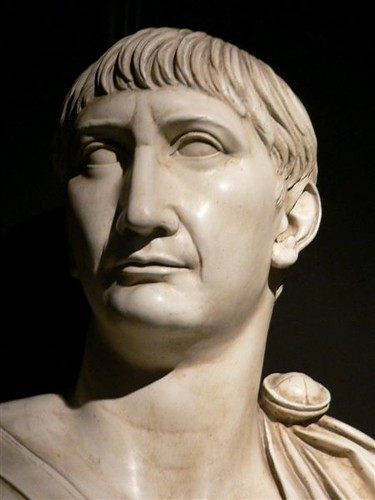
Pliny the Younger, now more than ten years older than the vice-prefect of Machain's first novel, Roman Games (my review), arrives in the Roman province of Bithynia-Pontus with a directive from the emperor Trajan to essentially clean house.  Rampant corruption has left the country in ruins.  Partially constructed aqueducts, temples and baths, starved of funding that has been skimmed by ambitious Greek contractors and greedy Roman procurators, are scattered across the landscape.

The Roman Emperor Trajan.
Photo by Mary Harrsch.


Pliny dives into this task wholeheartedly both in the novel and historically, as reflected in his first correspondence with the emperor Trajan upon his arrival:

"I am at present engaged in examining the finances of the Prusenses, their expenses, revenues, and credits; and the farther I proceed in this work, the more I am convinced of the necessity of my enquiry. Several large sums of money are owing to the city from private persons, which they neglect to pay upon various pretences; as, on the other hand, I find the public funds are, in some instances, very unwarrantably applied. This, Sir, I write to you immediately on my arrival. I entered this province on the 17th of September, and found in it that obedience and loyalty towards yourself which you justly merit from all mankind. You will consider, Sir, whether it would not be proper to send a surveyor here; for I am inclined to think much might be deducted from what is charged by those who have the conduct of the public works if a faithful admeasurement were to be taken: at least I am of that opinion from what I have already seen of the accounts of this city, which I am now going into as fully as is possible." - Pliny to Trajan, correspondence XVI.

Statue of Pliny the Younger on the façade of
Cathedral of S. Maria Maggiore in 
Como.
Photo courtesy of Wikipedia.
But, Pliny quickly learns that the local "Greeklings" have no affection for his diligence or any of their Roman caretakers.  So, when the latest procurator in charge of collecting taxes is found murdered, no one seems to want to cooperate in the investigation of his death.

Pliny begins piecing the clues together with the help of Gaius Suetonius Tranquillus.  Suetonius is often thought of as a gossip monger by modern scholars but he actually held a number of important posts in Roman administration and was Pliny's friend.  Although most famous for his literary work "The Twleve Caesars", at this point in his career Suetonius was working on a compilation of the lives of famous prostitutes, in his Pratum de rebus variis, a light natured work often referred to as the Playground.  So Suetonius' interest in the local prostitutes comes in handy when one of the clues leads Suetonius and Pliny to the wealthy madam of a local brothel.

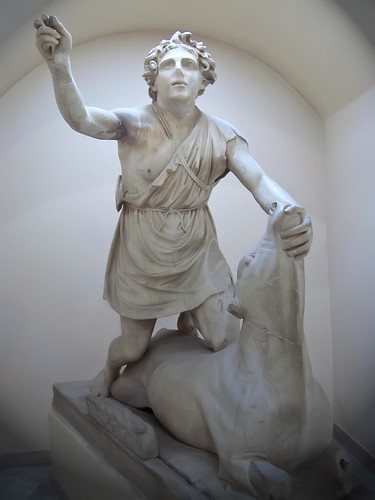
They learn that the murder victim was a member of the mysterious cult of Mithras, the "Bull Slayer" of the novel's title.  With a doctorate in ancient history, Machain weaves the story artfully around what facts about the cult have been gleaned from the study of over 400 archaeological sites related to Mithraism.

Roman sculpture of Mithras slaying the sacred bull from
a Mithraeum in Ostia Imperial Period 1st - 3rd centuries CE.
Photographed in Ostia Antica by Mary Harrsch.
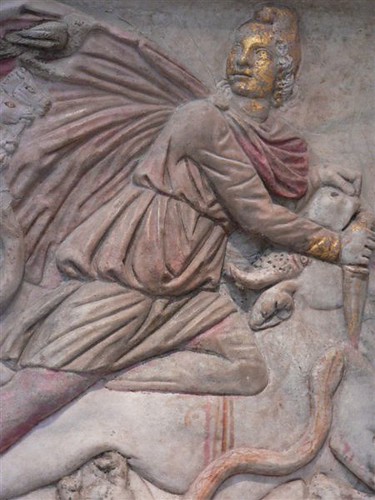
"Archaeological finds indicate the extent of Mithraism included most of the Roman Empire, from Rome to Turkey to Britain. It was especially concentrated in Rome (35 Mithraic temples found) and its port of Ostia (15 temples). In total, over 400 archaeological find-spots related to Mithraism have been found, along with about 1,000 dedicatory inscriptions and 1,150 pieces of sculpture.

A gilded frieze depicting Mithras slaying the bull (known
as the Tauroctony) from a Mithraeum  in Rome.  Photographed
 at the Terme di Diocleziano  (National Museum) in Rome, Italy
 by Mary Harrsch.
"As in its Persian form, Roman Mithraism was a religion of loyalty, contracts and friendship between men, especially between officials and rulers. There are no known women followers of Mithraism. The cult was supported by several emperors, including Commodus (180-92), Septimius Severus (193–211), and Caracalla (211–17). As part of an effort at renewing the Roman empire, Diocletian dedicated an altar to Mithra in Carnuntum (on the Danube near Vienna) in 307, designating the god patron of their empire (fautori imperii sui)." - Mithraism

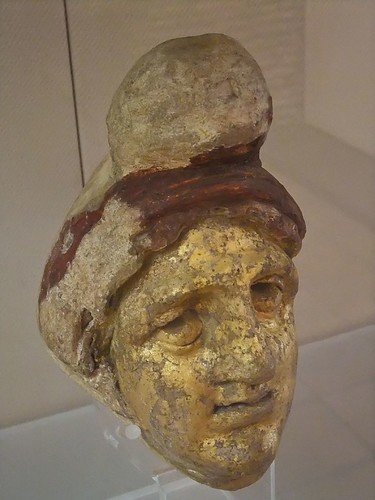
Gilt Head of Mithras found in the Mithraeum of
Castra Peregrinorum under Santo Stefano Rotondo
 2nd century CE.  Photographed by Mary Harrsch
at the  Terme di Diocleziano in Rome, Italy
The murder victim held the rank of Lion, one of the seven ranks known from frescoes in the Santa Prisca Mithraeum in Rome and the mosaic pavement of the Felicissimus Mithraeum in Ostia. As the plot unfolds we discover other members of this clandestine sect hold the ranks of  Soldier, Persian and "Sun-Runner" (Heliodromus).  The youngest initiates join the group with the rank of Raven and Machain imagines the mysterious initiation ceremony in one of the novel's opening scenes.

"Contemporary sources indicate this included ablutions (or baptism), purifications, chastisements, fetters and liberation, and ceremonial passwords. Frescoes at Capua (Italy) show the initiates blindfolded and kneeling. A simulated death and resurrection was probably part of the ceremony, as the ascent through the initiation grades was seen as prefiguring the ascent of the soul after death." - Mithraism

A reconstruction of a Mithraeum prepared for the communal meal at
Nijmegen, The Netherlands.  Photo courtesy of Wikipedia.


Tertullian tells us that the simulated death involved the refusal of a crown:

"The Christian author Tertullian sheds some light on intitiation to the third level, "Soldier," in a treatise about Christians refusing crowns in military service. He notes that a Soldier of Mithras, during his initiation in some gloomy cave, is presented with a crown at sword-point. He refuses it, saying that Mithras is his crown, and he never wears a crown after that." - Tertullian (c.200), On the Soldier's Crown 15.

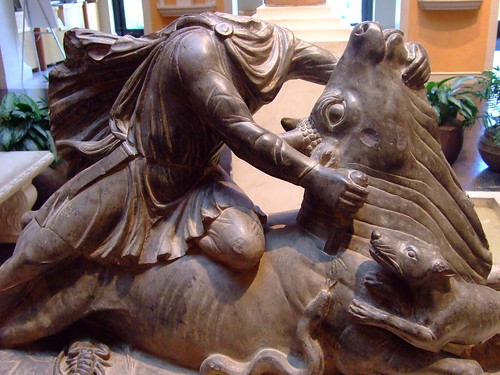
Pliny finds a book of astrology among the victim's possessions and assumes that joining the cult also involves the study of astronomy.  This is consistent with the beliefs of some modern scholars who have speculated that the typical iconography of Mithras slaying the bull found in Mithraic sites is an astrological allegory since Mithras is accompanied by a dog, snake, scorpion and raven, each representing astrological signs.

This fragmented sculpture of Mithras slaying the bull includes a dog,
snake and scorpion representing astrological signs.
Photographed at the Santa Barbara Museum of Art by Mary Harrsch.
So I found Machain's use of Mithraism as a plot point to be both entertaining and educational.

I only found one aspect of the novel troubling.  Machain uses Pliny's relatively young wife, Calpurnia, as  the foundation for a subplot.  Although the subplot was plausible, I had a hard time accepting that a proconsul's wife, and the level-headed and well educated Calpurnia in particular, could have become involved in something so foolish.  Her actions seemed to be more of a silly adolescent even though at this point in her life she was close to thirty years old.

One of the things I enjoy about Pliny's letters is his expressions of unabashed love for his wife.  Pliny clearly adored her in his letters.  One of the most poignant is his Letter LXXIV written to his wife while she is convalescing from a serious illness in Campagna.

"You will not believe what a longing for you possesses me.  The chief cause of this is my love; and then we have not grown used to be apart.  So it comes to pass that I lie awake, a great part of the night, thinking of you,; and that by day, when the hours return at which I was wont to visit you, my feet take me, as it is so truly said, to your chamber, but not finding you there, I return sick and sad at heart, like an excluded lover.  The only time that is free from these torments is when I am being worn out at the bar, and in the suits of my friends.  Judge you what must be my life when I find my repose in toil, my solace in wretchedness and anxiety.  - Pliny the Younger To Calpurnia, Letter LXXIV

Machain must have had this period of absence in mind when he was crafting the subplot although he applied a much darker undertone to the event than I would have preferred.  All marriages have their highs and lows but I would rather keep my vision of unblemished love between Pliny and Calpurnia that has endured through the centuries as revealed in the pages of his letters rather than replace it with a scene from a modern tabloid.

I assume Machain added this plot point to appeal to more female readers and maybe I am just a victim of my own streak of romanticism.

Nevertheless, Machain has once again produced an intriguing story filled with vibrant characters while, at the same time, providing a wealth of historical information about Rome in the second century CE.

Historically, Pliny disappears from the record while either in Bithynia or shortly after his return to Rome as no further correspondence between Pliny and his wide circle of friends has been found after this period leading scholars to believe he died at about the age of 50.  So, I'm unsure Machain will write another tale with Pliny at its core.  He leaves a few loose ends in "The Bull Slayer" that appear to be pointing to a sequel, though, so I am hopeful!


Enhanced by Zemanta
If you enjoyed this post, never miss out on future posts by following me by email!


Tuesday, March 5, 2013

Review: The Joy of Sexus by Vicki León


Vicki León has been out collecting ancient trivia again and this time her subject is sex.  In her latest collection of the obscure, she has assembled anecdotes about ancient aphrodisiacs, wandering wombs, practitioners of erotic mysteries and victims of doomed love.

By reading her book I learned about Callipygia worship - a fixation on a person's derriere - and divine gender-bending that affected such ancient prophets as Teiresias the Seer.  I think my favorite passage from the book, though, was a retelling of the story of Pherenike of Rhodes.

I have not studied ancient Greece as extensively as I have studied Republican Rome so, although I knew that the ancient Greek Olympics were conducted in the nude and that women were not allowed to attend, I had never read any background material to explain why.  León provided me with all the information I could have hoped for in her passage about Pherenike of Rhodes.

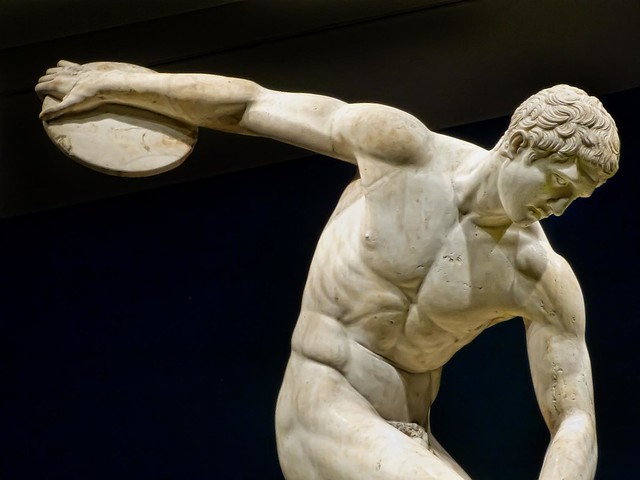
Diskobolos (discus thrower) 2nd century CE Roman copy of  450-440 BCE 
Greek bronze by Myron recovered from Emperor Hadrian's Villa in Tivoli, 
Italy.  Photographed by Mary Harrsch at the Body Beautiful exhibit at the 
Portland Art Museum, Portland, OR.
It seems that Pherenike was a young woman born into a family of Olympic victors.  Her father was a champion boxer at the Olympic Games in 464 BCE.

"Her big burly brothers continued the winning streak.  In boxing and the ferocious boxing-wrestling event called the pancratium, Pherenike's brothers swept six different Olympic Games." - Vicki León, The Joy of Sexus

León goes on to surprise me by observing that Pherenike probably watched her athletic family compete in the games when she was a young girl and later before her marriage.  Apparently, young virgins were allowed to watch the games - just not married matrons!

Then León continues saying Pherenike also married a famous athlete named Callianax and bore two sons who also trained for the Olympics.  Pherenike's older son, Eucles, won his boxing event but, because Pherenike was now married, she was not able to witness his victory.

A few years later, Pherenike's younger son Pisodorus entered his name as a contender for the boys boxing competition but before he could complete his ten months of training, Pherenike's husband died.  So, secretly Pherenike took up the mantle and resumed training her son dressed in the male garb of an official trainer.  When his time came to report for the 388 BCE Olympics, his mother went with him disguised in the full length robe of a trainer and carrying the traditional wooden staff.

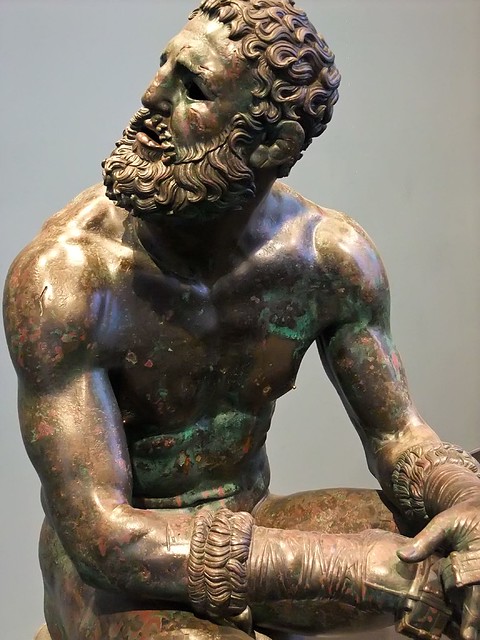
Boxer Resting 1st century BCE Roman copy of 3rd century 
Greek original by Apollonius.  Photographed at the Palazzo
Massimo in Rome, Italy by Mary Harrsch.

When her son was ultimately victorious, Pherenike, forgetting her precarious situation since a woman attending the forbidden event faced the death penalty of being thrown from the Typaeum cliffs, let out a high-pitched whoop and jumped over the fence to run and kiss her son.

"Either the high-pitched sound of her voice, or perhaps what her jump over the fence revealed, blew her disguise." - Vicki León, The Joy of Sexus

Fortunately for Pherenike, the ten Olympic judges decided not to punish her because of her illustrious family's contributions to the games, but forever after both trainers and athletes were decreed to appear in the nude.

So now I know why athletes are always depicted in the nude on all of those red and black-figure vases!

I also learned about Koan silk, a sheer see-through fabric.  I guess I hadn't kept up on all the latest discoveries and still thought silk worms were a closely guarded secret until much later in history than ancient Greece.  León reveals that some silk worms were purloined by the ancient Persians and made their way to the Greek islands of Amorgos and Kos.  Unlike the Chinese, who killed the worm to harvest the silk from their cocoons, the Greeks let the worm emerge naturally, breaking the threads as it went.  Then, using the same method they used with flax known as hackling, the women produced a gossamer silk that commanded a premium price.  The silk was so popular that Aristophanes referred to it in his play Lysistrata where women go on a sex strike to keep their men from going to war and sexually tease their husbands by prancing around "naked in their Amorgian chitons."

Apparently, in a surviving letter from Plato, the famous philosopher (and León questions "cheapskate?") orders three tunics for the daughters of a host but says "not those expensive Amorgian ones!" (I always love little tidbits that reveal what kind of person  a famous ancient was!)

The fashion eventually reached Rome and León found a quote from Pliny who called Koan silk "the vestments that cover a woman while at the same time revealing her naked charms."

These wonderful little glimpses about the truly personal lives of the ancients is what makes León's book so enjoyable.

There were only a couple of missteps that made me say "What?"  In her chapter about Alexander and Hephaestion, León explains that the Macedonians defeated the Persians at the battle of Issus. Then in the next sentence she says Persian King Darius was killed and his queen Statira captured. (p. 69 - 70) She may have been simply trying to condense the chapter but it makes it sound like Darius was killed at the battle of Issus and, of course, he wasn't.  Darius was killed some time after he fled the battle of Gaugamela and was assassinated by his own officers, who hoped to impress Alexander.  Alexander was not impressed with their treachery and ordered their execution.

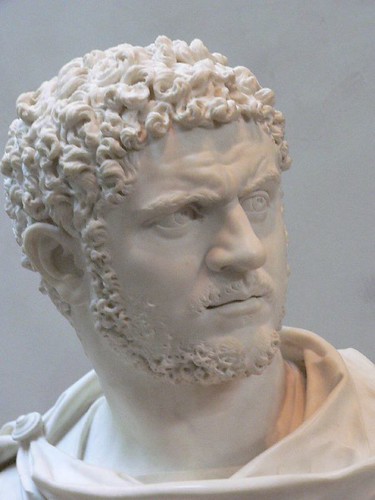
Roman emperor Caracalla by Italian sculptor
Cavaceppi 1750 CE after ancient original.
Photographed by Mary Harrsch at the
J. Paul Getty Museum in Los Angeles, CA

León made another confusing statement about the Roman emperor Caracalla.  She alluded to his death being the result of too many mistresses and a gladiator.  Although Caracalla may have dallied with too many mistresses and maybe a gladiator, too, this sounded much more like Commodus.  Caracalla was killed by a member of his own body guard when he stopped to relieve himself while marching with his army near Carrhae during a war with Parthia.  Historian Cassius Dio said the assassin, Martialis, was disgruntled for not being promoted to the rank of centurion.

But, I salute Vicki for such a revealing and fascinating look at lust, love and longing in the ancient world!

If you enjoyed this post, never miss out on future posts by following me by email!


Tuesday, February 19, 2013

Getty to Extend "Lion Attacking a Horse" Exhibit


I just got back from LA but didn't have time to go see this beautiful monumental sculpture.  Maybe I'll get another chance!

THE GETTY VILLA EXTENDS DATES FOR LION ATTACKING A HORSE  

Now through May 6, 2013

LOS ANGELES—The Getty Museum announced today that the monumental sculpture Lion Attacking a Horse, on loan from the Capitoline Museums in Rome, will be on extended view at the Getty Villa until May 6, 2013. Presented for the first time outside Rome, where it has not been on public view since 1925, the sculpture is the centerpiece of a special installation that traces its history from antiquity to the modern era and showcases recent conservation work undertaken in Rome.


“We are thrilled to have the celebrated Lion Attacking a Horse on view for an additional three months,” says Timothy Potts, director of the J. Paul Getty Museum. “This ancient masterpiece is one of the most storied sculptures to have survived from antiquity and is a dramatic addition to the Villa’s galleries as the first work of art visitors see when entering the Museum. We are grateful to our colleagues at the Capitoline Museums for agreeing to extend the loan period.”
Created in the era of Alexander the Great, Lion Attacking a Horse was a trophy of war in imperial Rome before it became a symbol of justice in the medieval city.  The sculpture’s image of savage animal combat was admired by Michelangelo and inspired generations of artists. On the Capitoline Hill, its presence heralded the Renaissance spirit, laying the foundation for the world's first public art collection. For many years, the lion-and-horse image served as the emblem of Rome before being replaced by the famous statue of a she-wolf suckling the twins Romulus and Remus.
Part of “The Dream of Rome,” a project initiated by the Mayor of Rome Giovanni Alemanno to exhibit timeless masterpieces from the city of Rome in the United States, the installation also includes related works from the Getty Museum and Getty Research Institute’s collections, as well as from private lenders.
In August 2012, the J. Paul Getty Museum and the Capitoline Superintendency of Roma Capitale signed a bilateral agreement for cultural collaboration that established a general framework for cooperation on conservation and restoration projects, exhibitions, long-term loans, conferences, publications, and other kinds of cultural exchange. Lion Attacking a Horse is the first major loan to arise from this agreement.
Other cultural partnerships between the Getty Museum and Italian institutions include the Sicilian Ministry of Culture and Sicilian Identity and the Museo Archeologico Nazionale in Florence, which will result in a number of exhibitions and cultural exchanges over the coming years. - Getty Press Release

Enhanced by Zemanta
If you enjoyed this post, never miss out on future posts by following me by email!