Saturday, March 6, 2021

Animals in Ancient Art: Zoomorphic Askoi

 In her book, Animals in Roman Life and Art, the late professor Jocelyn Toynbee explains that the appearance of animals in Greco-Roman art, especially funeral art, are not allusions to a particular occupation or favorite food item but symbolize the existence of idyllic peace and plenty in paradise, either existing within the home or in the anticipated afterlife.  The Greek word for paradise derived from the eastern term "paradeisos" was first used by Xenophon to describe the extensive parks of the Persian kings that were planted with luxuriant flora and stocked with a variety of wild creatures.

This symbolism extends back as the Chalcolithic period.  Scholars have noted a marked preference for askoi of zoomorphic forms on Cyprus suggesting that, at least there, askoi had a cultic and ritual use.  They point to the vessel's ancient name reflecting an object made of animal leather as proof of further assocation with animals, enough so that the term is now primarily used to signify a terracotta imitation of such a closed vessel with a handle or cylindrical spout that is partially or totally zoomorphic in form and used for dispensation of liquids, often oil for lamps. 

Early types often fell into the classifications bag-shaped,  bird-shaped, fish-shaped, or aberrant forms with horns or other zoomorphic aspects such as a bird-shaped askos with an animal head. Those shaped like an animal skin bag gradually acquired protomes of various animal heads during the Early Iron Age. These vessels evolved still further to animal-shaped askoi which were modeled on the wheel as hollow figurines then handle and spout added.

On Cyprus the mammals depicted most often included bulls, horses and goats.  Some deer shaped vessels have also been found as well as plastically-rendered riders. A Cypriot askos in the shape of a reclining lion, now in the collections of the Metropolitan Museum of Art, is thought to be unique. 

It is thought that initial askoi shapes on Cyprus were influenced by trade relations with Crete and Mycenaean Greece. But, by the 9th century CE, Greeks in the Aegean developed a taste for exotic goods and Cypriot goods with new forms developed there were reintroduced to the Greeks.  These forms were further adapted by the Greeks and exported to other trading partners including the Etruscans and Romans. The original purpose of askoi was also adapted for other activities other than cultic or funereal and with this development the animals depicted became more whimsical, especially if the askoi were used at symposia where uniquely shaped vessels could be subtly employed as "conversation starters."

Terracotta askos in the form of a weasel, 4th century B.C.E., Greek, South Italian, Campanian at the Metropolitan Museum of Art.

Terracotta vase in the form of a lobster claw, ca. 460 B.C.E., Attributed to the Class of Seven Lobster-Claws at the Metropolitan Museum of Art. Because so many aspects of Greek life depended on the sea, a vase in the shape of a lobster claw is not surprising. It is, however, exceptional and may be a variant of the askos—a bag-shaped oil container provided with a vertical mouth and strap handle. The Dionysiac iconography of the lobster claw suggests that it was a novelty item used at symposia (drinking parties).

Terracotta vase in the form of a lobster claw, ca. 460 B.C.E., Attributed to the Class of Seven Lobster-Claws at the Metropolitan Museum of Art. Because so many aspects of Greek life depended on the sea, a vase in the shape of a lobster claw is not surprising. It is, however, exceptional and may be a variant of the askos—a bag-shaped oil container provided with a vertical mouth and strap handle. The Dionysiac iconography of the lobster claw suggests that it was a novelty item used at symposia (drinking parties).

Terracotta askos in the form of a duck, late 5th century B.C.E., Greek, Attic, at the Metropolitan Museum of Art.

Terracotta askos (flask with a spout and handle over the top) in the form of a duck, 4th century B.C.E., at the Metropolitan Museum of Art.

Zoomorphic askoi and unguentari in the shape of a stag from Tomb 83 Trebba Valley, 300-275 BCE from the Archaeological Museum of Ferrara, Italy courtesy of Wikimedia Commons contributor Sailko

Askos in the form of a bull, Greek, South Italian, Apulian, courtesy of the Metropolitan Museum of Art.

Askos in the form of a dog, Greek, 2nd - 1st century CE, , courtesy of the Metropolitan Museum of Art.

Cyprus, geometric age, Kourou Group I, askos with equine protome, from tomb 2138 of the necropolis of the pond, 770-750 BCE courtesy of Wikimedia Commons contributor Sailko

Cypriot; Askos in the form of a fish, 1200-1175 BCE, courtesy of the Metropolitan Museum of Art.

Cypriot Askos in the form of a lion, 1200-1050 BCE, courtesy of the Metropolitan Museum of Art.

Zoomorphic Askos with geometric configuration, from Rhodes, Archaic Age, courtesy of Wikimedia Commons contributor Sailko

Hellenistic Askos in the shape of a ram, courtesy of Wikimedia Commons contributor Sailko

If you enjoyed this post, never miss out on future posts by following me by email!


Thursday, March 4, 2021

The Penthesilea Painter

The Penthesilea Painter, active between 470 and 450 BCE in Athens, Greece, was named from a red-figure vase which depicts the slaying of Penthesilea by Achilles. Using the painting style of that vase, classicist John Beazley attributed 177 known vases to the painter.  His work has been found on bowls, skyphoi, kantharoi and bobbins (or possibly yoyos).

His work is characterised by large, space-filling figures whose posture is often bent so as to permit them to fit on a vessel. For the same reason, ornamental decoration around the edges is often very narrow. His works are also characterised by being very colourful, permitting several intermediate shades. Apart from dark coral red and the usual light red, he also used tones of brown, yellow, yellow-white and gold. His figures are painted remarkably meticulously in every detail.

The Penthesilea Painter's works are dominated by depictions of boys and youths engaged in athletic activity, teaching scenes, weaponry and armour, as well as scenes of people talking to horses. While he painted the occasional mythological motif, they are so rare that they should be considered an exception among his work. Throughout his career, scenes from everyday life gain an increasingly dominant share of his paintings.

Terracotta bobbin (or yoyo) ca. 460–450 B.C.E., Attributed to the Penthesilea Painter at the Metropolitan Museum of Art. This side, Nike (the personification of victory) offering fillet (band) to youth.

Terracotta bobbin (or yoyo) ca. 460–450 B.C.E., Attributed to the Penthesilea Painter at the Metropolitan Museum of Art. This side, Eros and Youth.

Achilles killing Penthesilea. Tondo of an Attic red-figure kylix, 470–460 BCE. From Vulci. Courtesy of Wikimedia Commons contributor Bibi Saint-Pol.


Zeus and Ganymede. Penthesilea Painter. 470 BCE. Ferrara Archaeological Museum courtesy of Wikimedia Commons contributor Mapk1978.


If you enjoyed this post, never miss out on future posts by following me by email!


Wednesday, March 3, 2021

The Gundestrup Cauldron: Nuragic influence?

Mark Cartwright of the Ancient History Encyclopedia just published and excellent article on the Gundestrup Cauldron and I wish to share it with you.  But first some of my personal musings about the object.

The Gundestrup Cauldron, dated to the 1st century BCE, was discovered by workers cutting peat blocks in a bog near Gundestrup, North Jutland, Denmark on 28 May 1891 CE. The details of the decorative reliefs on the cauldron show a clear Celtic influence but some motifs, particularly the exotic animals (lions or leopards, elephants, and griffins), suggest, too, a Near Eastern influence so that scholars generally attribute its manufacture to peoples living in the Lower Danube region, specifically Dacia or Thrace (which is today’s Romania and Bulgaria). The use of silver is another link with the Lower Danube region as it is rare in Celtic art but not so in Thracian art. 

When I first encountered Nuragic art from Sardinia, I wondered if those people may have had an influence on the creators of the Gundestrup Cauldron as well, since there seemed to me to be a stylistic similarity. I was especially struck by the appearance of what looked to me like horned appendages on the heads of Nuragic warriors depicted as bronze figurines.

One of the roundels on the Gundestrup Cauldron depicts the hunting or sacrifice of a bull. Bulls or half-man, half-bull figures appear to have had religious significance to the Nuragic people as well and were frequently depicted on ships and bronze vases, and used in religious rites. A figure riding a dolphin is also depicted in the decorative panel. Dolphin iconography is common in the art of island peoples.

Nuragic artists themselves were probably influenced by the Phoenicians who began visiting Sardinia around 900 BCE and may account for the "Near Eastern influence" described by some art historians.  Nuragic statues and figurines have been found wearing what appears to be eastern dress. But these are just my own speculations though.

https://www.ancient.eu/Gundestrup_Cauldron/

The roundel of the Gundestrup Cauldron. The scene shows the hunting or sacrifice of a bull. Above the bull is a human figure and there are two hunting dogs and possibly a lizard.  Image courtesy of Claude Valette (CC BY SA)


A panel from the Gundestrup Cauldron showing a seated god with stag’s antlers, often identified as Cernunnos, an ancient Celtic god who represented nature, flora and fauna, and fertility. There is also a stag and deer on the left side and on the right five strange animals and a small figure riding what may be a dolphin. Image courtesy of Malene Thyssen (CC BY SA)


If you enjoyed this post, never miss out on future posts by following me by email!


Tuesday, March 2, 2021

Earth Shaker

 In pre-Olympian Bronze Age Greece, Poseidon was venerated as a chief deity at Pylos and Thebes. He had also the cult title "earth shaker". In the myths of isolated Arcadia he is related with Demeter and Persephone and he was venerated as a horse, however it seems that he was originally a god of the waters. He is often regarded as the tamer or father of horses, and he could create springs with a strike of his trident.

 Homer and Hesiod suggest that Poseidon became lord of the sea following the defeat of his father Cronus, when the world was divided by lot among his three sons: Zeus was given the sky, Hades the underworld, and Poseidon the sea, with the Earth and Mount Olympus belonging to all three. In Homer's Iliad, Poseidon supports the Greeks against the Trojans during the Trojan War and in the Odyssey, during the sea-voyage from Troy back home to Ithaca, the Greek hero Odysseus provokes Poseidon's fury by blinding his son, the Cyclops Polyphemus, resulting in Poseidon punishing him with storms, the complete loss of his ship and companions, and a ten-year delay. In Plato's "Timaeus and Critias", the legendary island of Atlantis was Poseidon's domain.

Poseidon was named Neptune by the Romans and held a special place in their pantheon of deities because in Book XX of the Iliad, even though Poseidon (Neptune) favored the Greeks, he rescues Aeneas from Achilles.  In Virgil's Aeneid, Neptune is still resentful of the wandering Trojans, but is not as vindictive as Juno, and in Book I he rescues the Trojan fleet from the goddess's attempts to wreck it, although his primary motivation for doing this is his annoyance at Juno's having intruded into his domain.

Poseidon. National Archaeological Museum of Athens courtesy of Wikimedia Commons contributor Ricardo André Frantz

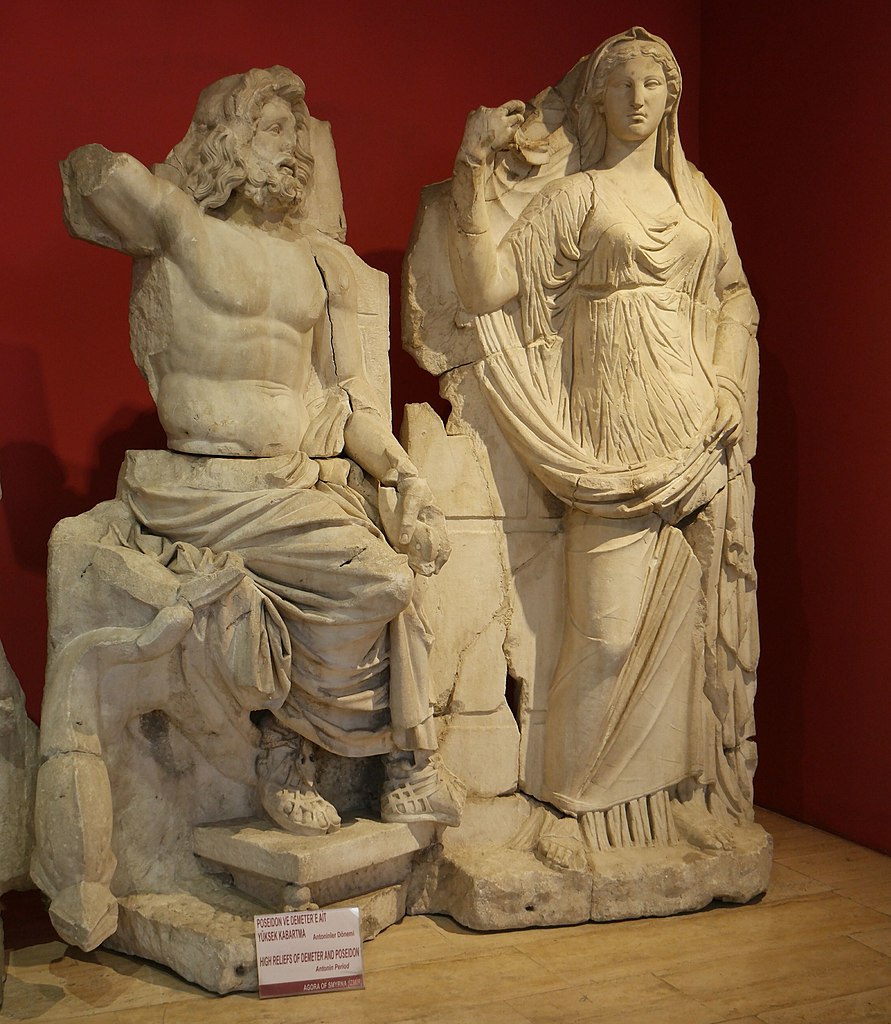
High reliefs of Poseidon and Demeter, from the Nerva–Antonine dynasty period, found in the Agora of Smyrna, now on display in the Izmir's History and Culture Museum Athens courtesy of Wikimedia Commons contributor Isabeau

Closeup of Neptune by Adam Lambert-Sigisbert 1725-1727 CE that I photographed at the Los Angeles County Museum of Art.

Bronze statuette of Poseidon, found in the Gulf of Livadostra, c. 480 BCE, courtesy of Wikimedia Commons contributor Sailko.

Roman mosaic depicting the Triumph of Neptune, 2nd century CE, at the Bardo National Museum in Tunisia courtesy of Wikimedia Commons contributor Tony Hisgett.

Mosaic depicting Neptune and Amphitrite, 1st century CE, that I photographed in the House of Neptune and Amphitrite in Herculaneum in 2007.

Reproduction of a frieze depicting an archaic style Neptune decorating the sacred area in Herculaneum that I photographed in 2007.

Sculpture of Neptune that I photographed at Huntington Gardens in Pasadena, California.

Neptune with a Hippocamp by Michel Anguier French 1652 CE Bronze that I photographed at the National Gallery of Art in Washington D.C. in 2015.

Triumph of Neptune and Amphitrite", a Roman mosaic from Cirta, now in the Louvre courtesy of Wikimedia Commons.

Neptune (with Cosimo I's head) on his chariot by Bartolomeo Ammannati II that I photographed in the Piazza della Signoria in Florence in 2005.

The Lateran Poseidon is a 2nd century CE colossal statue which derived from the lost bronze sculpture made by Lysippos (IV century BCE) for the Temple of Isthmia, on the Isthmus of Corinth, dedicated to the god Poseidon. The statue was originally in the Lateran Museum in Rome (then suppressed) and is probably the most significant evidence of the lost masterpiece of Lysippos.

Roman mosaic of Neptune from Monastir, Tunisia courtesy of Wikimedia Commons contributor Touzrimounir

Terracotta lekythos (oil flask), ca. 440 B.C.E. attributed to the Phiale Painter at the Metropolitan Museum of Art. Poseidon, the god of the sea and the brother of Zeus and Hades is said to have created fresh water springs including the great springs at Lerna in the southern Peloponnesos which gushed forth as a result of his pursuit of Amymone, the daughter of the king of Argos.

Detail of Neptune from the Roman "Mosaic of the Seasons" from Palermo in the Regional Archaeological Museum of Palermo courtesy of Wikimedia Commons contributor Giovanni Dall'Orto.


If you enjoyed this post, never miss out on future posts by following me by email!


Monday, March 1, 2021

Greco-Roman female portraiture


Head of a woman, Greek, 200-100 BCE Marble at the Yale University Art Gallery.


"In Greek and Roman female portraits, private women often imitated goddesses or queens in order to gain status and influence. This head, perhaps, echoes features of the goddess Aphrodite or the Egyptian ruler Cleopatra VII (reigned 69–30 BCE).  Although extensive damage and repairs, including a damaged nose and a missing section of hair, have made examinations of the head difficult, one can still see the resemblance to the two iconic figures."

"The figure’s melon hairstyle and the beginnings of what was probably a slightly aquiline nose relate the head to portraits of Cleopatra VII who is shown with these features in her more ‘masculinized’ portraits, as in her portrait on a silver denarius in the British Museum.  At the same time, the portrait of a woman also has the classic turn of the head and soft facial features one finds in portraits of typical Greek women and of Aphrodite.  Cleopatra VII herself is sometimes depicted in this softer, more classical style.  Thus this head can be related to Cleopatra VII, although the lack of a diadem indicates it cannot be a portrait of the queen herself." - Adria Brown, Yale University, Class of 2015 


If you enjoyed this post, never miss out on future posts by following me by email!