Friday, October 26, 2007

University of Kentucky Students to examine Magna Graecia sites


The University of Kentucky will offer a course in Italy in summer 2008, designed to give students the opportunity to take part in an excavation at a Greek fort on the summit of Monte Palazzi in the Calabria region of southern Italy. The course will be of special interest to students studying art, anthropology, architecture, archaeology, geography, history and art history.

Working in teams, UK students will begin to reconstruct the architectural history of the site, which was inhabited by Greek settlers between the sixth and third centuries B.C.E. Students will also get hands-on experience in processing archaeological data. During the four-week UK program, participants will visit Pompeii; museums in Locri, Crotone, Scolacium and Reggio Calabria; and classical sites around the region.

The program, directed by Paolo VisonĂ , a scholar in residence for the UK art history program, will run May 26 to June 20, 2008. It is open to undergraduate and graduate students.

"This course will be a full immersion into Mediterranean archaeology," said VisonĂ . "Participants will learn about the history, art and architecture of Magna Graecia before leaving. Students will be trained to excavate with a variety of tools, to sift soil, and to process and record the ceramic, lithic and metal finds under the supervision of experienced archaeologists. These UK excavations will be the first large-scale archaeological project at Monte Palazzi since 1961, when this site was discovered."
If you enjoyed this post, never miss out on future posts by following me by email!


Thursday, October 25, 2007

Mosaics in Ravenna Still Dazzle


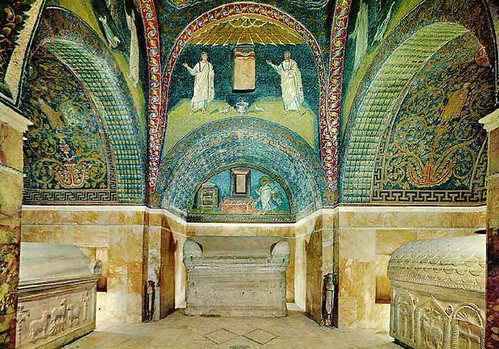
I was searching for a picture of the Amazon Warrior sculpture that was recently found in Herculaneum and stumbled across this blog about Mosaic Art and these wonderful pictures of the tomb of Galla Placidia, the powerful half-sister of Honorius and wife of Emperor Constantius III. I had heard that the mosaics in Ravenna are particularly spectacular and if these are any indication, they certainly are!

"Galla Placidia was the daughter of Roman Emperor Theodosius I (379-395) and his second wife, Galla, the daughter of Valentinian I. She was the half-sister of the young Roman emperors Honorius (393-423) and Arcadius (383-408), the aunt of Theodosius II, the wife of Athaulf, King of the Goths, and then of Flavius Constantius (421) (who was promoted to co-emperor with Honorius shortly before his death), and the mother of Valentinian III.

When, under the leadership of Alaric, the Goths sacked Rome in August 410, they took Galla Placidia with them to Gaul. After the death of Alaric, Athaulf became the king. Galla Placidia married him in Narbo in January 414 -- against the wishes of her half-brother Honorius, and had a son named Theodosius who died soon thereafter. Following the death of Athaulf in 414, the Goths returned Galla Placidia to the Romans who wanted her to marry Flavius Constantius, who had succeeded Stilicho to power. Reluctantly, Galla Placidia did so and produced two children, Justa Grata Honoria and Valentinian. When, on February 8, 421, Constantius was made co-emperor (Constantius III) in the west by Honorius, Galla Placidia was named Augusta. Constantius died on September 2, 421. Galla Placidia and her childless half-brother Honorius became very close for a while, but then they quarreled. Galla Placidia fled with her children to Constantinople in 423 to escape a charge of aiding her brother's enemies. Although earlier Theodosius hadn't recognized the imperial elevation of Constantius and therefore, the status of his aunt as Augusta, he welcomed her, and soon recognized both her status and the legitimacy of her son as heir. Honorius died soon after, on August 27 of the same year. A usurper John assumed the throne in Ravenna. Theodosius set out to win the throne back for his family. When the imperial party reached Thessalonica the young Valentinian was made Caesar. Placidia was regent for her young son for the next 12 years. She had legislation passed in her son's name (according to Oost), stating that the emperor was subject to the laws of the land, as opposed to the situation in the east where the emperor was above the law. Galla Placidia was also involved in the power play between Felix, Boniface, and Aetius, who has been called the last of the Romans. Earlier, Placidia is thought to have been involved in the conspiracy against the Vandal Stilicho and the subsequent execution of Serena, Stilicho's wife and Galla Placidia's cousin." - About Ancient History

Image by designucdavic
If you enjoyed this post, never miss out on future posts by following me by email!


Friday, October 5, 2007

Descendants of Crassus' Army in China

In preparing for my upcoming trip to Italy next week I was trying to clean out my email inbox and came across a message from a friend in England with a link to a fascinating article about Roman descendants in China:

Telegraph.co.uk: "Residents of a remote Chinese village are hoping that DNA tests will prove one of history's most unlikely legends — that they are descended from Roman legionaries lost in antiquity.

Cai Junnian, Roman descendants found in China?
Villager Cai Junnian with his green eyes and ruddy complexion

Scientists have taken blood samples from 93 people living in and around Liqian, a settlement in north-western China on the fringes of the Gobi desert, more than 200 miles from the nearest city.

They are seeking an explanation for the unusual number of local people with western characteristics — green eyes, big noses, and even blonde hair — mixed with traditional Chinese features.

"I really think we are descended from the Romans," said Song Guorong, 48, who with his wavy hair, six-foot frame and strikingly long, hooked nose stands out from his short, round-faced office colleagues.

"There are the residents with these special features, and then there are also historical records about the existence of these people long ago," he said.

Studies claiming that Liqian has Roman ancestry have greatly excited the impoverished county in which it is situated. The village is now overlooked by a pillared portico, in the hope of attracting tourists. A statue at the entrance of the nearby county town, Yongchang, shows a Roman legionary standing next to a Confucian scholar and a Muslim woman, as a symbol of racial harmony.

Even entrepreneurs have caught on: in "Imperial City Entertainment Street" there is a Caesar Karaoke bar.


Rome to China map, Roman descendants found in China?

The town's link with Rome was first suggested by a professor of Chinese history at Oxford in the 1950s. Homer Dubs pulled together stories from the official histories, which said that Liqian was founded by soldiers captured in a war between the Chinese and the Huns in 36BC, and the legend of the missing army of Marcus Crassus, a Roman general.

In 53BC Crassus was defeated disastrously and beheaded by the Parthians, a tribe occupying what is now Iran, putting an end to Rome's eastward expansion.

But stories persisted that 145 Romans were taken captive and wandered the region for years. Prof Dubs theorised that they made their way as a mercenary troop eastwards, which was how a troop "with a fish-scale formation" came to be captured by the Chinese 17 years later.

He said the "fish-scale formation" was a reference to the Roman "tortoise", a phalanx protected by shields on all sides and from above. Gu Jianming, who lives near Liqian, said it had come as a surprise to be told he might be descended from a European imperial army. But then the birth of his daughter was also a surprise. Gu Meina, now six, was born with a shock of blonde hair. "We shaved it off a month after she was born but it just grew back the same colour," he said. "At school they call her 'yellow hair'. Before we were told about the Romans, we had no idea about this. We are poor and have no family temple, so we don't know about our ancestors."


Another resident, Cai Junnian, 38, said his ruddy skin and green eyes meant he was now nicknamed Cai Luoma, or Cai the Roman, by friends. He has become a local celebrity, and was recently flown to the Italian consulate in Shanghai to meet his supposed relatives. The professor's hypothesis took almost 40 years to reach China. During Chairman Mao's rule, ideas of foreign ancestry were not ideologically welcome and the story was suppressed.

Mr Cai said his great-grandfather told him that there were Roman tombs in the Qilian mountains a day and a half's walk away, but he had never connected them to the unusual appearance he inherited from his father. "People thought I had a skin problem," he said."


I tried to find a followup article but came up empty handed. I would be interested to know the results of the DNA tests. The theory is certainly plausible. I found this reference to 1st century BCE contacts between the Chinese (Seres) and Rome:

"The Roman historian Florus describes the visit of numerous envoys, included Seres (Chinese), to the first Roman Emperor Augustus, who reigned between 27 BCE and 14 CE:
"Even the rest of the nations of the world which were not subject to the imperial sway were sensible of its grandeur, and looked with reverence to the Roman people, the great conqueror of nations. Thus even Scythians and Sarmatians sent envoys to seek the friendship of Rome. Nay, the Seres came likewise, and the Indians who dwelt beneath the vertical sun, bringing presents of precious stones and pearls and elephants, but thinking all of less moment than the vastness of the journey which they had undertaken, and which they said had occupied four years. In truth it needed but to look at their complexion to see that they were people of another world than ours." ("Cathey and the way thither", Henry Yule).

In 97 CE the Chinese general Ban Chao went as far west as the Caspian Sea with 70,000 men and established direct military contacts with the Parthian Empire, also dispatching an envoy to Rome in the person of Gan Ying.

Several Roman embassies to China soon followed from 166 CE, and are officially recorded in Chinese historical chronicles."

If you enjoyed this post, never miss out on future posts by following me by email!


Tuesday, October 2, 2007

Encaustic Art Makes Comeback


I was interested to note that a major art museum is featuring an exhibit of encaustic art. My favorite ancient application of the art form is, of course, the Fayum mummy portraits of Egypt. I also read that Julius Caesar once paid the equivalent of 1/4 of a million dollars for an encaustic painting for his villa.

"The new Marin Museum of Contemporary Art is sponsoring Re-Newal, an exhibition that focuses on contemporary art using wax. Juried by Bob Nugent, Re-Newal includes more than fifty works from artists who are members of International Encaustic Artists.

Enkaustikos-the name means "to burn in." The ancient Greeks gave the art of painting with hot beeswax more than a name, they gave it a form. The exact timeline is unclear, but at a point some three thousand years ago, Greek shipbuilders began experimenting with uses for heat and wax other than simple hull caulking. By adding pigments for color, and resin for hardness, they created a painting medium like no other. Before long, encaustic could be found everywhere, from painted ships to depictions of everyday life on urns and lifelike colors applied to statuary.

Encaustic painting weaves in and out of art history, gaining prominence for a time, then slipping back into the shadows for centuries. A thousand years after the Greek shipbuilders discovered it, Egyptian painters resurrected the medium, crafting exquisite portraits to decorate the mummy after a patron's death. In the seventh century, veneration of a Byzantine icon made of beeswax, using the ashes of Christian martyrs for pigment, was credited with saving Constantinople from attack by the Persians.

Fast-forward to the mid-twentieth century. Almost single-handedly, artist Jasper Johns reintroduced encaustic to the art world. Since that time, it has steadily gained acceptance. The medium's popularity has begun picking up momentum rapidly in the last decade. It's no wonder that we keep revisiting this ancient art form-few others can match its versatility, both in technique and result.

Re-Newal will be on view at MarinMOCA at 500 Palm Drive, Novato, CA from September 29-October 27."

I found a website for aspiring encaustic artists that sells supplies and features a gallery of modern encaustic art. I notice modern encaustic artists have incorporated the use of a hot air blow dryer to create unusual effects. I found this image entitled "Purple Dawn" particularly interesting.
If you enjoyed this post, never miss out on future posts by following me by email!


Sunday, September 23, 2007

The Ubians

A history resource article by Mary Harrsch © 2007


I was watching my DVD set of HBO's Rome with a feature activated called "The Road to Rome". This feature displays explanatory notes about references made in the character's dialog or activities that characters are engaged in or watching.

In the episode where Vorenus and Pullo are taking an advance guard to Rome to post a notice that Caesar is on his way, the auxilliary troops that are with them are dressed in furs and carrying slashing swords. The information posted about them was that they were Ubians, a tribe of Germano-Celtic people that allied with Rome and that Caesar employed as bodyguards.

Romeo Model of a Germanic Warrior (54mm) beautifully rendered by artist Sergey Popovichenko


I had not studied anything about them before so I researched them on the web. I found an interesting article about them on The History Files website.

"The Ubii tribal name is an easy one to break down. Without the '-i' plural suffix, the proto-Germanic forms of the word are 'uba' and 'ubaraz', meaning 'up, over, above'. This was retained in Old High German as 'oba', meaning 'up, over’. The tribe seemingly were above everyone. As this wasn't meant in a geographical sense by the middle of the first century BC, it was either meant as an expression of superiority or it related to their original homeland, perhaps at the top of the Jutland peninsula. Given the German habit of using place names for tribal names, this would make sense geographically." - The History Files

It points out that Caesar's foray across the Rhine was supposedly in response to a plea from the Ubians to defend them against the Suevians (also spelled Suebians).

"As recorded by Julius Caesar in his work, Commentarii de Bello Gallico, the Tencteri and Usipetes tribes are driven out of their tribal lands in Germania by the militarily dominant Suevi. This probably places them on the middle Rhine. They force their way into the lands of the Belgic Menapii, also attacking the Condrusi and Eburones tribes. Feigning a withdrawal to lure out the Menapii, the Tencteri and Usipetes defeat them, capture their ships and occupy many of their villages for the winter. 
Caesar, alarmed at this threat to the north of territory in Gaul that he has already conquered, takes a force into the region. After much diplomatic effort and some delays, he attacks the Germanic tribes and drives them back into Germania with heavy losses. Both tribes follow the east bank of the Rhine upstream and find refuge with the Sicambri. They remain settled in these lands for much of the remainder of their existence. Caesar crosses the Rhine to follow them and to show the Germans that Romans are not afraid to stage a counter-invasion. Another reason is that a portion of the cavalry of the Usipetes and Tencteri had not been present at the recent battle. Instead they had proceeded to the territories of the Sicambri to join this tribe, remaining defiant, while uniquely amongst the peoples across the Rhine, the Ubii petition Caesar for help against the oppressive Suevi who until recently have been ruled by the powerful Ariovistus. 

A model of Caesar's Rhine bridge at the Museo nazionale della civiltĂ  romana in Rome, Italy.
Photograph by Jona Lendering cc by-nc-sa 4.0.
 Several other tribes submit to Caesar, but the Sicambri withdraw from their territories on the advice of the Usipetes and Tencteri. Caesar remains in their lands for a few days before burning down their villages and taking their corn. He moves his forces into Ubii territory to show solidarity with them against the Suevi threat before returning to Gaul.
Having left a strong guard with the Treveri following the conclusion of their revolt, Caesar again crosses the Rhine to deal with their German supporters. The Ubii reaffirm their loyalty to him while Caesar discovers that the auxiliaries that had joined the Treveri had been sent by the Suevi. They are drawing together units of infantry and cavalry from all across their vast domain and, having learned of Caesar's approach, they withdraw to the vast wood called Bacenis (a thick forest of beech trees which has been equated with the Harz), which separates the Suevi from the Cherusci. Unwilling to follow them, Caesar fortifies the bridge that connects to the Ubii and stations twelve cohorts there." - The History Files
Wikipedia also had this information:

"They [the Ubians] were transported in 39 BC by Marcus Vipsanius Agrippa to the left bank [of the Rhine]. This was apparently at their own request, as they feared the incursions of the Suevi.

A portrait bust of Marcus Vipsanius Agrippa at The Louvre
in Paris, France.  Photo by Mary Harrsch © 2008

Agrippa founded the city of Cologne as their capital, whose Latin name Colonia Agrippensis is the origin of the current form. The Ubii remained loyal allies of Rome, and were instrumental in crushing the Batavian rebellion in 70. They seem to have been so thoroughly Romanized that they adopted the name Agrippenses in honour of their “founder”, and their later history is submerged in that of eastern Gaul as a whole."

The Oppidum Ubiorum was founded in the first century BC, on a site that had seen occupation since the Neolithic period, but it was Rome that turned it into the city of Cologne.  Public domain image courtesy of The History Files.
Gravestone of an Ubian bodyguard for Nero
Gravestone of an Ubian bodyguard for Nero.  Image courtesy of
Wikimedia Commons.
The Ubians remained loyal to Rome into the 4th century CE with many serving as personal bodyguards to the emperors.  Archaeologists have recovered a gravestone of one such body guard for the emperor Nero.

I also found this interesting legend related to the Ubians:

"The Dogs of St. Cassius

The majestic Minster of Bonn rises high above the surrounding houses. In olden times, when the tribe of the Ubians was still dwelling in that part of the country, a heathen temple stood on that very site. It had been an important place of worship for the whole Rhine valley. The Ubians offered their numerous human sacrifices there.

Some time ago the big altar of the ancient temple was excavated, and is still preserved under the name of Ara Ubiorum. Many prisoners of war and poor slaves have been slain on this mouldering stone.

When St. Helena, mother of Constantine, came to Bonn, the old heathen temple was burnt to ashes. The pious empress destroyed many sanctuaries of the idolaters, and hewed down the gigantic oaks of the sacred forest near. She built a Christian church in the same place, and dedicated it to St. Cassius.

After some time this church was enlarged and embellished. A high tower with slender spires crowned the lofty fane, and big bells hung in the steeples. For long centuries they rang in good and evil days.

Portrait Sculpture of the Empress Helena, mother of Constantine at the Capitoline Museum in
Rome, Italy.  (This 4th century CE sculpture was once thought to be Agrippina The Younger,
the mother of the Emperor Nero)  Photographed by Mary Harrsch  © 2009


In the lapse of time they saw war and peace, joy and woe passing by. They mingled their deep solemn tones with the joyful cries of the populace, when the German Emperor, Frederick the Beautiful, and Charles, Father of Bohemia, marched in splendid procession to the Minster to be crowned.

Whenever the electors of Cologne, who chose Bonn as their residence, were singing high mass in the church below, the bells joined in the Te Deum with their melodious peals.

Originally the Minster was the collegiate church of Saints Cassius and Florentius, who were Roman legionaries of the legendary all-Christian Theban Legion. The legion's garrison, according to legend, was in the Egyptian town of ThebesRoman Emperor Maximianus Herculius ordered the legion to march to Gaul and assist in subduing rebels from Burgundy. At some point during their march, the legion refused to follow the emperor's orders either to kill fellow Christians or to worship Maximianus Herculius as a god. As a result, a large number of legionaries were martyred in Agaunum, now named Saint Maurice-en-Valais after Saint Maurice. According to legend, Saints Cassius and Florentius, who were under the command of Saint Gereon, were beheaded for their religious beliefs at the present location of the Bonn Minster.  Image courtesy of  Hans Weingartz, Wikimedia Commons CC-BY-SA-3.0-DE

But when the French had pitched their tents in Bonn and the brave warrior Brandenburg lay outside its gates, the Minster bells rang in woeful shrill sounds, for their steeple was set on fire.

Often when a thunderstorm threatened to burst the clouds, the bells gave their clear warning, and rang loudly as if they would drown the roaring of the thunder.

At midnight a thunderstorm round the old Minster is an awful thing. The legend records that as soon as the first growling of the thunder is audible, the idolaters who had dominated the minds of the Ubians during long centuries with their grim rites rise from their ancient burial places that surround the Christian church. United with the gods of darkness, they rage with shrill howlings round the grey building, where now the remains of St. Cassius are resting. They hate the pious saint whose martyrdom converted thousands of heathens.

Busts of Saint Cassius and Saint Florentius at the Bonn Minster.  Image courtesy of Wikimedia Commons.

In vindictive anger they fill the air with burning brimstone, thicken the clouds, and direct lightnings towards the quiet Minster, to devour it with fire. But the saint himself watches over his tomb.

All at once the bells ring, though no human hand has touched the ropes, and sound clearly above the infernal noise below. The spirits of the heathens cry out. "Woe to us, the saint watches, the dogs of Cassius announce us. Woe to us, the dogs of Cassius are barking!"

With these cries and with terrible maledictions they vanish into the night. For a little while the thunder is still heard in the distance, but soon a deep stillness envelops the high Minster once more. Undamaged and as serene as ever, it stands pointing majestically towards heaven.

Time however, which has destroyed so many of the old customs, has hushed the dogs of Cassius into silence The bells of the Minster sound no more of their own accord at the approach of a thunderstorm at midnight.

Yet let us hope that in spite of this, the saint watches from heaven over his town, and will preserve his sanctuary for many years to come. "

A Kindle preview of an interesting look at Drusus the Elder, one of the Roman conquerors of Germania:


Other suggested reading:

If you enjoyed this post, never miss out on future posts by following me by email!