Wednesday, October 19, 2011

Were Sparta's "Happy Helots" a template for Roman slavery?

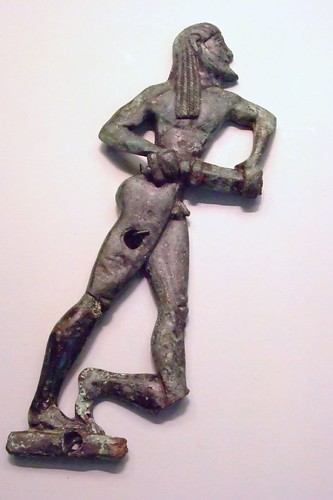
Lacedaemonian furniture appliqué depicting
a nude swordsman 550 - 525 BCE, Bronze.
Photographed at the Getty Villa in Malibu, CA
by Mary Harrsch.
While doing some housekeeping up on Blogger I happened to notice a post by historian Helen P. Schrader entitled "Sparta's Happy Helots: A Closer Look at Helot Society".  Of course I was intrigued because I have always envisioned Sparta's helots as a generally downtrodden lot always looking over their shoulder for an up and coming Spartan youth out to make his first kill.  But Schrader paints a much different picture of helot society and as I read the article I immediately recognized similarities in the slavery practiced by the Spartans in comparison to Roman slavery.

Although there were obvious differences such as the fact that in Sparta the state owned all slaves that in turn were attached to particular governmental activities or particular parcels of land managed by a Spartiate elite while Roman slaves were the property of individual Roman patriarchs, I was astonished to learn that the ancient sources report that some helots became wealthy and were able to purchase their freedom just as in Roman society.

I have studied Greek history to some degree but this is the first time I had heard this.  Schrader explains that Spartan helots, although unable to own land, were often entitled to up to 50% of the produce from the land that they worked.  She also pointed out that helots were able to maintain a family unit and may have benefited from inheritance laws that channeled family wealth to the "tenant-in-chief" who in turn passed it on to a single recognized heir.  If a helot had more than one son, the younger sons were forced to seek employment elsewhere within the boundaries of Lacedaemon to support themselves and their families.

"Some younger sons would have been apprenticed to learn crafts scorned by the perioikoi and prohibited to the Spartiates. Through apprenticeship to those that had taken this path before them, they would have become tanners and tinkers, cobblers and coopers, masons and dyers. As a master craftsman, able to retain 100% of their earnings, these helots would have been in a position to found families, build houses and accumulate wealth." 
"Other young men unable or unwilling to embark on such a slow, hard career, would have sought employment as laborers for the Spartan army or state, or to individuals. Thus they could have become the personal attendants to Spartan hoplites or agricultural day-laborers, going from estate to estate.  Others would have worked for wages as teamsters and mule-drivers for the Spartan army or as construction workers, bath attendants, gardeners and repairmen for the Lacedaemonian government. Still other could have found employment in perioikoi factories and business - as miners, quarry workers, rowers, etc." - Helen Schrader, Sparta's Happy Helots: A Closer Look at Helot Society
This ability for helots to accumulate wealth and purchase their freedom is clearly reflected in the Roman approach to slavery and manumission.  Schrader did not delve into Spartan laws that may have regulated such manumissions, however.  The Romans, being consummate legislators, developed over time an exhaustive body of laws regulating not only when manumission could be granted but the social status of those manumitted.  One such law was the Lex Aelia Sentia of 4 CE.  Portions of it were cited in a textbook written by an unknown jurist named Gaius in the 2nd century CE.  I found the sections on the manumission of gladiators and former gladiators particularly interesting:

   
"The Lex Aelia Sentia requires that any slaves who had been put in chains as a punishment by their masters or had been branded or interrogated under torture about some crime of which they were found to be guilty; and any who had been handed over to fight as gladiators or with wild beasts, or had belonged to a troupe of gladiators or had been imprisoned; should, if the same owner or any subsequent owner manumits them, become free men of the same status as subject foreigners (peregrini dediticii)."

" 'Subject foreigners' is the name given to those who had once fought a regular war against the Roman People, were defeated, and gave themselves up."
"We will never accept that slaves who have suffered a disgrace of this kind can become either Roman citizens or Latins (whatever the procedure of manumission and whatever their age at the time, even if they were in their masters' full ownership); we consider that they should always be held to have the status of subjects."

Citizens

"But if a slave has suffered no such disgrace, he sometimes becomes a Roman citizen when he is manumitted, and sometimes a Latin."
"A slave becomes a Roman citizen if he fulfils the following three conditions. He must be over thirty years of age; his master must own him by Quiritary right; and he must be set free by ajust and legitimate manumission, i.e. by the rod (vindicta) or by census or by Will. If any of these conditions is not met, he will become a Latin." - Gaius, 2nd century CE, - More 
It would be interesting to compare and contrast the development of manumission over time between the Spartans and the Romans!


Enhanced by Zemanta
If you enjoyed this post, never miss out on future posts by following me by email!


Wednesday, October 12, 2011

Excellent princes, ridiculous sophists or jealous tyrants? Gibbon's take on some of Rome's good emperors

Caesar Augustus by Boschetti Italian
Bronze 19th century  CE after Prima Porta
 Augustus 2nd century CE.  Photographed
at the University of Utah Museum of Art by
Mary Harrsch.
In my ongoing readings of Gibbon's Decline and Fall of the Roman Empire I was surprised to learn that Edward Gibbon maintained a rather harsh opinion of three of Rome's most respected emperors.

Gibbon claimed Vespasian's merit was "more useful than shining" and his virtues "disgraced by a strict and even sordid parsimony."  He declared Hadrian to be, in turn, an excellent prince, ridiculous sophist and, eventually, jealous tyrant.  But most surprising was his blistering assessment of Gaius Octavius Thurinus - the emperor Augustus.

Of Augustus, Gibbon declared, "A cool head, an unfeeling heart, and a cowardly disposition, prompted him at the age of nineteen to assume the mask of hypocrisy, which he never afterwards laid aside."

Whoa!  That's certainly an extreme assessment of the man ultimately responsible for ushering in the Pax Romana!  I doubt Octavian was particularly likable since he appeared to calculate the political advantage in every move, but despite concessions that he had to make to his ill health, I would hardly call him a coward.  It took a lot of brass for a 19-year-old stripling to go up against a man with the military experience and following of Marc Antony or the Roman world's most renowned orator and formidable politician, Cicero.

Cicero, 1st century BCE.  Photographed at the
Capitoline Museum by Mary Harrsch
Gibbon seems to blame Octavian for authorizing Cicero's proscription but that was really done at the insistence of Antony.  Octavian pragmatically didn't have any particular reason to oppose it.  It's very much like the recent debt ceiling negotiations.  Some programs were ultimately considered expendable in the overall "game of thrones".

Cicero had been so openly hostile to Antony, his appearance on Antony' hit list must have surely been a foregone conclusion.  Cicero had also arrogantly miscalculated Octavian's political astuteness and assumed he could simply dispose of Octavian after he had served the purposes of the power brokers in the Senate - also a fatal error.

As for hipocrisy, Augustus, like many politicians today, maintained power and control by telling people what they wanted to hear while quietly disposing of those deemed a threat to his position through political maneuvering or outright assassination covered by some socially engineered construct.  Scholars point to Augustus' blatant philandering while enacting morality laws to dictate the behavior of the people of Rome.  But as I pointed out in an earlier post on Roman infanticide, perhaps these laws were meant as deterrents to abortion and infant abandonment and to encourage larger Roman families because Roman birthrates were falling noticeably and there was administrative concern that the economic system was in jeopardy.


A decidedly different view of Rome's first emperor was presented by author John Williams in his novel "Augustus".  It is a novel written in the form of a collection of correspondence between the emperor and various members of his family and his imperial courtiers - much like Thornton Wilder's "Ides of March".  Williams, in contrast to Gibbon, was relatively kind to Octavian and seemed to gloss over some of his shortcomings, like his false promises of military support to Marcus Antonius during the latter's Parthian campaigns.  I think Williams did a good job, though, of demonstrating the overwhelming turmoil Octavian faced when he assumed the reins of power upon the death of his uncle, Julius Caesar.
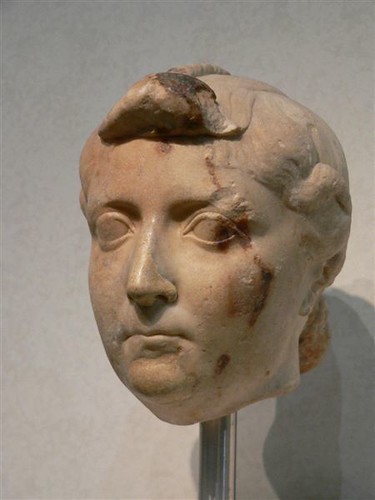
Livia, 1st century BCE.
Photographed at the Palazzo
Massimo by Mary Harrsch.

Unlike Robert Graves, however, Williams also spared  the empress Livia from any insinuations of overt murder in relating the deaths of many of Octavian's would-be successors.  Instead, however, he surprisingly portrayed her as a cold, rather loveless individual who ran Octavian's household but did not command his heart.  In Williams novel, most of Augustus' later years were spent in the company of Terentia, the wife of Octavian's close friend and advisor, Maecenas.  I knew Octavian reputedly engaged in adultery in flagrant violation of his own morality laws, but I guess I didn't realize much of his philandering was targeted at the wife of one of his closest friends.  Williams portrays Maecenas as openly homosexual and willingly supportive of his friend's dalliances but other scholars point out that the relationship between Maecenas and Augustus appears to have become more strained in later life probably due to the emperor's indiscretions.  Marcus Velleius Paterculus said Maecenas was "of sleepless vigilance in critical emergencies, far-seeing and knowing how to act, but in his relaxation from business more luxurious and effeminate than a woman." Perhaps Williams relied on that reference to support his development of Maecenas' character.


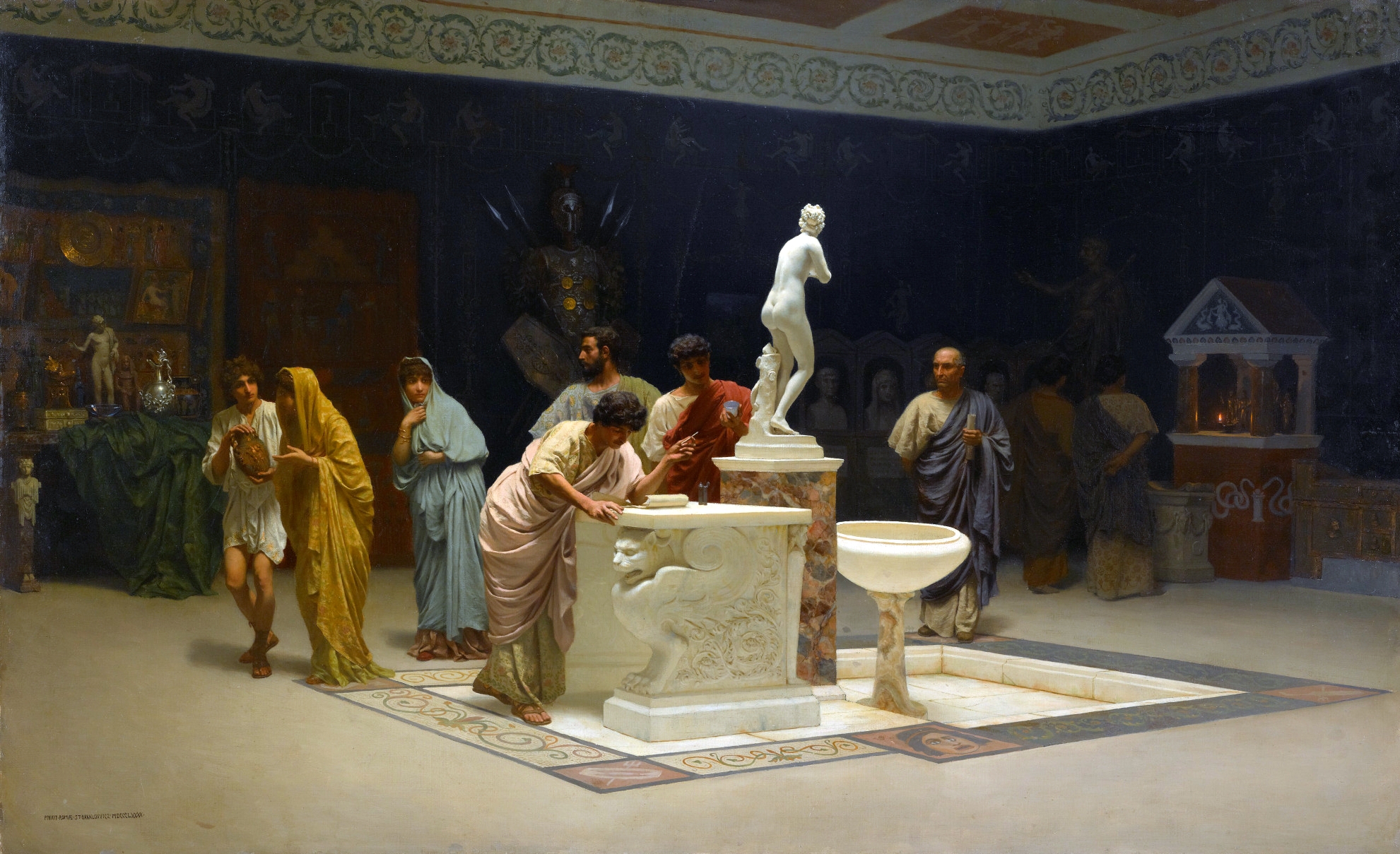
At Maecenas' reception room by Stepan Bakalovich (1890)


Williams also had a decidedly different take on Octavian's banishment of his daughter Julia as punishment for her licentiousness.  This has often been a sticking point with scholars who, like Gibbon, decry Octavian's hypocrisy.  Instead of the traditional approach to this incident, Williams portrayed their father-daughter relationship as one that was quite close even to the point that Augustus simply ignored the string of lovers his daughter entertained in her efforts to display her contempt for her husband, the future emperor Tiberius because Augustus despised Tiberius as well. 
Julia Livilla, daughter of Germanicus, like
Julia the Elder, daughter of Augustus, also
suffered exile to the island of Pandataria
after being accused by the emperor Claudius
of adultery with Seneca.  Photographed at
the Palazzo Massimo by Mary Harrsch.


But when Augustus' spies reported that Julia's latest lover, Jullus Antonius, son of Augustus' dead arch rival, Marcus Antonius and his third rebellious wife Fulvia, was plotting a coup and the emperor's assassination, Augustus had no alternative except to condemn her. 


This may have been simply dramatic license on Wiliams' part - after all it is a novel not a text book - but this coup may have been more fact than fancy.  When Julia and her lovers were tried for their breach of Augustus' morality laws, all of the lovers except Jullus were exiled.  Jullus, however, was condemned to death as a traitor.  Williams proposes that Julia, although apparently not aware of the particulars of the plot, would have been found guilty of treason too and also sentenced to death if Augustus' had not engineered her conviction on the violation of his morality laws.  Thus, Julia's subsequent exile actually was an effort by her father to save her life, not severely punish her for moral indiscretions.  The thing I find puzzling, however, is if her exile was meant only to preserve her life, why did Augustus keep up the pretense of punishment for the rest of his life, as he reportedly refused to ever see her or speak of her again.  Had Tiberius already gained so much power that he could have pushed aside the aging Augustus whenever he chose to and exacted his revenge against Julia despite her father's acclaim as father of his country?
If you enjoyed this post, never miss out on future posts by following me by email!


Saturday, July 9, 2011

Hail Caesar: The evolution of family name to imperial title

"The princes who by their birth or their adoption belonged to the family of the Caesars, took the name of Caesar.    After the death of Nero, this name designated the Imperial dignity itself, and afterwards the appointed successor. - Footnote, Gibbon's Decline and Fall of the Roman Empire

However, scholars in Gibbon's time were unsure of the exact point in the Roman succession that the name transitioned to an imperial title.

Augustus as Pontifex Maximus
photographed at the Palazzo
Massimo in Rome by Mary
Harrsch.
"The time at which it was employed in the latter sense, cannot be fixed with certainty. Bach (Hist. Jurisprud. Rom. 304) affirms from Tacitus, H. i. 15, and Suetonius, Galba, 17, that Galba conferred on Piso Lucinianus the title of Caesar, and from that time the term had this meaning: but these two historians simply say that he appointed Piso his successor, and do not mention the word Caesar.  [Actually, Galba himself assumed the title "Servius Galba Imperator Caesar" then passed it on by adoption to his successor.]

Aurelius Victor (in Traj. 348, ed. Artzen) says that Hadrian first received this title on his adoption; but as the adoption of Hadrian is still doubtful, and besides this, as Trajan, on his death-bed, was not likely to have created a new title for his successor, it is more probable that Aelius Verus was the first who was called Caesar when adopted by Hadrian. Spart. in Aelio Vero, 102.- W."   - Footnote, Gibbon's Decline and Fall of the Roman Empire

Adoption certainly accounts for Augustus, who was adopted by Julius Caesar, and Tiberius, who was subsequently adopted by Augustus.  Claudius assumed the name of Caesar upon accession without previous adoption but he was a direct descendant of Caesar's bloodline.  Claudius later adopted Lucius Domitius Ahenobarbus (Nero) thus transmitting the name Caesar to him. So Gibbon's initial observations are correct.  However,  Gibbon seems to become a bit confused with the successions occurring in the Year of the Four Emperors.

Roman emperor Otho in 69 CE.  
Photographed at The Louvre in Paris
by Mary Harrsch.
"Galba's reign did not last long and he was soon deposed by Marcus Otho. Otho did not use the title "Caesar", but occasionally used the title "Nero" as emperor. Otho was then defeated by Aulus Vitellius who acceded with the name "Aulus Vitellius Germanicus Imperator Augustus." Vitellius did not at first adopt the cognomen "Caesar" as part of his name, and may have intended to replace it with "Germanicus" (he bestowed the name "Germanicus" upon his own son that year).

Publis Septimus Geta 3rd century CE.
Photographed at the Palazzo Altemps
in Rome by Mary Harrsch.
Nevertheless, Caesar had become such an integral part of the imperial dignity that its place was immediately restored by Titus Flavius Vespasianus ("Vespasian"), whose defeat of Vitellius in 69 [CE] put an end to the period of instability and began the Flavian dynasty. Vespasian's son, Titus Flavius Vespasianus became "Titus Caesar Vespasianus". - Wikipedia

Following the Flavians, the emperor Nerva assumed the title as well then passed it on through adoption to his heir  Caesar Nerva Traianus who, supposedly, adopted his heir Hadrian, passing the title to him.  At this point our path once more converges with Gibbon.


I thought it was also interesting to read that to further distinguish the use of the name to designate the imperial heir, the title Nobilissimus (meaning "most noble") was added in the 3rd century CE beginning with  Publius Septimius Geta.


If you enjoyed this post, never miss out on future posts by following me by email!


Wednesday, July 6, 2011

On Scipio's Villa


Scipio Africanus the ElderImage courtesy of  Wikipedia
Scipio Africanus the Elder
Today I was listening to one of Professor Steven Tuck's lectures in his series "Pompeii: Daily Life in an Ancient Roman City" and  I was intrigued to learn that Dr. Tuck ascribes the introduction of Roman villa architecture to none other than Scipio Africanus.  Not only did Scipio come back from conquering Carthage with a boatload
of money, but he subsequently ran afoul of other members of the senate, particularly Cato the Elder, so eventually chose self exile to free himself of the political bickering.

According to Seneca he cried “It is my wish,” said he, “not to infringe in the least upon our laws, or upon our customs, let all Roman citizens have equal rights. O my country, make the most of the good that I have done, but without me. I have been the cause of your freedom, and I shall also be its proof; I go into exile, if it is true that I have grown beyond what is to your advantage!”

So, Scipio took his hard earned wealth and moved to the seaside town of  Liternum.  There, he constructed a personal residence of significant proportions that would be emulated and embellished by Rome's later elite.


Two hundred years after Scipio's death, Seneca visited the villa and we are fortunate to have an extant copy of his observations.
Lucius Annaeus Seneca, sculpture by Puerta de ...Lucius Annaeus Seneca in Cordoba Spain.  Image courtesy of  Wikipedia


"I have inspected the house, which is constructed of hewn stone; the wall which encloses a forest; the towers also, buttressed out on both sides for the purpose of defending the house; the well, concealed among buildings and shrubbery, large enough to keep a whole army supplied; and the small bath, buried in darkness according to the old style, for our ancestors did not think that one could have a hot bath except in darkness. It was therefore a great pleasure to me to contrast Scipio’s ways with our own. Think, in this tiny recess the “terror of Carthage,” to whom Rome should offer thanks because she was not captured more than once, used to bathe a body wearied with work in the fields! For he was accustomed to keep himself busy and to cultivate the soil with his own hands, as the good old Romans were wont to do. Beneath this dingy roof he stood; and this floor, mean as it is, bore his weight." - Lucius Annaeus Seneca, On Scipio's Villa


I assume the forest (sometimes translated as "park") enclosed by the villa's walls represents the first vestiges of what would later become the peristyle garden.  Although the structure was probably palatial for the time period, Seneca, tutor to the emperor Nero in the 1st century CE and well acquainted with the lavish accommodations of the imperial court, is obviously appalled by the modest nature of Scipio's bathing facility.


"But who in these days could bear to bathe in such a fashion? We think ourselves poor and mean if our walls are not resplendent with large and costly mirrors; if our marbles from Alexandria are not set off by mosaics of Numidian stone, if their borders are not faced over on all sides with difficult patterns, arranged in many colors like paintings; if our vaulted ceilings are not buried in glass; if our swimming-pools are not lined with Thasian marble, once a rare and wonderful sight in any temple-pools into which we let down our bodies after they have been drained weak by abundant perspiration; and finally, if the water has not poured from silver spigots." Lucius Annaeus Seneca, On Scipio's Villa


Seneca goes on to point out that Scipio probably only washed his soiled limbs on a daily basis and did not fully bathe but once a week since he toiled at honest work and had no need to rid himself of perfumed oils like later members of elite Roman society.  I found this interesting because I often think about how our own society has been influenced by the Romans and wonder if my parents view of weekly bathing back in the 1950s and 60s was ultimately a European adoption of a ritual handed down from conservative merchant-class Romans who also did not use perfumed oils excessively.


Seneca also makes much of the fact that Scipio bathed almost in the dark as his bathing chamber featured only "tiny chinks-you cannot call them windows-cut out of the stone wall in such a way as to admit light without weakening the fortifications..."  I think Seneca should have, instead, marveled at how much safer the Italian countryside was in his time as opposed to the early 2nd century CE.  After all, Scipio had just defeated Hannibal a few years before Scipio retired to Liternum and Hannibal had ravaged much of the surrounding Campanian countryside during the Second Punic War.  It's hardly surprising, then, that Scipio would have been careful to preserve the strength of his walls rather than carelessly focus on aesthetics.


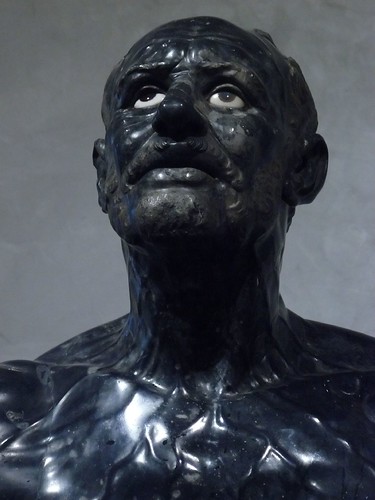
Old fisherman or Dying Seneca 2nd century
CE Roman copy of Hellenistic original.
Photographed at The Louvre by Mary Harrsch
Seneca also should have pondered Scipio's reputed mystic nature.  Perhaps Scipio found that bathing in a relatively dark chamber encouraged the visitations of prophetic dreams.  Most of what I had read about Scipio up until now described his military strategies and his political activities so I was not aware that some ancient sources, including Livy, reported that Scipio was prescient.  Polybius, on the other hand, attributed Scipio's successes to good planning, rational thinking and intelligence, which he perceived as a better indication of divine favor than prophetic dreams.

"His [Livy's] account is more literary than historical, more dramatic and careless. He was not very critical of sources. In his effort to promote Roman patriotism he reduces Roman strength and increases that of the enemy. As for his attitude toward Scipio, he did not assume the mystical religion bit was purely 'a cloak and tool'..."
"The closest we can come to Scipio is the writing of Polybius, the eminent Greek general and historian, who composed his history of Rome some 60 years after Scipio's active career...He was, however, a Stoic. This philosophy insisted on the rationality of the universe and the existence of natural causes for historical events. This philosophy certainly helped him in comparison with the more mystic ideas held by others, but in Scipio's case it caused Polybius trouble."
"Polybius' sources besides the Scipio family and Laelius, were Greeks, on both the Roman and Carthaginian side. These Greeks followed the school of thought of Alexander the Great - that of a mystic leader. They were perhaps the original "image makers". They liked to surround the idea of the leader with a divine glow. If they could not explain something, they said it was due to divine intervention. Hence they developed the Legend of Scipio. Polybius was anxious to refute this legend. [However,] He admired Scipio as his Stoic HERO, so made him a supremely rational genius. The result was a kind of caricature, a cunning individual who purposely plays on the superstition of his followers and uses religion for his own ends. Polybius makes it seem Scipio spread these ideas of his divinity himself, while disbelieving them." - John Sloan, Scipio Africanus, Publius Cornelius, (The Elder) (237 - 183 BC), son of Publius Cornelius Scipio


So called Patrizio Torlonia. Escultura de Marc...Image courtesy of Wikipedia
A rather sour-faced Cato the Elder
Sloan also mentions that some scholars point to Scipio's Etruscan origins and the widespread acknowledgment of Etruscan mystical gifts as the source of belief in his prophecy.  Whatever the reason behind this legendary aspect of his nature, I find it quite intriguing.


I noticed another interesting tidbit about Scipio in my research, too.  He supposedly wore his toga in the Greek fashion, resembling the dress of Greek poets and artists.  He was well known to be an avid Graekophile but this overt demonstration of his embrace of Greek culture did not endear him to many of the staunch Roman traditionalists, particularly Cato the Elder.  Yet, Scipio also introduced the practice of being clean shaven, perhaps emulating images of Alexander the Great, but not typical of Greek philosophers and poets of the time.  Definitely, a man of unusual contradictions.  Perhaps what frustrated Cato the Elder so much was that he couldn't pigeon-hole Scipio into any particular category making it difficult for Cato to mount an all out political attack on the man.


Cato did ultimately succeed in driving him away, though.  Apparently, Scipio took his resulting bitterness to his grave, reportedly ordering a tomb inscription that read:  "Ingrata patria, ne ossa quidem habebis"—ungrateful fatherland, you will not even have my bones!" (although we don't really know where Scipio was ultimately buried and have never recovered any funerary monument with these words.)  


I was curious whether any effort had been made to find Scipio's villa and learned that an initial excavation of Liternum was begun in 1923 and continued until 1937 but apparently no evidence of the villa was unearthed.  A UNESCO volunteer excavation was launched in the 1970s but it, too, did not reveal the site of Scipio's last days. Then in 1988 a more extensive excavation was launched.


"The remains as they stand today date mostly from the the early imperial period. The standing monuments consist of a temple, a basilica and a small theatre, positioned on the west side of the forum with a large open area in front. These are contained within a surrounding wall onto which are abutted a number of small rectangular buildings that are thought to be shops.
"The temple is in a typical Roman style set on a high podium of locally quarried tufa, with the emphasis of approach from the front of the building, the facade of which would have dominated the space in front of the temple. One complete and one partial column are all that remain of the temple facade.." 
"To the left of the temple lie the scant remains of the basilica. The brickwork in opus reticulatum suggests a date for the building between the second half of the first century BC and the first century AD, although the existing structure would almost certainly have been built to replace an earlier building on the site. The remains of the basilica today are unimpressive, but the vestiges of the marble that originally decorated the building, visible in one or two places where modern 'quarriers' haven't yet found it, give some indication of a rather grander past for the building."
"The other main structure on the site, to the right of the temple, is a small theatre of the imperial period. The remains show that the theatre follows a typical Roman plan. After removal of dense vegetation the scaena or stage building, and the cavea or seating area where clearly visible. The upper part of the cavea had collapsed, creating the impression that the theatre was much smaller than it actually had been. Although very small, the theatre would have been quite adequate for a town of this size. It might be surmised that the population had grown from the three hundred families of the original foundation, but probably not by much." - Jim Devine, University of Glasgow, Liternum: A Campanian Coastal Town


So, it seems that Scipio remains as elusive as ever.  As for Scipio being credited with the development of one of the first villas, though, it seems the jury is still out on that one too.  Helsinki scholar Eeva Maria Viitanen points out that the "Auditorium Villa", excavated in the 1990s, indicates there was a luxurious residential complex constructed as early as the 6th century BCE.


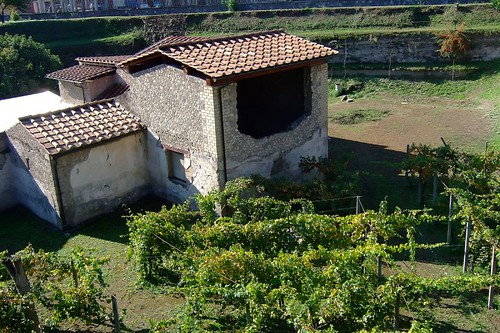
The Villae Regina, a villae rusticae unearthed at Boscoreale near Naples, Italy
was one of 30 small holdings situated  on the lower slopes of Vesuvius and
 on the adjacent plain of Sarno.  These 
small- and medium-sized 
properties
 were family-run or employed
 a few slaves.  Photographed 
by Mary Harrsch.
"The building has a very long history, starting from the Archaic period, and its earlier phases are also fairly well perserved.  What is special about this site is the rebuilding of the early small farm as a large and luxurious complex with what are probably separate living quarter and productive parts towards the end of the 6th century BCE.  In comparison with other sites of the period, the built area is enormous and it remains very large among its peers until the 1st century BCE, when the villa becomes quite normal in size among the many other large country houses.  It has been suggested that the Auditorium Villa was in fact a country residence for the head of a Roman elite family, who thus asserted his right over the landscape inhabited by members of his clan.  Such residences would have been relatively rare which is why they probably have not been found before.  The other farms were small in size and there would not have been intermediary forms between the very large and the small.  The possible model for these large residences might have been the slightly earlier Etruscan elite palaces, such as Murlo.  It is also claimed that there were no Catonian small or medium-sized villae rusticae in the 3rd-2nd centuries BCE.  The development into the 1st century BCE villa would have been faster and the changes would have happened closer to this boom period than suggested before.  The economic explanation echoes the common model of war booty invested in land, as external funds were needed to establish the new large villas and that the owners would have represented a much more heterogeneous group of persons than before." - Eeva Maria Viitanen, Locus Bonus: The Relationship of the Roman Villa to its Environment in the Vicinity of Rome


But whether Scipio inspired the widespread development of Roman villa architecture or not, he certainly was a passionate and gifted individual that I plan to study further.  I hope that by giving up those "triumphs with their withering laurels" he found those "lasting rewards that keep forever fresh and green" Cicero described so eloquently in Scipio's Dream.


Enhanced by Zemanta
If you enjoyed this post, never miss out on future posts by following me by email!


Tuesday, June 28, 2011

Trade Protectionism in the Roman Empire


"It appears from the newly discovered treatise of Cicero de Republica, that there was a law of the republic prohibiting the culture of the vine and olive beyond the Alps, in order to keep up the value of those in Italy. Nos justissimi homines, qui transalpinas gentes oleam et vitem serere non sinimus, quo pluris sint nostra oliveta nostraeque vineae."  - Footnote from Gibbon's Decline and Fall of the Roman Empire.
I found this reference interesting because I had not thought about the Romans engaging in trade protectionism before.  I did a little more research and found that the prohibition of the cultivation of grape vines beyond the Alps was actually mandated by the Roman Senate as early as 154 BCE.


Silver wine cup depicting Odysseus from 
Homer's Odyssey Book 11 Lines 26-42,
 Roman 1st century CE. 
 Photographed
 at the Getty
Villa by Mary Harrsch. 
  

But, by the 1st century CE, Roman demand for wine had grown so much that the ban must have either been overturned or was largely ignored as it is reported that by then Italian-produced wine was in such short supply that wine had to be imported from the Iberian peninsula or Gaul.
Mulsum was wine sweetened with honey, mixed in just before drinking (and therefore not like mead) and served as an aperitif at the beginning of the meal. (Conditum had herbs and spices such as pepper added as well.) Often freely dispensed to the plebs at public events to solicit their political support, the demand for mulsum became so great that it was more profitable to sell wine at home than to export it and, by the first century AD, wine had to be imported from Iberia and Gaul.  - Wine and Rome 
The problem of a wine shortage was further exacerbated by Domitian's vine edit in 90-91 CE.
"[Domitian]...thought that the corn-fields were being neglected as a result of too much concentration on vineyards, and issued an edit that no more vines were to be planted in Italy and that vineyards in the provinces were to be cut down, leaving no more than half standing..." - Suetonius, Life of Domitian, 7.2
 Suetonius goes on to point out that Domitian did not initially go through with this measure when a poem appeared depicting him as a vine-eating goat.  But he was later praised by others like Silvae (4.3.11-12) who hailed the legislation saying "to chaste Ceres, restores acres long denied her and a sober countryside", obviously considering the legislation more moral than economic, as did Suetonius and Statius.
"Undoubtedly, he wanted to encourage cereal-production both in Italy and in the provinces for shortages were not unknown.  The vine edit (of c. 90-1) had been issued just before the severe famine in Pisidian Antioch (92-3) but there was more to it than this; the cities of Asia had been growing and their populations expanding for many years, but the emperors were reluctant to allow the local elite to assume complete control over the production of corn [grain], for fear it would result in a concomitant loss of imperial authority.  In fact, what it did produce was famine.  Domitian tried to deal with the problem: hence, perhaps, his popularity amongst the provincials." - Brian W. Jones, The Emperor Domitian 
Furthermore, the cultivation of grapes in the provinces was apparently restricted to Roman citizens until Caracalla conferred citizenship on all free inhabitants of the empire in 212 CE. Then, the last restriction on viticulture, Domitian's edict, was finally overturned in 280 CE.

In researching this aspect of Roman law, I found one other little interesting bit of information.  I knew that Falernian wine (made from grapes grown on the slopes of Mount Falernus on the border between Latium and Campania) was generally considered the best quality.  A wine price list still visible on the wall of a Pompeii tavern declares, " "For one as (a unit of money) you can drink wine; for two, you can drink the best; for four, you can drink Falernian."
"Next in rank were the wines of the Alban Hills southeast of Rome, and Surrentine and Massic (among others) from the Campania. Finally, there was Mamertine from Messina, first brought into favor by Julius Caesar, who had it served at public banquets." -  Wine and Rome 
Apparently Julius Caesar spent lavish sums of money on public banquets but even he did not favor the mob with the best wines Italy had to offer!


Enhanced by Zemanta
If you enjoyed this post, never miss out on future posts by following me by email!