Monday, August 27, 2012

Review: The Sword of Revenge by Jack Ludlow


The Sword of Revenge is the second book in Jack Ludlow's "Republic " trilogy.  One of the main protagonists in this novel is the young outcast, Aquila, the son of the wife of the famous Aulus Cornelius Macedonicus and a Celtic warlord named Brennos who captured her in a Celtic raid in Iberia (ancient Spain).  Aquila has grown up on the small farm of an old ex-legionary who discovered the infant abandoned in the woods with no indication of his parentage except a gold talisman depicting an eagle in flight wound around his foot.

Clodius raises the child as his own but Clodius is a better soldier than a farmer so the struggling family must rely on hunting and fishing just to put food on the table.  One day, Clodius, having drunk a little too much wine, is tricked into accepting the offer of a wealthy neighbor, Piscius Dabo, who says he will provide for Clodius' family if Clodius would serve in the legions as  the wealthy neighbor's surrogate.  In truth, Dabo has previously served in the legions but has found it much more profitable to stay home and buy up all the surrounding farms from other neighbors who have gone off to serve the Republic.
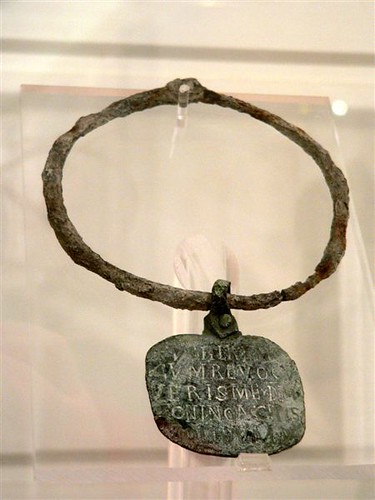
Roman Slave Medallion photographed at the
Terme di Dioclezione in Rome, Italy by
Mary Harrsch


With his adoptive father gone, Aquila spends his days in the surrounding hills hunting until one day he comes upon what appears to be an old shepherd.  However, Aquila discovers the man is really a one-eyed Celtic warrior named Gadoric who was captured by the Romans and masquerades as a feeble cripple to avoid being sent to Sicily to work on the large latifundias (farms owned by wealthy Roman senators) there.  The Celt is mystified by Aquila's tall, blonde appearance and feeling a kinship with the boy, teaches him to use a spear and a bow despite the fact that if the warrior, now a slave, should be found with weapons he could be crucified.

The Celt becomes a surrogate father to the youth and the two become inseparable.  But one day Aquila finds the Celt has been discovered and watches tearfully as his friend is led away in shackels towards Sicily.  More misfortune follows when his adoptive mother dies and he must go to live with the despised Piscius Dabo.

The other protagonist whose story runs parallel to Aquila's is Marcellus Falerius, son of Lucius Falerius, one of the two main characters from Book 1 who has, as yet, escaped the fate prophesied by the Sybil when Lucius and his boyhood friend Aulus clandestinely sought out the Sybil as children.
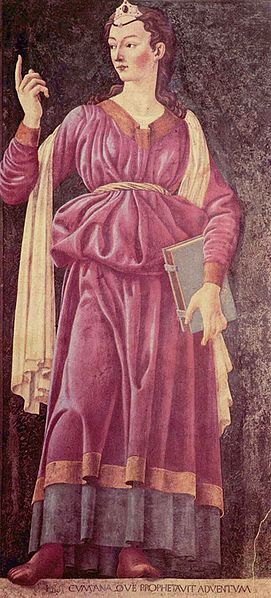
Cumaen Sybil by 
Andrea del Castagno 


One will tame a mighty foe, the other strike to save Rome's fame.
Neither will achieve their aim.
Look aloft if you dare, though what you fear cannot fly.
Both will see it before you die.

The old crone had scratched a drawing of an eagle in flight on a scrap of papyrus and tossed it to the two boys but as Lucius caught it, the image burst into flame, but not before searing the image into each boy's mind.

Before the climactic battle of Thralaxas at the conclusion of Book 1, Clodius, serving as a legionary under the great Macedonicus, had scratched his adopted son's eagle talisman in the dirt where Aulus stumbled across it before his bloody death at the Thermopylae-like defeat.  But Lucius is unaware that the first half of the prophecy has come to pass as he visits the tomb of his old friend at the beginning of Book 2.

Lucius Falerius grew up to become an ambitious politican and was the man who had ordered the murder of the tribune of the plebs (a character based on Tiberius Gracchus) because the man supported legislation to redistribute land to the poor.

A monument to the Gracchi by Eugene Guillame, French, 1853.
Photographed at the Musee d'Orsay by Mary Harrsch.


Falerius viewed this legislation as a move that would destroy the Rome he knew, directed by the wealthy elite known as the Optimates.  Although his ruthless act had caused quite a stir at the time, Falerius, claiming innocence, expertly manipulated the strings of power to overcome the opposition and become the first man in Rome.  Now aging, he works desperately to pass on his knowledge of the political machine to his son, Marcellus.  But Marcellus, actually the son of one of Falerius' barbarian slaves and Falerius' wife, unlike his "father", harbors an innate athletic ability that makes the martial arts come naturally to him.  Although he learns the political lessons his father drills into him, he, as yet, is not the ruthless singleminded individual his father has become.  And, he is beginning to chafe under his father's constant surveillance although he remains obedient to his father's commands.

This information is provided in the lengthy prologue as well as artfully woven throughout the fabric of the narrative as needed to make the novel stand on its own for readers who have not yet read Book 1, "The Pillars of Rome".

Then, "The Sword of Revenge" formally begins.

Flaccus, an old centurion who served with Aquila's adoptive father, shows up at the Nabo farm with a band of ex-gladiators on their way to take over the management of one of the large farms on Sicily.  Flaccus tells the boy of his adoptive father's death.  So, Aquila, without any further reason to stay, decides to throw in with Flaccus and his toughs and heads for Sicily hoping to find his old friend Gadoric.

Flaccus has made a bargain with the wealthy Cassius Barbinus, Aquila's vicious neighbor who owned Gadoric, to go to Barbinus' other farm on Sicily and "crack the whip" so to speak to improve the land's yield in return for a large percentage of the excess profit.

On the way to Sicily, some of Flaccus' ruffians sneak out at night to murder and pillage the surrounding countryside to enable them to buy wine and women.  I thought this was an excellent way Ludlow has chosen to introduce his readers to the dangerous environment of this period in Rome's history.  Such activities during this time were clearly described by Roman historian, Diodorus Siculus in his narrative about The First Servile War.

"With such licence given to men who had the physical strength to accomplish their every resolve, who had scope and leisure to seize the opportunity, and who for want of food were constrained to embark on perilous enterprises, there was soon an increase in lawlessness. They began by murdering men who were travelling singly or in pairs, in the most conspicuous areas. Then they took to assaulting in a body, by night, the homesteads of the less well protected, which they destroyed, seizing the property and killing all who resisted." - Diodorus Siculus
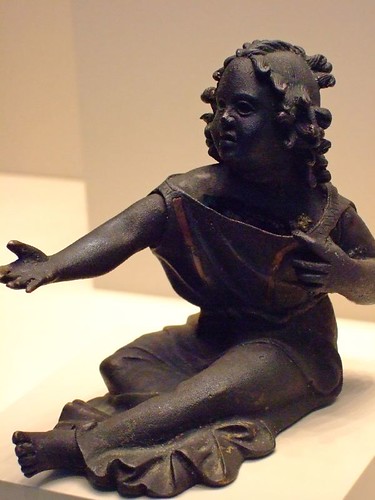
A bronze Roman coin bank depicting a beggar girl 25-50 CE.
Photographed at the Getty Villa by Mary Harrsch.


Once on Sicily, Flaccus,  implements a harsh regime, working not only the men but the women and children as he pushes hard to improve the farm's output.

"...they treated them with a heavy hand in their service, and granted them the most meagre care, the bare minimum for food and clothing. As a result most of them made their livelihood by brigandage, and there was bloodshed everywhere, since the brigands were like scattered bands of soldiers." - Diodorus Siculus

Soon a problem develops with runaway slaves who are banding together in the foothills and raiding the Roman estates.  This led to the revolt referred to as The First Servile War that lasted from 136 - 132 BCE.
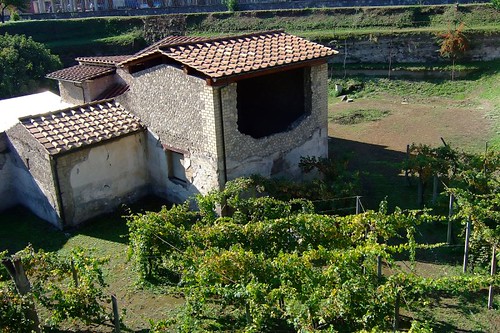
A Roman villa rustica excavated at Boscoreale near Naples, Italy.  Photo by
Mary Harrsch
The governor of Sicily calls for a meeting of the farming overseers to try to come up with a plan to avert the looming slave revolt.  Now a trusted bodyguard for Flaccus, Aquila goes with Flaccus to the meeting.  But on the way there he discovers his old Celtic friend, Gadoric, bound to a stake along the roadside in preparation for his impending crucifixion.

Aquila slips away from the meeting and when night falls, he overpowers the guards near the crucifixion site and frees his friend and a Palmyran Greek slave staked nearby named Hippolytas.

The rest of the novel focuses on the slave revolt eventually led by Aquila's friend and the mysterious Hippolytas who convinces the slaves on the island that he has oracular powers and demonstrates his ability to commune with the gods by spewing flames from his mouth.  This character is obviously based on the slave leader Eunus who led the slave revolt on Sicily in 136 BCE.

"There was a certain Syrian slave, belonging to Antigenes of Enna; he was an Apamean by birth and had an aptitude for magic and the working of wonders. He claimed to foretell the future, by divine command, through dreams, and because of his talent along these lines deceived many. Going on from there he not only gave oracles by means of dreams, but even made a pretence of having waking visions of the gods and of hearing the future from their own lips. 
Of his many improvisations some by chance turned out true, and since those which failed to do so were left unchallenged, while those that were fulfilled attracted attention, his reputation advanced apace. Finally, through some device, while in a state of divine possession, he would produce fire and flame from his mouth, and thus rave oracularly about things to come. 
For he would place fire, and fuel to maintain it, in a nut -- or something similar -- that was pierced on both sides; then, placing it in his mouth and blowing on it, he kindled now sparks, and now a flame. Prior to the revolt he used to say that the Syrian goddess appeared to him, saying that he should be king, and he repeated this, not only to others, but even to his own master." - Diodorus Siculus

Ludlow even has one of his characters confront Hippolytas about the use of the fuel-containing nut in his mouth to produce the illusion he throws flames from his mouth during his mystical prophesies.

Like Eunus, Hippolytas grows increasingly pompous as his superstitious followers become more insistent he assume the role of king of the slave army.  But Aquila, appalled by the brutality of the rebels and Hippolytas' growing greed, withdraws to the hills.

Meanwhile, back in Rome, an attempt is made on the life of Lucius Falerius.  To recover from his wounds, the old fox decides to seek solace in the south of Italy where he can direct the activities of Titus Cornelius, son of his late friend Aulus and now a military legate, and his own son, Marcellus, who are preparing a Roman military response to the slave revolt on Sicily.

Historically, the slaves take over the south central town of Enna and are eventually defeated there through siege and betrayal.

"Cities were captured with all their inhabitants, and many armies were cut to pieces by the rebels, until Rupilius, the Roman commander, recovered Tauromenium for the Romans by placing it under strict siege and confining the rebels under conditions of unspeakable duress and famine: conditions such that, beginning by eating the children, they progressed to the women, and did not altogether abstain even from eating one another. It was on this occasion that Rupilius captured Comanus, the brother of Cleon, as he was attempting to escape from the beleaguered city. 
Finally, after Sarapion, a Syrian, had betrayed the citadel, the general laid hands on all the runaway slaves in the city, whom, after torture, he threw over a cliff. From there he advanced to Enna, which he put under siege in much the same manner, bringing the rebels into extreme straits and frustrating their hopes. Cleon came forth from the city with a few men, but after an heroic struggle, covered with wounds, he was displayed dead, and Rupilius captured this city also by betrayal, since its strength was impregnable to force of arms." - Diodorus Siculus
Eunus is captured alive and thrown into prison where he sucuumbs to disease and dies at Morgantina.

"Eunus, taking with him his bodyguards, a thousand strong, fled in unmanly fashion to a certain precipitous region. The men with him, however, aware that their dreaded fate was inevitable, inasmuch as the general, Rupilius, was already marching against them, killed one another with the sword, by beheading. Eunus, the wonder-worker and king, who through cowardice had sought refuge in certain caves, was dragged out with four others, a cook, a baker, the man who massaged him at his bath, and a fourth, whose duty it had been to amuse him at drinking parties. 
Remanded to prison, where his flesh disintegrated into a mass of lice, he met such an end as befitted his knavery, and died at Morgantina." - Diodorus Siculus

Ludow, however, moves the action to the southern coastal city of Agrigentum where he treats us to an exciting naval battle between a rebel-converted merchant galley and a Roman trireme.

The revolt also ends quite a bit differently than in the history books as Aquila takes his revenge upon the Greek charlatan leaving blood-spattered images of his eagle talisman in his wake.  The sketches are dutifully copied and transmitted to none other than Lucius Falerius, thereby fulfilling the fateful prophecy.

Meanwhile, Marcellus visits the nearby cave of the Sybil and receives a prophecy of his own that sounds relatively benign.  The prophetess tells the young man he will inherit his father's fortune.  But, although Marcellus is unconcerned, it sent a shiver down my spine remembering that his real barbarian father was betrayed by Lucius Falerius and set upon by assassins who wounded him so severely that when he sought escape by jumping into the Tiber he could not withstand the strong current and drowned.

So, I'm looking forward to Book 3 of Ludlow's Republic trilogy, "The Gods of War" to learn how Aquila fulfills his destiny and if Marcellus escapes his fate.

Enhanced by Zemanta
If you enjoyed this post, never miss out on future posts by following me by email!


Thursday, August 16, 2012

Getty to feature modern depictions of Pompeii catastrophe


Unlike many other 
exhibitions of archaeological material from Pompeii, The Getty Villa's new presentation,  The Last Days of Pompeii: Decadence, Apocalypse, Resurrection, scheduled to open September 12, 2012 and running until January 7, 2013, begins with modern representations of perceived Pompeian decadence.  

The prevailing idea that the cataclysmic eruption that destroyed the Vesuvian cities in A.D. 79 was a justly deserved punishment for sins has pervaded popular consciousness through art and literature up to the present day. This notion has inspired artists and provided a vehicle to present sensual scenes or subversive themes in an acceptable setting.  A highlight of this section is Francesco Netti’s most famous work, Gladiator Fight during a Meal at Pompeii (1880, Naples, Museo di Capodimonte), which depicts the aftermath of a mortal combat held at a Pompeian banquet for the entertainment of dissolute, drunken Romans, while ladies swoon after the victor.

Gladiator Fight at a Meal in Pompeii by Francesco Netti (1880)

But despite its seeming accuracy, achieved through the precise depiction of archaeological artifacts, this scene has little basis in ancient practice. Roman gladiators generally performed in public arenas and rarely fought to the death.  The painting, rather, can be viewed as a contemporary critique of mid-nineteenth-century Italian aristocrats. 
Also on display are photographs by Wilhelm von Gloeden and Gugliemo Plüschow, some from Sir Lawrence Alma-Tadema’s personal archive, which record some of the best-known monuments at Pompeii populated by local youths staged in various states of undress. These photographs perpetuate a long-standing notion that Pompeii was a place of desire and erotic indulgence.

The second section examines the well-known apocalyptic event. Pompeii’s catastrophic demise has become the archetype for all subsequent disasters, whether natural or man-made. While eighteenth- and nineteenth-century artists often celebrated the terrifying yet beautiful power of nature, more recent artists have used the event to explore such issues as the aftermath of World War II and the angst of the Atomic Age.
 Image courtesy of the Art Institute of Chicago
Flight From Pompeii by Giovanni
Maria Benzoni, Italian,  1873.
Image courtesy of the Art Institute of Chicago.
Sebastian William Thomas Pether’s Eruption of Vesuvius with Destruction of a Roman City (1824, Boston, Museum of Fine Arts) dramatically shows the volcano spewing lava onto the ancient city, but his depiction of Roman architecture and figures in early-nineteenth century dress cross temporal boundaries. Also, embedded in the gilt frame are pieces of what appears to be lava, but is actually trimmed wood burl. Thus, what was intended to add authenticity to the imaginary scene is itself false. Alternatively, Andy Warhol’s Mount Vesuvius (1985, Pittsburg, Warhol Museum), with its vibrant palette and cartoonish effects, demonstrates that serial reproductions and kitsch are not just hallmarks of Pop Art, but also relate to the proliferation of images of the famous volcano. 
The exhibition also explores the famous body casts of Vesuvius’s victims. Since the invention of the plaster casting technique in 1863, body casts of victims have captured the imagination of the public through photographs of such artists as Giorgio Sommer, whose image on view of the famous cast of a dog found in the House of Vesonius Primus at Pompeii has served as an iconic representation of the suffering of the victims.
Cast of an unfortunate animal victim of
the 79 CE Vesuvius eruption.  
Photographed at Boscoreale, Italy by
Mary Harrsch.

Widely reproduced, it has been featured in numerous modern and contemporary works of art including Robert Rauschenberg’s Small Rebus (1956, Los Angeles, Museum of Contemporary Art) and Allan McCollum’s sculpture The Dog from Pompeii (1991, New York, Artist/Friedrich Petzel Gallery), which appear in the exhibition. The body casts on display in the exhibition are modern works, made from the now lost voids of disappeared bodies. Although we react to them emotionally, they are far removed from Vesuvius’s ancient victims. 
Another myth about Pompeii is its state of preservation. Few people realize that during World War II, the archaeological site was badly damaged by bombing carried out by American and British fighters seeking to disrupt German resupply routes nearby. After the war, many of the damaged structures were quickly rebuilt. Included in the exhibition are items from the Getty Research Institute’s special collections, which record the destruction caused by the bombing and detail the locations of the strikes. 
The exhibition concludes with an examination of archaeological fantasy and the attempts of artists to resurrect the ancient city. For over three hundred years, buildings and artifacts excavated at Vesuvian sites have advanced scientific reconstructions of daily life in the classical world. 
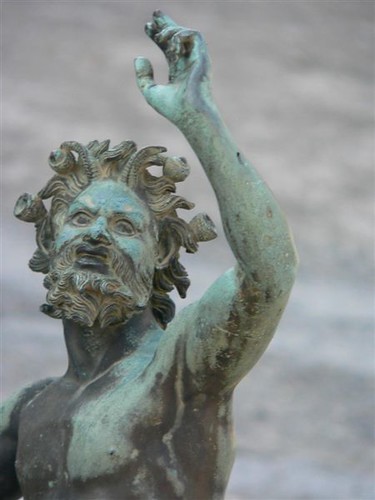
Reproduction of a bronze Faun found in the
House of the Faun in Pompeii.  Photographed
by Mary Harrsch at the Pompeii Archaeological
Park near Naples, Italy.

Simultaneously, they have underpinned more fanciful reincarnations, as artists have superimposed their contemporary values and ideas on antiquity with a variety of motivations, from the light-hearted to the serious. 
Inspired by a famous ancient figure of a dancing faun found in Pompeii, Hippolyte Alexandre Julien Moulin’s large bronze, A Lucky Find at Pompeii (1863, Paris, Musée d’Orsay), playfully depicts a nude Neapolitan youth rejoicing in the discovery of a fragmentary statuette of the hero Hercules, which he holds up in his right hand. The boy’s pleasure at his Pompeian find embodies the nineteenth-century European enthusiasm for both the artworks newly unearthed at Vesuvian sites and the process of their recovery, however idealized. The sculpture was much celebrated, winning a medal at the Paris Salon of 1864.
(Foreground) A Lucky Find in Pompeii by
Hippolyte Alexandre Julien Moulin, French
1863.  Photographed at the Mus
ée d'Orsay by Mary Harrsch.
 From the Vatican Museums comes an extraordinary loan of a cabinet containing objects excavated at Pompeii during the 1849 site visit by Pope Pius IX. There is much doubt about the extent to which these excavations were staged and whether artifacts were planted, since the objects found are strikingly diverse in type and material, including items of marble, glass, bronze, terracotta, local stone and lava, perhaps chosen in advance to emphasize the quality and variety of finds.
I sincerely hope I can make it down to the Getty Villa during this important exhibition.
Enhanced by Zemanta
If you enjoyed this post, never miss out on future posts by following me by email!


Review (sort of): Coriolanus (2012 DVD)


Well, after waiting for months to finally get my hands on a DVD of the new remake of "Coriolanus" starring Ralph Feinnes and Gerard Butler, I must confess that I was disappointed.  I had so hoped that, with the star power of two of my favorite actors, the film makers would give us a motion picture based on the general plot line of the Shakespearean play but give us more modern and natural dialogue.  (Sorry, Will, but your 15th century prose is so stilted and difficult to grasp at times it is REALLY distracting with the backdrop of a modern-day action movie).

As expected the acting was superb, especially with such acting veterans as Vanessa Redgrave playing Coriolanus' mother.  Gerard Butler was also back in fine form.  But the modern sets, costume and attitudes just served to emphasize the antiquated dialogue.  My husband and I usually watch any disks we get from Netflix together and despite the action, he revolted and demanded something else after only about 30 minutes.

I have actually seen a modernized version of "Coriolanus" before at the Oregon Shakespearean Festival down in Ashland a couple of years ago.  There, since I was prepared to hear Shakespeare, I enjoyed the performance despite the fact that I prefer my historical epics to be costumed for the period.  (As costumes are such an integral part of a live performance, I am always a bit disappointed when the producers opt for St. Vincent de Paul leftovers instead of burnished Roman cuirasses and dashing crested helmets.)

But I was taken off guard by the latest big screen version.  The trailer had succeeded in building up my expectation of an action packed thriller with a twist of political duplicity.  If you notice, there is no long rambling Shakespearean passages, just short phrases containing words that could have been spoken in modern dialogue.


 Instead I got “Know thou first, I loved the maid I married; never man sigh’d truer breath; but that I see thee here, thou noble thing more dances my rapt heart than when I first my wedded mistress saw bestride my threshold.”

Maybe "Coriolanus" will eventually make it to Netflix instant streaming and I can watch it alone without spousal distraction.  Maybe my appreciation for it will grow.  However, I do hope someday a filmmaker will actually take the legend of "Coriolanus" and produce a box office smash.  I'm afraid this wasn't it.

For a more thorough (and positive) review of Ralph Feinnes directing debut, I recommend the following:

Related articles
Enhanced by Zemanta
If you enjoyed this post, never miss out on future posts by following me by email!


Tuesday, July 24, 2012

Lion Attacking A Horse to be featured at Getty Villa


A Lion Attacking A Horse, a wonderful  monumental marble sculptural group dating to the early Hellenistic period (the late 4th century B.C.), will be the centerpiece of a new exhibit at the Getty Villa beginning August 10th (2012).  This work, part of the “The Dream of Rome,” a project initiated by the Mayor of Rome, Giovanni Alemanno, to exhibit timeless masterpieces from the city of Rome in the United States, was created during an artistic period when Greek sculptors began to produce naturalistic portrayals of intense emotion and physical exertion. 

Giambologna, the sculptor of Flemish origins who dominated Florentine
sculpture in the late 1500s, produced small bronzes based on the Hellenistic
work around 1580-1589.  This one is related to a version owned by the
Emperor Rudolf II (now in Vienna). However, here the horse's forelock is
lengthened and twisted into a small, spiral horn, evoking the unicorn of
medieval legend.  Image courtesy of the Walters Art Museum of Baltimore,
Maryland.
"Although the original location of the sculpture is unknown, its massive scale and dramatic carving suggest that it embellished a monument in northern Greece or Asia Minor (present-day Turkey). Created in the era of Alexander the Great’s conquest of Asia, the sculpture may have formed part of a larger composition with a melee of wild beasts and mounted hunters, which commemorated the young king’s famous lion-hunting exploits at Sidon (present-day Lebanon) in 332 B.C. and a royal game preserve in Basista (present-day Uzbekistan) in 328-327 B.C.  The sculpture was eventually brought to Rome, most likely as war booty seized by a victorious general for display in the imperial capital. It was ultimately discovered in the streambed near the Circus Maximus, a stadium used for chariot races, gladiatorial games, and animal combats." - Getty Villa

The work has been the focus of several restoration efforts.

"The work was first mentioned in an archival document in 1300. By 1347, the sculpture was prominently displayed on the Capitoline Hill in Rome, the seat of the city’s civic administration. During this time, Renaissance Rome was experiencing a great rebirth of interest in its glorious ancient past, which served as a model for the present..."

"...Throughout the late Middle Ages and the early Renaissance, the sculpture was a battered fragment consisted only of an equine torso and feline foreparts. In 1594, Michelangelo’s student Ruggero Bascapé (Italian, active by 1580, died about 1600) replaced the horse’s head and both animals’ missing limbs and tails. His restoration of the horse, with its head straining forward and its lower back leg folded awkwardly beneath its body, was not well received at the time.

"Much admired by Michelangelo, who praised the colossal fragment as “most marvelous,” the Lion Attacking a Horse was a compelling model for generations of artists who studied in Rome. It features in several 16th-century illustrations which show the work before and after restoration, and became the prototype for numerous small and large scale replicas. The installation at the Getty Villa will include a 1585 engraving by Giovanni Battista de’ Cavalieri from the Getty Research Institute, illustrating the sculpture prior to Bascapé’s additions. A 17th-century bronze statuette by Antonio Susini from the Department of Sculpture and Decorative Arts at the Getty Museum renders the horse’s head turned back toward the lion, a dynamic solution that reflects the likely composition of the original Greek sculpture." Getty Villa

Mosaic depicting a lion attacking an Onager Roman about 150 CE stone 
and glass.  Photographed at the Getty Villa by Mary Harrsch.
One of my favorite pieces at the Getty Villa,  a Roman mosaic of a lion attacking an onager, will be displayed with the work to help viewers visualize the original appearance of the Capitoline sculpture along with a set of  Parthian silver horse-trappings, vase-painting, coins, and gems featuring scenes of lion attacks.

I have had the privilege of visiting the Villa three times so far and each time have found the experience to be a  remarkable foray into the lives and culture of the ancient world.  

I hope to see  Lion Attacking a Horse before the close of the exhibit on February 4, 2013.  If I go after September 12, 2012 but before January 7, 2013, I could also see another fascinating presentation, The Last Days of Pompeii: Decadence, Apocalypse, Resurrection, an exhibit co-organized by the J. Paul Getty Museum and the Cleveland Museum of Art in association with the Musée national des beaux-arts du Québec.  I've been to Pompeii itself twice and attended three major exhibits about Pompeii but can never get enough!
Enhanced by Zemanta
If you enjoyed this post, never miss out on future posts by following me by email!


Saturday, July 7, 2012

Review: The Pillars of Rome by Jack Ludlow


"One shall tame a might foe, the other strike to save Rome's fame, neither will achieve their aim.  Look aloft if you dare, though what you fear cannot fly, both will face it before you die." - Jack Ludlow, The Pillars of Rome

This prophesy by the Alban Sybil, accompanied by a crude drawing of an eagle in flight that bursts into flame of its own accord, set the stage for Jack Ludlow's first novel set in ancient Rome.

"The Pillars of Rome" is the first book in a trilogy by Jack Ludlow set in the late 2nd century BCE.  Ludlow is an experienced writer and has published a number of books set in other time periods but this is his first with a Roman theme.  Ludlow does an excellent job of developing vibrant characters and deftly recreates Republican Rome with its strict social hierarchy, scheming and corrupt senators and provincial governors, politically motivated marriages, military reliance on landowners (this is before Marius approved career soldiers without land ownership requirements) and strict military "disciplina" in the conduct of its troops who, in turn, extended little mercy to the conquered.

However, Ludlow chooses to populate his book with purely fictional characters, making it more of a challenge for me to identify the time period and discuss the differences between events described in the novel compared to actual historical events like I usually do in most of my reviews.

Ludlow did give me some clues, though, as to the historical personages used as models for his main characters thus pinpointing the period of Roman history as well.

Ludlow's two main protagonists, Aulus Cornelius Macedonicus and Lucius Falerius Nerva, are lifelong companions and the prologue opens with a scene of the two as boys creeping into a dark cavern to clandestinely meet with the Sybil to gain insight into their respective futures.  It is soon apparent that Aulus is far more pious and god-fearing than Lucius  who is willing to risk eternal damnation to learn if he will realize his dreams of fame and fortune.  Aulus' piety will eventually become revered by Roman society and serve him well in his ascension to the peak of military success.  Likewise, Lucius' ambition will be the driving force in his future where risk-taking becomes second nature in his struggle to become politically the first man in Rome.

From his cognomen, Macedonicus, we know that Aulus apparently was instrumental in the Roman conquest of Macedon.  There were a number of Macedonian Wars but as we read the novel, we learn that he defeated King Perseus, son of King Philip V of Macedon, who ascended the throne in 179 BCE giving us a historical period of the early to mid 2nd century BCE.

Perseus was defeated by the legions led by Lucius Aemilius Paullus at the Battle of Pydna in 168 BCE at the climax of the Third Macedonian War.  Thereafter, he became known as  Lucius Aemilius Paullus Macedonicus.  So, we can assume Aulus is a surrogate for Paullus and examine the life of Paullus  to gain historical insight into this personage and the events surrounding this period of history.

In Plutarch's Lives, Paullus is held up as an examplery nobleman with "traditional Roman firmness and courage in adversity" ( an introduction by Philip A. Stadter and Robin Vaterfield to Roman Lives: A Selection of Eight Lives by Plutarch).  He carefully prepared for each engagement unlike his nemesis Perseus who is characterized as miserly, cowardly and unfaithful to his mercenaries who he failed to pay.
Perseus surrenders to Paullus. Painting by Jea...
Perseus surrenders to Paullus. Painting by Jean-François Pierre Peyron from 1802. Museum of Fine Arts, Budapest. (Photo credit: Wikipedia)
Paullus was also painfully aware of the fickleness of fortune.  One of his young sons, a boy of only 14, died just five days before Paullus was set to celebrate his victory.  While preparing for his triumph, Aemilius chided the cowering Perseus for failing to bear his reversal of fortune but follows this with reproaching his sons and officers for taking too much pride in their victory:

"What occasion can there possibly be for men to take heart, when victory over others is precisely the time when we are most compelled to be afraid of fortune, and when a happy man can be plunged into the depths of depression by the realization that fate follows a cyclical course and attaches itself to different people at different times?"

This reminds me of the fatalism expressed by Scipio Aemilianus, son of Paullus, upon witnessing the destruction of Carthage in 146 BCE.  Polybius reports:

"Scipio, when he looked upon the city as it was utterly perishing and in the last throes of its complete destruction, is said to have shed tears and wept openly for his enemies. After being wrapped in thought for long, and realizing that all cities, nations, and authorities must, like men, meet their doom; that this happened to Ilium, once a prosperous city, to the empires of Assyria, Media, and Persia, the greatest of their time, and to Macedonia itself, the brilliance of which was so recent, either deliberately or the verses escaping him, he said:

A day will come when sacred Troy shall perish,
And Priam and his people shall be slain.

And when Polybius speaking with freedom to him, for he was his teacher, asked him what he meant by the words, they say that without any attempt at concealment he named his own country, for which he feared when he reflected on the fate of all things human."

The son obviously learned this sad truth from his father.


Detail of The Triumph of Aemilius Paulus
Detail of The Triumph of Aemilius Paulus (Photo credit: Wikipedia)


Aulus' [Paullus'] triumph is mentioned several times in the novel and was obviously the crowning achievement of his career.  Fortunately, a wonderful description of the  three day spectacle comes down to us from Plutarch in his biography of Paullus:

"The first day - and it was only just enough - was given over to the spectacle of all the statuettes, paintings, and statues taken during the war, which were transported on 250 wagons.  On the next day the most beautiful and valuable of the Macedonian arms and armour were carried through the streets on large numbers of carts.  The bronze and iron parts of the weapons had been polished until they shone, and all the objects had been artfully and aesthetically positioned, so as to look as much as possible as though they had fallen into random heaps of their own accord: there were helmets lying next to shields, breastplates on top of greaves, Cretan targes and Thracian wicker shields and quivers all jumbled up with horses' bridles; the piles bristled with unsheathed swords, and pikes had been planted among them.  The arms and armour were somewhat loosely arranged, so that as they were carried along they struck against one another and gave out a harsh and fearsome sound, and even though they had belonged to the losers in the war their appearance was not without its terrors.  After the wagons with the arms and armour came three thousand men carrying coined silver money in 750 boxes; each box held three talents' worth of money and was carried by four men.  Then came more men carrying silver mixing-bowls, drinking-horns, drinking bowls, and cups, each shown off to its best advantage and each remarkable for its size and for the depth of the chased work on it."

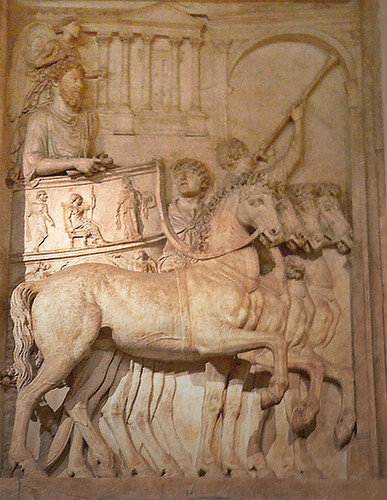
Marcus Aurelius driving a quadriga in a 
triumphal procession.  Photographed at the
Capitoline Museum by Mary Harrsch.


"Early in the morning of the third day trumpeters made their way through the streets, but the music they played was unusual for a procession or an exhibition; it was the kind with which the Romans used to rouse themselves in battle.  Behind the trumpeters 120 stall-fed oxen, with their horns gilded, and arrayed with headbands and chaplets were being led to sacrifice by young men dressed in ceremonial aprons with purple borders, and boys went with them, carrying silver and gold libation cups.  Next came the men carrying the gold coinage, which had been divided up, like the silver money, into vessels with a capacity of three talents, and there were seventy-seven such vessels altogether.  They were followed by men carrying the sacred bowl, which had been made, on Aemilius' instructions, out of ten talents of gold and studded with gems.  Next came men displaying the Antigonid, Seleucid, and Thericlean goblets, and all the golden tableware Perseus used.  They were followed by Perseus' chariot, which carried his arms and armour with his diadem lying on top of them.  Not far behind the chariot Perseus' children were led along as slaves, accompanied by a throng of weeping nurses, teachers, and tutors, who stretched out their hands in supplication to the spectators and taught the children to beg and plead.  There were two boys and one girl, too young to comprehend the magnitude of the disaster - and this made people feel so much more sad for them, considering the fact that one day this incomprehension would end, that Perseus walked by almost unnoticed by the Romans, who were just staring at the children in pity.  Many people started crying, and in all of them the spectacle aroused a mixture of pleasure and pain, until the children had passed by."

"Behind the children and their retinue came Perseus.  He wore a grey cloak and Macedonian boots, and looked as though he was utterly astounded and bewildered by the magnitude of the disaster that had happened to him.  He too was accompanied by a crowd of associates and friends; their faces were heavy with grief, but because they were constantly glancing at Perseus and weeping they gave the spectators to understand that they were mourning his fate and did not care in the slightest for their own.  Perseus had written to Aemilius, asking not to be paraded through the streets and included in the triumph, but Aemilius, apparently in mockery of Perseus' cowardice and fear of death, remarked: 'The situation is no different now from what it was before: he could grant his own request, if he wanted.' He [Aemilius] meant that he [Perseus] could always choose death instead of dishonour, but the coward could not bring himself to do that.  Instead, unmanned by hope, he became a part of his own spoils."

"After Perseus and his retinue, four hundred golden garlands were carried along, which had been brought and presented to Aemilius by representatives from the various cities in recognition of his valour.  Then came the man himself, mounted on a magnificiently decorated chariot.  He would have made a remarkable sight even without all these trappings of power; he wore a cloak dyed with purple and shot through with gold, and held in his right hand a spray of laurel.  Every single soldier likewise carried laurel.  The army marched behind their commander's chariot in their units and divisions, with the men singing partly traditional songs with an element of humour in them , and partly hymns of victory and praise for Aemilius' achievements."
In the novel, Aulus is said to have ritually strangled Perseus at the conclusion of the triumph but historically this did not occur.  Paullus actually arranged for Perseus to be moved from the "carcer" (prison) to a place that was clean "where he could life more like a human being."  But Perseus died anyway.  Plutarch says some writers say he starved himself to death while others report he angered his guards who, in retaliation, decided to not allow him to sleep, "until, eventually, worn out by this treatment he died."-  Plutarch, Aemilius Paullus, Roman Lives: A Selection of Eight Lives, edited by Philip A. Stadter and Robin Vaterfield.

As for his children that were so pitied by the Roman spectators, two of the children also died.  But Perseus' son Alexander survived and became an expert engraver and an accomplished secretary.

I sometimes wonder if ritual strangulation was as common as we are led to believe when I read about kings and rulers, like Perseus, that escaped the executioner's rope.  Maybe this ritual only occurred occasionally much like fights to the death between gladiators in the arena.

Returning to the novel, I think  Ludlow did a superb job of capturing this essence of nobility in his characterization of Aulus Cornelius.

Ludlow's novel makes a giant leap in time from the boyhood of the prologue to the mature years of his two main characters that comprise most of the novel.  When we pick up the tale in Chapter 1, Lucius has, indeed, become a powerful senator and leader of the Optimates while Aulus, the consummate warrior, has just returned from Spain where he has been battling the Celt-Iberians who have been stirred up by an outcast Gallic Druid by the name of Brennos.  The rebel activity must have been a prelude to the Celtiberian War.

"The Celtiberians, famous for their martial ability, fought a long and bitter war against Rome known as the Celtiberian war (Bellum Celtibericum, 153-133 BCE) and were involved in other conflicts with Rome throughout the 2nd century BC." -John T. Koch,  Celtic Culture: A Historical Encyclopedia

Aulus, like Paullus, had fought the Celt-Iberians in Spain earlier in his military career before his victories in Macedonia.

"Rome's most competent commanders were busy with the war against Antiochus the Great when another war broke out in the west, in Spain, where there had been serious disturbances.  Aemilius was dispatched there with the rank of praetor, but he had six extra lictors over and above the usual six praetorian lictors, with the reulst that his office was equivalent in dignity to that of a consul.  He won two pitched battles against the local tribesmen, who lost about thirty thousand men, and apparently it was plain to see that his success was due to his tactical skill, since he made victory easy for his troops by ensuring that they fought on favourable ground, on the far side of a certain river.  He also subdued 250 towns, which were happy to open their gates to him." Plutarch, Aemilius Paullus, Roman Lives: A Selection of Eight Lives, edited by Philip A. Stadter and Robin Vaterfield.

Although Plutarch never mentions Paullus' return to Spain, this is certainly a plausible plot development considering the ongoing conflicts  referred to by Koch.

Aulus finds Lucius, who has built his career around his ability to manipulate people with clever words rather than military prowess, mired in a dispute with a tribune of the plebs pushing land reform.  This can be no other than Tiberius Gracchus and Ludlow has kept the praenomen Tiberius but given his character a different gens name, Lavonius.   Tiberius Gracchus was elected tribune of the people in 133 BCE.  Historically, the problem is Paullus was already dead, having died in 160 BCE.  So Ludlow has compressed the historical timeframe at this point.  The only other reference I could find to earlier land reform efforts was a bill introduced during the consulship of Laelius in 140 BCE that was supported by Scipio Aemilianus but rejected by the senate (Paullus' younger son was adopted by the son of Scipio Africanus because Paullus, having four sons, could not afford to fund that many sons in their efforts to climb the Coursus Honorum).

Ludlow also portrays Lucius as the senator most violently opposed to the Gracchus figure which would make Lucius equivalent to Scipio Nasica Serapio.  Lucius,  like Nasica, unable to sway Tiberius Lavonius [Gracchus] from his determination to alleviate the inequality between the priviledged wealthy and thousands of Rome's destitute, hires thugs armed with clubs to seek out the tribune and club him to death - the actual fate that befell Tiberius Gracchus.

For those of you unfamiliar with Gracchus' land reform bill, here is a very good summary:

"There already existed a law at Rome - the so-called Licinian law - which limited the number of acres to be possessed by any one citizen to five hundred.  But this Licinian law had been a dead letter for many years, and there were many rich citizens in Rome who counted the number of their acres by the thousand or even ten thousand.  It was this violation of the Licinian law, and the open injustice done to the poor by this violation, which Teiberius Gracchus wanted to correct.  He therefore introduced a new agrarian law which aimed to revive the Licinian law, but at the same time greatly modified and attenuated its provision.  The change in the law which Tiberius Gracchus proposed was in one respect an act of injustice, because it put a premium on the violation of the law as it had existed, instead of punishing that biolation by imposing an adequate fine.  Under the new law a citizen might hold 500 acres of the public lands in his own name, and in addition, 250 acres for each son still under the paternal roof and authority.  Moreover, the new law provided that, whenever a citizen should be compelled to give up land which he held in excess of the share which the law allowed him, he should be reimbursed for this loss, at the appraised value, from the public treasury.  Tiberius Gracchus also favored the immediate distribution of the conviscated lands among the poor as their absolute property, and proposed that, whenever a Roman colony was founded on conquered territory, a similar distribution of the newly acquired land should be made." - Francis Johnson, Famous Assassinations of History From Philip of Macedon to Alexander of Servia

There is no mention of any violence surrounding the earlier debate over land reform in 140 BCE.  So, I feel I have teased out the historical figure represented by Lucius with a caveat.  In Ludlow's novel, Lucius and Aulus have been friends since boyhood.  However, if Lucius is really a surrogate for Scipio Nasica Serapio who orchestrated the death of Tiberius Gracchus, Ludlow must have decided to consolidate historical personages with Scipio Nasica Corculum (his father) since it is that Nasica that was more of a contemporary with Aemilius Paullus.  It is also that Nasica that served under Paullus in the Third Macedonian War, according to Plutarch in his description of the key battle of Pydna. 

Lucius is also portrayed as having no real military gifts except logistics (supply) but both Nasica Corculum and Nasica Serapio served as military commanders with Corculum leading a night action that was instrumental in the victory at Pydna. Serapio, however, is thought to be the praetor who suffered a great Roman defeat at the hands of the Pannonians in 141 BCE.  So Ludlow must have decided to soften this disparity with a middle path.

Now, let us return to Ludlow's narrative.

Aulus, suspects Lucius of having a part in the death of Tiberius Lavonius [Gracchus]and withdraws his political support, leaving Lucius angry and resentful.  Historically we know Paullus was considered a member of the aristocracy but he was recognized as being of such noble stature that he was considered "above" the day-to-day political mudslinging of the period.  We also know that his younger son did openly support the first efforts at land reform under Laelius.

Lucius is also put out about a social snub inadvertently committed by Aulus  when he failed to appear when summoned to attend the birth of Lucius' first son because Aulus was dealing with a secret birth within his own household - the subject of a subplot in the novel that will further manifest itself in successive books.

This subplot involving Paullus' second wife is, of course, totally fictitious because of the timeline if nothing else.  However, we know nothing about Paullus' second wife from the ancient sources so it isn't really historically misleading.  The ancient sources record the name of Paullus' first wife and state that Paullus actually divorced her - some say without adequate cause - even though  Aulus is portrayed as a widower in the novel.  Ludlow portrays the lady Claudia as barely 16 when she is offered to Aulus, even though he is quite mature, a common practice for the period.

(Spoiler alert) The baby is the result of Paullus' wife being captured by the Celt-Iberians and Aulus and his faithful Greek body servant Cholon take the child far away and expose it where they think no one would possibly find it.  Of course, someone does just like in the ancient Greek epics.  It's at this point that land ownership requirements for serving in the legions plays an important part in succeeding events.

One of the minor characters, a well meaning but unsuccessful former legionary who has gambled away the plot of land he received upon discharge from the army, is seduced into rejoining the legions as a surrogate for a neighbor who has been far more successful with his own plot.  The neighbor agrees to take care of the man's wife and adopted son (the child exposed by Aulus) while the hapless man is on campaign in the neighbor's stead.  In the meantime, the neighbor further fattens his pockets by avoiding taxes on his properties because he has had his surrogate enlist under the prosperous neighbor's name, making him exempt from taxation.

I never really thought about this much before since most of my study has focused on the post-Marius reform period where just about anyone could join the legions, but I'm sure these types of deceptions probably occurred during the second century BCE when military service was restricted to landowners.  The wealthy have always had carefully orchestrated loopholes to avoid mandatory military service in my lifetime so it would be logical to assume this practice has come down to us from antiquity.

But back to Aulus and Lucius!

To get Aulus out of his way politically, Lucius arranges for Aulus to head an investigation of the corrupt activities of the new governor of Illyricum since Aulus had initially pacified the area earlier in his career.

This background information about Aulus (Paullus) is also based on history.

"After being elected consul, Aemilius led an army against the Ligurians, whose territory ran alongside the Alps.  The Ligurians were a warlike and courageous people who were having their military skills honed by the Romans, whose neighbours they were...Aemilius' advance was met by a force of forty thousand, five times the number of his eight thousand men, but he engaged them in battle, forced them back, and pinned them inside their strongholds...The Ligurians trusted Aemilius and surrendered both their ships and their settlements to him.  He restored their settlements to them unharmed..." - Plutarch, Aemilius Paullus, Roman Lives: A Selection of Eight Lives, edited by Philip A. Stadter and Robin Vaterfield.

But after his conquest of Macedon, we have no evidence Paullus returned to Illyricum so this coupled with the timeline issue points to the rest of story as purely fictional.

In Illyricum, Aulus finds that the people who he had left pacified were on the verge of open revolt because the greedy governor was gouging them with taxes while at the same time delaying payment to his own legions so he could loan out money in the pay chests and reap the interest for himself.  The men of the legions have lost their discipline and are no longer in fighting trim.  So Aulus has his work cut out for him and takes command offending the corrupt governor Vegetius.  Meanwhile the rebels of Epirus rise up against the Roman administration there. Aulus marches a relief force towards the gathering rebel army near a narrow defile named Thralaxas where he faces the dire fate forecast those many years ago in the Sybil's cavern.

I'm sure Paullus would have welcomed such a heroic end but in fact, he died of natural causes.  Apparently not long after being named censor (although Plutarch points out he had time to complete all of the most important things) he fell critically ill.  His doctors advised him to rest in the country by the sea so he sailed to Velia.  But the Romans missed him.

"...in the theaters they often gave voice to what seemed to be prayers and appeals to see him.  And so, when a sacrifice was to take place which required his presence, and his health seemed up to it, he returned to Rome.  He performed the sacrifice along with his fellow priests, surrounded by a crowd of visibly happy Romans, and then the next day made another sacrifice, in private, asking the gods to keep him in good health.  When the sacrifice had been performed in the prescribed manner, he returned home and lay down, but suddenly, before he had time to notice and comprehend the change, he became delirious and deranged, and two days later he died." - Plutarch, Aemilius Paullus, Roman Lives: A Selection of Eight Lives, edited by Philip A. Stadter and Robin Vaterfield.

I found Ludlow's novel to be culturally immersive and with enough complexity to be intellectually satisfying.  His battle sequences were exhilarating and his characters empathetic.  I have already begun book two in the trilogy "The Sword of Revenge" and look forward to Aulus' son Titus exacting retribution for his father's betrayal.


Enhanced by Zemanta
If you enjoyed this post, never miss out on future posts by following me by email!