Showing posts with label Isis. Show all posts

Wednesday, March 24, 2021

Rome's integration of Isis

In the first millennium BCE, Osiris and Isis became the most widely worshipped Egyptian deities, and Isis absorbed traits from many other goddesses. Rulers in Egypt and its neighbor to the south, Nubia, built temples dedicated primarily to Isis, and her temple at Philae was a religious center for Egyptians and Nubians alike. Her reputed magical power was greater than that of all other gods, and she was said to protect the kingdom from its enemies, govern the skies and the natural world, and have power over fate itself.

In the Hellenistic period (323–30 BCE), when Egypt was ruled and settled by Greeks, Isis was worshipped by Greeks and Egyptians, along with a new god, Serapis. Their worship diffused into the wider Mediterranean world. Isis's Greek devotees ascribed to her traits taken from Greek deities, such as the invention of marriage and the protection of ships at sea, and she retained strong links with Egypt and other Egyptian deities who were popular in the Hellenistic world, such as Osiris and Harpocrates. As Hellenistic culture was absorbed by Rome in the first century BCE, the cult of Isis became a part of Roman religion. Her devotees were a small proportion of the Roman Empire's population but were found all across its territories. Her following developed distinctive festivals such as the Navigium Isidis, as well as initiation ceremonies resembling those of other Greco-Roman mystery cults. Some of her devotees said she encompassed all feminine divine powers in the world.

Authorities in the Republic tried to define which cults were acceptable and which were not, as a way of defining Roman cultural identity amid the cultural changes brought on by Rome's expansion. In Isis's case, shrines and altars to her were set up on the Capitoline Hill, at the heart of the city, by private persons in the early first century BCE. The independence of her cult from the control of Roman authorities made it potentially unsettling to them. In the 50s and 40s BCE, when the crisis of the Roman Republic made many Romans fear that peace among the gods was being disrupted, the Roman Senate destroyed these shrines, although it did not ban Isis from the city outright.

Egyptian cults faced further hostility during the Final War of the Roman Republic (32–30 BCE), when Rome, led by Octavian, the future emperor Augustus, fought Egypt under Cleopatra VII. After Octavian's victory, he banned shrines to Isis and Serapis within the pomerium, the city's innermost, sacred boundary, but allowed them in parts of the city outside the pomerium, thus marking Egyptian deities as non-Roman but acceptable to Rome. Despite being temporarily expelled from Rome during the reign of Tiberius (14–37 CE), the Egyptian cults gradually became an accepted part of the Roman religious landscape. The Flavian emperors in the late first century CE treated Serapis and Isis as patrons of their rule in much the same manner as traditional Roman deities such as Jupiter and Minerva. The cults also expanded into Rome's western provinces, beginning along the Mediterranean coast in early imperial times. At their peak in the late second and early third centuries CE, Isis and Serapis were worshipped in most towns across the western empire, though without much presence in the countryside.[145] Their temples were found from Petra and Palmyra, in the Arabian and Syrian provinces, to Italica in Spain and Londinium in Britain.

My closeup of the Marble statue of Isis found at Hadrian's Villa that I photographed at the Capitoline Museum in 2005.

Marble statue of Isis, the goddess holds a situla and sistrum, ritual implements used in her worship, from 117 until 138 CE, found at Hadrian's Villa (Pantanello), Palazzo Nuovo, Capitoline Museums, courtesy of  Wikimedia Commons contributor Carole Raddato.

Statue of Isis-Persephone holding a sistrum. Temple of the Egyptian gods, Gortyn. Roman period ( 180-190 CE) at the Archaeological Museum in Herakleion, courtesy of Wikimedia Commons contributor Wolfgang Sauber.

Bust of Isis-Sothis-Demeter. White marble, Roman artwork, second part of Hadrian's reign, ca. 131–138 CE. From the gymnasium in the Villa Adriana, near Tivoli, courtesy of Wikimedia Commons contributor Marie-Lan Nguyen.

Roman statue of Isis at Kunsthistorisches Museum in Vienna, Austria courtesy of Wikimedia Commons contributor Manfred Werner. 

Head of divinity, possibly Isis, 2nd century CE, at the Musée Saint-Raymond courtesy of Wikimedia Commons contributor Daniel Martin.

Roman statue of Isis from the 1st - 2nd century CE at the Museo Nazionale Romano, Terme di Diocleziano, courtesy of Wikimedia Commons contributor Szilas.


If you enjoyed this post, never miss out on future posts by following me by email!


Sunday, December 6, 2020

Social Integration in Roman Period Egypt

 The social structure in Aegyptus under the Romans was both unique and complicated. On the one hand, the Romans continued to use many of the same organizational tactics that were in place under the leaders of the Ptolemaic period. At the same time, the Romans saw the Greeks in Aegyptus as “Egyptians”, an idea that both the native Egyptians and Greeks would have rejected. To further compound the whole situation, Jews, who themselves were very Hellenized overall, had their own communities, separate from both Greeks and native Egyptians.

The Romans began a system of social hierarchy that revolved around ethnicity and place of residence. The Augustan takeover introduced a system of compulsory public service, which was based on poros (property or income qualification), which was wholly based on social status and power. Other than Roman citizens, a Greek citizen of one of the Greek cities had the highest status, and a rural Egyptian would be in the lowest class. In between those classes was the metropolite, who was almost certainly of Hellenic origin. Gaining citizenship and moving up in ranks was very difficult and there were not many available options for ascendancy. 

One of the routes that many followed to ascend to another caste was through enlistment in the army. Although only Roman citizens could serve in the legions, many Greeks found their way in. The native Egyptians could join the auxiliary forces and attain citizenship upon discharge.

Although Alexandria enjoyed the greatest status of the Greek cities in Egypt, it is clear that the other Greek cities, such as Antinoopolis, enjoyed privileges very similar to the ones seen in Alexandria and the Romans looked to Greek elites  to provide municipal officers and well-educated administrators. In contrast, the native Egyptians were treated as a conquered race.

Prior to Roman conquest, the Hellenistic Ptolemies identified Egyptian deities with their own. This continued after Roman annexation. The cult of Isis appealed even to Greeks and Romans outside Egypt, and in Hellenized form it spread around the Mediterranean and eventually across the Roman Empire. The result was the creation of hybrid deities such as those depicted on this "good luck" bracelet crafted in Roman Egypt in the late 1st century BCE or 1st century CE. 

The first known temple to Isis in Greece was built during or before the fourth century BCE by Egyptians living in Athens. Isis's cult reached Italy and the Roman sphere of influence at some point in the second century BCE.  It was one of many cults that were introduced to Rome as the Roman Republic's territory expanded in the last centuries BCE. Authorities in the Republic tried to define which cults were acceptable and which were not, as a way of defining Roman cultural identity amid the cultural changes brought on by Rome's expansion. In Isis's case, shrines and altars to her were set up on the Capitoline Hill, at the heart of the city, by private persons in the early first century BCE. 

The independence of her cult from the control of Roman authorities made it potentially unsettling to them. In the 50s and 40s BCE, when the crisis of the Roman Republic made many Romans fear that peace among the gods was being disrupted, the Roman Senate destroyed these shrines, although it did not ban Isis from the city outright.

Egyptian cults faced further hostility during the Final War of the Roman Republic (32–30 BCE), when Rome, led by Octavian, the future emperor Augustus, fought Egypt under Cleopatra VII. After Octavian's victory, he banned shrines to Isis and Serapis within the pomerium, the city's innermost, sacred boundary, but allowed them in parts of the city outside the pomerium, thus marking Egyptian deities as non-Roman but acceptable to Rome. Despite being temporarily expelled from Rome during the reign of Tiberius (14–37 CE), the Egyptian cults gradually became an accepted part of the Roman religious landscape. The Flavian emperors in the late first century CE treated Serapis and Isis as patrons of their rule in much the same manner as traditional Roman deities such as Jupiter and Minerva.


Image: Bracelet with Agathodaimon, Isis-Tyche, Aphrodite, and Thermouthis, 1st century B.C.E.–1st century CE, Roman Period at the Metropolitan Museum of Art.  

"Powerful talismans of fertility and good destiny are woven into this rich golden composition. The bodies of two snakes intertwine to form a Herakles knot, the centerpiece of this bracelet. The snake on the left represents Agathodaimon, and the cobra on the right Thermouthis, two agrarian/fertility deities associated with Serapis and Isis, respectively. On the platform between them stand two goddesses, Isis-Tyche (or Isis-Fortuna), a deity closely associated with Alexandria, and the nude Aphrodite." - Metropolitan Museum of Art

If you enjoyed this post, never miss out on future posts by following me by email!


Monday, August 10, 2020

Roman worship of the Egyptian goddess Isis

Greeks were aware of Egyptian deities, including Isis, at least as early as the Archaic Period (c. 700–480 BCE), and her first known temple in Greece was built during or before the fourth century BCE by Egyptians living in Athens. The conquests of Alexander the Great late in that century created Hellenistic kingdoms around the Mediterranean and Near East, including Ptolemaic Egypt, and put Greek and non-Greek religions in much closer contact. The resulting diffusion of cultures allowed many religious traditions to spread across the Hellenistic world in the last three centuries BCE. 

Isis's cult reached Italy and the Roman sphere of influence at some point in the second century BCE. It was one of many cults that were introduced to Rome as the Roman Republic's territory expanded in the last centuries BCE. Authorities in the Republic tried to define which cults were acceptable and which were not, as a way of defining Roman cultural identity amid the cultural changes brought on by Rome's expansion. In Isis's case, shrines and altars to her were set up on the Capitoline Hill, at the heart of the city, by private persons in the early first century BCE. The independence of her cult from the control of Roman authorities made it potentially unsettling to them. In the 50s and 40s BCE, when the crisis of the Roman Republic made many Romans fear that peace among the gods was being disrupted, the Roman Senate destroyed these shrines, although it did not ban Isis from the city outright.

Egyptian cults faced further hostility during the Final War of the Roman Republic (32–30 BCE), when Rome, led by Octavian, the future emperor Augustus, fought Egypt under Cleopatra VII. After Octavian's victory, he banned shrines to Isis and Serapis within the pomerium, the city's innermost, sacred boundary, but allowed them in parts of the city outside the pomerium, thus marking Egyptian deities as non-Roman but acceptable to Rome. Despite being temporarily expelled from Rome during the reign of Tiberius (14–37 CE), the Egyptian cults gradually became an accepted part of the Roman religious landscape. The Flavian emperors in the late first century CE treated Serapis and Isis as patrons of their rule in much the same manner as traditional Roman deities such as Jupiter and Minerva. The cults also expanded into Rome's western provinces, beginning along the Mediterranean coast in early imperial times. At their peak in the late second and early third centuries CE, Isis and Serapis were worshipped in most towns across the western empire, though without much presence in the countryside. Their temples were found from Petra and Palmyra, in the Arabian and Syrian provinces, to Italica in Spain and Londinium in Britain.

Image:  Oracle statue of Isis, Roman, Bronze, 150 CE, that I 
photographed at the Neues Museum in Berlin.

If you enjoyed this post, never miss out on future posts by following me by email!


Tuesday, May 5, 2020

Isis-Aphrodite, Roman symbols of fertility and rebirth in the Second Century CE

Isis-Aphrodite is a form of the great goddess Isis that emphasizes the fertility aspects associated with Aphrodite. She was concerned with marriage and childbirth and, following very ancient pharaonic prototypes, also with rebirth. Figures depicting this goddess are found in both domestic and funerary contexts. Popular already in the 3rd to 2nd centuries B.C., they continued to be made in Roman times. Dating technology places these pieces in the Roman period. These statuettes were created between 161 - 180 CE and are thought to be possibly reflecting the image of Empress Faustina Minor, wife of Marcus Aurelius. Statuettes with a vulture cap have been found in both Egypt and Syria. Images courtesy of The Metropolitan Museum of Art.

Isis-Aphrodite resembling the Roman Empress Faustina Minor, wife of Marcus Aurelius, 1st - 2nd century CE Egypt

Isis-Aphrodite with vulture cap that resembles Roman Empress Faustina Minor wife of Marcus Aurelius 161-180 CE Egypt


If you enjoyed this post, never miss out on future posts by following me by email!


Monday, March 12, 2012

Identifying Ancient Art - A game of smoke and mirrors?

History resource article by Mary Harrsch © 2012

Today, I watched a fascinating lecture "Mistaken Identities: How to identify a Roman emperor" by Mary Beard recently delivered at Stanford University.  As a "fan" of Julius Caesar, I thought her critique of a number of heads identified as Caesar over the years was very enlightening.

I also found her overall discussion of the rather tenuous nature of sculpture identification particularly interesting because lately, I have been re-editing a number of images I shot of Roman sculpture at the Capitoline and National Museums in Rome back in 2005.  I had just started my crusade to photograph historical art and make my images freely available to teachers, researchers and students and had not yet developed my current practice of photographing the identification placards in a sequence with the sculpture to enable me to properly identify the artwork once I returned home to my office.  So, on that first trip to Rome, I ended up with dozens of photographs that all I could say for sure were portraits of Roman men or women until I had a chance to research them further to label them properly.

With the internet and our current technology, I naively believed that proper identification would be a relatively straightforward process.  I have since learned that not only is it not straightforward, even what is thought to be accurate identification at the time changes as different scholars apply different interpretations or museums reliant on governmental support become subject to various political agendas seeking some kind of historical confirmation through a culture's art legacy.

It gets even more confusing when identification displayed at a museum differs from the museum's own collections catalog. I recently received a request from a publisher in Denmark for an image I took back in 2007 of a fresco at the Museo Archeologico Nazionale in Naples that, at the time, was labeled "Cleopatra greets the god of the Underworld'.  But, when I looked the image up in the collections book that I purchased at the museum, I noticed that it said it was Io being welcomed upon her arrival to Egypt by the goddess Isis to her sanctuary of Canopos.  The fresco was unearthed in 1764 in the Temple of Isis in Pompeii in a room dubbed the Ekklesiasterion.


The satyr-looking creature bearing up Io looks like it could be Hades but the catalog says it is a river god.  Io is identified by the vestiges of horns she still retains from her time as a heifer.  Isis appears to be dressed in the Greek fashion and holds a cobra coiled around her arm.  The catalog tells us that the painting originated from the court of the Ptolemies in Alexandria "in order to legitimize their dynasty by rooting it in ancient Heraclean and Argive origins which embraced the dual ethnic components of the new kingdom, the Egyptian and the Macedonian".  The fresco is thus dated to the the early Ptolemaic dynasty after a 3rd century BCE prototype .  This all sounds quite carefully researched and definitive.  However, there is no mention of technical dating examinations so I must assume this is educated conjecture.  The only thing that nags at me is the prominent display of the cobra and the knowledge that the fresco was apparently once thought to represent Cleopatra VII in the role of Isis.

In the historical record, Cleopatra VII represented herself as the living embodiment of Isis and the cobra was known to be not only a sacred creature but a pharaonic symbol.  When I check the "king's list" of the Ptolemaic Dynasty, I find a few females mentioned as co-rulers, usually regents for under-age male inheritors, beginning with Cleopatra II Philometora Soteira in 131 BCE, but you really don't find a woman ruling with the trappings of pharaoh until you reach Cleopatra VII in 51 BCE.  So the possibility that Cleopatra VII as Isis is the welcoming figure in the fresco cannot be totally dismissed.  I also can't help but think the widespread publicity surrounding Cleopatra and her death by the bite of a cobra in the 1st century BCE could easily have influenced a Roman artist charged with decorating the walls of a temple to Isis in Pompeii during that period.

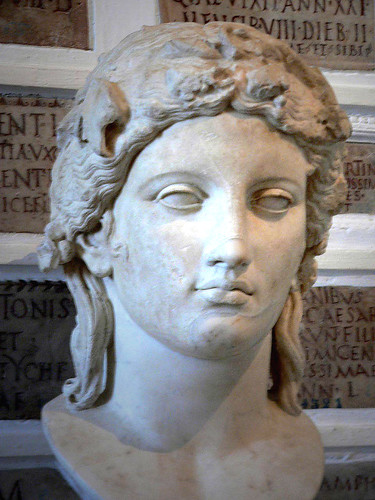
Another confusing identification I encountered recently was a picture of a sculpture said to be Apollo of the Anzio type at the Capitoline Museum:


Call me crazy but it looks like remnants of grapes and grape leaves in the hair which would make me think it was Dionysos.  Many sculptures of Apollo also have an iconic knot in the hair on top of the head so I am baffled by the identification associated with this piece.

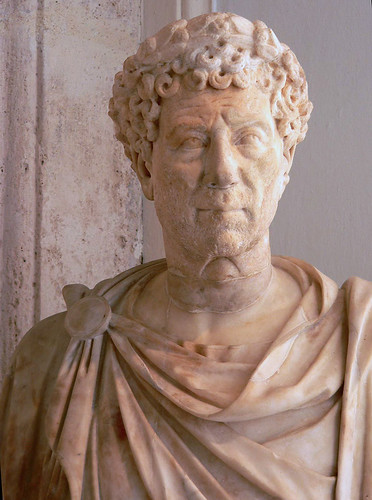
Reviewing my images from the Hall of Emperors in the Capitoline Museum, I came across the following bust:


After reviewing hundreds of images of Roman emperors (or said to be Roman emperors), I cannot find a single one that looks like him.  He appears to be wearing a laurel crown and in 2005 was positioned close to the busts of  Vespasian, Domitian and Titus (based on the photo time stamp).  This would make me think he may have been one of the emperors in the Year of the Four Emperors after the assassination of Nero but I checked images of Otho, Galba and Vitellius and he doesn't resemble any images identified as them.  Although I thought the museum positioned busts in relationship to the sequence of their reigns, this may not be the case either.  So, I would appreciate any information anyone could offer that would help identify this Roman.  


Enhanced by Zemanta
If you enjoyed this post, never miss out on future posts by following me by email!