Showing posts with label Alexandria. Show all posts

Wednesday, February 17, 2021

Cremation or Inhumation?

During the Ptolemaic period a distinctive type of subterranean tomb for multiple burials proliferated in the cemeteries around the city of Alexandria. Underground chambers cut into the living rock radiated from a central courtyard open to the sky. Most chambers contained a number of loculi, long narrow niches cut into the walls, which served as burial slots. Some loculi were sealed with painted limestone slabs in the form of small shrines. - Metropolitan Museum of Art

Roman columbaria were often built partly or completely underground as well. Most columbaria were managed by funeral societies and used by the lower and middle-classes. Niches could be quite simple or elaborately decorated with inscriptions, paintings, and mosaics depending on each family's economic means.  

The Columbarium of Pomponius Hylas is a 1st-century CE Roman columbarium, situated near the Porta Latina on the Via Appia, Rome, Italy. It was discovered and excavated in 1831 by Pietro Campana. Though its name derives from Pomponius Hylas, who lived in the Flavian period (69-96 CE), the building itself has been dated to between 14 and 54 CE due to inscriptions on two of its niches (one dedicated to a freedman of Tiberius and the other to a freedman of Claudia Octavia, daughter of Claudius and Messalina). It was later bought by Pomponius Hylas for himself and his wife.

 Inhumation was practiced regularly in archaeic Rome although cremation was gaining acceptance and a practice known as os resectum ("cut-off bone") was developed to satisfy both economy and spiritual traditions. According to Plutarch, King Numa Pompilius (r. 715-673 BCE) had forbidden cremation so perhaps in at least partial obedience to this prohibition, and perhaps on the understanding that "a part implies the whole", a complete finger was sometimes cut from the corpse before cremation and buried separately, unburnt, to complete the household's purification, return the deceased to mother Earth and make the grave inviolable. 

But, cremation became the most common burial practice in the Mid- to Late Republic and the Empire into the 1st and 2nd centuries. Interestingly, this appears to correspond to the military expansion of Rome and the increasing lack of ability to return intact war dead from distant battlefields.

Patrician members of the gens Cornelia seem to have resisted this change, though, and continued inhumating their dead until the first century BCE. In 79 BCE, the dictator Sulla was the first patrician Cornelius to be cremated, perhaps because he feared his body would be defaced by his former enemies.

Eventually, however, cremation remained a feature of imperial deification funerals, and very few others.  Building columbariums was finally halted during Hadrian’s rule from 117 to 138 CE as inhumation once more preferred.

Painted limestone funerary slab with a man controlling a rearing horse, 2nd half of 3rd century B.C.E. at the Metropolitan Museum of Art in New York. Here, a lively depiction of a Thessalian man named Pelopides trying to bridle a horse, while a boy stands behind him, commemorates a man from Thessaly in Northern Greece, who must have been one of the many foreigners who congregated in the wealthy, cosmopolitan Ptolemaic capital.

Painted limestone funerary slab depicting a soldier and two girls from Alexandria, 2nd half of 3rd century BCE at the Metropolitan Museum of Art.

Painted limestone funerary slab with a soldier taking a kantharos from his attendant girls from Alexandria, 2nd half of 3rd century BCE at the Metropolitan Museum of Art.

Painted limestone funerary slab with a soldier standing at ease, 2nd half of 3rd century B.C.E. at the Metropolitan Museum of Art. A soldier wearing a long blue cloak stands alone, with a spear in his right hand and a tall ovoid shield at his left. Celtic groups from Europe migrated eastward in 279 B.C. and established independent kingdoms in Thrace and central Asia Minor. Known as Galatians, they were used extensively as mercenary soldiers. Inscriptions identifying at least three Galatian soldiers who must have served under the Ptolemies occur on loculus slabs in a rather simple tomb found in 1884.

Interior of the Columbarium of Pomponius Hylas (Rome, Italy) courtesy of Wikimedia Commons contributor Tyler Bell. 


If you enjoyed this post, never miss out on future posts by following me by email!


Wednesday, November 18, 2020

The cult of Serapis: Visions and Portents

Serapis, sometimes spelled Sarapis, is a Graeco-Egyptian deity promoted during the 3rd century BCE by Ptolemy I Soter as a means to unify Greeks and Egyptians in his realm.  Alexander the Great had attempted to use Amun for this purpose, but he was more prominent in Upper Egypt, and not as popular in Lower Egypt, where the Greeks had stronger influence. Ptolemy built an immense temple to the god in Alexandria which became known as the Serapeum.  

However, there is evidence the cult of Serapis existed before the Ptolemies came to power in Alexandria as a temple of Serapis in Egypt is mentioned in 323 BCE by both Plutarch (Life of Alexander, 76) and Arrian (Anabasis, VII, 26, 2).  In descriptions of Alexander's death, a temple of Serapis is said to have existed in Babylon at the time and Serapis was considered so important,  he alone is named as being consulted on behalf of the dying king.  Some scholars point out, though, that a Babylonian god named Ea (also referred to as Enki) was titled Šar Apsi, meaning "king of the Apsu" or "the watery deep", and perhaps he is the one meant in the diaries.

Plutarch claimed Ptolemy stole the cult statue of Serapis from Sinope in Asia Minor after being  instructed in a dream by the "unknown god" to bring the statue to Alexandria.  There, a member of the  Eumolpidae, the ancient family from whose members the hierophant of the Eleusinian Mysteries had been chosen, proclaimed it to be Serapis. Tacitus, however, stated that Serapis had been the god of the village of Rhakotis before it expanded into the great capital of Alexandria.

The statue suitably depicted a figure resembling Hades or Pluto, both being kings of the Greek underworld, and was shown enthroned with the modius, a basket/grain-measure, on his head, since it was a Greek symbol for the land of the dead. He also held a sceptre in his hand indicating his rulership, with Cerberus, gatekeeper of the underworld, resting at his feet. The statue also had what appeared to be a serpent at its base, fitting the Egyptian symbol of rulership, the uraeus.

Whatever its origins, by the second century Serapis was well ensconced in both the Greek world and throughout the Roman Empire.  Pausanias notes two Serapeia on the slopes of Acrocorinth, above the rebuilt Roman city of Corinth and one at Copae in Boeotia. At Rome, Serapis was worshiped in the Iseum Campense, the sanctuary of Isis built during the Second Triumvirate in the Campus Martius. The Roman cults of Isis and Serapis gained in popularity late in the 1st century CE when Vespasian experienced a vision while visiting the Temple of Serapis in Alexandria where he was securing Egypt's grain supply before returning to Rome triumphantly as emperor in 70 CE. Later, Vespasian  was confronted by two laborers, who were convinced that he possessed a divine power that could work miracles. From the Flavian Dynasty onward, Serapis was one of the deities who sometimes appeared on imperial coinage with the reigning emperor.

High Clerk in the Cult of Serapis, 230 - 240 CE,  at the Altes Museum, Berlin, courtesy of Wikimedia Commons contributor Ophelia2.


A fragmented statue of Serapis with a modius on the head, depicted as Pluto, next to him is standing the three headed dog Cerberus, guardian of the Hades, from the Roman Villa of Chiragan, 3rd - 4th century CE at the Musée Saint-Raymond in Toulouse, France, courtesy of Carole Raddato.  


If you enjoyed this post, never miss out on future posts by following me by email!


Tuesday, May 26, 2020

Ptolemaic Greek funerary traditions in Alexandria, Egypt

During the Ptolemaic period a distinctive type of subterranean tomb for multiple burials proliferated in the cemeteries around the city of Alexandria. Underground chambers cut into the living rock radiated from a central courtyard open to the sky. Most chambers contained a number of loculi, long narrow niches cut into the walls, which served as burial slots. Some loculi were sealed with painted limestone slabs in the form of small shrines. Here, a lively depiction of a man trying to bridle a horse, while a boy stands behind him, commemorates a man from Thessaly in Northern Greece, who must have been one of the many foreigners who congregated in the wealthy, cosmopolitan Ptolemaic capital. - Metropolitan Museum of Art


Image: Painted limestone funerary slab with a man controlling a rearing horse 2nd half of 3rd century B.C.E. at the Metropolitan Museum of Art
If you enjoyed this post, never miss out on future posts by following me by email!


Monday, March 12, 2012

Identifying Ancient Art - A game of smoke and mirrors?

History resource article by Mary Harrsch © 2012

Today, I watched a fascinating lecture "Mistaken Identities: How to identify a Roman emperor" by Mary Beard recently delivered at Stanford University.  As a "fan" of Julius Caesar, I thought her critique of a number of heads identified as Caesar over the years was very enlightening.

I also found her overall discussion of the rather tenuous nature of sculpture identification particularly interesting because lately, I have been re-editing a number of images I shot of Roman sculpture at the Capitoline and National Museums in Rome back in 2005.  I had just started my crusade to photograph historical art and make my images freely available to teachers, researchers and students and had not yet developed my current practice of photographing the identification placards in a sequence with the sculpture to enable me to properly identify the artwork once I returned home to my office.  So, on that first trip to Rome, I ended up with dozens of photographs that all I could say for sure were portraits of Roman men or women until I had a chance to research them further to label them properly.

With the internet and our current technology, I naively believed that proper identification would be a relatively straightforward process.  I have since learned that not only is it not straightforward, even what is thought to be accurate identification at the time changes as different scholars apply different interpretations or museums reliant on governmental support become subject to various political agendas seeking some kind of historical confirmation through a culture's art legacy.

It gets even more confusing when identification displayed at a museum differs from the museum's own collections catalog. I recently received a request from a publisher in Denmark for an image I took back in 2007 of a fresco at the Museo Archeologico Nazionale in Naples that, at the time, was labeled "Cleopatra greets the god of the Underworld'.  But, when I looked the image up in the collections book that I purchased at the museum, I noticed that it said it was Io being welcomed upon her arrival to Egypt by the goddess Isis to her sanctuary of Canopos.  The fresco was unearthed in 1764 in the Temple of Isis in Pompeii in a room dubbed the Ekklesiasterion.


The satyr-looking creature bearing up Io looks like it could be Hades but the catalog says it is a river god.  Io is identified by the vestiges of horns she still retains from her time as a heifer.  Isis appears to be dressed in the Greek fashion and holds a cobra coiled around her arm.  The catalog tells us that the painting originated from the court of the Ptolemies in Alexandria "in order to legitimize their dynasty by rooting it in ancient Heraclean and Argive origins which embraced the dual ethnic components of the new kingdom, the Egyptian and the Macedonian".  The fresco is thus dated to the the early Ptolemaic dynasty after a 3rd century BCE prototype .  This all sounds quite carefully researched and definitive.  However, there is no mention of technical dating examinations so I must assume this is educated conjecture.  The only thing that nags at me is the prominent display of the cobra and the knowledge that the fresco was apparently once thought to represent Cleopatra VII in the role of Isis.

In the historical record, Cleopatra VII represented herself as the living embodiment of Isis and the cobra was known to be not only a sacred creature but a pharaonic symbol.  When I check the "king's list" of the Ptolemaic Dynasty, I find a few females mentioned as co-rulers, usually regents for under-age male inheritors, beginning with Cleopatra II Philometora Soteira in 131 BCE, but you really don't find a woman ruling with the trappings of pharaoh until you reach Cleopatra VII in 51 BCE.  So the possibility that Cleopatra VII as Isis is the welcoming figure in the fresco cannot be totally dismissed.  I also can't help but think the widespread publicity surrounding Cleopatra and her death by the bite of a cobra in the 1st century BCE could easily have influenced a Roman artist charged with decorating the walls of a temple to Isis in Pompeii during that period.

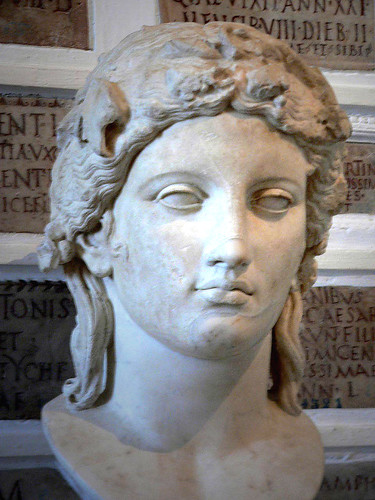
Another confusing identification I encountered recently was a picture of a sculpture said to be Apollo of the Anzio type at the Capitoline Museum:


Call me crazy but it looks like remnants of grapes and grape leaves in the hair which would make me think it was Dionysos.  Many sculptures of Apollo also have an iconic knot in the hair on top of the head so I am baffled by the identification associated with this piece.

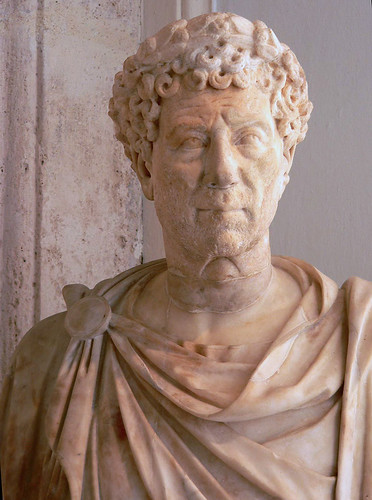
Reviewing my images from the Hall of Emperors in the Capitoline Museum, I came across the following bust:


After reviewing hundreds of images of Roman emperors (or said to be Roman emperors), I cannot find a single one that looks like him.  He appears to be wearing a laurel crown and in 2005 was positioned close to the busts of  Vespasian, Domitian and Titus (based on the photo time stamp).  This would make me think he may have been one of the emperors in the Year of the Four Emperors after the assassination of Nero but I checked images of Otho, Galba and Vitellius and he doesn't resemble any images identified as them.  Although I thought the museum positioned busts in relationship to the sequence of their reigns, this may not be the case either.  So, I would appreciate any information anyone could offer that would help identify this Roman.  


Enhanced by Zemanta
If you enjoyed this post, never miss out on future posts by following me by email!


Tuesday, December 14, 2010

Caesarion: Victim of the wicked who whispered 'Too Many Caesars'

Colossal head thought to depict Caesarion recovered
from Abukir Bay of the coast of Alexandria by French
archaeologist Frank Goddio in 1997
.


A history resource article by Mary Harrsch © 2010

Behold, you came with your vague charm. In history only a few lines are found about you, and so I molded you more freely in my mind.I molded you handsome and sentimental. My art gives to your face a dreamy compassionate beauty.And so fully did I envision you,
that late last night, as my lamp was going out -- I let go out on purpose -- I fancied that you entered my room,
it seemed that you stood before me; as you might have been in vanquished Alexandria, pale and tired, idealistic in your sorrow, still hoping that they would pity you, the wicked -- who whispered "Too many Caesars." 
- Constantine P Cavafy, Greece (1863-1933)


Like Greek poet Constantine Cavafy, I have tried to imagine what Caesarion was like.  Surely he possessed a healthy dose of charisma like his mesmerizing mother Cleopatra VII and his inspiring father Gaius Julius Caesar.   But then again, when I studied genetics in high school back in the 60s I was told that nature tends to return to the "norm" rather than build successively on the talents of one's parents.  I was always puzzled by that since researchers exploring the boundaries of eugenics always tried to manipulate the gene pool by selective breeding.

I had never seen a sculpted portrait of Caesarion, except the highly stylized relief of him as pharaoh alongside his mother Queen Cleopatra VII on the temple of Dendera, until I attended the "Cleopatra: The Search For The Last Queen of Egypt" exhibit at the Franklin Institute in Philadelphia, Pennsylvania last month.  There I saw an image of a handsome young man with hair peeking out from under the royal nemes headdress looking so melancholy as if he sensed his life would end soon without any of his dreams or ambitions fulfilled.

'Son of the avenging god, Chosen by Ptah, Dispenser of the justice of Ra, Living power of Amun' proclaims the translation of Caesarion's Egyptian name, Iwapanetjerentynehem Setepenptah Irmaatenra Sekhemankhamun.  Sadly, Caesarion, Ptolemy XV, known by his Greek subjects as Ptolemy Caesar, did not live to dispense justice or avenge the death of his father.  He was executed by his father's adopted son, Octavian, who would become the Roman emperor Augustus.


Of course, with literally the control of the Roman World at stake, Caesarion's actual paternity, needless to say, was much disputed by some ancient Romans, probably fueled by Octavian's robust propaganda machine.

Dio Cassius, a Roman consul and historian writing in the 3rd century CE (47.31.5) claimed Cleopatra VII only "pretended" that Caesar was his father while Nicolaus of Damascus, a Greek historian who actually served as tutor to Antony and Cleopatra's children but was later patronized by Augustus, in his Life of Augustus (20) claimed that Caesar explicitly repudiated Caesarion in his will.

Suetonius[, a second century historian patronized by the Roman emperor Trajan,] is carefully neutral in his Caesar 52. He notes that he [Caesarion] was said to closely resemble Caesar, but also that Caesar's secretary G. Oppius wrote a book proving that Caesar could not be Caesarion's father. He also says that Caesar "allowed" Cleopatra VII to name the child after him, implying that he did not in fact acknowledge him as his, but then notes that Antony had declared to the Senate that Caesar did acknowledge the boy as his. - Chris Bennett, Egyptian Royal Genealogy
How painful for a young man to look so much like his famous father but be denied by him.  Of course, we must consider the real possibilities of political bias in these accounts.  Even the later historians would have been influenced by the Roman public's perception that Augustus represented the 'gold standard" for a Roman emperor.

Even if Nicolaus of Damascus was faithfully recording his observation of  Caesar's will it would not have been beyond the pale for Octavian to have discretely amended the will to reinforce his position as unchallenged heir - especially if , as Plutarch reports, Caesarion successfully escaped to India and was at large elsewhere in the world for a time before being lured back to his death.
Caesarion, who was said to be Cleopatra's son by Julius Caesar, was sent by his mother, with much treasure, into India, by way of Ethiopia. There Rhodon, another tutor like Theodorus, persuaded him to go back, on the ground that [Octavian] Caesar invited him to take the kingdom. - Plutarch, Life of Antony
Plutarch's account coincides with an oral tradition in India that Cheras of Kerala traded extensively with Egypt and the descendants of that royal family were told that letters were exchanged with Cleopatra.

The [Canadian] historian George Woodcock says that Caesarion did indeed manage to escape with a large treasure and was granted asylum in Kerala. Lucy Hughes-Hallet in her book “Cleopatra: histories, dreams, distortions” says that the Queen herself intended to flee to India but fell ill and therefore ordered her son to leave without her...whether or not he reached Kerala and survived is not known clearly, but the story assumes that he arrived in Kerala and was received as a honored guest of the royal family. In fact, such was the respect and importance of this guest that there is said to have been a matrimonial alliance between the Egyptian prince and a Chera Princess. -Cleopatra and Cheraman Perumal


 Furthermore, Nicolaus of Damascus reported ongoing communications between factions in India and Augustus at this time.

This writer [Nicolaus of Damascus] states that at Antioch, near Daphne, he met with ambassadors from the Indians, who were sent to Augustus Caesar. It appeared from the letter that several persons were mentioned in it, but three only survived, whom he says he saw. The rest had died chiefly in consequence of the length of the journey. The letter was written in Greek upon a skin; the import of it was, that Porus was the writer, that although he was sovereign of six hundred kings, yet that he highly esteemed the friendship of Cæsar; that he was willing to allow him a passage through his country, in whatever part he pleased, and to assist him in any undertaking that was just.
Were these letters part of Augustus' attempt to lure Caesarion back into his grasp?

Archaeological evidence cannot settle the paternity issue without scholarly controversy either - not so much from a lack of physical remains attesting to Caesarion's birth date but to the confusion over Egyptian regnal year notations as well as the state of flux in the official reading of the Roman calendar that was in the midst of being converted to the new Julian version.

A stele in the Louvre appears to record Caesarion's birth giving 23 Payni year 5 as the birthday of "the pharaoh Caesar".

Assuming this dates the birth of Caesarion to 23 June 47, it places his conception in September 48 = November AUC 706, which is precisely the period when Cleopatra VII and Caesar were in closest contact in Alexandria under the siege of the forces of Achillas. At this time, it is very difficult to imagine how anyone else could be Caesarion's father. - Chris Bennett, Egyptian Royal Genealogy


Bennett points out, though, that other scholars like J. Carpocino, Passion et politique chez les Césars (1958) 37, argued that Antony had been smitten by the 14-year-old Cleopatra in 55 BCE while stationed as a cavalry officer in Egypt and could have had an illicit affair with her resulting in the birth of Caesarion.  

Head of Gaius Julius Caesar from Trajan's Foru...Image by mharrsch via Flickr
Portrait of Gaius Julius Caesar
from Trajan's Forum in Rome.
The second argument (J. P. V. D. Balsdon, Historia 7 (1958) 80, 86) is that Caesar's track-record for conceiving children is poor, and therefore he was possibly sterile at this time of his life. Only one child is certainly acknowledged, his daughter Julia, and the assassin Marcus Brutus, who is sometimes claimed as a son, can be excluded on chronological grounds. This is in spite of his having had three wives and numerous affairs. But R. Syme, Historia 29 (1980) 422, correctly points out that this means nothing. Low birth rates among the Roman aristocracy were a matter of official concern, whether this was due to lead in the pipes or the increasing independence of aristocratic Roman women in that time. Short-lived children were more common than not, and rarely noticed. And "Adultery in high society is more amply documented than any consequences"; although Cicero makes many scandalous charges against his opponents he never once accuses an opponent of not being his father's son. In illustration of the point, Syme constructs suggestive arguments that Decimus Brutus and P. Cornelius Dolabella may have been unacknowledged sons of Caesar. A Gaul, Julius Sabinus, claimed descent from Caesar through his great-grandmother in 70 AD (Tacitus, Histories 4.55). This has been generally disbelieved from Tacitus' day onwards, though, with H Heinen (Historia 18 (1969) 181, 202), I see no particular reason to doubt the story. - Chris Bennett, Egyptian Royal Genealogy
 
Bennett also discusses numismatic evidence with dual dates representing periods of the joint rule of Cleopatra and Caesarion.  Although all of these speculations are interesting, the real bottom line is that the Romans at the time knew Cleopatra was making a valid claim which made Octavian's resolution to the question of his legitimate inheritance of Caesar's fortune and power base so urgent.

Colleen McCullough imagined a very poignant confrontation between Octavian and Caesarion in her book Antony and Cleopatra: A Novel (Masters of Rome)Caesarion fearlessly approaches Octavian with a proposal to become a client king. But Octavian explains to the youth that he regretfully must take Caesarion's life. Caesarion's face reflects his confusion, disbelief, then resignation when he finally realizes his death is the consequence of looking so much like his famous father.  This scenario was strictly fictitious, of course, but it was certainly plausible and perhaps painfully close to actual events that played out in those final days of the Ptolemaic Dynasty of Egypt.

Head thought to be of Gaius Julius Caesar recovered
from the Rhone River near Arles, France in 2007
.
So, did Caesarion so closely resemble his father that he had to die to avoid future problems for Octavian?  If we compare the (suspected) colossal head of Caesarion found in Alexandria harbor with one of the stylized portraits of the divine Julius found in Trajan's forum, we can point to vague similarities in the width of the forehead and the angle of the cheekbones but, I think I see more similarity between Caesarion and a marble head found in the Rhone River near Arles, France in 2007 that is thought to be a portrait of the aging Caesar carved in 46 BCE, just two years before his assassination on the Ides of March.  Caesar's hair has receded and his face is deeply lined but this more natural looking portrait appears to reflect a similar shape of the mouth and the same innate melancholia as I saw in the head of Caesarion recovered by French divers.


When I think of Caesarion, I can't help but wonder what might have been.  Like Alexander IV, Caesarion held such promise but, as happens far too often in history, fortune doesn't just favor the bold, but the greedy and the ruthless.


A document thought to be written in Cleopatra VII's own
hand.  Image courtesy of National Geographic.
Although I was fascinated by the portrait head of Caesarion at the Cleopatra exhibit, I eventually had to tear myself away to view the rest of the artifacts that had been assembled there.


I felt a real connection to Cleopatra viewing a document written in her own hand ordering her administrators to "Make it happen" - sounds a bit like Captain Jean-Luc Picard doesn't it?


I also found a statue thought to be Cleopatra II or III, both of whom ruled Egypt during the mid-2nd century BC, to be quite breathtaking.  Near the remains of a temple that Cleopatra passed every day, divers discovered a beautifully carved sculpture of a priest holding an Osiris-Canopus jar.

"The tender way the priest carries the Osiris-Canopus vase, resting it lightly on his cheek, evokes a love for the god and a desire to forever remain in his presence." - Cleopatra: The Search for the Last Queen of Egypt


The exhibit also included a variety of votive objects, a beautiful head of the god Serapis, and a wonderfully detailed statue of a delicate woman thought to have been Cleopatra VII herself although the head had either been broken off in the devastating earthquake that leveled and submerged the palace or perhaps stricken off by a vengeful Octavian.

The exhibit is in its final month at the Franklin Institute in Philadelphia.  If you are going to be in the Philadelphia area over the holidays, I would strongly encourage you to attend.


If you enjoyed this post, never miss out on future posts by following me by email!


Saturday, April 3, 2010

Were Hypatia's astrolabes among the first working models?

As I wait eagerly for the release of the movie "Agora" later this year about the efforts of one of the last academicians of Alexandria, Hypatia, to save its library, I noticed the Smithsonian. just published an interesting article on Hypatia. It mentioned some facts about Hypatia's family and scholarly work that I had not read before.

[Image: Hypatia by Charles William Mitchell, 1885]

I knew she was a mathematician but I didn't realize that she was also a skilled astronomer and actually collaborated with her father, Theon, on several treatises.

"It is thought that Book III of Theon’s version of Ptolemy’s Almagest—the treatise that established the Earth-centric model for the universe that wouldn’t be overturned until the time of Copernicus and Galileo—was actually the work of Hypatia." - Hypatia, Ancient Alexandria's Great Female Scholar, Smithsonian.com


 [Image: Front of  an astrolabe created by Frenchman Jean Fusoris.  Photo courtesy of the Adler Planetarium and Astronomy Museum , Chicago, IL.  The Adler Planetarium houses the largest collection of astrolabes in North America]
If you enjoyed this post, never miss out on future posts by following me by email!


Thursday, March 11, 2010

Ancient Vine Delights Visitors with Beautiful Recreations of Ancient Life

Today I received a news alert from Heritage Key about the impending illumination of Hadrian's Wall event and it included a marvelous video of a 3D recreation of Hadrian's Wall and Newcastle Fort by a system's analyst known as Decimus who manages a website called Ancient Vine.  The graphics in the video were absolutely stunning.


I actually thought Decimus had merged 3D computer graphics with live action because the soldiers in the video looked so lifelike.  When I visited his site I saw that they were creations of his talent as well:


Decimus has also created a virtual Roman domus as part of the exhibit "A Day in Pompeii" at Museum Victoria in Melbourne, Australia.

Above is Decimus' recreation of a Roman tablinum.  The museum created a wonderful video of a virtual visit to the domus complete with rain water falling in the atrium, music and background sound effects.

He is now working on a reconstruction of the ancient city of Alexandria.


He has already finished several iterations of the Pharos lighthouse and is presently working on a recreation of the famous library.

Decimus is also working on a game set in the fictional Roman town of Opacia that was built on the ruins of Oplontis.  It will be an adventure/role playing game and I'm sure the visuals alone would make it well worth the price of the final product!

He has a marvelous image gallery and even offers his graphics for free use with attribution.  His site also features a discussion forum with interesting discussions about both Roman History and 3D graphics tools.  So, please check out Ancient Vine and continue to encourage such an artistic enthusiast!

Roman Art in the Private Sphere: New Perspectives on the Architecture and Decor of the Domus, Villa, and Insula   Pompeii and the Roman Villa: Art and Culture Around the Bay of Naples   Pompeii and the Roman Villa   In Stabiano: Exploring Ancient Roman Villas
If you enjoyed this post, never miss out on future posts by following me by email!