Showing posts with label Sack. Show all posts

Monday, September 28, 2009

Possible Victims of Trojan War unearthed in Turkey


A team from the University of Tubingen, led by Ernst Pernicka, have uncovered a pair of skeletons in the ancient city of Troy near ceramic fragments dated to the period of the Trojan War. It is discoveries like this that remind us how important literature like Homer's Iliad is to understanding our ancient past. It will really blow me away if they find a skeleton of an infant with its head crushed. We could then be looking at the only corporeal remnant of the famous Hector, trainer of horses!

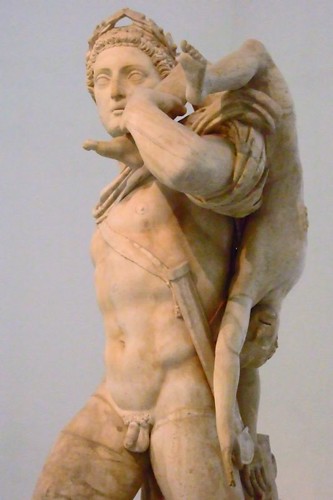
[Image - Warrior with captured child, Roman copy of 3rd century BCE Greek original. Photographed at the Museo Archaeologico di Napoli, Naples, Italy by Mary Harrsch.]

This discovery, though, also raises the question about disposal of "enemy" dead after a catastrophic sack. Both the Greeks and the Trojans at the time practiced cremation. If skeletons are found that could have been retrieved for burial, it makes a person wonder if the Greeks not only violated religious taboos by slaughtering people who had fled to the temples for sanctuary, but did not grant the defeated and enslaved survivors the courtesy of properly burying their dead either. Perhaps the violent deaths later visited upon the Mycenaean victors were just desserts after all.

"Pernicka said pottery found near the bodies, which had their lower parts missing, was confirmed to be from 1,200 BC, but added the couple could have been buried 400 years later in a burial site in what archaeologists call Troy VI or Troy VII, different layers of ruins at Troy. professor of archaeometry who is leading excavations on the site in northwestern Turkey, said the bodies were found near a defense line within the city built in the late Bronze age.

The discovery could add to evidence that Troy's lower area was bigger in the late Bronze Age than previously thought, changing scholars' perceptions about the city of the "Iliad."

"If the remains are confirmed to be from 1,200 B.C. it would coincide with the Trojan war period. These people were buried near a mote. We are conducting radiocarbon testing, but the finding is electrifying," Pernicka told Reuters in a telephone interview.

Pernicka said pottery found near the bodies, which had their lower parts missing, was confirmed to be from 1,200 BC, but added the couple could have been buried 400 years later in a burial site in what archaeologists call Troy VI or Troy VII, different layers of ruins at Troy.

If you enjoyed this post, never miss out on future posts by following me by email!


Thursday, June 26, 2008

Commemoration of 1600th Anniversary of Alaric's Sack of Rome taking shape for August 2010

I received an email yesterday from Dr. Daniel Costa, who recently wrote "The Lost Gold of Rome: The Search for Alaric's Treasure". He and his friend Luigi di Girolamo are trying to encourage a group of us Roman history enthusiasts to meet in Rome August 24 - 27, 2010 (year after next - on a no-host basis) to commemorate the 1600th anniversary of Alaric's sack of Rome. Among those who have indicated an interest in participating are Professor

Andreas Schwarcz from the University of Vienna, Professor Michael
Kulikowski of the University of Tennessee and author of Rome's Gothic
Wars: The Third Century to Alaric and Professor Emeritus Ludovico
Gatto, former department head of medieval studies at the University of
Roma La Sapienza. I think it would be wonderful to discuss the
complex events that helped precipitate the "fall" of the imperial
administration in the western Roman Empire and explore how these forces are at work today and what the modern consequences might be awaiting us all.

Dr. Costa would like to incorporate a group visit to major sites in the city that were impacted by the sack and activities relating to the late imperial period and early dark ages. A possible agenda is still very much in the planning stage. Some of the sites might include Piazza Fiume, where Porta Salaria, the point of entry of the Goths, used to stand; Porta Pinciana, as example of a still surviving ancient gate of the Aurelian Wall; St. Peter's; St John in Lateran; St. Paul's; the Coloseum; The Arch of Constantine (many of the riches donated by him to the new Christian churches ended up in the hands of the Goths); St Mary of the Angels (formerly the Baths of Diocletian) stormed by the Goths, the Roman Forum with Basilica Aemilia (hoping that the authorities might remove for us the wooden cover protecting the marble slab with the marks left by coins melted by the fire started by Alaric's Goths); the Arx ( which is now home to St. Mary in Aracoeli); the Temple of Jupiter (which has been replaced by Palazzo Caffarelli); St. Clement with its fascinating Mithraic temple, inscriptions and frescoes; St. Pudenziana (depicting the Apostles dressed as senators); the Jewish and Christian catacombs, both ravaged by the Goths; the Jewish district of Trastevere and Saint Mary in Trastevere.


Although Dr. Costa and his friend are attempting to obtain sponsorship from the Universita La Sapienza so we could possibly have access to a formal meeting space, their sponsorship is not yet assured. So, for the time being, the gathering is very much just a “confluence” of interested people, each paying their own travel expenses. There are also several activities that may be arranged if anyone is interested. This may sound funny coming from a soon-to-be retired woman but I, for one, would love to spend a day at the gladiator school out on the Via Appia. Although I am still recovering from two torn rotator cuffs after a bad spill in Naples last year, I think I could still wield a gladius. I would also like to see if we could possibly gain admission to Cinecitta Studios and tour the sets that were used in HBO’s “Rome” miniseries. I had read that Cinecitta was planning to open a Universal Studios-type theme park around their “backlot” in 2010 but haven’t heard anymore about it since.

Anyway, I hope to attend such a gathering. If any of you are interested please let me know so I can advise Dr. Costa. My direct email address is mharrsch@uoregon.edu.

If you enjoyed this post, never miss out on future posts by following me by email!


Wednesday, June 27, 2007

Brennus and the First Sack of Rome


I'm about two-thirds of the way through Steven Saylor's latest epic novel, "Roma", and am enjoying it very much. I just finished a section about the first sack of Rome by the Gauls under the command of Brennus. Most of my study has concentrated on the Late Republic so I didn't know much about this first sack other than when it occurred and it was the Gauls who did it.

However, Steven's characters are among the defenders that fortified themselves up on top of the Capitoline and held off the Gauls for seven months. I always assumed the sack was over in a few days like most sacks but it went on for quite a prolonged period. I also did not realize that the Veii question was so disruptive. I knew the Romans had conquered Veii but I assumed they simply added its people to the expanding Republic. I didn't realize the people were sold away into slavery and the city was left abandoned. Perhaps its people were treated so harshly because of the legendary massacre of the 300 Fabii at Cremora.

"Within a year of the victory at Cremora, the Etruscan navy, in conflict with Greece, was destroyed by Hieron of Syracuse, off of Cumae. The result was a military disaster for the Etruscans that they never really seemed to recover from. The various city states of the Etruscan league, including Veii, devolved more and more into separate unrelated entities, thereby losing the strength of mutual protection. Veii, despite its recent upper hand at Cremora, was forced to make a treaty with Rome.

Within this time frame a more consequential series of events were taking place, however. Celtic Gauls had been migrating into northern Italy from the 6th century BC and establishing themselves at or near Etruscan territory. Raids and warfare with these people would have a debilitating effect on the Etruscans and play directly into the growing strength of Rome. The Gauls so weakened the Etruscans that the Romans, between 406 and 396 BC, went on the offensive.

It's about this period in history that Livy tells us of the legendary Roman hero M. Furius Camillus. Under his command Fidemae was retaken from Veii, and then the city of Veii itself came under siege. According to the legend, the Siege of Veii lasted 10 years, but its description is so closely paralleled to the Homeric Siege of Troy, that we must take into account the propaganda used by ancient sources to inflate the glory of Rome. The actual siege probably lasted considerably less time, though the introduction of a paid professional legion during this course of events indicates that it was a protracted campaign. The siege was finally broken, in 396 BC, when the Romans supposedly drained Alban Lake. This not only would divert water supplies from the city but allowed access for Roman soldiers to sneak under the walls through empty stream beds. In the end, whatever the truth behind the legend may be, Camillus was credited with saving Rome and bestowed with the unending admiration of the Romans throughout its history.

Gaining Veii, the Romans, in stark contrast to their general conquest policies of incorporation, destroyed much of the city and drove out many of the Etruscan residents. The territory was allotted to Roman citizens, and four new tribes were created: the Stellatine, Tromentina, Sabatina and Aniensis." - Veii and the Etruscans, UNRV.com

Therefore, when the Gauls practically destroyed Rome, the hotly debated question became whether to rebuild Rome or to transfer her entire population to the empty city of Veii only twelve miles away. The hero Camillus was instrumental in persuading the people to rebuild Rome although those jealous of his success constantly complained that he was enriching himself through building contracts since he controlled most of the spoils and property from the Veii conquest.
If you enjoyed this post, never miss out on future posts by following me by email!